Tuesday, August 16, 2016

Catholic Answers Discussion Asks: Should Catholics Praise Martin Luther???

Here's an interesting read from the Catholic Answers "Non-Catholic Religions" forum: Should Catholics Praise Martin Luther??? Normally in a cyber-discussion like this in a Roman Catholic cyber-venue, the typical answer is "No, because Luther was a Nazi, killed the peasants, was a drunkard, believed one could sin a thousand times a day, and taught that Christ committed adultery with Mary Magdalene, he took books out of the Bible..." and so on...  Some of that sort of thing does pop up in this discussion. What fascinated me was that a retired Roman Catholic priest with a strong ecumenical approach defended Rome's more recent kindness towards Luther (see any of the posts in the discussion by Don Ruggero).  I sat back and kept out if it for a while, and then posted the following:

Jul 25, '16, 11:14 pm
Regular Member
 
Join Date: May 19, 2004
Location: New Jersey
Posts: 908
Religion: Reformed
Default Re: Should Catholics Praise Martin Luther???

I find this entire discussion fascinating, and I'm grateful for the opinions expressed. I've been in online dialog with Catholics on Martin Luther for over 10 years. Here's what I've encountered:

1. Older Catholic scholarship (pre-Lortz) is typically hostile to Luther.
2. Newer Catholic scholarship (post-Lortz) is less hostile to Luther.
3. Current Catholic scholarship is ecumenical and willing to be gracious towards Luther.

4. The majority of online Catholics participating in forums like these typically revert to the position of older Catholic scholarship (pre-Lortz).

The reason why I think there's such a variety of Catholic opinions toward Luther is that at Trent, Luther was never condemned by name, so there is no dogmatic judgment by which Catholics are bound in regard to him personally. Some time back, Jimmy Akin went through Exsurge Domine (the bull condemning Luther's teachings). Akin pointed out that the bull was not infallible, so there's no help there in establishing an official position.

So basically: you all have the freedom within Catholicism to express yourselves about Martin Luther. Enjoy that freedom.

And then, the following took place:

Jul 25, '16, 11:47 pm
Forum Master
 
Join Date: April 7, 2008
Location: Constitution Party
Posts: 14,596
Religion: Catholic
Default Re: Should Catholics Praise Martin Luther???

Quote:
Originally Posted by TertiumQuid View Post
I find this entire discussion fascinating, and I'm grateful for the opinions expressed. I've been in online dialog with Catholics on Martin Luther for over 10 years. Here's what I've encountered:

1. Older Catholic scholarship (pre-Lortz) is typically hostile to Luther.
2. Newer Catholic scholarship (post-Lortz) is less hostile to Luther.
3. Current Catholic scholarship is ecumenical and willing to be gracious towards Luther.

4. The majority of online Catholics participating in forums like these typically revert to the position of older Catholic scholarship (pre-Lortz).

The reason why I think there's such a variety of Catholic opinions toward Luther is that at Trent, Luther was never condemned by name, so there is no dogmatic judgment by which Catholics are bound in regard to him personally. Some time back, Jimmy Akin went through Exsurge Domine (the bull condemning Luther's teachings). Akin pointed out that the bull was not infallible, so there's no help there in establishing an official position.

So basically: you all have the freedom within Catholicism to express yourselves about Martin Luther. Enjoy that freedom.
But why would it be about Luther to begin with? It's really about teachings.

Anyhow, I trust the magisterium. 

xx
Jul 25, '16, 11:54 pm
Regular Member
 
Join Date: May 19, 2004
Location: New Jersey
Posts: 908
Religion: Reformed
Default Re: Should Catholics Praise Martin Luther???

Quote:
Originally Posted by Peter J View Post
But why would it be about Luther to begin with? It's really about teachings.

Anyhow, I trust the magisterium. 
This thread is entitled, "Should Catholics Praise Martin Luther???" By its mere existence, it demonstrates the overwhelming obvious: that Catholics have opinions about Martin Luther, and even yours is an opinion (that the teachings rather than the person should be discussed).

Enjoy your freedom.

xx
Jul 26, '16, 12:07 am
Forum Master
 
Join Date: April 7, 2008
Location: Constitution Party
Posts: 14,596
Religion: Catholic
Default Re: Should Catholics Praise Martin Luther???

Quote:
Originally Posted by TertiumQuid View Post
This thread is entitled, "Should Catholics Praise Martin Luther???" By its mere existence, it demonstrates the overwhelming obvious: that Catholics have opinions about Martin Luther, and even yours is an opinion (that the teachings rather than the person should be discussed).

Enjoy your freedom.
Fair enough: a thread on the internet does have the aforementioned title.

(Bang gavel.)

 But seriously, I'm not really saying Don't talk about him. Just that he isn't "what it's all about". Heck, you pointed out that even the 16th century condemnations don't mention him.
xx
Jul 26, '16, 8:49 am
Regular Member
 
Join Date: June 2, 2013
Posts: 1,672
Religion: Catholic
Default Re: Should Catholics Praise Martin Luther???

Quote:
Originally Posted by TertiumQuid View Post
I find this entire discussion fascinating, and I'm grateful for the opinions expressed. I've been in online dialog with Catholics on Martin Luther for over 10 years. Here's what I've encountered:

1. Older Catholic scholarship (pre-Lortz) is typically hostile to Luther.
2. Newer Catholic scholarship (post-Lortz) is less hostile to Luther.
3. Current Catholic scholarship is ecumenical and willing to be gracious towards Luther.

4. The majority of online Catholics participating in forums like these typically revert to the position of older Catholic scholarship (pre-Lortz).
It would be wise to move beyond 'online discussions' to gather insight into how Catholics feel about Luther.
What you oftentimes encounter here are Trad Catholics and non-Trad Catholics.
2PT3 was a case in point.
xx
Jul 26, '16, 9:49 am
Regular Member
 
Join Date: May 19, 2004
Location: New Jersey
Posts: 908
Religion: Reformed
Default Re: Should Catholics Praise Martin Luther???

Quote:
Originally Posted by Son of Niall View Post
It would be wise to move beyond 'online discussions' to gather insight into how Catholics feel about Luther.
What you oftentimes encounter here are Trad Catholics and non-Trad Catholics.
2PT3 was a case in point.
To clarify: by "online discussions" these interactions with Catholics (specifically on Luther) have included pro-Catholic forums, anti-Catholic forums, blogs, e-mail exchanges, etc. I've interacted with anonymous laymen as well as more well-known Catholic apologists.

Exactly how do you propose I move beyond these interactions "to gather insight into how Catholics feel about Luther"? What is the method you suggest in this path of wisdom you're describing?
xx
Jul 26, '16, 10:49 am
Regular Member
 
Join Date: June 2, 2013
Posts: 1,672
Religion: Catholic
Default Re: Should Catholics Praise Martin Luther???

Quote:
Originally Posted by TertiumQuid View Post

Exactly how do you propose I move beyond these interactions "to gather insight into how Catholics feel about Luther"? What is the method you suggest in this path of wisdom you're describing?
Turn off the computer.
Walk outside without a device (first, get out your pajamas).
Talk to people (you'll spot them right away, they have bodies like ours).
End of lesson.
xx
Jul 26, '16, 10:58 am
Regular Member
 
Join Date: May 19, 2004
Location: New Jersey
Posts: 908
Religion: Reformed
Default Re: Should Catholics Praise Martin Luther???

Quote:
Originally Posted by Son of Niall View Post
Turn off the computer.
Walk outside without a device (first, get out your pajamas).
Talk to people (you'll spot them right away, they have bodies like ours).
End of lesson.
Interesting conundrum that someone without a body is giving me advice to speak to someone with a body in order to arrive at the correct conclusion on a particular issue.

Keep in mind: I do talk to Catholics in person- but these cyber-discussions attract people who want to talk about certain issues and can at times have knowledge on certain issues (like Luther and the Reformation). On the other hand, I have typically not come across the same with Catholic "bodied" people. Perhaps that's your point: most (or many) Catholic people out in the tangible world don't have an opinion or care about Luther one way or other.

xx
Jul 26, '16, 11:07 am
Regular Member
 
Join Date: June 2, 2013
Posts: 1,672
Religion: Catholic
Default Re: Should Catholics Praise Martin Luther???

Quote:
Originally Posted by TertiumQuid View Post
Interesting conundrum that someone without a body is giving me advice to speak to someone with a body.

Keep in mind: I do talk to Catholics in person- but these cyber-discussions attract people who want to talk about certain issues and have knowledge on certain issues. On the other hand, I have typically not come across the same with Catholic "bodied" people. Perhaps that's your point: most Catholic people out in the tangible world don't have an opinion or care about Luther one way or other.
....or is it perhaps a guy with an anti-Catholic blog (followed by what? Five people?) needs to keep coming back to CAF trying to portray himself as something he is not?
Many Protestants, Lutherans included "in the tangible world" also don't have an opinion about Luther.
Why? Perhaps because it is not 1517 anymore.
I would rather listen to an old retired priest like Don Ruggero, who has far more experience in the 'tangible world' than someone trying to gather a cyber-crowd.
xx
Jul 26, '16, 11:10 am
Regular Member
 
Join Date: May 19, 2004
Location: New Jersey
Posts: 908
Religion: Reformed
Default Re: Should Catholics Praise Martin Luther???

Quote:
Originally Posted by Son of Niall View Post
....or is it perhaps a guy with an anti-Catholic blog (followed by what? Five people?) needs to keep coming back to CAF trying to portray himself as something he is not?
Many Protestants, Lutherans included "in the tangible world" also don't have an opinion about Luther.
Why? Perhaps because it is not 1517 anymore.
I would rather listen to an old retired priest like Don Ruggero, who has far more experience in the 'tangible world' than someone trying to gather a cyber-crowd.
Ah, OK, now I get it. It's personal for you... against me. I wondered what was going on. You may have the last word.... or feel free to insult me again.

Edited to add: I've had over a million hits to my blog, and I don't advertise, or sell anything. Frankly, I write for me, so if those 5 people move on, that's fine with me.

xx
Jul 26, '16, 11:13 am
Regular Member
 
Join Date: June 2, 2013
Posts: 1,672
Religion: Catholic
Default Re: Should Catholics Praise Martin Luther???

Quote:
Originally Posted by TertiumQuid View Post
Ah, OK, now I get it. It's personal for you... against me. I wondered what was going on. You may have the last word.... or feel free to insult me again.
No ones insulting you dude.
But if you wish to interact with Catholics, maybe you should not spend so much time insulting them on your 'blog'.
Just sayin'.
xx
Jul 26, '16, 11:15 am
Moderator
 
Join Date: September 30, 2009
Location: Non-Catholic Religions
Posts: 7,751
Religion: Catholic
Default Re: Should Catholics Praise Martin Luther???

The OP please.
__________________
Forum Rules and guidelines


The comments were indeed personal. Now, with Catholic Answers, I've learned to not use the alert system (I've gotten infractions for doing that, and I've been suspended for doing that). Had I defended myself, I could have also easily been giving an infraction or a suspension. I'm not exactly sure how the moderation works over at CA, but I know many of the rules do not apply to me.

Monday, August 15, 2016

Luther: People are now possessed with seven Devils, whereas formerly they were possessed with one Devil


Here's a Luther quote from the book, Henry O'Connor, Luther's Own Statements Concerning His Teaching and Its Results: Taken Exclusively from the Earliest and Best Editions of Luther's German and Latin Works (1884), p. 55.

"People are now possessed with seven Devils, whereas formerly they were possessed with one Devil; the Devil now enters into the people in crowds, so that men are now more avaricious, unmerciful, impure, insolent........ than formerly under the Pope." [Walch. XIII. 10]

This quote pops up every once in a while. It's typically used by Rome's defenders as proof of the failure of the Reformation (or something like Luther's regrets or concession to the failure of the Reformation, etc. example #1, example #2). One old Roman Catholic publication uses it to describe how the authors of the Reformation "described the results of their labours" under the sub-heading, "By their fruits ye shall know them."  O'Connor uses it to describe the "Results of Luther's Teaching," specifically, the "Moral Results" that there was a "Lower State of General Morality."

Luther's Own Statements Concerning His Teaching and Its Results is an old small anthology of Luther quotes peppered with vilifying commentary from O’Connor. In an early edition of this work, the author was so sure of his effort he originally titled the book, "The Only Reliable Evidence Concerning Martin Luther." The author claims to have compiled the quotes from the original sources: “Nearly two-thirds of the matter contained in this pamphlet is taken from the original editions of Luther’s own Works, as published in Wittenberg, under the very eye of the Reformer of Germany himself”(p. 3) He says “I have taken special care not to quote anything, that would have a different meaning, if read with the full context”(p.5).


Documentation
The footnote "Walch. XIII" refers to the thirteenth volume in a set of Luther's works published between 1740-1753 by Johann Georg Walch (Die Hauspostille Teil 2, Lutherpredigten für ein Jahr, zusammengestellt von Georg Rörer). Page 10 can be found here (see top of second column, note "XIII, 8-11" on the top right). It appears to me though there may be a printers glitch in some of the versions of O'Connor's book. His documentation appears like this:
All the on-line versions of this book I checked use this same image. Even my hard copy of the book has the same sort of printing. If you look closely, it is not page 10 being referenced, but actually page 19 from Walch XIII. Page 19 can be found here. The pertinent text in question reads:


This paragraph is from Luther's House Postil sermon on Matthew 21:1-9 (First Sunday in Advent, Second Sermon, 1533).Technically, Luther did not write this text. These printed words are from the notes of Georg Rörer who heard and took notes on Luther's sermon. The current English edition of Luther's Works does not include the House Postil (nor are there plans to include it as far as I know). However, an English translation of Rörer's version is available via a multi-volume Baker Books edition (1996) edited by Eugene F. A. Klug. This version is included in The Complete Sermons of Martin Luther (Grand Rapids: Baker Books, 2000). The quote in question can be found in Vol. 5, p. 29-30.

There is another version of this sermon that was compiled by another person taking notes on Luther's sermon, Veit Dietrich. His version can be found here. The quote in question can be found on pages 8-9. O'Connor's footnote refers to Rörer's version, so that's the one I'll primarily refer to below.


Context

Georg Rörer's version 
10. That is our King, our dear Lord Jesus Christ, and this is his kingdom and office. Dollars, crowns, castles, and vast kingdoms don't constitute his mission. For if we depended on that and died, our life would be nothing. But it is his office and work that we know that through his suffering and death we are redeemed. On this we rest and can say: through the righteousness of my King, the Lord Jesus Christ, I am justified. For that purpose he became poor and wretched, let himself be nailed to the cross, to make me holy and to drown sin and death in me. Whoever believes what the gospel declares has what it says. For that purpose Christ instituted holy baptism, thereby to clothe you with his righteousness. It is tantamount to his saying, My righteousness shall be your righteousness; my innocence, your innocence. Your sins indeed are great, but by baptism I bestow on you my righteousness; I strip death from you and clothe you with my life. That's Christ's true regimen; his office and mission are summed up in this, that he daily strips away our sin and death and clothes us with his righteousness and life. 
11. We must certainly receive this message eagerly and gratefully, by it becoming more pious and godly. Unfortunately there's the opposite side, that by this teaching the world becomes more and more hostile, wicked, and malicious; yet not through fault of the teaching but of the people, thanks to the pernicious devil and death. Today people are possessed by seven devils, whereas before it was only one. The devil now bulldozes the people so that even under the bright light of the gospel they become greedier, slyer, more covetous, crueler, lewder, more insolent and ill-tempered than before under the papacy. Why so? Not through fault of the teaching but because the message is not met with thankful acceptance; people cast it to the wind and pay more attention to money and goods than to the blessed treasure which our Lord Christ brings to us. Hence our Lord God scolds again, saying, Have you no appreciation for this—that through the suffering and death of my only begotten Son I have removed your sin and death? Well, then, if that's the way you want it, I will multiply sin and death sevenfold for you. And whereas before one devil possessed and troubled you, now seven worse devils will afflict you. No station in life—peasant, burgher, aristocrat—is spared, from highest to lowest, as they give their lives shamelessly, carelessly to greed, gluttony, drunkenness, immorality, and all manner shameful depravity.
 12. Therefore I exhort that you listen eagerly and lovingly to Word, receive it with deep gratitude, and beseech the Lord from the bottom of your heart for a firm faith to cling to this teaching. You may be certain that this will bear fruit day by day, as you become more humble, obedient, loving, chaste, and godly, for it is in the nature and art of this teaching to create godly, decent, obedient and pious people. But if people refuse to receive it with loving ready hearts, they will become seven times more wicked than before they came to know this teaching, as experience shows. Be forewarned therefore; the hour is coming—it cannot be avoided—the ingrates will be afflicted and punished. They will then recieve what now they have earned. God will certainly find them out [The Complete Sermons of Martin Luther Vol. 5, (Grand Rapids: Baker Books, 2000).  p. 29-30.

Veit Dietrich's Version
This now is our King, the dear Lord Jesus Christ, and this is His kingdom and office. It deals not with golden crowns and kingdoms, or with great worldly pomp ; no, but when we must die, and cannot retain this life any longer, then it is His office and work to deliver us from sin, death and the power of hell; and through the preaching of the gospel He announces to us that we shall certainly receive this gift or benefit from Him, so that when we are in trouble on account of our sins, or in danger of death, we can comfort ourselves by faith and say: Now help is afforded me through my dear King, Jesus Christ, the Just One and Savior; to this end He came, so lowly and poor, and suffered Himself to be nailed to the cross, that He might justify and sanctify me; in Himself He hath destroyed my sin and death, gives me His own righteousness and victory over death and hell, and gives me also His Holy Spirit, that I might have in my heart a sure seal and witness of His help. See now, whoever believes this as he hears it, and as it is preached in the gospel, he also has it. For to this end holy baptism was instituted by our Savior that He might clothe you with His righteousness, and that His holiness and innocence should be yours. For we are all poor sinners, but in baptism, and afterwards in our whole life, if we turn unto Christ, He comforts us, and says: Give me your sins and take my righteousness and holiness; let your death be taken from you, and put on my life. This is, properly speaking, the Lord Jesus' government. For all His office and work is this, that He daily takes away our sin and death, and clothes us with His righteousness and life.
This announcement we should indeed hear with great joy, and every one should thereby be bettered and made more holy. But alas, the contrary is true, and the world grows worse as it grows older, becoming the very Satan himself, as we see that the people are now more dissolute, avaricious, unmerciful, impure and wicked than previously under the papacy. What causes this? Nothing else than that the people disregard this preaching, do not use it aright for their own conversion and amendment, that is, for the comfort of their conscience, and thankfulness for the grace and benefit of God in Christ; but every one is more concerned for money and goods, or other worldly matters, than for this precious treasure which Christ brings us. For the most of us, when we do not feel our misery, the fear of sin and death, would rather, like the Jews, have such a king in Christ as would give us riches and ease here on earth, than that we should comfort ourselves in Him in the midst of poverty, crosses, wretchedness, fear and death. The world takes no delight in this, and because the gospel and Christ do not give it what. it desires, it will have nothing to do with Christ and the gospel. Therefore our Lord in turn rebukes this world and says: Do you not rejoice in this, nor thank me, that through the sufferings and death of my only begotten Son, I take away your sins and death? Then I will give you sin and death enough, since you want it so; and where you were possessed of and tormented by only one devil, you shall now be tormented by seven that are worse. We see farmers, citizens and all orders, from the highest to the lowest, guilty of shameful avarice, inordinate life, impurity and other vices. Therefore let every one who would be a Christian be hereby warned as of God himself, joyfully and thankfully to hear and receive this announcement, and also pray to God to give him a strong faith, that he may hold fast this doctrine; then surely the fruit will follow, that he will daily become more humble, obedient, gentle, chaste and pious. For this doctrine is of a character to make godly, chaste, obedient, pious people. But those who will not gladly receive it, become seven times worse than they were before they heard it, as we see everywhere. And the hour will surely come when God will punish this unthankfulness. Then it will appear what the world has merited by it. Now, since the Jews would not obey the prophet, it is told to us that our King comes meek and lowly, in order that we may learn wisdom from their sad experience, and not be offended by His poverty, nor look for worldly pomp and riches, like the Jews; but learn that in Christ we have a King who is the Just One and Savior, and willing to help us from sin and eternal death. This announcement, I say, we should receive with joy, and with hearty thanks to God, else we must take the devil, with walling, weeping and gnashing of teeth [link].

Conclusion
Notice in Georg Rörer's version Luther doesn't blame his teaching for the current state of affairs, but rather the people and ultimately Satan. Veit Dietrich's version shows Luther also states those who accept the Gospel will have fruit follow and "will daily become more humble, obedient, gentle, chaste and pious. For this doctrine is of a character to make godly, chaste, obedient, pious people." Those who do not receive it are those who become seven times worse.  For Luther, mankind will always oppose God's truth en masse and rebel against it, for that's what Satan and sin have always done in battle against God's word. Luther consistently held that the Gospel would find great opposition, and would be attacked from all sides. The Gospel would be used by the world as a licence to sin and all sorts of evil because of Satan. The Gospel would indeed make those of the world worse. But on the flip-side, the Gospel would also transform those whom God intended to redeem, and they are those who comprise the church. 

Addendum
Some years back I covered this same quote as used by Rome's defender Steve Ray and Rome's historian Heinrich Denifle. The entry can be found here: Luther: People are Worse Than They Were Under The Papacy. 

Wednesday, August 10, 2016

Luther: Those who follow the Gospel should be worse after receiving the Gospel than they had been before


Here's a Luther quote from the book, Henry O'Connor, Luther's Own Statements Concerning His Teaching and Its Results: Taken Exclusively from the Earliest and Best Editions of Luther's German and Latin Works (1884), p. 55.

"I think it must needs be the case, that those who follow the Gospel (literally 'who become evangelical'), should be worse after (receiving) the Gospel than they had been before, not on account of the Gospel, but on account of the people who so abuse the Gospel" (Walch. XIII. 2193).

This quote pops up every once in a while. It's typically used by Rome's defenders as proof of the failure of the Reformation (or something like Luther's regrets or concession to the failure of the Reformation, etc. example #1, example #2).

Luther's Own Statements Concerning His Teaching and Its Results is an old small anthology of Luther quotes peppered with vilifying commentary from O’Connor. The author claims to have compiled the quotes from the original sources: “Nearly two-thirds of the matter contained in this pamphlet is taken from the original editions of Luther’s own Works, as published in Wittenberg, under the very eye of the Reformer of Germany himself”(p. 3) He says “I have taken special care not to quote anything, that would have a different meaning, if read with the full context”(p.5).

According to O'Connor's translation, people who "follow the Gospel" are worse after "receiving the Gospel." That part makes sense. What doesn't make sense is that this state of being "worse" isn't the fault of the Gospel, but rather the fault of those who "abuse the Gospel." We'll see below that the reason this doesn't make sense is because in his translation, O'Connor did not capture the essence of the context. Despite his attempted "special care," he missed the mark with this quote.

Documentation
The footnote "Walch. XIII" refers to the thirteenth volume in a set of Luther's works published between 1740-1753 by Johann Georg Walch (Die Hauspostille Teil 2, Lutherpredigten für ein Jahr, zusammengestellt von Georg Rörer). Page 2193 can be found here (see top of second column, note "XIII, 2193-2196" on the top right). The specific German text O'Connor appears to have taken his quote from is here:


This paragraph is from Luther's House Postil sermon on Matthew 18:21-25 (Twenty Second Sunday After Trinity, 1530).Technically, Luther did not write this text. These printed words are from the notes of Georg Rörer who heard and took notes on Luther's sermon. The current English edition of Luther's Works does not include the House Postil (nor are there plans to include it as far as I know). However, an English translation of Rörer's version is available via a multi-volume Baker Books edition (1996) edited by Eugene F. A. Klug. This version is included in The Complete Sermons of Martin Luther (Grand Rapids: Baker Books, 2000).


Context
28. The nature of the gospel is such, that those who misuse it, become more wicked than they were before. Christ himself says (Matt. 12:43-45): "When the unclean spirit is gone out of a man, he walketh through dry places, seeking rest, and findeth none. Then he saith, I will return into my house from whence I came out; and when he is come, he findeth it empty, swept, and garnished. Then goeth he, and taketh with himself seven other spirits more wicked than himself, and they enter in and dwell there: and the last state of that man is worse than the first. Even so shall it be also unto this wicked generation." There you have it, black on white! Any person to whom the gospel is proclaimed and who then misuses that gospel, becomes seven times more wicked than he was to begin with, and it would have been better for him if he had never heard the gospel. That is why I have often said that if I could accomplish things by wishing, I would wish that peasants, burghers, and nobles, who now horribly misuse the gospel, might still be under the papacy, for they are nothing but a hindrance, a shame and a disgrace to the gospel. 
29. You see that illustrated here in this wicked servant too. After having experienced such great mercy, this scoundrel leaves and becomes more wicked than he had been before. This is not just my own personal judgment or opinion; it is the judgment of our Lord Christ himself, In crystal clear words he asserts that those who become evangelicals turn out to be more wicked than they were before. Experience, too, teaches us that this is so. Sad to say, we daily experience the fact that people who are under the gospel now bear greater and more bitter hatred and envy in their hearts; they are more greedy and to materialistic now than when they were still under the papacy. As Christ says, The reason for this is that they have again opened their heart's door to Satan, and he has brought with himself seven other spirits more wicked than he himself is. We, who proclaim the gospel, must simply put up with the fact that under the gospel people become more wicked than they were before. But it is not the fault of the gospel, but of the devil and those people who return to serving Satan, allowing him to reenter their hearts and rule there along with sew other, more wicked spirits. This really depresses and angers the rest of the servants, so they come and report to the king the sordid conduct of their fellow servant. We, too, experience the same kind of disappointment when those who have the reputation of being "evangelical" conduct themselves so disgracefully and abominably that we really wish they were still under the papacy. But here we follow the example of these fellow servants by bringing their disgraceful abuse of the gospel to the attention of God and of the public [The Complete Sermons of Martin Luther vol. 7 (Grand Rapids: Baker Books, 2000), p. 141-142].

Conclusion
The people who become worse because of the Gospel is not an all-inclusive statement as O'Connor insinuates. The people in view here are not Christians.  Luther has in mind "wicked people" of the "godless world." He says of these people, "For such people there is not forgiveness" (p. 140-141). "[T]he gospel is a message for the depressed, for people with a guilty conscience, not for those who deliberately sin against a gracious God" (p. 141).  Like the judgment of the wicked servant in Matthew 18, "the Lord God will soon bring down upon our false 'evangelicals' plagues, hard times, and war" (p. 142-143). "[Y]ou who are misusing the gospel so shamefully will meet a different fate from the one that is reserved for us, whom you are mistreating and depressing so severely" (p. 143-144).

What provoked O'Connor to so abuse the context? Speculating, I would suggest it's his zeal to defend Rome at all costs. For O'Connor, "Luther can only have been a Reformer chosen by Almighty God, if his teaching caused an increase of virtue and a decrease of vice" (O'Connor, p. 50). This is an unproven assumption, and it isn't even Biblical: many of the prophets of the Old Testament demonstrate that in their attempts to reform Israel by proclaiming the truth of God, they often were not heeded and the nation of Israel grew worse. 

Sunday, August 07, 2016

Luther: As soon as our Gospel began, decency and modesty were done away with, and everybody wished to be perfectly free to do whatever he liked


Here's a Luther quote from the book, Calvin the Psychopath:
Other Testimonies as to the Effects of the Reformation:
Luther: "As soon as our Gospel began, decency and modesty were done away with, and everybody wished to be perfectly free to do whatever he liked." 
Documentation
This quote pops up every once in a while, typically used by Rome's defenders as proof of the failure of the Reformation, Luther's regrets or concession to the failure of the Reformation, etc. (example #1, example #2, example #3, example #4).

Calvin the Psychopath appears to be using this Roman Catholic source from 1901. This 1901 source probably relied another Roman Catholic source: Henry O'Connor, Luther's Own Statements Concerning His Teaching and Its Results: Taken Exclusively from the Earliest and Best Editions of Luther's German and Latin Works (1884), p. 55. O'Connor states, "Luther says: 'As soon as our Gospel began....... decency...... and modesty were done away with, and everybody wished to be perfectly free to do whatever he liked' (Walch. V. 114)." It appears to me that most (if not all) of the English translations stem from this source. The translation into English was probably done by O'Connor.

Luther's Own Statements Concerning His Teaching and Its Results is an old small anthology of Luther quotes peppered with vilifying commentary from O’Connor. The author claims to have compiled the quotes from the original sources: “Nearly two-thirds of the matter contained in this pamphlet is taken from the original editions of Luther’s own Works, as published in Wittenberg, under the very eye of the Reformer of Germany himself”(p. 3) He says “I have taken special care not to quote anything, that would have a different meaning, if read with the full context”(p.5).

The footnote "Walch V" refers to the fifth volume in a set of Luther's works published between 1740-1753 by Johann Georg Walch. Page 114 can be found here (see second column, note "V 112-115" on the top right). The German text states:


This paragraph is from Luther's comments on Psalm 2:1 (March 1532). Technically, Luther did not write this text. These printed words are from the notes of Georg Rörer who heard Luther's lecture (and there is a possibility Veit Dietrich's notes were used as well, see LW 12:viii).   A Latin version can be found in WA 40 II:198-199. There is an English translation in LW 12:7-8 (cited below).

Context
Luther's comments refer specifically to the Psalmists words, "Why do the nations conspire and the peoples plot in vain?" Note the words in bold quoted by O'Connor and also the surrounding context from Luther.
This is a very moving introduction and a wonderfully apt rhetorical figure. For the prophet is filled with amazement and asks: “What is this, anyway? The nations conspire, and the peoples plot and take counsel not against the king of the Persians, not against the Turk, but against the Lord. Will these efforts not prove to be ridiculous, stupid, and foolish? Let no one therefore fear, let no one allow himself to be terrified by these counsels, whose net result will show that they have been in vain. For they are undertaken not against man, as it seems, but against the Lord.” Thus right in the beginning he leads us from fear to hope and offers the comfort that the peoples and the nations will perish unless they abandon these counsels, because they plot against God and not against men.
Read the writings of the papists, listen to their discourses, and you will find that they rely on this one argument, namely, the claim that nothing good has come of our teaching. For immediately after our Gospel sounded forth, there followed the horrible revolt of the peasants, disagreements and sects arose in the church, discipline broke down, and, as if all the restraints of the laws were done away with, all began to indulge in the greatest license. This is indeed true. For now there is greater freedom for all vices than there was in former times, when the common crowd was coerced with fear. But now, like an unbridled horse, it undertakes everything according to its own good pleasure. For it despises the ecclesiastical chains with which it was formerly held by the papacy and makes full use of the negligence of the civil magistrate. All these misfortunes, which are by no means trifling, our adversaries impute to our teaching or to the Gospel.
But suspend judgment a little while, and first reflect more carefully. Reduce the argument to a dialectical form, and consider whether this is a logical conclusion: “This theologian is evil, therefore theology is evil; this lawyer is worthless, therefore a knowledge of the law is also bad; this teacher is a fornicator, therefore the arts which he teaches are a fornication.” Would we not call anyone mad who defended these conclusions as good and sound? Nevertheless the adversaries draw inferences not a bit wiser than this. But listen to this psalm foretelling that when this King begins His kingdom, that is, when He begins to teach, the murmurings of the heathen will follow, the conspiring of the peoples, battles and the wars of kings, the plottings and counsels of the rulers. Against whom? Against the Lord and His Christ. Therefore fortify your conscience and, admonished by the Holy Spirit in this passage, understand that the world will be in an uproar. But do not put the blame on this King or His Word, but rather on Satan and the godless world. You must, on the contrary, affirm and declare: “Though evils follow the teaching of this King, nevertheless the teaching is not on that account evil, but rather the men are evil who are opposed to the good teaching and wish it suppressed.” For it is a true and logical conclusion that the more eagerly the world opposes this sacred teaching, the more evil and wicked it is. Nor should the teaching be maligned on account of the fault of men. The Jews crucify Christ, shall we therefore accuse Christ, the Teacher? It is therefore necessary for us to be well fortified in advance and to say: “What is that to God, what is that to His Word, if men are evil? For this is the imperfection of men, not of God, who for this very reason sends His Son and His Word that men may be saved. But if they are not willing, they perish by their own fault. Christ does not for this reason cease to be the Son of God, God does not for this cause reject Him whom He has appointed king over all things.” [LW 12:7-9].

Conclusion
When O'Connor used this quote it was part of a montage of Luther statements explaining the "Moral Results" of Luther and the Reformation (p.50).  O'Connor states,
Every reasonable person will agree with me, that Luther can only have been a Reformer chosen by Almighty God, if his teaching caused an increase of virtue and a decrease of vice. If, however, it can be plainly shown, that in consequence of his teaching there was, on the contrary, an increase of vice and a decrease of virtue, we must come to the conclusion, that Luther had not the sanction of God for the work which he undertook (p.50).
Ironically, both O'Connor and Luther appeal to reason to explain the state of things in sixteenth century Germany. O'Connor's paradigm appears to be almost postmillennial: God authorizes particular people to straighten the church out and get it back on track. Luther's paradigm is that there is a higher standard of truth that must be upheld even if it causes trouble. Mankind will always oppose God's truth en masse and rebel against it, for that's what Satan and sin have always done in battle against God's word. Luther consistently held that the Gospel would find great opposition, and would be attacked from all sides. The Gospel would be used by the world as a licence to sin and all sorts of evil because of Satan. The Gospel would indeed make those of the world worse. But on the flip-side, the Gospel would also transform those whom God intended to redeem, and they are those who comprise the church.


Addendum
 Also in Henry O'Connor, Luther's Own Statements Concerning His Teaching and Its Results: Taken Exclusively from the Earliest and Best Editions of Luther's German and Latin Works (1884), p. 55, another quote from this same context is provided:
"In all classes frivolity and every kind of vice, sin, and disgrace are now much greater than formerly" (Walch. V. 114)."
This appears to be the following text from LW 12:
For now there is greater freedom for all vices than there was in former times, when the common crowd was coerced with fear. But now, like an unbridled horse, it undertakes everything according to its own good pleasure. For it despises the ecclesiastical chains with which it was formerly held by the papacy and makes full use of the negligence of the civil magistrate. All these misfortunes, which are by no means trifling, our adversaries impute to our teaching or to the Gospel. [LW 12:7-8]

Friday, August 05, 2016

Luther "did not have to wait long to see the havoc his ideas would unleash"

Here's a Roman Catholic blogger blaming Luther for today's "God is dead morality" and that "Western Civilization" is "adrift from the solid mooring of the anchor of Truth."  The Blogger states that the "havoc" we see today was immediately seen by Luther:
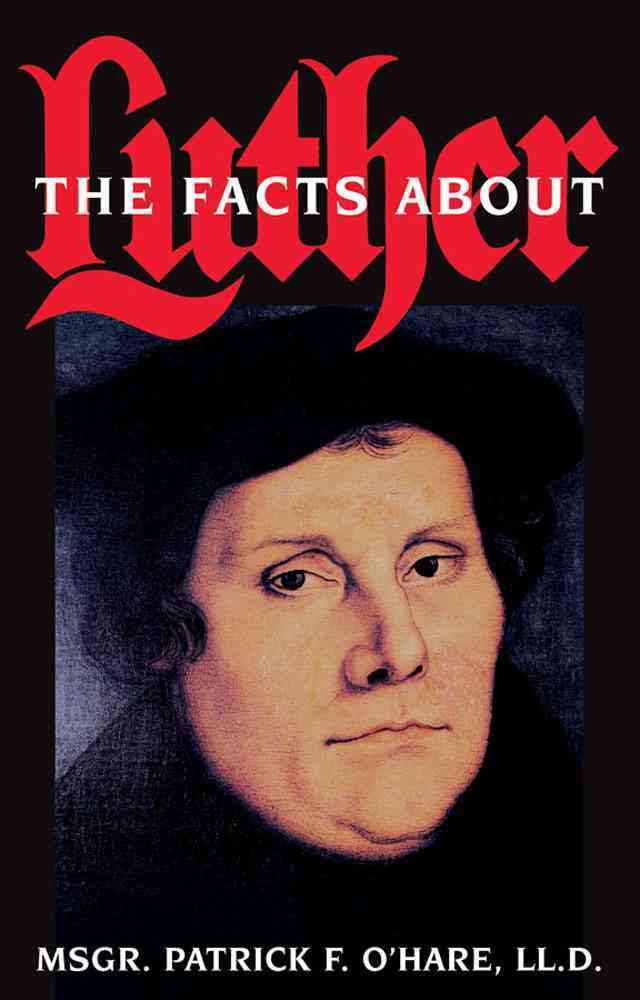
Martin Luther did not have to wait long to see the havoc his ideas would unleash. He himself lamented that “the people feel they are free from the bonds and fetters of the Pope, but now they want to get rid also of the gospel and of all the laws of God.” He also wrote that “if we succeed in expelling one devil, he immediately is replace by seven other who are much worse. We can then expect that after having driven away the monks, we shall see arise a race seven time worse than the former.”[4- Msgr. Patrick F. O’Hare, “The Facts about Luther”, Tan Publishing, 1916] [Today’s “God is Dead” Morality: Opening Act — Martin Luther]
There are two specific Luther quotes provided, both said to be from "Msgr. Patrick F. O’Hare, 'The Facts about Luther', Tan Publishing, 1916."  Though not provided, the page in question from Father O'Hare can be found here. Let's take a look at these quotes and see if they support the conclusions of this defender of Rome.

Documentation: Quote One
"The people feel they are free from the bonds and fetters of the Pope, but now they want to get rid also of the gospel and of all the laws of God."
O'Hare documents the first quote as "Walch IXV. 195." This refers to a set of Luther's works published between 1740-1753 by Johann Georg Walch. This page can be found here (see paragraph #2 beginning on page 194). This page can also be found in WA 50:119:


This first quote was translated into English in LW 60:149-150, Preface to Ambrosius Moibanus, The Glorious Commision of Jesus Christ, Our Lord and Savior (Mark 16 [:15]). This preface was written in 1537 for a work against schwärmer (enthusiasts) that were emphasizing the inner work of the Holy Spirit at the expense of the sacraments (LW 60:147-149).

Context: Quote #1
I have no doubt that the Last Day is not far away, though the highly intelligent and super-rational world is not concerned about this, being are that there is no need for that for a long time. As time goes on it is becoming so callous and wicked that, even if no Last Day were supposed to come, still it itself—highly intelligent reason—would have to say that it may not and cannot continue or remain this way for long; rather, either a flood must take place or else what happened to Sodom as an example, if it is really true that there is a God who punishes injustice. Innumerable examples of this are manifest since the beginning of the world and are still before our eyes every day, if only reason, so highly intelligent and so profoundly blind, could see such horrible punishment and would allow itself to be moved thereby.
It is an old saying, repeated by many teachers, that after the revelation of the Antichrist the people will become so dissolute that they will thereafter be unwilling to know or to believe anything about any god. Rather, each one will do or not do according to his own pleasure, as the devil and the flesh teach. We see such a time being fulfilled here before our eyes. For now that the horrible, dreadful lies and deception of the abominable Antichrist, the papacy, have been revealed and come to the light of day through God's amazing and exceptional grace, the people are beginning to believe nothing at all any longer. And because they feel freed and released from the bonds and strictures of the papacy, they want to be released and freed from the Gospel and all of God's commandments as well. From now on whatever pleases them and seems good is to be good and right By rights, this will be the end of the song, if God so wills.  [LW 60:149-150].
As the first sentence from Luther's pen demonstrates, in his mind, it was the end times. For Luther, it was the end of the world. Things were indeed going to get worse. The Gospel was going to be fought against by the Devil with all his might. The true church was a tiny flock in a battle against the world, the flesh, and the Devil. He hoped the people would improve with the preaching of the Gospel, he often admitted he knew things were going to get worse because of the Gospel, which is exactly what this context demonstrates.


Documentation: Quote #2
The second quote states, "if we succeed in expelling one devil, he immediately is replace by seven other who are much worse. We can then expect that after having driven away the monks, we shall see arise a race seven time worse than the former." It is documented by Father O'Hare as "Erl. XXXVI, 411." This page can be found here. O'Hare is wrong with his documentation.


This German text being cited is from Luther's comments on Deuteronomy 9:25 (1529). It's the last paragraph of the sermon. I've covered this German text previously: Luther: Our evangels are now sevenfold more wicked than they were before.  This paragraph has been translated as,
Moses is thus a fine teacher; he has well expounded the first commandment, and led the people to a knowledge of themselves, and humbled the proud and arrogant spirits, besides which he upbraided them with all kinds of vices, so that they had merited anything but the promised land. If we do not abide by our beloved Gospel, we deserve to see those who profess it, our Gospellers, become seven times worse than they were before. For, after having become acquainted with the Gospel, we steal, lie, cheat, we eat, drink, and are drunken, and practise all sorts of iniquity. As one devil has been driven out of us, seven others, more wicked, have entered in; as may be seen at the present time with princes, noblemen, lords, citizens, and peasants, how they act, without shame and in spite of God and His threatenings.
True, this German text above does say something like, "if we succeed in expelling one devil, he immediately is replace by seven other who are much worse," but it does not say, " We can then expect that after having driven away the monks, we shall see arise a race seven time worse than the former." I believe the reason for this discrepancy is that O'Hare mis-documented the quote.  He may have had either a Table Talk statement in mind or Luther's comments on Galatians 5:13 (LW 27:50) from 1535 (or some other source!). The quote certainly is not from Erl. XXXVI, 411 as O'Hare states.

Context: Quote #2
How it standeth with the Christian Church.
IT standeth with the Christian church, no otherwise than with a, silly sheep, which the wolf already hath catched by the wool to devour it. Our nobility, our gentry, citizens, etc. will not hear aright, they think (when we preach the Gospel, and reprove the Papists concerning their confidence in works) that as then we preach of good and easy days, and, that they have leave now to live, and to do what and how they please. O, they sin too highly, insomuch that if we drive out one devil, then there come seven others in his stead. If we should drive away all these Friars, then other, seven times worse than these, would come [Table Talk].
Of course, it is impossible to teach or persuade unspiritual people of this teaching about the love to be mutually observed among us. Christians comply with it voluntarily. But when the others hear this freedom proclaimed, they immediately draw the inference: “If I am free, then I have the right to do whatever I please. This thing belongs to me; why should I not sell it for as much as I can? Again, if we do not obtain salvation on account of good works, why should we give anything to the poor?” In their great smugness such people shrug off this yoke and obligation of the flesh, and they transform the freedom of the Spirit into the license and lust of the flesh. Although they will not believe us but will make fun of us, we make this sure announcement to these smug despisers: If they use their bodies and their powers for their own lusts—as they are certainly doing when they refuse to help the poor and to share, but defraud their brethren in business and acquire things by fair means or foul—then they are not free, as they loudly claim to be, but have lost both Christ and freedom, and are slaves of the devil, so that now, under the title of “Christian freedom,” their state is seven times as bad as it used to be under the tyranny of the pope (Matt. 12:43–45). For when the devil who has been cast out of them returns to them, he brings with him seven spirits more evil than himself. Therefore their last state becomes worse than the first (LW 27:50).

Conclusion
The overall argument from this Roman Catholic blogger is too big in its scope: he blames one sixteenth century person for just about... everything at the expense of Luther's point in his own time period. For Luther, it wasn't his teaching that caused "havoc," but rather he thought it was the devil responding to the pure preaching of the Gospel causing havoc. This Roman blogger thinks these quotes demonstrate Luther was lamenting over "the havoc his ideas would unleash." If there is a lament, it was not a lament of sorrow for his teaching or seeking the reform of the church. Rather, it was a lament over the work of Satan against the tiny flock (the true church).

One other thing does jump out from this little context exploration: this educated Roman Catholic blogger may have never actually read these quotes in their immediate context, their historical context, or with any sort of attempt in keeping Luther's theological framework in view. Using Patrick O'Hare's The Facts About Luther typically leads far away from the actual facts about Luther.

The blogger also included a comment with a cut-and-paste from another old spurious source (but it was probably taken from something like either this or this rather than an actual book).  He prefaced with a comment leading one to conclude he actually did the work of finding the quotes in their context:
I give you Luther’s own assessments. The source is The Walch edition of “Luther’s Own Works” which was published by Gebauer, Halle, in 24 volumes, between 1740 and 1753. The work was carried on under the supervision of Professor D. Johann Georg Walch, of Jena.
Beware of someone in English claiming they've pulled quotes from an eighteenth century source written in German and Latin. There's no need to go to such obscure out-of-print sources when there are modern editions of Luther's Works readily available.