Showing posts with label Catholic Encyclopedia. Show all posts

Saturday, March 14, 2026

Martin Luther: "I am unable to pray without at the same time cursing"

A defender of Rome did just enough reading of the Catholic Encyclopedia to conclude Martin Luther was "extremely demonic" based on... his prayer life! Did this papal warrior survey Luther's vast writings and examine his statements on prayer? No, it was enough to pull one shocking quote out of the Catholic Encyclopedia. He posted the following:
If we look at Luther's prayer life we will see that it was extremely demonic, at least at certain times of his life. He is recorded as saying that he could not pray without cursing. Where did Jesus tell us to curse our enemies in prayer? I must have missed that in the Gospels. The Catholic Encyclopedia records Luther's words as, "For I am unable to pray without at the same time cursing. If I am prompted to say: 'hallowed be Thy name', I must add: 'cursed, damned, outraged be the name of the papists.' If I am prompted to say: 'Thy Kingdom come', I must perforce add: 'cursed, damned, destroyed must be the papacy.' Indeed I pray thus orally every day and in my heart without intermission" (Sammtl. W., XXV, 108)
This Roman Catholic layman isn't alone using this quote to denigrate Martin Luther. Secular psychologist Erik Erikson used the quote in his popular book, Young Man Luther. Erikson doesn't use it to prove Luther was "extremely demonic" in prayer. Rather, he uses Freudian psychology and determines statements like these "...are an attempt to find a safety-valve when unrelenting inner pressure threatened to make devotion unbearable and sublimity hateful- that is, when he was again about to repudiate God in supreme rebellion, and himself in malignant melancholy."

This defender of Rome though has followed the lead of the Catholic Encyclopedia. This resource infers statements like these were part of his "sinister moods." They refer to one of Luther's "old admirers" stating,"with his shameless, ungovernable tongue, [Luther] must have lapsed into insanity or been inspired by the Evil Spirit." The author of the Luther entry in the Catholic Encyclopedia, George Ganss, presented a wild tempered Martin Luther, depressed and mentally ill, abandoned by most of his friends and colleagues, dejected and despairing, tortured in body and spirit. 

Documentation
The Catholic Encyclopedia vol. 9 cites "Sammtl. W., XXV, 108." This page can be found here. Erikson cites a different source: "L.W. W.A. XXX, 3, 470." This page can be found here. Both are correct references from editions of Luther's works. This quote was taken from the 1531 treatise, Wider den Meuchler zu Dresden. In English, the title is Against the [Character] Assassin at Dresden or sometimes referred to as Against the Traitor at Dresden. The Catholic Encyclopedia also notes this treatise can be found in Walch, op. cit., XVI 2062-2086. The treatise, to my knowledge, has not yet been translated into English.

There is debate as to who the "assassin" / "traitor" at Dresden was. Some older sources refer to Franz Arnold (or Pranz Arnold). The sparse information about Arnold identifies him as "a Roman Catholic priest at Cologne, [who] was one of the most violent, though not one of the most distinguished opponents of Luther." Franz is said to have penned "Der unpartheyische Laye" which was "a violent attack on Luther." Luther is said to have responded with "Wider den Meuchler zu Dresden." More often though, the "assassin" / "traitor" at Dresden is thought to be Duke George. 

Duke George was a sworn enemy of Luther's. He stands out as a ruler vigorous in maintaining a campaign of propaganda against him. He kept a team of writers busy against Luther. The writings were quite hostile. Duke George actually sought to have Luther's works censured and reviewed, while his work and those under him who wrote just as intensely were allowed to print whatever they wanted. Interestingly, Duke George used one of the most virulent critics of Martin Luther whose impact on Roman Catholic scholarship lasted for centuries:  Johann Cochlaeus. Duke George also used his ruling power to obstruct Reformation printing, as well as promoting wholesale burnings and confiscation of Luther's books. If one was caught printing pro-Reformation materials, it was quite possible Duke George would have that person arrested (which actually did happen). Duke George was part of a secret Roman Catholic alliance seeking to restore Roman Catholicism within Electoral Saxony by having Luther and other Protestants handed over to the authorities. After Luther published "Against the [Character] Assassin at Dresden," "Duke George expelled a number of evangelically minded persons from Leipzig and Oschatz" [LW 38:142]. Interestingly, Duke George was one of the leaders responsible for actually slaughtering the peasants during their revolt.

In 1531, things became heated between Duke George and Luther. The Duke campaigned that Luther was attempting to incite rebellion against the empire. Duke George wrote an anonymous work (published at Dresden) responding to Luther's "Warning to His Dear Germans" entitled, "Against Luther's Warning to the Germans That They Should Not Be Obedient To the Emperor, Another Warning That They Should Not Allow Themselves To Be Misled By It Nor To Be Moved To Disobedience." Franz Arnold wrote a short afterword to the second edition of this treatise. Luther entitled his response "Against the [Character] Assassin at Dresden" because Duke George published his attack against Luther anonymously. 

In his counter treatise, Luther said it was the papists who were really against the empire, not the Lutherans. He listed twelve pieces of evidence proving that Roman Catholic authorities were seeking the physical destruction of Protestants. The quote in question comes from the end of the treatise. It's a response to Duke George's assertion that Luther's writings were filled with evil words and devil references.

Context
It should be my fame and honor, [and] so I also wish to have it, that one should say of me from now on how full I am of evil words, abuse, and cursing for the papists. For more than ten years I have often humbled myself and have used the very fairest words with the result that the longer [I have done so] the worse I have made them. . . . Now, however, since they are impenitent [and] have decided to do simply no good but rather nothing but evil so that there is no hope [for them], I also wish from now on to occupy myself with cursing and rebuking those rogues to my grave [wil jch auch hinfurt mich mil den bosewichten zu fluchen und zu schelten bis jnn meine gruben], and no good word more should be heard from me. I wish to ring them into the grave with my thunder and lightning.
For I cannot pray without thereby having to curse. If I say: "Holy be Thy name," I must in addition say: "Cursed, damned, and disgraced must be the papists' name and all who slander Thy name." If I say: "Thy kingdom come," then I have to add: "Cursed, damned, destroyed must be the papacy with all kingdoms on earth that are opposed to Thy kingdom." If I say: "Thy will be done," then I must add: "Cursed, damned, disgraced, and to nothing must be all thoughts and plots of the papists and all who strive against Thy will and advice." In truth, I pray thusly daily without fail [both] orally and in my heart, and with me [pray in the same manner] all who believe on Christ, and I also feel indeed that it will be heard. . . . Still I hold a good, friendly, peaceful, and Christian heart towards everyone. Even my greatest enemies know that [English translation from Mark U. Edwards, Luther's Last Battles, pp. 50-51. An alternate English rendering can be found in Arthur Cushman McGiffert, Martin Luther: The Man and His Work, pp. 151-152].

German text: ...das soll mein Ruhm und Ehre sein, wills auch so haben, daß man von mir hinfurt sagen solle, wie ich voll böser Wort, Scheltens und Fluchens über die Papisten sei. Ich hab länger denn zehen Jahr mich oft gedemüthigt, und die allerbesten Wort gegeben, damit ich sie je länger je ärger gemacht habe... Nu aber, weil sie verstockt, schlecht kein Gutes, sondern eitel Böses zu thun beschlossen haben, daß keine Hoffnung da ist, will ich auch hinfurt mich mit den Bösewichten zusuchen und zuschelten bis in meine Grube, und sollen kein gut Wort mehr von mir hören. Ich will ihn mit meinem Donnern und Blitzen also zum Grabe läuten.

Denn ich kann nicht beten, ich muß dabei fluchen. Soll ich sagen: Geheiligt werde dein Name; muß ich dabei sagen: Verflucht, verdammt, geschändet müsse werden der Papisten Namen, und aller, die deinen Namen lästern. Soll ich sagen: dein Reich komme; so muß ich dabei sagen: Verflucht, verdammt, verstöret müsse werden das Papstthum, sampt allen Reichen auf Erden, die deinem Reich wider sind. Soll ich sagen: Dein Wille geschehe; so muß ich dabei sagen: Verflucht, verdammt, geschändet und zunichte müsse werden alle Gedanken und Anschläge der Papisten, und aller, die wider deinen Willen und Rath streben. Wahrlich, so bete ich alle Tage mündlich, und mit dem Herzen ohn Unterlaß, und mit mir alle, die an Christum glauben, und fühle auch wohl, daß es erhöret wird...Er argumentiert, dass sein Zorn sich gegen das System (das Papsttum) richtet, das er als gottlos ansieht, er aber als Christ dennoch Nächstenliebe gegenüber jedem einzelnen Menschen empfindet (WA 30.3:470).


Conclusion
The historical context demonstrates that this writing from Luther was not set in a quiet milieu of theological contemplation. Rather, the quote rests in a period of societal conflict with detrimental physical implications to both Protestants and Roman Catholics. In essence, this was a writing set in a war zone. Both sides were in a war of who had the right to be the true church. Extreme circumstances often lead to extreme behaviors. 

But does the historical context acquit Luther of such harsh language directed against his enemies? Note that last line above, "Nevertheless I have a kind, friendly, peaceable, and Christian heart toward everyone, as even my worst enemies know." This is a tip off that Luther was admitting to using highly rhetorical and inflammatory language. Secular historian Will Durant's volume on the Reformation uses the same quote as an example of Luther's use of unrestrained language, often to a fault. He also adds the following disclaimer immediately after citing the quote:
Such rhetorical passion was in the temper of the times."Some of the preachers and pamphlet writers on the orthodox side," confessed the learned Cardinal Gasquet, "were Luther's match in this respect." Vituperation was expected of intellectual gladiators, and relished by their audiences; politeness was suspected cowardice (Durant, The Reformation, p.418-419).
Both sides, Papist and Lutheran, felt justified in such abusive language because they considered the other to be in league with the devil. Again, this identification of the devil's leadership was not arrived at in a quiet milieu of theological contemplation. These sixteenth century people took the devil's authority seriously and needed to be vigorously opposed. Historian Mark U. Edwards makes an insightful point that the use of harsh language may primarily have been used to inspire those on the side of the author rather than it serving as a direct attack against the opposition: 
Given such opposed convictions, it is not surprising that the language and form of argumentation employed by the publicists—Luther, Duke Georg, Cochlaeus—suggest that each was speaking more to his own party than to one another. Expressions of righteous indignation, liberal use of insult and name-calling, lengthy recitals of old grievances, rehashing of past disputes, repetition of familiar arguments—such material may appeal to the converted and may reinforce convictions already held. But it is unlikely to move the unconverted. And it will only enrage the opponent [Edwards, Luther's Last Battles, pp. 38-39].

Delving deeply into history like this typically never satisfies Roman Catholics that flippantly interpret history with conclusions like, "If we look at Luther's prayer life we will see that it was extremely demonic." This quote is yet another example of Roman Catholic bias, perceiving one's enemies in the worst possible way. It would be interesting to find out if this Roman Catholic critic would conclude David was also demonic in Psalm 109 when he wrote the following about his enemies: 

8 Let his days be few; Let another take his office. 9 Let his children be fatherless And his wife a widow. 10 Let his children wander about and beg; And let them seek sustenance [e]far from their ruined homes. 11 Let the creditor seize all that he has, And let strangers plunder the product of his labor. 12 Let there be none to  extend lovingkindness to him, Nor any to be gracious to his fatherless children. 13 Let his posterity be cut off; In a following generation let their name be blotted out.

Also, the facts of Luther's theology on prayer don't bear out the conclusion he was demonic. For Luther, prayer was a weapon we have to call down the power of God against the power of the devil. We call down God’s power against every evil the devil tries to bring upon our lives. Prayer is a weapon in our fight against the devil on the battlefield of the lives of those around us. We call down the power of God against the devil for those we love. For Luther, the devil was the mastermind behind the Papacy. Hence, his prayer above reflected this. 

This entry at this point could succumb to text overload with Luther quotes. Anyone interested in a concise overview on Luther's theology of prayer should seek out the entry on "Prayer" in the anthology compiled by Lutheran theologian Ewald Plass, What Luther Says. An overwhelming amount of evidence could be put forth to demonstrate the conclusion Luther's prayer life proved him demonic is spurious and slanderous.    

In a final point of irony, Roman Catholic historian Anton Fischer argued Martin Luther was an admirable man of prayer, a man to be appreciated by Roman Catholics:

However rich a Church may be in truly great Christian men of prayer, it would still have room for the distinctives of the praying Luther; it should not pass carelessly over this great man of prayer and his precious utterances on prayer and his excellent instruction on prayer (English translation by Richard Stauffer, Luther as Seen by Catholics, p. 55).

German text: Mag eine Kirche noch so reich an wahrhaft großen christlichen Beter-Persönlichkeiten sein, sie sollte doch auch noch Raum haben für die Eigenart des betenden Luther; sie sollte nicht achtlos an diesem großen Beter und an seinen köstlichen Aussprüchen über das Gebet und seinen trefflichen Anweisungen zum Gebete vorübergehen! (Luther in okumenischer Sicht, pp. 187-188).

Richard Stauffer explains:
Fischer makes a distinction in Luther between the fighter and the man of prayer. The former, to his mind, is the concern of only a part of Christianity; all Christian denominations can, however, lay a claim to the second. In so far as he was a man of prayer, Luther was truly ecumenical. Even a Church rich in believers who are devoted to prayer (he means the Roman Church, of course) has much to learn from him.

And what can Luther teach all Christians about prayer? Two essential truths. The first is that prayer has only one valid criterion—the Word and the Holy Spirit who reveals Himself through Scripture. Luther drew all his strength from the Bible and took all his instruction about prayer from the Bible. In the same way, all believers are exhorted to nourish themselves on the Old and New Testaments, if they wish to pray effectively; there they too will meet with God. The second truth is that the Pater noster constitutes the very heart of the Christian life, and for this reason should be pronounced with the reverence and fervour due to Christ's own words. If it is said in the spirit of the great masters of prayer like St. Augustine, St. Francis of Assisi and Martin Luther (so Fischer ends his article), the Lord's Prayer can bridge the gap which really separates Roman Catholics and Protestants.” [Richard Stauffer, Luther as Seen by Catholics, pp. 38-39].


Addendum: Lutheran scholar Julius Köstlin on the Historical Background 

Luther gave open vent to his indignation at the Recess of the Diet and the violent attacks of the Catholics in two publications, early in 1531, one entitled 'Gloss on the supposed Edict of the Emperor,' and the other, 'Warning to his beloved Germans.' In the former here viewed the contents of the Edict and the calumnies it heaped upon the Evangelical doctrines, not intending, as he said, to attack his Imperial Majesty, but only the traitors and villains, be they princes or bishops, who sought to work their own wicked will, and chief of all the arch-rogue, the so-called Vicegerent of God, and his legates. The other treatise contemplates the 'very worst evil' of all that then threatened them, namely, a war resulting from the coercive measures of the Emperor and the resistance of the Protestants. As a spiritual pastor and preacher he wished to counsel not war, but peace, as all the world must testify he had always been the most diligent in doing. But he now openly declared that if, which God forbid, it came to war, he would not have those who defended themselves against the bloodthirsty Papists censured as rebellious, but would have it called an act of necessary defence,and justify it by referring to the law and the lawyers.These publications occasioned fresh dealings with Duke George, who again complained to the Elector about them, and also about certain letters falsely ascribed to Luther, and then published a reply,under an assumed name, to his first pamphlet. Luther answered this 'libel' with a tract entitled 'Against the Assassin at Dresden,' not intended, as many have supposed, to impute murderous designs to the Duke, but referring to the calumnies and anonymous attacks in his book. The tone employed by Luther in this tract reminds us of his saying that 'a rough wedge is wanted for a rough log.' It brought down upon him a fresh admonition from his prince, in reply to which he simply begged that George might for the future leave him in peace (Köstlin, Life of Luther, pp. 431-432).

 This entry is a rewrite of a post from 2009. The original can be found here.

Friday, April 06, 2018

Luther: Augustine has Often Erred, He is Not to be Trusted

Here's a comment left under one of my old blog entries:
Luther did in fact exalt himself above the Fathers,if Protestant theologian/historian Philip Schaff is to be believed (though he doesn't express it in those terms). http://www.newadvent.org/cathen/02091a.htm You will find the relevant citation in the 4th paragraph under "The dominating qualities of his doctrine" in the article "Teaching of St. Augustine of Hippo."
Who would care if  "Luther did in fact exalt himself above the Fathers"? Typically, this line of argumentation is put forth by Rome's defenders. The argument goes: Luther showed a lack of respect for those in church history who preceded him. One of Luther's failures, or flaws, therefore, was his pride and arrogance: the Catholic church, in all her history, awaited him as its savior. Everyone before him was theologically incompetent, expressing a false gospel. When Luther is charged with exalting himself above the Fathers, it's his alleged heretical arrogance Rome's defenders have in mind. How dare a heretic criticize a respected doctor of the church.

The person who left this comment did so anonymously (see their blogger description). I'm going to assume based on this argumentation (and the link provided) that the person is some sort of Roman Catholic. Here though is an example of someone using the same newadvent.org source (and quote) who appears to not be a defender of Rome, so who knows?  It's up to this mystery person to set the record straight.

The "relevant citation in the 4th paragraph" from the newadvent.org link appears to be the comment attributed to Luther, "Augustine has often erred, he is not to be trusted. Although good and holy, he was yet lacking in true faith as well as the other Fathers," so says Luther via Protestant historian, Philip Schaff. Of the same Luther quote, the great Reformed theologian B.B. Warfield refers to it as a "well-known assertion." While there are quite a number of comments Luther made about Augustine, we'll see below that finding the context for this "well known assertion" is not all that easy. We'll also take a closer look at the newadvent,org link provided, Philip Schaff's actual comment, and this particular Luther quote to see if it demonstrates "exalting himself above the fathers." As it stands now, Luther's overall opinion appears to be that Augustine was so incompetent, he shouldn't be trusted on anything.

The Catholic Encyclopedia, Philip Schaff: Luther's Exhalation Above the Fathers
While church historian Philip Schaff is referred to as the deciding voice demonstrating Luther's arrogance, he isn't cited directly, he's alluded to via a link that leads back to the old Catholic Encyclopedia. It's admitted that Schaff "doesn't express it in those terms" that being, "Luther did in fact exalt himself above the Fathers." So, Schaff wasn't exactly saying what this mystery person is trying to prove. Here is what the Catholic Encyclopedia says:
Attempts to monopolize Augustine and to make him an ante-Reformation reformer, were certainly not wanting. Of course Luther had to admit that he did not find in Augustine justification by faith alone, that generating principle of all Protestantism; and Schaff tells us that he consoled himself with exclaiming (op. sit., p. 100): "Augustine has often erred, he is not to be trusted. Although good and holy, he was yet lacking in true faith as well as the other Fathers."
The Catholic Encyclopedia cites Schaff's Luther quote as "op. sit., p. 100." "op. cit." means "in the work cited." What they are referring to is found in their documentation: "Schaff, Saint Augustine, Melanchthon, Neander (New York: 1886)." Here is page 100 from that source. Schaff presents a number of comments about the fathers from Luther, and then states,
The Reformer was at times dissatisfied with Augustin himself, because, amid all his congeniality of mind, he could not just find in him his "sola fide." "Augustin has often erred, he is not to be trusted. Although good and holy, he was yet lacking in true faith as well as the other Fathers." But over against this casual expression stand a number of eulogies on Augustin. 
Luther's words must not be weighed too nicely, else any and everything can be proven by him, and the most irreconcilable contradictions shown. We must always judge him according to the moment and mood in which he spoke, and duly remember his bluntness and his stormy, warlike nature. Thus, the above disparaging sentences upon some of the greatest theologians are partly annulled by his churchly and historical feeling, and by many expressions, like that in a letter to Albert of Prussia (a.d. 1532), where he declares the importance of tradition in matters of faith, as strongly as any Catholic. In reference to the real presence of Christ in the Lord's Supper, he says: "Moreover this article has been unanimously believed and held from the beginning of the Christian Church to the present hour, as may be shown from the books and writings of the dear Fathers, both in the Greek and Latin languages, which testimony of the entire holy Christian Church ought to be sufficient for us, even if we had nothing more. For it is dangerous and dreadful to hear or believe anything against the unanimous testimony, faith, and doctrine cf the entire holy Christian Church, as it has been held unanimously in all the world up to this year 1500. Whoever now doubts of this, he does just as much as though he believed in no Christian Church, and condemns not only the entire holy Christian Church as a damnable heresy, but Christ Himself, and all the apostles and prophets, who founded this article, when we say, 'I believe in a holy Christian Church,' to which Christ bears powerful testimony in Matt, xxviii. 20 : 'Lo I am with you always to the end of the world,' and Paul in 1 Tim. iii. 15 : 'The Church is the pillar and ground of the truth.'"
Schaff's actual view is certainly not the sentiment put forth by the anonymous comment which began this entry. The context of the remark concerns sola fide, not a blatant covering of everything either Augustine or the Church Fathers said or did. For Schaff, while Luther may have made disparaging comments directed towards the church fathers, these must be considered in the context in which they were made and be balanced with  his "churchly and historical feeling," i.e., those comments he made positively in regard to church tradition and the fathers. This is also hardly the view claimed by the old Catholic Encyclopedia: "Schaff tells us that he consoled himself with exclaiming..." Schaff does not say Luther "consoled himself." Here we see Rome's defenders treating the context of Luther's words as needed, to support... Rome.

Documentation:  "Augustine has Often Erred..."
In Fairness to the Catholic Encyclopedia, Schaff does not document the Luther quote in Saint Augustine, Melanchthon, Neander. Schaff uses the same undocumented quote in a few of his books, so perhaps it was he who popularized it (cf. this book, this book, this book). Schaff uses the quote in a an extended footnote in NPNF 1 with slightly different wording ("wanting in the true faith"), but similarly does not document it. In his History of the Christian Church series, he does though provide documentation:
Augustin did more than all the bishops and popes who cannot hold a candle to him (XXXI. 358 sq.), and more than all the councils (XXV. 341). If he lived now, he would side with us, but Jerome would condemn us (Bindseil, III. 149). Yet with all his sympathy, Luther could not find his “sola fide.” Augustin, he says, has sometimes erred, and is not to be trusted. “Although good and holy, he was yet lacking in the true faith, as well as the other fathers.” “When the door was opened to me for the understanding of Paul, I was done with Augustin” (da war es aus mit ihm. Erl, ed., LXII. 119).
Schaff cites Erl LXII, 119. This source states:


Schaff is citing the Table Talk. The Table Talk is a collection of second hand comments written down by Luther's friends and students, published after his death.  Schaff is relying on the later German version of the Table Talk. This particular statement was originally collected by Veit Dietrich, not in pure German, but rather German with Latin text mixed in. This text reads,


 Here is an English translation of  this older Latin / German version of this Table Talk statement:
No. 347: Augustine at First Devoured, Then Put Aside, Summer or Fall, 1532
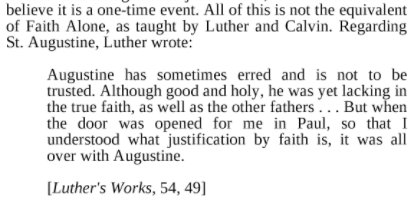
“Ever since I came to an understanding of Paul, I have not been able to think well of any doctor [of the church]. They have become of little value to me. At first I devoured, not merely read, Augustine. But when the door was opened for me in Paul, so that I understood what justification by faith is, it was all over with Augustine. There are only two notable assertions in all of Augustine. The first is that when sin is forgiven it does not cease to exist but ceases to damn and control us. The second is that the law is kept when that is forgiven which does not happen. The books of his Confessions teach nothing; they only incite the reader; they are made up merely of examples, but do not instruct. St. Augustine was a pious sinner, for he had only one concubine and one son by her. He was not given much to anger. St. Jerome, like the rest of us—Dr. Jonas, Pomeranus, and me—we are all much more inclined to angry outbursts. Nor do I know which of our doctors today has Augustine’s temperament except Brenz and Justus Menius” [LW 54:49-50, WATR 1:140 (347); cf. alternate English translation of a version of this Table Talk statement].
There are some notable differences between these versions. In the pure German text relied on by Schaff, the entire first paragraph is missing. In this brief paragraph, Luther describes Augustine as an excellent teacher, presenting a defense against the heretical Pelagians, and faithfully teaching God's grace (cf. LW 54: 8, "In his controversy with the Pelagians, Augustine became a strong and faithful defender of grace"). Then comes the section about Paul, Augustine, the Confessions, etc., contained in both versions. The German version is then missing the final section beginning with, "St. Augustine was a pious sinner..."  This is the confusing nature of the Table Talk!

Schaff's documentation appears to only apply to the sentence, "When the door was opened to me for the understanding of Paul, I was done with Augustin" (da war es aus mit ihm). There is similar sentiment in this utterance, but it does not quite match up to what Schaff is citing Luther saying, particularly the quote under scrutiny. The original context nowhere says  "Augustin has often erred, he is not to be trusted." There is the possibility that Schaff did more of a dynamic equivalence sort of translation on the next sentence. If this was the case, Augustine being "good and holy" would correspond to the sentiment expressed in the first paragraph. This though is a stretch. The part about "lacking in true faith as well as the other Fathers" is a little easier to jive with what the text actually says, but this is still a stretch. Wherever Schaff got these two sentences from, they do not appear to be from the Table Talk utterance he's referring to (Erl LXII, 119).

It's interesting what some of Rome's defenders have done with this undocumented Luther quote from Schaff. Some have morphed it together with this other Table Talk utterance. Notice in the following example how Schaff's undocumented Luther quote is pasted together with the above Table Talk statement:


In this version, Schaff's original words "Augustin, he says, has sometimes erred, " have been turned  turn into Luther's direct words! Schaff has also been plagiarized: LW 54: 49 does not include "Augustine has sometimes erred and is not to be trusted. Although good and holy, he was lacking in the true faith, as well as the other fathers..." The English words appear to be Schaff's. The English translation appears to be unique to his writings.  Numerous examples of Rome's defenders cut-and-pasting this wrongly documented plagiarized mis-quote can be found all over the Internet (example #1example #2, example #3, example #4, etc.).

Conclusion
As of the writing of this entry, I have not been able to locate exactly where Schaff's Luther quote comes from. It appears to be unique to Schaff.  While one may not always agree with Schaff's historical interpretation, he was indeed a well-respected historian. When my detractor above states, "Luther did in fact exalt himself above the Fathers,if Protestant theologian/historian Philip Schaff is to be believed," yes, Schaff is to be believed, but his opinion does not equal historical infallibility. Here we find a great historian using an undocumented quote in multiple books, and then when Schaff did provide documentation for the quote, it's incorrect.

One thing Schaff does say that makes a lot of sense pertinent to all this is,  "Luther's words must not be weighed too nicely, else any and everything can be proven by him, and the most irreconcilable contradictions shown." If one were to rely simply on the Table Talk, this is indeed the case. For instance, consider Luther's 1539 Table Talk statement:
None of the sophists was able to expound the passage, ‘He who through faith is righteous shall live’ [Rom. 1:17], for they interpreted ‘righteous’ and ‘righteousness’ differently. Except only for Augustine, there was great blindness among the fathers. After the Holy Scriptures, Augustine should especially be read, for he had keen judgment. However, if we turn from the Bible to the commentaries of the fathers, our study will be bottomless (LW 54:352).
Here we find almost the exact opposite sentiment from the quote under scrutiny. There are quite a number of mentions of Augustine in Luther's writings, both negative and favorable. Yes, there were times Luther spoke negatively about Augustine and the Church Fathers, then there were times he did not. If one were step outside a Roman Catholic worldview, if only for a moment, Luther only considered the Scriptures to be infallible. The writings of everyone else, including his own, were not above criticism. This is not exalting oneself, this is placing the correct value on what is to be exalted; the Sacred Scriptures. Did not Augustine himself pen his own Retractationes (corrections)?

Addendum
Beyond Schaff, I located another historian who uses a similar Luther quote: J.M Audin, History of the Life, Writings, and doctrines of Luther, vol. 2 (1854). This hostile Roman Catholic source says,
"St. Augustine often erred: he cannot be trusted.(2) Many of his writings are worthless.(3) It was a mistake to place him among the saints, for he had not the true faith."(4)
(2) Op. Luth. tom. ii. Jen. Germ. fol. 103; tom. vii. Witt. fol. 353; tom. ii. Alt. fol. 142. Von Menschen-Lehre zu meiden.
(3) Coll. Mens. Lat. torn. ii. p. 34.
(4) 'Enarr. in xlv. cap. Genes, tom. ii. Witt. Germ. p. 227; Alt. p. 1382. 
Notice how Audin placed three sentences together from three different sources! The sentence pertinent to this discussion is the first. It is documented with three references, all pointing to the same section of the same primary source: Von Menschen-Lehre zu meiden. Audin appears to be referring to this section:


This text is from WA 10, II, 89 (cf., Audin's references, Opera 2, 103, Opera 7, 353Alt 2, 142). This is a snippet from Luther's 1522 treatise, Avoiding the Doctrines of Men and a Reply to the texts Cited in Defense of the Doctrines of Men.  What Luther actually says is more involved than what Audin presented. In context, Luther was replying To King Henry's use of the popular quote "I should not  believe the gospel if I did not believe the church" (LW 35:149).  Luther states:
The third text is St. Augustine’s word in his book Against the Fundamental Letter of the Manicheans, which goes like this, “I should not believe the gospel if I did not believe the church [Kirche].”
“Look,” they say, “the church is to be believed more than the gospel.” I answer: Even if Augustine had said so, who gave him the authority that we must believe what he says? What Scriptures does he quote to prove this statement? What if he erred here, as we know that he frequently did, just as did all the fathers? Should one single sentence of Augustine be so mighty as to refute all the texts quoted above? God would not have that; St. Augustine must yield to them (LW 35:150).
A larger context of Luther's remarks can be found here. It does not appear to me that Schaff took his quote from this treatise because I could not find the next sentence, "Although good and holy, he was yet lacking in true faith as well as the other Fathers."

Saturday, October 29, 2011

Compare and Contrast: The Old vs. the New Catholic Encyclopedia Entry on Martin Luther


When I first began looking into Luther-related issues, it was not uncommon for Roman Catholics to direct me to the old Catholic Encyclopedia (1905-1914). An encyclopedia has the connotation of being a reliable source of information complied by credible scholars. If one simply skims through the Luther entry from the old Catholic Encyclopedia, one finds a scholarly well-documented submission explaining that, historically considered, Luther was wild-tempered, depressed, mentally ill, and lustful. He ended up abandoned by most of his friends and colleagues, dejected and despairing, tortured in body and spirit. There you have it: a credible scholarly encyclopedia has spoken (read: sarcasm).

The Meaning of "Encyclopedia"
Most people probably don't even stop to consider what the concept of an encyclopedia means. It was during the nineteenth century (particularly with German thinkers), that the notion of encyclopedia became a pursuit. The idea was to present information on what is known through the various sciences and how the information has an organic interconnected relationship.  During this time period the notion of a theological encyclopedia also became popular. The Catholic Encyclopedia was thus a product of its time period:  
The need of a Catholic Encyclopedia in English was manifest for many years before it was decided to publish one. Editors of various general Encyclopedias had attempted to make them satisfactory from a Catholic point of view, but without success, partly because they could not afford the space, but chiefly because in matters of dispute their contributors were too often permitted to be partial, if not erroneous, in their statements [source].
The text cited above goes on to point out that at the time, the Catholic Encyclopedia attempted to present the best Roman Catholic Scholarship available:
The editors have insisted that the articles should contain the latest and most accurate information to be obtained from the standard works on each subject. Contributors have been chosen for their special knowledge and skill in presenting the subject, and they assume the responsibility for what they have written.
Indeed, there is a lot of helpful information in the old Catholic Encyclopedia. But during the time period it was put together, Roman Catholic research into the life and work of Martin Luther was still engaged in a period of destructive criticism. Historian James Atkinson explains,
It took Roman Catholicism a long time to come around to giving Luther a cold and careful look. For over four and a half centuries, since the night that Luther nailed up his Ninety-five Theses against Indulgences on 31 October 1517, Roman Catholicism took an unrelenting line of vicious invective and vile abuse against Luther's person, while virtually disregarding his vital and vivid religious experience, his commanding and irrefutable biblical theology, and his consuming concern to reform the Church according to the teaching and purpose of its founder, Jesus Christ. It is one thing to offer criticism; it is quite another to hurl scurrilous abuse: the former creates and maintains some relationships; the latter will deaden and destroy any relationship that exists (Atkinson, James. Martin Luther: Prophet to the Church Catholic, p. 3].
This general statement in no way implies Luther research wasn't pursued in-depth  by some Roman Catholic scholars during the nineteenth and early twentieth centuries. One need only to do a cursory skim through Jesuit historian Hartmann Grisar's massive multi-volume set on Luther or see the appeal to primary sources put forth by Heinrich Denifle.  But despite the scholarly work by these Roman Catholic historians,  their overall ideal was to attack Luther the person rather than consider his work as the output of an honest theologian.

The Old Catholic Encyclopedia Entry on Luther
The Luther entry in the old Catholic Encyclopedia was written by George Ganns (1855 – 1912). He was a priest of the Diocese of Pittsburgh.  He may have influenced American Catholic attitudes towards Luther more than any other Roman Catholic scholar. I've provided He relied heavily on the tradition of Roman Catholic destructive Luther criticism (Denifle, Grisar, Dollinger, Janssen, etc.). For Ganss, Luther was ultimately a liar and a psychotic.

The New Catholic Encyclopedia Entry on Luther
The New Catholic Encyclopedia (1967) comes decades after the paradigm shift in the Roman Catholic approach to Martin Luther and shortly after the ecumenical pursuits of Vatican II. During the first five hundred years of Roman Catholic evaluations of Luther, a strong emphasis on vilifying Luther’s character as a means of discrediting the Reformation was the normal Roman Catholic approach. The emphasis shifted in the twentieth century: Roman Catholic historians began to study Luther as a sincere religious man and an honest theologian and admit the failure of their sixteenth century church. 

The New Catholic Encyclopedia presents an almost completely different image of Luther than that of the old Catholic Encyclopedia. This Luther entry was written by Roman Catholic Reformation scholar John P. Dolan. Dolan's approach to Luther is quite different. He argues:
...[N]o evidence existed for prior Catholic assertions that Luther's family's poverty "created an abnormal atmosphere" for his early development. It was absolutely absurd, moreover, to contend that Luther was a "crass ignoramus," and it was no longer tenable to hold, as Denifle did, that Luther was an "ossified Ockhamite." To question Luther's religious motives for entering the monastery, furthermore, did Luther a Fundamental injustice. Dolan instead focused upon Luther’s religious and theological discoveries and admitted the scandalous and immoral simoniacal acts associated with the sale of indulgences. Dolan’s article recognizes precisely what religious and doctrinal issues were at stake in the Reformation, a view that was not evident in the earlier twentieth or nineteenth century views of Luther" [Patrick W. Carey, “Luther in an American Catholic Context,” found in: Timothy Maschke, Franz Posset, and Joan Skocir (eds.), Ad Fontes Lutheri: Toward the Recovery of the Real Luther: Essays in Honor of Kenneth Hagen’s Sixty-Fifth Birthday, (Milwaukee: Marquette University Press, 2001), pp. 52-53.]
Here is the New Catholic Encyclopedia entry on Luther in its entirety. I have included the entire entry below in the Addendum. Simply compare it to the old entry, and it's as if two different people are being described. Sometimes it's not what's said, but what isn't said. Luther the person is not subjected to personal attack by Dolan. He most often simply states the facts.  Lest anyone think though Dolan does not concisely locate Luther on the wrong side of the Roman church, in discussing justification Dolan states Luther "rejected the traditional teaching of the Church."

Conclusion
I offer this simple compare and contrast for any of you that have been accosted with the old Catholic Encyclopedia entry on Martin Luther. If you find yourself in such a situation, ask the following questions:

1. Are you aware of the history of Roman Catholic interpretation on Luther?

2. Are you aware that there is no unified Roman Catholic interpretation of Martin Luther (or the Reformation)?

3. Do you believe that historical research ended in 1914?

4. Have you ever read the New Catholic Encyclopedia entry on Luther?

5. If you have read the New Catholic Encyclopedia entry on Martin Luther, can you explain why it describes an almost completely different person than the old Catholic Encyclopedia does?

6. On what basis does one decide which Encyclopedia article to use?


Addendum: The New Catholic Encyclopedia Entry on Martin Luther

New Catholic Encyclopedia vol. 8 (1967), pp. 1085-1091.

LUTHER, MARTIN
German Reformer; b. Eisleben, village in Thuringia, Nov. 10, 1483; d. there, Feb. 18, 1546. His parents, Hans Luder and Margaret Ziegler, had recently emigrated from the farming community of Möhra, where the Luder family had lived for many generations. As was the practice of the time, the child was baptized the following day by the pastor, Bartholomew Rennebecher; and since it was the feast of St. Martin of Tours, he was named after the sainted Roman soldier.

Early Years. Within a year after his birth the family moved to Mansfield, where the father was employed as a laborer in the copper mines. Luther's father was a strict disciplinarian and in his early childhood the family was beset by poverty. There is little evidence to argue, as Erik Erikson once did, that the atmosphere of the household was abnormal. By the turn of the 16th century his father's financial situation had improved, and in 1511 he became owner in a number of mines and foundries in the area. He had been elected to the city council in 1491. Young Martin was enrolled in the local Latin day school in 1488 and there began the traditional study of Latin grammar. In 1496 he was sent to Magdeburg, where he remained until Easter of the following year at a school conducted by the brethren of the common life. The next semester he transferred to Eisenach because he had relatives there.

Student at Erfurt. In April 1501 Luther matriculated at the University of Erfurt and enrolled in the bursa of St. George. Two of his professors, Jodocus Trutvetter and Bartholomew Arnold von Usingen, were followers of the via moderna. Whether Luther was deeply influenced by nominalism is still disputed. The picture drawn by Heinrich denifle, OP, that portrays Luther as an ossified Ockhamite is no longer tenable. Although Luther, in his later life, remarked that he belonged to the school of William of Ockham, he did not, on other occasions, hesitate to refer to the nominalists as"hoggish theologians." Nor was Luther, as his Dominican biographer contends, a "crass ignoramus." He received his baccalaureate in 1502 and immediately began the required studies for a master's degree. In January 1505 he passed the examinations after the shortest period of study possible, standing second in his class. Although the young Luther had but a slight knowledge of Greek, he was well acquainted with the classical Latin authors. Ovid, Vergil, Plautus, and Horace were well known to him. He was also fairly well acquainted with humanism. The humanist Hieronymus emser had lectured at Erfurt during the summer of 1504; and Luther was familiar with the Eclogues of the Latin humanist Baptista Mantuanus. Grotius Rubeanus, a close friend of young Luther, was painfully shocked at his decision to enter the monastery.

The Call to Religion. In the summer of 1505 Luther, influenced no doubt by his father, began the study of law. Sometime in July of the same year, while returning to Erfurt from a visit to Mansfield, he encountered a severe thunderstorm near the village of Stotternheim; as a lightning bolt threw him to the ground, he vowed to St. Anne in a sudden panic that he would become a monk. To assume that the decision to enter the monastery was as impromptu as it is often depicted does Luther an injustice. His strict religious upbringing, his natural bent toward piety, and above all the experiences of the last few years at the university were unquestionably factors of his move. In 1503 he had severely wounded himself by accidentally cutting the artery in his thigh and had spent many weeks in meditative recuperation. In the same year one of his closest friends, a fellow student, had died suddenly. The plague that struck the city of Erfurt in 1505 made him keenly aware of the preeminence of death. All of this indicates that a call to religion was something that had been in his thoughts for a long period.

Nor is it without significance that he chose to enter the monastery of the Hermits of St. Augustine. The city of Erfurt boasted a Dominican, a Franciscan, and a Servite monastery in addition to the Black Cloister, a member of the Observant, or stricter Augustinian, congregation of Saxony, which was by far the most severe religious house in the city. On July 16, 1505, much to the chagrin of his parents, who were already selecting a bride for the student of law, Luther entered the novitiate. Soon after his profession, the exact date of which is not known, he was told to prepare himself for the reception of Holy Orders. He was ordained a deacon by the suffragan bishop, Johann von Laasphe of Erfurt, on Feb. 27, 1507; he received the priesthood in the Erfurt cathedral on the following April 4th.

Professor at Wittenberg. Soon after ordination, Luther was sent to wittenberg, where the order held two professorships at the Elector Frederick's newly founded university. Johann von staupitz, vicar-general of the Saxon congregation of the Augustinians, held the chair of scriptural theology; Luther was given the chair of moral philosophy in the arts faculty. In addition to lecturing on the Nicomachean Ethics, Luther was also obliged to continue his theological studies. He received his baccalaureate in theology in the spring of 1509. The following autumn he returned again to Erfurt, where he continued with his study of the Sentences of Peter of Lombard and lectured on philosophy to the Augustinian students there. Luther's studies were interrupted in 1510, when he was chosen to accompany Staupitz to Rome. The vicargeneral had for years been identified with the reform group in the order who sought to unite both the observant, or stricter, group in the order with the more numerous conventuals. Luther probably spent a month in Rome, visiting its shrines and churches. He was not edified with the horde of unlettered clergy whom he encountered there, many of whom were unable to hear confessions. He later observed that the priests said Mass in such an irreverent fashion that it reminded him of a juggling act. Yet there is little evidence that the scandals of Rome had any bearing on the gradual religious transformation that was taking place in his mind.

After his return to Erfurt he was again sent to Wittenberg in the late summer of 1511. In October of 1512 he received the doctorate in theology and was assigned to the theological faculty succeeding Staupitz as professor of Scripture. The next five years were of vital importance in the development of Luther's theological ideas. During this period he lectured on the Psalms (1513–15), on the Epistle to the Romans (1515–16), the Epistle to the Galatians, and the Epistle to the Hebrews (1517–18). One gains some idea of the competence of the man in considering that in addition to following a monastic and academic schedule, he also preached at the castle church and held the office of Augustinian vicar of the district of Meissen and Thuringia.

Inner Conflict. If Luther had sought peace of mind in entering religion, he found it illusory. He gradually grew aware of the vast abyss between what he felt himself to be in his innermost self and the demands of God. He was increasingly conscious of the power of sin, and repeated confession brought him no peace. Further, the complacency that he felt at doing good seemed, as he said, "to poison his soul as the frost nips flowers in the bud." There were times when he felt on the brink of hell and the verge of despair. He tells us that while contemplating the righteousness of God in the monastery tower, probably in 1512, a new concept, a new illumination came to him, and "the gates of paradise were opened."

The study of the Epistle of Paul to the Romans had convinced him that the justice of God before which he trembled is not exacting, does not condemn, but is wholly beneficent. It is a justice that reinstates the sinner qua sinner in the eyes of God, in virtue of Christ's redemption. In explaining how this phenomenon is produced, Luther logically rejected the traditional teaching of the Church. For justification, no longer an objective transformation, is produced by the word of God, the Gospel. It is in, with, and through the Gospel that God works upon the soul through His Spirit. The soul remains passive and receptive. Thus Luther made an extremely personal experience the center of a new theory of salvation that was no longer in harmony with the one traditionally taught by the Church. These ideas were only gradually formed, but a study of the glosses and the notes kept by Luther's students during the years 1513 to 1518 leaves no doubt that they had formed the basis of his religious thought. They would probably have remained within the depths of his own inner spiritual struggle and never spread beyond the confines of the classroom where he lectured were it not for a series of events that brought the focus of all Christendom on the Wittenberg monk and changed the course of history.

The St. Peter's Indulgence. albrecht of brandenburg, brother of the elector Joachim, at the age of 23 was elected archbishop of Magdeburg and was, at the same time, given the administration of the diocese of Halberstadt. Both his age and the accumulation of two bishoprics were in direct violation of Canon Law; nor was his personal life beyond reproach. The Holy See condoned the appointment and a year later the same pluralist was elected archbishop of Mainz, a position that automatically made him prince elector, Reich-chancellor, and primate of all Germany. The move was undeniably inspired by political aspirations since it gave the Hohenzollerns two votes in the electoral college. Yet the price was incredibly high. For the dispensation to hold benefices in three dioceses Albrecht had to pay the Curia a sum of 10,000 golden ducats. Another 14,000 was demanded to pay up the arrears in pallium taxes for the See of Mainz. An agreement was made with the Curia whereby, for allowing the Peter's Indulgence to be preached in his episcopal territories, the bishop would receive one half of the income and the other half would go toward the construction of St. Peter's.

As principal agent for this sordid simoniacal act, the Fuggers chose the well-known indulgence preacher Dominican Johann tetzel. Of the indulgence agreement between the House of fugger, the Curia, and the archbishop of Mainz, Luther knew nothing. It was only when Tetzel began to preach the indulgence in the towns of Jüterbog and Zerbst on the northern boundary of Saxon territory that Luther felt it his duty to admonish his electoral highness, the archbishop of Mainz and Magdeburg, regarding the difficulties Tetzel was causing. He wrote him on October 31, 1517: "Papal indulgences for the building of St. Peter's are hawked about under your illustrious sanction. I am not denouncing the sermons of the preachers who advertise them, for I have not seen them, but I regret that the faithful have conceived some erroneous notions about them. These unhappy souls believe that if they buy a letter of pardon they are sure of their salvation; also that souls fly out of purgatory as soon as money is cast into the chest, in short, that the grace conferred is so great that there is no sin whatever which cannot be absolved thereby, even if, as they say, taking an impossible example, a man should violate the mother of God. They also believe that indulgences free them from all guilt of sin."

The Ninety-five Theses. At the same time as Luther approached Tetzel with his criticisms he also wrote and circulated his attack upon indulgences, the so-called 95 theses, and announced his intention to hold a debate on their value. What had been for years a question in the mind of Luther, a matter of theology, now became a matter of reform. Most of the theses were not opposed to traditional Catholic doctrine.

Tetzel, who was in Berlin at the time the theses were published, was supported by the members of his order, and to confirm their confidence in his theological competence they later gave him an honorary degree in theology from their Roman college. Luther's own attitude toward his antagonist was anything but hostile. Later, when he heard that Tetzel was stricken with a fatal illness, he wrote him a consoling letter stating that the unfortunate affair was in no way the Dominican's responsibility. The roots of the controversy lay much deeper.

In early February 1518, Luther presented the bishop of Brandenburg with a series of Resolutiones on the theses, requesting that the bishop strike out whatever he found displeasing. He wrote, "I know that Christ does not need me. He will show His Church what is good for her without me. Nothing is so difficult to state as the true teaching of the Church, especially when one is a serious sinner as I am." He ended his letter of explanation by urging reform of the Church and pointing out that, as recent events proved, namely, the Lateran Council, the reform is the concern not of the pope alone or of the Cardinals but of the entire Christian world. The bishop answered Luther, informing him that he found no error in the Resolutiones and that in fact he thoroughly objected to the manner in which indulgences were being sold.

Denunciation from Rome. Rome had already been alerted to the dangers contained in Luther's novel doctrine by the archbishop of Mainz. In view of the recent negotiations between Albrecht and the Curia, it is understandable that his protest was interpreted in terms of declining revenues rather than threatened dogma. However, with the powerful Dominican Order now denouncing the Wittenberg professor, Rome had no alternative but to act. Following an established pattern, the Roman authorities, having failed to silence Luther through his own order, instigated a formal canonical process against him. The provincial of the Saxon province of the Dominicans, Herman Rab, induced the fiscal procurator, Marius de Perusco, to have the pope instigate charges against Luther. At the procurator's request, an auditor of the Curia, Girolamo Ghinucci, was entrusted with the preliminary investigation, and a Dominican, Sylvestro Prierias, Master of the Sacred Palace and censor librorum of Rome, was commissioned to draw up a theological opinion on Luther's doctrinal writings.

A thorough Thomist, Prierias handled Luther's writings as if he were conducting a scholastic disputation. His Dialogus was nothing more than a polemic tagging the various theses as erroneous, false, presumptuous, or heretical. A citation, which reached Luther on August 7, 1518, was drawn up demanding that he appear personally in Rome within 60 days to defend himself. The citation and the dialogue were dispatched to the general of the Dominican Order, Tommaso de Vio, commonly known as cajetan, probably the outstanding theologian of the century.

The Meeting with Cajetan. During the same month, the pope, now informed of Emperor Maximilian's willingness to prosecute Luther, instructed Cajetan, whom he had appointed as his legate to the Diet of Augsburg, to cite the accused to appear before him. An order of extradition was also sent to Frederick the Wise, Luther's territorial sovereign, and also to his provincial, Gerhard Hecker, who was commanded to arrest him. Upon receipt of the citation, Luther immediately moved to forestall his appearance before what he considered anything but an impartial tribunal. Supported by Frederick the Wise, he demanded that his case be tried in Germany and by a group of competent scholars. Frederick managed to obtain a promise from Cajetan of a fair hearing and pledged safe-conduct to the young monk. On October 12, Luther appeared before the Dominican cardinal and his entourage of Italian jurists. It was Cajetan's hope to obtain recantation by paternal exhortations, but Luther obstinately refused to make an act of revocation, maintaining that he would not do so as long as he was not convinced of his errors on a basis of scriptural proof. He flatly denied the validity of Pope Clement VI's decretal on indulgences, Unigenitus. When Luther suggested that the decretal be submitted to the opinion of a Council, Catejan accused him of being a Gersonist. (see gerson, jean; conciliarism, history of.)

On October 16, Luther informed the cardinal of his willingness to stop commenting on indulgences and his readiness to listen to the Church. He apologized for his violent outbursts against the pope. Yet there was not a word of recantation. To his brethren at Wittenberg he wrote: "The Cardinal may be an able Thomist, but he is not a clear Christian thinker, and so he is about as fit to deal with this matter as an ass is to play the harp." Cajetan, thwarted in his attempt to reconcile Luther, demanded that the Elector Frederick extradite Luther and send him to Rome for trial. On November 28, Luther appealed to a general council. The appeal was actually a legal device intended to stay the civil effects of the excommunication that was now imminent.

Rome and the Impending Imperial Election. The delay of the excommunication of Luther was not a result so much of this legal maneuver as it was of a developing political situation that involved the papacy once again in the affairs of Germany. The Emperor Maximilian had since 1513 been planning the election of his grandson, Charles, Duke of Burgundy and King of Castile and Aragon, as Holy roman emperor. The election of Charles would have constituted a threat to the territorial independence of the pope because of the latter's sovereignty over Naples. Hence the Curia, favoring an election of either Francis I of France or, preferably, Frederick, Luther's sovereign, made efforts to delay any move that would antagonize the elector. To win the support of Frederick, Karl von miltitz, a swaggering, alcoholic Saxon, holding the office of papal notary in the Rome court, was sent to the elector with a plan to have Luther tried in a German ecclesiastical court, preferably in Trier. In addition he was to present the elector with the Golden Rose, as well as a letter of legitimization for Frederick's two children. None of the supporters of Luther were, however, deceived by the boastful Saxon. In fact, his presence in Germany supported their conviction that politics, not theology, was behind Rome's denunciation of Luther.

Leo X's Bull of Excommunication. A bull of excommunication, Exsurge Domine, was issued in Rome on June 15, 1520, and Johann eck, Luther's opponent in his debates with karlstadt at Leipzig in July 1519, was commissioned to promulgate it throughout the empire. In September he published the bull in the diocese of Brandenburg and in the diocese of Saxony. Before the 60-day time limit, within which he had to submit, Luther again appealed to a general council. The appeal did not delay, however, the final bull of excommunication, Decet Romanum Pontificem, which pronounced sentence on Luther on January 3, 1521. In April of that year he appeared before the Diet in Worms; and although protected by a writ of safe-conduct, he was declared henceforth a criminal in the Empire.

It is one of the strange turns of history that Luther was never officially prosecuted in his own country, although excommunication, by labeling him a heretic, made him liable to the death penalty in the Empire. A number of circumstances combined to render the ecclesiastical and civil penalties ineffective. In the first place there was strong public reaction that rebelled at the prospect of condemning a man who had become the outright spokesman for their own grievances against corruption in the Church. The conviction that until a council had actually pronounced against him, he and his followers were not definitely cut off from the Catholic Church was widespread. Finally, the majority of the German bishops, still influenced by conciliarism, were hardly inclined to stand in the way of a man whose attacks on papal claims to ecclesiastical supremacy expressed their own opposition to Romanism.

Almost everywhere the publication of the bull met with strong opposition. In Luther's home diocese of Brandenburg, the local ordinary, Hieronymus Schulz, did not dare to publish it. The University of Wittenberg brushed it aside as a further example of Eck's skullduggery. There, on Dec. 10, 1520, before an assembly of students, Luther had consigned the bull to the flames together with a copy of Canon Law. In Erfurt the document was cast into the river, and in Leipzig a riot of the students at the University forced the executor to flee the city.

Writings of 1520. During the summer and fall of 1520, Luther wrote what many consider, after the translation of the Bible, to be the most important of his works. In a series of pamphlets, An Appeal to the Nobility of the German Nation, On the Babylonian Captivity of the Church, and the Liberty of a Christian Man, he outlined what he felt would be a program for reforming and revitalizing the Church. The first edition (some 4,000 copies) of the Appeal to the Nobility was sold out between August 18 and 23. In this work he pointed out the three walls the Romanists have built about themselves that constitute the main obstacles to true reform and are responsible for the decline of Christianity: the claim that civil government has no rights over them, the superiority of papal decrees over Scripture, and, finally, the superiority of the pope over a council.

In early October Luther penned his second famous work, On the Babylonian Captivity of the Church. While the first had been an attack on the century-old abuses of the Church and contained little that was novel, this next work openly struck a blow at the sacramental system and the Sacrifice of the Mass. Written in Latin, it was intended for theologians and scholars and opened the eyes of many, for the first time, to the radical elements in his new doctrines. Erasmus declared that it precluded all possibility of peace with the papacy. The third great work of this period, On Christian Liberty, continued to strike out at the roots of papal Christianity by emphasizing the primacy of Scripture, the priesthood of the laity, and the doctrine of justification by faith alone. In emphasizing Christian liberty, Luther stresses the freedom expressed in obedience to God and service to one's neighbor. He traces the religious implications of justification by faith and impugns the idea that good works are the mechanical performance of ecclesiastical laws. Rather, they are the fruit of faith from which they flow. Although these three writings in a certain sense epitomize the salient features of the early Lutheran movement, it would be unjust to say that they are the very heart and soul of Luther's doctrine. Neither would it be correct to assert that Luther or his followers felt that they had in any way separated themselves from the Catholic Church by condemning the abuses within it. But the three treatises of 1520, widely circulated in the next decade, did win large numbers of converts for the evangelical movement.

Progress of the Lutheran Reform. While returning from Worms Luther was kidnapped by the agents of Frederick the Wise and placed in hiding at Wartburg, where he continued to pour forth his scriptural and reformatory writings. The years between 1521 and 1525 were the most decisive period in the growth of Lutheranism. Since neither the bull of excommunication nor the Edict of Worms were actually put into effect in the empire, the reform movement continued to flourish. A number of events, however, caused a loss in its original momentum. As a popular uprising it was thwarted by the very forces that Luther had originally hoped to liberate. For several generations the peasants in the south and west of Germany had threatened local governments with grievances arising out of the economic and sociological changes of this transitional period. The doctrines of Luther, particularly his teaching on Christian liberty, were quickly transformed into demands for social reform. Eventually, peasant uprisings broke out in the Black Forest region in June 1524 and spread throughout Swabia, Franconia, Thuringia, and parts of the Rhineland. Luther firmly opposed the revolt, asserting that rebellion would stir up more ills than it would cure. The subsequent failure of the revolt and the urging of Luther that the civil authorities step in to stop the political anarchy that was threatening large areas of the Empire gave a definite impetus to the formation of territorial or state churches. see peasants' war (1524–25).

In the fall of 1526 philip of hesse summoned a synod in Homberg. There, under the direction of former Franciscan Franz Lambert of Avignon, a new church ordinance was imposed on the territory of Hesse. Monasteries and other ecclesiastical properties were confiscated, Catholic pastors were removed, and the Lutheran adaptation of the Mass was introduced. The following year in Saxony a commission of lawyers and theologians, after a series of visitations to the parishes in the area, published regulations governing divine service and the establishment of schools to instruct the faithful in the new gospel teaching.

To implement the new state church regulations Luther wrote his Large Catechism—a manual of instruction for pastors—and his Small Catechism—both a devotional work and an instruction for the faithful in the fundamentals of the Christian religion.

A loss of humanist support inflicted on the cause of Lutheranism a blow even more severe than that incurred with the disaffection of the peasants. Luther's De Servo Arbitrio, an attack upon free will, heightened the difference between his own position and that of his earlier humanist sympathizers. In denying freedom of the will it must not be assumed that Luther intended to deny individual responsibility. Throughout his life, beginning with the theses, his appeal to the Church had been one of repentance. A denial of responsibility would have completely nullified this call.

The Confessio Augustana. The break with humanism and the growing interference of German political leaders turned the attention of the reformer to the more practical implementations of his design. The controversy on the Eucharist that arose at the same time that Luther wrote his De Servo Arbitrio made it obvious that some strong clarification of doctrinal position was necessary if the movement was not to dissolve into warring parties. Doctrinal divisions within the reform movement accentuated by the Eucharistic controversy at Marburg in 1529 had their counterpart in the political sphere. Between 1524 and 1529 the political leadership of the Lutheran movement gradually passed from the Saxon electors to the Landgrave Philip of Hesse. At the Diet of Speyer (1526) it was already apparent that a division between the Catholic and the Lutheran princes within the empire was taking shape. In 1530 at Augsburg, Luther's closest associate at Wittenberg, Melanchthon, who had already attempted to systematize Luther's teachings in his Loci communes in 1521, drew up the Confessio Augustana, the final embodiment of the basic Lutheran, or reformed, doctrine. An examination of the document gives some insight into the perplexities of the religious situation as it stood after almost 12 years of religious controversy. It also demonstrated the ambivalence that invested the expression "reform" long after the Edict of Worms. Melanchthon maintained the conviction that he had not departed from the teaching of the Catholic Church in a single dogma, and Elector John of Saxony strongly rejected the accusation that the signers of the Confession had separated themselves from the Church. The Confession addressed to the emperor laid down the fundamental points of the new doctrine and repudiated all rival doctrines.

After the Diet of Augsburg in 1530, which Luther was not permitted to attend (being refused safe-conduct by the emperor), he tended to remain more and more aloof from the political developments that continued to detract from the religious aspect of the reform movement. The Augustinian monastery in Wittenberg had become secularized and was finally deeded to Luther in 1532. With few interruptions Luther continued to teach at the university until his death.

Luther's Marriage and Later Years. In 1525 Luther married Katherina von Bora, some 16 years his junior. She came from the town of Lippendorf, near Leipzig, and at the age of five she had been sent to the Benedictine nuns near Brehana. Four years later she transferred to a Cistercian cloister near Grimma, where her aunt was abbess and an older sister, a nun. She took her vows here in 1515 but during the generally troubled times in 1523 joined in the exodus from her convent. Wittenberg had become a refuge for hundreds of monks and nuns who left their monasteries during these years, and it was there that she met Luther. Their marriage caused a great stir in Europe. erasmus, in correspondence with Luther at that time on the Diatribe, attributed the failure of Luther to answer his letters to his marriage, He wittily remarked that in comedies troubles are wont to end in marriage with peace to all. He added that he felt the marriage was timely as he heard that a child was born ten days afterward. It was his hope that Luther would be milder in his attacks on the Church since even the fiercest beasts can be tamed by their female mates. Later on he apologized for his inference about the child, remarking that he had always been skeptical about the old legend that the antichrist would be born of a monk and a nun. Were this true, there would have been too many antichrists in the world already. The Luther household became a gathering place for needy priests, poor relatives, and indigent students. In addition to his own six children, four of whom survived their parents, Luther brought up eleven orphaned children. Luther's almost reckless hospitality and generosity to friends necessitated income greater than his professor's salary provided. He constantly refused the honorarium demanded of students in the German universities and turned down frequent offers for the sale of his manuscripts.

During these years Luther continued his commentaries on the New Testament and revised many of his earlier writings. During his lifetime he published more than 400 works, which fill more than 100 volumes. With the possible exception of Goethe, no single writer influenced the development of German literature as did Luther.

Luther's support of Philip of Hesse in the celebrated case of bigamy did little to enhance the reformer's cause. He had approved the marriage on March 4, 1540, of the duke to Margaret von der Saal, even though Philip was married to Christina, daughter of Duke George of Saxony. Luther's recommendations to Philip of Hesse were virtually the same as those he had made to Henry VIII of England: he should take a mistress rather than divorce. They were also consonant with the arguments he had made about marriage as early as The Babylonian Captivity of the Church in 1520. There he had argued that divorce and annulment were contrary to divine law, but that the problems of a barren marriage might be resolved in the manner of the Old Testament Patriarchs, that is, through the employment of a concubine. In so arguing he was not entirely at variance with many contemporary Catholic theologians, including Cajetan. The convocation of the Council of Trent gave him little hope that any reconciliation between Protestants and Catholics would result. In one of his final works against the papacy he refers to the Council as a juggling contest. Luther died of a stroke on the morning of Feb. 16, 1546, at Eisleben, where he had been attempting to arbitrate a disagreement between the courts of Mansfield.

Evaluation. It is an exaggeration to identify the Reformation solely with the person of Luther and to equate all of Protestantism with his doctrines. Nevertheless, one must admit the enormous influence that he exercised upon the movement. The survival of Luther's own brand of evangelicalism was greatly aided by the rise of numerous reformers elsewhere in Northern Europe, that is, by the rise of figures like Zwingli, Bucer, Calvin, and a host of others. Lutheranism's success as a protest against the Church's dominant teachings concerning salvation, and its later growth as a church independent of Rome, is also in part attributable to Luther's long and productive life. He continued to exert his stamp upon the evangelical cause for a quarter century after the movements birth. And upon his death in 1546, he had trained large numbers of pastors and theologian who were prepared to carry on his legacy.

Bibliography: His writings are found in several large collections. Wittenberg ed., 19 v. (12 v. in German, 7 v. in Latin; 1539–59); j. g. walch ed., 24 v. (Halle 1740–53); Erlangen ed., 105 v. (67 v. in German, 38 v. in Latin; 1826–86); Weimar ed. by j. k. f. knaake et al. (1883–); Luthers Werke in Auswahl, ed. o. clemen et al. (5th ed. Berlin 1959–); an Engish ed. by j. pelikan and h. p. lehmann (St. Louis-Philadelphia 1955–). Career of the Reformer, v.31, ed. h. j. grimm, v.32, ed. g. forell, arranges his writings about his life in chronological order. k. aland et al., Hilfsbuch zum Lutherstudium (Gütersloh 1957), an analytical listing of all Luther's writings. Literature. k. scottenloher, Bibliographie zur deutschen Geschichte im Zeitalter der Glaubensspaltung, 1517–85, 6 v. (Leipzig 1933–40) 1:458–629. h. jedin, Lexikon für Theologie und Kirche, ed. j. hofer and k. rahner, 10 v. (2d, new ed. Freiburg 1957–65); suppl., Das Zweite Vatikanische Konzil: Dokumente und kommentare, ed. h. s. brechter et al., pt. 1 (1966) 6:1223–30, bibliog. h. bornkamm and h. volz, Die Religion in Geschichte und Gegenwart, 7 v. (3d ed. Tübingen 1957–65) 480–495, 520–523, bibliog. j. pacquier, Dictionnaire de théologie catholique, ed. a. vacant, 15 v. (Paris 1903–50; Tables générales 1951–) 9.1:1146–1335, bibliog. g. ritter, Luther, Gestalt und Tat (Munich 1959). k. a. meissinger, Der katholische Luther (Munich 1952). e.g. rupp, The Righteousness of God: Luther Studies (New York 1954). h. bÖhmer, Road to Reformation, tr. j. w. doberstein and t. g. tappert (Philadelphia 1946). h. s. denifle, Luther und Luthertum, 2 v. (Mainz 1904–09), Eng. Luther and Lutherdom, tr. r. volz (Somerset, Ohio 1917–), a polemical, unsympathetic view. h. grisar, Martin Luther: His Life and Work, ed. f. j. eble and a. preuss (2d ed. St. Louis 1935; repr. Westminster, MD 1950), a psychological study. p. j. reiter, Martin Luthers Umwelt, Charakter und Psychose, 2 v. (Copenhagen 1937–41). r. h. fife, The Revolt of Martin Luther (New York 1957). e. h. erikson, Young Man Luther: A Study in Psychoanalysis and History (New York 1959). e. w. zeeden, Martin Luther und die Reformation im Urteil des deutschen Luthertums, 2 v. (Freiburg 1950–52) v.1 tr. r. m. bethell, The Legacy of Luther (Westminster, Md. 1954). a. herte, Das katholische Lutherbild im Bann der Lutherkommentare des Cochläus, 3 v. (Münster 1943). j. lortz, Die Reformation in Deutschland, 2 v. (Freiburg 1949). r. bainton, Here I Stand: A Life of Martin Luther (New York 1950). j. m. todd, Martin Luther (London 1964). j. p. dolan, History of the Reformation (New York 1965). m. brecht, Martin Luther, j. l. schaaf, trans. (Philadelphia 1985). g. ebeling, Luther, r. a. wilson, trans. (London 1970). h.a. oberman, Luther, e. walliser-schwarzbart, Trans. (New Haven 1989). d. steinmetz, Luther and Staupitz (Durham, NC 1980). d. steinmetz, Luther in Context (Bloomington, IN 1986).

Revised entry, March 2026