"leaving/abandoning the commandment of God, you are holding onto the traditions of men"
Mark 7:8
The Aorist participle of "leaving"/ "neglecting" / "abandoning" (aphentes- αφεντες, from aphiaemi αφιημι ) seems to be contrasted with the present active verb of "holding onto" ( κρατειτε )- because they are so focused on teaching as doctrine, the commandments of men (verse 7), or they are so focused on holding onto their own man-made traditions (8b), it caused them to neglect, abandon, leave the commandment of God (the word of God, the Scriptures). Or, it could be an adverbial participle of means or manner, modifying the way they are holding onto the traditions of man - "by abandoning" or "by neglecting" . . . "you are holding onto". Or it could be a causal participle, "because you neglected the commandment of God, you are holding onto the traditions of man". Or it could be a temporal participle: "while neglecting the commandment of God" or "after neglecting the commandment of God". Any of these three fit the context. This is exactly what the church started doing little by little in history.
It is interesting to me that the word for "leaving" ("abandoning" or "neglecting") is also the word used in Revelation 2:4 - "you have left your first love" ἀλλὰ ἔχω κατὰ σοῦ ὅτι τὴν ἀγάπην σου τὴν πρώτην ἀφῆκες "But I have this against you, that you have left your first love"
and Matthew 23:23 - "you have neglected the weightier provisions of the law . . . "
Dr. Plummer pointed out in the video that this word, aphiaemi / αφιημι - has a wide range of meaning, many times, in context, it means "to forgive" sins, and other times "to divorce", but you can see the idea of "leaving", "abandoning", "neglecting", "forsaking" in the basic concept.
This is what the Roman Catholic Church did in history, by clinging to man-man traditions and holding onto them, they neglected and abandoned important doctrines such as justification by faith alone; and emphasized Mary too much and exalted her too much, and created doctrines such as Purgatory; and said that bread and wine turns into the body and blood of Jesus by the words of a RC priest. They emphasized and clung to external works and relics and penances and pilgrimages, and clinging to those things caused them to not see the main issues. Justification by faith alone was there all along in the Bible, and hinted at by some early church fathers, but it was left behind and neglected by their emphasis on external works, focus on non-Biblical things about Mary, statues, priests, penances, relics, etc.
Some Roman Catholics like to say that Protestants treat "tradition as a dirty word" or "always negative" and some (far too many) Evangelicals have done that; but that should not be and everyone should be able to handle the passages that speak of "traditions" in a positive way, since they are the true apostolic traditions.
2 Thessalonians 2:15
"But we should always give thanks to God for you, brethren beloved by the Lord, because God has chosen you rom the beginning for salvation through sanctification by the Spirit and faith in the truth.14 It was for this He called you through our gospel, that you may gain the glory of our Lord Jesus Christ.15 So then, brethren, stand firm and hold to the traditions which you were taught, whether by word of mouth or by letter from us." 2 Thessalonians 2:13-15
Then he turned the tables on me. The students were supposed to ask him a question or two. He said, "Can I first ask you a question, Professor Hahn? You know how Luther really had two slogans, not just sola fide, but the second slogan he used to revolt against Rome was sola Scriptura, the Bible alone. My question is, 'Where does the Bible teach that?'" I looked at him with a blank stare. I could feel sweat coming to my forehead. I used to take pride in asking my professors the most stumping questions, but I never heard this one before. And so I heard myself say words that I had sworn I'd never speak; I said, "John, what a dumb question." He was not intimidated. He look at me and said, "Give me a dumb answer." I said, "All right, I'll try." I just began to wing it. I said, "Well, Timothy 3:16 is the key: 'All Scripture is inspired of God and profitable for correction, for training and righteousness, for reproof that the man of God may be completely equipped for every good work....'" He said, "Wait a second, that only says that Scripture is inspired and profitable; it doesn't say ONLY Scripture is inspired or even better, only Scripture's profitable for those things. We need other things like prayer," and then he said, "What about 2 Thessalonians 2:15?" I said, "What's that again?" He said, "Well, there Paul tells the Thessalonians that they have to hold fast, they have to cling to the traditions that Paul has taught them either in writing or by word of mouth." Whoa! I wasn't ready. I said, "Well, let's move on with the questions and answers; I'll deal with this next week. Let's go on." I don't think they realized the panic I was in. When I drove home that night, I was just staring up to the heavens asking God, why have I never heard that question? Why have I never found an answer?
Aside for failing to distinguish between 1 or 2 Timothy, it is amazing to me, that he could not handle this, when one looks at the context of verses 13 and 14; and the date and historical background of when 2 Thessalonians was written. 1. The historical context of when the Thessalonians epistles were written. (50-52 AD) Obviously, at this point, the only other letters that Paul has written are Galatians (48-49 AD) and 1 Thessalonians (50 AD), so it seems obvious that the apostle was preaching and teaching content that will be later included in letters such as Romans, 1 & 2 Corinthians, Ephesians, Philippians, Colossians, 1-2 Timothy, etc. There is no evidence at all that the apostle taught anything that Roman Catholics claim he may have, RC traditions like Mary as a perpetual virgin, or purgatory, or priests as a NT office, or indulgences, or the Papacy, or the Immaculate Conception of Mary, or Transubstantiation, external penances, relics, praying to Mary. No; it is obvious that Paul means was essential doctrine that will be later in the rest of Scripture. There is no evidence that the apostles taught any of those things that Roman Catholics developed centuries later. They read their own traditions back into the word "tradition".
2. The context of the verse within the paragraph. Verse 14 identifies the traditions of verse 15 as the gospel ("our gospel"), and verse 13 shows the doctrines of election, salvation, "sanctification by the Spirit", "faith in the truth" as part of the gospel.
2 Thessalonians 3:6 This verse points to the context of the teachings in verses 7-14, and what Paul already taught them in 1 Thessalonians 4:11-12 and 5:14.
1 Corinthians 11:2 - same principle here; 1 Corinthians is early also, around 55 AD, so the same principle goes, and by the rest of the content of the whole letter of 1 Corinthians, especially in the rest of chapter 11 and 15, but not excluding any of the letter. Paul considers his teaching and letters as spiritual truths (1 Corinthians 2:12-13) that he is passing on/delivering/handing over = "traditioning" to them. Since they have written questions about issues that were raised after he taught them (see 1 Cor. 7:1); and he will also write another letter to them (2 Corinthians, which may have as part of it embedded in it, the same content as the "painful letter" about church discipline mentioned in 2 Corinthians 7:8 and 7:12 and possibly with 2 Corinthians 2:2, or it may also refer to 1 Corinthians 5 about church disciple), (or it may be a lost letter); it seems obvious the traditions are basic gospel issues and teachings. These essential teachings will all be included in writing, that will eventually all be finished by 96 AD. All Scripture is written down by either 70 AD or 96 AD. Also, the context is on the content of what he writes to them in chapter 11.
1 Corinthians 15:3 has the verbal form of "tradition", "to deliver", which is also used in Jude 3 - "the faith once for all delivered to the saints". It seems obvious that the context of 1 Corinthians 15 is about gospel essentials (which agrees with 2 Thessalonians 2:13-15, and that Jude 3 shows that all the truths of the faith necessary for the saints was already delivered once for all. This, along with Jesus' promise that when the Holy Spirit comes, He would lead the apostles into all the truth (John 16:12-13) and bring to their remembrance everything (John 14:26); it is reasonable to assume that all the truths needed would be written down.
It seems to me easy to see, when 2 Timothy 3:16 says that "all Scripture is God-breathed", that whatever is God-breathed or inspired is revelation from God, and when that revelation is written Scripture; and since it is God-breathed, is also "canon", since "canon" meant "principle", "law", "criterion", "standard", before it meant "a specific list of books" recognized / discerned as "God-breathed". As Dr. White has said many times, and James Swan in an article below,
"The canon list is not revelation, it's an artifact of revelation." This means it is physical evidence and a result of revelation, a proof that revelation happened in history, since all 27 books were first individual scrolls in the first century, and each one was God-breathed Scripture, the list is merely the "footprint" or evidence or product of them all together. Scripture is sufficient to equip the man of God in the church for "every good work" (2 Timothy 3:17; verse 17 is important to include), for ministry and teaching and counseling people (rebuking, correcting, training). Paul assumes that the "man of God" is a man like Timothy who has already been qualified to be an elder/pastor/teacher/overseer in the local church (see the whole letters of 1 and 2 Timothy, and Titus). Things like the local church (1 Timothy 3:14-16), teaching, being an elder/pastor/teacher, a man of God, a man of prayer, qualified, are assumed in the whole context of the whole letters of 1 and 2 Timothy and Titus. The fact that Paul quoted gospels with law in 1 Timothy 5:18 as Scripture, and that Peter wrote that all of Paul's letters are Scripture (2 Peter 3:16), along with the "once for all" of Jude 3, rounds things out as logical and reasonable to assume that all things that were needed for the church were written down in Scripture. 2 Timothy 3:15 is about the OT only, but 2 Timothy 3:16 expands it to "all Scripture", including by principle, all of the NT books, even those written in the future.
Colossians 2:8 and 2:20-23 are also negative on man-made traditions. They also point to man-made traditions, (as Mark 7 and Matthew 15 do), philosophy, and the "elementary principles of this world" (see with Galatians 4:9-11) - these things seem to point the things that Roman Catholicism emphasizes - external rituals and laws, asceticism, rites and things that humans can do to make themselves feel religious - like visiting graves and praying to the dead, kissing relics, and the legalisms of adding things to faith as being necessary to do in order to merit finally that one may be justified before God in the future.
Those gospel essentials or essential doctrines are what Irenaeus (180-200 AD), Tertullian (190-220 AD), Origen (250 AD), and Athanasius (297-373 AD) refer to when they explain what "the tradition of the apostles" or "the faith" or "the preaching" is to their readers in the centuries that follow. When they explicate what the tradition is, it never includes any of the things that Roman Catholics read back into it. They are the same basic content as the early creeds, such as the Apostles Creed and the Nicean Creed. More on that later, Lord willing.
See Irenaeus, Against Heresies, 1:10:1 to 1:11:1 and 1:22:1 and 3:4:2.
Tertullian, Presciption Against Heretics, 13:1-6 Against Praxeas 2:1-2
Origen, On First Principles, 1. preface. 2-8
Athanasius, To Serapion, Concering the Holy Spirit Against the Tropici Heretics, Book 1, 28-32 This work, unforuntately, is not available at the www.ccel.org or www.newadvent.org site.
From several years ago, Joey Henry wrote an excellent 8 Part response to "Catholic Nick" (linked to on Devin Rose's blog) on Imputation as part of Justification by Faith Alone, which I hope to write more about later if and when I find the time.
Luther's Reformation Breakthrough (by Church History, Historical Theology Professor Ryan Reeves, Gordon-Conwell Seminary)
Dr. Reeves summarizes Luther's Breakthrough on Justification by Faith Alone:
Dr. Reeves then goes back to explain the 95 Theses:
I confess I have not had time to post much over the past year, but I wanted to have a link of some of the best that I consider that James Swan has put together in the apologetic issues of Roman Catholic claims against Luther.
Summary of some links that I have found the most helpful articles of James Swan on Luther and the Reformation and apologetics of answering some of the main Roman Catholic common claims against Luther.
An Excerpt from James Swan's excellent research on Martin Luther's "Epistle of Straw" comment:
4: Martin Luther Called The Book Of James “An Epistle Of Straw”
The most frequent charge against Luther’s view on the canon is his opinion on the book of James.[50] Luther wrote this statement in his original Preface To The New Testament in 1522:
“In a word St. John’s Gospel and his first epistle, St. Paul’s epistles, especially Romans, Galatians, and Ephesians, and St. Peter’s first epistle are the books that show you Christ and teach you all that is necessary and salvatory for you to know, even if you were never to see or hear any other book or doctrine. Therefore St. James’ epistle is really an epistle of straw, compared to these others, for it has nothing of the nature of the gospel about it. But more of this in the other prefaces.”[51]
Rarely is Luther accurately quoted on this topic. Luther says James “is really an epistle of straw” compared to “St. John’s Gospel and his first epistle, St. Paul’s epistles, especially Romans, Galatians, and Ephesians, and St. Peter’s first epistle.” Luther wants his readers to see a comparison.
An interesting fact about this quote (hardly ever mentioned by Luther-detractors!) is that it only appears in the original 1522 Preface To The New Testament. John Warwick Montgomery points out: “Few people realize — and liberal Luther interpreters do not particularly advertise the fact — that in all the editions of Luther’s Bible translation after 1522 the—Reformer dropped the paragraphs at the end, of his general Preface to the New Testament which made value judgments among the various biblical books and which included the famous reference to James as an “Epistle of straw.”[52] Montgomery finds that Luther showed a “considerable reduction in negative tone in the revised Prefaces to the biblical books later in the Reformer’s career.”[53] For anyone to continue to cite Luther’s “epistle of straw” comment against him is to do Luther an injustice. He saw fit to retract the comment. Subsequent citations of this quote should bear this in mind.[54]
"The refrain of lay Catholic apologists is that Protestants must submit to the Magisterium. Yet if the primary lens of theological inquiry is authority, why is so much of the heavy lifting done by Catholic laypersons?" (Matthew Schultz)
Addendum: (June 30, 2018) The debate goes to the nature of the gospel in the way Protestants and Roman Catholics disagree with each other, and they also touched on issues like purgatory, church history, Semi-Pelagianism, Augustine, Gottschalk, the development of doctrine, the wrath of God, Penal Substitutionary Atonement, and Sola Scriptura and the Canon. Rich in content.
A very good overview of the issues that touches on other areas in life (social, arts, music, aesthetics, etc.) that apologists and theologians usually don't mention in this whole issue of Roman Catholicism vs. Protestantism.
This is a repost of the content of an earlier article I wrote. In the earlier one, the photo is gone; so I thought I would repost the content here again. Also, I have added a video of David Wood's at the end that is very good on the issue of dealing with Jesus as "the Son of God" with Muslims.
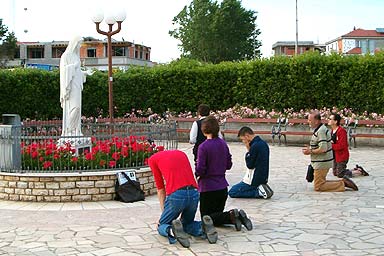
Bad Witness: Praying to and bowing down to Mary
Someone recently (around September of 2009) called into the Dividing Line Pod-cast Program (Dr. James White of Alpha & Omega Ministries; see www.aomin.org) and asked for help on witnessing to Muslims. He told of his experience in a Muslim area in Africa (Uganda) and that the Muslims kept saying, “God cannot reproduce!”; How many times have I heard this over the last 26 years in witnessing to Muslims?!: “God cannot have a wife!” “God cannot have a son!” “God did not lust after Mary and marry her and have sex with her!”
To our Roman Catholic and Orthodox readers – see, here we have a living example of recent history of Muslims who still believe the Trinity is “Father, Son, and Mother”. (Surah 5:116) This is very common all over the Muslim world. I know from experience also. So, the Marian dogmas and practices and praying to her and having statues and icons and exalting her too much are still contributing to that mis-understanding. The Qur’an defines for them what we believe – Surah 6:101 – they don’t really care what the official doctrine of the Trinity is.
“Wonderful Originator of the heavens and the earth; How can He have a son when He hath no consort [spouse, mate, sexual partner]?” He created all things, and hath full knowledge of all things.” ( Qur’an 6:101, with my own parenthetical comments)
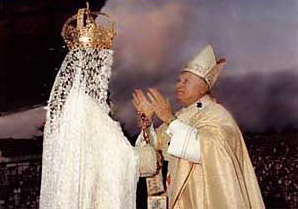
Pictures of John Paul 2 (and other Popes and other Roman Catholics) bowing down before a giant statue of Mary just confirms in their minds and hearts what the Christians really believe.
Only very educated Muslims who take the time to read and study find out what the doctrine of the Trinity is; and it is usually their “apologists” who are trained to come to the west to seek to win westerners to Islam.
I would like to suggest that believers in Jesus Christ slow things down a bit for the Muslims and, to use a mathematical learning analogy, instead of trying to teach them Calculus (the eternal Sonship of Christ and the Trinity); we should begin with simple math: like addition, subtraction and multiplication. We will get to Calculus, don’t worry, but don’t move there too quickly.
1. With passion and conviction, agree with your Muslim friend that it is Blasphemy to think God took a wife !! Get worked up over this and show them with passion that we do not believe this. There is a fun Arabic phrase that many Muslims know and use when someone says something wrong, "Estaqfr'ullah !" استغفرالله (Literally in Arabic, this means "I seek the forgiveness/pardon of Allah", but it seems to be saying to the person who said something like "Jesus is the Son of God" as a response to that - ie, "May God forgive you!"; "May it never be!") I have used this and it is effective to show how strongly the Bible is against their idea of what "the Son of God" or the Trinity means. Focus like a laser beam and spend time on this with your Muslim friend before you try and explain the “eternal Sonship” of Christ and “eternally begotten” language, or the Trinity. Most Muslims are so strong in their belief in monotheism, that if you move too fast and try to explain the doctrine of the Trinity, they will not hear what you are saying, because you have not convinced them first of your own monotheism, that there is only one God. As it is, only the Spirit of God can open people's hearts, whether they are an atheist or Muslim or a teenager American who is the son of a Turkish father and Swedish mother. (see John 6:44, 65; Ezekiel 36:26-27; John 3:1-8; Acts 16:14; Luke 24:45; 2 Timothy 2:24-26) Even so, that does not give an excuse for being rude or short with people and for not sincerely trying to explain things to them. God works through the means of patience, explaining, teaching, suffering, praying, hospitality, non-verbal communication, tone, attitude, etc. You have to work on these truths first - and show them verses from the Bible - 1. You don’t believe God got married or had sex with Mary; and 2. You don’t believe in three gods. It is also effective to stay on monotheism for a while and quote and use Mark 12:29 (Jesus quoting the Shema in Deut. 6:4).
Muslims are fun people to witness to! They are willing to talk about God and spiritual things. They believe in right and wrong and heaven and hell, and judgment day. I have had many Muslims say to me, "I respect you Mr. Ken, because you believe in your book as the truth." "Most of the other Christians we meet don't really believe they have the truth."
They are incredibly hospitable and we need to learn how to reach out in friendship evangelism, along with apologetics and debate; and one time "contact" evangelism. Jesus was the friend of sinners and tax-collectors, eating with them. We need to show Christ's love by being willing to have meals of shish kebab and hummus and drink strong Arabic/Turkish coffee with them.
Trying to explain the Trinity and the eternal Sonship of Christ too soon for Muslims is like trying to explain Calculus before addition, subtraction, and multiplication. You can and should eventually get to those truths; but it is better to start on the basic issues to help the Muslim overcome them; all the while praying that God will open their eyes and heart to understand and believe. ( John 6:44; Acts 16:14) It may not happen in one setting either. Many missionaries to Muslims have said that the average Muslim usually needs to hear the gospel 100 times over a period of 1 year in friendship with a true Christian. Obviously God can open the heart and draw in only one hearing of the gospel. We are only saying that this is the experience of many missionaries who have spent lots of time with Muslims; including this writer.
2. Point out that the Qur’an also uses metaphoric language of filial terms, “son” and “mother”.The Arabic phrase, “son of the road” ( Ibn ol sabeel ) = “traveler”, “wayfarer”; “mother of the book” ( um ol kitab ) = source of revelation; “Mother of villages” = Mecca. (Surah 6:93, 42:7, Pickthall’s footnote) In Egypt, the Arabic expression, “son of the Nile” – “one who lives on the Nile River.
“Son of the Road” (Qur’an 2:177; 4:36; 8:41; 9:60), “Mother of Book” (Qur’an 13:39; 43:3-4; 3:7) “Mother of Villages” – (Qur’an – 6:92; 28:59; 42:7)
Can roads, villages, rivers, or books have sex or get married? Asking this question will confound and silence the Muslim for his attacks and lack of listening to our explanations of "the Son of God".
This proves that metaphoric language is used by the Qur'an, and the Muslims should then give respect and a ear to us when we are also using the term metaphorically.
This proves that is not blasphemous to call Jesus, "the Son of God", because the Bible does not mean it in the way that Muslims think when they hear the phrase.
The Qur'an affirms the virgin birth of Christ. (Surah 3:47; 19:19-22) Affirm that Jesus had no human father; therefore, in this sense, God was His Father.
Luke 1:34-35 sounds very similar to the Qur'anic passages on the Virgin Birth of Jesus. It is powerful to use passages in the Bible that are similar to verses in the Qur'an to begin with to establish understanding, and then go forward.
3. Show them some specific Scripture. If possible have them read it in their heart language, whether it is Arabic, Farsi, Turkish, Urdu, Pushtun, Kazakh, Malaysian, or Fulani.
I have found that Luke 1:34-35 along with Hebrews 10:5 to be very effective in answering the “Son of God” terminology.
Luke 1:35 - “ . . . for this reason, the Holy offspring will be called the Son of God” For what reason? Because Jesus had no human father; and because of the “power of the Most High” and “the Holy Spirit” who conceived, unified, joined spiritually inside the womb of Mary – so, it is NOT from marriage and sex; that is blasphemy (and what Mormons and Greek mythology believed). Rather, the phrase “Son of God” describes the close eternal spiritual relationship that the Father and Son have always had from all eternity past, being of the same nature, but in personal relationship. God is personal, not an impersonal force or principle. God is Spirit (John 4:24), so there can be no physical sex or marriage. This is what Surah 112 and 6:101 and 5:72-73 and 5:116 are speaking against, they are speaking against understanding God and terms like “father”, “son”, and “begotten” in a physical, sexual way.
I have found that Hebrews 10:5 is very effective. - “a body You have prepared for Me”. This shows that Jesus existed before He was born and that God the Father prepared a body for Him.
4. Then you can go to John 1:1 and 1:14 and proceed from there. John 1:1, 14 are powerful for the Muslims because they clearly are calling Jesus “the Word”. In the Qur’an, Isa (the Arabic Islamic word for “Jesus”) Al Masih is called “the word” in Arabic. (Kalimat’allah) (Qur’an 4:171; 3:45) This is a powerful tool. Focus on “the Word” of God before you focus on the “Son of God”. “Allah’s word was with Him from all eternity, right?” You can ask your Muslim friend these kinds of questions: “Did Allah ever exist without His word (His mind expressing itself)? And what about Allah’s Spirit? Was there ever a time where Allah was without His Spirit?” Jesus is also called “a spirit from Allah”. (Ruh min Allah) in Qur’an 4:171. That verse denies the Islamic understanding of the Trinity and the Deity of Christ and the Sonship of Christ; but it does call him, Al Massih (the Messiah), the son of Mary, the Word, and a spirit from Allah; so it is useful to begin with Muslims from where they are coming from; and then go to Scriptures in the New Testament that we emphasized above. We can communicate the "eternal Son of God" (into the past in relationship with the Father) by focusing on the eternalness of the Word of God in eternity past. David Wood's excellent video on the issue:
3. A recent entry by Dr. White at his Facebook page about the earliest sources for a lot of Mary doctrines and doctrines that were in later centuries "developed on steroids" (my words) that are so unBiblical and crazy that it really mystifies me as to how anyone can go along with these unBiblical doctrines, dogmas, and pious beliefs and practices regarding Mary.
The earliest sources that gave rise to the eventual Marian dogmas are truly troubling when you take the time to read them in their context. I was listening to my debate with Gerry Matatics on Long Island from long ago and the topic of the Odes of Solomon came up. He was questioning my identification of them being "tinged with gnosticism."
There is a big debate about that, but, you tell me! Here's one of the key texts that eventually became important in the development of the idea of the perpetual virginity of Mary:
Ode 19
A cup of milk was offered to me, and I drank it in the sweetness of the Lord's kindness.
The Son is the cup, and the Father is He who was milked; and the Holy Spirit is She who milked Him;
Because His breasts were full, and it was undesirable that His milk should be ineffectually released.
The Holy Spirit opened Her bosom, and mixed the milk of the two breasts of the Father.
Then She gave the mixture to the generation without their knowing, and those who have received it are in the perfection of the right hand.
The womb of the Virgin took it, and she received conception and gave birth.
So the Virgin became a mother with great mercies.
And she labored and bore the Son but without pain, because it did not occur without purpose.
And she did not require a midwife, because He caused her to give life.
She brought forth like a strong man with desire, and she bore according to the manifestation, and she acquired according to the Great Power.
And she loved with redemption, and guarded with kindness, and declared with grandeur.
Hallelujah.
Add in the character of the Protevangelium of James, another key source, and you really start getting a good idea of where these concepts came from, and it was NOT from the Apostles or from Scripture.
4. Also, Dr. White's recent Dividing Line Program on why the Reformation was necessary and good reasons to celebrate the 500 Anniversary of the Reformation that we have historically dated to Oct. 31, 1517, when Luther nailed the 95 theses up on the Wittenberg Castle Church door.
I noticed that my "Initial Review" of Rod Bennett's book, Four Witnesses, that I put up at Amazon.com and linked to in this article, is no longer there. It is actually "part 1a" of my article.
Update: (April 18, 2017)
see Rob's comment in the com-box:
Ken, I found it. The Amazon grading system wants to show Verified purchases only. If you click on the filter for verified purchases, it will alternate to "All Reviewers. Then your review does show. see my comment also in the combox. I will leave this up here. and adjust the title
It is very good. I learned a lot of new valuable information about Irenaeus and church history.
I also read Part 1, which is very good also. Tim has done a lot of work and provided a lot of great information at his web-site/blog. I wish I had time to fully digest more of it.
I encourage everyone to check out his material on this 8 part series and the one below.
Dr. James White recently did a 5 part series on Sola Scriptura. I had planned to go through it again and type out more of his comments and analysis, but all I have had time for is to make about 5 additional points that I would make; additional points to his already excellent series. See the link to John Samson's blog post of putting all 5 together in one post.
Again, I wish I had time to write up an article on this; but I don't. I hope to find time in the future to study the issues more and write more on it.
Some very substantive programs that Dr. White has been doing lately. Also the one on the gospel of Mark, inerrancy, and Mike Licona's perspective. See links at my apologetics and agape link.
Augustine explains that his view that Peter is the rock of Matthew 16 was later replaced by the view that Christ is the rock. Notice that he refers to his former view being *replaced*, not just adding a second interpretation to it. He says that the reader can decide for himself which interpretation is more likely. He expects the reader to choose between the two, not accept both. Thus, Augustine advocated the *rejection* of the view that Peter is the rock, and he said that others could do the same:
"In a passage in this book, I said about the Apostle Peter: 'On him as on a rock the Church was built.'...But I know that very frequently at a later time, I so explained what the Lord said: 'Thou art Peter, and upon this rock I will build my Church,' that it be understood as built upon Him whom Peter confessed saying: 'Thou art the Christ, the Son of the living God,' and so Peter, called after this rock, represented the person of the Church which is built upon this rock, and has received 'the keys of the kingdom of heaven.' For, 'Thou art Peter' and not 'Thou art the rock' was said to him. But 'the rock was Christ,' in confessing whom, as also the whole Church confesses, Simon was called Peter. But let the reader decide which of these two opinions is the more probable." (The Retractions, 1:20:1)
[See discussion below on the Latin word, "Retractationes", which is more accurately translated as something like "Review and Corrections" or "Corrections" or "Reconsiderations".]
Augustine held the Roman church and its bishop in high regard, but he had a non-papal view of church government. Roman Catholic historian Robert Eno comments:
"Elsewhere I have argued in detail Augustine's views of authority in the Church and that, in my opinion, the council [not the Pope] was the primary instrument for settling controversies....I believe that Augustine had great respect for the Roman church whose antiquity and apostolic origins made it outshine by far other churches in the West. But as with Cyprian, the African collegial and conciliar tradition was to be preferred most of the time." (The Rise of the Papacy [Wilmington, Delaware: Michael Glazier, 1990], p. 79)
Scott Windsor pointed out about the Latin word "Retractationes", that it does not mean "Retractions", but more like "Review and Correct":
From the combox:
Scott, Thanks for your comments. I take your word for it on the Latin word, as I looked around some to confirm it; and as far as I can tell, you are correct. It seems the Latin means more like "Review and Correct"
Thanks for the link, and I will use some of that from William Jurgens, unless someone else comes along and convinces me that this is not accurate. It seems accurate to me.
Augustine wrote The Retractationes (also known as Retractationum) between 426-427.
His purpose was to clarify and enhance his previous efforts to explain and defend them.
As the patristic scholar, William A. Jurgens, explains,
English-speaking authors usually avoid the problem of what the title means by the simple expedient of referring to it by its Latin title, Retractationes. When it is mentioned in English and in the English translations now available it is invariably referred to as Retractations or Retractions. The first is an affront to English and the second is incorrect. Actually, Augustine had very little to retract, and the meaning of Retractationes is Reconsiderations, Revisions, Second Thoughts, or, as I have called it, Corrections. With the Corrections, Augustine again invented a new literary genre: a summation and criticism of his own writings. He had originally intended to include in his review his books, letters, and sermons. But when he had completed the review of his books in 426 or 427, he was persuaded to publish the whole work as it then stood. (The Faith of the Early Fathers [Collegeville: Liturgical Press, 1979] 3:163)
Dr. White's article that deals with the issue you raised. (if that is what you meant by your link - the link is different now. see below)
Did he use the words "Rome has spoken?" No, but he did say Rome responded (sent rescripts) and then stated "causa finita est" (the cause is ended, or the case is closed). He obviously accepted the decision made by the pope. (Scott Windsor, Sr.)
Except in Augustine's time, he would not have used "Pope" in the sense of jurisdictional authority - that claim comes much later. As far as I know, all presbyters/bishops / ministers (in other areas around the Christian world in the early centuries, not just the bishop of Rome.) were called "papa" or "father", meaning "spiritual father", as in 1 Cor. 4:15-17 and 1 Timothy 1:2, 1:18, etc.
The final words of the sermon, then, in which we find the key phrase (placed in bold), are in reference to this heresy, this error (Pelagianism), and its denial of grace. I simply point out that throughout the sermon you have had one source of authority cited over and over again: Holy Scripture. No quotations of Popes or prelates, just Scripture. With this in mind, we come to the actual passage: 10. What then was said of the Jews, the same altogether do we see in these men now. “They have a zeal of God: I hear them record that they have a zeal of God, but not according to knowledge.” What is, “not according to knowledge”? “For being ignorant of God’s righteousness, and wishing to establish their own, they have not submitted themselves unto the righteousness of God.” My Brethren, share with me in my sorrow. When ye find such as these, do not hide them; be there no such misdirected mercy in you; by all means, when ye find such, hide them not. Convince the gainsayers, and those who resist, bring to us. For already have two councils on this question been sent to the Apostolic see; and rescripts also have come from thence. The question has been brought to an issue; would that their error may sometime be brought to an issue too! Therefore do we advise that they may take heed, we teach that they may be instructed, we pray that they may be changed. Let us turn to the Lord, etc. It is a measure of the utter desperation of the Roman position to have to make reference to such things, in our opinion. The topic is not the bishop of Rome nor the authority of Rome. It is obvious, beyond question, that Augustine’s point is that Pelagianism is a refuted error. It is not refuted because the bishop of Rome has refuted it. It is refuted because it is opposed to Scripture. Two councils have concluded this, and the bishop of Rome has agreed. From Augustine’s position, the error has been exposed and refuted. If only those who are in error would come to know the truth! Augustine exhorts his hearers to teach the gainsayers, and pray that they may be dissuaded from their errors. This then is the context and content of Sermon 131 of Augustine (which is, btw, Sermon 81 in the Eerdman’s set, pp. 501-504 of volume VI for those who wish to read the entirety of the work). It is now painfully obvious that to place the words “Roma locuta est, causa finita est” in quotation marks and attribute them to Augustine in the context of Papal Infallibility is simply inexcusable. But, there is more to the situation than that. For history shows us that Augustine would never have uttered such words in the context Keating alleges. How he responded when Zosimus became bishop of Rome and attacked the North African churches for condemning Pelagius proves, to any person even semi-desirous of fairly dealing with Augustine’s position, that Augustine did not view the bishop of Rome as the infallible leader of the Christian Church. But to appreciate fully the depth of the error of Roman Catholic controversialists at this point, we must take a few moments to study the history. (James White, "Catholic Legends and How they Get Started", see link below.)
There is nothing much new here, if you have listened to Rod Bennett in his previous testimony on the Coming Home Network, and other lectures that are on you tube and catholic web-sites (some are radio interviews and question and answer pod-casts); and if you have seen and read my previous blog posts on my friend (both here at Beggar's All, and at Apologetics and Agape).
Even though both sides repeat a lot of the same arguments; I still think it is important for me to repeat the Protestant responses and apologetic answers to the Roman Catholics who keep making these claims. Even though this is all a repeat of many issues that Protestants and RCs keep debating, I wanted to have these points here together in one blog article with Rod's lecture, because it seems good to me. Again, nothing is meant as a personal attack; I am merely defending the historic Protestant Evangelical position against the Roman Catholic Apologetic arguments.
Rod Bennett's recent appearance on Marcus Grodi's "Coming Home Network", again.
Below is most of my response (edited and developed from the combox comments at the chnetwork site, not at the You Tube link) to Rod's interview and responses to some Roman Catholics who commented. I am not repeating the RC arguments here. In order to get the Roman Catholic comments, go the link and see the comboxes.
----------
Issues revolving around church history, Sola Scriptura, the canon, and tradition:
Rod is right in that our Southern Baptist Mega Church did not
teach us about church history, and it did not prepare us to understand church
history. But knowledgable Protestants do not have that "great
apostasy" view like the Mormons, JWs, or "the Fields of the
Woods" (A. J. Tomlinson, founder of Church of God that later splintered into the Church of God of Prophesy and the Church of God, Cleveland, Tennessee,etc.) Rod tells that story of "The Fields of the Woods" and Tomlinson in his latest book, The Apostasy That Wasn't, and in his lecture, "The Four Witnesses Brought Me Home". He may have mentioned that in his first book, but I don't remember for sure. Another group that likes to promote the "Great Apostasy" theory are the the Seventh Day Adventists
(who teach that Sunday Worship is the mark of the beast and was done by Constantine). Another common view of "The Great Apostasy" is like the liberal and conspiracy theory views of Dan Brown of the DaVinci Code fame or "the Christ of history vs. the Christ of faith" paradigm. Knowledgeable Protestants just don't have that view, that Rod tries to lump in with those false groups. But Rod is right that some, in fact too many, Evangelicals are ignorant of church history and many of the Evangelical free church types, many Baptists, and Charismatics and Pentecostals do see church history wrongly as in the "Great Apostasy" theory. I remember in seminary, when some one called this the "BOBO" theory, "Being true in the NT, then, "Blink Off sometime after NT was finished, Blink On with Luther".
Knowledgable Protestants who believe the Bible and appreciate
church history appreciate Ignatius, Polycarp, Tertullian, Irenaeus, Justin
Martyr, Cyprian, Athanasius, Augustine, Jerome, the Cappadocian fathers,
Anselm, etc. But they were not infallible; they made some mistakes.
Knowledgable Protestants don't say "the church went totally
bust" or "went off the rails", etc.
At first, I
thought Rod was saying that Constantine did make Christianity the state
religion, rather than that is what many Evangelicals (and others also)
believe.It is a common mistake repeated
a lot, even in history books. A couple of the RC commenters helped me see Rod was not saying that. Polycarp and Relics:
Rod
mentioned what happened after Polycarp was burned at the stake. If one reads
the account carefully, (The account of Polycarp's martyrdom is available atccel.orgornewadvent.org) it does not say that after they buried them,
they took out his bones next year for exhibition or stored them in a reliquary
in a church for exhibition, or prayed to Polycarp, or kissed his bones, etc. It says that they honored his remains by gathering them up after he was burned, and then they buried them. I think Timothy Kauffman makes a good case for understanding that "depositing" just meant burial. See Timothy Kauffman's excellent article on this issue of the early church and relics here.
They remembered him the next year on the anniversary of his
martyrdom, but the text does not indicate that they brought out his bones for exhibition or veneration or
kissing them or staring at them or praying before them. And the passage does not say they prayed to
Polycarp for him to pray for them. The Proto-Evangelium of James and Mary:
Rod mentions the Proto-evangelium of James. The Proto-evangelium of James was mentioned and used as a basis
for the Marian dogma of the Perpetual virginity of Mary, etc. It is Gnostic
tinged, since it implies that Jesus just "popped out" from inside of
Mary, without the normal pains of childbirth and passing through the birth
canal. This is a problem of Roman Catholicism - basing a dogma on a
non-canonical writing. It is a Gnostic idea to think that Jesus was not born in
the normal human way that we all are - after all, He was 100 % human, and that
is a dogma that Protestants agree with the RCC on - Jesus is 100% God and 100 %
man - the God-man; the second person of the Trinity who became flesh/human.
(John 1:1-5; 1:14; Philippians 2:5-8) Athanasius, canon, Sola Scriptura
Much of Rod's new book, The Apostasy that Wasn't, was about Athanasius and his fight to defend Nicene orthodoxy and the Arian heresy. However, Protestants love Athanasius and his fight against Arianism. He
also wrote: "they (the Arians, the heretics) have the buildings, but you
have the faith" (Letter 29) The heretical Arians held the external
buildings and priesthood and bishoprics for some 60 years. Protestants agree
with Athanasius and others who resisted Arianism. To try and imply that
Protestants think the early church went completely off is wrong.
Athanasius also wrote:
"in these alone (the 27 books of the NT) are the doctrine of
godliness" (that is Sola Scriptura in seed form). (Letter 39)
"Alone" = (Greek, "mono" = alone, which in Latin,
"Sola")
And, Athanasius also wrote, "the holy and God-breathed
Scriptures are self-sufficient for the preaching of the truth." (Contra
Gentiles, "Against the Heathen", 1:3)
Athanasisus also wrote:
"Vainly do they run about with the pretext that they have demanded
Councils for the faith's sake; for divine Scripture is sufficient above all
things . . . " (De Synoodis 6)
The Mass and Eucharist:
Rod claimed that the Didache has a Roman Catholic mass in it. The Didache does not have anything in it that implies
transubstantiation or a RC mass. It does not even imply the "real presence" in the Eucharist. The word Eucharist is used, but that is not a problem in itself. Protestants would use it, if it was not for the all the RC and transubstantiation associations with it because of the centuries of man-made traditions added to it. It just points to "thanksgiving" and being thankful for the Lord Jesus' atonement on the cross. Using the word "Eucharist" in the early writings, does not mean backloading the word with all the development of the meaning of the Lord's Supper that slowly takes place over centuries all the way up until 1215 AD.
General church history and the "great apostasy" question:
The corruptions that people like John Wycliffe in the 1300s, Jan
Hus in the 1400s, and Luther, Zwingli, and Calvin in the 1500s objected to was
a very slow process of an emphasis on externals, penances, works, rituals,
visiting shrines and relics, and the addition of man-made traditions like
purgatory and praying to dead saints, indulgences, transubstantiation, Marian
dogmas, Papal doctrines, priestly ex opera operato powers, etc. that had
eclipsed or hidden the true teaching of Scripture on justification and
sanctification; and understanding the distinction between the two.
Rod's main point is that many Evangelicals and cultic groups both seem to think that there was a great apostasy with Constantine around 313 AD - 325 and afterward. It is true that many Baptists and free church Evangelicals and Charismatics probably are ignorant of the details of church history and wrongly think there was a complete apostasy with Constantine. But this idea get mixed up with cultic groups and liberal theology and Rod does an effective job of lumping them all together.
All these groups (cultic groups, liberal theology, semi-cultic groups (Seventh Day Adventism), and uninformed Evangelicals), even though totally unlike one another, seem to blame everything on Constantine. Anti-Trinitarian groups, cultic groups, historical revisionism as in the Dan Brown Da Vinci code type of thinking, and a lot of liberal theology (the whole "separating the Christ of history from the Christ of faith" liberal paradigm). We don't
say the early church went off the rails completely - At least not until the
Council of Trent ( 1545-1563) - that is where the Roman Catholic Church
knowingly condemned the doctrine of justification by faith alone; and only then
did it become a completely false church.
Athanasius is claimed to have had a high view of Mary as arc of the covenant:
A Roman
Catholic named Anthony cited from a work attributed to Athanasius called, “the
Homily of the Papyrus of Turin”.
There is some doubt about the work that has been attributed to
Athanasius called, "The Homily of the Papyrus of Turin" - it was
found more recently and was unknown in the west for centuries. It is not part
of the standard works of the early church fathers and was not in Migne's
Patrology.
"I wonder whether this is spurious or genuine. The name of
the document is not itself frightfully reassuring. It suggests attribution to
Athanasius based on a single copy (probably in Coptic-Sahaddic not Greek) from
the 6th century or so. As far as I can tell, it was unknown to the Western
church as part of the Athanasian corpus and has become known via the journal Le
Muséon in 1958." (Turretinfan, at his blog,) ( with my editing for clarity.)
Even
if that can be proven it was from Athanasius himself, it is just his private
opinion. It carries no weight at all as authoritative. We can accept the good
and Biblical things from the fathers, and reject the man-made traditions and
opinions as just that. They are not infallible. Only Scripture is infallible.
Back to issues of Tradition, Canon, Sola Scriptura, church, and the Trinity:
Rod and another Roman Catholic commentator mention sacred tradition, and as we all know, their main text for that is 2 Thessalonians 2:15.
Sacred tradition of the apostles was all eventually written
down. 2 Thessalonians 2:15; 3:6; (very early epistles - 51-52 AD - it is reasonable
to assume that the things he was teaching orally and not written down yet at
the time, were later written down in other letters like Romans, Colossians, the
pastoral epistles, etc.) 1 Corinthians 11:2; 15:1-9, Jude 3. The harmonization of sound exegesis of passages such as Jude 3 (the faith was once for all delivered to the saints), 2 Peter
1:3-4 (His divine power has given us everything we need for life and godliness); and John 17:8 (Jesus praying to the Father, "the words You gave Me, I have given to them" - to the disciples), John 17:17 (Your Word is truth), John 14:26 (the Holy Spirit will teach you all things, and bring to your remembrance all that I said to you), and John 16:13 (The Holy Spirit will guide you into all the truth), with 2 Tim. 3:16-17 (All Scripture is God-breathed; and is sufficient to equip the man of God for every good work), and 2 Peter
3:16 (Peter considers all of Paul's letters as Scripture), and Hebrews 1:1-3 (in the last final days, God has spoken decisively and finally through His Son) - all of these together strongly implies that everything we need was written down for
us, and that with the death of the apostles, there will be no more revelation.
A Roman Catholic claims that the Trinity is only known through later tradition (meaning the interpretation of the church, in RC understanding), church councils and creeds.
Athanasius speaking of the Holy Trinity - well, since the Holy
Trinity is scriptural and we Protestants agree with that, and Athanasius was writing against the heresies of the Arians, Sabellians, and Tropici, that is not a good
example of something that becomes particularly Roman Catholic that Protestants
disagree with, that is called as part of the "Rule of Faith" or
"the Tradition". The Rule of Faith or "the tradition"
spoken of by Irenaeus, Tertullian, Origen, and Athanasius are all doctrinal
statements based on the organization around the Trinity, that are similar to
the Apostles Creed, the Nicene-Constantinopolitan Creed, etc. that Protestants
agree with that are in infallible Scripture.
On
the "canon" of Scripture. All of the 27 NT books and letters were
God-breathed / inspired, the moment they were written from around 45 AD to 96
AD, with most written before 70 AD. They were individual scrolls written to
different places by different authors and from different areas. The form of a
codex was not even in existance in the first century. A simple codex - flattening out the sheets of papyri and tying more than one book together -
which later became basis for book making with a binding. 'canon"
originally just meant "standard", "rule", "law"
before it came to mean "list". They were canon or standard already
because they were God-breathed at the time of the writing of them in the first
century. Just because it took time to even know about them(some areas would not
have known about every NT book until enough time passed for all the areas to
communicate with one another about all the different books), then discern them
all as Scripture, and then gather them together in one "codex", does
not make that in itself some sort of infallible act. It is true and correct,
but it was a natural part of a process of history. Irenaeus and Tertullian
(around 180-220 AD) list most all of the 27 NT books in their writings. Before
then, we just don't have anyone writing the volume that they wrote to quote
from all or most of the books. What we have that is extant from writers earlier
than those 2 are very small works and short letters. (Clement of Rome,
Ignatius, Polycarp, Didache, Hermas, Justin Martyr)
Although the word Trinity, and homo-ousias (same substance) and
hupostasis (for person of the 3 persons formula for the Trinity) are not words
for the Trinity in the NT (though hupostasis is used for Jesus' nature/ being
in Hebrews 1:3, the word was later adopted for the person that is
"existing under" the one substance (ousia); although those words are
not employed in the text of the NT in the doctrine of the Trinity, the doctrine
is Biblical in that the concept and doctrine is taught by harmonizing all that
Scripture says about the Father, the Son, and the Holy Spirit. (and based on
Matthew 28:19 and 2 Corinthians 13:14 and Matthew 3:13-17, and others). That is
the proper role of theological development, or proper interpretations, which
the Roman Catholic Church calls tradition also. (beyond the revelatory
traditions that were apostolic, as in 2 Thess. 2:15 and 1 Cor. 11:2, etc.)
There is proper doctrinal and theological development, and then there is
improper (additions, corruptions), which is what the RC dogmas about Mary
(beyond the ones Protestants agree with such as the Virgin Birth of Christ),
Popes, indulgences, purgatory, penances, trafficking in relics, prayers to Mary
and dead saints, priests, ex opere operato powers, Transubstantiation, etc. -
these are man-made traditions that are not in the early centuries and not
biblical.
If you go back and look at the context of De Decretis (Defense
of the Nicene Definition) 27, it is all about explaining Scripture. "this
view was transmitted from Father to Father" just means the proper
interpretation of the Deity of Christ and the Trinity, which Athanasius
explains and Protestants agree with that. Athanasius (about 300-373 AD)
mentions Origen, who was about a century before him. (250 AD) The quote does
not go against Sola Scriptura, it merely is testifying that the Nicene Creed
was Biblical. He was condemning Arianism and Sabellianism (Modalism) and
Protestants agree with that. So that quote is not saying Creeds or Bishops or
fathers are above Scripture, it is only saying that the fathers properly
interpreted the Scriptures on that issue - the issue of the Deity of Christ and
the Trinity, which is all Biblical.
The To Serapion, On the Holy Spirit, against the Tropici heretics, 1:28 quote, is in Athansius' work on the Holy Spirit
against the heretical group called the Tropici, and if you look at the context
of that also, he is quoting Scripture about the Deity of the Holy Spirit, and
the Trinity, and so the Tradition, the teaching and faith of the universal church
at the time was the sound doctrine about the Trinity, which Protestants agree
with, so that, (and the other quotes) do not exalt some extra-Biblical
tradition above Scripture, but rather are expressing the proper interpretation
of infallible Scripture.
Here is more of the full quote: (It is all based on Matthew
28:19 and 2 Cor. 13:14, and Ephesians 4:6:
28. But, beyond these sayings, let us look at the very
tradition, teaching, and faith of the Catholic Church from the beginning, which
the Lord gave, the Apostles preached, and the Fathers kept. Upon this the
Church is founded, and he who should fall away from it would not be a
Christian, and should no longer be so called. There is, then, a Triad, holy and
complete, confessed to be God in Father, Son, and Holy Spirit, [based on
Matthew 28:19; 2 Cor. 13:14] having nothing foreign or external mixed with it,
not composed of one that creates and one that is originated, but all creative;
and it is consistent and in nature indivisible, and its activity is one. The
Father does all things through the Word in the Holy Spirit. Thus the unity of
the holy Triad is preserved. Thus one God is preached in the Church, ‘who is
over all, and through all, and in all’ [ Ephesians 4:6] — ‘over all’, as
Father, as beginning, as fountain; ‘through all’, through the Word; ‘in all’,
in the Holy Spirit. It is a Triad not only in name and form of speech, but in
truth and actuality. For as the Father is he that is, so also his Word is one
that is and God over all. And the Holy Spirit is not without actual existence,
but exists and has true being. Less than these (Persons) the Catholic Church
does not hold, lest she sink to the level of the modern Jews, imitators of
Caiaphas, and to the level of Sabellius. Nor does she add to them by speculation,
lest she be carried into the polytheism of the heathen. And that they may know
this to be the faith of the Church, let them learn how the Lord, when sending
forth the Apostles, ordered them to lay this foundation for the Church, saying:
‘Go and make disciples of all nations, baptizing them in the name of the Father
and of the Son and of the Holy Spirit.’ [ Matthew 28:19 ] The Apostles went,
and thus they taught; and this is the preaching that extends to the whole
Church which is under heaven. (Athanasius, To Serapion, against the Tropici heretics, Book 1:28, Translated, intro, and notes by C.R. B. Shapland.)
It
is the same principle for the other 2 quotes; they are not exalting some kind
of extra-biblical man made tradition over Scripture, but Athanasius is saying
the proper interpretation of Scripture about the Deity of Christ and the
Trinity is passed down by the fathers.
Athanasius' work Decretis or Defense of the Nicene Definition you
can find it at
www.ccel.org
www.newadvent.org
Prayers to the dead:
A Roman Catholic commenter claims that praying to the dead is early and good.
No; Scripture is clear and forbids praying to the dead. Pray only to God. The angel rebuked John several times for worshiping the angel. Revelation 19:10 and 22:8-9.
The issue of Mary:
Mary is more honored by us (Protestants) by teaching what Scripture says about her and her faith and humility, but that she admitted she was a sinner and needed salvation ( Luke 1:46) and that Jesus was born of the virgin. (Matthew 1:18-25; Luke 1:26-37; chapter 2) Matthew 1:25 is clear - "until" 'εως 'ου = heos hou = "until, and after that, no more". Mary and Joseph had other children after Jesus. Matthew 12:46-47; 13:55-56; Mark 3:32; 6:3; John 7:5-10; Luke 8:19-20; Galatians 1:19
Praying to Mary and thinking she is a co-mediatrix, is a clear violation of 1 Timothy 2:5 - for there is one God and one mediator between God and man, the man Jesus Christ . . .
In later centuries, the church was wrong on over-exalting Mary and praying to her and having icons and statues to her later. The New Eve statements (Justin Martyr, Irenaeus, Tertullian) are not a big deal. God used her as the channel / instrument to bring the Messiah into the world.
But the other stuff about Mary, which developed later, especially after Athanasius, Totally wrong. Mary was a godly woman and Jesus was born of the virgin Mary, but she was not perpetual virgin and we should not pray to her. Prayers to her are later anyway, but they are still wrong. She was not sinless, nor Immaculately conceived, nor bodily assumed. These are all man-made traditions.
"Theotokos", as originally meant, about Jesus being God from conception (and thus pre-existent before the conception in the womb of Mary) was right; but Nestorius was right in that people will get the wrong impression and think Christians are saying Mary brought God into existence, which is exactly what Muslims thought by hearing this, and even to this day, the Muslims still misunderstand and think Christians worship Mary and over-exalt Mary and the Qur'an thought Mary was part of the Trinity because of your church's error and man-made traditions. (The Qur'an, Surah 5:116, with 5:72-78) puts Mary, Jesus, and God as the Trinity, with Surah 4:171 - "say not three", etc.)
A Roman Catholic asks, "How do you think the Church Fathers read the Scriptures regarding Our Lady?
Many of them said she sinned. Origen, Chrysostom, Tertullian, Basil, Cyril of Alexandria
Tertullian said she had a normal marriage after Jesus was born. She was not perpetual virgin.
Basil the Great:
Basil commented on the sword of Luke 2:35-36 stating, “Even you yourself [Mary], who hast been taught from on high the things concerning the Lord, shall be reached by some doubt. This is the sword” (Basil of Caesarea, Letter, 260, 9 italics mine).
Cyril of Alexandria (A. D. 376 – 444) also taught that Mary sinned in severe ways thereby holding to a position in opposition to an immaculate conception:
“For, doubtless, some such train of thought as this passed through her mind: ‘I conceived Him That is mocked upon the Cross. He said, indeed, that He was the true Son of Almighty God, but it may be that He was deceived; He may have erred when He said: I am the Life. How did His crucifixion come to pass? and how was He entangled in the snares of His murderers? How was it that He did not prevail over the conspiracy of His persecutors against Him? And why does He not come down from the Cross, though He bade Lazarus return to life, and struck all Judaea with amazement by His miracles?" The woman, as is likely, not exactly understanding the mystery, wandered astray into some such train of thought” (Cyril of Alexandria, Commentary on John, Book 12).
1 Clement, elders and bishops, and NT priests and Latin:
One RC wrote: I mean, up until the late 4th century, the Epistle of St. James had not even been quoted in the west.
Actually, 1 Clement 23:3 seems to be combination of James 1:8 and 2 Peter 3:4, and Clement of Rome is western, and dated at 96 AD. Also a strong case for patristic witness to 2 Peter.
Even if it can be proven Athanasius did write the Homily of the Papyrus of Turin, it is just his opinion. It just does not sound like him, when I read his other writings.
You are right, I am not infallible; but neither is any human - no bishop of Rome or "Pope" was ever infallible, not matter how much your RC Church claims it.
Only Scripture is infallible (as opposed to interpretations later in history, non-apostolic traditions, creeds, church councils, bishops, priests, etc.), because it is revelation from God, and only God is infallible. Since God is infallible and perfect, it is a function of His attributes; and Scripture is His Word, therefore Scripture is infallible. Since man makes mistakes, he and Popes and bishops cannot be infallible, since they are human.
An RC commenter seemed to claim I was saying that 1 Clement taught Sola Scriptura. I did not say 1 Clement taught Sola Scriptura, rather I was responding to his claim that the epistle of James was not even quoted in the west until the late 4th Century.
One RC wrote: I mean, up until the late 4th century, the Epistle of St. James had not even been quoted in the west.
And my answer was: Actually, 1 Clement 23:3 seems to be combination of James 1:8 and 2 Peter 3:4, and Clement of Rome is western, and dated at 96 AD. Also a strong case for patristic witness to 2 Peter.
1 Clement (96 AD) is actually proof that each church had a plurality of elders, and understood that the office of elder and overseer (bishop) was the same. 1 Clement 42-44. This confirms the clear teaching of Scripture in Titus 1:5-7 (elder and bishop same office/person); Acts 14:23 (elders - plural - for each church); 1 Peter 5:1-4 - each elder is to oversee and shepherd (pastor) the flock. Peter is "fellow-elder", not a Pope nor a "bishop over all other bishops", (a false doctrine that came along centuries later.) Acts 20:17 (elders) - Acts 20:28 - each elder is to oversee and shepherd the flock. Clement does not claim any special office for himself, never says "I am Pope" or "bishop over bishops" and writes "from the church at Rome" "to the church at Corinth". He was right to rebuke the schism and rebellion in the Corinthian church for deposing the elders because of jealousy, for they had no good reason to rebel against their church elders.
There was no hierarchy of one bishop over the college of elders, until Ignatius, who comes a few years after Clement. ( Ignatius, around 107-117 AD) Even so, it was a practical practice, Jerome around 400 AD, agrees that bishops are elders and elders are bishops, and calls what Ignatius and others after him did, as "custom", rather than revelation/in Scripture. (commentary on Pastoral Epistles).
The problem in Latin Christianity (later, Tertullian and Cyprian) was the conflating of the term of priest in the OT with the idea of elder in the NT. A priest in the OT (Kohen) was translated in the NT and Clement as heireus, priesthood as heirosunaes 'ειρωσυνης (in 1 Clement 43:2, which you quoted). In the NT, an priest is the Greek word heireus / 'ειρευς where that word in 1 Clement is derived. The Hebrew for that was Kohen כהנ and yet both Hebrew and Greek had other words for "elder" ( Greek: presbuteros / πρεσβυτερος ). There was another Latin term for those that offered the sacrifices in the temple (the priests). Latin = sacerdos, where we get "sacerdotal" from.
But in English and in Roman Catholicism, the elder/ presbuteros and the priest / Sacerdos got combined into "priest" because they (what later became Roman Catholicism exemplified in the Mass and Transubstantiation - mainly developed from 800s AD to 1215 AD) wanted to combine the ideas of offering sacrifices with the office of elder. But in the NT, there is no sacerdotal office in the NT church, as Jesus was and is our mediator/ high priest, and priest according to the order of Melchizadek (Hebrews 5, 7) and He offered the last and final sacrifice, Himself. And when the NT does refer to priests and priesthood, aside from Christ, it is talking about all believers in Christ who are priests who offer spiritual sacrifices of praise and thanksgiving to God. (1 Peter 2:5-10; Revelation 1:6; Revelation 5:10) There is no special NT office of priests for the churches, as it was for Israel in the OT.
Since elder in the NT was NOT a sacerdos, it was wrong for the Latin development of the word into priest, rather than to keep the two words separate and clear.
Clement is pointing out that there was jealousy, envy and strive over the OT priests in the OT times; and there was jealousy and strive against the elders/bishops in the church of Corinth, but he is not saying that elders/bishops are priests like in the OT. The Corinthians were wrong to allow the presbyter-overseers to be deposed, and Clement rightly rebukes them for that; but Clement was not teaching any mono-episcopate or NT priesthood; and he clearly affirmed that elders and overseers (episcopos, translated sometimes as "bishop") are the same office, just as Titus 1:5-7; Acts 20:17, 28; 1 Peter 5:1-4; Acts 14:23; and Philippians 1:1, 1 Timothy 3, 5 show. The NT, 1 Clement, the Didache, and the Shepherd of Hermas show that the earliest NT and earliest in church history local church government was a plurality of elders and they were all expected to be shepherds (pastors) and overseers and there was no mono-episcopate; and definitely no "bishop over all other bishops". The mono-episcopte developed from Ignatius onward, and it grew to a bishop over a larger area, and then, centuries later, evolved into the claims of the bishop of Rome (as "Pope"), but the East never accepted such a claim.
He clearly teaches that they are the same office, if you read 1 Clement 42 to 44 fairly.
especially this section of paragraph 44:
"For our sin will not be small, if we eject from the episcopate those who have blamelessly and holily fulfilled its duties. Blessed are those presbyters who, having finished their course before now, have obtained a fruitful and perfect departure [from this world]; for they have no fear lest any one deprive them of the place now appointed them. But we see that ye have removed some men of excellent behavior from the ministry, which they fulfilled blamelessly and with honor." I Clement 44:4-5
Conclusion: Rod is wrong.
Those early pious beliefs or side comments (like using the word Eucharist, or "Catholic" or the "Mary as the New Eve" comments by Tertullian, Irenaeus, and Justin Martyr, or the respect shown to Polycarp's bones, or that they seem to teach baptismal regeneration, or the mono-episcopate from Ignatius onward, or the conflating of the Latin creation of the word priest from the Greek presbuteros that developed, etc.) by early church fathers that RC developed into later dogmas, are not things that mean a complete apostasy of the whole church in the early centuries (Constantine or a little later) at that time. The church existed even in the time of Wycliffe, Hus, Luther, though it has drifted far and was full of corruption. The real apostasy does not come until the Council of Trent in 1545-1563.
"It is true that the best apologetics can be given only when the system of truth is well known. But it is also true that the system of truth is not well known except it be seen in its opposition to error."- Cornelius Van Til
"The Scriptures obtain full authority among believers only when men regard them as having sprung from heaven, as if there the living words of God were heard."- John Calvin
Luther's Works
A Collection of On-line Resources For All Your Luther Needs
"But a most pernicious error widely prevails that Scripture has only so much weight as is conceded to it by the consent of the church. As if the eternal and inviolable truth of God depended upon the decision of men!"- John Calvin
“Let nobody suppose that he has tasted the Holy Scriptures sufficiently unless he has ruled over the churches with the prophets for a hundred years. Therefore there is something wonderful, first, about John the Baptist; second, about Christ; third, about the apostles...“We are beggars. That is true.” - Martin Luther
This is the best book available on Sola Scriptura. For Protestants, it will help you understand and defend sola scriptura. For Roman Catholics, this book will help you understand exactly what Protestants mean by sola scriptura... rather than what you think it means!




 Posts
Posts


