Showing posts with label Paul Althaus. Show all posts

Monday, November 20, 2023

Did Luther Believe Justification is a Process?

An anonymous participant left this comment: "Luther believed justification is an ongoing process and not a one-time-event like most Protestants today hold to as part of their interpretation of faith alone." In support of this claim, the following citations were provided:

Luther said: “We perceive that a man who is justified is not yet a righteous man, but is in the very movement or journey toward righteousness,” - Disputation on Justification, thesis 23, in Luther’s Works 34:152.

“Our justification is not yet complete.... It is still under construction. It shall, however, be completed in the resurrection of the dead.” - D. Martin Luthers Werke. Kritische Gesamtausabe (Weimar, 1883), 39I:252 (cited in Althaus, 237 n. 63).

With these citations, Luther is put forth as an advocate of the process of justification... which is notoriously a Roman Catholic theological construct. Let's take a closer look at these quotes and see where they come from and what they are actually saying. We'll discover that the lines between what Luther and Rome are saying about Justification and the final judgment are being obfuscated. 

Documentation
The immediate red flag that this may be a blatant drive-by cut-and-paste are the English citations of Luther and accompanying German references. The cut-and-paste of these quotes is suspiciously similar to an old article by Rome's defender, Jimmy Akin, but more precisely material from Akin's later book, The Drama of Salvation, p. 29.  
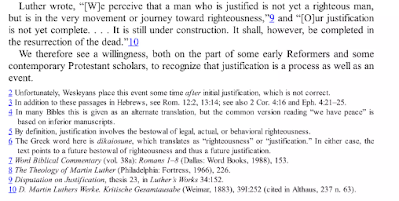

It looks like Mr. Akin recycled his old article and made additions and corrections when he published his book (for instance, the first Luther quote is expanded in the book form and the documentation was corrected).  Mr. Akin has relied heavily on a section from Paul Althaus, The Theology of Martin Luther, (particularly page 226) in this presentation of Luther, with both quotes cited by Althaus on page 237 (Althaus translation of the first quote is slightly different than LW 34). Akin uses this material drawn from Althaus to conclude that "a number of recent Protestant scholars" recognize that Justification is a process and "in doing so they are retrieving a concept that was present in the thought of some of the early Reformers" (p.28). 

Mr. Akin argues for the Roman Catholic "process" of justification rather than the imputation of Christ's righteousness. For Akin, it's only "the final, consummating declaration of our righteousness" done in the future that will be the deciding factor if one is actually justified before God or not.  

Quote #1 "We perceive that a man who is justified is not yet a righteous man, but is in the very movement or journey toward righteousness"

This quote comes from a series of disputation statements based on Romanns 3:28, While this is the extent of the statement (it is point #23), the explanation of what Luther means in regard to justification is contained in the surrounding theses and subsequent explanations. In Theses #4, Luther says, "A man is truly justified by faith in the sight of God, even if he finds only disgrace before man and in his own self" (LW 34:151). For Luther, this is profound, for it is human nature to expect to earn salvation by works.  For Luther, our works do not contribute to standing before God as justified. In the same set of Theses, Luther says, "Therefore, whoever is justified is still a sinner; and yet he is considered fully and perfectly righteous by God who pardons and is merciful" (Theses #24).  Luther says the righteousness of Christ "cannot be laid hold of by our works" (Theses # 27) and that "faith alone justifies without our works " because one cannot say "I produce Christ or the righteousness of Christ" (Theses #28).

Luther says that God, in essence, tolerates sin in people until they enter his heavenly eternal kingdom. It is there he states, "For we perceive that a man who is justified is not yet a righteous man, but is in the very movement or journey toward righteousness." Is Luther saying that justification is a journey of the "process" of gaining righteousness toward some sort of eventual justification to stand before a holy God? Not at all. Luther says that good works done by the regenerate are the "start of a new creature" "in the battle against the sin of the flesh" (Theses #35).


Quote #2 “Our justification is not yet complete.... It is still under construction. It shall, however, be completed in the resurrection of the dead.” 

The document this quote comes from (Die Promotionsdisputation von Palladius und Tilemann [Rom 3:28] On the Works of the Law and of Grace [1537]) is scheduled to be released in a future volume of Luther's Works for English readers. The original text can be found here. Similar to the first quote, when Luther speaks of justification as "under construction" and then "completed in the resurrection of the dead," the emphasis is not on process-journey of gaining righteousness to stand before a holy God. The earthly existence is only the mere beginning of intrinsic personal righteousness.  As Paul Althaus explains of Luther, "The condition of being righteous in ourselves can be described in the present tense only as having begun, but its completion lies only in the future; we are only becoming righteous" (Althaus, 237). 


Conclusion
This blog entry is one of those keep your eyes on the ball exercises. For Luther, it's the one-time event in a person's life, in which the righteousness of Christ is imputed to a sinner that allows one into the saving presence of the Holy God, and to savingly remain forever in the presence of Holy God. In the final court room scene in each person's life, God declares a person righteous because the righteousness of Christ entirely covers that person.

The confusion that the anonymous commenter seized and applied to Romanism is that, according to Lutheran scholar Paul Althaus, "Luther used the term 'to justify' in [iustificare] and 'justification' [justificatio] in more than one sense" (Althaus, 226). Sometimes Luther used it to mean that sense in which a sinner stands before God and is judged according to the righteousness of Christ, imputed by faith. Other times he uses it to mean a person actually intrinsically becoming righteous. Althaus explains, "Justification in that sense remains incomplete on this earth and is first completed on the Last Day. Complete justification in this sense is an eschatological reality" (Althaus, 226).     By being made "perfectly righteous" Luther means being given a glorified body. Althaus later says of Luther's view, "This already present righteousness is both a complete and a partial righteousness, depending on the way in which it is viewed. It is complete when viewed as acceptance by God and as a participation in Christ's righteousness; Christ's righteousness is a totality and the believer participates in that totality. It is partial as man's new being and new obedience" (Althaus, 236). That new obedience culminates in the future: For Luther, in the final court room scene, a person is given a new existence: "Sin remains, then, perpetually in this life, until the hour of the last judgment comes and then at last we shall be made perfectly righteous" (LW 34:166).

For Rome, in the eternal state, God will look at person and judge whether or not that person is completely righteous. If that person is not completely infused with personal righteousness, that person is not given a glorified body, but is sent off to purgatory until personal righteousness is complete. In this world, therefore, a strong emphasis is placed on participating in the sacraments and gathering up as much righteousness as one can. Note Jimmy Akin's comment from his old article
[T]he ultimate and final courtroom declaration concerning the believer does not occur until he stands before God (at his death and at the end of the world). So we may infer that the ultimate and final pronouncement of the believer as righteous does not lie in this life.
In Luther's view, it is the righteousness of Christ given to a person that allows a sinner to enter into God's holy presence... and stay there. There is no need to be sent off to purgatory to be made righteous. In The Disputation Concerning Justification, Luther comments on the view of Erasmus that captures some of the nuances under scrutiny here: 
By faith we are justified and by faith we receive forgiveness of sins and the beginning of obedience, as Erasmus also argues. He distinguishes between faith and works in this way. Faith alone begins the forgiveness of sins, but works obtain salvation or merit and the kingdom of heaven or eternal life. He says that faith in this life removes sins and gives remission of sins, afterward he ascribes salvation to works. This is most excellent and plausible, and this argument pleases reason. For reason rushes in blindly and thinks thus: Eternal salvation is something else than Christian righteousness. It concludes that it can by its own works merit eternal salvation, as if we obtained justification through faith and salvation through works. So it seems plausible enough, since the text clearly said, “Man believes with his heart and so is justified, and he confesses with his lips and so is saved” [Rom. 10:10]. But this is absurd in the first place, because then Christ must be an incomplete and not a perfect savior. They wish thereby to make us more perfect than our Savior, because they attribute that which is the greatest to works and that which is least to Christ and faith. Even if Christ merits forgiveness of sins for us, we must still save ourselves. Likewise, we need Christ for justification, as if for the least important reason, afterward we need obedience for our salvation, as if for the most important reason. Who says such things? Beware of these arguments and of such men, since this now makes Christ less highly esteemed a savior, but detracts from his honor, that he has made us righteous by his death, since we ourselves can obtain eternal life by our works. These absurdities bring darkness into the minds of men. For they assume that Christ must not be the Savior, that he made us safe from original sin, and that we must later become perfect by ourselves. [LW 34:163]
In this life, if works are done, they are not done to gain favor with God.  In the Disputation in which the first quote was extracted, Luther repeatedly argues,
Works only reveal faith, just as fruits only show the tree, whether it is a good tree. I say, therefore, that works justify, that is, they show that we have been justified, just as his fruits show that a man is a Christian and believes in Christ, since he does not have a feigned faith and life before men. For the works indicate whether I have faith. I conclude, therefore, that he is righteous, when I see that he does good works. In God’s eyes that distinction is not necessary, for he is not deceived by hypocrisy. But it is necessary among men, so that they may correctly understand where faith is and where it is not. [LW 34:161].

Addendum

“Official Roman Catholic theology includes sanctification in the definition of justification, which it sees as a process rather than a single decisive event and affirms that while faith contributes to our acceptance with God, our works of satisfaction and merit contribute too. Rome sees baptism, viewed as a channel of sanctifying grace, as the primary instrumental cause of justification, and the sacrament of penance, whereby congruous merit is achieved through works of satisfaction, as the supplementary restorative cause whenever the grace of God’s initial acceptance is lost through mortal sin. Congruous, as distinct from condign, merit means merit that it is fitting, though not absolutely necessary, for God to reward by a fresh flow of sanctifying grace. On the Roman Catholic view, therefore, believers save themselves with the help of the grace that flows from Christ through the church’s sacramental system, and in this life no sense of confidence in God’s grace can ordinarily be had. Such teaching is a far cry from that of Paul.” (J.I. Packer Concise Theology)

Thursday, November 10, 2011

Luther: I am now more negligent than I was under the Pope

Recently, I was asked about this obscure Luther quote:
"I confess... and many others could undoubtedly make an equal confession, that I am now more negligent than I was under the Pope: and there is now nowhere such an amount of earnestness under the Gospel, as was formerly seen among monks and priests" (Walch, IX.1311).
This quote is used by Roman Catholics in a variety of ways. First, it sometimes serves as proof Luther admitted his personal life was characterized by sin, or that once he was freed from Rome, his moral and spiritual life became worse (see below). Second, it's sometimes used as proof that the doctrine of justification by faith alone does not produce good works, and Luther here admitted it. This blog entry uses the quote as an answer to this statement: "...if Sola Fide is correct, the Catholic Church falls, but if it is not right, then Protestantism crumbles. We will start by reading what Luther had to say about himself after leaving the Catholic Church." Another blogger uses the quote as proof Luther had "regrets as to the relative failure of the 'Reformation' " and "the lower state of general morality." Martin Luther regretted the Reformation? No, he didn't.

Documentation
If you search around on the Internet for this quote, you'll probably not find any of Rome's current defenders producing a primary context. What you'll typically find is the reference "Walch IX 1311." I doubt any of Rome's current defenders actually possess or have read this old source. Most of them couldn't tell you if this statement was from a treatise, letter, sermon, or a Table Talk recording. Their "deep into history" triumphalism is often abandoned when Luther is the subject. Where did Luther say it? What's the context?  These basic questions should be asked by anyone thinking of using this quote. My best guess is this quote was popularized by Father Patrick O'Hare's The Facts About Luther. On page 131 (page 125, 1987 Tan version reprint) O'Hare stares:
The new Gospel did not even make Luther himself better. He said: "I confess . . . that I am more negligent than I was under the Pope and there is now nowhere such an amount of earnestness under the Gospel, as was formerly seen among monks and priests." (Walch, IX. 1311.)
A similar interpretation and citation can also be found in Henry O'Connor's Luther's Own Statements. It appears Father O'Hare may have plagiarized O'Connor (it is a source he used). On page 56 O'Connor states exactly,
The new Gospel did not even make Luther himself better. He writes: "I confess that I am much more negligent, than I was under the Pope, and there is now nowhere such an amount of earnestness under the Gospel, as was formerly seen among Monks and Priests." (Walch IX.1311)
A similar version of the same quote was used by Hartmann Grisar in the third volume of his massive biography of Luther. On page 206, Grisar states:
"I confess of myself," he says in a sermon in 1532, "and doubtless others must admit the same [of themselves], that I lack the diligence and earnestness of which really I ought to have much more than formerly; that I am much more careless than I was under the Papacy; and that now, under the Evangel, there is nowhere the same zeal to be found as before." This he declares to be due to the devil and to people's carelessness, but not to his teaching. (Werke, Erl. ed., 18 2 , p. 353).
O'Hare and O'Connor cite "Walch, IX. 1311." "Walch" refers to a set of Luther's works published 1740-1753 by Johann Georg Walch. The set was revised from 1885-1910 (in St. Louis), and may not match up with the earlier set. It appears O'Connor used the 18th Century edition. Here is volume IX, 1311 from the old set.  Grisar refers to "Werke, Erl. ed., 18 2 , p. 353." This volume is also available. Page 353 can be found here. The writing in question is a lengthy sermon on 1 john 4 16-21. It can be found in WA 36:416 - 477, with the quote being found on page 469.  The text reads:


The document this paragraph comes from is a lengthy sermon from Luther's Kirchen-Postille (Church Postil).  This sermon has only recently become available in English (LW 78:365-405). The quote can be found at LW 78:399.


Context: Overview of Luther's Sermon
A cogent and concise overview of this sermon by a leading Luther scholar is available.  Paul Althaus devoted a few pages to it in The Theology of Martin Luther (Philadelphia: Fortress Press, 1966). The context has nothing to do with Luther admitting the failure of the Reformation or admitting how sinful his life was. Rather, the sermon is on love: the love God and the love of neighbor. Before tackling the quote, here is part of the overview from Althaus (pp. 450-455):
In 1532, five years later, Luther again interprets I John 4:17 in a series of sermons on I John 4:16 This later interpretation is quite different from that of 1527. It also differs from his interpretation of the corresponding passage, I John 3:19. He now recognizes that perfect love includes the love which Christians have. This corresponds to his exegesis of I John 3:19f. in the lectures. However, the confidence or joy which love gives is no longer understood in terms of man's relationship to God. Luther rather distinguishes a twofold joy (or "courage" or "boast") and correspondingly a twofold fear which is overcome by the Christian's joyfulness. This victory results in a corresponding increase in joy. On the one hand, the Christian on the day of judgment stands before God the Lord as his judge and must fear his wrath. This is the "fear which falls down from above."

Before God, every man is lost because he is guilty when judged by the high standards of God's commandments. "I am a sinner in your sight"' On the other hand, however, when death and the day of judgment come—yes, even before this, in life itself--Satan, death, the world, and the neighbor against whom I have become guilty, so very guilty, rise up to accuse me. They accuse me of lacking good works and transgressing God's commandments. And this, too, I must fear. This is the fear which comes from below, that is, from the world.

The first fear, the "basic fear before God," cannot be overcome in any other way; and my joyfulness and my confidence before God cannot be established in any other way than with Christ and with God's work of salvation in him, that is, by faith in Christ. The fear which we feel toward God because of our sins "is conquered only through faith." Faith works the "most important joyfulness," and our "chief glory." The fear which "falls down from above" cannot be overcome "except through baptism and the gospel. This gives great courage that we cannot find in ourselves but only in Christ."

But the fear which I feel because Satan, death, the world, and my neighbor accuse me, must be overcome in another way. And my joyfulness in the face of it must have another foundation. This is given by good works and love. Before God we always have a bad conscience. But in relationship to demonic powers and to men we should, like Paul (I Cor. 4:4; II Cor. 1:12; II Tim. 4:7), have a good conscience because of the manifest love for our neighbor toward whom we in our calling have fulfilled the Ten Commandments. This love is definitely not perfect before God. And the Apostle John does not intend to say that when he says that love is perfect. Love is perfect when it has content and is not a mere empty husk, not false, and not "only a rattling of our teeth" with "nothing behind it." In view of Paul's statement, Luther asserts that it is possible for a Christian to have love that is perfect in this sense, that is, it is possible that the Christian has fulfilled his obligation to his neighbor. Thus "through firmly grasping right works" love silences the accusations of the others and no longer needs to fear. I can fully and faithfully fulfill my calling in an orderly fashion; and in every case that is a service of love. Luther personally asserts that he has fulfilled the office of the ministry in this way. For this reason the glorying and courage of a good conscience does have a place.

Under no circumstances, however, does it mean adequacy before God. The Christian standing before God and under God's observation may, in opposition to accusations made by demonic powers and men, well boast that he has faithfully fulfilled his calling in love, but he may never do this in order to establish his relationship to God" For no man can stand under the commandments as God himself interprets them. Luther thus sharply distinguishes a twofold oughtness in God's commandments: on the one hand, that which God expects of me and, on the other hand, that which my neighbor and the world can expect of me. God the Lord demands more than my neighbor and the world can demand. There is all the difference in the world between having to answer to God and to my neighbors and the men and the powers who accuse me. "I will not come to terms with God in any other way than through Christ" "I must speak differently with God," that is, than with men and powers. I can only speak to God in such a way that I point to Christ and hold fast to him.

Thus I can insist that I have acted in love only when I speak with men and demonic powers but never when I speak with God. I neither can nor may think that I have been saved by acting in love or have created my own salvation. Luther never tires of emphasizing this. Two completely different dimensions are involved. And Luther says that his opponents are constantly confusing the two. That fear which produced Psalm 6 ("Rebuke me not in thy anger, nor chasten me in thy wrath") is cast out not by our love but only by Christ and by faith in him."

On the other side, however, living and working in love and the joy which it gives on the day of judgment is of great significance for the Christian when he confronts his accusers—even though it does not establish his salvation. To have to appear on that day without works of love would mean to be afraid and, according to I John 4:18, fear has to do with punishment. For the accusations of men and of other authorities do strike our conscience. "Whoever is terrified feels great agony for the conscience is the greatest cross on earth." If we have no works, our heart becomes fearful and trembles under the accusations of Satan and of men. "It pains a man to have to admit: 'I have not done right. I have despised authority and have not honored my teacher and my spouse." "That hurts" is Luther's translation of John's "fear has to do with punishment" (RSV). And this is in addition to the fear of God's wrath which every man must have. How can a man get rid of this double burden? "If you want to take the sting out of what your neighbor and the devil say and out of God's wrath you have a doubly difficult task. Yes, dear fellow, it is more than you can do." Luther can say, "I must also bring that glory [which comes from works of love] with me or God will not treat me in a friendly way.""He can also say that it "damages" faith to have no work. It must be exercised "and kept moving." "It is difficult for a Christian to believe in the hour of death if he has no experience or signs of faith. "It is difficult to hang only on the mere grace of God." This is how far Luther goes in urging that faith be exercised in love and its works. Faith is in trouble when it has not been tested in life and when it lacks the "signs" which such testing produces.

This may be also put positively. Entering into judgment with works of love does not bring anyone salvation. Salvation comes only from God's forgiving grace. These works of love are, however, the "crown" of which the Apostle Paul speaks in II Timothy 4:8, "Henceforth, there is laid up for me the crown of righteousness which the Lord, the righteous judge, will award to me on that Day." Although the Christian is and remains a sinner before God, God will give the crown to him because he has tirelessly continued to serve the world in spite of its unthankfulness. Luther thus distinguishes between blessedness and salvation on the one hand and the crown or the praise, the honor, the glory on the other.

This glorying in view of one's works of love is admittedly a very minor sort of glory when it is compared with faith's glorying for the sake of Christ. The confidence which it brings is of a lower grade and yet we must have it so that the world cannot accuse us before God.

On the other hand that is not yet the final word. Luther's pastoral theology must also speak a word to those who, because of their lack of works, are so terrified by the accusations of men and of the authorities that they completely collapse in despair. God does not want that to happen. The fear which arises from a lack of love in our lives admittedly causes agony. But Luther constantly emphasizes that the Christian still should not collapse in despair. For God has commanded us to believe and to be joyful in him. "Faith and not fear should be in control"; even though, as we have already heard, faith is "weakened" when it is not tested in love and through sins against the commandments. But Luther's reference does not imply that a man will be damned because of such weakness. Whoever does not have works should really not despair; he too can be saved through faith in God's grace. Luther in his lectures on I John 3:19 f. in 1527 had said that we should certainly be concerned to have the good conscience that comes from living in love. But even if we have no works or if our works against love accuse us, that is, if we cannot achieve that living love described in vs. 19 which "reassures our heart before God," we are still not left without comfort. Rather, we should remind ourselves that God not only advises but expressly commands us to hope in him. Therefore whatever may happen we should not despair. For the highest commandment, the sum total of the gospel, is that we should in faith grasp the grace which is offered to us; and this makes us worthy before God.

Thus the dialectic of the relationship between faith and love is adequately treated on all sides. We are saved only through faith in that grace offered to us in the gospel and through nothing else. True faith, however, demonstrates itself in love. If it is missing, then it is difficult for faith to be faith and to overcome the accusation of a bad conscience with the joyful certainty of salvation. Yet we cannot tell anyone in such a situation to do anything else than to believe. If you have no works, then do not be without faith.

The Quote in Context
This is what St. Paul meant when he preaches about love."If I speak in the tongues of angels;" and again: :If I had all faith so that I could move mountains, but did not have love, then I would still be nothing," etc. (1 Corinthians 13[:1-2]) If a person goes off securely in the thought that he has faith, and yet never experiences it, he must decay and dry up; his faith will be found nowhere at all when it comes to the point that it should be found.
The dear apostles certainly saw this, and we experience it. The world always either boasts falsely about faith, or wants to be holy without faith. If we preach about faith and grace, no one wants to do works. If we promote works, no one wants faith. Those who keep to the true middle course ave very rare. Indeed, it is even hard for righteous Christians. 
I confess for myself- and without a doubt others must also confessthat I lack the diligence and seriousness, which I should now much more than before; I am much more careless than I was under the papacy. Nowhere is there now the seriousness with the Gospel which we saw previously among the monks and priests, when people established and built so much, and no one was so poor that he would not give something. However, now there is not one city which would support a preacher, and nothing except only robbing and stealing among the people, and no one restrains it. Where does such a shameful affliction come from? They cry out: "From the doctrine they teach, that people should not rely on works!"  However, it is the devil himself who falsely blames this on the pure, saving doctrine; it is the fault of his and people's malice who misuse this doctrine- as well as our old Adam who always wants to follow the forest trail to nowhere- and think that it is unnecessary, even if we do not do many good works and so become unintentionally lazy and negligent and stale, until we completely lose the strength and savor of faith. 

Conclusion
Ripped from its context, one can make a quote say whatever one wants to. Luther's goal in this statement is balance. The entire sermon is an exposition on faith and works, and achieving that balance. Does the quote serve as proof that the doctrine of justification by faith alone was to blame for a lack of works? Luther says no: " ...it is only Satan who can blame such things on pure and salvific doctrine." To place the blame on the doctrine of faith would be to admit works are to be trusted in for salvation. Luther was not admitting his "new Gospel did not even make himself better" (O'Hare and O'Connor). For under the papacy in Luther's day, works were stressed over faith. It was an unbalance. I could just as easily picture an ex-Jehovah's Witness state "When I was under the Watchtower, I excelled in works, now under the Gospel, I struggle to maintain a healthy balance."

Note also what Luther links his admission to in regard to his hearers: donating and building.  Under the papacy, there was a works oriented zeal to give to the church.  Luther's statement is a preaching exhortation to both himself and his hearers- that faith should produce fruit. That fruit though is not salvific, it is done out of heartfelt gratitude to what God has done through Christ.

Addendum #1(2017)
This blog entry is a revision of an entry I posted in 2011. The original can be found here. Because so many sources are now available online, I'm revising older entries by adding additional materials and commentary, and also fixing or deleting dead hyperlinks. Nothing of any significant substance has changed in this entry from that presented in the former.

Addendum #2
In previous version of this entry, some fellow-bloggers provided translations of the sermon. Here are those translations:

Brigitte translated the surrounding context of this quote:
This is what St. Paul meant when he preached about love, 1. Cor. 13 (verse 1): if I speak in tongues of angels; similarly (verse 2): if I had all faith so that I could move mountains, but have not love, so I would be nothing, etc. Because when a person goes along in security with the illusion that he has faith but never experiences it, it must decay and dry up, and nothing is found when it comes to the point in time when some is supposed to be found.

The dear apostles understood this quite well; and we experience it, too. Because the world always remains this way, that it praises itself falsely because of its faith, or otherwise it wants to be seen as quite holy without faith.

But if a person preaches regarding faith and grace, nobody wants to perform works; and if a person urges works, then nobody seeks faith. Those people are quite rare who can hold to the right middle of the road; yes, it becomes difficult even for the pious Christian.

I confess even of myself, and no doubt so will many others also, that I, too, lack the diligence and earnestness, which I should now have in greater measure than before, but rather am more slack than I was under the papacy, and nowadays there hardly is such earnestness under the gospel as one used to see previously under the monks and priests, when there was a great deal of donating and building, and none was so poor, that he did not desire to give something.

But now, no town which can support a preacher, and nothing except robbing and stealing is going on among the people with no one there to stop them.

From where comes such a plague? There are those who scream that it is due to the teaching that one should not build upon and trust in works. But no, it is the pesky devil who blames this condition falsely on the salutary doctrine; also it is our old Adam who wants to always break out to the side onto the wrong path, and believes that it does not matter whether or not we do many good works; and thus we become quickly lazy and careless, persisting in this way until we lose the sap and strength of faith altogether.
Alternate translation (ht: Rhology):
The world invariably offers one of the two following options/aspects: either we boast falsely of a faith that we really don't have, or we pretend to sanctify ourselves without faith. Either way, we lack faith. Whether we preach faith and grace, each one believes that he is doing his own works and we neglect faith. Nothing is stranger, even among people who are truly pious, than those who know how to choose the middle road.

I confess for my own part, and many other people could no doubt say the same, that I am much more negligent than when I was under Papism and that I lack also the discipline and the zeal that, today more than ever, I should have. There is nowhere in the Gospel the ardor and the zeal that one demonstrated once in the priests and monks, whereas everywhere we used to see pious foundations laid at great cost, and no one was so poor as not to desire to contribute for something. There is no town today that does not, instead, demonstrate its ill will when it comes to providing for their pastors' living. Theft and banditry are those things for which we demonstrate zeal. So to what shall we attribute this shameful complaint? "To doctrine", say the shouters, "to the doctrine that teaches us that we must not place our trust in works". But no, it is only Satan who can blame such things on pure and salvific doctrine.

Thursday, January 28, 2010

Luther Condemned the Word "Trinity"?

Here's one I found over on the Catholic Answers Forums:
"does anybody have documentaiton [sic] on Luther's criticism of the word 'Trinity'? I read about this in Newman, but don't have a source (I don't recall Newman giving one)"
Here is the Cardinal Newman quote in question:
Lutheranism has by this time become in most places almost simple heresy or infidelity; it has terminated, if it has even yet reached its limit, in a denial both of the Canon and the Creed, nay, of many principles of morals. Accordingly the question arises, whether these conclusions are in fairness to be connected with its original teaching or are a corruption. And it is no little aid towards its resolution to find that Luther himself at one time rejected the Apocalypse, called the Epistle of St. James "straminea," condemned the word "Trinity," fell into a kind of Eutychianism in his view of the Holy Eucharist, and in a particular case sanctioned bigamy. Calvinism, again, in various distinct countries, has become Socinianism, and Calvin himself seems to have denied our Lord's Eternal Sonship and ridiculed the Nicene Creed. {199}[source]
I've been searching around looking for exactly what Newman may have been referring to. Given the examples he uses, it's obvious, his Luther scholarship was a bit weak. That is, he repeats the popular Roman Catholic polemic against Luther.

Each instance I've read from Luther using the word "Trinity" is positive. If Luther did strongly condemn the word, it must have been an isolated instance, or a few isolated instances. That is, if one simply searches Luther's Works for the word "Trinity," you would never arrive at Newman's "Luther condemned the word 'Trinity' ".... at least as something consistently held throughout Luther's career. Keep in mind, condemning a word is not the same thing as condemning a doctrine. Even Roman Catholic historian Hartmann Grisar stated,
Certain controversialists have undoubtedly been in the wrong in making out Luther to have been skeptical about, or even opposed at heart to, many of the ancient dogmas which he never attacked, for instance, the Trinity, or the Divinity of Christ. A few vague and incautious statements occasionally let slip by him are more than counterbalanced by a wealth of others which tell in favour of his faith, and he himself would have been the last to admit the unfortunate inferences drawn more or less rightly from certain propositions emitted by him. [source]
Even the folks on the Catholic Answers board figured this one out. One person quoted a sermon from Luther that states:
Today we celebrate the festival of the Holy Trinity, to which we must briefly allude, so that we may not celebrate it in vain. It is indeed true that the name “Trinity” is nowhere to be found in the Holy Scriptures, but has been conceived and invented by man. For this reason it sounds somewhat cold and we had better speak of “God” than of the “Trinity.”
This word signifies that there are three persons in God. It is a heavenly mystery which the world cannot understand. I have often told you that this, as well as every other article of faith, must not be based upon reason or comparison, but must be understood and established by means of passages from the Scriptures, for God has the only perfect knowledge and knows how to speak concerning himself.
The source for this quote can be found here in a limited preview with some pages missing. The full text can be found in the Complete Sermons of Martin Luther Volume 2 (Grand Rapids: Baker Books, 2000), vol. 2.1 p. 406-407). In this early sermon from 1522, Luther goes on to vigorously argue for the Trinity from the Bible.

A very helpful explanation as to Luther's approach to the word "Trinity" and the limitations of human language and reason can be found here:


In fact, in the very sermon quoted on the Catholic answers forum, Luther immediately goes on to say:
The great universities have invented manifold distinctions, dreams and fictions by means of which they would explain the Holy Trinity, and have made fools of themselves. We shall therefore quote only passages from the Scriptures in order to determine and establish the divinity of Christ. In the first place, we quote from the New Testament, where we find many proof texts; for instance, John I, I-3 : "In the beginning was the Word, and the Word was God. The same was in the beginning with God. All things were made through him; and without him was not anything made that hath been made." Now if he is not made, but is himself the Maker, he must indeed be God. John also says afterwards: "And the Word became flesh." [Sermons of Martin Luther 2.1 p. 407].
He concludes a few sections later, "Therefore we cling to the Scriptures, those passages which testify of the Trinity of God, and we say: I know very well that in God there are the Father, the Son and the Holy Spirit; but how they can be one I do not know, neither should I know it."

Elsewhere Luther comments on the inadequacy of the term "Trinity": "The words trinitas, unitas are really mathematical terms. And yet we can't talk about God without using such words. But at the same time, it is also true that when we use human language to speak about God, it seems to have a ring to it, a whole new connotation" [Complete Sermons of Martin Luther Volume 6, pp. 206-207]. "True [Trinity] is not choice German, nor has it a pleasing sound, when we designate God by the word 'Dreifaltigkeit' (nor is the Latin, Trinitas, more elegant): but since we have no better term, we must employee these" [Complete Sermons of Martin Luther Volume 4.2, pp. 7-8]. I'm sure a plentiful supply of similar sentiment from Luther could be brought forth as testimony to the fact he didn't deny the Trinity, and also used the word positively.

Paul Althaus provides a good overview of Luther's understanding of the Trinty:


Source: Paul Althaus, The Theology of Martin Luther [Philadelphia: Fortress Press, 1966], pp. 199-201

Here's another tidbit to go along with this:
Though correct for leading the Reformation Movement, Martin Luther had been deceived for years on 95 or more points of Roman Catholic teaching. The trinity was not a subject of concern to him. As it turns out, the trinity was the 96th point that Martin Luther did not include in his thesis nailed to the church door.[source]
First it's asserted The Trinity didn't concern Luther. Then it's asserted the Trinity was left off the 95 Theses. Interestingly, the Trinity does appear in Luther's earlier Disputation Against Scholastic Theology, but in no sense important to the charge being asserted. Perhaps the writer is intending to say, "the Trinity should have been the 96th point." That is, the author of the web page finds the Trinity to be a heretical concoction of the Roman Catholic Church. This is probably the sense in which it's intended.

Wednesday, January 04, 2006

Luther And The Law: Did Martin Luther Abhor God's Law? (Part Two)

Rome's defenders say:


“Luther of course wanted the Law announced. He preached and taught it; he inserted it in his catechism and he exhorted his followers to recite it daily. Nevertheless, he, at the same time, warned against allowing the Law to have any influence on the conscience, for then it would become, as he said, “a sink of heresies and blasphemies” [Father Patrick O’Hare, The Facts About Luther (Illinois: Tan Books, 1987), 108].

The Law and the Gospel are not opposed to each other. Jesus and Paul taught that the Law by itself never saved anyone - it was always faith and grace. But that is not the same thing as saying that Law is antithetical to the Gospel. That was Luther's error (one of many) and it is simply unbiblical. Matthew 5:17-20 is sufficient in itself to nail this point down. Salvation is a lifelong process, free will does cooperate after the initial pure act of grace by God. It can't be otherwise.” [ The Interpretation and Exegesis of Romans 2-4]

Contrary to these polemicists, Luther’s theology indeed had a place for the Law of God and its use in the life of a Christian. The Law for Luther was dual purposed: it first drives one to see their sin and a need for a savior. Secondly, it functions in the life of a Christian to lead one to a correct understanding of the good one ought to do. The polemicists above should have had at least a cursory knowledge of how important Moses and the law was in his theology. For instance, Luther taught that anyone who is to preach must be able to preach the law:
First, he must preach the Law so that the people may learn what great things God demands of us; of these we cannot perform any because of the impotence of our nature which has been corrupted by Adam's fall. [Sermons of Martin Luther Volume 1 (Michigan: Baker Books, 2000), 1:131].
Luther also points out that only by knowing God’s Law does one even "know" what a good work is:
…[O]nly those things are good works which God has commanded, just as only that is a sin which God has forbidden. Therefore, he who wants to know and do good works need only know God’s Commandments… These Commandments of God must teach us how to distinguish among good works. [Ewald Plass, What Luther Says Volumes 1-3 (St. Louis: Concordia Publishing house, 1959) 3:1499; cf. Works of Martin Luther. Vol. 1, p. 187].
These examples show that Luther valued the law. Luther scholar Paul Althaus points out for Luther, “The Ten Commandments have their place not only ‘before’ but also ‘after’ justification; thus they not only exercise the Christian in the theological function of the law but also lead him to a right knowledge of the good he ought to do according to God’s will.” [Paul Althaus, The Theology of Martin Luther (Philadelphia: Fortress Press, 1963), p. 272].

Althaus points out Luther composed a hymn on the Ten Commandments in which he states, “To us come these commands, that so- Thou son of man, thy sins mayst know- And make thee also well perceive- How before God man should live.” [LW 53:279] Elsewhere Luther said of the Ten Commandments, “They are the true fountain from which all good works must flow.” [Paul Althaus, The Theology of Martin Luther (Philadelphia: Fortress Press, 1963), p. 272, footnote 124; Book of Concord, p. 401].

In Luther’s Small Catechism the Ten Commandments were placed first to demonstrate immediately that God is wrathful against sin. The negative prohibitions in the Ten Commandments were to show the need for a savior. Also in the Small Catechism, Luther suggests a daily regiment of prayer and includes a verbal reading of the Ten Commandments. In the reciting of the Ten Commandments along with the Apostles Creed and Lord’s Prayer, one hears both law and gospel at the beginning and ending of each day. Luther says,  "…[N]o man can progress so far in sanctification as to keep even one of the Ten Commandments as it should be kept, but that the Creed and the Lord’s Prayer must come to our assistance, as we shall hear, through which we must continually seek, pray for, and obtain the power and strength to keep the Commandments" [What Luther Says 3:1501; cf Book of Concord, p. 402].

Luther placed a strong emphasis on the First Commandment. It was one of the key factors in the shape of his entire theology. He believed God spoke the word of creation bringing human creatures into existence, and this creative word was repeated in the First Commandment. Further, the whole of the Scripture could be summarized in the First Commandment. It was both law and gospel. It is law because it invokes a demand with a burden that can crush us. This command is also gospel: it is good news that God says He is our Father, protector-provider, Lord and Savior. As Roland Bainton has rightly said,
One might have expected the great line of demarcation for [Luther] to have lain between the Old Testament and the New. It did for some Protestants, like the Anabaptists, who rejected the wars of Yahweh and took literally the ethic of the Sermon on the Mount. Luther on a different count might have used his distinction of law and gospel to repudiate Moses as law, but Luther did not. Law and gospel, said he, lie side by side throughout the whole Bible. That which relies on man's good works is law. That which relies on God's good grace is gospel. The Ten Commandments can witness to grace and the Sermon on the Mount can be treated as a new law. Therefore, the Old Testament is not to be rejected or relegated to a lower rank. Here one must recall that Luther interpreted the Old Testament in terms of the pre-existent Christ, who was speaking through Moses and through David [Roland Bainton, Studies on the Reformation, (Boston: Beacon Press, 1963) 6-7].

Luther said of the entire Old Testament, “Christ must first be heard in the Gospel, then it will be seen how beautiful and lovely the whole Old Testament is in harmony with him, so that a man cannot help giving himself in submission to faith and be enabled to recognize the truth of what Christ says in John 5: 46, "For if ye believed Moses, ye would believe me, for he wrote of me.” [Sermons of Martin Luther Volume 1 (Michigan: Baker Books, 2000), 1:151].

Addendum 2006
This blog entry is a revision of an entry I posted back in 2006. The original can be found here. Because so many sources are now available online, I'm revising older entries by adding additional materials and commentary, and also fixing or deleting dead hyperlinks. Nothing of any significant substance has changed in this entry from that presented in the former. 

Luther And The Law: Did Martin Luther Abhor God's Law? (Part Two)

Rome's defenders say:


“Luther of course wanted the Law announced. He preached and taught it; he inserted it in his catechism and he exhorted his followers to recite it daily. Nevertheless, he, at the same time, warned against allowing the Law to have any influence on the conscience, for then it would become, as he said, “a sink of heresies and blasphemies” [Father Patrick O’Hare, The Facts About Luther (Illinois: Tan Books, 1987), 108].

The Law and the Gospel are not opposed to each other. Jesus and Paul taught that the Law by itself never saved anyone - it was always faith and grace. But that is not the same thing as saying that Law is antithetical to the Gospel. That was Luther's error (one of many) and it is simply unbiblical. Matthew 5:17-20 is sufficient in itself to nail this point down. Salvation is a lifelong process, free will does cooperate after the initial pure act of grace by God. It can't be otherwise.” [ The Interpretation and Exegesis of Romans 2-4]

Contrary to these polemicists, Luther’s theology indeed had a place for the Law of God and its use in the life of a Christian. The Law for Luther was dual purposed: it first drives one to see their sin and a need for a savior. Secondly, it functions in the life of a Christian to lead one to a correct understanding of the good one ought to do. The polemicists above should have had at least a cursory knowledge of how important Moses and the law was in his theology. For instance, Luther taught that anyone who is to preach must be able to preach the law:
First, he must preach the Law so that the people may learn what great things God demands of us; of these we cannot perform any because of the impotence of our nature which has been corrupted by Adam's fall. [Sermons of Martin Luther Volume 1 (Michigan: Baker Books, 2000), 1:131].
Luther also points out that only by knowing God’s Law does one even "know" what a good work is:
…[O]nly those things are good works which God has commanded, just as only that is a sin which God has forbidden. Therefore, he who wants to know and do good works need only know God’s Commandments… These Commandments of God must teach us how to distinguish among good works. [Ewald Plass, What Luther Says Volumes 1-3 (St. Louis: Concordia Publishing house, 1959) 3:1499; cf. Works of Martin Luther. Vol. 1, p. 187].
These examples show that Luther valued the law. Luther scholar Paul Althaus points out for Luther, “The Ten Commandments have their place not only ‘before’ but also ‘after’ justification; thus they not only exercise the Christian in the theological function of the law but also lead him to a right knowledge of the good he ought to do according to God’s will.” [Paul Althaus, The Theology of Martin Luther (Philadelphia: Fortress Press, 1963), p. 272].

Althaus points out Luther composed a hymn on the Ten Commandments in which he states, “To us come these commands, that so- Thou son of man, thy sins mayst know- And make thee also well perceive- How before God man should live.” [LW 53:279] Elsewhere Luther said of the Ten Commandments, “They are the true fountain from which all good works must flow.” [Paul Althaus, The Theology of Martin Luther (Philadelphia: Fortress Press, 1963), p. 272, footnote 124; Book of Concord, p. 401].

In Luther’s Small Catechism the Ten Commandments were placed first to demonstrate immediately that God is wrathful against sin. The negative prohibitions in the Ten Commandments were to show the need for a savior. Also in the Small Catechism, Luther suggests a daily regiment of prayer and includes a verbal reading of the Ten Commandments. In the reciting of the Ten Commandments along with the Apostles Creed and Lord’s Prayer, one hears both law and gospel at the beginning and ending of each day. Luther says,  "…[N]o man can progress so far in sanctification as to keep even one of the Ten Commandments as it should be kept, but that the Creed and the Lord’s Prayer must come to our assistance, as we shall hear, through which we must continually seek, pray for, and obtain the power and strength to keep the Commandments" [What Luther Says 3:1501; cf Book of Concord, p. 402].

Luther placed a strong emphasis on the First Commandment. It was one of the key factors in the shape of his entire theology. He believed God spoke the word of creation bringing human creatures into existence, and this creative word was repeated in the First Commandment. Further, the whole of the Scripture could be summarized in the First Commandment. It was both law and gospel. It is law because it invokes a demand with a burden that can crush us. This command is also gospel: it is good news that God says He is our Father, protector-provider, Lord and Savior. As Roland Bainton has rightly said,
One might have expected the great line of demarcation for [Luther] to have lain between the Old Testament and the New. It did for some Protestants, like the Anabaptists, who rejected the wars of Yahweh and took literally the ethic of the Sermon on the Mount. Luther on a different count might have used his distinction of law and gospel to repudiate Moses as law, but Luther did not. Law and gospel, said he, lie side by side throughout the whole Bible. That which relies on man's good works is law. That which relies on God's good grace is gospel. The Ten Commandments can witness to grace and the Sermon on the Mount can be treated as a new law. Therefore, the Old Testament is not to be rejected or relegated to a lower rank. Here one must recall that Luther interpreted the Old Testament in terms of the pre-existent Christ, who was speaking through Moses and through David [Roland Bainton, Studies on the Reformation, (Boston: Beacon Press, 1963) 6-7].

Luther said of the entire Old Testament, “Christ must first be heard in the Gospel, then it will be seen how beautiful and lovely the whole Old Testament is in harmony with him, so that a man cannot help giving himself in submission to faith and be enabled to recognize the truth of what Christ says in John 5: 46, "For if ye believed Moses, ye would believe me, for he wrote of me.” [Sermons of Martin Luther Volume 1 (Michigan: Baker Books, 2000), 1:151].

Addendum 2006
This blog entry is a revision of an entry I posted back in 2006. The original can be found here. Because so many sources are now available online, I'm revising older entries by adding additional materials and commentary, and also fixing or deleting dead hyperlinks. Nothing of any significant substance has changed in this entry from that presented in the former.