Showing posts with label R.C. Sproul. Show all posts

Monday, June 08, 2026

Did Martin Luther say, “Love God? I hate Him!”?

This came up in a Roman Catholic vs. Protestant Facebook debate group:
“Love God?! I hate Him!" - Martin Luther. Question for Protestants who are not Anglican... Why would you listen to Martin Luther if he hates God?"
Lest one think this was an unbiased question from a sincere Roman Catholic participant, the same person went on to write, "let's not also forget he influenced Hitler with his Antisemitic writings" and "Martin Luther was evil." I was also informed that Martin Luther was in hell because of visions from a few saints. The intent of this question amounts to online rage bating.  

Let's take a closer look to see if Martin Luther really said he hates God.

Documentation
As is often the case from online hostile Roman Catholics, no documentation was provided. In the discussion I repeatedly asked for an actual quote, an actual context, and if possible, a meaningful link. The author of the question did not respond to this request. Very few Roman Catholic participants responded to this request. In fact, only one person ventured this proof:


Out of principle, I flatly rejected the A.I. method of lazy documentation. Would Rome's defenders step up and locate the quote? The same defender of Rome gave a few more tries with secondary links, even providing a link to R.C. Sproul's famous lecture on Luther. However, helpful Dr. Sproul's classic lecture is, it still doesn't show proper documentation. Even in the overview contained in his book, The Holiness of God, Dr. Sproul cites Roland Bainton's Here I Stand, a Martin Luther biography, not a primary source. The point in provoking Rome's defenders to search out a primary context is to have the correct document to determine who's correctly interpreting it.

Leaving this documentation cat and mouse game aside, there is no such exact quote from Luther in which he says, "Love God?! I hate Him!” I suspect the quote is a rendering of Luther's comment, "I did not love, yes, I hated the righteous God who punishes sinners..." being morphed with Dr. Sproul's classic lecture seeping into the collective unconscious of the Internet. 

If this is the correct quote, it's easy enough to locate. The primary source for would be Vorrede zum ersten Bande der Gesamtausgaben seiner lateinischen Schriften, Wittenberg 1545, located at WA 54:185. In English, this treatise is entitled, Preface to the Complete Edition of Luther’s Latin Writings, Wittenberg, 1545. The quote is found located at LW 34:336-337.


Context
Though I lived as a monk without reproach, I felt that I was a sinner before God with an extremely disturbed conscience. I could not believe that he was placated by my satisfaction. I did not love, yes, I hated the righteous God who punishes sinners, and secretly, if not blasphemously, certainly murmuring greatly, I was angry with God, and said, “As if, indeed, it is not enough, that miserable sinners, eternally lost through original sin, are crushed by every kind of calamity by the law of the decalogue, without having God add pain to pain by the gospel and also by the gospel threatening us with his righteousness and wrath!” Thus I raged with a fierce and troubled conscience. Nevertheless, I beat importunately upon Paul at that place, most ardently desiring to know what St. Paul wanted.
At last, by the mercy of God, meditating day and night, I gave heed to the context of the words, namely, “In it the righteousness of God is revealed, as it is written, ‘He who through faith is righteous shall live.’ ” There I began to understand that the righteousness of God is that by which the righteous lives by a gift of God, namely by faith. And this is the meaning: the righteousness of God is revealed by the gospel, namely, the passive righteousness with which merciful God justifies us by faith, as it is written, “He who through faith is righteous shall live.” Here I felt that I was altogether born again and had entered paradise itself through open gates. There a totally other face of the entire Scripture showed itself to me. Thereupon I ran through the Scriptures from memory. I also found in other terms an analogy, as, the work of God, that is, what God does in us, the power of God, with which he makes us strong, the wisdom of God, with which he makes us wise, the strength of God, the salvation of God, the glory of God.
And I extolled my sweetest word with a love as great as the hatred with which I had before hated the word “righteousness of God.” Thus that place in Paul was for me truly the gate to paradise. Later I read Augustine’s The Spirit and the Letter, where contrary to hope I found that he, too, interpreted God’s righteousness in a similar way, as the righteousness with which God clothes us when he justifies us. Although this was heretofore said imperfectly and he did not explain all things concerning imputation clearly, it nevertheless was pleasing that God’s righteousness with which we are justified was taught (LW 34:336-338).

Original text: 

Ego autem, qui me, utcunque irreprehensibüis monachus vivebam, sentirem coram Deo esse peccatorem inquietissimae conscientiae, nee raea satisfactione placatum confidere possem, non amabam, imo odiebam iustum et punientem peecatores Deum, tacitaque si non blasphemia, certe ingenti raurmuratione indignabar Deo, dicens: quasi vero non satis sit, miseros peecatores et aeternaliter perditos peccato originali omni genere calamitatis oppressos esse per legem decalogi, nisi Dens per euangelium dolorem dolori adderet, et etiam per euangelium nobis iustitiam et iram suam intentaret. Furebam ita saeva et perturbata conscieutia, pulsabam tarnen importunus eo loco Pallium, ardentissime sitiens scire, quid S. Paulus vellet.

Donec miserente Deo meditabundus dies et noctes connexionem verborum atteuderem, uempe: lustitia Dei revelatur in illo, sicut scriptum est: lustus ex fide vivit, ibi iustitiam Dei coepi intelligere eam, qua iustus dono Dei s vivit, nempe ex fide, et esse hanc sententiam, revelari per euangelium iustitiam Dei, scilicet passivam, qua uos Deus misericors iustificat per fidem, sicut scriptum est: lustus ex fide vivit. Hie ine prorsus renatum esse sensi, et apertis portis in ipsam paradisum intrasse. Ibi continuo alia mihi facies totius scripturae apparuit. Discurrebam deinde per scripturas, ut habebat lo memoria, et coUigebam etiam in aliis vocabulis analogiam, ut opus Dei, id est, quod operatur in nobis Deus, virtus Dei, qua nos potentes facit, sapientia Dei, qua nos sapientes facit, fortitudo Dei, salus Dei, gloria Dei.

lam quanto odio vocabulum 'iustitia Dei' oderam ante, tanto amore dulcissimum mihi vocabulum extollebam, ita mihi iste locus Pauli fuit vere is porta paradisi. Postea legebam Augustinum de spiritu et litera S ubi praeter spem offendi, quod et ipse iustitiam Dei similiter interpretatur: qua nos Deus induil, dum nos iustificat. Et quamquam imperfecte hoc adhuc sit dictum, ac de imputatione non clare omnia explicet, placuit tarnen iustitiam Dei doceri, qua nos iustificemur (WA 54:185-186).


Conclusion
This context provides Luther's detailed account of his discovery of justification by faith alone. It is one of the few detailed biographical accounts written by Luther himself. Even with this firsthand information, historians have not been able to conclusively determine the exact date or exact place in which the events described occurred. There have been a number of theories as to the specific date in which Luther came to his understanding of justification by faith alone.

The pertinent aspect of the context is that Luther did not leave the statement, "I did not love, yes, I hated the righteous God" hanging or representative of his total life. He goes on to describe his experience of coming to grasp that "the righteousness of God is that by which the righteous lives by a gift of God, namely by faith" (LW 34:337). He states he arrived at the opposite of hating the righteousness of God:
Here I felt that I was altogether born again and had entered paradise itself through open gates... And I extolled my sweetest word with a love as great as the hatred with which I had before hated the word “righteousness of God.” Thus that place in Paul was for me truly the gate to paradise (LW 34:337).


Friday, April 03, 2015

Some excellent links and messages for deeper study and meditation for this Good Friday

With all the troubling news in our world today - the Islamic violence, the "gay agenda" seeking to destroy decency, etc.; it is good to focus on the meaning of Jesus Christ and His atonement on the cross today, traditionally known as "Good Friday".  "fixing your eyes on Jesus" (Hebrews 12:1-4)

Questions and Answers with Dr. James White  at the Confessing Baptist website.

This is a very good question and answer session with links to other lectures / videos that Dr. White has done for background to the questions.  Covers issues such as "Gay Christians" (Christians who struggle with same sex attractions), Islam, Covenant Theology, Theonomy, the Prosperity Gospel, Modalism.

What happened on Good Friday?   (A Harmony of the Gospel accounts)

The Cup of the Wrath of God.  (R. C. Sproul)

The Weight of the Cross.  ( R. C. Sproul)


Understanding Jesus' Cry from the Cross:  "Eloi, Eloi, Lama Sabachtani?", "My God, My God, Why have You forsaken Me?"  (Desiring God Ministries, Donald Macleod)


How do we understand Jesus' words and the balance of the Father pouring out His justice and wrath on Jesus as the sin-bearer, and that the Trinity was not ontologically split or separated?

Dr. White has often made the point that Jesus is quoting the first verse of Psalm 22, and expects the Jewish audience to know the rest of the Psalm, like when someone starts the first verse of "Amazing Grace" and many will naturally join in singing it, because they are familiar with it and have memorized it.

Jesus quoting Psalm 22:1 seems to invite the person to read the rest of the Psalm and notice especially these verses below that are also teaching about the suffering servant, the Messiah, who would be crucified and be the ransom for sin:
"But I am a worm and not a man, reproach of men and despised by the people. All who see me sneer at me; They separate with the lip, they wag the head, saying,  “Commit yourself to the Lordlet Him deliver him; Let Him rescue him, because He delights in him.” Psalm 22:6-8
. . . 
My strength is dried up like a potsherd, And my tongue cleaves to my jaws;  And You lay me in the dust of death.16   For dogs have surrounded me; A band of evildoers has encompassed me; They pierced my hands and my feet.17 I can count all my bones. They look, they stare at me;18  They divide my garments among them, And for my clothing they cast lots."  Psalm 22:15-18
. . . All the ends of the earth will remember and turn to the LordAnd all the families of the nations will worship before You.28   For the kingdom is the Lord’s And He rules over the nations."  Psalm 22:27-28

Excerpt from the Desiring God article by Donald Macleod:

"The words are an Aramaic-tinged quotation from Psalm 22, and although Matthew and Mark both offer a translation for the benefit of Gentile readers, they clearly want us to hear the exact words that Jesus spoke. At his lowest ebb, his mind instinctively breathes the Psalter, and from it he borrows the words that express the anguish, not now of his body, but of his soul.

He bore in his soul, wrote Calvin, “the terrible torments of a condemned and lost man” (Institutes, II:XVI, 10). But dare we, on such hallowed ground, seek more clarity?

Against All Hope

There are certainly some very clear negatives. The forsakenness cannot mean, for example, that the eternal communion between the Father, the Son, and the Holy Spirit was broken. God could not cease to be triune.

Neither could it mean that the Father ceased to love the Son: especially not here, and not now, when the Son was offering the greatest tribute of filial piety that the Father had ever received.

Nor again could it mean that the Holy Spirit had ceased to minister to the Son. He had come down upon him at his baptism not merely for one fleeting moment, but to remain on him (John 1:32), and he would be there to the last as the eternal Spirit through whom the Son offered himself to God (Hebrews 9:14).

And finally, the words are not a cry of despair. Despair would have been sin. Even in the darkness God was, “My God,” and though there was no sign of him, and though the pain obscured the promises, somewhere in the depths of his soul there remained the assurance that God was holding him. What was true of Abraham was truer still of Jesus: against all hope, he in hope believed (Romans 4:18).

Truly Forsaken

Yet, with all these qualifiers, this was a real forsaking. Jesus did not merely feel forsaken. He was forsaken; and not only by his disciples, but by God himself. It was the Father who had delivered him up to Judas, to the Jews, to Pilate, and finally to the cross itself.
And now, when he had cried, God had closed his ears. The crowd had not stopped jeering, the demons had not stopped taunting, the pain had not abated. Instead, every circumstance bespoke the anger of God; and there was no countering voice. This time, no word came from heaven to remind him that he was God’s Son, and greatly loved. No dove came down to assure him of the Spirit’s presence and ministry. No angel came to strengthen him. No redeemed sinner bowed to thank him."  

Donald Macleod  (see the rest here) at Desiring God Ministries. 

At the same time, Jesus, the eternal Son, who voluntarily became flesh for us; also voluntarily went to the cross to pay for our sins.

"No one takes My life from Me, I lay it down on My own initiative, and I take it up again . . . "  John 10:18  (one of the most important verses to know in dealing with Muslims, who think that Christianity teaches that God forced Jesus to pay for our sins in an unjust way.)


Wednesday, June 11, 2014

Sproul on Pelagianism, Semi-Pelagianism, Roman Catholicism, and the will of man

R. C. Sproul demonstrates the contradiction in Roman Catholic Theology, when it claims it agrees with Augustine against Pelagius and the Semi-Pelagians (Provincial Synod of Orange in 529 AD), but later re-affirms Semi-Pelagianism by the decrees of Trent (1545-1563) and then, later, arguably, it approves of even Pelagianism by the condemnation of the Jansenists (roughly, 1638-1713) and the modern Roman Catholic Catechism of 1994.  Sproul calls it an "ambiguity".  Indeed, it is more than that; it is a real contradiction.  It also shows the Roman Catholic Church to be fallible; thus bringing down the whole system of its claim to be infallible.


I recommend Sproul's book, Willing to Believe, and DVD teaching series. 

See also an earlier post about the tendency of Roman Catholicism to drift back to Semi-Pelagianism between the Council of Orange in 529 AD until Luther questioned the issue, and the Council of Trent in 1545-1563. 


Wednesday, August 01, 2012

After Darkness, Light!


Most people who visit this blog will know this information, but it is an excellent intro to Martin Luther. Historical introduction to Martin Luther -- R. C. Sproul recounts historical aspects of the beginning of Martin Luther's life and how he came to be an Augustinian monk.

"After Darkness, Light!"  - from the Latin phrase, "Post Tenebras Lux"  (On the Reformation Wall in Geneva)

What was the "Darkness" ?

The Roman Catholic teaching that had engulfed the whole European culture that salvation comes through the Sacerdotal (from the Latin word for "priest") system of dependence upon the Roman Catholic priest in the RC churches to dole out salvation through infant baptismal regeneration by the ex opere operato words of the priest, deeds of penances that were ordered by the priest such as saying 100 hail Mary's or climbing up the steps of St. Peter's Cathedral in Rome or giving alms to the poor, confession to the priest, partaking of the eucharist, thinking it to be changed into the literal blood and body of the Lord Jesus Christ, by the mere words spoken by the priest, etc.   Those were truly "Dark Ages" (beginning around 430 - 500 AD) until the Reformation, beginning in 1517 when Luther nailed the 95 theses to the church door in Wittenberg.
[scholars usually date the beginning of the "Dark Ages" as when the Goths and Vandals and other "barbarian tribes" conquered the city of Rome and N. Africa around 400-430 AD.
The Reformation brought light back in by pointing people back to the Scriptures as the only infallible rule of faith and practice.

Interesting tidbit about Jan Hus' trial and burning at the stake and his statement, that has become a popular story: Hus is reported to have said: "You may burn this goose (Hus in the Czech language means "goose") but after me will come a swan who you will not be able to silence."  And, according to Sproul, that under the very place where Luther was consecrated into the Augustinian order of monks, was the tomb of the bishop who ordered Hus' execution in 1415!
Addendum: James Swan blogged about that in 2010 here also. I should have known he would have researched it thoroughly before I pushed the publish button here! It was unclear to me if the sources are saying that Hus didn't say that at all; or that it was later exaggerated at Luther's funeral and afterward; but after I went back and read more carefully, it seems that Luther conflated 2 statements into one, one from Hus and the other from Jerome of Prague.
I had heard or read about this story before, I am pretty sure from listening to Sproul years ago; and it makes for a good story, but James Swan is to be commended for his historical research on Luther. It is still true that Hus was condemned for opposing some of the same traditions, un-biblical practices, and doctrines of the Roman Catholic Church that Luther later opposed.

HT: Justin Taylor - Sproul on Luther and the Reformation ___ Note: this article went through several changes after I first hit the publish button; so I apologize for anyone who read it right after I posted it; for the inaccuracies at the beginning.

Wednesday, February 09, 2011

Sproul: "The Bible is a fallible collection of infallible books"

I noticed Jason Engwer recently addressed R.C. Sproul's statement that the Bible is a fallible collection of infallible books. I  wrote about this a few years ago, beginning with the charge against Sproul's view:

"I've read second-hand that R.C. Sproul said Christians have "a fallible list of infallible books." Do you believe this? How does this factor into Protestant certainty?"


R.C. Sproul has made this point multiple times. I have at least three sources in which he makes this point. Probably though, the point wasn’t even Sproul’s to begin with. He was the pupil of John Gerstner, this statement might have been originally his.

Don Kistler points out:

Though Luther did not challenge the infallibility of Scripture he most emphatically challenged the infallibility of the church. He allowed for the possibility that the church could err, even when the church ruled on the question of what books properly belonged in the Canon. To see this issue more clearly we can refer to a distinction often made by Dr. John Gerstner. Gerstner distinguishes between the Roman Catholic view of the Canon and the Protestant view of the Canon in this manner:
• ROMAN CATHOLIC VIEW: The Bible is an infallible collection of infallible books.

• PROTESTANT VIEW: The Bible is a fallible collection of infallible books.
The distinction in view here refers to the Catholic Church’s conviction that the Canon of Scripture was declared infallibly by the church. On the other hand, the Protestant view is that the church’s decision regarding what books make up the Canon was a fallible decision. Being fallible means that it is possible that the church erred in its compilation of the books found in the present Canon of Scripture.
When Gerstner makes this distinction he is neither asserting nor implying that the church indeed did err in its judgment of what properly belongs to the Canon. His view is not designed to cast doubt on the Canon but simply to guard against the idea of an infallible church. It is one thing to say that the church could have erred; it is another thing to say that the church did err.
Gerstner’s formula has often been met with both consternation and sharp criticism in evangelical circles. It seems to indicate that he and those who agree with his assessment are undermining the authority of the Bible. But nothing could be further from the truth. Like Luther and Calvin before him, Gerstner has been an ardent defender of the infallibility and inerrancy of Scripture. His formula is merely designed to acknowledge that there was a historical selection process by which the church determined what books were really Scripture and what books were not Scripture. The point is that in this sifting or selection process the church sought to identify what books were actually to be regarded as Scripture.
[Source: “The Establishment of Scripture” Sola Scriptura! The Protestant Position on the Bible. (Don Kistler, ed. Morgan, PA: Soli Deo Gloria, 1995), found in the electronic edition of Sproul’s Chapters in Symposium Volumes]
Do I agree with the statement, “The Bible is a fallible collection of infallible books”? Yes, because the heart of the statement is only meant to point out that the church is not infallible.

Sproul points out:
Roman Catholics view the canon as an infallible collection of infallible books. Protestants view it as a fallible collection of infallible books. Rome believes the church was infallible when it determined which books belong in the New Testament. Protestants believe the church acted rightly and accurately in this process, but not infallibly.[Source: R.C. Sproul, Grace Unknown: The Heart of Reformed Theology, 58].
For me to admit that the Bible is an “infallible collection” is really only a way of being cornered into admitting the Roman Catholic paradigm of an infallible extra-Biblical authority. Does that therefore mean that I believe the bible contains a book it shouldn’t? No.

I recognize the Christian Church received the Canon. It does not though, create the Canon, or stand above the Canon. In other words, I see no reason to grant the Church infallibility in order for the Church to receive the Canon. The Church was used by God to provide a widespread knowledge of the Canon. The Holy Spirit had worked among the early Christian Church in providing them with the books of the New Testament. This same process can be seen with the Old Testament and Old Testament believers. The Old Testament believer 50 years before Christ was born had a canon of Scripture, this despite the ruling from an infallible authority.

First century Christians had the Old Testament, and had “certainty” that it was the very word of almighty. Clement of Rome frequently quotes the Old Testament. He does so, with the understanding that the words of the Old Testament are the very words of God. He was certain of it, this despite the alleged infallible ruling of either Pope Damaus or Trent. His use of Old Testament passages show a certainty that the words were God’s words. Or, think of Paul’s exhortation to Timothy- Paul notes that from infancy Timothy “knew” the Holy Scriptures (2 Tim 3:15): “…and how from infancy you have known the holy Scriptures, which are able to make you wise for salvation through faith in Christ Jesus.” How was it Timothy could know the Scriptures were the words of God without an infallible Church council declaring which books were canonical?

Obviously, the notion that an infallible council can only provide Canon certainty cannot be accurate. To expand this, think of all the New Testament writers: they freely quote the Old Testament with the certainty that it was the Word of God. Yet, no infallible source defined the Canon for them. A “source” definitely received the Old Testament Canon, but that “source” was not infallible, nor do I recall Rome arguing that the Jewish Old Testament leadership was infallible. Hence, I see no reason why the entirety of the Bible needs an infallible body to declare the Canon. It wasn’t needed previous to Trent, Damasus, or the pre-Christ Jewish authority.

That being said, how was it that Timothy had “certainty” the Old Testament was the word of God? It is God’s sovereign power that reveals the canon to His church, for His purposes. The people of God are indwelt with the Holy Spirit. It is they, who are given spiritual life and continually fed by its words. Jesus did this himself, as recorded in Luke 24:45, “Then He opened their minds so they could understand the Scriptures.” As to how a Protestant can have certainty on the Canon, my certainty is in the providence and work of God. Only faith will read the Bible and hear the voice of God. God used means in giving us His Canon, but like the Old Testament believers, those means don’t need to be infallible for one to know they are reading and hearing God’s word.

Tuesday, June 29, 2010

Dueling Footnotes: Steve Ray vs. Francis Beckwith

Here's an interesting comparison having to do with R.C. Sproul's assertion that the canon is a fallible collection of infallible books. Steve Ray says Sproul has a weak position, Beckwith says it's a coherent position.

Steve Ray, from his book, Crossing the Tiber, pp. 38-39:


And also Steve Ray states:

I know R. C. Sproul admits that the classic Protestant position is that we only have a “fallible collection of infallible books”. I would never have admitted to that three years ago. I would have (and I think you would have to) fought to the death on that one. A fallible collection is not very assuring. If I was still an Evangelical and had to struggle over Sproul’s statement, I think, like others, I would have seriously been pushed toward agnosticism. [source]

Francis Beckwith, from his book, Return to Rome page 142, footnoting his statement on page 123, "because the list of canonical books is itself not found in scripture- as one can find the Ten Commandments or the names of Christ's Apostles- any such list, whether Protestant or Catholic, would be an item of extra-biblical theological knowledge" :

Reformed theologian R. C. Sproul seems to concede as much: “Roman Catholics view the canon as an infallible collection of infallible books. Protestants view it as a fallible collection of infallible books. Rome believes the church was infallible when it determined which books belong in the New Testament. Protestants believe the church acted rightly and accurately in this process, but not infallibly.” (R.C. Sproul, What is Reformed Theology?: Understanding the Basics [Grand Rapids, MI: Baker Books, 2005], 54). It seems that Sproul is claiming that the ecclesiastical body that determined (or discovered) the canon was not infallible but that its list of canonical books is in fact right and accurate (and by implication “inerrant”). That is a coherent position. For example,I am fallible, but I am able to issue inerrant statements, such as, “It is the case that I am fallible,” “2 + 2 = 4,” “The United States is in North America,” and “All bachelors are unmarried males.

Beckwith is correct- Sproul's position is coherent, and actually reflects the Old Testament church, so why not the New Testament church as well? As to Mr. Ray's comments, simply because fallible people discover the canon, this doesn't mean that God's providence in revealing his Word to humanity isn't perfect. God can still perfectly reveal his word through fallible beings.

For more on this topic, see my earlier blog entry: Sproul: "The Bible is a fallible collection of infallible books."

Tuesday, May 18, 2010

This Wednesday: R.C. Sproul will be on Iron Sharpens Iron

On Wednesday May 19, R.C. Sproul will be on the Iron Sharpens Iron radio program. Dr. Sproul will discuss Tough Questions Christians Face (the theme of Ligonier Ministries' 2010 National Conference).

Iron Sharpens Iron is a live broadcast airing daily 6 to 7 P.M. (Eastern Standard time) on WNYG 1440 AM in the New York City area. You can listen live to WNYG here over the Internet. Tune in at 6 P.M. to hear Chris Arnzen interview Dr. Sproul.

You can also call in to Iron Sharpens Iron with your own questions during the first half-hour of Dr. Sproul's interview (6 - 6:30 pm) at (631)482-8300.

If you miss the live broadcast, a free archived mp3 recording will be available shortly after the broadcast at sharpens.org. Free mp3's of previous Iron Sharpens Iron show are also available, many with Dr. James White.

Sunday, May 16, 2010

R.C. Sproul and the Neurosis of Luther

Recently I came across the following from R.C. Sproul:

Luther's chronic stomach troubles have also been linked to a psychosomatic problem. His neurotic phobias all seemed to go directly to his stomach, destroying his digestion [R. C. Sproul, The Holiness of God (Illinois: Tyndale House Publishers, 2000), p. 78].

I'm quite fond of Sproul's Holiness of God book. If I recall, it was this lecture from Sproul in which I first encountered a deeper presentation of the life of Luther. The lecture is basically the same Luther content presented in Sproul's later book. I remember listening to the lecture while driving to a friend's house. I was so riveted by Sproul's presentation, I didn't want to exit the car before hearing it to the end. Now here I am years later, still involved with basically the same material on a regular basis.

The entire chapter from which this quote is taken is available here. It is indeed a worthy read.

If one were to simply isolate this quote from the context, one misses the thrust of Sproul's argumentation. From the quote above, one sees only Sproul describing the image of Luther as a man with neurotic phobias. If one though reads the entire chapter, quite a different image takes shape.

The neurotic phobias which precede this quote are described by Sproul as "the fear of violent death as an expression of divine judgment and punishment" (p.77). Along these lines, Sproul recounts Luther's thunderstorm experience (via Bainton's rendition) which drove him to the monastery (p. 76-77).

After the quote in question, Sproul goes on to describe Luther's deep belief in the reality of Satan. For the modern mind, Luther appears quite unstable. Sproul states though,

The Satan stories are ripe with fodder for practicing psychologists. They see in these accounts two indications of mental imbalance. On the one hand Luther is thought to have suffered from hallucinations and on the other from delusions of grandeur that the Prince of Darkness would single him out as his favorite target.Yet from the vantage point of church history it should not surprise us to think that in the sixteenth century satanic energy might most strongly be focused on Martin Luther (p.78).

Sproul then describes another frequent episode from Luther's life which is supposed to prove his neurotic instability: Luther's celebration of his first mass. Sproul uses Luther's own explanation of his apparent neurotic behavior as to why he was paralyzed by the words, "We offer unto thee, the living, the true, the eternal God":

At these words I was utterly stupefied and terror-stricken. I thought to myself, “With what tongue shall I address such majesty, seeing that all men ought to tremble in the presence of even an earthly prince? Who am I, that I should lift up mine eyes or raise my hands to the divine Majesty? The angels surround him. At his nod the earth trembles. And shall I, a miserable little pygmy, say ‘I want this, I ask for that’? For I am dust and ashes and full of sin and I am speaking to the living, eternal and the true God (p.80).

A key episode of Luther's alleged insanity and neurosis for Sproul is the trial at Worms. Sproul recounts Luther's famous "Here I Stand" speech and the says:

The words of a crazy man? Perhaps. The question is raised how one man dare stand against pope and emperor, councils and creeds, against the entire organized authority of Christendom. What arrogance there must be to contradict the finest scholars and the highest officials of the church, to set his own powers of mind and biblical interpretation against that of the whole world. Is this egomania? Is it megalomania? Are these the musings of a biblical genius, a courageous saint, or the ravings of a maniac? Whatever the verdict, this lonely stand, for good or for evil, divided Christendom asunder.

As important as this event was to the church and to the personal history of Martin Luther, it was not the chief reason future scholars would judge Luther insane. There was something even more extraordinary, more morbid, indeed macabre, about the man. It had to do with Luther’s behavioral patterns while he was a monk in the monastery (p.84).


Then Sproul examines Luther's behavior in the monastery. He explores Luther's drive to be "the perfect monk" by his indulgence in severe forms of self-flagellation and obsession with confessing sin. Sproul states:

Here it is! Here is the aspect of Luther that has most brought the verdict of insanity. The man was radically abnormal. His guilt complex was unlike anyone’s before him. He was so morbid in his guilt, so disturbed in his emotions that he could no longer function as a normal human being. He could not even function as a normal monk. He was still running from the lightning bolt (p.79-80).

Stopping here in The Holiness of God would lead one to think the earlier quote which began this blog entry is vindicated: Sproul indeed thought Luther suffered from neurosis. Sproul though states:

Some theorists argue that a person may have a more accurate view of reality when they are insane than when they are sane. We think of the anxiety-stricken man who goes to the psychiatrist and complains that he is so paralyzed by fear that he cannot attend a church picnic. When the psychiatrist probes, the man explains that he could be involved in a car crash on the way to the picnic, be struck by a poisonous snake while at the picnic, be hit by lightning if a storm comes up, or choke to death on a hot dog.

All of these fears represent sober possibilities. Life is dangerous business. Nowhere are we safe from a multitude of life-threatening dangers. Howard Hughes, with all his millions, could not find an environment where he was totally safe from the attack of hostile germs. The psychiatrist cannot prove that all picnics are safe. The man’s perception of all the things that could go wrong is accurate, but he is still abnormal, because he has lost the defenses we normally carry with us that enable us to ignore the clear and present dangers that surround us every day.

One aspect of Luther’s background and personality is often overlooked by the psychological analysts. They miss the point that before Luther went to the monastery he had already distinguished himself as one of the brightest young minds in Europe in the field of jurisprudence. Luther was brilliant. There was nothing wrong with his brain. His grasp of subtle and difficult points of the law made him a standout. Some heralded him as a legal genius.

It has been said many times that there is a fine line between genius and insanity and that some people move back and forth across it. Perhaps that was the problem Luther had.

He was not crazy. He was a genius. He had a superior understanding of law. Once he applied his astute legal mind to the law of God, he saw things that most mortals miss.

Luther examined the Great Commandment, “Love the Lord your God with all your heart and all your mind and all your strength, and your neighbor as yourself.” Then he asked himself, “What is the Great Transgression?” Some answer this question by saying that the great sin is murder, adultery, blasphemy, or unbelief. Luther disagreed. He concluded that if the Great Commandment was to love God with all the heart, then the Great Transgression was to fail to love God with all the heart. He saw a balance between great obligations and great sins.

Most people do not think that way. None of us keeps the Great Commandment for five minutes. We may think that we do in a surface way, but upon a moment’s reflection it is clear that none of us loves God with our whole heart or our whole mind or our whole strength. No one loves his neighbor as he loves himself. We may do everything in our power to avoid thinking about this at a deep level, but there is always that nagging sense in the back of our minds to accuse us of the certain knowledge that in fact we violate the Great Commandment every day. Like Isaiah, we also know that no one else keeps the Great Commandment either. Herein is our comfort: Nobody is perfect. We all fall short of perfect love for God, so why worry about it? It doesn’t drive sane fellows to the confessional for six hours a day. If God punished everyone who failed to keep the Great Commandment, He would have to punish everyone in the world. The test is too great, too demanding; it is not fair. God will have to judge us all on a curve.

Luther didn’t see it that way. He realized that if God graded on a curve, He would have to compromise His own holiness. To count on God doing so is supreme arrogance and supreme foolishness as well. God does not lower His own standards to accommodate us. He remains altogether Holy, altogether righteous, and altogether just. But we are unjust and therein lies our dilemma. Luther’s legal mind was haunted by the question: How can an unjust man survive in the presence of a just God? Where everyone else was at ease in the matter, Luther was in agony:

Do you not know that God dwells in light inaccessible? We weak and ignorant creatures want to probe and understand the incomprehensible majesty of the unfathomable light of the wonder of God. We approach; we prepare ourselves to approach. What wonder then that his majesty overpowers us and shatters! [Roland Bainton, Here I Stand (NAL, 1978).] (p.87-88).


Summing up the chapter, Sproul recounts Luther's discovery of "The just shall live by faith" as the solution to Luther's encounter with the holiness of God. Sproul concludes:

“The just shall live by faith.” This was the battlecry of the Protestant Reformation. The idea that justification is by faith alone, by the merits of Christ alone, was so central to the gospel that Luther called it “the article upon which the church stands or falls.” Luther knew that it was the article by which he would stand or fall. Once Luther grasped the teaching of Paul in Romans, he was reborn. The burden of his guilt was lifted. The crazed torment was ended. This meant so much to the man that he was able to stand against pope and council, prince and emperor, and, if necessary, the whole world. He had walked through the gates of paradise and no one was going to drag him back. Luther was a Protestant who knew what he was protesting. Was Luther crazy? Perhaps. But if he was, our prayer is that God would send to this earth an epidemic of such insanity that we too may taste of the righteousness that is by faith alone (p.94-95).

Once again, the lesson is to be careful with context. The "chronic stomach troubles" which began this entry were, according to Sproul, symptoms of a neurosis which ultimately was the neurosis of Luther's acute understanding and encounter with the Holiness of God.

Sunday, February 26, 2006

Dave Hunt Celebrates The Reformation in February


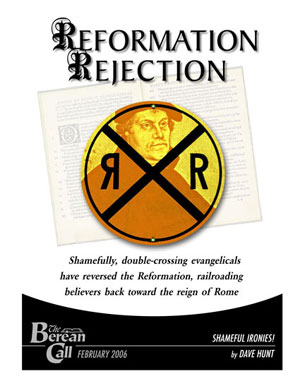
Most folks stopping by probably know the Reformation is usually remembered as an October event. Popular author Dave Hunt though has dedicated his entire Berean Call February Newsletter to the Reformation.

The Issue is entitled, Reformation Rejection: shamefully, double-crossing evangelicals have reversed the Reformation, railroading believers back toward the reign of Rome.

Hunt is surprisingly sympathetic to Luther in this article. He gives a quick overview of the causes of Reformation- basically getting his facts right- although at one point he refers to the “fifteenth-century Reformation” (it’s the sixteenth century Reformation Dave).

Dave rallies against Protestants who take part in “ecumenical compromise- like the 1999 joint declaration between Lutherans and Roman Catholics. Hunt asks: “How can those who profess to admire Luther and the Reformation defend Catholicism?

Dave Hunt passionately says:

Although the Roman Catholic Church no longer burns opponents at the stake (a practice now repugnant even to the secular world), it still maintains every false teaching and practice opposed by Luther and his fellow Reformers, thereby deceiving countless millions. It still teaches salvation through baptism, good works, and the other sacraments mediated by Mary as the “doorway to Christ”; it still offers indulgences at a price for release from purgatory to heaven; and it still rejects the final authority of Scripture! All of the anathemas pronounced by Trent against Protestant beliefs remain in full force and effect. Yet many of Luther’s modern followers now embrace Roman Catholicism as the true gospel!”

Martin Luther and the other Reformers would have died at the stake rather than sign such documents as JDDJ and ECT! How do we explain today’s denial of all that the Reformation stood for by those who claim to honor it and to follow in the faith of the Reformers?”

Hunt asks five good questions:

Though lip service is still given to the Reformation, the deep convictions that birthed it have been compromised. The hour grows late and the evangelical church desperately needs to face some honest questions:

1) What was the purpose of the Reformation?

2) Was its uncompromising affirmation of biblical truth appropriate in Luther’s day but not now?

3) What did it stand for at that time, at the cost of so many martyrs and so much suffering, that should now be denied?

4) Have Jesus Christ and His gospel changed?

5) Has any belief or practice changed in the Catholic Church that would justify evangelicals embracing Catholicism as the biblical gospel?”

Here’s the irony: I would love to ask Dave Hunt these same five questions. I think Hunt would do well to look at his own understanding of the Reformation- and ask himself if his theology isn’t itself a denial of the Reformation. This is what I mean: by Hunt’s denial of a key Reformation concept, he in effect denies the entirety of the Reformation.

In Luther’s closing remarks to Erasmus in his monumental work, The Bondage of the Will, Luther states:

I praise and commend you highly for this also, that unlike all the rest you alone have attacked the real issue, the essence of the matter in dispute, and have not wearied me with irrelevancies about the papacy, purgatory, indulgences, and such like trifles (for trifles they are rather than basic issues), with which almost everyone hitherto has gone hunting for me without success. You and you alone have seen the question on which everything hinges, and have aimed at the vital spot; for which I sincerely thank you, since I am only too glad to give as much attention to this subject as time and leisure permit.”

Source: LW 33:294.

What was the question on which the entire Reformation hinges? Was it indulgences, Purgatory, or good works? Was it Mary as “the doorway to Christ?” Luther say things like this are alienis, that is, extraneous- or trifles. The real issue was the freedom or bondage of the human will. Thomas Nettles sums it up this way:

If all hinges on something outside of man, immediately a controversy arises with reference to “the freedom and powers of the will.” If one has any ability to serve God acceptably, then he is not saved only by the merit of Christ but will attribute part to himself. Their “opponents”[of the Reformers] maintained, in spite of holding the doctrine of original sin, that “the powers of man are only weakened, not wholly depraved.” The grace of Christ, therefore, aiding him, the sinner has something “from himself which he is able to contribute.” The reformers maintained that the sinner “possesses no ability whatever to act aright.” These teachings called for an alteration of the Roman system from its roots; they made Luther at odds with the entire theological world.”
Source: Thomas J. Nettles, “Reformation and Revival” [Reformation and Revival Vol 1.2 28-29].

What is the hinge upon which the whole Reformation turned? It is the realization of the enslaved will- the total depravity of mankind. Luther came to realize the depravity of mankind and the beautiful grace of Christ that sets the enslaved sinner free from bondage. The will itself is in bondage to sin. It can do nothing God pleasing to merit salvation- not a work or positive inclination. It is dedicated to God-hatred until God sets it free. What does Dave Hunt think of the bondage of the human will?

Dave Hunt makes no hesitation in denying the bondage to sin of the human will- thus, at the most important point in Reformation doctrine, Hunt denies the Reformation. In his book, What Love Is This? Hunt launches into a lengthy section attacking Luther’s book, the Bondage of the Will. He states:

Luther boasts of his conclusion without giving any valid supporting arguments. He secures his thesis by his own mere definition, not by logic or Scripture. His assertions above do not follow. Nor does he provide sufficient biblical support in this entire work to make his case for the will being in bondage.”

Source: Dave Hunt, What Love is This? [Second edition] page 219.

Throughout Bondage, Luther is like a bully who will not listen to reason. Yet Packer and other Calvinists praise the “dialectical strength of Luther ’s powerful Latin.” B.B. Warfield calls Bondage “a dialectic and polemic masterpiece. In fact, Bondage contains so many contradictions and so much fallacious reasoning that one wonders how it obtained its reputation as such a logically drawn treatise.”

Source: Dave Hunt, What Love is This? [Second edition] page 227.

That the will —contrary to what Luther argues in his greatest treatise —is not bound is clear. We have already refuted the argument that, because the will is always beset with influences, that proves it is not free. Man, as Paul admits in his case (Romans 7:7-25), often fails to do what he would like to do —but not always. Paul doesn’t say that he never can do what he wills —much less that his will is in bondage.”

Source: Dave Hunt, What Love is This? [second edition] page 228.

Even though there would be major differences in the religious expression of Dave Hunt and Desiderius Erasmus, at the most fundamental point they are united against Luther. Roman Catholic and Evangelical Dispensationalist stand together in unity. While Hunt can rally against the Papacy, Purgatory or Mary, these are really nothing in comparison to the devastating effect of inserting free will into one’s theology. By doing so, Hunt has in effect turned faith into a meritorious work.

In his book Willing to Believe, R.C. Sproul points out that the Arminian position (someone like Dave Hunt holds) is really a return to the works righteousness of Rome:

Packer and Johnston note that later Reformed theology, however, condemned Arminianism as a betrayal of the Reformation and in principle as a return to Rome. They point out that Arminianism ‘in effect turned faith into a meritorious work.’ We notice that this charge is qualified by the words in effect. Usually Arminians deny that their faith is a meritorious work. If they were to insist that faith is a meritorious work, they would be explicitly denying justification by faith alone. The Arminian acknowledges that faith is something a person does. It is a work, though not a meritorious one. Is it a good work? Certainly it is not a bad work. It is good for a person to trust in Christ and in Christ alone for his or her salvation. Since God commands us to trust in Christ, when we do so we are obeying this command. But all Christians agree that faith is something we do. God does not do the believing for us. We also agree that our justification is by faith insofar as faith is the instrumental cause of our justification. All the Arminian wants and intends to assert is that man has the ability to exercise the instrumental cause of faith without first being regenerated. This position clearly negates sola gratia, but not necessarily sola fide.

Then why say that Arminianism “in effect” makes faith a meritorious work? Because the good response people make to the gospel becomes the ultimate determining factor in salvation. I often ask my Arminian friends why they are Christians and other people are not. They say it is because they believe in Christ while others do not. Then I inquire why they believe and others do not? “Is it because you are more righteous than the person who abides in unbelief?” They are quick to say no. “Is it because you are more intelligent?” Again the reply is negative. They say that God is gracious enough to offer salvation to all who believe and that one cannot be saved without that grace. But this grace is cooperative grace. Man in his fallen state must reach out and grasp this grace by an act of the will, which is free to accept or reject this grace. Some exercise the will rightly (or righteously), while others do not. When pressed on this point, the Arminian finds it difficult to escape the conclusion that ultimately his salvation rests on some righteous act of the will he has performed. He has “in effect” merited the merit of Christ, which differs only slightly from the view of Rome.”

If the Scriptures are correct on total depravity, then no such “work” of faith is possible- in other words- Hunt's concept of non-meritorious faith really is an empty, meaningless theological concept .OK, I know Arminians like Dave Hunt do not believe that placing faith in Christ is a work. But, if the Arminian theological paradigm allows man to do at least one good thing pleasing to God: believing on Christ- then a fallen man can do at least one good thing on his own- he has the ability to do something that merits grace. Goodbye Reformation- hello chaos.

In effect, Hunt denies the Reformation by his doctrine of free will- and makes possible things like ECT and JDDJ. Because of the virus of free will inserted into a theological system, all sorts of deviant theology can abound. In other words- theology like that put forth by Dave Hunt makes possible the gross heresies we find today rampant in evangelicalism. It's the common ground of free will Dave that theology like yours share with Roman Catholics and double crosses those of us dedicated to the Reformation.

Saturday, January 28, 2006

Spiritual Death and Ephesians 2:8-9 in Dialog

This is a continuation of my interaction with a blog participant on Ephesians 2:8-9 on subjects related to Calvinism. The focus of this will be on Ephesians 2:1-7.

Ray Says: “Remember the context of Eph 2:8-9! God is graciously offering a gift that is to be received by meritless (I'll justify use of this term shortly.) faith. In that sense, man brings nothing to the table. This is natural and normal language that has been used throughout the history of commerce in descriptions of barter and trade."

Swan Replies: The context of Ephesians 2:8-9 is Ephesians 1:1-2:7 and Ephesians 2:10-6:24. Pay particular attention to 1:1- 2:7. What one needs to do is approach these verses and ask: what do these verses teach about the abilities of man? Do these verses explicitly state what an unregenerate man is able to do? 1:12 speaks of “we, who were the first to hope in Christ”. Does this explicitly tell us that an unregenerate man has the ability to “hope in Christ”? No, it doesn’t. 1:13 says, “And you were included in Christ when you heard the word of truth, the gospel of your salvation. Having believed, you were marked in him with a seal…” Does this explicitly tell us that an unregenerate man has the ability to believe without God first doing something? No, all it tells us is that when a person savingly believes, they are saved. One needs to go to those sections of scripture that tell us what the abilites of unregenerate man are.

And then comes Paul’s bombshell: Ephesians 2:1-7
“And you were dead in your trespasses and sins, in which you formerly walked according to the course of this world, according to the prince of the power of the air, of the spirit that is now working in the sons of disobedience. Among them we too all formerly lived in the lusts of our flesh, indulging the desires of the flesh and of the mind, and were by nature children of wrath, even as the rest. But God, being rich in mercy, because of His great love with which He loved us, even when we were dead in our transgressions, made us alive together with Christ (by grace you have been saved), and raised us up with Him, and seated us with Him in the heavenly places in Christ Jesus, so that in the ages to come He might show the surpassing riches of His grace in kindness toward us in Christ Jesus.”

Here is an explicit truth: while we were dead in sins, God made us alive and raised us up with Christ. The picture is of spiritual death. Is there any description of merit-less faith that is the product of someone spiritually dead? No. I don’t find that type of language here in the context, at all.

Ray Says: “Let me illustrate. If two men are sitting at a table and discussing terms regarding an exchange of goods, and one offers the goods as a gift, a 3rd party observer would certainly not infer that inherent in this gift of goods was the ability of the receiver to believe and accept the goods as part of the gift. Quite the contrary, the receiver of the goods would have to recognize that there's value in what is being offered and that reception of the gift as a gift (no remuneration) is in his best interest.”

Swan Replies: Of course, there may never be a perfect analogy. In the one you provide above, certain paradigms have to first be in place in order for it to work with Ephesians 2. I offer you mine, which also carries inherent paradigms:

It's the old west. Two men are sitting at a table. One is doctor, very much alive; the other is cowboy, very much dead. His head is slumped down and his hat is barely staying on his head. The cowboy died from a deadly disease. The doctor has fixed an elixir that will heal him, free of charge. The cowboy only needs to reach out his hand and take this generous healing gift. The doctor offers it to him, but the cowboy just stays slumped in his chair…. because he’s dead. The doctor was told the cowboy had just died, so he throws him to the floor and begins beating his chest to jump-start his heart. After a few seconds, the cowboy appears to revive- the doctor quickly offers him the healing elixir: “I’m a doctor- take this it will cure your disease!” The cowboy quickly grabs the drink and slurps it down. But one more thing about this cowboy: he was a mean guy who had killed the doctor's family.

I find there to be nothing within the context of Ephesians 2:1-7 that suggests a spiritually dead man brings a spiritual-faith-ability to God in order to receive salvation. Rather, “Because of his great love for us, God who is rich in mercy, made us alive in Christ even when we were dead in transgressions- it is by grace you have been saved.” Now, note that earlier Paul says we were dead in our transgressions and sins- gratifying the cravings of our sinful nature and following its desires. But when God makes us spiritually alive, we follow new desires. My question to you is thus: If a spiritually dead man is able to put forth "merit-less faith," is this not following a Godly desire? How can this be squared with Ephesians 2:1-7? It can’t. It would be saying we were dead in our transgressions and sins- gratifying the cravings of our sinful nature and following its desires, except for our ability to produce a Godly desire to exert "merit-less faith." But Paul says differently. He says none of our desires are God-ward.

I agree that faith is “merit-less”- but I do so for a different reason than you. It is “merit-less” because it is a gift. Without it being a gift, it cannot really be “merit-less”. The term you use is fundamentally a return to Rome- because faith- in your usage, in effect, becomes a meritorious work.
I’ve always found this explanation from RC Sproul simple and useful:
Usually Arminians deny that their faith is a meritorious work. If they were to insist that faith is a meritorious work, they would be explicitly denying justification by faith alone. The Arminian acknowledges that faith is something a person does. It is a work, though not a meritorious one. Is it a good work? Certainly it is not a bad work. It is good for a person to trust in Christ and in Christ alone for his or her salvation. Since God commands us to trust in Christ, when we do so we are obeying this command. But all Christians agree that faith is something we do. God does not do the believing for us. We also agree that our justification is by faith insofar as faith is the instrumental cause of our justification. All the Arminian wants and intends to assert is that man has the ability to exercise the instrumental cause of faith without first being regenerated. This position clearly negates sola gratia, but not necessarily sola fide.
Then why say that Arminianism “in effect” makes faith a meritorious work? Because the good response people make to the gospel becomes the ultimate determining factor in salvation. I often ask my Arminian friends why they are Christians and other people are not. They say it is because they believe in Christ while others do not. Then I inquire why they believe and others do not? “Is it because you are more righteous than the person who abides in unbelief?” They are quick to say no. “Is it because you are more intelligent?” Again the reply is negative. They say that God is gracious enough to offer salvation to all who believe and that one cannot be saved without that grace. But this grace is cooperative grace. Man in his fallen state must reach out and grasp this grace by an act of the will, which is free to accept or reject this grace. Some exercise the will rightly (or righteously), while others do not. When pressed on this point, the Arminian finds it difficult to escape the conclusion that ultimately his salvation rests on some righteous act of the will he has performed. He has “in effect” merited the merit of Christ, which differs only slightly from the view of Rome."
Source: RC Sproul, Willing To Believe (Grand rapids: Baker Books, 1997), 26.

-continued-