Showing posts with label Luther Biographies. Show all posts

Friday, May 18, 2018

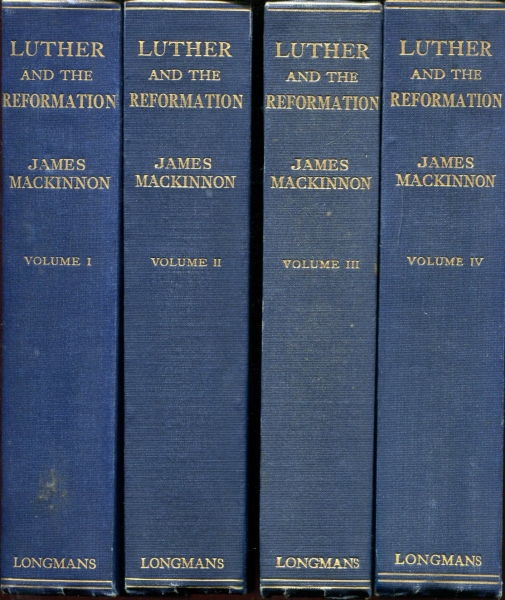
James MacKinnon: Luther and the Reformation


Here are pdf links to the four volume biography of Martin Luther from James MacKinnon.

Volume 1: Early Life and Religious Development to 1517

Volume 2: The Breach with Rome (1517-21)

Volume 3: Progress of the Movement (1521-29)

Volume 4: Vindication of the Movement (1530-46)

I found these volumes via this link. This set was one of the original biographies I used when I started researching the Reformation. I'm grateful someone has made them available online.  MacKinnon's work is valuable because he was fluent in understanding the Denifle / Grisar (Roman Catholic) distortion of Luther. These are good historical source volumes to have.

Monday, September 29, 2008

Did Luther REALLY Believe in God?

Most people don't realize the book, Martin Luther: The Christian Between God and Death by Richard Marius is very similar in title to Heiko Oberman's book, Luther: Man Between God and the Devil. The books are easy to confuse for those not paying attention. In the past, I've had people quote things to me from Oberman's book, only to go look it up, and find they meant the book by Marius!

Heiko Oberman evaluated Luther as a religious man with a deep belief in God, and in a daily battle with the Devil. Richard Marius though argues Luther was not the heroic God believer in a cosmic spiritual battle. Luther was a man who questioned whether or not God even exists, and was terrified of death. Below is from the preface of Marius' book, in which he clearly lays out his understanding of Luther:


Marius states:

Insofar as possible in writing about a man whose complications and contradictions were numerous and often baffling, I have tried to write a narrative history about both events and ideas. Others are writing now about the German and broader European societies that either accepted or rejected Luther's doctrines. But my interest remains fixed on the man himself, his acts, his character, and his temperament. The temperament is all-important.

Everyone who knows anything about Luther knows that he had doubts all his life. The traditional understanding is that he doubted that God could save a sinner such as himself. This reading long ago appeared simplistic to me, even when I found it eloquently stated in Roland H. Bainton's seminars at Yale and in his great biography. Here I Stand, the most popular book about Luther in the English-speaking world.

My own view is that Luther's doubts were far deeper, swept along by one
of the great recurring waves of skepticism in human history, doubts that God exists at all and that he can or will raise the dead. Luther was situated in the Renaissance, where chaos and order, justice and injustice, appearance and reality, darkness and light contended with each other to an uncertain end. For him faith and the most radical kind of doubt dwelt entwined together until the end of his days. His tragic meaning for Western civilization is that to him radical doubt was akin to blasphemy, a sin to be purged from the human heart by vehement assertion and hateful insult.

-snip-

Why did he not face the difficulties of scripture squarely and arrive at the irenic balance between faith and skepticism that characterized Erasmus? The ultimate answer, of course, is temperament, the mysterious and perplexing force that makes all of us unique and gives us our own niche in history. As Luther confessed time and again, his was a temperament driven by fear and by the need to conquer it so he could live day by day. His greatest terror, one that came on him periodically as a horror of darkness, was the fear of death—death in itself, not the terror of a burning and eternal hell awaiting the sinner in an afterlife. It is startling to see how seldom he speaks of hell as a place of eternal torment, and indeed he finally rejected the notion of hell as any sort of place. When he spoke of inferno in Latin or Holle in German, he usually meant the Hebrew sheol, which he correctly said meant simply the grave. When locked in combat with an especially galling foe, Luther could consign such a person to everlasting flames, but the more reflective Luther scarcely mentions hell. His ultimate question was this: Can I believe that God has the power to raise us from the dead? The corollary to this unanswerable, existential puzzle is another question: How does the Christian deal with the terror that death evokes while reaching for a faith that the triumph over death is possible? It seems to me that Luther's theology arose from these two elemental queries. He would shake the world to its foundations so he could believe in the resurrection of the dead.

Luther, who hated skepticism, was a skeptic in spite of himself, and his titanic wrestling with the dilemma of the desire for faith and the omnipresence of doubt and fear became an augury for the development of the religious consciousness of the West in modern times. Although few scholars seem to have contemplated the idea or studied Luther's works with that possibility in mind, this thesis, I believe, brings Luther closer to us, makes him more human, and explains if it does not excuse some of the more terrible words and deeds in his career.

It is interesting Marius stops his book at the year 1527 (but really ending around 1525), while Oberman's book looks at Luther's entire life until his death in 1546. This fact alone should make one question if the Luther put forth by Marius can support his presuppositions. I say it cannot.

Marius says his underlying presuppositions to his study on Luther is “essentially non-religious.” From this perspective, he begins with the notion that “Luther represents a catastrophe in the history of Western civilization.” And, “…[W]hatever good Luther did is not matched by the calamities that came because of him” (p. xii) (Marius also lays part of the blame on the Catholic Church as well). Because the Reformation led to wars between Catholics and Protestants, the loss of life was a grave calamity of the Reformation. Humanists are always concerned with preserving humanity, for humanity’s sake. Try applying Marius’s reasoning to Moses: The Jews would have been better off if they stayed in Egypt because they almost all died in the desert wilderness. The Jews that went into the Promised Land exterminated a large number of people. Moses should have been like Erasmus and sought to negotiate more conservatively with Pharaoh. Hence, whatever good Moses did is not matched by the calamities that came because of him… Or consider the early church: instead of giving their lives for their beliefs, they should have negotiated with the Roman government. They should have said, “we’ll bow to Caesar as god, but we don’t really mean it.” Countless lives could have been saved. Thus, whatever good the early church caused by not cooperating with the Roman government is not matched by the calamities they caused.

Thursday, September 25, 2008

Heiko Oberman: Luther is not fit to teach in today's universities

Over on the CARM discussion boards, a Roman Catholic has been posting rants about Luther's authority claims. I interacted recently with this person, but I must say, his posts have gotten progressively worse. The spirit of Cochlaeus is alive and well.

In the "authority" discussion, an excursion into Luther Psychohistory was added to the mix. It was stated:

"Let’s take a look at another Protestant “take” on Luther, his concept of his own authority AND his psychological “fitness”. Oberman considers what type of “position” Luther would “quality” for in today’s world."

Then a selection of quotes from Heiko Oberman's book, Luther: Man Between God and the Devil were posted. The argument: even a Protestant biographer of Luther didn't think Luther was "psychologically fit."I'd like to look at all the quotes at some point, but these, as posted caught my eye. They are a striking example of missing the broad context:

“he would not likely be offered a professorship (at the University of Wittenberg, now a part of the University of Halle), nor would it be any different in Heidelberg or Marburg…..He would be an indisputably successful teacher, but as a colleague he would be irksome and unwilling to bow to majorities…….He would be driven by singular notions about the Devil and the Last Judgment………..

He would be biting and sometimes overly rough toward colleagues with whom he disagreed. Where generalized judgments were concerned, he would outdo anyone, working himself up to furious tirades. He would rant against papists, Jews, lawyers, and high officials……………..

A psychiatric analysis would rob Luther of whatever chances he had left of teaching at a present-day university. The diagnosis would be persuasive – Paranoia reformatorica – but the grounds for it must remain irritatingly uncertain, ranging from neurosis to psychosis, from Oedipus complex to mother fixation. Fear of the Lord and abhorrence of the Devil are indicators of disturbed childhood development. And disturbing is what they really are…………….

Nevertheless, there is something to be learned from trying to imagine Luther as our contemporary because it is his personality and character that are at issue. Our anachronistic test is so illuminating because questions regarding his commitment cannot simply be shunted aside in an analysis of his person. The man and his cause are both intimately linked that any separation of the two will be at the expense of both. Even this speaks against offering Luther a professorship in our time, which prefers objective scholarship to a personal commitment and vision.” Oberman, pg 313-314


I tend to get very suspicious when I see frequent uses of "...". The following analysis of these quotes was provided by the Roman Catholic using Oberman's book:

"This is an interesting combination of comments from this Protestant writer. He admits that Luther had obvious psychological issues, and while he also admits that Luther’s problems would preclude the possibility of being allowed to teach in a modern university, he somehow fails to connect the dots in that he does not bring up the possibility that it could have been Luther’s psychological problems ALONE (solo psycho) that led to his certainty of his authority, and also hindered him from recognizing that he had no such authority whatsoever."

"In regards to the quote from Oberman about Luther’s psychological condition AND his supposed “fitness” to teach in one of today’s universities; Can you imagine a context either preceding or following that quote, or anywhere else in the book for that matter, that would somehow rehabilitate the impression that Oberman leaves us with in that quote? Do you think that there is something just prior to the quote I posted which says something like: “IF I wanted to smear Luther’s FINE name, I would say the following about this upstanding and emotionally healthy man: (My Oberman quote here)” Seriously, can think of ANY kind of text which would negate the quote that I posted? Short of reading the book, one cannot escape the conclusion that Oberman at least accurately portrayed HIS opinions on Luther and that after a great deal of study of the man."


It was asked above, "Can you imagine a context either preceding or following that quote, or anywhere else in the book for that matter, that would somehow rehabilitate the impression that Oberman leaves us with in that quote?" Well, yes, I can. The context is the particular perspective from which Oberman wrote this book. Oberman asked his readers to "...be prepared to leave behind our own view of life and the world: to cross centuries of confessional and intellectual conflict in order to become [Luther's] contemporary." That means, one must be prepared to find Satan very real and at work continually. Satan was busy attacking the individual Christian and the Church. Luther was a medieval man, not a product of the Enlightenment. The Devil was real, and it was the end of the world. Luther had a healthy fear of the hidden God- which drove his christocentric theology. Oberman therefore paints Luther as a man between God and the Devil: fighting the later, while clinging to Christ.

In the opening preface to the English edition, Oberman states:

The translation enterprise is as hazardous as it necessary; nuances are easily lost, especially when once vitally important existential expressions are rendered as antiquated parts of an absolute "belief-system." In the case of Martin Luther this problem is all the more acute, as his interpreters, intent on mining riches, have been given to present him as "relevant" and hence "modern." Thus they have been inclined to bypass or remove medieval "remnants"- first among these, the Devil Himself. This book has been written with the double assumption that, first, the Reformer can only be understood as a late medieval man for whom Satan is as real as God and mammon; and, second, that the relevancy so sought after is not found by purging the record and hence submitting to post-Enlightenment standards of modernity, but rather by challenging our condescending sense of having outgrown the dark myths of the past. (Oberman,xv)

In the preface to the first edition, Oberman states:

Discovering Luther the man demands more than scholarship can ever expect to offer. We must be prepared to leave behind our own view of life and the world: to cross centuries of confessional and intellectual conflict in order to become his contemporary. When the Church was still equated with Heaven, and the Emperor represented the might of the world, a monk named Luther rose up against these powers of Heaven and Earth: he stood alone with only God and his omnipresent adversary, the Devil. Surprisingly, the discoveries and experiences of a life marked by battle raging within and without make him a contemporary of our time, which has learned to sublimate the Devil and marginalize God. (p. ix).

The Roman Catholic posting the quotes completely missed that Oberman is not a psycho-historian. Therefore, Oberman's comments about Luther's psychological state evaluated by today's standards, must keep this presupposition in mind- he isn't siding with psychohistorical analysis, but rather demonstrating it cannot comprehend a 16th century medieval worldview.

Oberman states that psychological diagnoses of Luther's upbringing are subject to "changing scholarly trends" and are based on the "psychologizing mood of our times." He also shows the folly of using psychohistory via an interpretation of a letter from Freud, noting that psychohistory can make history "more difficult to hear what is actually being said."

From the way the Catholic cited Oberman, it makes it appear as though Oberman was a psychohistorian. Hardly! I thought it would be interesting to read the context the snippet quotes above came from:


Luther Today: A Test

Where would a man like Martin Luther fit in today? What kind of job would he be suited for?

Were there still a university in Wittenberg (it was merged with the University of Halle in 1815), he would not likely be offered a professorship there; nor would it be any different in Heidelberg or Marburg. It is the Erasmian type of ivory-tower academic that has gained international acceptance. If there were a chair somewhere, whether in Harvard or Holten, it would be futile to look for his name on the list of applicants—one must follow a call, be driven against one's will. Should he nonetheless be shortlisted by a department of religion, the problem would arise of what subject Luther should teach today. The professor of biblical theology would probably be best suited for the present-day field of practical theology.


But for that he would be too conservative and far too pious, as well as being too Catholic in approach and too strongly committed to the Middle Ages—in short, he would not be up-to-date. He would be an indisputably successful teacher, but as a colleague he would be irksome and unwilling to bow to majorities. The modern trend toward ecumenism would cause him particular problems because he would not be prepared to suppress those questions that divide Christians. He was driven by singular notions about the Devil and the Last Judgment. With respect to the Devil he had not yet experienced the Enlightenment and would seriously have to let himself be
asked this question: "What would he have done without the Devil, without the possibility of attributing the grotesque and embarrassing contradictions in his personal history to Evil personified?" How strange his answer would sound, that he would be even worse off without the Devil, for God, too, would then have become remote! Whether the discoveries of modern psychology would have changed his mind cannot be determined; he distrusted solutions that were "self-evident" and learned to see contradictions as proof of the proximity of truth.

He would certainly be an unpredictable ally in faculty politics. He might take an interest in curricular reforms, as he had in the autumn of 1517, and even present comprehensive plans that would be popular among the students who filled his lecture halls to the point of overflowing. But if, as in the summer of 1520, a great many of these students started fighting, as they had with journeymen painters, and caused a riot, he would preach publicly against them and even leave the meeting angrily when the rector and senate of the university tried to defend the students.


He would be biting and sometimes overly rough toward colleagues with whom he disagreed. Where generalized judgments were concerned, he would outdo anyone, working himself up to furious tirades. He would rant against papists, Jews, lawyers, and high officials because he felt all of them strangled human life with suffocating laws that undermine the common good. He would hardly have bowed to anything like a minister of education—he was not "politically reliable."


A psychiatric analysis would rob Luther of whatever chances he had left of teaching at a present-day university. The diagnosis would be persuasive—Paranoia reformatorica—but the grounds for it must remain irritatingly uncertain, ranging from neurosis to psychosis, from Oedipus complex to mother fixation. Fear of the Lord and abhorrence of the Devil are indicators of disturbed childhood development. And disturbing is what they really are.


Of course there is an objection to this conceptual experiment of attempting to hire the sixteenth-century Luther at a modern university: a "child of his time" cannot simply be transplanted to an era centuries later. The distance between the dawn of the modern age and the twentieth century is vast.Historically we are separated by the Enlightenment, politically by the American (1776), French (1789), and Russian (1918) revolutions, and socio-politically by the Industrial Revolution.

Nevertheless, there is something to be learned from trying to imagine Luther as our contemporary because it is his personality and character that are at issue. Our anachronistic test is so illuminating because questions regarding his commitment cannot simply be shunted aside in an analysis of his person. The man and his cause are so intimately linked that any separation of the two will be at the expense of both. Even this speaks against offering Luther a professorship in our time, which prefers objective scholarship to a personal commitment and vision.

Oberman isn't saying Luther had Paranoia, neurosis, psychosis, Oedipus complex and mother fixation, he's saying that the modern worldview cannot comprehend the medieval man. For the modern mind, Luther's fear of the Lord and belief in the Devil can only be translated into psychosis. The modern mind cannot account for an intense belief in the Devil or God- that's all Oberman is saying on pp. 313-314.

As to Oberman's views on Luther, after his section "Luther Today: A Test" he presents his interpretation of Luther's psyche:

Sickness unto Death

The Reformation movement cannot be separated from Luther the man, but it would also be incorrect to see it as the consequence of his exposure to psychic pressures: Luther might be able to accept a diagnosis of Paranoia reformatorica, since "Reformation madness" includes the foolishness that is an intrinsic part of faith. And it can scarely have been anything but this foolishness that enabled him to bear the burdens and pressures attendant on his role as a reformer—a role he did not want to play but which friend and foe alike forced upon the "Evangelist." One aspect of these burdens is particularly noteworthy. Luther's fear of God proved an overwhelming force before which human fears receded and lost their thrust. We can outline the range of this fear of God in five points:

Fear of the Lord is awe of the majesty of the Lord and fear of God's holy wrath: "If I could believe that God was not angry at me, I would stand on my head for joy."

Faith and fear of the Lord are not mutually exclusive, but faith lives on trust in God's mercy and not the knowledge of His majesty. The faithful creep under the cross of Christ like chicks under the wings of the mother hen.

God's wrath is not directed against man but against his lack of faith: faith is the obedience demanded by God.

The Reformation discovery did not leave the "wrath of God" and the "fear of God" behind as outdated medieval concepts.

Faith is not individual self-protection. The Evangelical movement should build a wall of faith to protect the people.


Modern day pyschology, when evaluating people who are extremely religious, think extremely religious people are crazy. That is, those who take their faith seriously must have deep psychosis. Now, apply this to what Oberman wrote in "Luther Today: a test." Luther, an extremely religious man, if evaluated by modern psychology, would arrive at a diagnosis of paranoia, neurosis, psychosis, Oedipus complex and mother fixation. The modern day psychologists will not think the real motivation of Luther's behavior was his faith in Jesus and fear of God, and battle with the Devil.

Oberman thinks Luther's behavior and life was motivated by his faith in Jesus and fear of God, and battle with the Devil, not paranoia, neurosis, psychosis, Oedipus complex and mother fixation.

Indeed, all of us that claim to believe in God with deep faith in His resurrected Son would get a negative evaluation from a secular psychologist! So, Oberman is arguing for Luther's genuine religious faith. That's why the context says something positive about Luther.

This explanation troubled Marius. That's why the Marius book had a very similar title to the Oberman book. Marius felt it was Luther's atheism and fear of death that motivated him, thus the title: Martin Luther: The Christian Between God and Death. The book by Marius was a DIRECT response to Oberman's book. Oberman and Marius were having a scholarly disagreement on what Luther was "between" so to speak.

The irony for me is a few years back I dialoged with Catholic apologist Art Sippo on psychological approaches to Luther, and Sippo blasted away at Oberman. This Roman Catholic though uses Oberman to prove Luther's psychosis.

Friday, June 16, 2006

Catholic Apologist Art Sippo on Roland Bainton's "Here I Stand"

"People like Mr. Swan attack me because I assert opinions that disagree with theirs. When I challenge them to defend their views, they are unable to do so and so they run away making excuses."- Catholic Apologist Art Sippo

Comments like the one above from Dr. Sippo are definitely "head scratchers". If anyone reading through my "discussion" (for lack of a better word) with Dr. Sippo can substantiate Sippo's assertion, i'd like to see it. For the most part, Sippo has ignored my comments. I write about 3 pages reviewing his comments, and then he responds in a few paragraphs ignoring what I wrote. This cycle has gone on now for a few weeks. My review of Roland Bainton's book Here I Stand followed this same cycle.

I assume those who are interested in finding a Luther biography really don’t want books written for scholars- they want easily readable and digestible material. Probably the most popular biography of Martin Luther written in English is Roland Bainton’s Here I Stand: A Life Of Martin Luther [New York: Mentor Books, 1950]. I always mention this book when asked for recommendations. The reason? The book is easy to find, it’s very affordable, and it’s historically reliable. It’s been in print for over 50 years now.

The book presents the basic “facts” about the 16th Century Reformation in non-technical terms. Bainton’s work is generally very reliable. A review states,“…Dr. Bainton displays masterful skill in writing a history of those times which is at once technically sound and singularly readable. In relatively few pages he has made those eventful timescome alive” for the lay reader of church history” [Westminster Theological Journal Volume 13 (Vol. 13, Page 167)].

One knows if they utilize his book as a historical reference, one is not getting “hearsay” or speculative psychological interpretations. One is getting the facts from a man who spent his academic career keenly focused on Luther’s writings. A review from 1950 states, “Dr. Bainton, who holds the Titus Street Professorship of Ecclesiastical History in the Yale Divinity School, is one of the foremost Reformation scholars in this country—a fact which in itself lends considerable worth to this work”[Westminster Theological Journal Volume 13 (Vol. 13, Page 164)]. It should be pointed out, Here I Stand is not a book very interested in expositions on Luther’s theology. Primarily, the book is a historical analysis, and a simple one at that.

Catholic apologist Art Sippo though does not recommend this book:

Bainton is also a convinced Protestant who lacks balance in his study of the Deformation. He acts as if there was nothing wrong with Luther and that it was the Catholic Church which was at fault. His book is definitely not recommended.”

Granted, Roland Bainton is a “convinced Protestant”, but this doesn’t diminish the accuracy of the presentation. Even a scholar that Dr. Sippo recommends positively utilizes the book. For instance, Dr. Sippo strongly recommends the work of Richard Marius on Luther. If one picks up his book, Luther: The Christian Between God And Death, Marius utilizes Bainton’s Here I Stand, as well as other of his writings. In most instances, Marius uses the book in the same way I do: simply a ready guide for the “facts.” If the books shouldn’t be used because it was written by a “convinced Protestant”, Sippo needs to explain why Marius used it, and if the writings of Marius can still be trusted.

Sippo also says Bainton “acts as if there was nothing wrong with Luther…”. Granted, Bainton is sympathetic to Luther, and this has been a criticism of his work over the years. Interestingly, another Catholic apologist has used Bainton’s book to prove many of the negative characteristics of Luther that Sippo so gravitates to. One would think that if Bainton’s book “acts as if there was nothing wrong with Luther…” this other apologist wouldn’t be able to use it to build a case. (See the review of Roland Bainton and Luther here).

What one finds in Bainton’s book is a head on interaction with some of the hot issues surrounding his life. Bainton says, “There are several incidents over which one would rather draw the veil, but precisely because they are so often exploited to his discredit they are not to be left unrecorded” [Here I Stand, 292]. Bainton takes on issues: like Luther’s later coarseness in his writings, his usage of Cranach’s paintings, his railings against the Jews, the bigamy of Phillip of Hesse, to name a few. Bainton though provides an apologetic in evaluating these issues. This isn’t acting as if nothings wrong with Luther- this is an evaluation of the facts surrounding the “hot” issues and putting them in perspective. If Dr. Sippo disagrees, he should be willing to get himself a copy of Here I Stand and be ready to counter argue against Bainton’s explanations. I would never argue that Bainton is an infallible interpreter of Luther’s life, but I would say his apologetic is sound in most instances.

Dr. Sippo also states that Bainton writes as if “…it was the Catholic Church which was at fault…” in the Reformation controversy. What Bainton does in Here I Stand in present the facts going on at the time of the Reformation. One reads the deliberate subterfuge of the Roman Catholic hierarchy. One sees how the Papacy was motivated by its desire to continue gaining funds for its building project. Discussion would have probably helped the situation, but Luther came up against a “bulwark” of Roman power that basically said, “our way or the highway”.

Bainton recalls the basic “facts” of the situation: The Pope sent one of his best theologians to demand Luther to recant his position on indulgences: Cardinal Cajetan. Luther refused. The Cardinal was well versed in Roman Catholic doctrine, and realized quickly the dilemma the Pope had: there was no adequate foundation to condemn Luther as a heretic. Why? Because there was not an official teaching on indulgences when Luther posted the 95 Theses. There was no official doctrine as to the effect of the indulgence upon Purgatory. So Cajetan knew that in order to put Luther down as a heretic, he must first be declared one according to some sort of doctrinal standard. Cajetan quickly drafted a declaration of dogma on the subject of indulgences. Pope Leo X found this to be a good idea. Thus came the decretal Cum postquam. The dogma of indulgences was defined as Cajetan outlined them. The Pope also threatened any of his representatives that may have held a divergent view on the subject.

Sippo concludes of Bainton, “…His book is definitely not recommended.” Of course Art Sippo would never recommend Here I Stand. The book has a noticeable absence of psychohistory (a.k.a. “guessing”)… and by the way, Bainton elsewhere wrote a devastating critique of Erik Erikson’s Young Man Luther.

Here I Stand is a basic presentation of the facts surrounding Luther’s life. The book should be read by Catholics- if for just the reason to have an accurate account of the Luther situation. Balance this with Catholic biographies of Luther, like John Todd, Jared Wicks, or George Tavard. All I’m asking is that Catholics at least be willing to read the works by Protestants. I frequently read Catholic produced material. It doesn’t hurt to have perspective. Take the time to understand where your opponent is coming from.

I know where Dr. Sippo is coming from in his opinion on Luther and Luther biographies. This is why he so wants to move away from a discussion of sources. It puts the spotlight on why he believes what he believes about the Reformation. This spotlight shows a bias that produces hostility. It shows why we could never discuss the actual facts about Luther in a cordial way.