Showing posts with label Scott Hahn. Show all posts

Thursday, December 13, 2012

A simple but helpful diagram


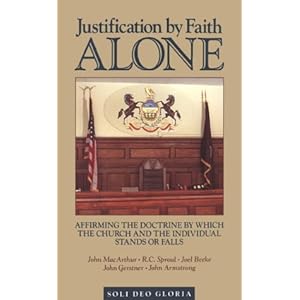
John Gertsner, in an appendix ("Rome NOT Home: A Response to Scott and Kimberly Hahn's Rome Sweet Home"),  in the excellent book, Justification by Faith Alone, edited by Don Kistler, on pages 172-173, has a very helpful but simple diagram that lets us see the issue of the doctrine of justification by faith alone clearly.

The book has good chapters by John McArthur, R. C. Sproul, Joel Beeke, John Gertsner, and John Armstrong.


1.  Biblical/Protestant View:

Faith  =  Justification + works


2.  Roman Catholic View:

Faith + works  =  Justification


3.  Antinomian / Easy Believe -ism View  (what Trent and RCC mis-understood and thought Luther and Reformers were saying)

Faith  =   Justification  - works

(Note: in the book, the diagrams have arrows, but I could not figure out how to make arrows, so I had to use the equal (=) sign.)  The arrow seems to communicate, "leads to".  So true faith in Christ alone for salvation leads to justification, resulting also in good works.  And the Roman Catholic view is that one must have faith as an adult, and that includes that one must believe in the 1854, 1870, and 1950 dogmas, since they are "de fide" (part of the doctrines of the faith that one must believe .  If one is an infant with RC parents, one must be baptized as a baby and that is called "initial justification", but that can be lost, so there must be good works of penance, indulgences, confession to the priest, giving alms, being a good Roman Catholic, going to mass, etc. and keeping it up and loosing it and gaining it back (the treadmill of sacramentalism) until, maybe, Lord willing, one dies in a "state of grace", but even then, every R.C.  has to go through Purgatory, since nobody is sinless.  No R.C. ever knows if he is justified or not or if they can have peace or assurance of his/her salvation.  According to one article I read a while back, Cardinal Robert Bellarmine and other RCs since Trent have said that the greatest Protestant heresy was "assurance"!!  The Antinomian view means that faith leads to justification with no works or fruit as a necessary result. John McArthur's 2 books, The Gospel according to Jesus and  The Gospel according to the apostles  (originally it was titled, "Faith Works:  The Gospel according to the Apostles") are two excellent works that refute the antinomian or "easy believism" view.

Saturday, March 10, 2012

Did Luther Believe Faith is the Gift of God?

I recently came across a Roman Catholic challenging the idea that Martin Luther believed faith was God's gift:

"Another thing... about Luther's idea of faith that I learned from listening to a Scott Hahn interview. His idea of faith is that it comes from oneself, that we bring our own faith to the table and God justifies us based on that."

He explained this Hahn interview was something purchased from Catholic Answers entitled, "Faith Alone Is it Justifiable." I did a quick search of Catholic Answers and came up with nothing. It appears to be a three-part interview from July 1998 no longer offered. Even though I wasn't able to track down the Hahn interview, the person making the assertion on Luther-according-to-Hahn was kind enough to actually transcribe the section from the Scott Hahn interview in question (part one, part two).

Hahn's Lutherans vs. Calvinists
If the transcription is accurate, Hahn appears to be saying more about how the Lutheran and Calvinist traditions understand the nature of faith differently rather than Luther specifically:
The Lutheran view of faith alone is that the word ‘sola’ or 'alone' is an adjective that modifies the word faith, so that you are justified by faith and faith by itself. The Calvinists view of 'alone' is different. Sola fide for the Calvinists is an adverb that modifies the word ‘justify’. So the Calvinist would say you are not justified by a faith that is alone rather you are only justified by faith... For the Lutherans our faith is what justifies us but our faith is what we ourselves contribute on our own power. The Calvinist say, oh no, you can't generate on your own a faith that would justify. God has to regenerate you first. He has to send his Spirit down to you. He has to recreate you in order for you to exercise any faith that would possibly justify you. The Lutheran would say, oh no, you can't say that God has to regenerate you or recreate you in order for you to exercise any faith that God would justify you with because once you say that that you've allowed the Catholic position back in through the back door. Because what you are in effect saying is that God only justifies the person he transforms and makes righteous and godly. So the Lutherans accused the Calvinists of kicking out the front door what they are bringing back through the back door.
I have to admit never having studied the differences on "faith alone" between Lutherans and Calvinists that Hahn refers to. If such a controversy between the two traditions has played out, I don't recall reading about it. I will say this though, as far as I understand historic Lutheranism via my Reformed sources, regeneration is monergistic ("On the whole the Lutherans maintain, in opposition to Rome, the monergistic character of regeneration. They regard man as entirely passive in regeneration and incapable of contributing anything to it, though adults can resist it for a long time" (Louis Berkhoff, Systematic Theology, p. 477).

Included in the Book of Concord is Luther's Small Catechism. There it states,
I believe that I cannot by my own reason or strength believe in Jesus Christ, my Lord, or come to Him; but the Holy Ghost has called me by the Gospel, enlightened me with His gifts, sanctified and kept me in the true faith; even as He calls, gathers, enlightens, and sanctifies the whole Christian Church on earth, and keeps it with Jesus Christ in the one true faith; in which Christian Church He forgives daily and richly all sins to me and all believers, and at the last day will raise up me and all the dead, and will give to me and to all believers in Christ everlasting life. This is most certainly true.
Luther and the Gift of Faith
The phrase "gift of faith" is peppered throughout Luther's writings. It certainly isn't given the emphasis later Reformed writers would give it.  Calvin's writings are a bit similar, provoking some to question whether or not Calvin believed faith was God's gift.

Here are a few specific instances from Luther on the gift of faith. The first  is an implicit example from Luther's Small Catechism. In regard to the regenerating work of the Holy Spirit, Question 161 asks, "Why do you say that the Holy Spirit has done this by the Gospel?" Answer: "The Gospel is the means by which the Holy Spirit offers us all the blessings of Christ and creates faith in us." Question 162 asks, "Besides faith, what else does the Holy Spirit create in you by the Gospel?" Answer: The Holy Spirit sanctifies me in the true faith, that is, by faith He works renewal of my whole life- in spirit, will, attitude, and desire- so that I now strive to overcome sin and do good works (sanctification in the narrow sense).

The second is an explicit example. In his sermon on The Feast of the Presentation of the Infant Christ at the Temple (Luke 2), Luther explains  what "first born" means. He says there are "two kinds of first born." The first birth refers to mankind being born in sin and unbelief through Adam. Of the second "first birth" Luther states,
The second type of first birth is faith which we attribute to God. It is the chief constituent of the whole Christian nature. Faith puts to death the old man. It makes new children which henceforth bring thoughts and goals in accordance with God's. This first birth is God's blessing and His own work. No one should take it upon himself, that is no one should understand faith as coming out of his own powers as many do. When they hear of faith they consider it as something they receive by an act of their own will. In this way they credit themselves with what alone belongs to God since it is purely a divine work to have true faith. As Saint Paul says to the Ephesians [Ephesians 2], 'By grace you have been saved through faith, and that not of yourselves. It is God's gift, not of works, so that no one can boast [The Festival Sermons of Martin Luther (Michigan: Mark V Publications, 2005), p. 238].
Conclusion
I don't have any notion to turn Luther into a Calvinist.

If there are differences as to what Luther meant by faith being God's gift as opposed to what the Reformed tradition holds, I don't recall reading anything on this, and would welcome any tips on relevant sources. If there are differences between what  Luther held as compared to subsequent Lutheranism, I'm not knowledgeable in that area, and likewise would welcome any pertinent materials.  I would assume Scott Hahn wasn't making up his exposition on the differences between Lutherans and Calvinists on the nature of faith. It smells of some sort of 19th or early 20th century technical dispute. Likewise, I'd be interested in seeing any supporting information on Hahn's comments.

I can't see how Hahn is correct when he states, "For the Lutherans our faith is what justifies us but our faith is what we ourselves contribute on our own power." There are a few possibilities. Perhaps he simply mis-spoke during the interview. Perhaps he clarified what he meant later. Perhaps the transcription is inaccurate.  Or, perhaps he's referring to a technical dispute that I'm not aware of, or maybe... he's just wrong.