

Recently I came upon this quote from Augustine:
Among these [apostles] Peter alone almost everywhere deserved to represent the whole Church. Because of that representation of the Church, which only he bore, he deserved to hear “I will give to you the keys of the kingdom of heaven” (Sermons 295:2 [A.D. 411]
This quote was the first in a cumulative case meant to establish the historical pedigree of the modern Roman Catholic papacy. Out of curiosity, I did a cursory search to see the quote in context. what I discovered was that it did not establish the historical pedigree of the modern Roman Catholic papacy.
Documentation
The reference provided was "Sermons 295:2 [A.D. 411]." This is a typical Roman Catholic sort of vague reference I'm used to dealing with in regard to Luther quotes. If you search out this reference and English wordage, it becomes apparent it's a popular cut-and-paste. Here's the exact quote form a 2002 This Rock Magazine. This 1983 book uses the same English wording, minus "[apostles]." This 1957 book uses the quote adding the word the word, "shone": "Among these Peter shone almost everywhere deserved to represent the whole Church..." The author gives the reference, "Sermo 295, 2, 2-4, 4 (PL 38, 1349-50), tr. by Giles, op. cit, doc. 155, p. 176." If this is correct, the person who originally did the English translation was E. Giles, Documents Illustrating Papal Authority found on page 176. Someone, therefore, took this English version of Augustine, placed it online, and it's multiplied ever since.
The actual complete "Sermon 295" isn't all the hard to track down. Here is a PDF of the entire, The Works of Saint Augustine, A Translation for the 21st Century, Sermons III/8
(273-305A)
on the Saints.
The sermon can be found beginning on page 197. It's a sermon on "the martyrdoms of the most blessed
apostles Peter and Paul." The date "411" isn't set in stone. According to the translation utilized below, it was sometime between 405 - 411.
Context
Peter, Rocky, from rock, not rock from Rocky. Peter comes from petra, rock, in exactly the same way as Christian comes from Christ. Do you want to know what rock Peter is called after? Listen to Paul: I would not have you ignorant, brothers, the apostle of Christ says; I would not have you ignorant, brothers, that our fathers were all under the cloud, and all passed through the sea, and all were baptized in Moses in the cloud and in the sea, and all ate the same spiritual food, and all drank the same spiritual drink. For they drank from the rock that was following them, and the rock was Christ (1 Cor 10:1-4). There you have where Rocky, Peter, is from.
2. Before his passion the Lord Jesus, as you know, chose those disciples of his, whom he called apostles. Among these it was only Peter who almost everywhere was given the privilege of representing the whole Church.2 It was in the person of the whole Church, which he alone represented, that he was privileged to hear, To you will I give the keys of the kingdom of heaven (Mt 16: 19). After all, it isn't just one man that received these keys, but the Church in its unity. So this is the reason for Peter's acknowledged pre-eminence, that he stood for the Church's universality and unity, when he was told, To you I am entrusting, what has in fact been entrusted to all.
I mean, to show you that it is the Church which has received the keys of the kingdom of heaven, listen to what the Lord says in another place to all his apostles: Receive the Holy Spirit; and straightaway, Whose sins you forgive, they will be forgiven them; whose sins you retain, they will be retained (Jn 20:22-23). This refers to the keys, about which it is said, whatever you loose on earth shall be loosed in heaven, and whatever you bind on earth shall be bound in heaven (Mt 16: 19). But that was said to Peter. To show you that Peter at that time stood for the universal Church, listen to what is said to him,3 what is said to all the faithful, the saints:4 If your brother sins against you, correct him between you and himself alone. If he does not listen to you, bring with you one or two; for it is written, By the mouth of two or three witnesses shall every matter be settled. If he does not even listen to them, refer him to the Church; if he does not even listen to her, let him be to you as a heathen and a tax collector. Amen amen I tell you, that whatever you bind on earth shall be bound in heaven, and whatever you loose on earth shall be loosed in heaven (Mt 18:15-18). It is the dove5 that binds, the dove that looses, the building built upon the rock that binds and looses.
Let those who are bound fear, those who are loosed fear. Let those who are loosed be afraid of being bound; those who are bound pray to be loosed. Each one is tied up in the threads of his own sins (Prv 5:22). And apart from the Church, nothing is loosed. One four days dead is told, Lazarus, come forth in the open (Jn 1 1:43), and he came forth from the tomb tied hand and foot with bandages. The Lord rouses him, so that the dead man may come forth from the tomb; this means he touches the heart, so that the confession of sin may come out in the open. But that's not enough, he's still bound. So after Lazarus had come out of the tomb, the Lord turned to his disciples, whom he had told, Whatever you bind on earth shall be bound in heaven, and said, Loose him, and let him go (Jn 11:44). He roused him by himself, he loosed him through the disciples.
Notes
2. "Almost everywhere," perhaps, because Augustine would sometimes like to think of John,
for example, as representing the Church, not to mention all sorts of other New Testament characters,
who were not apostles, like the Canaanite woman, or the woman who suffered from the issue of
blood.
3. He has in mind here Christ's answer to Peter's question which follows immediately on this
passage, Mt 18:21. The answer was the parable of the unforgiving servant.
4. "Faithful" and "saints" are treated as interchangeable terms, on the model of Paul's usage.
See, for example, Rom 1:7, 1 Cor 1:2, 2 Cor 1:1, Phil 1:1, etc.
5. A name for the Church, derived from the Song of Songs, 2:14, etc.
Early on in the sermon Augustine says that the "rock" is Peter's confession "you are the Christ, the Son of the living God." and then quoting 1 Cor. 10:1-4 that the "rock" was Christ. Then Augustine does go on to say that Peter represented the whole church, but then says it wasn't just Peter that received the keys, but the that the keys had been entrusted to the whole church. That is, when Peter gets the keys, it's like saying the whole church gets the keys. Then Augustine explicitly connects "keys" "to all the apostles" quoting John 20:22-23. At 295:4, Augustine applies "feed my sheep" of John 21, saying it is the church that is to feed.
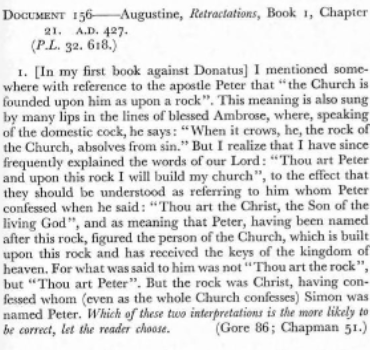
One interesting tidbit is that the English source this quote was taken from goes on to say, "Actually Augustine usually maintained that by the 'rock', in Matt. 16.18, our Lord was referring to himself... I believe the only known instance of his referring the 'rock' to Peter is in the next document." That "next document" states:
Conclusion
Frankly, there wasn't anything in the sermon I would necessarily quibble about in regard to Peter. The sermon itself was given to commemorate the martyrdoms of Peter and Paul, so that exuberant comments put forth are not surprising. The specific thing I looked for when I read the sermon was anything explicit from Augustine indicating Peter was "the rock" the church was founded on, that Peter had been given charism of infallibility, that papal succession over the universal church began with Peter, etc. I didn't find any of these concepts in the sermon. Certainly, Augustine notes Peter's preeminence in the Biblical record ("first among the apostles"), but this does substantiate the modern Roman Catholic historical papal claims. Perhaps knee-jerk Protestants think that Peter was just some guy among the myriad of first century Christians, but I do recognize that Peter was a main and important apostle. That's much different though than reading an infallible papacy back into the historical record!Early on in the sermon Augustine says that the "rock" is Peter's confession "you are the Christ, the Son of the living God." and then quoting 1 Cor. 10:1-4 that the "rock" was Christ. Then Augustine does go on to say that Peter represented the whole church, but then says it wasn't just Peter that received the keys, but the that the keys had been entrusted to the whole church. That is, when Peter gets the keys, it's like saying the whole church gets the keys. Then Augustine explicitly connects "keys" "to all the apostles" quoting John 20:22-23. At 295:4, Augustine applies "feed my sheep" of John 21, saying it is the church that is to feed.


 Posts
Posts


