Showing posts with label Dave Hunt. Show all posts

Wednesday, November 21, 2012

Dave Hunt Update

Some years back, an Arminian friend signed me up to Dave Hunt's Berean Call newsletter. This was actually back before Hunt had actually learned Reformed theology by osmosis overnight. Even before Mr. Hunt became an expert on Calvinism, I was never much of a fan of his work, even his work on Roman Catholicism (although, if I recall, He actually won this Roman Catholic debate because his opponent didn't even seem to know it was supposed to be a debate: mp3 link) .

That being said, I've got nothing personal against the man. I still get the Berean Call faithfully every month. Dave no longer writes actively for the newsletter, and hasn't for quite a while. In fact, I don't think he's able to write at all. The recent Berean Call explains:
As most of you know, Dave Hunt had his 86th birthday in September. He is presently in a nursing care facility here in Bend, Oregon. Some months ago, Dave had a stroke, and though his vital signs are good, the Lord’s warrior and watchman is no longer “standing on the wall” or able to swing the “sword of the Spirit” as he once did. Ruth spends half of her 24-hour days ministering to her champion, a challenging care-giving task that she assumes with joy. Please continue to pray for Dave and Ruth as they see the Lord using them in new and different ways that are certainly no less fruitful as they glorify Him daily. Pray also for their children as they have the opportunity to minister to their parents as never before. The wonderful thing about knowing the Lord is that whether He provides the opportunity for us to minister to others, or we become the opportunity for others to minister to us, spiritual fruit is produced and God is glorified.

Wednesday, December 15, 2010

A Woman Rides The Beast


"The reason started when James Swan posted his remarks on this thread about Dave Hunt. I google a search to see why Swan didn't like Hunt and I guess is because they disagree on some theological points. I just don't like it when people post insults/opinions without presenting all the facts why that person is wrong." [source]

"I did a google search to see why Swan had a problem with Hunt and you are right. It has to do with the whole Calvinist debates with Hunt. That explains why the potshot at Hunt." [source]

What provoked this? someone was recommending Jack Chick's web site and Dave Hunt's A Woman Rides The Beast over on the CARM boards. Thus ensued "I have it, great book" versus "I have it, terrible book" saga. I had simply stated, "I have spent a number of years defending the Gospel and the Scriptures against Romanism. I would not endorse any work against Romanism by either Mr. Chick or Dave Hunt." I had forgotten about this thread and my comment until a Private message alerted me to visit this now ten page discussion. Re-entering the arena, I stated:

I was raised on Chick tracts. Somewhere in my house, I probably have a few of them still laying around. I'm quite sure I still have the Alberto comic books somewhere. As a young 1970's kid, there was a lot of speculation and talk about the soon-to-be end of the world. The signs were all in place. Armageddon was coming...because Israel was now a nation again and "this generation will not pass away... etc." 1980 was quickly approaching! Get ready for the rapture! The Chick tracts back then put all the signs together in a helpful comic book form for young minds to easily digest. Not to mention the fact that the Jesuits had secretly infiltrated the evangelical church.... according to Mr. Chick's publications. Scary stuff. But then in the mid 1980's (if I recall), Cornerstone Magazine completely destroyed the Alberto story. Well, the 1980's came and went. Israel is still a nation, and the generation is quickly passing away, and, well all the "forty years" stuff was just wrong.

In the 1980's Dave Hunt became a popular Christian author with his Seduction of Christianity (and follow up books). I have a number of his books, and in fact, his newsletter came in the mail today. ("Born That Man No More Die" (12/10). He likewise reads the signs of the times. Yes, I've been through his "A Woman Rides the Beast." I'll even admit to seeing the movie version he released.

Those of you who know a bit about the subjects I enjoy know of my Martin Luther related studies. Luther was convinced it was the end of the world and of Rome's role in the coming apocalypse. Well, he was wrong. Here we are, hundreds of years later. He expected the end within a few decades from the 1540's.

I don't follow the approach that Roman Catholicism is in error and dangerous because of prophecy and apocalyptic literature. Those who attempt to refute Roman Catholicism by interpreting the book of Revelation are simply setting themselves up for embarrassment.

I don't think everything Mr. Hunt puts forth is in error. However, his apologetic material is dipped in prophetical interpretation. In my opinion, this is not a wise method. I've studied enough of the history of prophecy and Dispensationalism to understand those who do this have to continually read the signs of the times, and then readjust their apologetics.

Rome is indeed in error, and can be demonstrated to be so over the central issues of authority and the Gospel. This is where the battle lies. I can recommend a number of helpful resources that don't have to continually reevaluate the signs of the times.. and then put forth "shock" type of stuff.

Here are a few books currently on my desk:

James White, The Roman Catholic Controversy (Minnesota: Bethany House, 1996)

James White, Scripture Alone (Minnesota: Bethany House, 2004)

James White, The God Who Justifies (Minnesota: Bethany House, 2001)

David King & William Webster, Holy Scripture The Ground and Pillar of Our Faith, (three volumes) (Battle Ground: Christian Resources, 2001)

Eric Svendsen, Evangelical Answers, A Critique of Current Roman Catholic Apologists (New York: Reformation Press, 1999).

Eric Svendsen, Upon This Slippery Rock: Countering Roman Catholic Claims to Authority (Amityville, NY: Calvary Press, 2002)

Eric Svendsen, Who is My Mother? The Role and Status of the Mother of Jesus in the New Testament and Roman Catholicism (Amityville, NY: Calvary Press, 2001)

Eric Svendsen is not a "5 point Calvinist," so so much for my alleged bias against non-Calvinists. Also, Mr. Hunt made some good points in his Seduction of Christianity book. I read it, and own it. [That is, Dave Hunt isn't completely wrong on everything].

For those Protestants that have an interest in Roman Catholicism, take a look at your methodology. Are you defending the gospel, or are you speculating about which woman is riding the beast? Don't ignore the central truths of the faith to irritate your Roman Catholic acquaintances with speculative prophecy. Stick with defending the authority of scripture and the perfect righteousness of Christ. These issues don't require reading a newspaper in one hand, and the Bible in the other. They require reading a Bible with both your hands, and all of your mind.

Then came the following dialog:

Well, I endorse Dave's book. Many of the reviews reflect my own opinions that his book is well referenced. His book is where I learned about the Vatican Bank Claims. I followed the book's references to learn more about this history through the Orthodox websites. Years ago when I was Catholic I remember hearing about this in the news but then I didn't pay attention to it all that much. So it was interesting to go back and research it for myself to discover the Vatican's involvment in this criminal act during 1930-40's. His book addresses the dark role of the Roman Church down through the centuries up til the last century.[source]

Once again, I don't think everything Mr. Hunt puts forth is in error. But, he often misses the battle. The battle is over the Gospel & Scriptures. I could care less about Rome's bank accounts.

You are right the battle is over the Gospel and Scriptures. Hunt is exposing the darkside of what Roman Catholicism truly is. That needs to be known too. If you truly knew what the Vatican Bank Claims were about you wouldn't have made the flip comment "I could care less". Thousands of innocent men, women, children died at the hands of Franscican priests and even nuns because they were Orthodox Christians who wouldn't convert. The victims were brutally slaughtered even for their gold teeth. The money was sent to the Vatican. [source]

What you consider a "flip comment" actually has reasoning behind it.In terms of argumentation and apologetics, I really don't care about Rome's bank accounts. While it might be interesting and correct information, I try to completely throw out this type of stuff in discussion with Roman Catholics. Here's why: let's say you present all this information about how bad Rome's papacy is, in terms of moral behavior. Your Roman Catholic opponent (for lack of a better word) could respond by presenting information about corrupt churches or behavior in Protestantism.Try to keep this rule keep in mind: if you use an argument and it works against your own position when applied to your own position, the argument is not valid. Once again, stick with the real battle: Gospel, Scripture, and authority.

I try to do that too. Howeverl Catholics have their own interpretation of the Gospel and Scriptures plus their authority is "the Church" they will not reason with non-Catholics on Scriptures either. It also doesn't hurt to read books like Hunt's to get the background history of Roman Catholicism and the papacy. I've learned stuff I never knew about before about my former religion. [source]

Never under estimate the power of the word of God. "Faith comes by hearing, and hearing by the word of God" (Romans 10:17). The books I mentioned earlier will provide you with a number of ways of dialoging with Roman Catholics over the Gospel, the Scriptures, and authority. Indeed, reading historical treatments of any subject is worthwhile. I tend to read historical treatments from both Protestant and Roman Catholic authors. No historical treatment is perfect, and if Roman Catholics have done research on Mr. Hunt's materials, we should listen to what they say, honestly evaluate their criticisms, and then take or give correction graciously.

Sunday, February 26, 2006

Dave Hunt Celebrates The Reformation in February


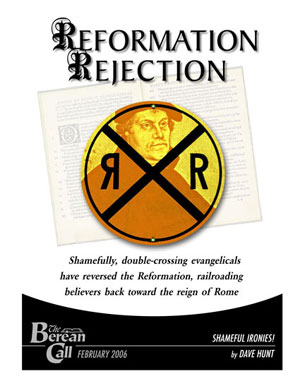
Most folks stopping by probably know the Reformation is usually remembered as an October event. Popular author Dave Hunt though has dedicated his entire Berean Call February Newsletter to the Reformation.

The Issue is entitled, Reformation Rejection: shamefully, double-crossing evangelicals have reversed the Reformation, railroading believers back toward the reign of Rome.

Hunt is surprisingly sympathetic to Luther in this article. He gives a quick overview of the causes of Reformation- basically getting his facts right- although at one point he refers to the “fifteenth-century Reformation” (it’s the sixteenth century Reformation Dave).

Dave rallies against Protestants who take part in “ecumenical compromise- like the 1999 joint declaration between Lutherans and Roman Catholics. Hunt asks: “How can those who profess to admire Luther and the Reformation defend Catholicism?

Dave Hunt passionately says:

Although the Roman Catholic Church no longer burns opponents at the stake (a practice now repugnant even to the secular world), it still maintains every false teaching and practice opposed by Luther and his fellow Reformers, thereby deceiving countless millions. It still teaches salvation through baptism, good works, and the other sacraments mediated by Mary as the “doorway to Christ”; it still offers indulgences at a price for release from purgatory to heaven; and it still rejects the final authority of Scripture! All of the anathemas pronounced by Trent against Protestant beliefs remain in full force and effect. Yet many of Luther’s modern followers now embrace Roman Catholicism as the true gospel!”

Martin Luther and the other Reformers would have died at the stake rather than sign such documents as JDDJ and ECT! How do we explain today’s denial of all that the Reformation stood for by those who claim to honor it and to follow in the faith of the Reformers?”

Hunt asks five good questions:

Though lip service is still given to the Reformation, the deep convictions that birthed it have been compromised. The hour grows late and the evangelical church desperately needs to face some honest questions:

1) What was the purpose of the Reformation?

2) Was its uncompromising affirmation of biblical truth appropriate in Luther’s day but not now?

3) What did it stand for at that time, at the cost of so many martyrs and so much suffering, that should now be denied?

4) Have Jesus Christ and His gospel changed?

5) Has any belief or practice changed in the Catholic Church that would justify evangelicals embracing Catholicism as the biblical gospel?”

Here’s the irony: I would love to ask Dave Hunt these same five questions. I think Hunt would do well to look at his own understanding of the Reformation- and ask himself if his theology isn’t itself a denial of the Reformation. This is what I mean: by Hunt’s denial of a key Reformation concept, he in effect denies the entirety of the Reformation.

In Luther’s closing remarks to Erasmus in his monumental work, The Bondage of the Will, Luther states:

I praise and commend you highly for this also, that unlike all the rest you alone have attacked the real issue, the essence of the matter in dispute, and have not wearied me with irrelevancies about the papacy, purgatory, indulgences, and such like trifles (for trifles they are rather than basic issues), with which almost everyone hitherto has gone hunting for me without success. You and you alone have seen the question on which everything hinges, and have aimed at the vital spot; for which I sincerely thank you, since I am only too glad to give as much attention to this subject as time and leisure permit.”

Source: LW 33:294.

What was the question on which the entire Reformation hinges? Was it indulgences, Purgatory, or good works? Was it Mary as “the doorway to Christ?” Luther say things like this are alienis, that is, extraneous- or trifles. The real issue was the freedom or bondage of the human will. Thomas Nettles sums it up this way:

If all hinges on something outside of man, immediately a controversy arises with reference to “the freedom and powers of the will.” If one has any ability to serve God acceptably, then he is not saved only by the merit of Christ but will attribute part to himself. Their “opponents”[of the Reformers] maintained, in spite of holding the doctrine of original sin, that “the powers of man are only weakened, not wholly depraved.” The grace of Christ, therefore, aiding him, the sinner has something “from himself which he is able to contribute.” The reformers maintained that the sinner “possesses no ability whatever to act aright.” These teachings called for an alteration of the Roman system from its roots; they made Luther at odds with the entire theological world.”
Source: Thomas J. Nettles, “Reformation and Revival” [Reformation and Revival Vol 1.2 28-29].

What is the hinge upon which the whole Reformation turned? It is the realization of the enslaved will- the total depravity of mankind. Luther came to realize the depravity of mankind and the beautiful grace of Christ that sets the enslaved sinner free from bondage. The will itself is in bondage to sin. It can do nothing God pleasing to merit salvation- not a work or positive inclination. It is dedicated to God-hatred until God sets it free. What does Dave Hunt think of the bondage of the human will?

Dave Hunt makes no hesitation in denying the bondage to sin of the human will- thus, at the most important point in Reformation doctrine, Hunt denies the Reformation. In his book, What Love Is This? Hunt launches into a lengthy section attacking Luther’s book, the Bondage of the Will. He states:

Luther boasts of his conclusion without giving any valid supporting arguments. He secures his thesis by his own mere definition, not by logic or Scripture. His assertions above do not follow. Nor does he provide sufficient biblical support in this entire work to make his case for the will being in bondage.”

Source: Dave Hunt, What Love is This? [Second edition] page 219.

Throughout Bondage, Luther is like a bully who will not listen to reason. Yet Packer and other Calvinists praise the “dialectical strength of Luther ’s powerful Latin.” B.B. Warfield calls Bondage “a dialectic and polemic masterpiece. In fact, Bondage contains so many contradictions and so much fallacious reasoning that one wonders how it obtained its reputation as such a logically drawn treatise.”

Source: Dave Hunt, What Love is This? [Second edition] page 227.

That the will —contrary to what Luther argues in his greatest treatise —is not bound is clear. We have already refuted the argument that, because the will is always beset with influences, that proves it is not free. Man, as Paul admits in his case (Romans 7:7-25), often fails to do what he would like to do —but not always. Paul doesn’t say that he never can do what he wills —much less that his will is in bondage.”

Source: Dave Hunt, What Love is This? [second edition] page 228.

Even though there would be major differences in the religious expression of Dave Hunt and Desiderius Erasmus, at the most fundamental point they are united against Luther. Roman Catholic and Evangelical Dispensationalist stand together in unity. While Hunt can rally against the Papacy, Purgatory or Mary, these are really nothing in comparison to the devastating effect of inserting free will into one’s theology. By doing so, Hunt has in effect turned faith into a meritorious work.

In his book Willing to Believe, R.C. Sproul points out that the Arminian position (someone like Dave Hunt holds) is really a return to the works righteousness of Rome:

Packer and Johnston note that later Reformed theology, however, condemned Arminianism as a betrayal of the Reformation and in principle as a return to Rome. They point out that Arminianism ‘in effect turned faith into a meritorious work.’ We notice that this charge is qualified by the words in effect. Usually Arminians deny that their faith is a meritorious work. If they were to insist that faith is a meritorious work, they would be explicitly denying justification by faith alone. The Arminian acknowledges that faith is something a person does. It is a work, though not a meritorious one. Is it a good work? Certainly it is not a bad work. It is good for a person to trust in Christ and in Christ alone for his or her salvation. Since God commands us to trust in Christ, when we do so we are obeying this command. But all Christians agree that faith is something we do. God does not do the believing for us. We also agree that our justification is by faith insofar as faith is the instrumental cause of our justification. All the Arminian wants and intends to assert is that man has the ability to exercise the instrumental cause of faith without first being regenerated. This position clearly negates sola gratia, but not necessarily sola fide.

Then why say that Arminianism “in effect” makes faith a meritorious work? Because the good response people make to the gospel becomes the ultimate determining factor in salvation. I often ask my Arminian friends why they are Christians and other people are not. They say it is because they believe in Christ while others do not. Then I inquire why they believe and others do not? “Is it because you are more righteous than the person who abides in unbelief?” They are quick to say no. “Is it because you are more intelligent?” Again the reply is negative. They say that God is gracious enough to offer salvation to all who believe and that one cannot be saved without that grace. But this grace is cooperative grace. Man in his fallen state must reach out and grasp this grace by an act of the will, which is free to accept or reject this grace. Some exercise the will rightly (or righteously), while others do not. When pressed on this point, the Arminian finds it difficult to escape the conclusion that ultimately his salvation rests on some righteous act of the will he has performed. He has “in effect” merited the merit of Christ, which differs only slightly from the view of Rome.”

If the Scriptures are correct on total depravity, then no such “work” of faith is possible- in other words- Hunt's concept of non-meritorious faith really is an empty, meaningless theological concept .OK, I know Arminians like Dave Hunt do not believe that placing faith in Christ is a work. But, if the Arminian theological paradigm allows man to do at least one good thing pleasing to God: believing on Christ- then a fallen man can do at least one good thing on his own- he has the ability to do something that merits grace. Goodbye Reformation- hello chaos.

In effect, Hunt denies the Reformation by his doctrine of free will- and makes possible things like ECT and JDDJ. Because of the virus of free will inserted into a theological system, all sorts of deviant theology can abound. In other words- theology like that put forth by Dave Hunt makes possible the gross heresies we find today rampant in evangelicalism. It's the common ground of free will Dave that theology like yours share with Roman Catholics and double crosses those of us dedicated to the Reformation.