Friday, June 10, 2011

"Luther, Exposing the Myth": a Response

Luther, Exposing the Myth is one of the worst Luther webpages I’ve ever come across: context, history, and truth don’t seem to be any sort of factor in its analysis of Martin Luther. The issues raised are the usual Roman Catholic invective. The hosting website is Catholic Apologetics Information, an Australian Roman Catholic website. Luther Exposing the Myth has also gone through revisions. Simply compare the original 2004 version to the one currently posted. Luther, Exposing the Myth appears to have been partially plagiarized from: Verbum the newsletter of St. Thomas Aquinas Seminary in Ridgefield, CT, Spring 1985.

A few years back I reviewed a portion of the material presented. I wrote to the hosting website letting them know of my reviews. I received the following reply, "We will forward [the author] your comments and ask him to send us a respond. Once he has sent us a response to your article, we will try to forward to you what he sends back to us." That was in 2006. I have yet to receive any response. I probably never will.


Why Respond to Luther Exposing the Myth?
Why go through the material from this hostile Roman Catholic web page? Shouldn't most people reading Luther, Exposing the Myth realize one or two sentences from a historical figure without a context is propaganda? Unfortunately, over the years I've watched the material from Luther, Exposing the Myth heavily used and quoted. I've come across various web discussion boards in which the material is accepted without scrutiny. I've watched many of the quotes utilized multiply like gremlins (from the movie) onto other web pages and Facebook groups.

I realize most people don't have the time nor the resources to look into the Luther quotes presented. Research takes time. It's my hope that the 1 out 100 people that love truth will come across the following research, utilize it, and set the record straight. I love truth. It's one thing to disagree with Luther's theology; it's quite another to deliberately misrepresent his theology and character.

My Original Introductory Response to Luther, Exposing the Myth
Back in 2006 I began reviewing Luther, Exposing the Myth. I had intended to work through the material in 2006, but the project eventually got put on the back burner. Here are my original reviews:

Part one of my original review of Luther, Exposing the Myth

Part two of my original review of Luther, Exposing the Myth

In Depth Review of Luther, Exposing the Myth
In the summer of 2010, I began once again to work through Luther, Exposing the Myth. I came across this discussion board thread, as well as other mentions on blogs. These provoked me to take a fresh look at this propaganda piece. Below are all the quotes used by Luther, Exposing the Myth and my responses hyperlinked as I work through them. 

If you're looking for more information on a specific Luther quote or topic used in Luther, Exposing the Myth, use the search engines on the right hand column of this blog. Chances are, I've covered the material elsewhere.

The Commandments

1. "Their only purpose is to show man his impotence to do good and to teach him to despair of himself"

2. “Thou shalt not covet,’ is a commandment which proves us all to be sinners; since it is not in man’s power not to covet, and the same is the drift of all the commandments, for they are all equally impossible to us.”

3. "Moses is an executioner, a cruel lictor, a torturer a torturer who tears our flesh out with pincers and makes us suffer martyrdom . . . Whoever, in the name of Christ, terrifies and troubles consciences, is not the messenger of Christ, but of the devil . . . Let us therefore send Moses packing and for ever."

4. "We must remove the Decalogue out of sight and heart” (deWette 4, 188).

5. “It does not matter what people do; it only matters what they believe.”

6. “If we allow them - the Commandments - any influence in our conscience, they become the cloak of all evil, heresies and blasphemies” (Comm. ad Galat, p.310).

from the original 2004 Luther Exposing the Myth:

“If Moses should attempt to intimidate you with his stupid Ten Commandments, tell him right out – chase yourself to the Jews”


Free Will

7. "...with regard to God, and in all that bears on salvation or damnation, (man) has no 'free-will', but is a captive, prisoner and bond slave, either to the will of God, or to the will of Satan."

8. "...we do everything of necessity and nothing by 'free-will'; for the power of 'free-will' is nil..."

9. "Man is like a horse. Does God leap into the saddle? The horse is obedient and accommodates itself to every movement of the rider and goes whither he wills it. Does God throw down the reins? Then Satan leaps upon the back of the animal, which bends, goes and submits to the spurs and caprices of its new rider... Therefore, necessity, not free will, is the controlling principle of our conduct. God is the author of what is evil as well as of what is good, and, as He bestows happiness on those who merit it not, so also does He damn others who deserve not their fate."

10. “His (Judas) will was the work of God; God by His almighty power moved his will as He does all that is in this world.”

On Reason

11. “No good work happens as the result of one’s own wisdom; but everything must happen in a stupor . . . Reason must be left behind for it is the enemy of faith.”

12. “Reason is the devils handmaid and does nothing but blaspheme and dishonor all that God says or does.”

13. “Reason is directly opposed to faith, and one ought to let it be; in believers it should be killed and buried.”

14. “One should learn Philosophy only as one learns witchcraft, that is to destroy it; as one finds out about errors, in order to refute them”

On Sin

15. “A person that is baptized cannot, thou he would, lose his salvation by any sins however grievous, unless he refuses to believe. For no sins can damn him but unbelief alone.”

16. "Be a sinner, and let your sins be strong, but let your trust in Christ be stronger, and rejoice in Christ who is the victor over sin, death, and the world. We will commit sins while we are here, for this life is not a place where justice resides... No sin can separate us from Him, even if we were to kill or commit adultery thousands of times each day."

17. "Do not ask anything of your conscience; and if it speaks, do not listen to it; if it insists, stifle it, amuse yourself; if necessary, commit some good big sin, in order to drive it away. Conscience is the voice of Satan, and it is necessary always to do just the contrary of what Satan wishes."

Faith and Good works

18. “For we account a man to be justified by faith alone, without the works of the law.” – On Translation and on the Intercession of the Saints

19. “It is more important to guard against good works than against sin.”

20. "Good works are bad and are sin like the rest."

21. “There is no scandal greater, more dangerous, more venomous, than a good outward life, manifested by good works and a pious mode of life. That is the grand portal, the highway that leads to damnation."

22. “He that says the Gospel requires works for salvation, I say, flat and plain, is a liar.”

Social Justice

23. “Peasants are no better than straw. They will not hear the word and they are without sense; therefore they must be compelled to hear the crack of the whip and the whiz of bullets and it is only what they deserve.”

24. “To kill a peasant is not murder; it is helping to extinguish the conflagration. Let there be no half measures! Crush them! Cut their throats! Transfix them. Leave no stone unturned! To kill a peasant is to destroy a mad dog!” – “If they say that I am very hard and merciless, mercy be damned. Let whoever can stab, strangle, and kill them like mad dogs”

25. “I, Martin Luther, have during the rebellion slain al the peasants, for it was I who ordered them to be struck dead. All their blood is upon my head. But I put it all on our Lord God: for he commanded me to speak thus.”26. “God has given the law, and nobody observes it. He has in addition instituted rod masters, drivers and urgers; so then are rulers to drive, beat, choke, hang, burn, behead, and break upon the well of the vulgar masses.”

27. “Like the drivers of donkeys, who have to belabor the donkeys incessantly with rods and whips, or they will not obey, so must the ruler do with the people; they must drive, beat throttle, hang, burn, behead and torture, so as to make themselves feared and to keep the people in check

28. “Wherever the princes take their power from, it does not regard us. It is the will of God, irrespective whether they have stolen their power or assumed it by robbery

The Jews

29. "My advice, as I said earlier, is: First, that their synagogues be burned down, and that all who are able toss sulphur and pitch; it would be good if someone could also throw in some hellfire... Second, that all their books-- their prayer books, their Talmudic writings, also the entire Bible-- be taken from them, not leaving them one leaf, and that these be preserved for those who may be converted...Third, that they be forbidden on pain of death to praise God, to give thanks, to pray, and to teach publicly among us and in our country...Fourth, that they be forbidden to utter the name of God within our hearing. For we cannot with a good conscience listen to this or tolerate it... He who hears this name [God] from a Jew must inform the authorities, or else throw sow dung at him when he sees him and chase him away"

30. "Burn their synagogues. Forbid them all that I have mentioned above. Force them to work and treat them with every kind of severity, as Moses did in the desert and slew three thousand... If that is no use, we must drive them away like mad dogs, in order that we may not be partakers of their abominable blasphemy and of all their vices, and in order that we may not deserve the anger of God and be damned with them. I have done my duty. Let everyone see how he does his. I am excused."

31. “ If I had to baptize a Jew, I would take him to the bridge of the Elbe, hang a stone round his neck and push him over with the words I baptize thee in the name of Abraham”

32. “The Jews deserve to be hanged on gallows seven times higher than ordinary thieves.”

Marriage and Women

33. “If the husband is unwilling, there is another who is; if the wife is unwilling, then let the maid come.”

34. “Suppose I should counsel the wife of an impotent man, with his consent, to giver herself to another, say her husband’s brother, but to keep this marriage secret and to ascribe the children to the so-called putative father. The question is: Is such a women in a saved state? I answer, certainly.”

35. “It is not in opposition to the Holy Scriptures for a man to have several wives.”

36. “Know that Marriage is an outward material thing like any other secular business. The body has nothing to do with God. In this respect one can never sin against God, but only against one’s neighbour.”

37. “As to divorce, it is still a debatable question whether it is allowable. For my part I prefer bigamy to it.”

38. “The word and work of God is quite clear, viz., that women are made to be either wives or prostitutes.”

39. “In spite of all the good I say of married life, I will not grant so much to nature as to admit that there is no sin in it. .. no conjugal due is ever rendered without sin. The matrimonial duty is never performed without sin.”

Virtue and Vice


On Lying

40. "What harm could it do if a man told a good lusty lie in a worthy cause and for the sake of the Christian Churches?”

41. “To lie in a case of necessity or for convenience or in excuse – such lying would not be against God; He was ready to take such lies on Himself”

On God

42. “I look upon God no better than a scoundrel

On Drunkenness

43. “We eat and drink to kill ourselves, we eat and rink up to our last farthing.”

On Pride

44. “St. Augustine or St. Ambrosius cannot be compared with me.”

45. “What I teach and write remains true even though the whole world should fall to pieces over it”

On the Person of Christ

46. “Christ committed adultery first of all with the women at the well about whom St. John tell’s us. Was not everybody about Him saying: ‘Whatever has He been doing with her?’ Secondly, with Mary Magdalen, and thirdly with the women taken in adultery whom He dismissed so lightly. Thus even, Christ who was so righteous, must have been guilty of fornication before He died.”

47. “I have greater confidence in my wife and my pupils than I have in Christ”

48. “It does not matter how Christ behaved – what He taught is all that matters

Sacred Scripture

49. "to my mind it (the book of the Apocalypse) bears upon it no marks of an apostolic or prophetic character... Everyone may form his own judgment of this book; as for myself, I feel an aversion to it, and to me this is sufficient reason for rejecting it."

50. "If your Papist annoys you with the word ('alone' - Rom. 3:28), tell him straightway, Dr. Martin Luther will have it so: Papist and ass are one and the same thing. Whoever will not have my translation, let him give it the go-by: the devil's thanks to him who censures it without my will and knowledge. Luther will have it so, and he is a doctor above all the doctors in Popedom."

51. "The history of Jonah is so monstrous that it is absolutely incredible."

52. "The book of Esther I toss into the Elbe. I am such an enemy to the book of Esther that I wish it did not exist, for it Judaizes too much and has in it a great deal of heathenish foolishness." [this link also]

53. "Of very little worth is the Book of Baruch, whoever the worthy Baruch might be."

54. "...the epistle of St. James is an epistle full of straw, because it contains nothing evangelical."

55. "We cannot claim to fathom completely the meaning of a single verse of Scripture; we succeed in apprehending only the A B C of it, and even that imperfectly." - Luther, Table-talk, trans. Gustave Brunet, Paris, Garnier, 1844, pg. 288.

56. "Let no one believe himself competent to understand Holy Scripture, unless he has, for a hundred years, governed the Church with the Prophets, with Elijiah and Elisha, St. John the Baptist, Jesus Christ and the Apostles." -Luther, Table-talk, trans. Gustave Brunet, Paris, Garnier, 1844, pg. 290.

Wednesday, June 08, 2011

Submit or Die! Early Islamic Da'wa

Letter of Omar, the second Khalif of Sunni Islam, to Yazdegird III, the Shah (King of Persia)

Omar died in 644 AD; Islamic expansion in Jihad and War was carried out under him from 636-644 AD.
The letter was written sometime after the Battle of Qadesiyyeh in 636 AD and before the battle of Nahavand, in 642 AD.


This is all in Farsi, the language of Iran ( also spoken in about half of Afghanistan and all of Tajikistan and parts of Uzbekistan).

I will give you a rough translation and synopsis of what she said here:

This Iranian lady is telling of how the trial of Saddam Hussein, a few years ago [ June of 2004- Dec. 2006 ], "the defeated Khalif of Iraq" (An Iranian friend told me she uses the word "khalif" in the sense of "cruel dictator", because Omar Ibn Khattab, the second Khalif of Sunni Muslims, especially was a cruel and ruthless dictator who attacked Persia in Islamic Jihad. Saddam was not really a "Khalif", but she uses it to show contempt for Omar, the second Khalif of Sunni Muslims.

She says,

"On the Monday morning when the trial of Saddam Hussein was widely publicized, Saddam Hussein, that defeated dictator ( "Khalif" ), in the storm and confusion of my own thoughts, I was reminded of when Mohammad Pahlavi, the Shah (King) of Iran, when he was a boy during a drought, asked his father, Reza Shah Pahlavi, about the dry land to the west of them, "What is that dry land in that corner?" Reza Shah answered, "that is Iraq".

"O Justice! for us! [because Saddam is being tried ] When this dry land without water or grass, of Iraq attacked our borders and people and raped our women! - soon after the tragedy of the Islamic revolution in Iran. [1979 was the Islamic Revolution in Iran, and in 1980 Saddam attacked Iran and they had a 8 year war until 1988.] Yes, with the same praise to Allah and the Qur'an in his hand and swearing to Allah, Saddam testified to Islam at his trial, it reminded me of the ancient document in the British Museum of the letter of Omar, the second Khalif of Islam (for Sunnis) to the Shah of Persia, Yazdegird III.

It is interesting how in history that the name of Allah is again proclaimed and spread. This historical document of the letter of Omar, the second Khalif of the Muslims, to Yazdegird III, the Sassanian King of Persia, and then the letter of Yazdegird back to Omar, after the battle of Qadesiyeh and before the battle of Nahavand, that took place over a period of about four months.

We translate these two letters for you (Iranians), which the original manuscripts of them exist today in the London Museum, we hope that in the future day in our own homeland (Iran), the place that these historical documents are connected to, we now translate them for you. . . "
(the video fades out before her sentence is complete, and then she reads the actual letter of Omar to Yazdegird)

[ Background info:
Yazgird III and Omar Al Muslemin letters

Copy of communications between Sassanian Yazdgird III (632 AD - 651 AD) and Omar Ibn Al Khatab Khalifat Al Muslemin, after the battle of Ghadesiyeh. The original copy of this letter from Yazdgird III (632 AD - 651 AD) is kept in the British museum of London. The date in which this letter has been written is after the battle of Ghadesiyeh.

A natural disaster in the form of a massive sand storm was blown upon the front line of Iranian troops and so took away their battle vision thus causing the loss of this battle. Later on Muslim Khalif mentioned that Allah sent the massive Sand Storm in Iranian faces which was why they lost the battle. Allah was the protector of Muslim against Ajams.

The battle of Ghadesiyeh did not just cost Iran a great loss due to a natural disaster, yet it also cost the life of greatest Iranian hero the Commander in Chief of Iranian Army, "Rostam-e Farokhzad." Arabs killed Rostam in this battle. Rostam and his squad fought until the last drop of their blood and at the end even after he lost his sword, he fought the Arabs with bare hands and his shield.]


Then she reads the letter of Omar to Yazdegird, the Shah of Persia -

From: Omar Ibn Al Khatab Khalifat Al Muslemin
To: Yazdgird III Shahanshah of Persian Empire

Yazdgird, I see not a fruitful future for you and your nation unless
you accept my offer and commit Bei'at (Joining with Khalifat and bringing Islam). Once upon a time your land ruled half the known world but what has it come down to now? Your troops are defeated in all fronts and your nation is bound to collapse. I offer you a way to rescue yourself. Start praying to a mono God, a single union God, the only God who created everything in the universe.

We bring you and the world his message, he who is the true God. Stop your Fire Worship, command your nation to stop their Fire Worship which is false; join us by joining the truth. Worship Allah the only true God, The creator of universe. Worship to Allah and accept Islam as your salvation. End your Pagan ways and your false worships now and bring Islam so you can accept Allah as your savior. By doing so, you will find the only way to your survival and peace for Persians. If you know what is best for Ajam (Arabic term for Persians meaning Retarded & Weird), you will choose this path. Bei'at is the only way.

Allah O Akbar
sign, Khalifat Al Muslemin
Omar Ibn Al Khatab


See the historical background and English translation of the letters of Omar to Yazdegird and Yazdegird's response here.

http://www.iran-heritage.org/interestgroups/islam-article4.htm

We may put the letter of Yazdegird to Omar up in a later post. This video stops here. You can see her facial expression at the end of reading this letter. Iranians do not like Omar, because he attacked Persia in unjust and aggressive warfare, only because the Persians were Zoroastrians and did not accept the message of Islam at first. The Arabs thought the Zoroastrians worshipped fire, but actually they believed fire was a symbol of God, whom they called "Ahura Mazda". ( By the way, Hebrews 12:29 is a good verse to use in witnessing to Iranians.) The Arabs attacked the Persians in Jihad warfare, and, according to some of my Iranian friends, it actually took about 3 centuries to fully subjugate the Iranians and integrate them into Islam.

Omar Ibn Al Khatab, learned this Da'wa (invitation to Islam) from his mentor and the founder of Islam, Muhammad.

Sahih Al Bukhari - the most respected Hadith collection of Sunnis.

Volume 4, Book 52, Number 190:
:Narrated 'Abdullah bin 'Abbas:

Allah's Apostle sent his letter to Khusrau and ordered his messenger to hand it over to the Governor of Bahrain who was to hand it over to Khusrau. So, when Khusrau read the letter he tore it. Said bin Al-Musaiyab said, "The Prophet then invoked Allah to disperse them with full dispersion, (destroy them (i.e. Khusrau and his followers) severely)"."

Khusrau or Khosrow was the Shah of Persia at the time of Muhammad's letter in 630 AD.

Muhammad also sent letters to other political leaders around the same time, one of them was the Emperor of the Byzantine Empire, Hericlius. Because both the Byzantine emperor and the Persian Shah rejected Mohammad's "da'wa" (invitaition); the Muslims attacked both the Byzantine Empire and the Persian Empire in holy war, which is what the ultimate application of Jihad (striving, exertion, effort) is in Islam. One cannot separate the Quran from the Hadith, as the Hadith shows us the historical context of most of the verses in the Quran.

The Historical Context of "A Common Word" - the verse in the Qur'an that 138 Muslim scholars used in October of 2007 to send to many Christian and Jewish leaders and asked them to "come together and agree with us that is no god but Allah, and call no one else Lord".

The verse in the Qur'an of 3:64, "come together in agreement with us", which is what the "Common Word" initiative is based on, does not mean only “agree with simple Monotheism”; it includes the rejection of Jesus the Messiah as “the Lord”. “take no other lords”. We have no right to re-interpret verses in the Qur'an out of their context and according to our understanding. We don't like this when Muslim debaters like Ahmad Deedat did this to the Bible (eisegesis) and we should not be doing that to the Qur'an.

See the Hadith, Al Bukhari, the letter and context of Muhammad's invitation to Byzantine and Persia to embrace Islam:

http://www.usc.edu/dept/MSA/fundamentals/hadithsunnah/bukhari/052.sbt.html#004.052.191

Volume 4, Book 52, Number 191:
Narrated Abdullah bin Abbas:
Allah's Apostle wrote to Caesar and invited him to Islam . . .
"In the name of Allah, the most Beneficent, the most Merciful (This letter is) from Muhammad, the slave of Allah, and His Apostle, to Heraclius, the Ruler of the Byzantine. Peace be upon the followers of guidance. Now then, I invite you to Islam (i.e. surrender to Allah), embrace Islam and you will be safe; embrace Islam and Allah will bestow on you a double reward. But if you reject this invitation of Islam, you shall be responsible for misguiding the peasants (i.e. your nation). O people of the Scriptures! Come to a word common to you and us and you, that we worship. None but Allah, and that we associate nothing in worship with Him; and that none of us shall take others as Lords besides Allah. Then if they turn away, say: Bear witness that we are (they who have surrendered (unto Him)..(Qur'an 3.64)

Evangelicals were very naive and seemingly ignorant of the historical context of Qur'an 3:64, when the Evangelicals then responded with the Yale Reconciliation initiative, "Loving God and Neighbor: An Evangelical Response", which had no gospel proclamation or explanation or apologetic answer to the Muslims.

John Piper gave an excellent response to the Yale Reconciliation Evangelical letter:

https://www.youtube.com/watch?v=T4EJShp5_kM


Muhammad's invitation (Da'wa) was "embrace Islam or we will fight" to pagans - it was "convert or die" ( Qur'an 9:5) and to Christians and Jews it was "submit by paying the Jiziye and become Dhimmis and you cannot evangelize or build new churches anymore" (Surah 9:29) - and they carried that out. Omar learned from him.

A summary of some of the most explicit verses on Jihad and violence in Islam:

Surah 8:39 – fight them until there is no more rebellion and religion is all for Allah. "Fitneh" does not mean "persecution", rather, "rebellion", "tumult", 'confusion", "mutiny" ( like protests in the streets and chaos).

Surah 9:5 The verse of the sword - slay the unbelievers where ever you find them.

Surah 9:29 “Fight against the people of the book, . . . Until they pay the tribute readily, being brought low.”

Hadith: Sahih Al Bukhari :

• Law of apostacy: If anyone turns from Islam, kill him. (9:84:57)
• "War is deceit" – repeated often. (4:52:267, 268, 269)
• “If you embrace Islam, you will be safe.” (4:53:392)
• Muhammed wrote letters to Khosrow, king of Iran and Hericlius, Byzantine Emperor, “If you become a Muslim, you will be safe.” (1:1:6) (also, 4:52:190-191)

Tuesday, June 07, 2011

Why Luther Removed 2 Maccabees from the Bible

Over on the Catholic Answers apologetics forum (now defunct), I've spent some time engaging Roman Catholics (and one Lutheran) in a thread entitled, Martin Luther and the Deuterocanonicals. The basic question being asked is: why did Martin Luther remove the Apocrypha from the Bible? 

It didn't take long in the discussion before the standard Roman Catholic answer appeared. According to many Roman Catholics, Luther removed the Apocrypha because it disagreed with his theology. For instance, 2 Maccabees 12:46 substantiates such things like Purgatory, and since Luther didn't believe in Purgatory, he removed it.  The second part of this Roman Catholic argument is that Luther was cornered into rejecting 2 Maccabees while debating John Eck on Purgatory. It has become standard now to mention Gary Michuta's argumentation on this from his book, Why Catholic Bibles Are Bigger for historical support on: Eck vs. Luther= remove 2 Maccabees.

That awful Luther just couldn't stand Roman doctrines, so he rejected all the Apocryphal books (read: sarcasm). But wait a minute... there are a few other Apocryphal books that go along with 2 Maccabees! I don't think I've ever heard a Roman Catholic explain which Roman Catholic doctrines the other books substantiate purgatory and why Luther rejected them, provoked by purgatory. No, their emphasis is always on Purgatory and 2 Maccabees. There alone a red flag should go up that perhaps the typical Roman Catholic response doesn't match up to historical reality. That Luther may have rejected one book because it taught a distinctly Roman Catholic doctrine doesn't explain why he rejected the other apocryphal books.

One of my favorite monkey wrenches to throw into these types of discussions is the ironic fact that when Luther engaged John Eck on purgatory, he still believed in Purgatory at this time and continued to do so for quite a while after the debate. 

Finally after a few days, a Roman Catholic response with some substance attempted to deal with this. Below is my reply to this response. I first debunked Roman Catholic apologist Gary Michuta's argument, then I touched on the main thrust of the argument directed at my way.

1. Gary Michuta, Luther, and Leipzig

Mr. Michuta's underlying argument against Luther in Why Catholic Bibles are Bigger is as follows. Before the 1519 Leipzig disputation against Roman Cathoic theologian JohnEck, Luther accepted the Apocrypha as authoritatively canonical (p. 247-248). As proof, he notes "In 1518, Luther freely quoted Sirach and Tobit against his Catholic detractors; but by the following year, Luther's view of the Deuterocanon had taken a decidedly negative turn" (p. 248). The event of the following year provoking Luther's change was the Leipzig disputation. During the Leipzig Disputation, Eck cornered Luther by forcing him to deny the canonicity of 2 Maccabees. "Eck appealed to 2 Maccabees 12:46 as a clear and incontestable proof from Scripture that Purgatory exists" (p.249).  He then quotes Luther responding "There is no proof of Purgatory in any portion of sacred Scripture, for the book of Maccabees not being in the Canon, is of weight with the faithful, but avails nothing with the obstinate" (p. 249). Michuta concludes, "Like the Marcionites, Ebionities, and Gnostics before him, Luther's theological convictions determined what constituted the canonical Scriptures. Consequently, Maccabees could never be allowed full canonical authority because it contradicts Luther's theology" (p. 252). Luther simply pulled out Jerome's appeal to the smaller rabbinical Jewish canon in order to deny Purgatory. Reading between the lines, Mr. Michuta is arguing Luther is fundamentally dishonest and simply changed to the smaller canon to just pick and choose his theology and squirm out of Eck's argument.

2. A Response to Gary Michuta's Argument

Contrary to Mr. Michuta's caricature of Luther pre-Leipzig, the reason why Luther could quote Sirach and Tobit is because Luther was heavily schooled with the Glossa Ordinaria. This standard source echoed the position of Jerome on the Apocrypha, that the books were of secondary or ecclesiastical canonical status. 
This standard medieval source informed his opinion on the canon. Even the Occamist influence in Luther's early training would have informed him similarly. Mr. Michuta himself notes Occam held to the allowance of reading the Apocrypha, but that the books were not canonical (p. 218).

Therefore, it wouldn't be odd to find Luther familiar with or fluent in the Apocrypha, but that doesn't mean he believed it was canonical scripture. If one reads Luther's preface to the Apocrypha, one will find the actual reasons he classified these books as non-canonical, and those reasons often echo previous voices from church history. What one will find in Luther's writings is that he  approvingly quoted from Sirach and Tobit throughout his career. The same type of citations found in Luther's Resolutions cited by Mr. Michuta are found later in Luther's writings. Mr. Michuta left this fact out or was perhaps unaware of it? If indeed the debate with Eck forced Luther to change his opinion on the Apocrypha, one would expect to find Luther's citations different than previously. What one finds is the exact method of citation from the Apocrypha both before and after Luther's encounter with Eck. Luther's last writings were his Lectures on Genesis. Both Sirach and Tobit are cited by Luther in a very similar way to that in The Resolutions (or as Michuta would say, in a method commensurate with sacred scripture) yet, not considering it canonical scripture.

The approach I take is the exact opposite of Mr. Michuta. I consider Luther fundamentally honest on this issue. He denied the authority of 2 Maccabees to establish doctrine because that was simply how he was trained as a theologian, following in a a tradition which denied the Apocrypha authority to establish doctrine.  Luther provides detailed opinions of the Deuterocanonical books in his biblical prefaces. There is no reason to grant that his entire opinion suddenly shifted because of Eck at Leipzig.  Luther quoted from the Apocrypha throughout his entire career, in a manner consistent with the views expressed in his Biblical prefaces. Mr. Michuta's paradigm has no way to account for this.

3. Catholic Answers
Returning to this Catholic Answers discussion. The thread begins with, "I've heard many of the Catholic apologists on this site make the claim that Martin Luther 'removed' the DC's because they provided biblical evidence for Catholic beliefs that Luther disagreed with (purgatory, etc)." Then added later, "For Catholics, I would hope we have some historical evidence to back up the claim that Luther did it for the reasons we say he did it."One Roman Catholic particpant found it hard to believe anyone would dispute that Luther removed the Apocrypha because it provided Biblical evidence for Roman Catholic beliefs: "I would think the story plausible enough to be true. It explains why the OT and NT canon became such a hot topic for Luther. If a part of Scripture didn't agree with his theology, a good strategy would be question the Book's authenticity." He also quoted the Catholic Encyclopedia stating, "In his disputation with Eck at Leipzig, in 1519, when his opponent urged the well-known text from II Machabees in proof of the doctrine of purgatory, Luther replied that the passage had no binding authority since the books was outside the Canon." Another contributor states,
"One of the reasons that Luther is perceived to have done this is detailed in the book Why Catholic Bibles Are Bigger by Gary Michuta. (which I happen to think is the best apologetics book published this century so far) In it he details an account of where Luther once spoke favorably of Maccabbees and then did a 180 later when he was debating Eck on purgatory."
There are therefore a number of people on Mr. Michuta's wavelength: Luther denied the canonicity of the Apocrypha, at least 2 Maccabees, because it clearly teaches Purgatory. Of course, the other Apocryphal books aren't  mentioned. This is the only issue ever brought up: 2 Maccabees and Purgatory.  This is historical Roman Catholic myopic reasoning.

Then appeared the first meaningful Roman Catholic response to my contributions to this discussion by someone whom I think is named Sam Entile (this is his Catholic Answers signature link). Sam makes some good points taking this discussion to a deeper level.

Sam says,"Whether or not Luther believed there was a Purgatory is beside the point." What? This has been the thrust of the entire discussion, and as another participant stated, "If a part of Scripture didn't agree with [Luther's] theology, a good strategy would be question the Book's authenticity." The very question that opened thread asked if Luther removed "the DC's because they provided biblical evidence for Catholic beliefs that Luther disagreed with (purgatory, etc)." Mr. Michuta states, "Maccabees could never be allowed full canonical authority because it contradicts Luther's theology." Almost the entire tenor of the discussion revolves around whether or not Luther removed certain books because it contradicted his theology. The underlying assumption is that Luther's theology denied purgatory, so certain books had to go. This happens because many (if not most) Roman Catholics assume Luther didn't believe in Purgatory in 1519.  Luther still believed in Purgatory in 1519, and continued to do so for some time afterward. Sam said also,
"Luther had a major problem with the Catholic understanding of Purgatory, which included the help we can exercise for them by way of penances, including a financial penance. (Even Michuta, in a post Swan cites, says Luther rejected 'Purgatory and all that goes along with it [prayer and sacrifices].' I think a careful reading of the section in Gary's book also shows this to be the context of Luther's theological departure from the Catholic understanding."
Sam also launched into a discussion on indulgences related to purgatory. This is anachronism. There was no complete dogma on the indulgence when Luther posted the Ninety-Five Theses, or at the 1519 Leipzig debate. There was no official Roman Catholic doctrine as to the effect of the indulgence and all that goes along with it upon purgatory. Until that was defined, theologians were able to debate on it, which is exactly what Luther did.

As to "a careful reading of Gary's book" which "shows this to be the context of Luther's theological departure from the Catholic understanding" I'd simply have to say: show me. I am working from the 1st edition, so if Gary Michuta has updated his arguments, I haven't seen them. I would posit though, if he did, he probably did so as a response to my blog entries! Unless shown otherwise from a later edition or elsewhere, my description of Mr. Michuta's argument above stands unless demonstrated from the context of his book.

Sam then says, "Luther's idea of Purgatory was very different than the Catholic idea of interceding on behalf of those souls (which included financial penance)." What Sam hasn't done though is provided any in-depth study as to what Luther's view of purgatory actually was, or what this view dogmatically consisted of for Roman Catholic theologians during Luther's lifetime. He then reiterates that the "Catholic idea of interceding on behalf of those souls (which included financial penance)." The underlying assumption is this was the dogmatic Roman Catholic view during this period in Luther's life, but as has been pointed out, the relationship of indulgences and Purgatory were still an issue to be worked out. Theologians in a Roman Catholic system were free to debate on issues not yet dogmatically defined. So, arguing Luther didn't believe in Purgatory correctly fails as a way to get Mr. Michuta off the hook. Both Luther and Eck believed in Purgatory in 1519.

Conclusion
As stated above, the approach I take is the exact opposite of Mr. Michuta and the Catholic Answers participants. I consider Luther fundamentally honest on this issue. He denied the authority of 2 Maccabees to establish doctrine because that was simply how he was trained as a theologian. He followed a tradition which denied the Apocrypha authority to establish doctrine. Luther provided detailed opinions of the Apocryphal books in his biblical prefaces. I see no reason to grant that his entire opinion suddenly shifted because of Eck at Leipzig. 

Revised, April 2026

Between Orange and Trent


An Evangelical Introduction to Church History, part 3

See Part 1

See Part 2

“Semi-Pelagianism condemned at Orange in 529 AD, but reaffirmed at Trent” (1545-1563) (Basically, the essence of statements by Bavinck, Berkouwer, and Sproul; see below)

The full text of the canons of the Council of Orange of 529 AD.


Historical Background: Augustine battled against Pelagius, Coelestius, and Julian of Eclanum. After Augustine died in 430 AD, his disciple Prosper took up the mantle against Pelagianism. There were others who later disagreed with Augustine and Prosper’s doctrines of grace. One of the main leaders of this, known as “semi-Pelagianism” was John Cassian.

Two articles that focus on the beneficial canons of the Council of Orange that Protestant Reformers also emphasized in their battles against the false doctrines of Pelagianism and semi-Pelagianism and how the Council of Trent is contradictory to much of the council of Orange.

Canons 5 - 8 of the Council of Orange

Shows contradictions between Orange and Trent

R. C. Sproul on the Council of Orange of 529 AD


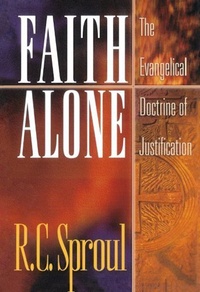
Faith Alone: The Evangelical Doctrine of Justification, by R. C. Sproul. Baker, 1995.

In chapter 7, entitled “Merit and Grace”, R. C. Sproul discusses the issues of merit and grace, Pelagianism, semi-Pelagianism, the Council of Orange in 529 AD and the council of Trent (1545-1463), which seems to affirm semi-Pelagianism.

“Rome has repeatedly been accused of condemning semi-Pelagianism at Orange [in 529 AD] but embracing it anew at Trent. Herman Bavinck held that “although semi-Pelagianism had been condemned by Rome, it reappeared in a ‘roundabout way’”. G. C. Berkouwer observed:

“Between Orange and Trent lies a long process of development, namely, scholasticism, with its elaboration of the doctrine of the meritoriousness of good works, and the Roman system of penitence . . . “
Bavinck and Berkouwer are cited by Sproul in Faith Alone, pages 140-141.

The big Problem with the Council of Orange of 529 AD:
Baptismal Regeneration – that baptism in water causes regeneration and gives grace so one may then be able to choose Christ.

This is one of the earliest false emphases and doctrines of the early church. Justin Martyr, who wrote many other good things, writing around 155 AD, seems to be the first to write and teach baptismal regeneration – that water baptism gives grace or causes someone to be born again. This is wrong, and based on a wrong understanding of John 3:5; Acts 2:38; I Peter 3:21, and Titus 3:5; and some other texts. (see the comprehensive exegetical papers on links at the end of this article that deal with all the relevant verses.) Since Jesus rebukes Nicodemus for being the teacher of Israel and not understanding in John 3:10-11, Jesus is pointing to Ezekiel 36:24-27. The water of John 3:5 points to the spiritual internal cleansing from the idolatry in Ezekiel 36:25 – “I will sprinkle clean water on you, and cleanse you from all your idols” . . . how? Ezekiel 14:3, 4, 7 speak of “idols in the heart”. Water cannot cleanse the heart. But the Holy Spirit can. And it is by faith alone that the heart is cleansed. Acts 15:9 “cleansing their hearts by faith”. I Peter 3:21 says that the “baptism that saves” is “not the removal of dirt from the flesh”; that is, is not an outward, physical thing, but an appeal to God for a good conscience” – an internal thing, a crying out and Godly sorrow over sin and a repentance and faith in Christ. Acts 2:38 is using “causal eis” – the Greek preposition eis means here, “because of” or “at” – like in other places. One example of the “causal eis” usage is Luke 11:32 - “they repented at the preaching of Jonah”, meaning, “they repented because of the preaching of Jonah”. (Other places in the NT where the causal eis is used are: Romans 4:20; 11:32; Matthew 3:11; 12:41. See Dana and Mantey, Greek Grammar, pp. 103-104.

24 “I will take you from the nations and gather you from all the countries and bring you into your own land. 25 I will sprinkle clean water on you, and you shall be clean from all your uncleannesses, and from all your idols I will cleanse you. 26And I will give you a new heart, and a new spirit I will put within you. And I will remove the heart of stone from your flesh and give you a heart of flesh. 27 And I will put my Spirit within you, and cause you to walk in my statutes and be careful to obey my rules.” Ezekiel 36:24-27

The Holy Spirit causes us to be born again, not an external rite of baptism in water. (John 7:37-39; John 3:3-8; Acts 10:43-48; I Corinthians 12:13) Baptism in water in the name of the Father, the Son, and the Holy Spirit is an external picture/symbol/testimony of an inward reality of faith and repentance, an appeal to God for a good conscience, and expression of faith and discipleship in following Christ, and a commitment to Christ’s body in a local congregation. (Matthew 28:19; Acts 2:41 – “those who received his word were baptized”)

The Council of Orange in 529 AD
Against Semi-Pelagianism

CANON 13. Concerning the restoration of free will. The freedom of will that was destroyed in the first man can be restored only by the grace of baptism, for what is lost can be returned only by the one who was able to give it. Hence the Truth itself declares: "So if the Son makes you free, you will be free indeed" (John 8:36).


Correction: It, the freedom of the will, can be only restored by the grace of God that He gives in repentance and faith in Christ. Acts 16:14; John 6:44, 65; Romans 6:22; Ezekiel 36:26-27; I Corinthians 12:13 – we are baptized by one Spirit into the body of Christ – water baptism is the outward symbol of the internal repentance and trust in Christ.

The Conclusion of the Council of Orange of 529 AD:
“CONCLUSION. And thus according to the passages of holy scripture quoted above or the interpretations of the ancient Fathers we must, under the blessing of God, preach and believe as follows. The sin of the first man has so impaired and weakened free will that no one thereafter can either love God as he ought or believe in God or do good for God's sake, unless the grace of divine mercy has preceded him. We therefore believe that the glorious faith which was given to Abel the righteous, and Noah, and Abraham, and Isaac, and Jacob, and to all the saints of old, and which the Apostle Paul commends in extolling them (Heb. 11), was not given through natural goodness as it was before to Adam, but was bestowed by the grace of God. And we know and also believe that even after the coming of our Lord this grace is not to be found in the free will of all who desire to be baptized, but is bestowed by the kindness of Christ, as has already been frequently stated and as the Apostle Paul declares, "For it has been granted to you that for the sake of Christ you should not only believe in him but also suffer for his sake" (Phil. 1:29). And again, "He who began a good work in you will bring it to completion at the day of Jesus Christ" (Phil. 1:6). And again, "For by grace you have been saved through faith; and it is not your own doing, it is the gift of God" (Eph. 2:8). And as the Apostle says of himself, "I have obtained mercy to be faithful" (1 Cor. 7:25, cf. 1 Tim. 1:13). He did not say, "because I was faithful," but "to be faithful." And again, "What have you that you did not receive?" (1 Cor. 4:7). And again, "Every good endowment and every perfect gift is from above, coming down from the Father of lights" (Jas. 1:17). And again, "No one can receive anything except what is given him from heaven" (John 3:27). There are innumerable passages of holy scripture which can be quoted to prove the case for grace, but they have been omitted for the sake of brevity, because further examples will not really be of use where few are deemed sufficient.


[The above was very good. Now comes the problem: ]

According to the catholic faith we also believe that after grace has been received through baptism, all baptized persons have the ability and responsibility, if they desire to labor faithfully, to perform with the aid and cooperation of Christ what is of essential importance in regard to the salvation of their soul. . . . “


There is more, see the full text of the Council of Orange here:

Some good articles that show that baptismal regeneration is not good exegesis of the Scriptural texts.

A Brief Rebuttal of Baptismal Regeneration, by James White


Baptismal Regeneration is not part of the gospel: Analysis of the main texts that some groups use to teach baptismal regeneration and a refutation of them all.

On Titus 3:5 Not By Works
http://vintage.aomin.org/NotByWorks.html

Sam Storms on John 3:5 – Part 1
http://www.enjoyinggodministries.com/article/john-35-part-i/

Sam Storms on John 3:5 – Part 2
http://www.enjoyinggodministries.com/article/john-35-part-ii/

Sam Storms on Acts 2:38
http://www.enjoyinggodministries.com/article/acts-238/

Refuting Sacramentalism: Part 1
http://www.enjoyinggodministries.com/article/sacramentalism-part-i/

Refuting Sacramentalism: Part 2
http://www.enjoyinggodministries.com/article/sacramentalism-part-ii/

On Sacraments, Part 1

On Sacraments, Part 2
http://www.enjoyinggodministries.com/article/sacraments-part-ii/

Sunday, June 05, 2011

Luther and Purgatory, Revisited

While spending a little time on the Catholic Answers forum, I came across an error in a secondary resource I use: What Luther Says by Ewald Plass. This actually turned out to be a helpful error. Back in 2008 I cited Plass stating,

"When in 1518 [Luther] further explained his fifteenth thesis, he remarked: 'I am very certain that there is a purgatory,'... In the Leipzig debate of the following year purgatory was discussed at length...Luther there said he knew that there is a purgatory. The dispute was about the nature of the institution rather than its existence. The 'orthodox' Romanists contended for the meritorious character of the purging. But increasingly Luther could find no room for this figment in Scripture theology. By November 7, 1519, he had progressed far enough to write to Spalatin: 'It is certain that no one is a heretic who does not believe that there is a purgatory,' although he had still professed to believe in its existence in February of that year. In fact, also in the following year in 1520, he still holds to it. But thereafter his language becomes different until...he calls it a fabrication of the devil" [Plass, What Luther Says Volume 1 (St. Louis: Concordia Publishing House, 1959), p. 387-388 n.25].

This information from Plass is helpful in debunking Roman Catholic apologist Gary Michuta's argument that Eck (in debate) forced Luther to abandon the canonicty of 2 Maccabees in order to deny the reality of purgatory (Why Catholic Bibles Are Bigger). According to Michuta, "Eck appealed to 2 Maccabees 12:46 as a clear and incontestable proof from Scripture that Purgatory exists." Gary states, "Luther refused to allow Maccabees into the argument" (Michuta, pp. 248-249), and "This denial of canonical status [of 2 Maccabees] was something new" (p.250). Michuta posits, "Consequently, Maccabees could never be allowed full canonical authority because it contradicts Luther's theology" (p.252). "Luther taught that Scripture alone is the highest and ultimate authority for the individual Christian. When confronted with Scripture that contradicted his theology (as he was with 2 Maccabees 12:43-46, used as a defense of Purgatory), Luther took advantage of the doubts raised by Jerome to deny that ancient book's full canonical weight" (p.309). One can see the picture of Luther being painted: the only way to get out of Eck's scriptural argument for proof of purgatory was to deny that the scriptural proof was truly Scripture! On the Catholic Answers forum, Michuta stated, "Luther was forced to reject (or down-grade) the authority of Maccabees because its meaning unmistakably affirmed Purgatory and all that goes along with it." One must question the motivation applied to Luther by Mr. Michuta in light of the fact that Luther had not yet denied purgatory.

Plass shows Luther still maintained a belief in purgatory even after the debate with Eck. Plass though didn't go far enough. The texts he cites to substantiate his assertion (WA 7:451; 454] are not from 1520, but are from the March 1521 treatise Grund und Ursach aller Artikel D. Martin Luthers so durch römische Bulle unrechtlich verdammt sind. But also in 1521, Luther published his Defense and Explanations of all the Articles. Luther states,

THE THIRTY-SEVENTH ARTICLE
That there is a purgatory cannot be proved by those Scriptures which are authentic and trustworthy.

The existence of a purgatory I have never denied. I still hold that it exists, as I have written and admitted many times, though I have found no way of proving it incontrovertibly from Scripture or reason. I find in Scripture that Christ, Abraham, Jacob, Moses, Job, David, Hezekiah, and some others tasted hell in this life. This I think was purgatory, and it seems not beyond belief that some of the dead suffer in like manner. Tauler has much to say about it, and, in short, I myself have come to the conclusion that there is a purgatory, but I cannot force anybody else to come to the same result.

There is only one thing that I have criticized, namely, the way in which my opponents refer to purgatory passages in Scripture which are so inapplicable that it is shameful. For example, they apply Ps. 66[:12], “We went through fire and through water,” though the whole psalm sings of the sufferings of the saints, whom no one places in purgatory. And they quote St. Paul in I Cor. 3[:13–15] when he says of the fire of the last day that it will test the good works, and by it some will be saved because they keep the faith, though their work may suffer loss. They turn this fire also into a purgatory, according to their custom of twisting Scripture and making it mean whatever they want.

And similarly they have arbitrarily dragged in the passage in Matt. 12[:32] in which Christ says, “Whoever speaks blasphemy against the Holy Spirit will not be forgiven, either in this world or in the world to come.” Christ means here that he shall never be forgiven, as Mark 3[:29] explains, saying, “Whoever blasphemes against the Holy Spirit never has forgiveness, but is guilty of an eternal sin.” To be sure, even St.Gregory interprets the passage in Matthew 12 to mean that some sins will be forgiven in the world to come, but St. Mark does not permit such an interpretation, and he counts for more than all the doctors.

I have discussed all this in order to show that no one is bound to believe more than what is based on Scripture, and those who do not believe in purgatory are not to be called heretics, if otherwise they accept Scripture in its entirety, as the Greek church does. The gospel compels me to believe that St. Peter and St. James are saints, but at the same time it is not necessary to believe that St. Peter is buried in Home and St. James at Compostella and that their bodies are still there, for Scripture does not report it. Again, there is no sin in holding that none of the saints whom the pope canonizes are saints, and no saint will be offended, for, as a matter of fact, there are many saints in heaven of whom we know nothing, and certainly not that they are saints, yet they are not offended, and do not consider us heretics because we do not know of them. The pope and his partisans play this game only in order to fabricate many wild articles of faith and thus make it possible to silence and suppress the true articles of the Scripture.

But their use of the passage in II Macc. 12[:43], which tells how Judas Maceabeus sent money to Jerusalem for prayers to be offered for those who fell in battle, proves nothing, for that book is not among the books of Holy Scripture, and, as St. Jerome says, it is not found in a Hebrew version, the language in which all the books of the Old Testament are written. In other respects, too, this book deserves little authority, for it contradicts the first Book of Maccabees in its description of King Antiochus, and contains many other fables which destroy its credibility. But even were the book authoritative, it would still be necessary in the case of so important an article that at least one passage out of the chief books [of the Bible] should support it, in order that every word might be established through the mouth of two or three witnesses. It must give rise to suspicion that in order to substantiate this doctrine no more than one passage could be discovered in the entire Bible; moreover this passage is in the least important and most despised book. Especially since so much depends on this doctrine which is so important that, indeed, the papacy and the whole hierarchy are all but built upon it, and derive all their wealth and honor from it. Surely, the majority of the priests would starve to death if there were no purgatory. Well, they should not offer such vague and feeble grounds for our faith! [LW 32:94-96]

Luther Added Books to his Bible?

Luther added books to the Bible? The common charge is Luther removed books from the Bible. Here though may be an addition to Luther's Bible, at least in terms of adding apocrypha to the apocrypha, if judged by today's generally accepted list of the apocrypha, that is.

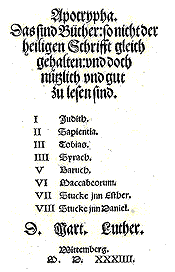
Some readers may have been surprised when I mentioned above that Luther's Bible even has a bit more than the Catholic one. What I mean by that is that he includes The Prayer of Manasses, with the OT Apocrypha, a writing which you will not generally find in Catholic Bibles. [source]

The Prayer of Manasseh was actually included in Luther's 1529 edition of his Personal Prayer Book (See LW 43:8) and in A Discussion on How Confession Should Be Made (1520) (LW 39:46). Apparently, (at least) the 1534 edition of Luther's Bible contains a translation of The Prayer of Manasseh with the Apocrypha, but it is not listed in the table of contents (pictured above). F.F. Bruce says, "Luther’s friend George Spalatin had translated the Prayer of Manasseh into German in 1519; another translation was included in the complete German Bible of 1534" (The Canon of Scripture, p. 102). Did this short apocryphal writing continue in subsequent editions of Luther's Bible? I don't know.

A footnote in LW 43 says,"Luther regarded this apocryphal book highly" (p.272). I've done one other blog entry related to Luther and the Prayer of Manasseh. While he valued it, he did not hold it to be canonical.

On the other hand, according to Phillip Schaff, "the third and fourth books of Ezra and the third book of the Maccabees [were] added to the Apocrypha" in Luther's Bible. Schaff though does not provide a date for this edition, and curiously mentions this fact in between dates of editions published after Luther's death. The editors of Luther's Works state, "Because they were not in the Septuagint, Luther omitted III and IV Maccabees as well as III and IV Esdras"(LW 35:232). It does appear from Schaff's comment the editions which contain these books were inserted after Luther's death. F.F. Bruce states, "As for 3 and 4 Esdras and 3 Maccabees, they were not included in Luther’s Bible; they were added to later editions from about 1570 onward" (The Canon of Scripture, p. 102).

In an obscure Table Talk, Luther is purported to have stated, "The third book of Esdras I throw into the Elbe; there are, in the fourth, pretty knacks enough; as, “The wine is strong, the king is stronger, women strongest of all; but the truth is stronger than all these....". In his preface to Baruch, Luther states,

Whoever the good Baruch may be, this book is very skimpy. It is hardly credible that the servant of St. Jeremiah, whose name is also Baruch (and to whom this letter is attributed), should not be richer and loftier in spirit than this Baruch. Furthermore, the book’s chronology does not agree with the [accepted] histories. Thus I very nearly let it go with the third and fourth books of Esdras, books which we did not wish to translate into German because they contain nothing that one could not find better in Aesop or in still slighter works[LW 35:349].

If a Roman Catholic ever states that Luther added books to the Bible, note this fact from F.F. Bruce:

The ruling that the ‘ancient and vulgate edition’ (the Latin Vulgate) be treated as the authoritative text of holy scripture required the provision of an accurate edition of this text. After the abortive attempt to make this provision in the Sixtine edition of 1590, the need was adequately met (for the next three centuries, at least) by the Clementine Vulgate of 1592. In this edition 3 and 4 Esdras and the Prayer of Manasseh were added as an appendix: they formed no part of the canon of Trent and were not included in the Sixtine Vulgate. It was the Clementine edition of the Old Testament that formed the basis of the English Douay version of 1609–10" [The Canon of Scripture, p. 104].


Addendum


The Prayer of Manasseh, King of Judah Among the Captives in Babylon [LW 39:46-47]O Lord Almighty,
God of our fathers,
of Abraham and Isaac and Jacob
and of their righteous posterity;
you who have made heaven and earth
with all their ornament;
who have shackled the sea by your word of command,
who have confined the deep
and sealed it with your terrible and glorious name;
at whom all things shudder
and tremble before your power,
for your glorious splendor cannot be borne,
and the wrath of your threat to sinners is irresistible;
yet immeasurable and unsearchable is your promised mercy,
for you are the Lord Most High,
of great compassion, long-suffering, and very merciful,
and repent over the evils of men.
You, O Lord, according to your great goodness
have promised repentance and forgiveness.
Therefore you, O Lord, God of the righteous,
have not appointed repentance for the righteous,
for Abraham and Isaac and Jacob, who did not sin against you,
but you have appointed repentance for me, who am a sinner.
For the sins I have committed are more in number than the sand of the sea;
my transgressions are multiplied!
I am weighted down with many an iron fetter,
so that I am rejected because of my sins,
and I have no relief:
for I have provoked your wrath
and have done what is evil in your sight,
setting up abominations and multiplying offenses.
And now I bend the knee for your goodness.
I have sinned, O Lord, I have sinned,
and I know my transgressions.
I earnestly beseech you,
forgive me, O Lord, forgive me!
Do not destroy me with my transgressions, or lay up evil for me;
For, unworthy as I am, you will save me in your great mercy,
and I will praise you continually all the days of my life.
For all the host of heaven sings your praise,
and yours is the glory for ever. Amen.

Saturday, June 04, 2011

By Our Tribulations God Weans Us from Excessive Love of this Present Life

III-9:1-2 Meditation on the Future Life
By Our Tribulations God Weans Us from Excessive Love of this Present Life [1 -2]

1. The vanity of this life

a. God, knowing our propensities, uses the best ways to draw us from love of the present world to contempt of it

b. our aspiration for heavenly immortality is what sets us off from beasts

c. but our nature constantly pulls us back to wallow in the present life

d. to counter this tendency in us, God metes out appropriate afflictions for each man's particular failing

e. the discipline of the cross teaches us that

(1) this life, by itself, is vain and vitiated by many evils

(2) but we are, conversely, to raise our eyes to heaven

2. Our tendency to leave unnoticed the vanity of this life

a. there is no compromise between rejection and acceptance the world

b. we act as if the present life were going to go on forever for us

c. hence we need constant and strong reminding of what life truly like

1. THE VANITY OF THIS LIFE
Whatever kind of tribulation presses upon us, we must ever look to this end: to accustom ourselves to contempt for the present life and to be aroused thereby to meditate upon the future life. For since God knows best how much we are inclined by nature to a brutish love of this world, he uses the fittest means to draw us back and to shake off our sluggishness, lest we cleave too tenaciously to that love. There is not one of us, indeed, who does not wish to seem throughout his life to aspire and strive after heavenly immortality. For it is a shame for us to be no better than brute beasts, whose condition would be no whit inferior to our own if there were not left to us hope of eternity after death. But if you examine the plans, the efforts, the deeds, of anyone, there you will find nothing else but earth. Now our blockishness arises from the fact that our minds, stunned by the empty dazzlement of riches, power, and honors, become so deadened that they can see no farther. The heart also, occupied with avarice, ambition, and lust, is so weighed down that it cannot rise up higher. In fine, the whole soul, enmeshed in the allurements of the flesh, seeks its happiness on earth. To counter this evil the Lord instructs his followers in the vanity of the present life by continual proof of its miseries. Therefore, that they may not promise themselves a deep and secure peace in it, he permits them often to be troubled and plagued either with wars or tumults, or robberies, or other injuries. That they may not pant with too great eagerness after fleeting and transient riches, or repose in those which they possess, he sometimes by exile, sometimes by barrenness of the earth, sometimes by fire, sometimes by other means, reduces them to poverty, or at least confines them to a moderate station. That they may not too complacently take delight in the goods of marriage, he either causes them to be troubled by the depravity of their wives or humbles them by evil offspring, or afflicts them with bereavement. But if, in all these matters, he is more indulgent toward them, yet, that they may not either be puffed up with vainglory or exult in self-assurance, he sets before their eyes, through diseases and perils, how unstable and fleeting are all the goods that are subject to mortality.

Then only do we rightly advance by the discipline of the cross, when we learn that this life, judged in itself, is troubled, turbulent, unhappy in countless ways, and in no respect clearly happy; that all those things which are judged to be its goods are uncertain, fleeting, vain, and vitiated by many intermingled evils. From this, at the same time, we conclude that in this life we are to seek and hope for nothing but struggle; when we think of our crown, we are to raise our eyes to heaven. For this we must believe: that the mind is never seriously aroused to desire and ponder the life to come unless it be previously imbued with contempt for the present life.

2. OUR TENDENCY TO LEAVE UNNOTICED THE VANITY OF THIS LIFE
Indeed, there is no middle ground between these two: either the world must become worthless to us or hold us bound by intemperate love of it. Accordingly, if we have any concern for eternity, we must strive diligently to strike off these evil fetters. Now, since the present life has very many allurements with which to entice us, and much show of pleasantness, grace, and sweetness wherewith to wheedle us, it is very much in our interest to be called away now and again so as not to be captivated by such ponderings. What, then, I beg of you, would happen if we enjoyed here an enduring round of wealth and happiness, since we cannot, even with evil continually goading us, be sufficiently awakened to weigh the misery of this life?

That human life is like smoke [Psalm 102:3] or shadow [Psalm 102:11] is not only obvious to the learned, but even ordinary folk have no proverb more commonplace than this. And since they counted this something very profitable to know, they have couched it in many striking sayings. But there is almost nothing that we regard more negligently or remember less. For we undertake all things as if we were establishing immortality for ourselves on earth. If some corpse is being buried, or we walk among graves, because the likeness of death then meets our eyes, we, I confess, philosophize brilliantly concerning the vanity of this life. Yet even this we do not do consistently, for often all these things affect us not one bit. But when it happens, our philosophy is for the moment; it vanishes as soon as we turn our backs, and leaves not a trace of remembrance behind it. In the end, like applause in the theater for some pleasing spectacle, it evaporates. Forgetful not only of death but also of mortality itself, as if no inkling of it had ever reached us, we return to our thoughtless assurance of earthly immortality. If anyone in the meantime croaks the proverb: “Man is the creature of a day,” we indeed admit it; but with no attention, so that the thought of perpetuity nonetheless remains fixed in our minds. Who, then, can deny that it is very much worthwhile for all of us, I do not say to be admonished with words, but by all the experiences that can happen, to be convinced of the miserable condition of earthly life; inasmuch as, even when convinced, we scarcely cease to be stunned with a base and foolish admiration of it, as if it contained in itself the ultimate goal of good things. But if God has to instruct us, it is our duty, in turn, to listen to him calling us, shaking us out of our sluggishness, that, holding the world in contempt, we may strive with all our heart to meditate upon the life to come.

-Continued: GRATITUDE FOR EARTHLY LIFE!

Catholic Answers: Martin Luther and the Deuterocanonicals

http://forums.catholic.com/showthread.php?t=566664

I've heard many of the Catholic apologists on this site make the claim that Martin Luther "removed" the DC's because they provided biblical evidence for Catholic beliefs that Luther disagreed with (purgatory, etc).


I've also heard many protestants defend Luther's move by claiming he wanted to simply stick with the shorter canon that was more universally accepted. They go on to say he didn't "remove" the books; rather he placed them at the end of the OT in a separate section.


I'm not terribly familiar with Luther, so does anyone have any actually evidence for Luther's motives? What did Luther himself say about this?

**************************************

The bigger question is, why is history seemingly so muddy on this? I don't have a problem accepting the that Luther had a personal agenda, however I would hope, for his sake, that he left a written defense of his actions.


For Catholics, I would hope we have some historical evidence to back up the claim that Luther did it for the reasons we say he did it.

**************************************

Simply read Luther's Works vol. 32 for Luther's opinion of the apocrypha.

Luther's Bible contains the Apocrypha. The books were not removed.A while back on Catholic Answers Fr. Sebastian Walshe addressed the topic Can Doctrine Develop? Fr. Walshe explained that previous to Trent's infallible declaration, there was uncertainty about which books were canonical. Fr. Walshe also briefly discussed the Apocrypha. Walshe admits there was indeed controversy in the church as to its status. It simply isn't the case that the church unanimously accepted these books early on and that Luther removed them.Walshe also says that Thomas Aquinas was not certain if the books of Maccabees should be considered part of canonical Scripture. That is, Aquinas didn't know one way or the other if the books of Maccabees were part of the canon because the church had yet to determine the status of these books. In fact, there were quite a number of people previous to Luther that doubted the full canonicity of the Apocrypha. Even one of the best Roman Catholic contemporaries of Luther, Cardinal Cajetan, held a similar view as Luther did on the status of the Apocrypha. There was even a group of very well respected Roman Catholic scholars at Trent that argued against including the Apocrypha as fully canonical.

Some argue Luther chose the Hebrew version out of convenience because it got rid of some of the support for the doctrine of Purgatory, with which he disagreed. The best argument so far is that put forth by Gary Michuta. In his book, Why Catholic Bibles Are Bigger Michuta argues it was at the Leipzig debate in which Eck cornered Luther into rejecting Maccabees because it taught the doctrine of purgatory. A major problem though with Michuta's position is that Luther went into this debate with Eck affirming the reality of Purgatory (though with reservations). So the typical Catholic argument that Luther had to deny the canonicity of 2 Maccabees at Leipzig in order to maintain his belief in the non-existence of purgatory fails.The fact of the matter is, Luther rejected the canonicty of 2 Maccabees for other reasons.

http://www.aomin.org/aoblog/index.php?itemid=2467

http://www.aomin.org/aoblog/index.php?itemid=2476

Rome's New Statue: "Wow is it ugly"

http://www.jimmyakin.org/2011/05/romes-new-ugly-john-paul-ii-statue.html


"I have to say that this statue is even worse than the one inside the entrance of the Vatican museums. That statue, titled “Varcare la soglia” (Crossing the Threshold), is a slab of marble with a bas relief of John Paul II on each side, apparently shoving a goofy-looking, modern, cell-phone clutching man out of the block of marble. I was stunned when I first saw it."

News From Rome: Mary is... Human

http://www.zenit.org/article-32750?l=english

ROME, JUNE 3, 2011 (Zenit.org).- The Second Vatican Council's "anthropological turn" brought a spotlight to the "woman of Nazareth," enabling the faithful to discover Our Lady in her full humanity, says the secretary of the Pontifical Marian International Academy.

"Past devotion clothed the Virgin in very precious mantles, crowns and gifts, forgetting little by little her humanity," he suggested. "The anthropological turn of Vatican II has made us discover 'the woman of Nazareth' in her full humanity. In her we find, next to Jesus, a totally fulfilled woman, but only after having accepted the will of God, which revealed itself to her in her constant journey of faith which points her out as a true disciple of Christ.

Court Lifts Ban On Prayer At High School Graduation

http://www.npr.org/2011/06/03/136934940/court-lifts-ban-on-prayer-at-high-school-graduation

by The Associated Press

June 3, 2011
Public prayer will be allowed at a Texas high school graduation after a federal appeals court Friday reversed a ban won by an agnostic family, who claimed that watching their son receive a diploma would amount to forced religious participation because of school traditions.

Friday, June 03, 2011

Trusting.... Which Roman Catholic Interpreter?

http://catholicchampion.blogspot.com/2011/06/mark-shea-hack-begging-for-money-so-you.html?showComment=1307131204843#c556448989913063084

"The real problem in all this is that there is a wide-spread sense of granting certain people the status of 'untouchable', so that they can say or do whatever they want and we are 'obliged' to turn a blind eye - or even defend it.

The truth is, and all reasonable folks will readily admit, is that not everything Shea, Keating, Sungenis, Pope John Paul II, etc, says is gold, and in fact some of the stuff they say is scandalous or even wrong."

The Voice of Bob Crying in the Wilderness of Romanism

It appears there is a new Reformer in the midst...

R. Sungenis: Now really, am I so wrong? Or am I one of the only ones brave enough to step off the gravy train and point out that the emperor really has no clothes on? Was I being “shabby, dishonest and unscrupulous” about John Paul II kissing the Koran; praying with animists; refusing to allow a statue of Our Lady at Assisi but allowing a Buddah statue; discouraging Catholic proselytism toward other religions; praising Martin Luther as a great theologian but apologizing for past popes of the Inquisition; allowing a cardinal to sign the Lutheran/Catholic Joint Declaration that said “man is justified by faith alone”; giving communion to non‐Catholic politicians; harboring bishops involved in the pedophile scandal or ignoring accusations of pedophilia and homosexuality among his clerics; removing the excommunication of Masons from Canon Law; saying the Old Covenant was never revoked; condoning the idea that Scripture contains historical errors; having “holy” cow dung placed on his forehead in honor of the god Shiva; allowing Voodoo witch doctors and snake charmers to pray to their false gods; honoring the Dalai Lama; wearing the religious garb of pagan religions; downplaying traditional Marian doctrines and interpretations of Scripture applying to her; failing to consecrate Russia; seeking to redefine and lessen the primacy of the papacy for the sake of ecumenism; or having scantily clad women perform dances at his masses, etc., etc.? No, no. The one who is being “shabby, dishonest and unscrupulous” is he who ignores these doctrinal and moral aberrations and tries to make John Paul II a saint instead.

Thursday, June 02, 2011

Homosexuality: An unpleasant subject, but necessary to be equipped with answers

Denny Burk has 2 recent blog articles exposing the “gender neutral” agenda that is part of the larger homosexual social and political agenda.

1. This is a form of child abuse to this poor baby:
http://www.dennyburk.com/hiding-baby’s-gender/

2. Teaching the far left liberal agenda on gender in public schools:
http://www.dennyburk.com/teaching-gender-in-public-schools/

Other good resources:

3. The Same Sex Controversy, by James R. White and Jeffery D. Niell
http://www.aomin.org/catalog/index.php?cPath=59_69

The best one book on the Biblical issues and refuting the faulty hermeneutics of the homosexuals who try and twist the Bible into saying that homosexuality is not a sin.


4. A Queer Thing Happened to America, by Michael Brown
http://askdrbrown.org/resources/store?page=shop.product_details&flypage=flypage.tpl&product_id=333

(I have not read this book yet, but I have heard the interview that Dr. White had with Dr. Michael Brown on this book on some recent Dividing Line programs, and it sounds like it is very important in understanding the social issues going on the public schools, media, culture, medical and science perspectives.

5. Homosexuality and the Politics of Truth, by Jeffery Satinover, M.D.
http://www.amazon.com/Homosexuality-Politics-Truth-Jeffrey-Satinover/dp/080105625X

I read this book years ago, by a Jewish Medical doctor and Psychiatrist, who is not an evangelical Christian. It has very useful information to combat those who try and bring science on their side and won’t listen to anything Scriptural or from a Christian author or perspective. We should still use the word of God and Scripture in our witness, but using the scientific information in this book would also be helpful, in my opinion, to perhaps get people to listen more or to cause them to think about these things intelligently.

6. Sex and the Supremacy of Christ, edited by John Piper and Justin Taylor
http://www.desiringgod.org/store/books/by-topic/sexual-purity
The whole book is excellent, and Al Mohler has a chapter on homosexuality.

7. Justin Taylor’s links to Robert P. George’s (with others) articles on the issue of so called “gay civil marriage”.

http://thegospelcoalition.org/blogs/justintaylor/2011/01/03/is-there-a-plausible-defense-for-gay-civil-marriage/


8. Robert Gagnon’s web-site and resources on the issue:
( I don’t know where Gagnon comes from on many other issues (but see below); but he seems to take a proper Biblical stand against homosexuality.)
http://www.robgagnon.net/Index.html

“Conservapedia” writes this about Robert Gagnon:
http://www.conservapedia.com/Robert_Gagnon


"Robert A. J. Gagnon is Associate Professor of New Testament at Pittsburgh Theological Seminary, and prolific author on the subject of Homosexuality and the Bible, in which he upholds the traditional Biblical position. He is also an ordained elder at a Presbyterian Church (USA) in Pittsburgh.
While being the most prolific writer upholding the historical/traditional Biblical position on homosexual relations, Gagnon holds to the controversial Documentary Source Hypothesis, [ Ken comments, since there is no link to it anymore - it is the JEPD theory of Julius Wellhausen] which is usually more associated with liberal Christianity.[2][3]
As a result of his work, Gagnon has been subject to much scorn, as well as some grudging respect from his opponents.
Despite his impressive credentials, Gagnon was not allowed to be called a scholar on the Wikipedia article on David and Jonathan, due to his work refuting pro-homosexual arguments.[4] "

Wednesday, June 01, 2011

Two recent excellent articles about Islam at Answering Muslims

1. Who Corrupted the Gospel?
By David Wood at
http://www.answeringmuslims.com/2011/05/who-corrupted-gospel.html

Who corrupted the Gospel?

Be sure to read and study Sam Shamoun’s answer to other details in the comboxes; which has lots of links to various articles at www.answering-islam.org


2. Who was Muhammad? By David Wood
Who was Muhammad?


http://www.answeringmuslims.com/2011/05/who-was-muhammad.html