Saturday, October 22, 2022

Debunked Luther: "If I profess with the loudest voice and clearest exposition every portion of the truth of God except precisely that little point which the world and the devil are at the moment attacking, I am not confessing Christ, however boldly I may be professing Christ. "


This quote has been debunked before. It strongly appears to be something Martin Luther never wrote. See Denny Burk's old treatment here, see also that put forth by The Gospel CoalitionThis link (as far as I can tell) is now only publicly available via the Internet Archive, but its essence is captured here. Let's give this quote a fresh look. Exactly where does this quote come from? 

Documentation
Most documentation (if any) refers to other sources citing the quote. This is typical (it is akin to saying, "Don't blame me, I got it from this source.... blame them!"). Perhaps the most well-known person to cite the quote was Dr. Francis Schaeffer, but linking Luther to this quote goes at least as far back as 1945. It is simply amazing how many publications have haphazardly utilized this quote. A primary source is sometimes mentioned: WA (BR) 3:81-82.  This 1523 letter from Luther to Albrecht of Mansfield contains some similar sentiment but does not capture the full quote. 

The earliest use that has been located is in a nineteenth century book entitled, Chronicles of the Schönberg-Cotta Family (sometimes known as, Our Neighbor Maritn Luther or, Luther by Those Who Knew Him). The book is a historical novel, or more precisely, "historical fiction" about the life of Martin Luther written by Elizabeth Rundle Charles. This author fictionally "examined the life and personal influence of the young Martin Luther on the family of his printer." According to the reviews I've read of Rundle-Charles, she was a prolific author, her Luther novel though being her most popular book. Some years back I found a copy of it in a pile of disorganized books in an antique store. Her book apparently was popular enough that cheap copies are still laying around in junk stores. My copy states the following just previous to the contents page:
The portions of these Chronicles which refer to Luther, Melancthon, Frederic of Saxony, and other historical persons, can be verified from Luther’s “Tischreden;” Luther’s “Briefe, Sendschreiben und Bedenken;” edited by De Wette; the four volumes called, “Geist aus Luther's Schriften,” edited by F. W. Lomler, C. F. Lucius, Dr. T. Rust, L. Sackreuter, and Dr. Ernst Zimmermann; Tutschmann’s “Friedrich der Weise;” the “History of the Reformation,” by Ranke; and that by D'Aubigné; with the ordinary English historical works relating to the period.
I don't question that Rundle-Charles actually read these sources and utilized them for her fictional Luther account. One biography says Rundle-Charles was instructed in "numerous languages" so perhaps she really did utilize these sources for her Luther citations. It's within the realm of possibility that her fictional Luther quotes accurately represent Luther.  

Context
Rundle-Charles presented fictional stories of fictional people who knew Luther. The story the quote occurs in is that of Fritz, a monk at the monastery in Eisenach. She dates his story, April 2,1526. Fritz is presented as a zealous Luther supporter. Fritz finds himself among those who think with severe and hostile negativity towards Luther. He finds himself at an anti-Luther service "accidentally."  After the service, he returns to his "convent."  He writes
Mournfully I returned to my convent. In the cloisters of our Order the opinions concerning Luther are much divided. The writings of St. Augustine have kept the truth alive in many hearts amongst us; and besides this, there is the natural bias to one of our own order, and the party opposition to the Dominicans, Tetzel and Eck, Dr. Luther's enemies. Probably there are few Augustinian convents in which there are not two opposite parties in reference to Dr. Luther.
In speaking of the great truths, of God freely justifying the sinner because Christ died, (the Judge acquitting because the Judge himself had suffered for the guilty), I had endeavoured to trace them, as I have said, beyond all human words to their divine authority. But now to confess Luther seemed to me to have become identical with confessing Christ. It is the truth which is assailed in any age which tests our fidelity. It is to confess we are called, not merely to profess. If I profess, with the loudest voice and the clearest exposition, every portion of the truth of God except precisely that little point which the world and the devil are at that moment attacking, I am not confessing Christ, however boldly I may be professing Christianity. Where the battle rages the loyalty of the soldier is proved; and to be steady on all the battlefield besides is mere flight and disgrace to him if he flinches at that one point.
It seems to me also that, practically, the contest in every age of conflict ranges usually round the person of one faithful, Godsent man, whom to follow loyally is fidelity to God. In the days of the first Judaizing assault on the early Church, that man was St. Paul. In the great Arian battle, this man was Athanasius—" Athanasius contra mundum.” In our days, in our land, I believe it is Luther; and to deny Luther would be for me who learned the truth from his lips, to deny Christ. Luther, I believe, is the man whom God has given to his Church in Germany in this age. Luther, therefore, I will follow-not as a perfect example, but as a God-appointed leader. Men can never be neutral in great religious contests; and if, because of the little wrong in the right cause, or the little evil in the good man, we refuse to take the side of right, we are, by that very act, silently taking the side of wrong.
Fictional Fritz goes on to tell of his persecutions for being a follower of Luther. "When I came back to the convent I found the storm gathering. I was asked if I possessed any of Dr. Luther's writings. I confessed that I did. It was demanded that they should be given up... one of the older monks came to me and accused me of secretly spreading Lutheran heresy among the brethren..The next day I was taken into the prison where John of Wesel died; the heavy bolts were drawn upon me, and I was left in solitude." After multiple weeks in prison, he escaped. He ended up meeting Luther on his way to Worms, and thus the tale continues showering accolades on Luther from the perspective of Fritz, an enthusiastic supporter. 

Conclusion
It would be interesting to know exactly what Elizabeth Rundle-Charles had in mind from Luther when she penned the quote. In context though, Rundle-Charles does not attribute the quote to Luther, but rather to her fictional character Fritz. Therefore, not only are people attributing a quote to Luther that he never wrote, but the actual "person" who made the comment is a fictional character!

Unlike some of the kinder earlier treatments debunking this quote, I find it appalling how many people have utilized the quote unchecked in published works. Published books typically are intended to generate income... for someone!  For anyone using this quote in a published book intended to generate income in the last ten or fifteen years, there isn't a meaningful excuse: a simple Google search reveals the Chronicles of the Schönberg-Cotta Family, easily. 

Tuesday, October 18, 2022

Debunked Luther: "For feelings come and feelings go, and feelings are deceiving; My warrant is the Word of God, Nought else is worth believing..."


Back in 2015 I looked at a poem attributed to Martin Luther. I have since determined its probable origin. Based on my findings presented below, I do not believe this poem was written by Luther:
"For feelings come and feelings go, and feelings are deceiving;
My warrant is the Word of God, Nought else is worth believing.
Though all my heart should feel condemned, For want of some sweet token,
There is One greater than my heart, Whose Word cannot be broken.
I'll trust in God's unchanging Word, ‘till soul and body sever;
For though all things shall pass away, His Word shall stand forever."~(Martin Luther)
A quick Google search reveals how far this quote has traveled, and a text search of the Internet Archive shows extensive use.  A Google Books search demonstrates how often it has been published, particularly in the 21st century. Well-known names have cited it: Norman Geisler used a snippet of it in his book, Christian Apologetics. Alistair Begg published it. D. James Kennedy's 1985 book refers to a portion of it. 

The words of this poem are sometimes cited as a hymn: God's Word Shall Stand Forever, "attributed to Luther." Since I first wrote about this poem in 2015, I've noticed many more links to it being a hymn / song. See for instance the incorporation of the poem into a song, here and here. The musical arrangement appears to be by someone named Faye Lopez. 

Documentation
Most often, "Martin Luther" is cited as the author of this poem. Careful people have cited, "attributed to Martin Luther." Neither of these are helpful in locating the source! After searching multiple uses of the poem through the decades, the oldest use I could locate is from 1929. Interestingly, an author other than Luther is cited, "W.M. Czamanske." I believe he is the author of this poem.


Who was he? Was he the W.M. Czamanske the Lutheran minister mentioned here? It appears he had a knack for poetry. In this periodical, he presents another rhyming Luther poem: 


In the same magazine, he offers a number of poems. There was also a Wm. Czamanske that authored a number of hymns. Was this the same person? The Evangelical Lutheran Hymnary Handbook states,

Czamanske, William Martin, 1873-1964

CZAMANSKE, William Martin (1873- ), was born August 26, 1873, at Granville, Wisconsin. He was graduated from Concordia College, Milwaukee, Wisconsin, in 1894, and from Concordia Seminary, St. Louis, in 1898. Ordained and installed as pastor July 31, 1898, he served successively Lutheran churches, near Madelia, Minnesota, 1898-1902; West Henrietta, New York, 1902-1904; Rochester, New York, 1904 to 1910; and Sheboygan, Wisconsin, 1910-1951, when he entered retirement. He has contributed poems to the Lutheran Witness, Sunday School Times, Etude, Expositor, Northwestern Lutheran, and other church publications. He served as member of a subcommittee of the Committee on Hymnology and Liturgics for the Synodical Conference of North America, which edited The Lutheran Hymnal.

tr. 186, 392

The periodical the poem originally appeared in (cited above) was The Sunday School Times. From this early use from the Sunday School Times, the quote begins to multiply.  For instance, in 1939, we find the following:


The poem continues to be cited through the decades. It would be interesting to see the full version of this snippet view from the 1943 Lutheran Witness to see if Czamanske submitted it. Note this shorter version also from 1943 which is in the same format (and citation) as the Lutheran Witness


This book from 1956 attributes the quote to Luther, via Moody Monthly: 


See also this same text from 1951, and its exact use in 1968

I came across shorter versions that hint part of it originated in the late 1800's - early 1900's:
Martin Luther was once asked, "Do you feel as if your sins were forgiven?" "No," he returned, stoutly. "I don't feel that they are forgiven, but I know that they are, because God says so in his Word. [source]
In some early instances, the one asking Luther is Satan. Note the part of this paragraph from 1889:
Martin Luther, in one of his conflicts with the devil, was asked by the arch-enemy if he felt his sins forgiven. "No," said the great reformer, "I don't feel that they are forgiven, but I know they are, because God says so in His Word." Paul did not say, "Believe on the Lord Jesus Christ, and thou shalt feel saved;" but, "Believe on the Lord Jesus Christ, and thou shalt be saved." No one can feel that his sins are forgiven. Ask that man whose debt was paid by his brother, "Do you feel that your debt is paid?" "No," is the reply, "I don't feel that it is paid; I know from this receipt that it is paid, and I feel happy because I know it is paid." So with you, dear reader. You must first believe in God's love to you as revealed at the Cross of Calvary, and then you will feel happy, because you shall know that you are saved. [source]
It appears that part of the core of this quote has been around at least 100 years.  It does sound suspiciously like a rewording of a Table Talk entry, but in my brief search of the extant English versions I didn't come across anything.

Conclusion
My conclusion: Luther did not write this rhyming poem. Based on the usage I searched out, the original author was probably W.M. Czamanske. He appears to have had a poetical nature. If in fact he was a Lutheran minister, it would make sense why the theology echoed Luther. Rev. Czamanske did live to 1964, so perhaps saw that his poem was being utilized by others. I think he would be amazed to see how extensively his poem has been cited and that his words became Luther's words!   


Addendum #1
Indeed, the sentiment of the quote could be demonstrated to be something Luther believed. Consider how easily it would have been for someone to read this old English Table Talk statement and summarize it in the one of the forms above:
That the Forgiveness of sins must pass through all things.
The law doth justify in no state, calling and art; impossible it is that every thing should go on in a straight line according to the Law, as we see in the grammar which is taught in schools; no rule is so common, which hath not an exception. Therefore, the forgiveness of Sins is needful through life, and is held out in all arts and sciences. The forgiveness of sins is declared only in God's Word, and there we must seek it; for it is grounded on God's promises. God forgiveth thee thy sins, not because thou feelest them and art sorry, for that doth sin itself produce, and can deserve nothing; but he forgiveth thy sins because he is merciful, and because he hath promised to forgive for Christ's sake, his dearly beloved Son, and caused his word to be applied to thee: namely, “Be of good cheer, thy sins are forgiven thee.”
Addendum #2
"So now turn from your conscience and its feeling to Christ who is not able to deceive; my heart and Satan however, who will drive me to sin are liars... You should not believe your conscience and your feelings more than the word which the Lord who receives sinners preaches to you... Therefore you are able to fight with your conscience by saying: You lie; Christ speaks truth and you do not." WA 27, 223 (cf. Paul Althaus, The Theology of Martin Luther, p. 59).

Addendum #3
I found a book citing my 2015 blog entry in regard to the poem: Untrustworthy: The Knowledge Crisis Breaking Our Brains, Polluting Our Politics, and Corrupting Christian Community. I know nothing about this book or author, but that she took the time to track down the source of Luther's poem is sometimes a good indication of the research put into the book.  

Monday, July 11, 2022

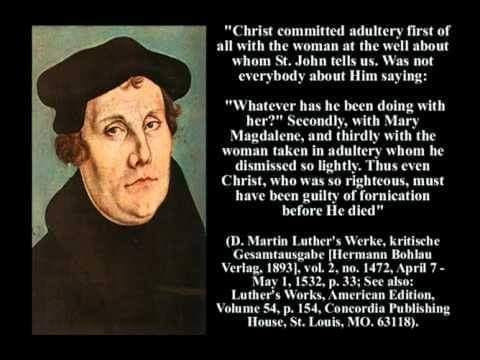
Luther Said Christ Committed Adultery? A Primer on How to Respond

This picture was taken from a private Facebook Group named, Sola Scriptura: A Foundation of Sand. The Roman Catholic who posted it said Luther admitted and sought to justify "his lack of sexual restraint and sin" and that "Luther was a prideful mentally-emotionally disturbed apostate."

While this quote has been covered here in-depth before, it appears to be popular on social media with people unable to approach history with integrity or lack the simple desire (or ability!) to do a basic web-search.

 Here is a simple method of response.

1. The documentation is partly erroneous.  The quote is said to be on page 33 of Martin Luthers Werke, kritische Gesamtausgabe, vol. 2. It is not. It's on page 107 of WA TR 2. Also, ask anyone using this documentation who the English translator was or where the English translation presented in this picture actually comes from. The English translation being utilized is not from Luther's Works, American Edition, Volume 54, p. 154.

2. This is not something Luther is known to have actually written. It is from a collection of secondhand comments written down by Luther's friends and students, published after his death, known in English as The Table Talk

3. There are multiple versions of Table Talk statements varying in reliability. That reliability is determined, in part, on how many people recorded the statement. This particular statement was recorded by only one person (a person little is known about). The extant manuscript version is a handwritten copy made sometime between 1551 and 1557 of the missing original. Keep in mind, the original statement is alleged to have been uttered between 1531-1532.

4. This particular Table Talk utterance was not available for roughly 350 years until it was published in 1888.  It contains textual anomalies in which what was written originally must be conjectured. In the Weimar edition of Luther's writings, a footnote is included noting the text is unclear and is a probable reading. 

5. If the statement is a rendering of what Luther said, there is no context for the remark. There is no meaningful historical or textual context to determine what Luther meant: Was he jesting? Was he summarizing someone else's argument? Was he using hyperbole?  Was he making a point to correspond to some aspect of his theology?

6. There have been efforts to harmonize the statement with Luther's actual written corpus. LW 54 suggests the comment can be harmonized with Luther's sermon from 1536 in which he asserted that "Christ was reproached by the world as a glutton, a winebibber, and even an adulterer" (LW 54:154, fn. 100). Lutheran theologian Arthur Carl Piepkorn compares the statement to Luther's theological motif that Christ became sin for us

7. There is ample meaningful textual evidence Luther held to the divinity of Christ. If Roman Catholics are using this context-less quote, remind them of Luther's repeatedly referring to Mary as "the mother of God."  See also Lutheran theologian Arthur Carl Piepkorn's article documenting Luther's adherence to the divinity of Christ as well as the perfect humanity of Jesus and his sinlessness. If Luther really believed that Jesus Christ, the Son of God, committed sin, the burden of historical proof is on those making the charge.  


Conclusion
Consider what Rome's defenders are asking you to believe with this quote: a verbal statement from Luther scribbled down on a piece of paper sometime between 1531 - 1532 (by a person not much is known about), an outrageous statement lacking a context, which then lay dormant in a handwritten notebook until at least 1551 or 1557, then copied by one person, then not published until approximately 350 years later, and then when it was published it is not certain what the text actually originally said... trumps all of Luther's actual verifiable writings on the nature and person of Jesus Christ... and proves Luther held that Christ committed adultery.  

Unfortunately, it's quite possible none of these historical seven points will have any effect on someone using this quote to denigrate either Luther or the Reformation.  For their talk about going "deep into history," some of Rome's defenders have little interest in actually doing the hard work involved with accurately and fairly studying history. The ironic aspect of this, in my opinion, is there's plenty of Luther quotes available to scrutinize that can be attributed to Luther without question. If someone is going to beat up Luther, why not use something with a better pedigree? Why resort to a second-hand comment with poor historical documentation? 


Addendum 

I did interact with the defender of Rome on Facebook that posted this quote. Along with getting his personal conversion story, here were some of his responses: 

"... it is eye witness Testimonies of friends, students and contemporaries.....as valid as the eye witness testimonies of the Apostles etc!!!"
"yep.....dismiss eye witness testimonies of those at his table who wrote it diwn and later published it....dismiss eye witnesses of Christ as well. So I guess his eye witnesses (Lutheran Family, Friends and Students at his Table Talks are all Liars) who took notes and spoke first hand with him in private are decievers who published garbage about him....OK....BS."
"Modern Conservative Lutherans know they can't change the 16th century printed eye witness testimonies of his co-religious contemporaries so they have in the 20th century tried to rehabilitate their blessed Apostle and Prophet Founder..."
"You choke, balk and dismiss. Too funny. You got nothing."
" You love the Bible and Calvin's Systematic Theology and Studies as your guide to understand that very Bible......You have your own dead 16th Century Geneva Jack Chick as your spirit Guide...not the Bible Alone. I hope you use the Geneva Bible too.."

Friday, July 08, 2022

Luther: "For, where God built a church, there the devil would also build a chapel…In such sort is the devil always God's ape."

 From the depths of cyberspace...

Would the devil ever attempt to beget in Roman Catholic persons a regard to the divine Word of God?
Of course. One of the wise statements made by Luther...
For, where God built a church, there the devil would also build a chapel…In such sort is the devil always God's ape.
Colloquia Mensalia (1566) ch. 2 (tr. H. Bell as Martin Luther's Divine Discourses, 1652)
The question in italics was asked by a non-Roman Catholic. The answer was from a Roman Catholic. Reading between the lines, I suspect the answer may either be a simple nod to an agreement with the statement attributed to Luther... or more insidiously, Luther is that person in which the devil beget "a regard for the divine Word of God."  If the later, that notion has precedent in Roman Catholic evaluations of Luther going all the way back to Luther's contemporary nemesis, Johannes Cochlaeus. 

When a participant pointed out that Luther died in 1546, not 1566, Rome's defender responded, "That's a direct Luther quote from the first English addition of Martin Luther's Divine Discourses (1652). His "Table Talk" discourses." Let's take a closer look at this quote. We'll see it's not a direct quote from Luther, and in context, Luther isn't being properly utilized to answer the question being asked.

Documentation
The reference provided was, "Colloquia Mensalia (1566) ch. 2 (tr. H. Bell as Martin Luther's Divine Discourses, 1652)."  Typical of many of Rome's defenders, I suspect this quote is a cut-and paste, since the same form and reference is found on this webpage, and also here.

The reference is accurate... to a point. "Colloquia Mensalia (1566)" refers to the first edition of Luther's Tischreden, or Table Talk (Tischreden oder Colloquia Doct. Mart. Luthers (Eisleben: Urban Gaubisch, 1566) compiled by John Aurifaber. What's being cited though is not this 1566 German edition, but rather a 1652 English edition translated by Captain Henry Bell. No page number is cited by Rome's defender, only that the quote is found in chapter 2.  On page 35 of the 1652 edition, the text reads: 


The same German can be found in WA TR 4: 612. WA cites FB 1, 91 (92). Unfortunately, for me the trail ends here. I was unable to determine if this was a recollection from Aurifaber or if he relied on another source.  LW points out that Aurifaber is less trustworthy than other manuscripts of Luther's recollected sayings. Aurifaber also presented his material topically. With his presentation of this quote, it's weaved together with a 1540 recollection from John Mathesius (#5010) about what God was doing before creation.  For the context below, I utilized this English translation of Aurifaber. 

Context
When one asked, where God was before heaven was created? St. Augustin made answer thereunto and said, He was in himself. And as another (said Luther) asked me the same question, I said, He was building of hell for such idle, presumptuous, fluttering spirits and inquisitors. After he had created all things, he was everywhere, and yet he was nowhere; for I cannot fasten nor take hold of him without the Word. But he will be found there where he hath bound himself to be. The Jews found him at Jerusalem by the throne of grace, Exodus, xxv. We find him in the Word and faith, in baptism and sacraments; but in his majesty he is nowhere to be found.
It was a special grace in the Old Testament, when God bound himself to a certain place where he would be found, namely, in that place where the tabernacle was, towards which they prayed; as first, in Silo and Sichem, afterwards at Gibeon, and lastly at Jerusalem in the temple.
The Greeks and heathens in after times (said Luther) did imitate the same, and did build temples for their idols in certain places, as at Ephesus for Diana, at Delphos for Apollo, &c. For, where God built a church there the devil would also build a chapel. They imitated the Jews also in this, namely, that as the most holiest was dark, and had no light, even so and after the same manner did they make their places dark where the devil made answer, as at Delphos, and elsewhere. In such sort is the devil always God’s ape. 
But (said Luther) whereas the most holiest must be dark, the same did signify that the kingdom of Christ no other way was to be taken hold of and fastened, but only by the Word and by faith.

Conclusion
Probably half of my Roman Catholic Luther studies involve tracking down obscure Luther quotes, and more often than not, these quotes find their way back to the Table Talk. It often falls on deaf ears when I point out to the defenders of Rome that Luther didn't write the Table Talk. Since the statements contained therein are purported to have been made by Luther, they should serve more as corroborating second-hand testimony to something Luther is certain to have written.  

In the context above, Luther's point is that the "Greeks and heathens" were imitating the Jews by building temples to their gods. When Luther is recorded saying, "where God built a church there the devil would also build a chapel." this has nothing to do with the devil attempting to "beget in Roman Catholic persons a regard to the divine Word of God." Typical of Rome's defenders, many do not bother to look up what they cite from Luther. In this instance, even a truncated second-hand Table Talk comment doesn't support their polemical attacks.

Thursday, July 07, 2022

Luther: "Seldom has the pope overcome anyone with Scripture and with reason"

 ...From the depths of cyberspace:

I came across another quote, allegedly from Luther: "Seldom has the pope overcome anyone with Scripture and with reason." Sometime after they tried to feed him Worms, I guess!  (There was no attribution, so...)
Documentation
The person posting this makes a correct observation that the quote is often posted without meaningful documentation, however it's not impossible to locate the source via a few cyber-searches.  The English version of this quote may originate from Roland Bainton's biography of Luther, Here I Stand, a Life of Martin Luther.  Bainton documents the burning of Luther's books at Cologne and then the subsequent event of Papal documents being burned at Wittenberg by Luther and his supporters.  Bainton records Luther saying,   
Since they have burned my books, I burn theirs. The canon law was included because it makes the pope a god on earth. So far I have merely fooled with this business of the pope. All my articles condemned by Antichrist are Christian. Seldom has the pope overcome anyone with Scripture and with reason.
Bainton cites "VII, 161-182" from WA. The careful reader will observe this amounts to twenty-one pages of text for five sentences! Bainton is actually citing the entire document the quote comes from: Warumb des Bapsts und siner Jungernn bucher vonDoct. Martino Luther vorbrant seynn.  The quote comes from the very end of the document (p.181):


This text has been translated into English: Why the Books of the Pope and His Disciples Were Burned by Doctor Martin Luther (LW:31, 382-395). The quote appears on pages 394-395

Context
I am willing to let everyone have his own opinion. I am moved most by the fact that the pope has never once refuted with Scripture or reason anyone who has spoken, written, or acted against him, but has at all times suppressed, exiled, burned, or otherwise strangled him with force and bans, through kings, and other partisans, or with deceit and false words, of which I shall convince him from history. Nor has he ever been willing to submit to a court of justice or judgment, but at all times bawled that he was above Scripture, judgment, and authority.
Ego unicuique libenter suum permiserim iudicium, nam me hoc movet potissimum, quod papa nunquam, ne semel quidem, quemquam vicerit vel Scriptura vel ratione, qui contra ipsum dixisset, scripsisset, vel fecisset, sed semper vi, excommunicatione, per reges, principes et reliquos fautores, aut per dolos malos et falsa verba oppresserit, eiecerit, combusserit, vel alioqui occiderit. Cuius rei eum possum testibus omnibus historiis convincere. Eoque nomine nunquam voluit neque iudicium neque sententiam pati, semper ausus praetendere et obstrepere, se esse superiorem omnibus Scripturis, iudiciis et potestatibus. 

Saturday, June 04, 2022

John Calvin and the "The Mother of God"

Circulating cyber space is a comment from John Calvin in which he wrote Mary is "the mother of the Lord." Rome's defenders use this statement in various ways to prove Calvin's Mariology overlaps in some sense with their blatant Mariolatry that Mary is the "Mother of God." Rather than reinvent my own wheel, I did a detailed entry back in 2019 entitled, John Calvin, The Mother of God, and the Great Protestant Cover-up.

 If you're going to engage Rome's defenders over the phrase, "Mother of God," keep your eye on the ball.  I would agree with Dr. White's assessment many years ago when he wrote that "Mother of God" is "the single most misused theological term around." The term points to the deity of Christ, not the nature of Mary. Track down Dr. White's book, Mary, Another Redeemer? and go through chapter five to parse this out. Rome's version of Mary includes her intercessory role as well as deep devotion to her. Some of Rome's defenders will spin you around in circles over Mary's role in giving birth to Jesus Christ but will avoid how the phrase "Mother of God" typically functions in popular piety.  


Monday, April 18, 2022

Augustine's Multiple References to Peter as the "Rock": a Response to Rome's Defenders

This is an addendum to my earlier blog entry: What Was Augustine "Retracting" on Peter, The Rock, and Mathew 16? That entry exegetes Augustine's likely final statement on his interpretation of Matthew 16:18-19.  His later view was that Peter was not the "Rock" the church was founded upon (he admits in his earlier writings he did put forth the opposite view that Peter was the "Rock" the church was founded upon). Augustine's later view is contrary to the modern view espoused by Rome's defenders, for instance, this apologist says, "Only Simon, among all the other personages of the New Testament, received a name change (cf. Matt. 16:18-19). This signified his status as the "rock" upon which Christ would build his Church." Who's correct, Augustine or modern Roman Catholic apologists? 

In response to Protestants bringing up Augustine's later view, some of Rome's defenders have located a number of times Augustine referred to Peter as the "Rock," This webpage states, "Far from repudiating the Catholic understanding of Matt 16:18, I will provide testimony from Augustine to show he interpreted Matt 16:18 in various ways during his life and not exclusively equating "this rock” with Christ Himself." What I've noticed in the quotes they've mined out is the distinction Augustine himself makes between his earlier and later writings on Peter and the "Rock" is blurred or non-existent.

This blog entry will go through their basic list and demonstrate the quotes that most clearly show Augustine referring to Peter as the "Rock" the church was built upon represent his discarded earlier view. The quotes from later in his life do not clearly demonstrate adherence to the earlier view. Certainly Augustine was a great theologian, but he was not an infallible theologian. I would not be at all surprised if he erred in consistency, went through a transition period, or if extant manuscripts contain errors making his comments fuzzy. When I did go through the basic texts being brought forth, it was clear Augustine shifted his view on Peter and the "Rock."

This is the basic list that will be scrutinized below. There are number of variations on this list as the quotes have journeyed through cyber-space over the years. It appears the cumulative case method of citing various statements from Augustine throughout his life is put forth to downplay Augustine's clear later view.  I contend Rome's defenders therefore are spoof-texting Augustine's writings, hiding the very distinction he refers to in the Retractationes. Let's work through each quote. 


1. “Number the bishops from the see of Peter itself. And in that order of Fathers see who succeeded whom, That is the rock against which the gates of hell do not prevail.”Psalmus contra partem Donati, 18 (A.D. 393),GCC 51
Documentation: "salmus contra partem Donati, 18 (A.D. 393),GCC 51." I suspect this quote may have been taken from Scott Butler's book, Jesus, Peter & the Keys, p. 250 (Butler's entire book is found here). Butler's text reads, 

Butler's documentation would explain what the cryptic "GCC,51" reference means: Dom John Chapman, Bishop Gore and Catholic Claims (London: Longmans, Green, and Co., 1903, 51. Chapman appears to be responsible for this particular English translation.  Other English renditions precede his (simply Google search 19th Century books with the phrase, "Number the Bishops even from the very seat of Peter"). Regardless of the documentation rabbit trails of Rome's defenders, the Latin text is: "Numerate sacerdotes vel ab ipsa Petri sede et in ordine illo patrum quis cui successit, videte: Ipsa est petra, quam non vincunt superbae inferorum portae," (PL 43, 30).

This quote comes from A.D. 393-394. It's from roughly the same time period as the lost treatise Augustine mentions in the Retractationes and strongly appears to be representative of his earlier viewpoint. It's not from a treatise per se, but from a hymn Augustine wrote in response to Donatist hymns being sung, therefore not an actual argument or exegesis, merely a passing lyrical phrase (Augustine also mentions it in The Retractations).  "Augustine of Hippo writes in the Retractations that he composed his Psalmus contra Partem Donati (393) as a retort to the rhymed "psalms" which Donatist congregations chanted, and that he had intended his own Psalm for chanting in his congregation (source). This 19th Century writer presents a lengthy argument suggesting that even with Augustine referring to Peter as the "Rock" in this hymn, it does not equal Rome's version of an transmission of an infallible papal office. 

2. “Let us not listen to those who deny that the Church of God is able to forgive all sins. They are wretched indeed, because they do not recognize in Peter the rock and they refuse to believe that the keys of heaven, lost from their own hands, have been given to the Church.” Christian Combat, 31:33(A.D. 397), in JUR,3:51
Documentation: "Christian Combat, 31:33(A.D. 397), in JUR,3:5." If one begins with the later part of the reference the entire reference becomes clear.  "JUR,3:5" refers to William A. Jurgens, The faith of the Early Fathers vol,3, 51. This text says, 

Jurgens mentions the quote comes from Augustine's "Christian Combat (A.D. 396 and 397)" and the location is "31,33." Jurgens appears entirely responsible for this particular English translation, therefore this is the likely source of this popular cut-and-paste. The Latin text of the quote can be found in De agone christiano (PL 40:307). The Christian Combat can be found in a complete English translation, with the quote found here.  Augustine says,
(33) Let us not heed those who deny that the Church of God can remit all sins. Failing to recognize in Peter the ‘rock,’ these unhappy souls have accordingly lost possession of the keys; they are unwilling to believe that the keys of the kingdom of heaven have been given to the Church. These are the people who condemn as adulteresses widows who marry, and who boast that theirs is a purity superior to the teaching of the Apostles. If they would only acknowledge their own names, they would call themselves ‘wordly’ [mundanos] rather than ‘pure’ [mundos]. For, by their unwillingness to be corrected when they have sinned, they have simply chosen to be condemned with this world [mundo]. 
These heretics do not preserve the spiritual health of those to whom they deny forgiveness of sins. They take away medicine from the infirm, forcing their widows to be consumed by the heat of passion, when they will not permit them to marry. Certainly these heretics are not to be accounted wiser than the Apostle Paul, who preferred that widows should marry, rather than be so consumed by passion. 
"Peter the 'rock'" is merely a passing comment. Based on the year it was penned (A.D. 396 - 397), it's within probability that Augustine is holding his earlier view. Note though that while Peter is the "rock," the keys of the kingdom have been given to the church and he also links his detractors think their teaching is superior to that of the Apostles, not just Peter.  This is clarified though in 30:32, "it is not without reason that, among all the Apostles, it is Peter who represents the Catholic Church. For the keys of the kingdom of heaven were given to this Church when they were given to Peter," and speaking of Peter's denial of Christ: "We see that pardon was granted to Peter, who represents the Church... "

3. “For if the lineal succession of bishops is to be taken into account, with how much more certainty and benefit to the Church do we reckon back till we reach Peter himself, to whom, as bearing in a figure the whole Church, the Lord said: ‘Upon this rock will I build my Church, and the gates of hell shall not prevail against it !’ The successor of Peter was Linus, and his successors in unbroken continuity were these: — Clement, Anacletus, Evaristus, Alexander, Sixtus, Telesphorus, Iginus, Anicetus, Pius, Soter, Eleutherius, Victor, Zephirinus, Calixtus, Urbanus, Pontianus, Antherus, Fabianus, Cornelius, Lucius, Stephanus, Xystus, Dionysius, Felix, Eutychianus, Gaius, Marcellinus, Marcellus, Eusebius, Miltiades, Sylvester, Marcus, Julius, Liberius, Damasus, and Siricius, whose successor is the present Bishop Anastasius. In this order of succession no Donatist bishop is found. But, reversing the natural course of things, the Donatists sent to Rome from Africa an ordained bishop, who, putting himself at the head of a few Africans in the great metropolis, gave some notoriety to the name of ‘mountain men,’ or Cutzupits, by which they were known.”
To Generosus, Epistle 53:2(A.D. 400), in NPNF1,I:298
Documentation:  "To Generosus, Epistle 53:2(A.D. 400), in NPNF1,I:298." "NPNF1" refers to 
A Select Library of the Nicene and Post-Nicene Fathers of the Christian Church,  vol. 1. Here is page 298. The text being cited is from a letter from 400 A.D. Augustine, with the Donatists in view. He refers to Peter as "bearing in a figure the whole church" and referred to as the "Rock," yet though again another passing reference, reflective of his stated earlier view. 


4. “When, therefore, He had said to His disciples, ‘Will ye also go away?” Peter, that Rock, answered with the voice of all, “Lord, to whom shall we go? Thou hast the words of eternal life.’ (Homilies on John, Tract 11:5(A.D. 417), in NPNF1,VII:76.

Documentation: "Homilies on John, Tract 11:5(A.D. 417), in NPNF1,VII:76." This is another reference to  A Select Library of the Nicene and Post-Nicene Fathers of the Christian Church,  volume 7. Here is page 76. The crucial aspect of this citation for Rome's defenders is the year "A.D. 417."  This would be a quote from seventeen years past the previous quote. Unfortunately, Augustine simply mentions Peter being called, "that Rock," with no indication that the building of the church is intended to rest on Peter. The text states, 
If thou be without God, thou wilt be less; if thou be with God, God will not be greater. Not from thee will He be greater, but thou without Him wilt be less. Grow, therefore, in Him; do not withdraw thyself, that He may, as it were, diminish. Thou wilt be renewed if thou come to Him, wilt suffer loss if thou depart from Him. He remains entire when thou comest to Him, remains entire even when thou fallest away. When, therefore, He had said to His disciples, “Will ye also go away?” Peter, that Rock, answered with the voice of all, “Lord, to whom shall we go? Thou hast the words of eternal life.” Pleasantly savored the Lord’s flesh in his mouth. The Lord, however, expounded to them, and said, “It is the Spirit that quickeneth.”

5. “And the Lord, to him to whom a little before He had said, ‘Blessed thou art, and upon this Rock I will build my Church,’ saith, ‘Go back behind, Satan, an offence thou art to Me.’ Why therefore ‘Satan’ is he, that a little before was ‘blessed,’ and a ‘Rock’ ?” In Psalms, 56[55]:14[PL 36, 656] (A.D. 418),in NPNF1,VIII:223

Documentation: "In Psalms, 56[55]:14[PL 36, 656] (A.D. 418),in NPNF1,VIII:223." This is a more complicated reference because someone cross referenced NPNF1 VIII:223 to the Latin text: PL 36, 656 ( "PL" stands for "Patrologia Latina")  The quote begins in column 656 and concludes in 657. It's not at all clear that in this quote from A.D. 418 Augustine is expressing his earlier view. Here is a broader context:
The Lord to His disciples was speaking of His Passion that was to be. Peter shuddered, and saith, “Far be it, O Lord;” he that a little before had said, “Thou art the Christ, Son of the living God,” having confessed God, feared for Him to die, as if but a man. But the Lord who so came that He might suffer (for we could not otherwise be saved unless with His blood we were redeemed), a little before had praised the confession of Peter.…But immediately when the Lord beginneth to speak of His Passion, he feared lest He should perish by death, whereas we ourselves should perish unless He died; and he saith, “Far be it, O Lord,  this thing shall not be done.” And the Lord, to him to whom a little before He had said, “Blessed thou art, and upon this Rock I will build my Church,” saith, “Go back behind, Satan, an offence thou art to Me.” Why therefore “Satan” is he, that a little before was “blessed,” and a “Rock”? “For thou savourest not the things which are of God,” He saith, “but those things which are of man.”  A little before he savoured the things which are of God: because “not flesh and blood hath revealed to thee, but My Father which is in the Heavens.” When in God he was praising his discourse, not Satan but Peter, from petra: but when of himself and out of human infirmity, carnal love of man, which would be for an impediment to his own salvation, and that of the rest, Satan he is called. Why? Because to go before the Lord he willed, and earthly counsel to give to the heavenly Leader. “Far be it, O Lord, this thing shall not be done.” Thou sayest, “Far be it,” and thou sayest, “O Lord:” surely if Lord He is, in power He doeth: if Master He is, He knoweth what He doeth, He knoweth what He teacheth. But thou willest to lead thy Leader, teach thy Master, command thy Lord, choose for God: much thou goest before, go back behind. Did not this too profit these enemies? “Turned be Mine enemies backward;” but let them not remain backward. For this reason let them be turned backward, lest they go before; but so that they follow, not so that they remain.


6. “Peter, who had confessed Him as the Son of God, and in that confession had been called the rock upon which the Church should be built.” In Psalms, 69:4[PL 36, 869] (A.D. 418), in Butler, 251

Documentation: "In Psalms, 69:4[PL 36, 869] (A.D. 418), in Butler, 251." Working backward, "Butler, 251" refers to Scott Butler's book, Jesus, Peter and the Keys, page 251. Butler's book says, 

Also cited is PL 36, 869, which was taken from Allnatt's  citation by Scott Butler. It appears to me that Allnatt is responsible for the English translation being utilized of "Petrus, qui paulo ante eum confessus est Filium Dei, et in illa confessione appellatus est petra, supra quam fabricaretur ecclesia." This spoof-texted version of the quote says it's from "A.D. 418," but Allnat says A.D. 400. Granted, this source point out that the dating Augustine's writing on the expositions of the Psalms "are largely hypothetical." It would be the responsibility of Rome's defenders to explain why they're using a later date when the source the quote was taken from indicates A.D. 400 (therefore another example of Augustine's earlier view).  The Latin text reads, 
Nam quod optatum est modo persecutoribus cogitantibus mala, dixit hoc ipse Dominus Petro. Praecedere quippe quodam loco Petrus voluit Dominum. Loquebatur enim Salvator de passione sua, quam si non suscepisset, nos salvi non essemus; et Petrus qui paulo ante eum confessus erat Filium Dei, et in illa confessione appellatus erat Petra, supra quam fabricaretur Ecclesia, paulo post Domino dicente de futura passione sua, ait: Absit, Domine; propitius esto tibi, non fiet istud. Paulo ante, Beatus es, Simon Bar Iona, quia non tibi revelavit caro et sanguis, sed Pater meus qui in coelis est: modo repente, Redi post me, satana. Quid est, Redi post me? Sequere me. Praecedere me vis, consilium mihi dare vis; melius est ut consilium meum sequaris: hoc est, Redi retro, redi post me. Antecedentem compescit, ut retro redeat; et appellat satanam, quia vult praecedere Dominum. Paulo ante, Beatus: modo, Satanas. Unde paulo ante, Beatus? Quia non tibi, inquit, revelavit caro et sanguis, sed Pater meus qui in coelis est. Unde modo, Satanas? Quia non sapis, inquit, quae Dei sunt, sed quae sunt hominum.
It's interesting to note that NPNF, First series, vol. VIII does not include the sentence being cited by Rome's defenders. Why? I have no idea as to why the  text was edited, and no footnote documents the deletion. It does make sense though why Rome's defenders would only cite the Latin text and Butler'a book. NPNF reads:
For that which had been desired but now for persecutors thinking evil things, the same the Lord Himself said to Peter. Now in a certain place Peter willed to go before the Lord.…A little before, “Blessed art thou, Simon Bar-jona, for flesh and blood hath not revealed it to thee, but My Father which is in Heaven:” now in a moment, “Go back behind Me, Satan.” What is, “Go back behind Me”? Follow Me. Thou willest to go before Me, thou willest to give Me counsel, it is better that thou follow My counsel: this is, “go back,” go back behind Me. He is silencing one outstripping, in order that he may go backward; and He is calling him Satan, because he willeth to go before the Lord. A little before, “blessed;” now, “Satan.” Whence a little before, “blessed”? Because, “to thee,” He saith, “flesh and blood hath not revealed it, but My Father which is in Heaven.” Whence now, “Satan”? Because “thou savourest not,” He saith, “the things which are of God, but the things which are of men.”
While this English translation says:
What he needs is to believe in Christ, and follow him; for what the psalm requests for those who harbor evil intentions is what the Lord himself ordered Peter. There was an occasion when Peter wanted to get ahead of the Lord. Our Savior had been speaking about his passion; if he had not accepted it, we should not have been saved. Just before this Peter had confessed him to be the Son of God, and for that confession he was called the Rock, on which the Church was to be built. But immediately afterward, when the Lord was speaking about his forthcoming passion, Peter protested: Far be it from you, Lord, have some pity for yourself. This will not happen. Only a moment ago Peter had been told, Blessed are you, Simon, son of Jonah, for it is not flesh and blood that revealed this to you, but my Father, who is in heaven; but now, suddenly, he is commanded, Get behind me, Satan (Mt 16:22. 1 7.23). What does get behind me mean? Follow me. You want to rush ahead of me, you want to give me advice. It would be much better for you to follow my advice. This is what "Go back, get behind me" implies. He curbs the man who rushes in front,and makes him take his place in the rear; he calls him Satan because he wants to go one better than the Lord. A minute ago Christ called him blessed; now he addresses him as Satan. Why did he deserve to be called blessed? Because it is notf lesh and blood that revealed this to you, but my Father, who is in heaven, said Jesus. Then why does he now deserve the name Satan? Because you have no taste for the things of God, but only for human things.

7. “And if a Jew asks us why we do that, we sound from the rock, we say, This Peter did, this Paul did: from the midst of the rocks we give our voice. But that rock, Peter himself, that great mountain, when he prayed and saw that vision, was watered from above.” In Psalms, 104[103]:16(A.D. 418), in NPNF1,VIII:513

Documentation: "In Psalms, 104[103]:16(A.D. 418),in NPNF1,VIII:513." NPNF1,VIII:513 can be found here. If this text is actually from A.D. 418, Augustine is not expressing his earlier view. In fact, in the context, Augustine say Christ was the "Rock":  

15. But think not that those “fowls of heaven” follow their own authority; see what the Psalm saith: “From the midst of the rocks they shall give their voice.” Now, if I shall say to you, Believe, for this said Cicero, this said Plato, this said Pythagoras: which of you will not laugh at me? For I shall be a bird that shall send forth my voice not from the rock. What ought each one of you to say to me? what ought he who is thus instructed to say? “If anyone shall have preached unto you a gospel other than that ye have received, let him be anathema.” What dost thou tell me of Plato, and of Cicero, and of Virgil? Thou hast before thee the rocks of the mountains, from the midst of the rocks give me thy voice. Let them be heard, who hear from the rock: let them be heard, because also in those many rocks the One Rock is heard: for “the Rock was Christ.” Let them therefore be willingly heard, giving their voice from the midst of the rocks. Nothing is sweeter than such a voice of birds. They sound, and the rocks resound: they sound; spiritual men discuss: the rocks resound, testimonies of Scripture give answer. Lo! thence the fowls give their voice from the midst of the rocks, for they dwell on the mountains.
16. “Watering the mountains from the higher places” (ver. 13). Now if a Gentile uncircumcised man comes to us, about to believe in Christ, we give him baptism, and do not call him back to those works of the Law. And if a Jew asks us why we do that, we sound from the rock, we say, This Peter did, this Paul did: from the midst of the rocks we give our voice. But that rock, Peter himself, that great mountain, when he prayed and saw that vision, was watered from above.…

Tuesday, April 12, 2022

What Was Augustine "Retracting" on Peter, The Rock, and Mathew 16?

Did Saint Augustine think that Peter was "the Rock" of Matthew 16:18 the church was founded upon? Towards the end of his life, Augustine looked over the scope of his literary output and put together a critique of his own writings, entitled Retractationes (in English popularly known as "retractions," but better understood as corrections, reconsiderations, revisions). He included an explanation of his view of Matthew 16:18, "And I tell you that you are Peter, and on this rock I will build my church, and the gates of Hades will not overcome it." Basically, Augustine says his earlier view was that the church was founded upon Peter, "the rock" and his later view was that Christ was the rock the church was founded upon. 

While this particular section from the Retractationes  is all over the Internet, I haven't found many instances of carefully working through the context. Protestants generally use the comment to demonstrate Augustine's later view doesn't line up with modern Roman Catholic argumentation about the papacy. Rome's defenders have a few different ways to handle the quote. One way suggests harmonizing Augustine's different positions by saying he was dealing with different issues so emphasized different things. Another way says he ultimately was agonistic on the exact meaning of Matthew 16:18. Another way says as a good Roman Catholic, Augustine maintained his earlier view to stay in harmony with the church. Yet another way simply ignores the details of Augustine's view on Matthew 16:18 and argues for Peter's papal primacy based on other writings from Augustine. 

I think, therefore, there are enough interpretative and historical ambiguities in the statement worth taking a close look at.  Augustine's view in the Retractationes is sort of like a football run in different directions depending on who has the ball. I've noticed polemicists on both sides using this quote without actually taking the nuances into account. I've also come across some weird truncated versions. For instance, this defender of Rome only cites "In my first book against Donatus I mentioned somewhere with reference to the apostle Peter that ‘the Church is founded upon him as upon a rock" and completely leaves out the rest of the statement! On the other end, I came across a non-Roman Catholic webpage that left off the last sentence, "Which of these two interpretations is more likely to be correct, let the reader choose." Highlighting one aspect of the quote or leaving out aspects of it is not a proper way to use Augustine's words. Let him say exactly what he said, not what you want him to say.

Let's first take a look at the statement from the Retractationes. Augustine writes,

[In my first book against Donatus] I mentioned somewhere with reference to the apostle Peter that ‘the Church is founded upon him as upon a rock.’ This meaning is also sung by many lips in the lines of blessed Ambrose, where, speaking of the domestic cock, he says: ‘When it crows, he, the rock of the Church, absolves from sin.’ But I realize that I have since frequently explained the words of our Lord: ‘Thou art Peter and upon this rock I will build my church’, to the effect that they should be understood as referring to him whom Peter confessed when he said: ‘Thou art the Christ, the Son of the living God’, and as meaning that Peter, having been named after this rock, figured the person of the Church, which is built upon this rock and has received the keys of the kingdom of heaven. For what was said to him was not ‘Thou art the rock’, but ‘Thou art Peter’. But the rock was Christ, having confessed whom (even as the whole Church confesses) Simon was named Peter. Which of these two interpretations is more likely to be correct, let the reader choose. [Document 156- Retractationes, Book 1, Chapter 21. A.D. 427. [source]

Latin text: 
Contra Epistulam Donati haeretici, liber unus. In quo dixi in quodam loco de Apostolo Petro quod in illo tamquam in petra fundata sit ecclesia; qui sensus etiam cantatur ore multorum in versibus beatissimi Ambrosii ubi de gallo galli-naceo ait Hoc ipsa petra ecclesiae Canente culpam diluet; sed scio me postea saepissime sic exposuisse quod a Domino dictum est Tu es Petrus...meam, ut super hunc intelligeretur quern confessus est Petrus dicens, Tu es Christus filius Dei vivi; ac sic Petrus ab hac petra appellatus personam ecclesiae figuraret, quae super hanc petram aedificatur, et accepit claves regni caelorum. Non enim dictum est illi Tu es petra, sed Tu es Petrus; petra autem erat Christus quem confessus Simon, sicut eum tota ecclesia confitetur, dictus est Petrus. Harum autem duarum sententiarum, quae sit probabilior, eligat lector. (PL32,618)

Alternate English text:

ONE BOOK AGAINST A LETTER OF THE HERETIC DONATUS (Contra epistulam Donati heretici liber unus) 
(1) In this same period of my priesthood, I also wrote a book against a letter of Donatus who, after Majorinus, was the second bishop of the party of Donatus at Carthage. In this letter, he argues that the baptism of Christ is believed to be only in his communion. It is against this letter that we speak in this book.
In a passage in this book, I said about the Apostle Peter; “On him as on a rock the Church was built.” This idea is also expressed in song by the voice of many in the verses of the most blessed Ambrose where he says about the crowing of the cock: “At its crowing he, this rock of the Church, washed away his guilt.” But I know that very frequently at a later time,3 I so explained what the Lord said: “Thou art Peter, and upon this rock I will build my Church,” that it be understood as built upon Him whom Peter confessed saying: “Thou art the Christ, the Son of the living God,” n and so Peter, called after this rock, represented the person of the Church which is built upon this rock, and has received “the keys of the kingdom of heaven.” For, “Thou art Peter” and not “Thou art the rock” was said to him. But "the rock was Christ,” in confessing whom, as also the whole Church confesses, Simon was called Peter, But let the reader decide which of these two opinions is the more probable. [The Fathers of the Church, a New Translation, vol. 60 (Washington D.C., Catholic University, 1968), Saint Augustine, The Retractations Chapter 20.1 (90-91)].

I see 4 basic sections to this statement from Augustine. 1) A recollection of his previous view, 2) A mention of Ambrose's view 3) An accounting of Augustine's later view, 4) A final ambiguous conclusion.  


1. Recollection of Augustine's Previous View
 Augustine first mentions what earlier work of his appears to be under the "revising" knife. In this case, it is his writing "In my first book against Donatus" ("Contra Epistulam Donati haeretici, liber unus"). According to all the historical sources I utilized, they uniformly say this book no longer exists. This is not the only place where Augustine critiques Contra Epistulam Donati haeretici, liber unus. The entry continues and Augustine points out more aspects of this writing that need to be corrected. 

Augustine affirms that his earlier view was that the church was established on Peter, the "Rock."  Augustine saw this earlier interpretation and literary location of it so important he needed readers to be aware of it, and that it was not consistent with his later position.  It's unfortunate this early book is missing. It would be interesting to see the extent of Augustine's comments on the issue and why this particular book was singled out. This source points out this may be the only writing from Augustine "directed against the man who is thought to have given his name to the Donatists" and that several treatises from Augustine are missing against the Donatists. 

Note carefully that Augustine speaks here of "a certain passage" rather than passages. One source using this quote says it may be the only instance of Peter being referred to as the "Rock." Some of Rome's defenders though have located other places in Augustine's writings in which he does equate Peter being the Rock. It appears to me this list of instances originated on this webpage (a cut-and-paste of it can be found here). Let's work through these examples. 

An example from roughly the same time period as the lost treatise comes from another similarly anti-Donatist writing: Psalmus contra partem Donati (393-394).  It's not from a treatise per se, but from a hymn Augustine wrote in response to Donatist hymns being sung, therefore not an actual argument or exegesis, merely a passing lyrical phrase (Augustine also mentions it in The Retractations). Another early passing "Rock" reference is found in De agone christiano (The Christian Combat) (396-397), found here. Again, it is simply a passing inference.  In a letter from 400 Augustine, again with the Donatists in view, refers to Peter as "bearing in a figure the whole church" and referred to as the "Rock," yet though again another passing reference.  In another comment from 400 A.D., "Petrus, qui paulo ante eum confessus est Filium Dei, et in illa confessione appellatus est petra, supra quam fabricaretur ecclesia" (Pl 36,869. cf. Allnatt,  11- 12), similar to the previous, just a passing reference. All of these references appear to testify to Augustine's earlier view discussed in Retractationes

Rome's defenders also mention later comments from Augustine equating Peter being the "Rock" the church was founded upon... but these refences aren't so clear.  A comment in Augustine's Homilies on John, Tract 11:5, in NPNF1,VII:76 occurs seventeen years later (417 A.D.), but simply mentions Peter being called, "that Rock," with no indication that the building of the church is intended to rest on Peter. Similarly with Augustine's 418 A.D. comment on Psalm 56 in NPNF1,VIII:223: it's not at all clear that Augustine is expressing his earlier view.  Another "that rock" comment occurs in a 418 A.D. writing (NPNF1,VIII:513), again, not clearly expressing the earlier view.  I think we can safely take Augustine at his word that early on (at least those of 393-400 from the quotes I checked), he did indeed say Peter was the "Rock" the church was founded upon. If he used the word "Rock" later (according to the examples from Rome's defenders that I checked), I see no clear-cut contextual evidence the earlier meaning was intended. Granted Augustine was a great theologian, but he was not an infallible theologian. I would not be at all surprised if he erred in consistency, went through a transition period, or if extant manuscripts contain errors.  

 
2. "Ambrose: When the cock crowed, the rock of the church washes away his guilt"
Augustine mentions Ambrose as regarding Peter as the "Rock" with a similar interpretation to his first book against the Donatists. If you're unfamiliar with the hymn, what Augustine is saying may not make much sense, "When it crows, he, the rock of the Church, absolves from sin." Is it that the "rock of the church," Peter the pope, when crowing, absolves from sin? No, it's a poetic rendering of Peter's denial of Christ (Matthew 26 Mark 14, Luke 22,  John 18).

 This source documents Augustine's mention of Ambrose as, "Ambrose, Hymn I (MPL, XVI, Col. 1409): Exameron V, xxiv, 88 (CSEL, XXXII, p. 201)." "Hymn 1" refers to Aeterne rerum conditor. The hymn does have allusions to Peter as the Rock: "The encouraged sailor’s fears are o’er, The foaming billows rage no more: Lo! E’en the very Church’s Rock, Melts at the crowing of the cock," or in another English translation, "Because of him the sailor gathers strength and the expanse of sea grows mild. when he, the herald, crowed, the Rock himself, the foundation of the Church, washed guilt away by his weeping." The "washed away guilt" is a reference to Peter's denial of Christ and the crowing rooster.  Augustine is attributing the hymn of Ambrose popularizing Peter being the "Rock" the church was founded on, "sung in the mouths of many." 

3. Augustine's Later View
Augustine compares these two meager mentions of Peter being the "Rock" to his "frequent" different interpretation that the "Rock" is Christ, not Peter.  He spends much more time explaining the second view. There's nothing in the sense of a repudiation, but rather a description of his later consistent position. Footnote #3 in the alternate translation utilized above mentions only one instance of Augustine's later view, Sermon 76.1.1. There Augustine states, 
1). The Gospel which has just been read touching the Lord Christ, who walked on the waters of the sea;1 and the Apostle Peter, who as he was walking, tottered through fear, and sinking in distrust, rose again by confession, gives us to understand that the sea is the present world, and the Apostle Peter the type of the One Church. For Peter in the order of Apostles first, and in the love of Christ most forward, answers oftentimes alone for all the rest. Again, when the Lord Jesus Christ asked, whom men said that He was, and when the disciples gave the various opinions of men, and the Lord asked again and said, “But whom say ye that I am?” Peter answered, “Thou art the Christ, the Son of the living God.” One for many gave the answer, Unity in many. Then said the Lord to Him, “Blessed art thou, Simon Barjonas: for flesh and blood hath not revealed it unto thee, but My Father which is in heaven.”2 Then He added, “and I say unto thee.” As if He had said, “Because thou hast said unto Me, ‘Thou art the Christ the Son of the living God;’ I also say unto thee, ‘Thou art Peter.’” For before he was called Simon. Now this name of Peter was given him by the Lord, and that in a figure, that he should signify the Church. For seeing that Christ is the rock (Petra), Peter is the Christian people. For the rock (Petra) is the original name. Therefore Peter is so called3 from the rock; not the rock from Peter; as Christ is not called Christ from the Christian, but the Christian from Christ. “Therefore,” he saith, “Thou art Peter; and upon this Rock” which thou hast confessed, upon this Rock which thou hast acknowledged, saying, “Thou art the Christ, the Son of the living God, will I build My Church;” that is upon Myself, the Son of the living God, “will I build My Church.” I will build thee upon Myself, not Myself upon thee.
Augustine immediately goes on to say in point 2: "For men who wished to be built upon men, said 'I am of Paul; and I of Apollos; and I of Cephas,' who is Peter. But others who did not wish to be built upon Peter, but upon the Rock, said, 'But I am of Christ.'"  A number citations from Augustine could be presented at this point to corroborate Augustine's testimony. Rather than reinvent the wheel, this source and this source present a number of Augustine citations affirming the later view of Augustine (though some of the specific dates are unclear to me in some of the utilized citations).  A profound strength of these later citations is they are not passing references like those used to support the earlier view Rome's defenders bring forth. One thing I could not locate from my cursory search of Augustine's writings is any mentions of Peter and his relation to the word "Rock" after the writing of the Retractationes (427). Augustine died a few years later. 

4. "However, the reader may choose which of these two notions is more plausible"
Augustine concludes, "But let the reader decide which of these two opinions is the more probable." If the Retractationes  from Augustine did not include the last sentence, the entire pericope would be easier to interpret.  Of the Protestant sources I checked, the interpretation is similar: Augustine was correcting his earlier view, maintaining his later view, and finally concludes allowing his readers the choice which one was preferred. This seems to be the easiest and most consistent reading of the text. This source makes pertinent observations:
The fact that [Augustine] would even suggest that individual readers could take a different position is evidence of the fact that after four hundred years of church history there was no official authoritative Church interpretation of this passage as Vatican One has stated. Can the reader imagine a bishop of the Roman Catholic Church today suggesting that it would be appropriate for individuals to use private interpretation and come to their own conclusion as to the proper meaning of the rock of Matthew 16? But that is precisely what Augustine does, although he leaves us in no doubt as to what he, as a leading bishop and theologian of the Church, personally believes.
Granted, I know that sometimes the easiest solution (in this case, interpretation) is not always the correct one. I learned that from my many years of searching out Luther quotes and their interpretive conclusions. I'm willing to hear what Rome's defenders have to say: convince me the easiest reading is not the correct interpretation.  From a cursory search, here's what I found being offered as an alternate explanation.   

 This old source makes the following Roman Catholic leaning observation: 
This is interesting, because it shows that Augustine couldn’t make a decision as to whether Peter or Christ was the rock upon which the church was founded. He had earlier held the former point of view, and Lagrange thinks that the former interpretation would be best, because, as a good Catholic, he follows the interpretation Of the Catholic Church at the Vatican Council, which upheld that view.  
Contemporary Roman Catholic interpretations I cobbled together for this entry tend to present even more complicated explanations.  This other defender of Rome states:  
Augustine was not steadfast in his interpretation of Matthew 16:18. Above, Augustine equated the rock with Peter’s faith, Peter’s successors, and Peter himself. It was during his controversies with the Manicheans, Donatists, and Pelagians that he emphasized the role of Christ and identified “this rock” with Christ. In his dealings with the Manicheans, the nature of God was in the forefront; with the Donatist, it was the nature of the Church and clergy; with the Pelagians, it was the nature of grace and its originator, Jesus Christ. Augustine equated “this rock” with Christ not to downplay Peter’s primacy, rather to emphasize Jesus Christ. Against all these heresies, Augustine stressed that the Church’s foundation and grace rested upon a divine and not a human person. Nevertheless, Augustine remained steadfast in his understanding of Peter’s primacy and the primacy of the Roman See. Augustine did not reject the Petrine interpretation, in favor of which he cites Ambrose’s hymn, but leaves it to the reader to choose. Simon remains a rock, a secondary rock dependent on the Rock-Christ, for Augustine writes, ‘Peter having been named after this rock ‘(Retractations1:21).


Checking Horn's source, Merry del Val offers yet another layer to Rome's response: "Augustine does allude to what he wrote when he was young, as requires correction: but it is also true that he adds in the same sentence that he does not assume even now that what he is writing will be without blemish. He does not say that he prefers a different translation, but only suggests another.

Rome's defenders are obviously not unified in their explanations of Augustine's final statement. Their explanations amount to, "I know it looks like this, but it could (or does!) mean that." Of the examples above, the first simply assumes Augustine went along with what the late Vatican council held, the second obfuscates by having Augustine adhere to multiple interpretations, the third claims Augustine simply provided an "alternative of what the words could mean," and the last insinuates that even the older Augustine could be mistaken. That Rome's defenders produce multiple interpretations of the text speak against any of their interpretations. If there was a unified body of an alternative interpretation to the obvious, then I think they could be taken more plausibly. 

Conclusion
I see a few interpretive choices here based solely on the text itself. First, Augustine is negating his earlier view, confirming his later view, and then informing his readers they can choose which one they like. Second, Augustine is explaining his earlier view, explaining its difference with his later view, and then telling his readers he doesn't know which one is correct and they can pick which one they like.

As I read the brief context of this statement, Augustine says his earlier view was that "the Church is founded upon [Peter] as upon a rock," and then expresses his current view. He says of his later view, "But I realize that I have since frequently explained the words..." etc. Note the word, "frequently."  Even in this present context, he spends more time explaining the second view. I've not come across any meaningful documentation that his later view changed or that affirms or corroborates his final view of Matthew 16:18 was either ambiguous or agnostic. In his honest appraisal of his life's work, he was aware of the discontinuity between the two views and suspected (or knew) others saw it as well. Add in the fact that interpreting Matthew 16:18 according to his earlier view was popular during his lifetime, that he contrasted the two views and allowed his readers freedom of interpretation makes sense.