Saturday, August 17, 2024

A Concocted Roman Catholic Luther Quote: "Mary is the noblest gem in Christianity after Christ. She is nobility, wisdom, and holiness personified. We can never honor her enough. Still honor and praise must be given to her in such a way as to injure neither Christ nor the Scriptures."

This picture has circulated Facebook for a few years... typically posted by Roman Catholics. I've been through this quote before, but it deserves a fresh look. 

I now believe this quote is comprised of words from different sources... and some of the words presented in this picture are not a direct citation of Luther, but rather are from a secondary source, or are the result of summarized secondary sources. Thus, this quote is a concocted Roman Catholic hodgepodge at best or a fabrication and propaganda at worst. 

This one is a little tricky to work through.  

What is this Quote Saying?
While not present in the picture above, this quote usually consists of four sentences from Luther, not three:

1. Mary is the noblest gem in Christianity after Christ.

2. She is nobility, wisdom, and holiness personified.

3. We can never honor her enough.

4. Still honor and praise must be given to her in such a way as to injure neither Christ nor the Scriptures.

When this quote is broken down into individual sentences, it demonstrates an over-the-top expression of Roman Catholic Mariology... said to come from the pen of Martin Luther.  Luther begins by calling Mary the "noblest gem" in Christianity, to then referring to her as the personification of nobility wisdom and holiness, then calling for her excessive honor... then weirdly qualifying all of this by preaching: do not go too far with these Marian facts. 

Not go too far? Think about it: Luther's just claimed Mary is almost as great as Jesus Christ, and like him, she's nobility, wisdom, and holiness personified! Luther also implies one should be in a perpetual state of honoring her... but... don't go too far in your honor and praise or you may injure Christ and the Bible! If you're skeptical that Luther actually said this in this order (or at all) or he's been taken out of context... then kudos to you for your discernment!

I contend that only sentences #1 and #3 are possibly based on Luther's Christmas sermon of 1531 (often documented as WA 34, 2, 497 and 499). Sentence #2 appears to be from a 1537 sermon. I've yet to discover a meaningful primary source for sentence #4. What complicates this even more is that in this typical English rendering, I believe sentences 2, 3, and 4 were not originally a direct citation of Luther, but rather a summary statement from a secondary English source. In essence, Roman Catholics have concocted a Luther quote to promote their version of Mariology.

Documentation & Partial Contexts. Where Did This quote come From?
In my previous entries I determined the English version of this quote circulating the Internet appears to have been directly taken from William Cole’s article "Was Luther a Marian Devoteee?" (Marian Studies Volume XXI, 1970, p.131). Cole states:

In a Christmas sermon of 1531, Luther speaks of Mary as the "highest woman and the noblest gem in Christianity after Christ." He goes on to claim that "she is nobility, wisdom and holiness personified. We can never honor her enough. Still honor and praise must be given to her in such a way as to injure neither Christ nor the Scriptures” (WA 34, 2, 497 and 499).

For years I've taken Roman Catholic historian William Cole at his word that he utilized "WA 34.2:497; 499" to construct the entirety of this quote (from two different pages separated by an entire page!). Back in 2015 though I discovered a curiosity of this Luther quote from Cole: there are phrases missing from WA 34.2:497; 499. "She is nobility, wisdom, and holiness personified" and "Still honor and praise must be given to her in such a way as to injure neither Christ nor the Scriptures" are not present on either of these pages in WA 34.2 cited by Cole. Now I think I know why. William Cole appears to have concocted this quote, at least in part, from possibly utilizing another secondary Roman Catholic source: Thomas O'Meara, Mary in Protestant and Catholic Theology (Cole cites O'Meara multiple times in his article).  In O'Meara's text (which predates Cole) we find the following: 

By the 1530’s Luther was stern in his condemnations. "The Salve Regina says too much." "The Papists have made Mary an idol." "We will keep celebrating the feast [of the Visitation] to remind us that they taught us apostasy." Yet, in Luther’s Christmas sermon of 1531, Mary is nobility, wisdom, and holiness personified. We can never honor her enough. Honor and prayer must be given to her in such a way as to injure neither Christ nor the Scriptures.

Notice the words in bold type: these are almost the exact words cited by Cole as coming from Luther via WA 34, 2, 497 and 499 (except Cole says "praise" while O'Meara says "prayer"). Notice particularly: O'Meara does not document these assertions, nor is he directly quoting Luther from the Christmas sermon of 1531 (he does not contain Luther's words using quotation marks). It looks suspiciously like Cole lifted the quote from O'Meara. He then added the word "still" and botched the word "prayer" by using the word, "praise." 

The Original Sources
Back in 2015 I thought maybe I was missing something William Cole saw in WA 34.2:497,499. The primary source is easily confusing. It contains two different versions of Luther's sermon on the same page. Both versions are a mixture of German and Latin. As I've been revisiting this source, I've yet to discover the entirety of what Cole or O'Meara are claiming is actually there. True, there are aspects of this quote that appear to be from WA 34, 2, 497 and 499 (actually, Cole is citing page 500). For instance, Cole says "Luther speaks of Mary as the 'highest woman and the noblest gem in Christianity after Christ.'" This sentence may be based on WA 34.2:497, 


Here's a broader context from an English translation:
17. Ah, Lord God, everyone ought open his hands here, take hold of and joyfully receive this child, whom this mother, the Virgin Mary, bears, suckles, cares for, and tends. Now, indeed, I have become lord and master and the noble mother, who was born of royal lineage, becomes my maid and servant! Ah! for shame, that I do not exult and glory in this, that the prophet says, This child is mine, it was for my sake and for the sake of us all that he has been born, to be my Savior and the Savior of us all! That is the way in which this mother serves me and us all with her own body.  Really we all ought to be ashamed with all our hearts. For what are all the maids, servants, masters, mistresses, princes, kings, and monarchs on earth compared with the Virgin Mary, who was born of royal lineage, and withal became the mother of God, the noblest woman on earth? After Christ, she is the most precious jewel in all Christendom. And this noblest woman on earth is to serve me and us all by bearing this child and giving him to be our own! It is about this that this beautiful festival preaches and sings: "To you this night is born a child Of Mary, chosen virgin mild; This little child, of lowly birth, Shall be the joy of all the earth. This is the Christ, our God and Lord, Who in all need shall aid afford; He will himself your Savor be From all your sins to set you free" (Sermons of Martin Luther vol. 7(Grand Rapids: Baker Books, 2000) p. 216).

Cole is within the textual ballpark with "Luther speaks of Mary as the 'highest woman and the noblest gem in Christianity after Christ." However, does Luther go on to extreme devotion or veneration of Mary? No! He goes on to then say, "And this noblest woman on earth is to serve me and us all by bearing this child and giving him to be our own!" Mary becomes a servant in Luther's thinking.

What about "She is nobility, wisdom, and holiness personified"? I could not locate this in WA 34.2:497 - 500.  I suspect the phrase "She is nobility, wisdom, and holiness personified" may possibly be based on an entirely different sermon from 1537 found in WA 45:105. There Luther states: "hochgelobt über allen Adel, Weisheit, Heiligkeit!" ([she] is highly praised above all nobility, wisdom, and holiness). Still, "personified" is missing. Curiously, Thomas O'Meara directly cites this phrase from Luther on page 80 of his book: "No woman is like unto thee! you are more than an empress or a queen! you are more than Eve or Sarah; blessed above- all nobility, wisdom or saintliness!" William Cole also cites this quote in his article (p.132), seemingly unaware of the odd similarity to the other quote. WA 34.2:497, 499 therefore does not say anything about Mary being the personification of nobility, wisdom, and holiness. In the context of the 1537 sermon, Luther once again uses Mary to present the contrast that between her high pedigree and her servanthood. It looks to me like Cole tried to document O'Meara's summary words with WA 34, 2, 497 and 499 (since O'Meara wrote, "Christmas sermon of 1531"). 

Cole also quotes Luther saying, "We can never honor her enough." This sentence appears to be based on WA 34.2:500 (not WA 34.2:499). 


Here's a broader context from the English translation:
24. Under the papacy only the mother has been praised and extolled. True it is, she is worthy of praise and can never be praised and extolled enough. For this honor is so great and wonderful, to be chosen before all women on earth to become the mother of this child. Nevertheless, We should not praise and extol the mother in such a way as to allow this child who has been born unto us to be removed from before our eyes and hearts and to think less highly of him than of the mother. If one praises the mother, the praise ought to be like the wide ocean. If either one is to be forgotten, it is better to forget the mother rather than the child. Under the papacy, however, the child has all but been forgotten, and attention riveted only on the mother. But the mother has not been born for our sakes; she does not save us from sin and death. She has, indeed, begotten the Savior! for this reason we are to wean ourselves away from the mother and bind ourselves firmly to this child alone! (Sermons of Martin Luther vol. 7 (Grand Rapids: Baker Books, 2000) pp. 219).
I have yet to directly locate "Honor and praise [prayer] must be given to her in such a way as to injure neither Christ nor the Scriptures." If, as I believe, O'Meara is responsible for this sentence and merely intended it to be summary statement, he says as much in his book:
Luther’s principle for Marian theology appears in a final sermon on the Feast of the Assumption. If Mary detracts from Christ and God (and Luther is becoming more convinced that she has done so in the past), then we must practice christocentric moderation. Mary must be honored, but Christ must be the matrix of this veneration. Mary exists for Christ alone, and this is the view of the Bible.
The "final sermon" being referenced is from 1522... but Luther does not say what O'Meara says he does. You can see the context here. There isn't anything about honoring Mary by practicing "christocentric moderation." 

Conclusion

Let's first recount the tedious errors.

1. Luther isn't being directly cited by contemporary Roman Catholic apologists. They are citing William Cole's article, "Was Luther a Devotee of Mary?"

2. Many Roman Catholics claim to be using one linear quote, the quote though comes from three pages of text shrunk down to four sentences.  

3. Of the four sentences in the quote, only two of them can possibly be construed to come from the same primary source (WA 34.2).

4. Three of the English rendered sentences are a summary statement from a secondary source (Thomas O'Meara, Mary in Protestant and Catholic Theology). That source isn't quoting Luther, and it doesn't provide meaningful documentation.

5. William Cole miscited O'Meara by using the English word "praise" (O'Meara used "prayer"). Contemporary Roman Catholics perpetuate this error.

6. Quote #3 is from a completely different sermon (WA 45:105). There is nothing in WA 34.2:497,499 about Mary being the personification of nobility, wisdom, and holiness.

7. WA 34.2:499 is not where quote #3 is potentially located. If it's in this text at all, it's on page 500.

8. Quote #4 is either a poor summary statement of WA 34.2:500, an unrelated summary statement to WA 34.2:500, or is a Luther quote from some other source. 

Ultimately, this botched citation appears to originate from Thomas O'Meara, then picking up momentum from William Cole. There is a sense in which I cut these old writers some slack. They composed their material by utilizing physical books and typewriters. They did not have the digital technology available now. They were scholars often much more competent than we are. They had to work much harder in presenting their material. I'm more amazed by the work they did rather than the errors they made!

Now though, a number of contemporary Roman Catholic webpages and books are freely utilizing this quote... none apparently taking the time to verify it. This unfortunately, is typical of contemporary Roman Catholic apologetics. I don't cut any of them slack. They have the same digital technology I have. If I can figure it out, they can also.

A reputable English translation of this sermon can be found in The Complete Sermons of Martin Luther, Vol. 7 (Grand Rapids: Baker Books, 2000), p. 209-220. The sermon is entitled, "Festival of Christ's Nativity" (first sermon), based on Isaiah 9:1-7. I've had this information available online since 2015. Many of the English citations above were taken from this source. This English translation appears to have combined both versions of the sermon found in WA 34.2 along with the footnotes.

I mention this source for those of you who've made it to this point in this entry and think: well, Luther did say Mary is "the noblest woman on earth" and "after Christ, she is the most precious jewel in all Christendom." I urge you: track this sermon down. Luther barely mentions Mary. She is not the focus of the sermon, at all. Roman Catholics have culled content together (from multiple sources) to create a caricature. They will ignore the entire point of this sermon in order to elevate Mary and bring Luther in as their supporter. 

There's no denying Luther said nice things about Mary. Luther though abandoned the distinction between latria and dulia. If you search out all the times Luther used the word “veneration,” you will find an entirely negative meaning applied to the term. The question that needs to be asked is: what exactly is Marian devotion and veneration? What does it mean for a Roman Catholic to be devoted to or venerate Mary, and what does it mean for Luther to be devoted to or venerate Mary? If you look closely at the text that begins with point 24 above, Luther chastised the papacy for its treatment of Mary. So, challenge Roman Catholic apologists to define their terms. They need to be able to tell you what Marian devotion is. They cannot be allowed to equivocate: Luther saying nice things about Mary does not equal Rome's version of devotion.  I do not deny that Luther spoke favorably about Mary, but when Catholics say "honor" or “devotion,” they mean something quite different than Luther!

Revised March 2026

Thursday, August 01, 2024

Another Fake Luther Quote Cited by Roman Catholics Exposed: "There can be no doubt that the Virgin Mary is in heaven. How it happened we do not know"

There's a popular Martin Luther quote that's been online for many years claiming Martin Luther believed in the Bodily Assumption of Mary. The quote states: 

"There can be no doubt that the Virgin Mary is in heaven. How it happened we do not know. And since the Holy Spirit has told us nothing about it, we can make of it no article of faith."

Sometimes after citing the quote, the commentary given claims that "Luther did not pronounce clearly on the subject, but was content simply to affirm it."

I've been through this quote many times before. I've had the primary source context for many years, as well as a solid English translation. When I've tried to match up the Roman Catholic version with the English translation of the context... they just don't fit together nicely. The context sort of says what the Roman Catholic version says but spread out over a much wider context. I concluded, either Roman Catholics have haphazardly translated Luther's German, or the English version I have was poorly translated. 

It's neither.

I have solved this mystery! Luther did not write the exact quote Roman Catholics say he did. Rather, the quote is not Luther words, but are from William Tappolet, author of the book, Das Marienlob der Reformatoren. The quote is actually William Tappolet summarizing his personal view of Luther on the Assumption. Then he cites a sermon from Luther for proof (the one I've had for many years). Tappolet writes on page 55:


The italicized words which begin the paragraph are Tappolet's words, not Luther's (Throughout his book, Tappolet italicizes his own words).  Tappolet wrote,  
Daß die Jungfrau Maria im Himmel ist, daran kann nicht gezweifelt werden. Wie das geschehen ist, wissen wir nicht. Und da die Heilige Schrift nichts darüber aussagt, sollen wir uns darüber keine Glaubensartikel machen. Wir sollen, uns daran genügen lassen zu wissen, daß ‘die Mutter Gottes lebt, wie denn auch die Erzväter und alle Heiligen leben. Im „Sermon von der Himmelfahrt Mariä” vom 15. August 1522 lesen wir...
Or in English:
There can be no doubt that the Virgin Mary is in heaven. We don't know how this happened. And since the Holy Scripture says nothing about it, we should not make any articles of faith about it. We should be satisfied with knowing that the Mother of God lives, just as the patriarchs and all the saints live. In the “Sermon of the Assumption of Mary” from August 15, 1522 we read...:
Tappolet then goes on to cite Luther's sermon. Roman Catholics probably began utilizing the English version of this quote by taking it from William Cole's article, Was Luther a Devotee of Mary?. Cole uses the quote as follows:
For Luther the Assumption seems not to be so much a matter of doubt as of little importance and this is perhaps the reason, as Max Thurian affirms, that Luther did not pronounce clearly on the subject, but was content simply to affirm it. It is in this sense that Walter Tappolet interprets the Reformer's sermon of August 15, 1522, the last time Luther preached on the Feast of the Assumption. Luther had said: "There can be no doubt that the Virgin Mary is in heaven. How it happened we do not know. And since the Holy Spirit has told us nothing about it, we can make of it no article of faith ."... and then explained the significance for him: "It is enough to know that she lives in Christ, as God is not the God of the dead, but of the living..." [William J. Cole, "Was Luther a Devotee of Mary?" (Marian Studies), (1970), p. 123].
Tedium: William Cole miscited Walter Tappolet. Tappolet didn't write "Holy Spirit," he wrote "Holy Scripture" (Heilige Schrift). What's most important though, Cole references WA 10.3:268-269 (the sermon from 1522) and also... Tappolet, page 55. So, there's great probability Roman Catholics took this quote from Cole who originally took it from William Tappolet. In reality, Roman Catholics are citing Tappolet, not Luther!

Conclusion
I suspect now may occur, at least on some Roman Catholic webpages, the disappearing Luther quote act, which has different variations. Drumroll please:

Edited. Poof! Gone.

Or: Nope, we never cited this as a Luther quote. See.. it's not on our webpage anymore, so it never happened.

Or: the documentation will be fixed: yep, we're just great Roman Catholic researchers that figured out all of this stuff on our own. 

Or perhaps, William Cole will be thrown under the bus: Cole said it, he's an expert. It's his fault, not ours.

I've demonstrated above, William Cole made two errors: wrongly attributing the quote to Luther and mistranslating Tappolet. A third error I pointed out years ago is that Cole also miscited Roman Catholic writer Max Thurian in the same section. Cole says "... as Max Thurian affirms, that Luther did not pronounce clearly on the subject, but was content simply to affirm it." Thurian never said Luther simply affirmed the Assumption. He says Luther was content to make an assertion in 1522: "On the issue of the Assumption Luther does not speak precisely but is content to assert on August 15th, 1522..." There's nothing necessarily wrong with citing Cole. I've found useful information in his article. However, there is something wrong with not checking his references! Almost anyone can do this now. No excuses Roman Catholic apologists! Do your homework!

An obvious question remains... does the Luther sermon Cole and Tappolet cite prove Luther believed in the Bodily Assumption of Mary? I've been over that before also. Read the context for yourself, either by visiting my old blog entry, Baseley's English rendering of the sermon from Festival Sermons of Martin Luther, or the German text. The Bodily Assumption of Mary is being read into the context by Roman Catholics. 

Nowhere in the context does Luther admit to believing in the Assumption of Mary, nor does he admit he's celebrating the Feast of the Assumption of Mary. He's simply mentioning the liturgical day, and that:
",,,this Gospel tells us nothing about Mary being in heaven" (The Festival Sermons of Martin Luther, p. 145).

Original text: Darumb kan man auß disem Euangelio nitt haben wie Maria im hymel sey, und es ist auch nit von nöten (WA 10.3:268).

"It is enough that we know that departed saints live in [Christ] God" (The Festival Sermons of Martin Luther, p. 145).

Original text: Es ist genügsam das wir wissen, das sy in Christo leben (WA 10.3:268).

"We do not make articles of faith out of what doesn't rest squarely on Scriptures" (The Festival Sermons of Martin Luther, p. 145).

Original text:  Darumb ist es genügsam, das wir wissen das sy leben, wie das aber ist, das ist uns nit von nöten zü wissen, und das hab ich darumb gesagt, das unser glaub alzeit auf dem gewissen stee und machen uns kain artickel des glaubens, da wir nit geschrift von haben, sunst kommen von tag zü tag new artickel des glaubens auf (WA 10.3:269). 

"Those things that are necessary to believe which you must always preserve, which Scripture clearly reveals, are to be markedly distinguished from everything else" (The Festival Sermons of Martin Luther, p. 145).

Original text: Darumb macht ain grossen underschaid under den dingen die da nötig seind züglauben und die nit nötig seind, anhalt eüch alzeit an das das die geschrift klar anzaiget, dann was die geschrift nit klar schleüßt, da bawet nit auff  (WA 10.3:269).    

There is no Luther-an affirmation of Mary's Bodily Assumption here!


Addendum: Lutheran Scholar Eric Gritsch Makes the Same Error on Luther and the Bodily assumption of Mary 

In an ecumenical dialog even the Lutheran scholar Eric Gritsch made the passing remark that "Luther affirmed Mary's Assumption into heaven but did not consider it to be of any benefit to others or accomplished in any special way" [H. George Anderson, J. Francis Stafford, Joseph A. Burgess (editors) The One Mediator, The Saints, and Mary, Lutherans and Catholics in Dialogue VIII (Minneapolis: Augsburg Fortress, 1992), p. 241] Gritsch's main proof? This 1522 sermon. Keep your eye on the ball. Notice how careful Gritsch is: Luther is said to affirm Mary's Assumption into heaven but it was not "accomplished in any special way." In this brief synopsis offered by Gritsch, he appears to redefine what it means to be "Assumed" into heaven. What he gives with one hand, he takes away with the other, for being Assumed into heaven by its very nature is a special way of arriving in heaven!

Revised, March 2026

Monday, April 29, 2024

The Value of Roman Catholic Information Dump Apologetics

I don't keep up with the dynamics of Rome's defenders... however, these comments from a former staff apologist at Catholic Answers caught my attention. She writes about the method of excessive information that some apologists utilize when making their arguments: 

From the way a lot of Catholic apologists present evidence for the arguments they make, you’d think they have either facts or precedent on their side. A cursory skim of their materials will turn up a lot of references to Scripture, canon law, and the Catechism of the Catholic Church. When I did apologetics reviews during my years as a professional apologist, I always knew I could safely allow my eyes to glaze over and read on autopilot when I got to the huge chunks of quotations from the Bible, the Church Fathers, and papal documents.

Why? Because apologists who used this method of arguing were not actually trying to persuade anyone to accept their conclusions. Rather, they were engaging in an information dump, intended to overwhelm audiences into accepting Catholic teaching on the sheer volume of evidence presented.

Occasionally, these information dumps backfired. Once, I was tasked with providing an alternative viewpoint to an essay that had “gone viral” on social media, igniting a firestorm of outrage at the position the author defended. When I dug into the piece, fact-checking its references, I was amused to note that the author had cited the Catechism incorrectly, and I took full advantage of that oversight in my rejoinder.

When apologists rely on information dumps to persuade their listeners, it’s all too easy for them to get lost in the weeds they’ve sown.
When I first began interacting with Rome's defenders, this method was often utilized in their presentations of Martin Luther or the Reformation. I remember specifically dealing with webpages that were filled with excessive despariging citations of either Luther or secondary sources buttressing their negative evaluations.  An interesting facet of these webpages was that often the material was pulled entirely from secondary sources... "Luther said x or y..." (in English) then a reference to either a German or Latin source was provided (if at all), and in some instances, the actual secondary source was given.  Perhaps the most egregious webpage I have ever encountered is Luther, Exposing the Myth. I spent quite a while looking up every quote and every reference (my results found here).  It was obvious many of Rome's defenders did not actually read the contexts of the works they were citing. 

This ex-Catholic Answers apologist makes a good point: some apologists use excessive information dumps intended to overwhelm a reader into accepting their arguments.  I would only add that while Rome's defenders are often guilty of this, I've seen the same method utilized on both sides of the Tiber. In a weird twist of irony, recently I came across someone on my side of the Tiber doing a "Luther was awful" information dump... and then was informed the content was cut-and-pasted from a Roman Catholic website! 

Granted, I suspect I have engaged in information dumps from time to time. However, I say the majority of what I've posted over the years is simply untangling the mess that Rome's defenders make with historical data. Looking up all the references they spew out takes much time, energy, and sometimes... money. 

I suspect this former staff apologist from Catholic Answers is still Roman Catholic (her comments cited above are now over two years old). I do though appreciate her candor in evaluating those on her own side. 

Monday, April 22, 2024

Departed Defender of Rome, Scott Windsor

In searching for something on this blog I came across comments left by Roman Catholic apologist Scott Windsor. I hadn't seen any online statements from Scott in a long time. Out of curiosity I checked his websites to see what he was up to. Scott ran the website, American Catholic Truth Society (Acts). He also had a few social media accounts. If I recall, Scott's claim to fame was being one of the first online defenders of Rome, arguing for her using a Bulletin Board Service (BBS) in the late 1980's and early 1990's. I'm not sure if he was the first Roman Catholic apologist online, but he certainly was one of the earliest, and he continued defending Rome through the following decades.  

Scott's website had not been updated since the fall of 2023. His website included Twitter (X) feed from early September 2023 in which he explains going though chemotherapy for cancer. My next search was for his obituary. Scott Windsor died October 23, 2023 according to this website. I say "according to" because it was the only obituary I located. I'm not a conspiratorialist, but it does seem to me that Google limits my searches and doesn't always give me helpful results, especially name searches. If it's not the fault of Google, Scott's death appears to have gone unnoticed by the Roman Catholic apologetics community, which I find both odd and sad. I suspect somewhere out there in the infinity of cyberspace, there are Roman Catholics friends that were saddened by his loss. 

Out of the numerous Roman Catholic apologists I've sparred with over the years, some well-known, some anonymous, I always found Scott Windsor to be a nice guy. Being on opposite sides of the Tiber, we had very few instances of theological agreement (tied with the fact that I believe Rome is a false church with significant truth rather than a true church with significant error). Sure, Scott and I sparred from time to time in a heated way via the written format, but as I mentioned to him many years ago, if we ever met in a coffee shop and had a discussion, the results of our discourse would be much different.  To hear Scott in action, he did a live "on air debate" with Dr. James White back in 2001. The blurb for this debate states, "Dr. White has been dialoguing with Scott Windsor for 15 years already..." If I recall, Scott was one of the first Roman Catholic apologists to interact with Dr. White.

One area of respect I have for Mr. Windsor is that, as far as I know, he did not claim to be a full-time Roman Catholic apologist. I don't know if he ever asked for donations, I don't recall him ever doing that. According to his obituary, he was a well-educated hard-working guy that did apologetics in his spare time. From my perspective, generally speaking, there certainly are some people that are meaningful professional apologists, but the overwhelming majority of people with an internet connection claiming to be professional apologists, either Protestant or Roman Catholic, should go out and get jobs. Scott demonstrated that one can still defend their beliefs and be a productive member of society. 

If by some chance Scott's friends or family come across this blog entry, I've written it for you. I only knew Scott by his online interactions. He was brought into my life by God's providence... and the older I get, the more aware I am of the brevity of life.  I will miss Scott!

Wednesday, February 28, 2024

Catholic Answers vs. Clement of Alexandria (and Eusebius) on Peter's Marriage

Here's an interesting compare and contrast between Catholic Answers and Clement of Alexandria (and Eusebius) on whether or not Peter was married. The biblical text which fuels this comparison is 1 Corinthians 9:5. Paul says that the Apostles have particular "rights," and one such right is taking a wife along when ministering... just as the Apostle Peter did! Here is the passage from the NAS:

3 My defense to those who examine me is this: 4 Do we not have a right to eat and drink? 5 Do we not have a right to take along a believing wife, even as the rest of the apostles and the brothers of the Lord and Cephas? 6 Or do only Barnabas and I not have a right to refrain from working? 7 Who at any time serves as a soldier at his own expense? Who plants a vineyard and does not eat the fruit of it? Or who tends a flock and does not use the milk of the flock?

Out of curiosity, I consulted the North American magisterium, Catholic Answers, to find out what this verse really means (read: sarcasm). What intrigued me about their answer was that they included a quote from Clement of Alexandria to substantiate their answer. Here's what Catholic Answers stated, 

...[T]he apostles [were] accompanied by 'sister women' who could assist them in ministering to women—for example, at full-immersion baptisms, where a question of modesty could arise, or in cases where it would be more appropriate for a woman to perform a charitable or catechetical function. Clement of Alexandria agreed, saying the women were not the wives of the apostles but were female assistants who could enter the homes of women and could teach them there (Stromata III, 6). In short, I think Peter was a widower at the time his mother-in-law was healed. 

With as much dripping sarcasm as I can muster through the printed word: The Fathers! The Fathers! The Fathers! So... I then went off to see what Clement of Alexandria said in context, and well... he didn't say what Catholic Answers asserts. In fact, he says the opposite, and none other than Eusebius backs Clement up on it! Here's the text from Clement (bolding mine):

Clement of Alexandria:

52. How then? Did not the righteous in ancient times partake of what God made with thanksgiving? Some begat children and lived chastely in the married state. To Elijah the ravens brought bread and meat for food.  And Samuel the prophet brought as food for Saul the remnant of the thigh, of which he had already eaten. But whereas they say that they are superior to them in behaviour and conduct, they cannot even be compared with them in their deeds. "He who does not eat," then, "let him not despise him who eats; and he who eats let him not judge him who does not eat; for God has accepted him." Moreover, the Lord says of himself: "John came neither eating nor drinking, and they say, He has a devil. The Son of man came eating and drinking and they say, Behold a gluttonous man and a wine-bibber, a friend of publicans and a sinner." Or do they also scorn the apostles? Peter and Philip had children, and Philip gave his daughters in marriage.

53. Even Paul did not hesitate in one letter to address his consort. The only reason why he did not take her about with him was that it would have been an inconvenience for his ministry. Accordingly he says in a letter: "Have we not a right to take about with us a wife that is a sister like the other apostles?"  But the latter, in accordance with their particular ministry, devoted themselves to preaching without any distraction, and took their wives with them not as women with whom they had marriage relations, but as sisters, that they might be their fellow-ministers in dealing with housewives. It was through them that the Lord's teaching penetrated also the women's quarters without any scandal being aroused. We also know the directions about women deacons which are given by the noble Paul in his second letter to Timothy. Furthermore, the selfsame man cried aloud that "the kingdom of God does not consist in food and drink," not indeed in abstinence from wine and meat, "but in righteousness, peace, and joy in the Holy Spirit."  Which of them goes about like Elijah clad in a sheepskin and a leather girdle? Which of them goes about like Isaiah, naked except for a piece of sacking and without shoes? Or clothed merely in a linen loincloth like Jeremiah? Which of them will imitate John's gnostic way of life? The blessed prophets also lived in this manner and were thankful to the Creator.

Granted, there is some ambiguity because the English word for wife being used is, "consort." Nor do I know which Clement source Catholic Answers used.  Could it be that I'm simply misreading Clement? Could it be that I'm demonstrating "Protestant" bias? Nope. Check out what Eusebius wrote, reading the same context: 

Eusebius: Chapter 30 The Apostles That Were Married

1. Clement, indeed, whose words we have just quoted, after the above-mentioned facts gives a statement, on account of those who rejected marriage, of the apostles that had wives. "Or will they, says he, reject even the apostles? For Peter and Philip begot children; and Philip also gave his daughters in marriage. And Paul does not hesitate, in one of his epistles, to greet his wife, whom he did not take about with him, that he might not be inconvenienced in his ministry."

2. And since we have mentioned this subject it is not improper to subjoin another account which is given by the same author and which is worth reading. In the seventh book of his Stromata he writes as follows: "They say, accordingly, that when the blessed Peter saw his own wife led out to die, he rejoiced because of her summons and her return home, and called to her very encouragingly and comfortingly, addressing her by name, and saying, 'Remember the Lord.' Such was the marriage of the blessed, and their perfect disposition toward those dearest to them." This account being in keeping with the subject in hand, I have related here in its proper place.

Conclusion
Frankly, I appreciate the writings of the church fathers, but I do not hold them to be that which is the final voice that determines what a Biblical passage means. On the other hand, Rome's defenders do claim the church fathers are of key importance to establish the validity of Roman Catholicism. This text from Clement and its use by Catholic Answers demonstrates a severe disconnect. When they cite something... look it up!  

Thursday, February 22, 2024

Calvinist Exorcism?

Here's the way Rome's defenders used to do apologetics. When they confronted Calvinism, they didn't argue, they did exorcisms. To prove demon possession, they would put a copy of Calvin's Institutes on the possessed and watch the person caress the book. Then, they would use the powers of Ignatius Loyola and the Virgin Mary to battle the demon! Once they beat the demon, the now un-possessed person would return back to the Roman Catholic Church!

The following tale comes from The Life of St. Ignatius Loyola: Founder of the Jesuits, vol. 2.

At Ostrog in Poland, A.D. 1627, a noble lady belonging to the sect of Calvin was delivered from satanic possession to the great glory of the Catholic faith. The evidence of her possession was unmistakable; for though she knew no other than her native tongue, she replied to questions in any language she was addressed by. The heretics had not courage to attempt her cure, and were constrained by necessity to put her into our hands, and accordingly made their petition to the rector of our college. He first demanded whether they were entirely convinced that she was a demoniac: they answered, yes. The man who was most urgent in his entreaties was a most obstinate heretic, and used to say that he would sooner be a dog or a pig than a Papist, and to him the rector said, "Do you not consider our ceremonies as superstitious, and our exorcisms as vanities? Why then do you come to us? is it faith or necessity which brings you? Send for your own ministers, and your schismatical priests, and see what power they have over the devil, and then come to us; for it is only fair that the trial should be considered as a proof of the reality of the two religions." The heretics excused themselves, saying that their ministers did not possess power to expel devils, and that if we succeeded they should judge quite differently of the Roman faith.

After this a visit was made to the woman to see if she were really possessed, and of this they were soon assured; for hardly had the rector sprinkled her with holy water, and put a relic of St. Ignatius upon her by stealth, than she began to writhe and twist about her body, saying that a bone of St. Ignatius tormented her. As the rector was more anxious to heal the souls of the heretics than the body of the woman, he bid them bring the book of Calvin's Institutions, or some other book containing their own dogmas, and give it to the woman. This was accordingly done, and the devil began to kiss and caress it with great marks of joy. The rector then took it and hid between the leaves a picture of St. Ignatius, and presented it to her again. The devil then drew back screaming with anger, and would not even touch it. Being compelled to acknowledge what it was he feared, he answered, "The picture of St. Ignatius which you have placed there." The heretics were greatly confounded at this, and one of them said in anger, "You papists have a good understanding with the devil, and so you can do what you will with him." One of the fathers then said, "Since this evidence does not content you, let us try this. I will pray to God that if yours is the true faith, the devil may pass into my body and torment me, but if the Catholic faith be true, that he may enter into you for the space of one hour only. Will this satisfy you?" Not one of them would consent, and all were silent. Then they earnestly begged the rector, that if he could assist the poor woman he would do so. This he promised and then went away. 

Then the rector ordered a three days' fast in the college, and other penances, and offered alms and many masses. Then one of our brethren went to visit the possessed, and on seeing him she flew into a passion, but if a heretic presented himself she called him her dear friend. The following facts ensued upon his being conjured to speak. First, the devil confessed that the Jesuits at Ostrog were his most hateful enemies, and that he endeavoured by every means in his power to render them odious in the city, and to counterwork the good they did. Secondly, that he had once tried to burn down the college, but that he had not been able to conceal the fire long enough to insure his success. Thirdly, that he tried to enter the rooms of the fathers to do them some evil; but that he was repulsed by Mary and Ignatius. In proof of this he described to one of the fathers all the articles in his room and their arrangement, and he added that a certain candle he had prepared ready for the feast of Candlemas would not be broken because it was put near the crucifix. As mass was being said in our church for the liberation of the woman, the devil from time to time uttered horrible cries and said, "Now they are raising the Most High!" 

The solemn exorcism was fixed for the feast of the Purification. The heretics begged that it might take place privately in the house, but the faith was not to be defrauded of so signal a testimony to its power over the devil, and our church was the place fixed upon. The woman was brought into the church in the presence of a vast multitude, she was tightly bound, and dragged by men before our Lady's and St. Ignatius's altar, and sent forth horrible and terrifying cries. Before commencing the rector addressed the people, and exhorted them to repentance, and they wept and showed great emotion. The devil was asked who he was, and how he had entered there after great resistance. He said that he was Ruteno, and that an old sorceress, named Rutena, had introduced him into that body by means of a thread with which a garland of flowers was bound, and that she had heedlessly put it on her head, as is the custom in that country. He was then conjured to say who had most power to cast him out after God. After writhing about, gnashing his teeth in spite, and shrieking out, he answered, Mary and Ignatius. Exorcisms were continued for two hours before the image of the saint, with invocation to the Blessed Virgin. Then the devil snatched the woman out of the hands of those who held her, and throwing her on the earth, as if dead, he left her. In a little time she came to herself, and being assisted to rise, she was led before the blessed Sacrament, weeping herself, and amidst the tears of all, and there she solemnly abjured her errors and professed the Catholic Faith.

Monday, February 12, 2024

Luther: "Christ is not found in church doctrine, but in your love for each other"


Social media has been steadily producing Martin Luther memes, and not all of them are accurate. The meme above certainly sounds like something Luther said. In the exact form in the picture above, I doubt theses sentences were either exactly written by Luther or presented by Luther in this order.

Perhaps all the elements can be located somewhere in Luther's vast written corpus.  For instance, my cursory search determined that the later half of the last line can be found in the Ninety-Five Theses: "Christians are to be taught that the pope, in granting indulgences, needs and thus desires their devout prayer more than their money."  Other than that, I'm not going to invest the time to discover who cobbled these ideas together from Luther's writings (the "sack of potatoes" line though does intrigue me). 

So where does this quote come from? 

The first line was uttered by a fictional representation of Martin Luther from the 2003 movie. Much thanks to the website, script-o-rama for the transcription of the following lines: "He isn't found in the bones of saints... but here, in your love for each other, in your love for one another... in His sacraments, and in God's holy word."

The second line appears to have originated from a documentary from Rick Steves Europe. This appears to be where the entirety of both lines comes from. See particularly, this link to a section of the video, including a transcript.  This video transcript also featuring Rick Steves includes some of the quote.


Monday, January 15, 2024

Zwingli: "The more the honor and love of Christ increases among men, so much the esteem and honor given to Mary should grow"

Over the years I've worked through a Roman Catholic pop-apologetic webpage documenting the Mariology of the Reformers. This propaganda is sometimes entitled, "The Protestant Reformers on Mary."  It highlights Marian quotes from Luther, Calvin, and Zwingli, specifically with the intention of showing the early Reformers were either devoted to Mary, venerated her, or retained specifically Roman Catholic Marian dogmas. 

"The Protestant Reformers on Mary" webpage is usually set in the form of one-sided information which will only present quotes from the Reformers that coincide (or can be misconstrued) to support Roman Catholic Mariology. Anything the Reformers said that does not bolster Roman Catholic Mariology is often ignored. It is blatant propaganda: Consider how often Roman Catholic apologists vilify the Protestant Reformation, yet if the Reformers say something that sounds like their version of Mariology, the original Reformers become the staunch supporters of Mary... leaders that all contemporary Protestants should learn a great lesson in Mariology from!

This quote from Ulrich Zwingli is typically cited in "The Protestant Reformers on Mary": 
"The more the honor and love of Christ increases among men, so much the esteem and honor given to Mary should grow" [Ulrich Zwingli, Zwingli Opera, Corpus Reformatorum, Volume 1, 427-428.]
For an example of the most general popular usage of this quote, the anonymous authors over at Wikipedia use it and state, "Some early Protestant Reformers venerated and honored Mary." Most of the other usages of the quote I checked (typically by Roman Catholics) imply the same thing. It's easy to see why Rome's defenders would cherry-pick this quote. Zwingli appears to be placing Mary in a high place of divine importance.  Zwingli doesn't say, "the more you love Christ, the more you should honor Paul or Abraham." He specifically places Mary in a unique category of honor, perhaps using the moral imperative, or normative, "should." The gist possibly being communicated with the use of this quote, is that... if you honor and love Christ, one has the moral obligation to grow in their esteem and honor of Mary. 

Was Zwingli venerating and honoring Mary... just like Roman Catholics do? Was he implying people have a duty to esteem and honor Mary?  Let's take a closer look at this quote and see what's going on.  We'll see with this quote, first, the word "should" is not what Zwingli originally meant. Second, this quote was only partially translated. The end of the sentence was left off, allowing Rome's defenders the needed ambiguity to make Zwingli appear to be venerating Mary... just like they do!

Documentation and Historical Background
Before even attempting to search the primary source out, one of the first questions I consider is the origin of the English translation. Ulrich Zwingli did not write in English, so someone, at some time in the past, did the work of translating his German into English. Then, someone lifted the English quote from this secondary source and put it on the Internet. As far as I can tell, this quote, in this English form, has been multiplying throughout cyberspace for at least twenty years!

It's very likely this quote comes from Thomas O'Meara, Mary in Protestant and Catholic Theology (New York: Sheed and Ward, 1966), p.144. Over the years, I've noticed quotes from the Reformers about Mary originating from this book. I'm not entirely certain that O'Meara did the English translation, but it seems likely. I have not found this specific English translation in any other book previous to O'Meara's publication. 

If the quote came from O'Meara, whichever Roman Catholic apologist originally mined this quote out of Mary In Protestant and Catholic Theology may have let their zealous worldview get in the way. Notice how O'Meara frames the quote:


According to O'Meara, even though Zwingli wrote something nice about Mary, "...he denied any special merit or work to Mary and was strongly opposed to any invocation to her." On the same page he mentions Zwingli's rejection of any mention of Mary in prayer as a "more drastic departure from Catholic tradition than Luther's" and that for Zwingli, images of Mary do not belong "in places of worship." For O'Meara, Zwingli had a Mariology, but there were significant deviations from the popular Marian piety of the sixteenth century. Rome's cyber-defenders don't mention that! 

A simple web search of this quote reveals extensive cut-and-pasting, including it being featured in published books. If documentation is given, it's similar to what's been provided above. Going with the assumption that O'Meara is the English source for this Zwingli quote, let's closely look at it: "Zwingli, Opera, CR 1, 427-428." What's being cited is the Corpus Reformatorum, specifically a volume dedicated to Zwingli's writings. "CR 1" is the first volume presenting Zwingli's writings (the actual volume in the overall set is 88). This volume (from 1905) has been digitized. 

In O'Meara's bibliography for "Reformation Marian Theology" many of the sources are in German. He lists a few German articles on Zwingli, and includes Tappolet's influential book, Das Marienlob der Reformatoren. I mention this because it could very well be that O'Meara did not actually consult a primary Zwingli source for this quote. This does not mean the secondary source he may have taken the quote from was necessarily inaccurate. It means there is more of a possibility for tedious and contextual errors. For instance, Either O'Meara got the page numbers wrong for this quote, or he was working with a different edition: I did not locate the quote on pages 427-428. Rather, the quote is on page 426. I have not located any edition yet in which the quote is on pages 427-428.

The quote comes from, "Ein predig von der reinen gotzgebärerin Maria," Sept. 17, 1522 ("Sermon on Mary, the Pure Mother of God").  This date is in interesting because technically, Zwingli was still a Roman Catholic when he preached the sermon on Mary. Shortly after the sermon (October 10, 1522), Zwingli gave up being a priest. This source states, 
After this sermon Zwingli made his break with the Roman Catholic Church. On October 10, 1522 the Zurich council released him from his priestly duties by creating a preaching office. This was not the introduction of the Reformation, that was still over two years away, and the breaking of the Lenten fast and public criticism of saints and images in the churches remained contrary to the will of the magistrates, but it marked Zwingli's definitive break with the Catholic priesthood.
An edited excerpt of the sermon has been partly translated into English here. An interesting sectional overview can be found here. For English speakers, this overview gives a fair and helpful overview of the entire sermon... and it was done by a Roman Catholic scholar. 

According to this source, the sermon was prompted by a disputation Zwingli was earlier involved in which he critiqued traditional Mariology. This source mentions, "For four hours they disputed on prayers to the Virgin Mary and the saints, with Zwingli convincing [French preacher Francis] Lambert [of Avignon] that such prayers were unscriptural." An overview:
After this disputation, rumors spread that Zwingli had denigrated Mary. Zwingli's later sermon on Mary is therefore a "defense against those accusations which charged him with having defamed the Mother of God in public and lowered her prominence" (source). This author continues about the sermon:  
He clearly recognizes the term "Mother of God" as well as her permanent and unblemished virginity. However, he definitely rejects Mary's mediatorship and the religious veneration accorded her person. Faith in Christ is diminished when in the confessional the reciting of the Ave Maria (cf. Luke 1:28) is ordered. The right veneration of Mary is to see in her an example of strict morals, modesty, and firmness in faith: "If you seek to honor Mary especially, follow her in her purity, innocence and firm faith" (z 1, 426, 22f).
Context
Hierumb so wüsse ein ieder, das dis die höchst eer ist, die man Marie mag thủn, das man die gůthat' ires suns, uns armen sünderen bewisen, recht erkenne, recht ere, zů imm louffe umb alle gnad; denn gott hat inn gesetzt ein gnädigung für unser sünd durch sin eigen blüt, ja so wir sölchen glouben zů imm habend Rom. 3. 25. Denn er ein einiger mitler ist zwüschend got und den menschen, in dem, das er sich ein rantzung oder loßgelt ußgeben hatt für alle menschen 1. Tim. 2. 31. Ja, der die zůversicht und vertruwen zů dem sun Marie hat, der hat sy am höchsten geeret; denn all ir eer ist ir sun. Und so ich ieman fragte: Was ist das gröst ding ann Marien, weyß ich wol, er mußte antwurten: Das sy uns den sun gottes, der uns erlößt, geboren hat. Ist nun ir gröste eer ir sun, so ist ouch ir gröste eer, das man den recht erkenne, inn ob allen dingen lieb hab, imm ewenklich danckbar sy umb die gúthat, uns bewisen. Dann ie me die eer und liebe Christi Jesu wachßt under den menschen, ie me das werd und eer Marie wachßt, das sy uns den so grossen doch gnädigen herren und erlöser geborn hat. Wiltu aber Mariam besunderlich eeren, so volg nach irer reinigkeit, unschuld und vestem glouben, und so du ein Ave Maria bettest und bedacht hast zum ersten den fürnemen handel unserer erlösung, wie obstat, gedenck darnach, das die, so großer gnaden und eeren von got begabet, ist nüt deß minder arm xin, hat durchächtung, schmertzen und ellend müssen lyden, in den dingen sy aber allen unabgewendt bliben ist. Und tröst darnach din armůt und widerwertigkeit mit iro, das sölche iamer so gewüß den menschen gegnen? 
Textual Issues
One will notice that the context given above is in German... but in actuality, it's in a type of German / Swiss dialect. Checking independently with a few friends, I can safely provide this updated English translation of the quote in question:
"The more the honor and love of Christ Jesus grows among the people, as it grows, also the honor of Mary grows because she has born for us the very great and gracious Lord and Savior."

or:

"The more honor and love for Jesus Christ grows among the people, the more worth and honor for Mary grows for bearing us the great yet benevolent Lord and Savior." 

George Tavard likewise translates the text similarly, and includes more of the context:
The more the honor and love of Christ Jesus has increased among humans, the more has the honor and appreciation of Mary increased, since she has born for us such a great and gracious Lord and redeemer. But if you wish especially to honor Mary, follow her purity, her innocence, and her strong faith. And when you say an Ave Maria and you have first thought what a great thing, as was said above, it is for our redemption, think also secondly that, with this great grace and honor given her by God, she has not become less poor herself and she has had to bear persecution, pain, and misery, in which however she has remained with a strong heart. And therefore may you, with your poverty and your weariness, find an example in her: This misery that is so well known to humans must be born, since the Holy Mother of God was not sheltered from it...
Compare all of this with what's been floating around the Internet for twenty years:
"The more the honor and love of Christ increases among men, so much the esteem and honor given to Mary should grow."
First, O'Meara says Marian honor should grow among people. The word "should" being used sounds like it may be being used as a moral imperative (a moral action that must be done). The use of the word "should" leads to questions as to whether the sentence is descriptive or normative. Is the sentence describing something that is the case (descriptive), or is it describing something that ought to happen (normative)? Whichever the translator intended, of the three alternate translations above, none include "should."  One source told me the word "should" isn't in the original text. 

The solution as to descriptive or normative is solved by the context. Notice O'Meara's English version didn't translate the entire sentence! He left out, "...because she has born for us the very great and gracious Lord and Savior." Zwingli is being descriptive.  Zwingli wasn't saying honor Christ and increase your honor of Mary. Zwingli was stating a historical fact: The more the honor and love of Christ Jesus increased throughout church history, the more has the honor and appreciation of Mary increased as well. 

Zwingli then explains the correct way to "especially honor Mary": "follow her purity, her innocence, and her strong faith." One does not honor Mary for her intrinsic qualities of greatness or intercession. George Tavard (a Roman Catholic scholar) interprets Zwingli's notion of correct devotion:


Conclusion
In summary: the quote, "The more the honor and love of Christ increases among men, so much the esteem and honor given to Mary should grow," has significant difficulties. First, it's often documented incorrectly. Second, it was actually written while Zwingli was still technically a Roman Catholic and also previous to the introduction of the Reformation in Zurich ("... the introduction of the Reformation, that was still over two years away, and the breaking of the Lenten fast and public criticism of saints and images in the churches remained contrary to the will of the magistrates..."). Third, the word translated "should" is not in the original text. The use of "should" without a context makes the quote at best ambiguous, at worst incorrectly either an imperative or a normative statement. Fourth, Zwingli explains the correct way to "especially honor Mary": "follow her purity, her innocence, and her strong faith." The honor is for one to modify their behavior by mirroring Mary's behavior. Zwingli reserves worshipful honor to Christ.  

I realize Rome's apologists read this blog. I can visualize some of them tapping away a rebuttal. Before they do this, I would respectfully ask they keep the following point in mind.

1. Zwingli had a Mariology
I believe that Ulrich Zwingli had a Mariology, in fact, I would agree with George Tavard when he said Zwingli was "the most Marian figure of the Reformation" among the early Reformers.  Yes, Zwingli said things about Mary modern Protestants would not say. He believed things about Mary that modern Protestants would not. Rome's defenders need to balance this though with the historical truth that Zwingli's Mariology also differed with the Roman Catholic Mariology of his day, particularly popular beliefs about Mary.

2.  Zwingli said nice things about Mary
There's no denying Zwingli said nice things about Mary. A point I've often made in regard to Luther, applies to Zwingli as well: saying nice things about Mary is not the same thing as Roman Catholic Marian devotion and honor, both then and now. The question that needs to be asked is what exactly is Marian devotion and veneration? What does it mean for a Roman Catholic to be devoted to or venerate Mary, and what does it mean for Zwingli to be devoted, honor, or venerate Mary? Rome's defenders should not be allowed to equivocate. Zwingli saying nice things about Mary does not equal Rome's version of devotion. I do not deny that Zwingli spoke favorably about Mary, but when Roman Catholics say "honor" or “venerate,” they mean something different than Zwingli, as demonstrated above.

3.The transitional early Reformers
Like Luther, there are quotes about Mary from Zwingli peppered throughout his writings that may "surprise" a reader. I suspect the quotes would be most surprising to someone ignorant of church history, particularly those unaware of the ebb and flow of trends and traditions, both within Roman Catholicism and Protestantism. It's true that the early Reformers made comments about Mary that current Protestants would not make. But similarly, there are comments made by Protestants today that would probably surprise the early Reformers. This isn't, to use the cliché, rocket science. The Marian climate of the early Protestant world is not the Marian climate of the current theological landscape. When the Reformers broke with Rome, they were, in some regard, transitional figures. To steal a concept from Alister McGrath: the Reformers demonstrated both continuity and discontinuity with the period which immediately preceded it. It shouldn't be at all surprising then to discover elements of the Reformer's Mariology that echoed the medieval theological worldview. Contrarily, it should also not be surprising to discover there were elements of their understanding of Mary that broke with the medieval theological worldview. Such is the case with this Zwingli quote. 

Addendum: Zwingli's Opposition to the Worship of Mary
By far, the best Zwingli blog is Zwinglius Redivivus by Jim West. He has posted, Zwingli's Opposition to the Worship of Mary.  He located this section from
The Latin Works and the Correspondence of Huldreich Zwingli (Vol. 2):
II. From this, most gracious King, you see clearly that we do not dismiss the saints nor the sacraments, nor move them from their place, as some men say that we do, but that we keep and guard them in their proper place and dignity, that no man may use them wrongly. We do not insult Mary, the Virgin Mother of God, when we forbid that she be adored with divine honors; but when we would attribute to her the majesty and power of the Creator, she herself would not permit such adoration. For true piety has one and the same character among all men and is the same in all, because it originates by one and the same Spirit. It cannot even be imagined, therefore, that any created being should at the same time be pious and suffer the worship due the Deity to be offered to himself. So also the Virgin Mother of God will as much the less accept the worship due the Deity as she is high above all created beings and reverently devoted to God, her Son. It is a mark of insanity in godless men and demons when they allow divine honors to be paid to them. This is proved by the images of demons and the arrogance of Herod, of whom the first, by teaching worship of themselves, deceived the world to its destruction, and the second, not refusing the divine honors offered him, was struck with phthiriasis, that he might learn to recognize the feebleness of man.

Monday, November 20, 2023

Did Luther Believe Justification is a Process?

An anonymous participant left this comment: "Luther believed justification is an ongoing process and not a one-time-event like most Protestants today hold to as part of their interpretation of faith alone." In support of this claim, the following citations were provided:

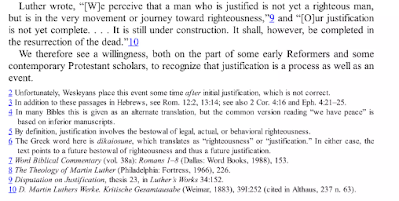
Luther said: “We perceive that a man who is justified is not yet a righteous man, but is in the very movement or journey toward righteousness,” - Disputation on Justification, thesis 23, in Luther’s Works 34:152.

“Our justification is not yet complete.... It is still under construction. It shall, however, be completed in the resurrection of the dead.” - D. Martin Luthers Werke. Kritische Gesamtausabe (Weimar, 1883), 39I:252 (cited in Althaus, 237 n. 63).

With these citations, Luther is put forth as an advocate of the process of justification... which is notoriously a Roman Catholic theological construct. Let's take a closer look at these quotes and see where they come from and what they are actually saying. We'll discover that the lines between what Luther and Rome are saying about Justification and the final judgment are being obfuscated. 

Documentation
The immediate red flag that this may be a blatant drive-by cut-and-paste are the English citations of Luther and accompanying German references. The cut-and-paste of these quotes is suspiciously similar to an old article by Rome's defender, Jimmy Akin, but more precisely material from Akin's later book, The Drama of Salvation, p. 29.  


It looks like Mr. Akin recycled his old article and made additions and corrections when he published his book (for instance, the first Luther quote is expanded in the book form and the documentation was corrected).  Mr. Akin has relied heavily on a section from Paul Althaus, The Theology of Martin Luther, (particularly page 226) in this presentation of Luther, with both quotes cited by Althaus on page 237 (Althaus translation of the first quote is slightly different than LW 34). Akin uses this material drawn from Althaus to conclude that "a number of recent Protestant scholars" recognize that Justification is a process and "in doing so they are retrieving a concept that was present in the thought of some of the early Reformers" (p.28). 

Mr. Akin argues for the Roman Catholic "process" of justification rather than the imputation of Christ's righteousness. For Akin, it's only "the final, consummating declaration of our righteousness" done in the future that will be the deciding factor if one is actually justified before God or not.  

Quote #1 "We perceive that a man who is justified is not yet a righteous man, but is in the very movement or journey toward righteousness"

This quote comes from a series of disputation statements based on Romanns 3:28, While this is the extent of the statement (it is point #23), the explanation of what Luther means in regard to justification is contained in the surrounding theses and subsequent explanations. In Theses #4, Luther says, "A man is truly justified by faith in the sight of God, even if he finds only disgrace before man and in his own self" (LW 34:151). For Luther, this is profound, for it is human nature to expect to earn salvation by works.  For Luther, our works do not contribute to standing before God as justified. In the same set of Theses, Luther says, "Therefore, whoever is justified is still a sinner; and yet he is considered fully and perfectly righteous by God who pardons and is merciful" (Theses #24).  Luther says the righteousness of Christ "cannot be laid hold of by our works" (Theses # 27) and that "faith alone justifies without our works " because one cannot say "I produce Christ or the righteousness of Christ" (Theses #28).

Luther says that God, in essence, tolerates sin in people until they enter his heavenly eternal kingdom. It is there he states, "For we perceive that a man who is justified is not yet a righteous man, but is in the very movement or journey toward righteousness." Is Luther saying that justification is a journey of the "process" of gaining righteousness toward some sort of eventual justification to stand before a holy God? Not at all. Luther says that good works done by the regenerate are the "start of a new creature" "in the battle against the sin of the flesh" (Theses #35).


Quote #2 “Our justification is not yet complete.... It is still under construction. It shall, however, be completed in the resurrection of the dead.” 

The document this quote comes from (Die Promotionsdisputation von Palladius und Tilemann [Rom 3:28] On the Works of the Law and of Grace [1537]) is scheduled to be released in a future volume of Luther's Works for English readers. The original text can be found here. Similar to the first quote, when Luther speaks of justification as "under construction" and then "completed in the resurrection of the dead," the emphasis is not on process-journey of gaining righteousness to stand before a holy God. The earthly existence is only the mere beginning of intrinsic personal righteousness.  As Paul Althaus explains of Luther, "The condition of being righteous in ourselves can be described in the present tense only as having begun, but its completion lies only in the future; we are only becoming righteous" (Althaus, 237). 


Conclusion
This blog entry is one of those keep your eyes on the ball exercises. For Luther, it's the one-time event in a person's life, in which the righteousness of Christ is imputed to a sinner that allows one into the saving presence of the Holy God, and to savingly remain forever in the presence of Holy God. In the final court room scene in each person's life, God declares a person righteous because the righteousness of Christ entirely covers that person.

The confusion that the anonymous commenter seized and applied to Romanism is that, according to Lutheran scholar Paul Althaus, "Luther used the term 'to justify' in [iustificare] and 'justification' [justificatio] in more than one sense" (Althaus, 226). Sometimes Luther used it to mean that sense in which a sinner stands before God and is judged according to the righteousness of Christ, imputed by faith. Other times he uses it to mean a person actually intrinsically becoming righteous. Althaus explains, "Justification in that sense remains incomplete on this earth and is first completed on the Last Day. Complete justification in this sense is an eschatological reality" (Althaus, 226).     By being made "perfectly righteous" Luther means being given a glorified body. Althaus later says of Luther's view, "This already present righteousness is both a complete and a partial righteousness, depending on the way in which it is viewed. It is complete when viewed as acceptance by God and as a participation in Christ's righteousness; Christ's righteousness is a totality and the believer participates in that totality. It is partial as man's new being and new obedience" (Althaus, 236). That new obedience culminates in the future: For Luther, in the final court room scene, a person is given a new existence: "Sin remains, then, perpetually in this life, until the hour of the last judgment comes and then at last we shall be made perfectly righteous" (LW 34:166).

For Rome, in the eternal state, God will look at person and judge whether or not that person is completely righteous. If that person is not completely infused with personal righteousness, that person is not given a glorified body, but is sent off to purgatory until personal righteousness is complete. In this world, therefore, a strong emphasis is placed on participating in the sacraments and gathering up as much righteousness as one can. Note Jimmy Akin's comment from his old article: 
[T]he ultimate and final courtroom declaration concerning the believer does not occur until he stands before God (at his death and at the end of the world). So we may infer that the ultimate and final pronouncement of the believer as righteous does not lie in this life.
In Luther's view, it is the righteousness of Christ given to a person that allows a sinner to enter into God's holy presence... and stay there. There is no need to be sent off to purgatory to be made righteous. In The Disputation Concerning Justification, Luther comments on the view of Erasmus that captures some of the nuances under scrutiny here: 
By faith we are justified and by faith we receive forgiveness of sins and the beginning of obedience, as Erasmus also argues. He distinguishes between faith and works in this way. Faith alone begins the forgiveness of sins, but works obtain salvation or merit and the kingdom of heaven or eternal life. He says that faith in this life removes sins and gives remission of sins, afterward he ascribes salvation to works. This is most excellent and plausible, and this argument pleases reason. For reason rushes in blindly and thinks thus: Eternal salvation is something else than Christian righteousness. It concludes that it can by its own works merit eternal salvation, as if we obtained justification through faith and salvation through works. So it seems plausible enough, since the text clearly said, “Man believes with his heart and so is justified, and he confesses with his lips and so is saved” [Rom. 10:10]. But this is absurd in the first place, because then Christ must be an incomplete and not a perfect savior. They wish thereby to make us more perfect than our Savior, because they attribute that which is the greatest to works and that which is least to Christ and faith. Even if Christ merits forgiveness of sins for us, we must still save ourselves. Likewise, we need Christ for justification, as if for the least important reason, afterward we need obedience for our salvation, as if for the most important reason. Who says such things? Beware of these arguments and of such men, since this now makes Christ less highly esteemed a savior, but detracts from his honor, that he has made us righteous by his death, since we ourselves can obtain eternal life by our works. These absurdities bring darkness into the minds of men. For they assume that Christ must not be the Savior, that he made us safe from original sin, and that we must later become perfect by ourselves. [LW 34:163]
In this life, if works are done, they are not done to gain favor with God.  In the Disputation in which the first quote was extracted, Luther repeatedly argues,
Works only reveal faith, just as fruits only show the tree, whether it is a good tree. I say, therefore, that works justify, that is, they show that we have been justified, just as his fruits show that a man is a Christian and believes in Christ, since he does not have a feigned faith and life before men. For the works indicate whether I have faith. I conclude, therefore, that he is righteous, when I see that he does good works. In God’s eyes that distinction is not necessary, for he is not deceived by hypocrisy. But it is necessary among men, so that they may correctly understand where faith is and where it is not. [LW 34:161].

Addendum

“Official Roman Catholic theology includes sanctification in the definition of justification, which it sees as a process rather than a single decisive event and affirms that while faith contributes to our acceptance with God, our works of satisfaction and merit contribute too. Rome sees baptism, viewed as a channel of sanctifying grace, as the primary instrumental cause of justification, and the sacrament of penance, whereby congruous merit is achieved through works of satisfaction, as the supplementary restorative cause whenever the grace of God’s initial acceptance is lost through mortal sin. Congruous, as distinct from condign, merit means merit that it is fitting, though not absolutely necessary, for God to reward by a fresh flow of sanctifying grace. On the Roman Catholic view, therefore, believers save themselves with the help of the grace that flows from Christ through the church’s sacramental system, and in this life no sense of confidence in God’s grace can ordinarily be had. Such teaching is a far cry from that of Paul.” (J.I. Packer Concise Theology)