
I realized I haven't had any blog posts up for a few days... the reason is due to my free time being spent over on the Catholic Answers Non Catholic Religions forum involved in the discussion,
"Martin Luther just knew that Catholics had too many rules." I will be doing a recap at some point in the future. I certainly though have learned about the standards Catholic Answers uses to moderate their forums in regard to what posts are allowed, which are deleted, who gets banned, who doesn't, which subjects are "on topic" and which aren't, and which religious bodies are allowed to be ridiculed and insulted and which are not.
Saturday, March 16, 2013


Monday, March 11, 2013
Saturday, March 09, 2013
Jimmy Akin on Why an Atheist May Be in Heaven
Here's another old post of Carrie's I just came across from the archives-
“It’s also possible for a person to die in God’s friendship even if the person didn’t consciously know God during life. Someone could, through no fault of their own, be unaware of God or not have ever been given sufficient evidence that they concluded God is true, through no fault of their own, and if they otherwise cooperated with his grace, then God won’t hold their ignorance of him against them. So, it’s possible for an atheist to be saved, it’s still through Jesus Christ and through God’s grace, but they can still die not knowing God and still be on their way to heaven as long as they otherwise cooperated with his grace.”This is justification by works alone, without faith, and contrary to Scripture.
"For God so loved the world that he gave his one and only Son, that whoever believes in him shall not perish but have eternal life. For God did not send his Son into the world to condemn the world, but to save the world through him. Whoever believes in him is not condemned, but whoever does not believe stands condemned already because he has not believed in the name of God's one and only Son." John 3:16-18Jimmy would also do well to read through Romans 1 before stating "Someone could, through no fault of their own, be unaware of God or not have ever been given sufficient evidence that they concluded God is true, through no fault of their own".
"The wrath of God is being revealed from heaven against all the godlessness and wickedness of men who suppress the truth by their wickedness, since what may be known about God is plain to them, because God has made it plain to them. For since the creation of the world God's invisible qualities—his eternal power and divine nature—have been clearly seen, being understood from what has been made, so that men are without excuse." Romans 1:18-20
Friday, March 08, 2013
Do You Have Problems Confessing Sin?
Well, these folks do:
http://forums.catholic.com/showthread.php?p=10454724#post10454724
Catholic Answers from this discussion:
"You have a valid complaint."
"Your complaint is valid if there is no option for "behind the screen" confession at all."
"I don't think you have a valid compliant in this instance."
http://forums.catholic.com/showthread.php?p=10454724#post10454724
Catholic Answers from this discussion:
"You have a valid complaint."
"Your complaint is valid if there is no option for "behind the screen" confession at all."
"I don't think you have a valid compliant in this instance."
Thursday, March 07, 2013
Luther's Painting of the Virgin Mary in His Study
From my mailbox:
I stumbled across your blog looking for a Table Talk reference where how the site of an image of the Virgin Mary and Child would evoke from Luther a lament at the way in which sinful man disregards the mercy shown by God in the Incarnation. Any help?
I've come across something like this before in Bridget Heal's The Cult of the Virgin Mary in Early Modern Germany: Protestant and Catholic Germany. She states, "Indeed we learn from the 'Table Talk' that he himself did in fact have an image of the Virgin and Child hanging in his study" [WA Tr., Vol. 2, no. 1755 and vol. 5, no. 6364. Attempts have been made to identify this with an existing painting of the Virgin and Child by Lucas Cranach. Joesef Lieball, Martin Luthers Madonnenbild (Stein am Rhein, 1981), pp. 77-80].
WA tr., 2, no. 1755 can be found here. This entry say something like, now the child is sleeping in Mary's arms, but wait til it wakes up! God may be slow to punish but wait til he gets to it. He will rouse himself... will also punish the cardinals, etc.
WA tr., 5 no. 6364 can be found here, and this appears to be the statement that the e-mail inquiry has in mind:
As always, it's to be remembered these are Table Talk statements, and not something Luther actually wrote, but is purported to have said. It also appears that any evidence of Luther having a picture of the Virgin and Child in his office comes from these Table Talk statements. It would be interesting to see Lieball's book and see what he concludes about this. I wonder what's happened since 1981? Have historians been able to identify if indeed such a painting was in Luther's study, and has that painting been identified today? There certainly are plenty to choose from if the painting was done by Cranach.
I stumbled across your blog looking for a Table Talk reference where how the site of an image of the Virgin Mary and Child would evoke from Luther a lament at the way in which sinful man disregards the mercy shown by God in the Incarnation. Any help?
I've come across something like this before in Bridget Heal's The Cult of the Virgin Mary in Early Modern Germany: Protestant and Catholic Germany. She states, "Indeed we learn from the 'Table Talk' that he himself did in fact have an image of the Virgin and Child hanging in his study" [WA Tr., Vol. 2, no. 1755 and vol. 5, no. 6364. Attempts have been made to identify this with an existing painting of the Virgin and Child by Lucas Cranach. Joesef Lieball, Martin Luthers Madonnenbild (Stein am Rhein, 1981), pp. 77-80].
WA tr., 2, no. 1755 can be found here. This entry say something like, now the child is sleeping in Mary's arms, but wait til it wakes up! God may be slow to punish but wait til he gets to it. He will rouse himself... will also punish the cardinals, etc.
WA tr., 5 no. 6364 can be found here, and this appears to be the statement that the e-mail inquiry has in mind:
"It is a great grace of God, That he gave his Son in the flesh. The mystery can be that no man can consider, and yet we are so cold and ungrateful.... When Doctor Martin viewed a painting of the little child Jesus resting in the lap of the pure virgin Mary, he sighed deeply on account of the article of the incarnation of God and said: Oh, that we would rightly contemplated the work of the divine mercy and not just cast is aside. Oh phooey, you disgusting unbelief! How you show yourself so horridly ungrateful regarding the friendly and gracious will of God, even while you attach yourself to all creatures instead. Oh, Adam's sin, what have you wrought?Special thanks to Brigitte for help with the translation.
As always, it's to be remembered these are Table Talk statements, and not something Luther actually wrote, but is purported to have said. It also appears that any evidence of Luther having a picture of the Virgin and Child in his office comes from these Table Talk statements. It would be interesting to see Lieball's book and see what he concludes about this. I wonder what's happened since 1981? Have historians been able to identify if indeed such a painting was in Luther's study, and has that painting been identified today? There certainly are plenty to choose from if the painting was done by Cranach.
Monday, March 04, 2013
Luther's Canon According to Roman Apologist, Mark Shea
There's a certain script that most Roman evaluations of the canon of Scripture follow. One scene will typically feature Luther. The scene has slight variations. Luther is portrayed as a radical who either removed books from the Bible, or wanted to remove books from the Bible. Sometimes Melanchthon is brought in in a supporting role restraining Luther from any moves against the canon. In the version below, Roman apologist Mark Shea gives his particular version:
At the Reformation, of course, the deuterocanon, both OT and NT, gets challenged. Luther wanted to chuck, not just the OT deuterocanon, but the NT deutercanon (Hebrews, James, 2 Peter, and Revelation) as well. (He remarks of James that it is an “epistle of straw” and says of Revelation something that many modern readers can empathize with: “A Revelation ought to reveal.”)[A reader puzzles about the deuterocanon]Mr. Shea should have had a historian check his script.
1. Luther was simply one of a number of theologians that questioned the canonicty of certain books during the 16th Century. His Roman Catholic contemporaries Cajetan and Erasmus did the same, as did some of the representatives at the Council of Trent. It is a simple historical fact that Luther’s translation of the Bible contained all of its books, even the Apocrypha (or Deutercanon).
2. Mr. Shea is in error that Luther had significant issues with 2 Peter. Luther's Preface to St. Peter, both the 1522 and 1546 versions do not indicate in any way that Luther thought this writing non-canonical.
3. In regard to Hebrews, Luther's opinion as to canonicty is not certain.The editors of Luther’s Works note Luther’s opinion fluctuated throughout his career: “… Luther was never consistent in either accepting or rejecting the Pauline authorship of the Epistle to the Hebrews but spoke of Paul as its author even when he had set forth the bold and brilliant suggestion that it was written by Apollos.”
4. Mr. Shea is correct that Luther held a negative view in regard to James, but has presented a caricature of the actual facts. Luther says James “is really an epistle of straw” compared to “St. John’s Gospel and his first epistle, St. Paul’s epistles, especially Romans, Galatians, and Ephesians, and St. Peter’s first epistle.” Luther wants his readers to see a comparison in regard to the presentation of the Gospel. That's why Luther would also praise James and considers it a “good book” “because it sets up no doctrine of men but vigorously promulgates the law of God.” Luther clearly values the law of God, but the Gospel, as presented elsewhere in the New Testament, stands as the "true kernel and marrow of all the books." An interesting fact that Shea may not know is that "the epistle of straw" comment only appears in the original 1522 Preface To The New Testament. For anyone to continue to cite Luther’s “epistle of straw” comment against him is to do Luther an injustice. He saw fit to retract the comment. Subsequent citations of this quote should bear this in mind.
5. Mr. Shea states Luther "says of Revelation something that many modern readers can empathize with: 'A Revelation ought to reveal'." This negative assessment from Shea intrigued me because elsewhere Shea affirms what Luther's alleges to have said:
"Anybody who says that Revelation is 'perspicuous' is simply a fool. Calvin was smart enough to not attempt a commentary on it because he knew it would give the lie to the notion of the perspicuity of Scripture. Luther, with his characteristic bluntness, sized the book up by remarking “A Revelation ought to reveal.” He tried to solve the problem by just excising it from the New Testament."Regardless of whether Shea agrees with what Luther is alleged to have said in regard to the perspicuity of Revelation, this quote is all over cyber-space typically without any sort of documentation. As far as I can tell it isn't in either of Luther's prefaces to the Book of Revelation. A few books (found via Google) use this quote. This book uses it and documents it by referring to another book which gives a short (and helpful) overview on Luther's view of Revelation. Scott Hahn uses it here. He provides a helpful clue, documenting it by referring back to Bainton's Here I Stand.
Bainton states, "He mistrusted Revelation because of its obscurity. 'A revelation,' said he, 'should be revealing'" (Bainton, 261). Bainton documents it as "CF. Fullerton" which refers to Fullerton, Kemper. "Luther's Doctrine and Criticism of Scripture," Bibliotheca Sacra, LXIII (1906), 1-34, 284-99. I found it odd that Bainton doesn't give a page number reference. I found Fullerton's articles. Part one (pages 1-34) can be found here; part two (pages 284-99) can be found here. After quickly going through these pages, I didn't find anything resembling that which Bainton cites. The closest thing I found was a discussion on pages 21-22. Fullerton states, "His chief objection to the book is its obscurity... the apostles prophesy with clear words, as it is proper to the apostolic office to speak clearly and without figure, of Christ's person and work." Unless I've missed it in Fullerton's articles, Bainton appears to be the popular source for Mr. Shea's Luther quote, and Bainton has either mis-documented the quote, or summarized Fullerton in such a way as to create a Luther quote. [See the pertinent section from Fullerton's article below].
Luther actually shares his own view of Revelation in his 1530 /1546 preface revision. In other words, contrary to Mr. Shea, Luther's solution was not to "chuck" the book. Even in the earlier 1522 version, Luther explains that his opinion is not to be binding: “About this book of the Revelation of John, I leave everyone free to hold his own opinions. I would not have anyone bound to my opinion or judgment,” and also, “let everyone think of it as his own spirit leads him.” By 1530, Luther took the opportunity to interpret Revelation. He begins by stating:
There are many different kinds of prophecy in Christendom. One is prophecy which interprets the writings of the prophets. Paul speaks of this in I Corinthians 12 and 14, and in other places as well. This is the most necessary kind and we must have it every day, because it teaches the Word of God, lays the foundation of Christendom, and defends the faith. In a word, it rules, preserves, establishes, and performs the preaching ministry. Another kind foretells things to come which are not previously contained in Scripture, and this prophecy is of three types. The first expresses itself simply in words, without images and figures—as Moses, David, and others of the prophets prophesy about Christ, and as Christ and the apostles prophesy about Antichrist, false teachers, etc. The second type does this with images, but alongside them it supplies their interpretation in specific words—as Joseph interprets dreams, and Daniel both dreams and images. The third type does it without either words or interpretations, exclusively with images and figures, like this book of Revelation and like the dreams, visions, and images that many holy people have had from the Holy Spirit—as Peter in Acts 2[:17] preaches from Joel [2:28], “Your sons and your daughters shall prophesy, and your young men shall see visions, and your old men shall dream dreams.” So long as this kind of prophecy remains without explanation and gets no sure interpretation, it is a concealed and mute prophecy and has not yet come to the profit and fruit which it is to give to Christendom. This is the way it has been with this book heretofore. Many have tried their hands at it, but until this very day they have attained no certainty. Some have even brewed it into many stupid things out of their own heads. Because its interpretation is uncertain and its meaning hidden, we have also let it alone until now, especially because some of the ancient fathers held that it was not the work of St. John, the Apostle—as is stated in The Ecclesiastical History, Book III, chapter 25. For our part, we still share this doubt. By that, however, no one should be prevented from regarding this as the work of St. John the Apostle, or of whomever else he chooses. Since we would nonetheless like to be sure of its meaning or interpretation, we will give other and higher minds something to think about by stating our own views. Since it is intended as a revelation of things that are to happen in the future, and especially of tribulations and disasters that were to come upon Christendom, we consider that the first and surest step toward finding its interpretation is to take from history the events and disasters that have come upon Christendom till now, and hold them up alongside of these images, and so compare them very carefully. If, then, the two perfectly coincided and squared with one another, we could build on that as a sure, or at least an unobjectionable, interpretation. [Luther, M. (1999, c1960). Vol. 35: Luther's works, vol. 35 : Word and Sacrament I (J. J. Pelikan, H. C. Oswald and H. T. Lehmann, Ed.). Luther's Works (35:399). Philadelphia: Fortress Press].
Addendum
Here is the only pertinent section from Fullerton on Luther's view of Revelation:
While the historical arguments are chiefly influential with Luther in the case of Jude and Hebrews, though the argument from contents is by no means ignored, the latter is the conclusive reason for his very unfavorable opinion of Revelation. He will not force others to adopt his opinions, but he proposes to say what he feels. His chief objection to the book is its obscurity (recall what has been said upon Luther's demand for a perspicuous Bible). The apostles prophesy without figure, of Christ's person and work. Not even in the Old Testament is there a prophet who deals so much in figures. The Apocalypse is more like Fourth Ezra [the same comparison is also made elsewhere], and Luther cannot discover that it is by the Holy Spirit. He finds fault with its threats and promises with regard to those who respectively add to or take from the book, or who keep its words when nobody knows what it means, and, as far as we are concerned, it need never have been written. In fine, his spirit cannot adjust itself to the book (Mein Geist kann sich in das Bitch nicht schicken), though he will let others think what they please about it. He notices also the doubts of the book in the early church, but this difficulty is entirely subordinate to the difficulties raised by the contents. It is enough reason for him to think little of the book because Christ is neither taught nor recognized in it, though that is the chief work of an apostle. In a sermon of the same year (1522) he actually classes the Apocalypse with the prophecies of Lichtenberger.
When it is remembered how hostile Luther was to Fourth Ezra (he would not even translate it), and to Lichtenberger, these comparisons are all the more surprising. But, as in the case of Jude and Hebrews, we must recognize here also the assumption of a much more conservative attitude in Luther's later writings. In a subsequent edition of the sermon just mentioned, the reference to the Apocalypse as being on the same plane with Lichtenberger is left out, and in the edition of his works in 1545 a new and much more moderate preface was substituted for the old one. He still finds trouble with the obscurity of the book. On account of this he had formerly let it alone, and especially because of the doubt of it in the early church, as attested by Eusebius (H. E. iii. 25). Many have attempted to explain it, but up to the present time have bought out nothing certain from it, but have read into it much inappropriate stuff out of their own heads (a timely warning still). But Luther will now make an earnest effort to give it an interpretation. It is noticeable how the emphasis now falls on the testimony of Eusebius, an historical argument as contrasted with the earlier emphasis upon the content.After going through Fullerton's article a second time, I'm of the opinion that the exact quote used by Bainton, "He mistrusted Revelation because of its obscurity. 'A revelation,' said he, 'should be revealing'" is a summary statement created by Bainton rather than a direct quote from Luther. This is how the quote came about:
Luther (1522) :"First and foremost, the apostles do not deal with visions, but prophesy in clear and plain words, as do Peter and Paul, and Christ in the gospel. For it befits the apostolic office to speak clearly of Christ and his deeds, without images and visions." .
Fullerton: "His chief objection to the book is its obscurity (recall what has been said upon Luther's demand for a perspicuous Bible). The apostles prophesy without figure, of Christ's person and work."
Bainton: "He mistrusted Revelation because of its obscurity. 'A revelation,' said he, 'should be revealing.'"
Sunday, March 03, 2013
Comforting Thoughts on Electing the Next Pope...
....from Jimmy Akin:
God Guides the Church
We can be confident of the general principle that God guides his Church. This is something we have biblical assurance of. But his guidance does not prevent human free will from operating, and that means there is the potential for humans to abuse their free will. That applies to the college of cardinals, too, even when they are electing a pope. They do not lose their free will.
Human Failure in History
We have been very fortunate in recent times to have a series of very holy, wise popes, but this has not always been the case. If you look at history, certain popes have been real scoundrels, like Pope Benedict IX (first elected in 1032). He was elected pope when still a boy. His reign was scandalous. He insisted upon monetary compensation in order to get him to resign. And then he didn't stay resigned. He was the only man to ever hold the papacy more than once. (In fact, he may have held it as many as three times.) Without going into all the scandals attributed to him, the Catholic Encyclopedia states: "He was a disgrace to the Chair of Peter."
God Guides the Church
We can be confident of the general principle that God guides his Church. This is something we have biblical assurance of. But his guidance does not prevent human free will from operating, and that means there is the potential for humans to abuse their free will. That applies to the college of cardinals, too, even when they are electing a pope. They do not lose their free will.
Human Failure in History
We have been very fortunate in recent times to have a series of very holy, wise popes, but this has not always been the case. If you look at history, certain popes have been real scoundrels, like Pope Benedict IX (first elected in 1032). He was elected pope when still a boy. His reign was scandalous. He insisted upon monetary compensation in order to get him to resign. And then he didn't stay resigned. He was the only man to ever hold the papacy more than once. (In fact, he may have held it as many as three times.) Without going into all the scandals attributed to him, the Catholic Encyclopedia states: "He was a disgrace to the Chair of Peter."
Saturday, March 02, 2013
Islam Against the Reformers
Rarely am I stumped by obscure Luther references. This one was recently sent over to me.
The excerpt below comes from a 19th Century Islamic work, Izharul-Haq (Truth Revealed) by "the distinguished 19th century Indian scholar, Rahmatullah Kairanv." The preface explains this book was "internationally recognized as one of the most authoritative and objective studies of the Bible." The book contains many of the common attacks against Luther, but the following excerpt is one of the most obscure I've ever come across. It was originally written in Arabic, translated into Urdu, and then into English:
The Fallibility of Luther and Calvin
Perhaps we might be allowed at this juncture, for the interest of the readers, to reproduce two incidents directly related to Luther and Calvin, the founders of the Protestant faith. We quote this from the book entitled Mira’atus Sidq that was translated into Urdu by a Catholic scholar and priest Thomas Inglus and printed in 1857. He relates the following incidents on pages 105-107:
This excerpt provides a number of clues, none of which led me to anything conclusive.
1. "We quote this from the book entitled Mira’atus Sidq that was translated into Urdu by a Catholic scholar and priest Thomas Inglus and printed in 1857." I spent a good deal of time trying to track down Mira’atus Sidq or Mira’atus Sidk known also as "The Mirror of the Truth" or "The Mirror of Truth." I'm not sure if this book is pro-Islamic or anti-Islamic. It appears to be pro, as one Islamic website alludes to it being reprinted in 2001.
2. I'm not certain who exactly wrote Mira’atus Sidq, since the only person mentioned, "Thomas Inglus" is noted as the translator. Some of the websites that use this same snippet say he was a "famous Catholic priest." I found nothing significant on "Thomas Inglus" even using the different spelling "Inglis" and also searching "Father Inglus" and derivatives. If he simply translated a pro-Islamic work, perhaps he did so to familiarize people with Islamic argumentation. Luther himself, if I recall, was interested in obtaining translations of Islamic works, particularly the Koran. If Inglus produced an anti-Islamic work, perhaps the material on the Reformers was simply another argument for the papacy.
3. I have no idea who "the son of Messina" is.
4. "Stiffels" appears to be Luther's friend Michael Stifel (1486?–1567). It is possible that in 1543 Luther had contact with him, as Stiefel appears to have been in Saxony in 1543 as a pastor. LW states:
After spending quite awhile looking for anything on the Luther material, I spent about five minutes on the Calvin story and realized I was in for the same sort of trip to nowhere. The bottom line: if one comes upon a Muslim using these stories, they have the burden of proof. Anyone using such materials as an apologetic is responsible for proving the material is historically verifiable. I certainly realize that a story about casting out demons is of a supernatural nature, however, credible historical documents from the 16th Century are not.
Rarely have I been stumped by obscure Luther references. Perhaps the reason this one made the list is due to it being based on Reformation folklore that had developed by the 19th Century. Perhaps something was lost in translation as well. This blog has been daily attacked by spam from Muslims (or, for fairness, users with Muslim names). Perhaps one of them could defend the claims of Rahmatullah Kairanv in regard to these stories about Luther and Calvin rather than spam the blog.
The excerpt below comes from a 19th Century Islamic work, Izharul-Haq (Truth Revealed) by "the distinguished 19th century Indian scholar, Rahmatullah Kairanv." The preface explains this book was "internationally recognized as one of the most authoritative and objective studies of the Bible." The book contains many of the common attacks against Luther, but the following excerpt is one of the most obscure I've ever come across. It was originally written in Arabic, translated into Urdu, and then into English:
The Fallibility of Luther and Calvin
Perhaps we might be allowed at this juncture, for the interest of the readers, to reproduce two incidents directly related to Luther and Calvin, the founders of the Protestant faith. We quote this from the book entitled Mira’atus Sidq that was translated into Urdu by a Catholic scholar and priest Thomas Inglus and printed in 1857. He relates the following incidents on pages 105-107:
“In 1543 Luther tried to cast out the devil from the son of Messina with a result similar to the Jews who once tried to cast out devil as is described by the Book of Acts in Chapter 19. Satan, in the same way attacked Luther and wounded him and his companions. Stiffels seeing that his spiritual leader, Luther was being choked and strangled by Satan, tried to run away but being in great terror was not able to open the latch of the door and had to break down the door with a hammer which was thrown to him from the outside by his servant through a ventilator.Both these leaders were considered to be the greatest spiritual leaders of their time. If they can be blamed for such acts what remains to be said of the generality of the people.
Another incident is related of Calvin, the great leader of the Protestants, by another historian. Calvin once hired a man called Bromius and told him to lie down in front of the people and pretend to be dead. He arranged with him that when he heard Calvin say the words, ”Bromius, rise from the dead and be alive,” he should rise from the bed as though he had been dead and had just risen, having been miraculously brought to life. The wife of Bromius was also told to cry and lament over the body of her husband. Bromius and his wife acted accordingly and people, hearing her cries and lamentation, gathered there for her consolation. Calvin came and said to the weeping woman, ”Do not cry. I will raise him from the dead.” He began to recite some prayers and then holding the hand of Bromius, said, ”Rise in the name of God.” But his design of deceiving people in the name of God was not a success as Bromius really had died. God had avenged Calvin for his deception and iniquity. Bromius’ wife, seeing that her husband had died in reality started crying and blaming Calvin.
This excerpt provides a number of clues, none of which led me to anything conclusive.
1. "We quote this from the book entitled Mira’atus Sidq that was translated into Urdu by a Catholic scholar and priest Thomas Inglus and printed in 1857." I spent a good deal of time trying to track down Mira’atus Sidq or Mira’atus Sidk known also as "The Mirror of the Truth" or "The Mirror of Truth." I'm not sure if this book is pro-Islamic or anti-Islamic. It appears to be pro, as one Islamic website alludes to it being reprinted in 2001.
2. I'm not certain who exactly wrote Mira’atus Sidq, since the only person mentioned, "Thomas Inglus" is noted as the translator. Some of the websites that use this same snippet say he was a "famous Catholic priest." I found nothing significant on "Thomas Inglus" even using the different spelling "Inglis" and also searching "Father Inglus" and derivatives. If he simply translated a pro-Islamic work, perhaps he did so to familiarize people with Islamic argumentation. Luther himself, if I recall, was interested in obtaining translations of Islamic works, particularly the Koran. If Inglus produced an anti-Islamic work, perhaps the material on the Reformers was simply another argument for the papacy.
3. I have no idea who "the son of Messina" is.
4. "Stiffels" appears to be Luther's friend Michael Stifel (1486?–1567). It is possible that in 1543 Luther had contact with him, as Stiefel appears to have been in Saxony in 1543 as a pastor. LW states:
Stiefel, was an Augustinian friar from Esslingen who in 1522 openly supported Luther. For this he had to flee to Wittenberg; while there, a close personal friendship between him and Luther developed. Upon Luther’s recommendation Stifel became a preacher in Mansfeld, and then later on in Tollet (in Upper Austria). From 1528 he held several pastorates in Electoral Saxony. Forced to leave Saxony during the Smalcaldic War, Stifel found a new home in East Prussia. In 1554 he returned to Wittenberg, and at once became involved in a controversy with Melanchthon. From 1559 to the end of his life Stifel taught mathematics at the University of Jena. Stifel had strong leanings toward apocalyptic speculation, which he combined with keen interest in and solid knowledge of mathematics. Consequently he could not resist attempting to determine when the world would come to an end. In 1532 he published a booklet in which he established that the world would come to an end and that Christ would return in glory on October 19, 1532. The enthusiasm with which he defended his theories and conclusions repeatedly caused him trouble, and Luther had to help him out of more than one tight situation. Luther, M. (1999, c1972). Vol. 49: Luther's works, vol. 49 : Letters II (J. J. Pelikan, H. C. Oswald and H. T. Lehmann, Ed.). Luther's Works (49:140). Philadelphia: Fortress Press.There are a significant number of apocryphal stories or folktales about Luther that grew and developed, and were eventually collected in the 1800's and early 1900's by German scholars. Most often these stories were pro-Luther (Luther seen with saint-like qualities). A great book on this is Popular Culture and Popular Movements in Reformation Germany by R.W. Scribner. Too bad I can't track him down and ask him if he's come across this story, as he was fluent in the pertinent literature. There are a handful of references of Luther and his associate in regard to demonic possession This would be the first time I've come across one in which The Reformers are seen as failing. For instance, in this link, note the same use of Acts 19 and the success of Johannes Bugenhagen against the Devil.
After spending quite awhile looking for anything on the Luther material, I spent about five minutes on the Calvin story and realized I was in for the same sort of trip to nowhere. The bottom line: if one comes upon a Muslim using these stories, they have the burden of proof. Anyone using such materials as an apologetic is responsible for proving the material is historically verifiable. I certainly realize that a story about casting out demons is of a supernatural nature, however, credible historical documents from the 16th Century are not.
Rarely have I been stumped by obscure Luther references. Perhaps the reason this one made the list is due to it being based on Reformation folklore that had developed by the 19th Century. Perhaps something was lost in translation as well. This blog has been daily attacked by spam from Muslims (or, for fairness, users with Muslim names). Perhaps one of them could defend the claims of Rahmatullah Kairanv in regard to these stories about Luther and Calvin rather than spam the blog.
Friday, March 01, 2013

Thursday, February 28, 2013
Online Reformed Responses to Roman Catholic Apologetic Claims
This blog post from the Reformed Reader is good idea:
Online Reformed Responses to Roman Catholic Apologetic Claims
Tuesday, February 26, 2013
Which American Roman Apologist Should Be the Next Pope?
As I venture around the Internet, I keep coming across the sentiment that technically any baptized male is eligible to be the next Pope. So, I started trying to determine which American Roman apologist, who already functions as an interpreter of Rome, should be deemed the next infallible interpreter of Rome. I've narrowed it down to Jimmy Akin and Scott Hahn. Suggestions?
The Pope and "Power tends to corrupt, and absolute power corrupts absolutely"
"Power tends to corrupt, and absolute power corrupts absolutely."I was just listening to a lecture in which is was pointed out that Lord Acton said this in regard to the question of whether the Pope has the power of infallibility. Sorry to say, I don't have any documentation to back this up, as it was only a passing comment in a lecture. It's interesting, if true, as I always thought this quote was in regard to secular rulers or political sentiment.
Luther: "I know that I have often done many things foolishly and very rashly"
"I know that I have often done many things foolishly and very rashly, so much so that I thought: “Why has God called me to preach when I do not have as much knowledge, discretion, and judgment as the importance of the office demands?” Although I performed everything with a pious and sincere heart, with pious devotion and zeal, yet a great deal of nonsense and many failures arose, with the result that heaven and the whole world seemed about to go to ruin. Then I was compelled to fall on my knees and to ask for help and counsel from God, who is powerful and turns a denouement in a tragedy into a catastrophe in a comedy while we are sleeping. Thus He creates Eve while Adam is sleeping. He takes a rib from him while he is sleeping, closes the place with flesh, and builds the rib which he took from Adam into flesh. Here someone may say that God had silken fingers, because He performs such a great work so nimbly and so easily. In the same manner He also governs His saints. Even if they have erred seriously in their thinking and have been guilty of great folly and rashness, from which countless evils can arise, yet He brings about a happy outcome, like the denouement in a comedy."
[Luther, M. (1999). Luther's works, vol. 5: Lectures on Genesis: Chapters 26-30 (J. J. Pelikan, H. C. Oswald and H. T. Lehmann, Ed.) (Ge 27:14). Saint Louis: Concordia Publishing House].
Monday, February 25, 2013
Luther's Sacristy Prayer
This will be the first blog post I've written on an Ipad, so I'm going to make it simple...
I came across this Luther-related blog post: Luther's Sacristy Prayer.
This blog entry did a good job tracking down a Luther quote back to the primary source. They also provided an English translation. What I found interesting is that they didn't use LW for their translation, provided below:
I came across this Luther-related blog post: Luther's Sacristy Prayer.
This blog entry did a good job tracking down a Luther quote back to the primary source. They also provided an English translation. What I found interesting is that they didn't use LW for their translation, provided below:
But above all a ruler in the church should pray in this manner: “Lord God, Thou hast appointed me in the church as bishop and pastor Thou seest how unfit I am to attend to such a great and difficult office, and if it had not been for Thy help, I would long since have ruined everything. Therefore I call upon Thee. Of course, I want to put my mouth and heart to use. I shall teach the people, and I myself shall learn and shall meditate diligently on Thy Word. Use me as Thy instrument. Only do not forsake me; for if I am alone, I shall easily destroy everything.” [LW 5:122]The blog entry states, "it isn't clear that Luther is offering this prayer for use just before worship." I don't see anything from the context that would indicate Luther has this in mind specifically, but it certainly could be used in such a way. They then provide what follows after from Luther, and here is how LW translates it:
The sects and the sectarians do the opposite, for they ascribe to themselves the wisdom and the ability to rule and to teach. Therefore they burst rashly into the church, do not pray, and do not believe that the administration either of the church or of the state is a gift of God; but they force themselves in as teachers and leaders. Therefore it eventually happens that they confuse and hinder what has been profitably built by others.Interesting stuff. Here I thought I was the only one tracking this stuff down...
Sunday, February 24, 2013
Martin Luther Teaching on Limited Atonement?
Here's a video I came across while searching for something else:
This video blogger asserts that "John Calvin was Martin Luther's greatest student." Calvin held Luther in high regard and there certainly are a number of theological agreements between these two men. But I would not go so far as to suggest, as this video blogger does, that Calvin followed Luther's view on the extent of the atonement as his greatest student. There's stronger evidence that suggests that it was, to a large extent, fellow Reformer Martin Bucer and an Augustian tradition that influenced Calvin on the extent of the atonement, not Luther.
The debate over the historicity of the doctrine of limited atonement is complex. It's actually more complex in regard to Calvin's view rather than Luther's. There are a number of scholars who argue Calvin did not hold to the doctrine of limited atonement. Then there are a number who argue the contrary. There are also typically two sorts of people who get involved with this controversy. Those in the first group are interested in history and in following the strands of evidence wherever it leads. They can either be Reformed or non-Reformed, and they can arrive at either position regarding Calvin's view. In the second group are those who are looking to refute Reformed soteriology by arguing Calvin himself did not hold to limited atonement (i.e. Geisler, etc.).
Jonathan Rainbow points out, "There is no single place where Calvin addressed the extent of Christ's redemption in a systematic fashion" (The Will of God and the Cross, p. 64). This means that each group of scholars arrives at their conclusion based on exegeting the strands of evidence throughout Calvin's writings. Rainbow points out that Calvin was never involved in any controversies involving the extent of the atonement. As far as I know, neither was Luther. This certainly means it requires much more work to sort out their views. Certainly by the late Sixteenth Century Lutheranism opposed limited atonement, while the Reformed tradition by the early Seventeenth Century embraced it with confessional statements (Rainbow, pp. 181-182). For what it's worth, I think Rainbow has presented one of the best constructed non-polemical treatments of Calvin's view.
If Calvin's view requires a lot of work to figure out, the evidence in regard to Luther's view is even more difficult to sift through. The simple truth is that, contrary to my Reformed brethren, Luther's writings are not filled with comments about predestination, election, and the extent of the atonement. Certainly Luther's Bondage of the Will gets involved with predestination, but if you set out to read Luther writings you'll find that these soteriological issues so important to Reformed theology don't get center stage in Luther's treatises.
This video-blogger cites Luther’s early work on Romans. There Luther comments on “God will have all men saved” (1 Tim 2:4). He says that sayings like this “must be understood only with respect to the elect” and that “Christ did not die for absolutely all.” From such comments it appears easy to conclude Luther taught limited atonement. But here's the crucial factor, as I see it: Other than this pre-reformation comment, there is no other evidence I know of that Luther maintained such a view throughout his life on the extent of the atonement.
Luther would instead go on to say things like, “[Christ] helps not against one sin only, but against all my sin; and not against my sin only, but against the whole world's sin. He comes to take away not sickness only, but death; and not my death only, but the whole world's death.” For Luther, the revealed God did indeed die for the sins of every human being. Quotes similar to this are peppered throughout his later writings. For Luther, the Scriptures state that Christ died for all men and not all are saved. Nevertheless, Christ died for all men, and wants all men saved.
I maintain that it appears, based explicitly on this one quote, and implicitly from Luther's early work on Romans, that limited atonement was an early view Luther held. His later writings strongly imply a different conclusion on the extent of the atonement. Those people (particularly Reformed people) use the Romans commentary quote at the expense of Luther's entire written corpus, thus caricaturing his view. It is typically the only quote they use, and I challenge them to search through Luther's writings to find another. I certainly would be interested in any quotes they find... I'm doubtful though anything like Luther's Romans quote exists.
This video blogger asserts that "John Calvin was Martin Luther's greatest student." Calvin held Luther in high regard and there certainly are a number of theological agreements between these two men. But I would not go so far as to suggest, as this video blogger does, that Calvin followed Luther's view on the extent of the atonement as his greatest student. There's stronger evidence that suggests that it was, to a large extent, fellow Reformer Martin Bucer and an Augustian tradition that influenced Calvin on the extent of the atonement, not Luther.
The debate over the historicity of the doctrine of limited atonement is complex. It's actually more complex in regard to Calvin's view rather than Luther's. There are a number of scholars who argue Calvin did not hold to the doctrine of limited atonement. Then there are a number who argue the contrary. There are also typically two sorts of people who get involved with this controversy. Those in the first group are interested in history and in following the strands of evidence wherever it leads. They can either be Reformed or non-Reformed, and they can arrive at either position regarding Calvin's view. In the second group are those who are looking to refute Reformed soteriology by arguing Calvin himself did not hold to limited atonement (i.e. Geisler, etc.).
Jonathan Rainbow points out, "There is no single place where Calvin addressed the extent of Christ's redemption in a systematic fashion" (The Will of God and the Cross, p. 64). This means that each group of scholars arrives at their conclusion based on exegeting the strands of evidence throughout Calvin's writings. Rainbow points out that Calvin was never involved in any controversies involving the extent of the atonement. As far as I know, neither was Luther. This certainly means it requires much more work to sort out their views. Certainly by the late Sixteenth Century Lutheranism opposed limited atonement, while the Reformed tradition by the early Seventeenth Century embraced it with confessional statements (Rainbow, pp. 181-182). For what it's worth, I think Rainbow has presented one of the best constructed non-polemical treatments of Calvin's view.
If Calvin's view requires a lot of work to figure out, the evidence in regard to Luther's view is even more difficult to sift through. The simple truth is that, contrary to my Reformed brethren, Luther's writings are not filled with comments about predestination, election, and the extent of the atonement. Certainly Luther's Bondage of the Will gets involved with predestination, but if you set out to read Luther writings you'll find that these soteriological issues so important to Reformed theology don't get center stage in Luther's treatises.
This video-blogger cites Luther’s early work on Romans. There Luther comments on “God will have all men saved” (1 Tim 2:4). He says that sayings like this “must be understood only with respect to the elect” and that “Christ did not die for absolutely all.” From such comments it appears easy to conclude Luther taught limited atonement. But here's the crucial factor, as I see it: Other than this pre-reformation comment, there is no other evidence I know of that Luther maintained such a view throughout his life on the extent of the atonement.
Luther would instead go on to say things like, “[Christ] helps not against one sin only, but against all my sin; and not against my sin only, but against the whole world's sin. He comes to take away not sickness only, but death; and not my death only, but the whole world's death.” For Luther, the revealed God did indeed die for the sins of every human being. Quotes similar to this are peppered throughout his later writings. For Luther, the Scriptures state that Christ died for all men and not all are saved. Nevertheless, Christ died for all men, and wants all men saved.
I maintain that it appears, based explicitly on this one quote, and implicitly from Luther's early work on Romans, that limited atonement was an early view Luther held. His later writings strongly imply a different conclusion on the extent of the atonement. Those people (particularly Reformed people) use the Romans commentary quote at the expense of Luther's entire written corpus, thus caricaturing his view. It is typically the only quote they use, and I challenge them to search through Luther's writings to find another. I certainly would be interested in any quotes they find... I'm doubtful though anything like Luther's Romans quote exists.
Sunday, February 17, 2013
For Lent I'm Giving Up...
For Lent I'm "giving up" giving up things...
Interesting post here: On Good Intentions, Spiritual Disciplines, and Christian Freedom
Interesting post here: On Good Intentions, Spiritual Disciplines, and Christian Freedom
Wikipedia's "John Calvin's views on Mary" (Part 2)

I've been intrigued by the alleged "Mariology" of the Reformers for years because of the argumentation of Roman Catholic apologists. While searching around the other day, I came across Wikipedia's John Calvin's views on Mary entry. I didn't get far into the entry before I came across facts that appeared odd. I'm going to work through the entry, time allowing.
Here's another odd fact:
Regarding Marian relics, Calvin commented in an ironical way that since the Roman Catholics believed in the Assumption of Mary, at least nobody can claim to have Marian relics, otherwise there would be so many Marian bones in circulation, that a huge new cemetery could be filled with them.[3][3]Algermissen 1988, 641Go ahead and try to search out the author "Algermissen" and the referenced work "Marienlexikon." It's not an easy find. The reference appears to be to a six-volume Marian encyclopedia by Remigius Bäumer in which Algermissen provided an entry on Calvin. The "1988" refers to the first volume.
Konrad Algermissen, John Calvin, in Marienlexikon, Regensburg, 1988 (quoted as Algermissen 1988)
While I wasn't able to get a copy of this source, the Calvin quote cited by Wiki appears to be from Calvin's treatise on Relics:
The Blessed Virgin.—The belief that the body of the Virgin was not interred on earth, but was taken to heaven, has deprived them of all pretext for manufacturing any relics of her remains, which otherwise might have been sufficiently abundant to fill a whole churchyard; yet in order to have at least something belonging to her, they sought to indemnify themselves for the absence of other relics with the possession of her hair and her milk. The hair is shown in several churches at Rome, and at Salvatierra in Spain, at Maçon, St Flour, Cluny, Nevers, and in many other towns. With regard to the milk, there is not perhaps a town, a convent, or nunnery, where it is not shown in large or small quantities. Indeed, had the Virgin been a wet-nurse her whole life, or a dairy, she could not have produced more than is shown as hers in various parts. How they obtained all this milk they do not say, and it is superfluous here to remark that there is no foundation in the Gospels for these foolish and blasphemous extravagances.If this is the quote the Wiki article has in mind, the citation they use is a very loose paraphrase of what Calvin actually wrote.
Saturday, February 16, 2013
Wikipedia's "John Calvin's views on Mary" (Part 1)
I've been intrigued by the alleged "Mariology" of the Reformers for years because of the argumentation of Roman Catholic apologists. While searching around the other day, I came across Wikipedia's John Calvin's views on Mary entry. I didn't get far into the entry before I came across a few facts that appeared odd. I'm going to work through the entry, time allowing.
One of the first oddities of this entry is that it states early on, "Calvin shows a decidedly positive view of Mary, and he did not hold to a number of the Protestant views on her that became common after the Reformation." It shortly thereafter states, "The criticism of Calvin on the Catholic Church in general and in regard to Mary in particular, is severe." The entry then states:
To Calvin, Mary is an idol in the Roman Church, and she diminishes the centrality and importance of Jesus. Hence, his Genevan Catechism not only outlawed Marian veneration, it also punished related behavior, such as carrying a rosary, observing a saints day, or possessing holy relics.[2]Certainly this type of punishment is consistent with the reforms put forth in Geneva in the 16th Century. However, note what the Wiki article asserts: Calvin's Genevan Catechism outlawed and punished Marian devotion. Now that's interesting, isn't it? A catechism that outlaws Marian devotion and sets forth punishment.
The [2] in the Wiki entry refers to Will Durant's volume on the Reformation, p. 469. Here's what Durant states:
"To restore the religious basis of an effective morality, Farel issued a Confession of Faith and Discipline, and Calvin a popular Catechism, which the Great Council approved (Novembver 1536). Citizens persistently transgressing the moral code were to be excommunicated and exiled. In July 1537, the Council ordered all citizens to go to the church of St. Peter and swear allegiance to Farel's Confession. Any manifestation of Catholicism- such as carrying a rosary, cherishing a sacred relic, or observing a saint's day as holy- was subject to punishment."Now I appreciate that the Wiki entry provided a reference, but if you compare what their entry says to what Durant says, it's two different things. The 1536 Confession of Faith can be found here. It doesn't have anything even remotely similar to what the Wiki article asserts. The closest you'll get to Wiki's assertions are the following:
XIX. Excommunication Because there are always some who hold God and his Word in contempt, who take account of neither injunction, exhortation nor remonstrance, thus requiring greater chastisement, we hold the discipline of excommunication to be a thing holy and salutary among the faithful, since truly it was instituted by our Lord with good reason. This is in order that the wicked would not by their damnable conduct corrupt the good and dishonor our Lord, and that though proud they may turn to penitence. Therefore we believe that it is expedient according to the ordinance of God that all manifest idolaters, blasphemers, murderers, thieves, lewd persons, false witnesses, sedition-mongers, quarrellers, those guilty of defamation or assault, drukards, dissolute livers, when they have been duly admonished and if they do not make amendment, be separated from the communion of the faithful until their repentance is known.
XXI. Magistrates We hold the supremacy and dominion of kings and princes as also of other magistrates and officers, to be a holy thing and a good ordinance of God. And since in performing their office they serve God and follow a Christian vocation, whether in defending the afflicted and innocent, or in correcting and punishing the malice of the perverse, we on our part also ought to accord them honour and reverence, to render respect and subservience, to execute their commands, to bear the charges they impose on us, so far as we are able without offence to God. In sum, we ought to regard them as vicars and lieutenants of God, whom one cannot resist without resisting God himself; and their office as a sacred commission from God which has been given them so that they may rule and govern us. Hence we hold that all Christians are bound to pray God for the prosperity of the superiors and lords of the country where they live, to obey the statutes and ordinances which do not contravene the commandments of God, to promote the welfare, peace and public good, endeavouring to sustain the honour of those over them and the peace of the people, without contriving or attempting anything to inspire trouble or dissension. On the other hand we declare that all those who conduct themselves unfaithfully towards their superiors, and have not a right concern for the public good of the country where they live, demonstrate thereby their infidelity towards God.
Great Musical Performances...
And now for something completely different... Here's a few great performances I've been grooving to...
Friday, February 15, 2013
This blog Does Not Have Malware
Recently, Google Chrome stopped people from visiting this blog saying there is malware present. The picture below is what they put up to warn people when they attempted to visit Beggars All. Well, there isn't Malware. What appears to have happened is that any links I posted to the CARM discussion boards caused Google Chrome to think I have malware. So, I've deleted all links to the CARM boards from the main page. Perhaps someone who knows Matt Slick should let him know about this.

Update from CARM:

Update from CARM:
Auto Response to many email questions: Forums are partially down, you may be able to view old links with error messages. Forums on and off for maintenance. Thank you for your patience. Apparently there are reports of "malware" that techs are working on, security reveals no "malware" on the forums but an error message related to attacks on our forum website.

Info from Google:

"Has this site acted as an intermediary resulting in further distribution of malware?

    Over the past 90 days, forums.carm.org/vbb did not appear to function as an intermediary for the infection of any sites.

Has this site hosted malware?

    No, this site has not hosted malicious software over the past 90 days.

How did this happen?

    In some cases, third parties can add malicious code to legitimate sites, which would cause us to show the warning message."
Thursday, February 14, 2013
Zwingli Believed in the Immaculate Conception?
Recently on the CARM boards someone stated, "Oddly, the father's of your Protestant heritage(i.e. Luther, Calvin, and Zwingli) all believed the teaching of the Immaculate Conception and it is only later Protestants that wandered from the truth." I've gone into detail on Luther's Mariology, and I've dabbled with the sparse comments Calvin made about Mary. But Zwingli hasn't been as easy study in regard to Mary. His writings can be difficult to track down. A few years back there were barely any available, now at least there is The Works of Zwingli (7 Volumes), Logos Bible Software Edition.
While searching around, I found some interesting comments from Zwingli's Thought: New Perspectives By Gottfried Wilhelm Locher in regard to Zwingli and the immaculate conception. It says "There is no trace in Zwingli of the doctrine of the 'immaculate conception'..."

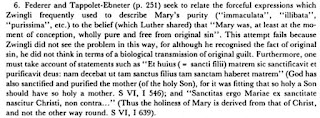
The page can be found on Google Books. Footnote #6 is quite interesting, particularly "Thus the holiness of Mary is serviced from that of Christ, and not the other way round." I'm curious as to which conception is in mind when the author states, "Mary was, at least at the moment of conception, wholly pure and free from original sin." With Luther, such a comment usually refers to the conception of Christ. I'm curious if this is the case with Zwingli as well.
Another book states, "Constantly as he insisted upon the certainty of the perpetual virginity of the mother of God he accepted neither her immaculate conception nor her assumption." Another book states, "The doctrine of the Immaculate Conception was disregarded by Zwingli..."
That the early Reformers were devoted to Mary (or held distinctive Roman Catholic beliefs later rejected by Protestants) has been a favorite argument of Roman Catholic apologetics. While the conclusions of the authors mentioned above are intriguing, they are not primary sources. A primary context needs to be exegeted. It does though make me wonder if the same thing is happening to Zwingli's Mariology as that which happened to Luther's Mariology: are Roman Catholic apologists reading history the way they want to, rather than actually tracking down the evidence to see what's there?
While searching around, I found some interesting comments from Zwingli's Thought: New Perspectives By Gottfried Wilhelm Locher in regard to Zwingli and the immaculate conception. It says "There is no trace in Zwingli of the doctrine of the 'immaculate conception'..."


The page can be found on Google Books. Footnote #6 is quite interesting, particularly "Thus the holiness of Mary is serviced from that of Christ, and not the other way round." I'm curious as to which conception is in mind when the author states, "Mary was, at least at the moment of conception, wholly pure and free from original sin." With Luther, such a comment usually refers to the conception of Christ. I'm curious if this is the case with Zwingli as well.
Another book states, "Constantly as he insisted upon the certainty of the perpetual virginity of the mother of God he accepted neither her immaculate conception nor her assumption." Another book states, "The doctrine of the Immaculate Conception was disregarded by Zwingli..."
That the early Reformers were devoted to Mary (or held distinctive Roman Catholic beliefs later rejected by Protestants) has been a favorite argument of Roman Catholic apologetics. While the conclusions of the authors mentioned above are intriguing, they are not primary sources. A primary context needs to be exegeted. It does though make me wonder if the same thing is happening to Zwingli's Mariology as that which happened to Luther's Mariology: are Roman Catholic apologists reading history the way they want to, rather than actually tracking down the evidence to see what's there?
Monday, February 11, 2013
Mutual understanding
Scott Alt, replying to a commenter to the effect that I am willfully blind to think that the Scripture teaches both of the following facts:
1) Believers who have reached the end of their earthly lives are alive to God, and
2) God forbids us from talking to dead people,
says the following:
Thus he shows that he doesn't even have the first idea what Calvinism says about the human will. Or, say, Romans 8:
1) Believers who have reached the end of their earthly lives are alive to God, and
2) God forbids us from talking to dead people,
says the following:
Scott_Alt· 20 hours agoI think that's right, though the concept of an obstinate refusal to see suggests the kind of freedom of the will that a Calvinist would deny. Interesting to speculate how Rhology would get himself out of that conundrum.
Thus he shows that he doesn't even have the first idea what Calvinism says about the human will. Or, say, Romans 8:
3For what the Law could not do, weak as it was through the flesh, God did: sending His own Son in the likeness of sinful flesh and as an offering for sin, He condemned sin in the flesh, 4so that the requirement of the Law might be fulfilled in us, who do not walk according to the flesh but according to the Spirit. 5For those who are according to the flesh set their minds on the things of the flesh, but those who are according to the Spirit, the things of the Spirit. 6For the mind set on the flesh is death, but the mind set on the Spirit is life and peace, 7because the mind set on the flesh is hostile toward God; for it does not subject itself to the law of God, for it is not even able to do so, 8and those who are in the flesh cannot please God.
It's just funny. Chalk this up to another "Protestant-to-atheist-to-Protestant-to-Catholic convert" who never got close to understanding Reformed theology. The problem here is that Alt thinks he does understand it. And the funny thing is that I get accused of misunderstanding Roman Catholic theology all the time but rarely does anyone attempt to demonstrate where I've mistaken its meaning. That's just projection.
Sunday, February 10, 2013
The North American Magisterium: Catholic Answers, last stop before Purgatory
I've sometimes referred Catholic Answers as the North American Magisterium. Consider this e-mail I just received from Catholic Answers. Catholic Answers has "had the Pope's back for more than three decades." I don't recall the Pope appointing them his official defender. Also, note the pitch at the end: you can keep Catholic Answers "in mind" before you arrive in purgatory.
Bragging a little about coming in second place may sound odd, but we want you to know that Catholic Answers’ website, Catholic.com, is the second most visited website in Catholic cyberspace.
“What’s the most visited site?”
I knew you’d ask. Well, it’s the Pope’s website, Vatican.va. If Catholic Answers has to come in second place, we’re happy to be behind the Holy Father. In fact, we’ve had the Pope’s back for the more than three decades we have been defending and sharing the Catholic Faith. Loyalty to the Holy Father and loyalty to the Magisterium are two of the hallmarks of Catholic Answers.
Our loyalty does not mean that some friendly rivalry is not called for. Our website is gaining on the Holy See’s.
Why?
Just a couple of weeks ago we added our new Catholic Answers Blog. With four or five daily posts from the likes of Karl Keating, Jimmy Akin, Tim Staples, Trent Horn, Matt Fradd, Patrick Coffin, Michelle Arnold, and Peggy Frye, we have been drawing many more visitors to our site.
In fact, our unique visitor count has gone up by 20%! So check out our new blog right on the front page of Catholic.com, and do continue to pray for us and keep Catholic Answers in mind as you make your estate plans.
Wednesday, February 06, 2013
And now, some slightly blasphemous prayers
While out at the abortion clinic, I've noticed that a few older Roman Catholic gentlemen come out as well for ~30 minutes, set out some pro-life signs, and pray what I was pretty sure was the Rosary.
Leaving aside the question of whether the Rosary has any effect on abortion (other than making demons laugh uproariously), last time I was out there, as they finished up their prayers and went back to their car, they passed my way and as we said hello, one of them handed me a pamphlet, saying, "These are the prayers we pray when we're out here."
I later flipped through it and found the following verses of sheer awesomeness, which I thought I'd share here. If you can pray these without wanting to throw up, you need to repent, and quickly.


Tuesday, February 05, 2013
How to Write a Worship Song (In 5 Minutes or Less)
Clever. We don't have this problem at my church. In fact, I've never seen a guitar in my church.
Sunday, February 03, 2013
The Absurdity of Separated Brethren
I came across this old post from blog contributor Carrie while looking up some of the recent ecumenical meanderings of Rome's defenders. Thanks Carrie, I frequently come across your old posts and enjoy what I find...
Before Protestants were "separated brethren"...
Before Protestants were "separated brethren"...
Q. Does the Lord make use of apostate Catholics, such as Martin Luther, Calvin, John Knox, Henry VIII., King of England, to reform the manners of the people?
A. The thought is absurd. The lives of those men were evil, and it is only the devil that makes use of them to pervert the people still more. The Lord makes use of His saints, such as a St. Francis of Assisium, a St. Dominick, a St. Ignatius, a St. Alphonsus, to convert the people and reform their evil manners by explaining to them the truths of faith, the commandments, and the necessity of receiving the sacraments with proper dispositions, and by setting them in their own lives the loftiest example of faith, purity, and all Christian virtues.
Q. Are there any other reasons to show that heretics, or Protestants who die out of the Roman Catholic Church, are not saved?
A. There are several. They cannot be saved, because
1. They have no divine faith.
2. They make a liar of Jesus Christ, of the Holy Ghost, and of the Apostles.
3. They have no faith in Christ.
4. They fell away from the true Church of Christ.
5. They are too proud to submit to the Pope, the Vicar of Christ.
6. They cannot perform any good works whereby they can obtain heaven.
7. They do not receive the Body and Blood of Christ.
8. They die in their sins.
9. They ridicule and blaspheme the Mother of God and His saints.
10. They slander the spouse of Jesus Christ —:the Catholic Church.
Q. What is the act of faith of a Protestant?
A. O my God, I believe nothing except what my own private judgment tells me to believe; therefore I believe that I can interpret Thy written word—the Holy Scriptures —as I choose. I believe that the Pope is anti-Christ; that any man can be saved, provided he is an honest man; I believe that faith alone is sufficient for salvation; that good works, and works of penance, and the confession of sins are not necessary, etc.
Q. Have Protestants any faith in Christ?
A. They never had.
Q. Why not?
A. Because there never lived such a Christ as they imagine and believe in.
Q. In what kind of a Christ do they believe?
A. In such a one of whom they can make a liar, with impunity, whose doctrine they can interpret as they please, and who does not care about what a man believes, provided he be an honest man before the public.
Q. Will such a faith in such a Christ save Protestants?
A. No sensible man will assert such an absurdity.
Familiar Explanation of Christian Doctrine
For the Family and More Advanced Students in Catholic Schools (1875)
(pgs 70, 91-93, 97-98; with imprimatur)
Luther on Copernicus
A friend's blog entry made me aware of this, from the Skeptical Lutheran blog:
I have run across this quote in several places attributed to Martin Luther, although I have been unable to find the original source.
If someone knows the original, or conversely, disputes the authenticity of the quote, please post in the comment section. No doubt a Lutheran in the early sixteenth century would have found himself excommunicated for insisting that the evidence supports a rotating earth. Of course, Lutherans now insist that God was being metaphorical when he wrote the book of Joshua. I find this astonishing, since Luther himself found the language so clear he was ready to call anyone who insisted otherwise a fool.
If you visit this blog entry, a comment left states:
I looked over the reference in White's book: Walch 22:2260. As far as I can discern, there's no page 2260 in the edition I checked (White used a 1743 edition, the one online is from 1887, so there could certainly be page number discrepancies between the editions). It is though, Luther's Table Talk, as White mentions. I don't believe the page number is a fabrication, but rather a different numbering. Consider the following Table Talk comment from LW 54:
Martin Luther on Copernicus
I have run across this quote in several places attributed to Martin Luther, although I have been unable to find the original source.
People give ear to an upstart astrologer who strove to show that the earth revolves, not the heavens or the firmament, the sun and the moon… Whoever wishes to appear clever must devise some new system, which of all systems is of course the very best. This fool wishes to reverse the entire science of astronomy; but the sacred scripture tells us [Joshua 10:13] that Joshua commanded the sun to stand still, not the earth.
If someone knows the original, or conversely, disputes the authenticity of the quote, please post in the comment section. No doubt a Lutheran in the early sixteenth century would have found himself excommunicated for insisting that the evidence supports a rotating earth. Of course, Lutherans now insist that God was being metaphorical when he wrote the book of Joshua. I find this astonishing, since Luther himself found the language so clear he was ready to call anyone who insisted otherwise a fool.
If you visit this blog entry, a comment left states:
I looked over the reference in White's book: Walch 22:2260. As far as I can discern, there's no page 2260 in the edition I checked (White used a 1743 edition, the one online is from 1887, so there could certainly be page number discrepancies between the editions). It is though, Luther's Table Talk, as White mentions. I don't believe the page number is a fabrication, but rather a different numbering. Consider the following Table Talk comment from LW 54:
No. 4638: Luther Rejects the Copernican Cosmology June 4, 1539 There was mention of a certain new astrologer who wanted to prove that the earth moves and not the sky, the sun, and the moon. This would be as if somebody were riding on a cart or in a ship and imagined that he was standing still while the earth and the trees were moving. [Luther remarked,] “So it goes now. Whoever wants to be clever must agree with nothing that others esteem. He must do something of his own. This is what that fellow does who wishes to turn the whole of astronomy upside down. Even in these things that are thrown into disorder I believe the Holy Scriptures, for Joshua commanded the sun to stand still and not the earth [Josh. 10:12].” Luther, M. (1999, c1967). Vol. 54: Luther's works, vol. 54 : Table Talk (J. J. Pelikan, H. C. Oswald and H. T. Lehmann, Ed.). Luther's Works (54:358). Philadelphia: Fortress Press.This seems to me to be very similar to that quoted by White. Keep in mind, sometimes there are multiple Table Talks referring to the same alleged statement from Luther. They usually say the same sort of thing, but can be longer or shorter. LW an English translation, often isn't a word for word translation, but thought for thought. Older translations can be very rigid. I've found that older citations of Luther are a lot looser than modern citations. White's book is from a period in which that was certainly the case. I wouldn't be at all surprised to discover that White conflated the longer Table Talk statement into the form he presents it in.
Saturday, February 02, 2013
Leaving Your Church vs. Leaving Your Infallible Authorty
Whenever any “church” or “pastor” does not conform to what by one’s own judgment the Spirit is speaking in one’s own heart, through one’s own study of Scripture, one is both free and obligated to reject and disobey the “church” or “pastor.” (Otherwise one cuts off the very act of Luther by which Protestantism justifies its entire existence as separate from the Catholic Church.) So the teachings and decisions of the “church” and “pastor” are always subject to the individual’s internal judgment concerning what the Spirit is speaking in the Scriptures. For that reason, the individual’s interpretive authority *is* ultimate, because the “church” and “pastor” can never trump it, but it can at any time trump that of the “church” and “pastor.”-snip-
Why did you choose to attend a Reformed church, rather than a Baptist church, a Methodist church, a Pentecostal church, a Church of Christ church, a Lutheran church, etc., etc., etc., …. etc.So says CTC's Bryan Cross.
As finite human beings, we never escape interpreting anything, be it an infallible Bible or an infallible church.
1. Did Mr. Cross use his own internal judgement when he chose the Roman church? If so, was this judgment "subject to the individual’s internal judgment concerning what the Spirit is speaking in the Scriptures"? That is, fundamentally, did Mr. Cross compare his reading of the Bible to what various churches believed, and then choose which church he wanted?
2. How is it that Mr.Cross isn't himself now a private interpreter of what Rome teaches? Why is he the correct interpreter of Rome, and someone like Gerry Matatics is not?
Sentiment as that put forth by Mr. Cross defines the context of the discussion. Don’t allow that. The discussion is not about joining this or that church. It’s about ultimate infallible authorities. Either Rome is the infallible authority or the Bible is the infallible authority. Whether or not one leaves this or that church isn’t the issue. I can certainly leave my infallible authority (the Bible) just as Mr. Cross could leave his infallible authority (the Roman church). Mr. Cross could use his private judgment and choose another infallible authority like the Mormon church. I could choose the Koran.
I choose not to leave my infallible authority. Sure, I might leave my church and join another, but this is not done at the expense of leaving my infallible authority. Mr. Cross could likewise choose to leave his particular flavor of Romanism for another flavor (a group in communion with Rome). He could do this without leaving Romanism. He would be using his private judgment… which he’s never stopped using.
Subscribe to:
Posts (Atom)

 Posts
Posts


