
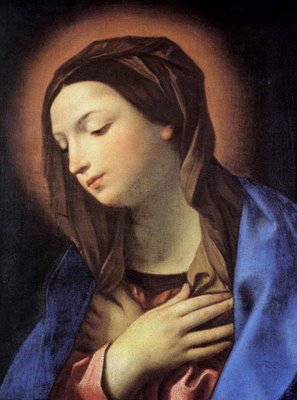
 I followed the link James White gave to a blogger who calls himself, "Tiber Jumper". I found one of those "Luther wants you to pray the Hail Mary" quotes. The brief discussion in which I engaged TJ can be found here: Magnificat: A Canticle of Mary, A Lesson for Us.The Luther quote used:
"Our prayer should include the Mother of God . . . What the Hail Mary says is that all glory should be given to God, using these words: "Hail Mary, full of grace. The Lord is with thee; blessed art thou among women and blessed is the fruit of thy womb, Jesus Christ. Amen!" You see that these words are not concerned with prayer but purely with giving praise and honor . . . We can use the Hail Mary as a meditation in which we recite what grace God has given her. Second, we should add a wish that everyone may know and respect her . . . He who has no faith is advised to refrain from saying the Hail Mary."
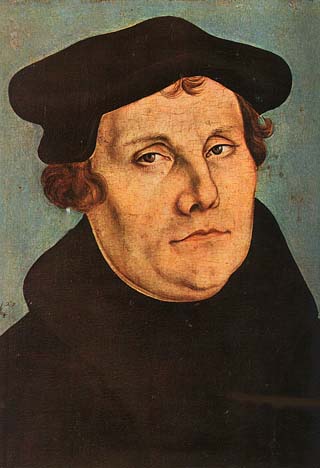
Roman Catholic criticism of Martin Luther is rampant in cyber-space. Fairly common topics include: Luther’s alleged antinomianism, his rejection of certain canonical books, his alleged desire to be a Protestant pope, and some even argue Luther’s partial responsibility for Nazi Germany. Interestingly though, when it comes to the topic of Mary, Roman Catholic sentiment towards Luther shifts considerably. Luther becomes the staunch supporter of Mary; a leader that all contemporary Protestants should learn a great lesson in Mariology from. This drastic shift is puzzling; particularly since Luther’s abandoning of the intercession of the saints and his doctrine of justification significantly changes his Marian approach.
Luther abandoned the most significant aspect of Roman Catholic Mariology: the intercession of Mary. Truly, this is the doctrine that defines Roman Catholic Mariology.Without a doctrine of the intercession of Mary, this woman and her attributes become less important in Luther’s theology.
The man who only a few years earlier called upon her, concluded that “those who bless her with many rosaries and constantly mouth the Hail Mary… speak evil against Christ’s word and faith in the worst way.” Their prayers to her are an evil deed against both her and her son. With the popular "Hail Mary" prayer, Luther reinterpreted it for his readers, again shifting the emphasis of praise to Mary to veneration of God alone.
Luther knew that prayers to, and faith in the saints violated the First Commandment. In his understanding, the role of faith or trust in the First Commandment determines whether one worships the true God, or an idol. To have a God is nothing else than to trust and believe in Him with the whole heart. This trust and the faith of the heart alone make either God or an idol. If faith and trust are “right,” then your god is the true God. If it is wrong, then you do not have the true God. That to which the heart clings is really your God. If your heart clings and entrusts itself to something God has made, then your faith is wrong, and you are caught in your sin, and you stand under the crushing condemnation of God’s law.
Even early in his Reformation career, Luther began changing the emphasis on Mary, and de-emphasizing the importance of her attributes:
“Take note of this: no one should put his trust or confidence in the Mother of God or in her merits, for such trust is worthy of God alone and is the lofty service due only to him. Rather praise and thank God through Mary and the grace given her. Laud and love her simply as the one who, without merit, obtained such blessings from God, sheerly out of his mercy, as she herself testifies in the Magnificat."But what does Luther mean by “through Mary”? Luther does not mean, “by praying to her,” but rather by thanking God for creating such a noble, blessed, person. The words of the Hail Mary are, according to Luther, “neither a prayer nor an invocation” and “are not concerned with prayer but purely with giving praise and honor” to God. Note the following quotes from Luther:
"Therefore we should make the Hail Mary neither a prayer nor an invocation because it is improper to interpret the words beyond what they mean in themselves and beyond the meaning given them by the Holy Spirit."
"…her giving birth is blessed in that it was spared the curse upon all children of Eve who are conceived in sin and born to deserve death and damnation. Only the fruit of her body is blessed, and through this birth we are all blessed.”
"…in the present no one speaks evil of this Mother and her Fruit as much as those who bless her with many rosaries and constantly mouth the Hail Mary. These, more than any others, speak evil against Christ’s word and faith in the worst way."
"Therefore, notice that this Mother and her Fruit are blessed in a twofold way—bodily and spiritually. Bodily with lips and the words of the Hail Mary; such persons blaspheme and speak evil of her most dangerously. And spiritually [one blesses her] in one’s heart by praise and benediction for her child, Christ—for all his words, deeds, and sufferings. And no one does this except he who has the true Christian faith because without such faith no heart is good but is by nature stuffed full of evil speech and blasphemy against God and all his saints."If TJ wants to practice Roman Catholic Mariology, I suggest he leaves Luther on the side of the Tiber in which he belongs. Luther will not champion the Roman Catholic cause. There is a particular effort among Catholic laymen apologists to use Luther as a "devotee of Mary". It's actually a farce if one does the research.





 Posts
Posts


