
I have previously posted two blogs discussing John Calvin, God’s gift of faith, and Ephesians 2:8-9:
Did Jon Calvin Believe Faith is a Gift given From God?
Everybody Loves Raymond.... But Raymond doesn't like Calvin
In the second link, a mystery man named Ray critiqued my analysis, and I responded accordingly. Well, Ray came back for more, and offered some further comments. My apologies for a longer blog entry. I’m trying to keep them short. I’m fairly convinced very few people read long writings.
Ray’s words will be in black, my words will be in blue (pun intended).
*****************************************************************
Ray Says: “Well, it sounds like we’ve hit a sensitive nerve. Mr. Swan (or is it Dr. Swan?) had a ready answer for my objections to his article.”
Swan replies: It’s not a sensitive nerve; it is simply a response to your comments. It is not “Dr. Swan,” but that title sure does have a nice “ring” to it.
Ray Says: “He suggests that I’m the worst of readers of Calvin since I believe Calvin contradicts himself on important issues. Notice how I was misquoted by Dr. Swan at this point. Hopefully, he wasn’t angry. Since he’s a new creation in Christ and no doubt abiding in Him, he can’t sin according to 1 Jn 3:6. I guess this was a simple oversight.”
Swan replies: I suggested previously you weren’t reading Calvin “carefully”. I also expressed amazement in your inability to understand Calvin in context. I don’t see where I misquoted you. You suggested first: scholars have a hard time with Calvin because he “appears” to contradict himself. Second: you affirmed agreement with a pastor who held Calvin did contradict himself on his comments on Ephesians 2:8-9.
Ray says: “But Dr. Swan brings up a good point. Did Calvin believe that faith is a gift from God or is it as I believe, a response to the offer of a gift by God? Dr. Swan showed examples in Calvin's writings other than Eph 2:8-9 that show Calvin believes faith to be a gift."
Swan replies: Calvin does not agree with you. He clearly held faith was a supernatural gift given by God to spiritually dead sinners. Sinners do not have the ability, according to Calvin, to muster up enough of their own faith to accept an offer of salvation without God first doing something supernatural to their spiritual inability to believe.
Ray says: "But wait a minute! Did Olson or Geisler claim that Calvin didn't believe faith was a gift or is it their claim that Eph 2:8-9 cannot be used as proof texts? I think Dr. Swan is guilty of going beyond what Olson and Geisler have said. Notice Dr. Swan's comment, "Both Geisler and Olson assert that Calvin did not believe faith was the gift of God, and his commentary on Ephesians 2:8-9 proves this." What kind of error would you call this Dr. Swan? Neither Olson nor Geisler ever claim that Calvin didn't believe faith is a gift of God. Did you really read them?"
Swan replies: Ok, I think I figured out what going on here. It appears you’re quoting me from John Mark’s blog. John Mark seems to have edited my words, I had sent him a huge document, and he extracted some sections from it to post on his blog. He posted this snippet:
“Both Geisler and Olson assert that Calvin did not believe faith was the gift of God, and his commentary on Ephesians 2:8-9 proves this. Geisler says, “But even John Calvin said of this text that "he does not mean that faith is the gift of God, but that salvation is given to us by God, or, that we obtain it by the gift of God.”<26> Olson comments similarly”
Actually what I had originally written was that Olson and Geisler’s position was “similar”:
“I once talked with a pastor who dismissed the Calvinist assertion that faith is a gift of God. An important facet of his argument was that even Calvin did not teach this, and his commentary on Ephesians 2:8-9 proves it. Both Geisler and Olson assert a similar position. Geisler says, “But even John Calvin said of this text that "he does not mean that faith is the gift of God, but that salvation is given to us by God, or, that we obtain it by the gift of God.”<26>"
On both John Mark’s blog (and my own) I clarified my position:
“Thus, Calvinists cannot be said to be “extreme” for holding that faith is the gift of God. It should be obvious that Geisler and Olson are in error if they are intending to assert that modern day Calvinists have gone beyond Calvin in believing faith to be a gift from God. In fairness, neither of these men explicitly asserts this, but the logical deduction is inherent in their comments, and the pastor I spoke with made the deduction. Neither Olson nor Geisler provide any positive statements like the above quotes. The pastor I spoke to seemed quite confident Calvin never believed faith to be a gift from God. When I brought these other Calvin passages to his attention, he had to agree that Calvin did in fact teach this doctrine. He then simply asserted that Calvin contradicted himself with comments on Ephesians 2:8-9, and this contradiction is a clear example of why Christians should never follow a fallible man.”
Ray says: “What they are claiming is that extreme Calvinists have an arsenal of proof texts to show that faith is the gift of God, and that Eph 2:8-9, as one, doesn't hold water. Olson and Geisler both go on to show that the remaining purported proof texts are equally weak. Indeed, their point is that Extreme Calvinism is an egregious example of a system of theology that is quick to read into texts of scripture what they want to hear rather than what it says. Interestingly, you have helped them prove their point with your examples of misquotes, going beyond what writers have said, misunderstanding what they have said, and then trashing them with flawed deduction and your own eisegesis."
Swan replies: What Olson and Geisler do is attempt to prove John Calvin was not a Calvinist. Norman Geisler calls those who (allegedly) go beyond Calvin “extreme Calvinists,” while mediates who interpret him (allegedly) correctly are “moderate Calvinists”:
“An extreme Calvinist is someone who is more Calvinistic than John Calvin (1509 – 1564), the founder of Calvinism. Since it can be argued that John Calvin did not believe in limited atonement…then it would follow that those who do are extreme Calvinists.”
Source: Norman Geisler, Chosen But Free (1st edition) (Minneapolis: Bethany House Publishers, 1999), 55.
Geisler says also,
“At first blush, it may seem absurd to ask whether John Calvin was a Calvinist. But he was not the first in the history of thought to have his views be distorted by his disciples. In fact, many of the great thinkers were misunderstood by their followers.”
Source: Norman Geisler, Chosen But Free (1st edition) (Minneapolis: Bethany House Publishers, 1999), 155.
The example of Calvin’s comment of Ephesians 2:8-9 is used by both Geisler and Olson. I find it extremely curious that neither Geisler nor Olson point out that Calvin explicitly noted Faith was a gift from God, but rather attempt to perpetuate a disharmony between Calvin and modern-day Calvinists by citing his comments selectively. Secondarily, I think they blew it on interpreting Calvin’s comment in context.
Ray says: "Let's look closer at Dr. Swan's review of my comments to his blog. Even though it's obvious that Calvin believes faith is a gift, he clearly does not believe that Eph 2:8-9 show that it's a gift."
Swan replies: As has been pointed out before, Calvin says that the error is restricting the word “gift” to faith alone.
Ray Says: “Amazingly, given the grammar, Calvin, Olson, Geisler and Ray to the contrary, Dr. Swan believes that Eph 2:8-9 does teach that faith is a gift. Let's look at his quote. He says, “Thus, grace, salvation, and faith are all the “gift of God.” It isn’t simply faith. It is the entire phrase. It is spurious logic to suggest that grace and salvation are gifts, but faith isn’t.”
Swan replies: A rendering of the grammar shows that the entirety of the phrase, “For by grace you have been saved through faith” is what the word “that”(touto) refers to. “touto” is a neuter singular demonstrative pronoun, and a proper exegesis would suggest that one looks for a singular neuter noun before it, but there aren’t any in the first part of the phrase in question. “Grace” is feminine singular; “Have been saved” is a masculine participle; and of course, as we all know, “faith” is feminine singular. In Ephesians 2:8-9, the neuter pronoun serves to wrap up the phrase into a single unity.
Ray Says: “Dr. Swan also says, " Note Calvin’s point: many people “restrict the word gift to faith alone.” But Calvin says that the entirety of salvation is the gift of God: that is, grace, salvation, and faith.." This is amazing. Calvin absolutely does not say that faith is included in the entirety of salvation. You are the only who says that. (Is this not eisegesis?) In fact Calvin goes out of his way to point out that to find faith as a gift in Eph 2:8-9 is an error. If what Dr. Swan says is true then I believe I can rest my case on Calvin being hard to pin down since he clearly contradicts himself. In fact, it's so confusing that even Dr. Swan got it wrong, and even suggests that Calvin is confused since he says one thing (Eph 2:8-9 is not teaching faith to be a gift) and believing another (Swan: "Calvin's point is…." and "Thus, grace, salvation, and faith are all the “gift of God.” It isn’t simply faith. It is the entire phrase. It is spurious logic to suggest that grace and salvation are gifts, but faith isn’t."”
Swan replies: Your comments clearly show your unfamiliarity with the historical/theological context in which Calvin wrote, thus you fall victim to anachronism. Those who restricted the word “gift” to “faith” alone were not extreme Calvinists like James Swan, RC Sproul or James White. They were Roman Catholics. Therefore, your interpretation of Calvin will never make sense, and you will always see a “contradiction”. Answer this question: why would a Roman Catholic want to restrict the word “gift” to “faith” alone? If you can answer this, you will grip Calvin in context.
Ray says: "I think Dr. Swan has been reading too much Calvin, White, and Sproul and not enough Olson and Geisler.”
Swan replies: In a situation like this, in which the question is “what did John Calvin believe?” It’s best to simply read Calvin, and reference multiple authors afterwards.
Ray says: "But let's look at the what Eph 2:8-9 really says . Reading the passage without straining, I would say that the grammar is saying that “salvation” is the gift, not grace, not faith, and its unlikely the whole phrase."
Swan replies: Your heroes say differently. Gordon Olson notes that touto “refers to the whole concept of salvation by grace” (Beyond Calvinism and Arminianism, 221). Norman Geisler says, “…(touto)…refers to the whole process of ‘salvation by grace through faith” (Chosen But Free, 183). I stated a similar position above. Paul is referring to salvation as a whole. Grace most definitely is a gift- it cannot be earned. If it could, it would not be grace. Faith is also a gift, as Philippians 1:29 so plainly teaches, as well as other passages. The entirety of salvation is a gift.
Ray says: "Grace is the means from God’s side (instrumental dative –te chariti), and faith is the meritless mechanism (dia + genitive) by which man appropriates the gift of salvation. (Though meritless we are held accountable for the choice.)"
Swan replies: Interesting choice of words: faith is the “Merit-less mechanism by which man appropriates the gift of salvation.” My Bible states that Jesus is the author and perfecter of faith. He begins it, and He is its goal. This is why it is “merit-less.” This is why it “appropriates the gift of salvation. It is not something that I authored. It has been created by Christ.
Ray says: “That faith is meritless and the means by which anyone can appropriate the gift is well illustrated by John 3:14-15 and the Israelite being immediately healed by simply looking at the brazen serpent. Would anyone consider this “look” a gift? I would say that the healing is the gift? The gift is offered, and the Israelite can either accept it or reject it. The provision of the brazen serpent and all of God’s power to effect the outcome could also be considered the gift, but God does require a volitional response, and that is provided by simply looking.”
Swan replies: John 3:14-15 describes that the crucifixion of Christ would result in the salvation of those who believe. It doesn’t delve into who is able to believe. Earlier, Christ tells Nicodemus that one must be born again to enter the kingdom of God. Look at the passage. No one chooses to be born. You didn’t choose your parents. Christ says, “Flesh gives birth to flesh, but the Spirit gives birth to spirit.” “The wind blows wherever it pleases. You hear its sound, but you cannot tell where it comes from or where it is going. So it is with everyone born of the Spirit.”
Ray says: "Bottom line: Olson and Geisler are solid in their exegesis. You Dr. Swan, however,………well the above discussion says it all."
Swan replies: Dr Geisler and Mr. Olson are lacking in historical exegesis. Had they taken the time to read Calvin in context, we wouldn’t be having this discussion.
Saturday, December 31, 2005


Tuesday, December 27, 2005
Popular Calvinist Myths and Calvin's Warning About Predestination

Pictured Above: Calvinist James Swan cautiously walks past a group of Arminians, Roman Catholic Apologists, and dispensationalists on his way to church this past Sunday.
Believe it or not, most Calvinists don’t hang around talking about predestination or the atonement. Maybe in cyber-space it seems that way, but in real life, this is not the case.
For example, I go to a very Reformed church. If you were to look in the hymnbook rack of the pew, you would find the Psalter hymnal. Flip to the back and you’ll find the Heidelberg Catechism, the Belgic Confession, and the Canons of Dort. These written confessions discuss "Calvinism." What you won’t find though in my church is a lot of people in the lobby before or after the service talking about the 5 points of Calvinism. During the service, you probably wont hear hymns being sung about predestination or limited atonement. Most of the time, the subject doesn’t even come up during the sermons. After the service, people aren't talking about "how great it is to be predestined" etc.
Why? Is it because I go to some liberal backslidden Reformed church? Absolutely not. We are very conservative. The reason actually is: the subjects of predestination, election, etc. are not “Bible basics”. They are not doctrines to discuss flippantly. They are deep and profound doctrines that require great care and handling when being discussed. They aren’t “Bible milk” –they are “Bible meat.” Even John Calvin gripped this. Most folks don’t realize Calvin didn’t really delve into these subjects in the Institutes until Book III. There was much doctrine that needed to come first. Calvin realized this- a good Reformed church will understand this, and a mature Calvinist should as well. I have (for the most part) avoided on-line discussions about predestination /election. It's important to have a healthy respect for the doctrines of Scripture. It's important to not use the Word of God recklessly.
But in cyber-space, this is not the case. These doctrines are thrown around like bouncing rubber balls in a china shop- causing all sorts of damage. Now, most of the time I blame non-Calvinists for doing this. They usually bring the rubber ball to the china shop and start throwing it, while some Calvinist chases after it to try to catch it, and throw it right back at where it came from. Some are pretty good at throwing it back, others end up simply breaking more china.
Here’s an old post I saved from the CARM discussion boards (2001). Check out this anti-Calvinist “rubber ball thrower.”These are the words of someone who doesn't know what they're talking about.:
“Why do Calvinists hate the love and mercy of God? Why do they hate the fact that God loves all men and seeks their salvation? Why do they get so upset with scriptures that teach of God's universal offer of atonement? Is it that they need to feel more special and above their non-elect neighbors?”Now, I’ve also heard a lot of negative things about John Calvin as the “originator” of Calvinism. Most of the time, I simply get the feeling those with a strong bent against Calvin never actually read Calvin. To echo the words of Ford Lewis Battles:
“I can usually tell, when people speak of Calvin, whether they know him only by hearsay, have read a few pages, or sampled him anthologically. They have no clue to the wonderful interconnectedness of Calvin’s thought. They ask questions which a fuller reading of the Institutes could have answered.”Source: Ford Lewis Battles, Analysis of the Institutes of the Christian Religion of John Calvin (New Jersey: P&R Publishing, 1980), 23.
I can usually tell also. Well, let’s do a little Calvin 101, with two tiny selections from Book III of the Institutes, chapter 21. Calvin offers a prefatory chapter on how to handle the subjects of predestination and election. Did Calvin just boldly rush into the Bible extracting Predestination and thrusting it onto the world? Read for yourself:
“Human curiosity renders the discussion of predestination, already somewhat difficult of itself, very confusing and even dangerous. No restraints can hold it back from wandering in forbidden bypaths and thrusting upward to the heights. If allowed, it will leave no secret to God that it will not search out and unravel. Since we see so many on all sides rushing into this audacity and impudence, among them certain men not otherwise bad, [Probably Zwingli] they should in due season be reminded of the measure of their duty in this regard.
First, then, let them remember that when they inquire into predestination they are penetrating the sacred precincts of divine wisdom. If anyone with carefree assurance breaks into this place, he will not succeed in satisfying his curiosity and he will enter a labyrinth from which he can find no exit. For it is not right for man unrestrainedly to search out things that the Lord has willed to be hid in himself, and to unfold from eternity itself the sublimest wisdom, which he would have us revere but not understand that through this also he should fill us with wonder. He has set forth by his Word the secrets of his will that he has decided to reveal to us. These he decided to reveal in so far as he foresaw that they would concern us and benefit us.”Source: Calvin's Institutes III.21. 1
“Let this, therefore, first of all be before our eyes: to seek any other knowledge of predestination than what the Word of God discloses is not less insane than if one should purpose to walk in a pathless waste [cf. Job 12:24], or to see in darkness. And let us not be ashamed to be ignorant of something in this matter, wherein there is a certain learned ignorance. Rather, let us willingly refrain from inquiring into a kind of knowledge, the ardent desire for which is both foolish and dangerous, nay, even deadly. But if a wanton curiosity agitates us, we shall always do well to oppose to it this restraining thought: just as too much honey is not good, so for the curious the investigation of glory is not turned into glory [Proverbs 25:27, cf. Vg.]. For there is good reason for us to be deterred from this insolence which can only plunge us into ruin.”Source: Calvin's Institutes III.21.2
These are only small snippets, and these words weren't a one-time-deal. I have other quotes in which Calvin says the same thing. These subjects must be approached with caution. But some go on to argue: these subjects shouldn't be approached at all. In part two, I'm going to look at another aspect of caution from Calvin on predestiantion and election: those who are too cautious.
Sunday, December 25, 2005
Checking In With The Theologians of Glory: Catholic Apologists
You’ll notice about halfway down on my sidebar I link to two groups of people. The first group is titled, “The Theologians of the Cross” and the second group is “Theologians of Glory.” These distinctions are stolen…well “borrowed” from Luther. You’ll notice that the second group is comprised of Roman Catholic apologists. Some of you may wonder why I as a Protestant would link to such folks (by the way, I have more i'd like to link to eventually). Is it because I have a spirit of ecumenicalism? The answer is blatantly “no.” I do not believe that the Roman Catholic Church preaches the Gospel, thus by extension, I do not agree with those who devote their lives to defending her.
But what do I mean “Theologians of Glory”? I assume, not everyone knows what i'm talking about. The subject of The Theology of the Cross vs. Glory is a lengthy subject. Here though, is the briefest overview I can put forth, (based on my notes from the lectures of Robert Kolb):
In 1518 Martin Luther was invited to Heidelberg to present his teaching. He presented his paradigm: “The Theology of the cross” vs. “Theology of Glory”. This disputation of 1518 created quite a stir and attention.
The Theology of the Cross is a theology of “foolishness.” It denies man’s wisdom and works; it rests totally upon Christ’s work. Indeed, it really does sound silly to think that salvation is found only through faith alone. All the worlds’ religions “reason” that God can only be appeased by some “work” on our part. But a Theologian of the Cross finds it is only in God’s action where we find salvation.
The Theology of Glory is founded on man’s wisdom and works. It is a worldview that seems “sensible and right” by worldly standards. Glory theologians have to understand by the use of reason, and they have to “do” by their own moral energy to be right with God.
The late medieval church that Luther was confronted with was a church filled with “glory.” By “glory,” Luther meant that the emphasis was not on the achievements of Christ, but on the achievement of the Roman Church, and those achievements were accomplished by the churches’ own power. Luther encountered the Theology of Glory in three different ways.
First he encountered the glory of “human reason” expressed in his earlier scholastic training. Scholastic theology had been strongly influenced by Aristotelian metaphysics, and this influence had misshaped the Biblical method.
Secondly, Luther was confronted with the glory of human effort (works). He encountered this in his monastic order. Neither Scholastic theology nor monasticism helped him escape his psychological burdens and sin.
Thirdly, he also rejected the “glory of the church” and said the church is a suffering church, rather than a church of beauty and splendor. The church is not supposed to be a “glory” of political power and luxury.
So why link to Roman Catholic apologists on this blog? I do so because I think one of the best ways to understand Protestant theology is to contrast it with Roman Catholic theology. The contrast of “Glory vs. Cross” is always in the forefront of my evaluations. The Reformation exploded onto the scene of history because of the Roman Catholic Church. In my own studies, I have learned a great deal about my own beliefs by comparing and contrasting it with the perspective of Rome.
Secondarily, I have also learned about my own beliefs by checking in with those contemporaries who defend Rome: modern-day Catholic apologists. It’s important to see the new ways they defend their beliefs and attack mine. So, from time to time on this blog, I’m going to run a feature called, “Checking In With The Theologians of Glory.”
But what do I mean “Theologians of Glory”? I assume, not everyone knows what i'm talking about. The subject of The Theology of the Cross vs. Glory is a lengthy subject. Here though, is the briefest overview I can put forth, (based on my notes from the lectures of Robert Kolb):
In 1518 Martin Luther was invited to Heidelberg to present his teaching. He presented his paradigm: “The Theology of the cross” vs. “Theology of Glory”. This disputation of 1518 created quite a stir and attention.
The Theology of the Cross is a theology of “foolishness.” It denies man’s wisdom and works; it rests totally upon Christ’s work. Indeed, it really does sound silly to think that salvation is found only through faith alone. All the worlds’ religions “reason” that God can only be appeased by some “work” on our part. But a Theologian of the Cross finds it is only in God’s action where we find salvation.
The Theology of Glory is founded on man’s wisdom and works. It is a worldview that seems “sensible and right” by worldly standards. Glory theologians have to understand by the use of reason, and they have to “do” by their own moral energy to be right with God.
The late medieval church that Luther was confronted with was a church filled with “glory.” By “glory,” Luther meant that the emphasis was not on the achievements of Christ, but on the achievement of the Roman Church, and those achievements were accomplished by the churches’ own power. Luther encountered the Theology of Glory in three different ways.
First he encountered the glory of “human reason” expressed in his earlier scholastic training. Scholastic theology had been strongly influenced by Aristotelian metaphysics, and this influence had misshaped the Biblical method.
Secondly, Luther was confronted with the glory of human effort (works). He encountered this in his monastic order. Neither Scholastic theology nor monasticism helped him escape his psychological burdens and sin.
Thirdly, he also rejected the “glory of the church” and said the church is a suffering church, rather than a church of beauty and splendor. The church is not supposed to be a “glory” of political power and luxury.
So why link to Roman Catholic apologists on this blog? I do so because I think one of the best ways to understand Protestant theology is to contrast it with Roman Catholic theology. The contrast of “Glory vs. Cross” is always in the forefront of my evaluations. The Reformation exploded onto the scene of history because of the Roman Catholic Church. In my own studies, I have learned a great deal about my own beliefs by comparing and contrasting it with the perspective of Rome.
Secondarily, I have also learned about my own beliefs by checking in with those contemporaries who defend Rome: modern-day Catholic apologists. It’s important to see the new ways they defend their beliefs and attack mine. So, from time to time on this blog, I’m going to run a feature called, “Checking In With The Theologians of Glory.”
Saturday, December 24, 2005
Luther, Christmas, and Complacency

Do you find yourself a bit bored with Christmas? I don’t think many Christians would admit it. Of course, we all hate the secularization and mass marketing of a sacred holiday. But what about the spiritual nature of this holiday? If you’ve been a Christian for a long period of time, have you become so familiar with the story of Christ’s birth that you’re “just going through the motions”? You know, you “space out” during sermons about the birth of Christ, or you simply mouth the words to the “Christmas” hymns? This is unfortunately the way we are as humans. We tend to become complacent with what is very familiar to us.
Martin Luther enjoyed Christmas day with full vigor. The thoughts of Christ’s birth filled his mind the entire day. Luther though often commented about man’s inability to fully appreciate the joy of Christmas:
“Ah, we poor people, to be so cold and sluggish in the face of the great joy that has clearly been prepared for us! This great benefaction exceeds by far all the other works of creation; and yet our faith in it is found to be so weak, although it is preached and sung to us by angels, who are heavenly theologians and who were so glad for our sake! Their song is very, very beautiful and describes the entire Christian religion. For giving glory to God in the highest heaven is the supreme worship. This they wish and bring us in the Christ."
Source: Ewald Plass (editor) What Luther Says Volume 1 (Saint Louis: Concordia Publishing house, 1959) 154..
Really, the story of Christ’s birth is an offense to sinful man. It is our sin nature that breeds complacency. Luther says sinful man “...cannot bear to have God speak to us in His majesty with countless thousands of angels.” To confound our sinfulness and ability to turn away from the praises of angels, God comes to us in Christ. Luther says,
“God says: Now I shall hide my majesty most thoroughly, shall allow My Son to become man, born of a virgin; let Him do good to men and preach them the forgiveness of sins. He shall act in the kindest manner possible; only bear in mind that this man is the same God who spoke in the desert at Mount Sinai to the Children of Israel. Believe, therefore, that it is He whom you are hearing. He has hidden His majesty in humanity, does not appear with lightning, thunder, or angels, but as one born of a poor virgin and speaking with men of the forgiveness of sins. But this makes men mad and irrational, and they nail Him to the cross. What shall we do? If God were to come with His angels, no one could listen to Him. Now he says: I will come in a simple and humble form, in the person of a man; therefore believe Me now. But we want to hear Him still less and despise Him. We hold He should by all means come in majesty, and yet we are unable to bear Him in this form. This we cannot bear, and that we do not want to bear. When He comes as the son of a poor virgin we say: Alas, this is to be the Messiah?”
Source: Ewald Plass (editor) What Luther Says Volume 1 (Saint Louis: Concordia Publishing house, 1959) 154-155.
Stop for a few moments and try to be honest with your complacency this holiday season. Realize, it is the inherent sinfulness of man that not only secularizes this holiday, but also causes those of the faith to be a little….bored. The cure? For me, by stopping for a while, meditating on my sinful life and the holiness of God, provokes a deep joy for the birth of a perfect Savior. The thought of my sins in the light of the holiness of God terrifies. Luther's advice: stay with God as He has revealed Himself in the lowly Christ. The lowly Christ offers forgiveness and salvation, peace with God. These cannot be attained by works, but grasped by faith.

Indeed, the most important stories of our lives are the stories of salvation. If you're married, you probably tell the "story" of your "salvation from singleness." If you have a great job, you probably tell the "story" of your "salvation from poverty." If you have wonderful friends who've been there for you, you probably tell your "story" of "salvation from isolation." I believe the babe in the manger is a mighty savior who forgave all my sins. The story of Christ's birth becomes the most important story of my life. I never tire of telling about the things i've been saved from- If you're struggling with boredom of the story of the birth of Christ, perhaps it isn't your story yet.
Friday, December 23, 2005
Everybody Loves Raymond...but "Raymond doesn't like Calvin"
As a follow-up to my last post about Calvin and the gift of faith, I’d like to respond to some comments directed towards me in the “comments section” on my friend John Mark’s blog found here.
To quickly summarize, John Calvin has been in the theological laboratories of some recent anti-Calvinist authors. After twisting, turning, and poking at Calvin’s writings, they’ve reinvented John Calvin to be a non-Calvinist.
For those of you who want to play along at home, one of the arguments against Calvinists and John Calvin goes like this:
1. Calvinists believe faith is a gift from God, given only to specific people.
2. Some Calvinists appeal to Ephesians 2:8-9 as proof that faith is a gift from God.
3. John Calvin did not believe Ephesians 2:8-9 teaches faith to be a gift from God.
4. Therefore, those Calvinists who do believe Ephesians 2:8-9 teach faith is a gift from God perpetuate an extreme form of Calvinism, one that John Calvin himself would not affirm.
A "mystery guy" by the name of Ray stopped by John Mark’s blog and took some shots at me. He was determined to defend the work coming out of the anti-Calvinist theological laboratories. Particularly, he was intent on the notion that Calvin contradicted himself on his comments on Ephesians 2:8-9.
Since this post is a bit of a brawl, Ray’s words will be in black; my words will be in blue.
****************************************************************
Ray says: “This was an interesting article and shows what many who've tried to get a fix on John Calvin's beliefs on a subject have found, viz., that Calvin is hard to pin down since he appears to contradict himself on important issues.”
Swan replies: I’m curious to who the “many” are you’re referring to. Which many conclude, “Calvin contradicts himself”? I've read dozens of books discussing Calvin. Only the worst of them say silly things like "John Calvin contradicted himself on his comments on Ephesians 2:8-9."
Ray says: “Swan's pastor is correct when he said, ‘Calvin contradicted himself with comments on Ephesians 2:8-9, and this contradiction is a clear example of why Christians should never follow a fallible man.’ Clearly a wise pastor.”
Swan replies: First of all, this pastor was not my pastor. Secondly, Reformed people do not “follow a fallible man.” They follow Christ. Thirdly, you have not demonstrated a contradiction in Calvin’s writings, but only asserted it. Nor have you demonstrated the error of my analysis of Calvin. For Calvin’s complete commentary on Ephesians see: Calvin's Ephesians Commentary. Here is the relevant section from Calvin:
“Ought we not then to be silent about free-will, and good intentions, and fancied preparations, and merits, and satisfactions? There is none of these which does not claim a share of praise in the salvation of men; so that the praise of grace would not, as Paul shews, remain undiminished. When, on the part of man, the act of receiving salvation is made to consist in faith alone, all other means, on which men are accustomed to rely, are discarded. Faith, then, brings a man empty to God, that he may be filled with the blessings of Christ. And so he adds, not of yourselves; that claiming nothing for themselves, they may acknowledge God alone as the author of their salvation.... This passage affords an easy refutation of the idle cavil by which Papists attempt to evade the argument, that we are justified without works. Paul, they tell us, is speaking about ceremonies. But the present question is not confined to one class of works. Nothing can be more clear than this. The whole righteousness of man, which consists in works, — nay, the whole man, and everything that he can call his own, is set aside. We must attend to the contrast between God and Man, between grace and works. Why should God be contrasted with man, if the controversy related to nothing more than ceremonies? Papists themselves are compelled to own that Paul ascribes to the grace of God the whole glory of our salvation, but endeavor to do away with this admission by another contrivance. This mode of expression, they tell us, is employed, because God bestows the first grace. It is really foolish to imagine that they can succeed in this way, since Paul excludes man and his utmost ability,—not only from the commencement, but throughout,—from the whole work of obtaining salvation. But it is still more absurd to overlook the apostle's inference, lest any man should boast. Some room must always remain for man's boasting, so long as, independently of grace, merits are of any avail. Paul's doctrine is overthrown, unless the whole praise is rendered to God alone and to his mercy. And here we must advert to a very common error in the interpretation of this passage. Many persons restrict the word gift to faith alone. But Paul is only repeating in other words the former sentiment. His meaning is, not that faith is the gift of God, but that salvation is given to us by God, or, that we obtain it by the gift of God.”
Note Calvin’s point: many people “restrict the word gift to faith alone.” But Calvin says that the entirety of salvation is the gift of God: that is, grace, salvation, and faith.
Ray says: “This brings me to my point. Since it's clear that basing one's argument on Calvin is risky, why doesn't Swan go to the heart of the argument, i.e., the grammar of Eph 2:8-9. This passage teaches clearly that salvation and not faith is the referent to gift.”
Swan replies: You’ve misunderstood the nature of my statements. I have never argued, “Faith is a gift from God because Calvin says so”. Rather, the nature of my comments are historical, and are intended to disprove the historical analysis of Dr. Geisler and Mr. Olson. The grammar shows that the phrase “for it is by grace you have been saved through faith” is what the word “that” refers to. Thus, grace, salvation, and faith are all the “gift of God.” It isn’t simply faith. It is the entire phrase. It is spurious logic to suggest that grace and salvation are gifts, but faith isn’t.
Ray Says: “Swan appears to ignore this important, even crux argument. Instead, he goes back to quoting Calvin to support the fact that Calvin didn't really mean what Calvin said directly in addressing this very same grammatical point. Amazing!”
Swan replies: No, what I did was show that Calvin consistently believed faith was a gift, and then I offered some minor explanations about the immediate context of Calvin’s comments. Simply, Calvin’s words are not that difficult to understand here if one simply reads them in context. Geisler, Olson, and Ray come to inaccurate conclusions because you’re not reading carefully.
Ray says: “Swan apparently didn't take to heart the wise counsel of his pastor.”
Swan replies: This man was not “Swan’s pastor.” Swan’s Pastors would never make such silly arguments. They know how to read books and understand contexts correctly.
Ray says: “In reading Olson, I was very impressed with his strategy that shows Calvinism to be a deductive theology.”
Swan replies: I was not impressed with Gordon Olson’s book. Quite frankly, the book is an awkward read and in need of severe editing. He basically regurgitates the anti-reformed arguments of Geisler and Laurence Vance. He sets up a false caricature. Calvinists (as well as non-Calvinists) use both inductive and deductive reasoning. We do so because we are human, and God's truth is consistent and knowable.
Ray Says: “Interestingly, one doesn't have to look far to find an illustrative example. Swan provides just that when he quotes White's comments on Calvin's response to Rome's claims in the Potter's Freedom: "nay, the whole man, and everything that he can call his own, is set aside. We must attend to the contrast between God and Man, between grace and works;" and "since Paul excludes man and his utmost ability, - not only from the commencement, but throughout, -” from the whole work of obtaining salvation." We suggest that the person who honestly wishes to know where Calvin would stand on the debate today would find these to be the key affirmations, for if Geisler's position is correct, and "anyone can believe," then Calvin's entire position is overthrown. WOULD NOT SUCH A FAITH BE SOMETHING THE MAN COULD "CALL HIS OWN"? CALVIN SAYS IT IS SET ASIDE. WOULD THIS NOT BE PART OF MAN'S "UTMOST ABILITY" ESPECIALLY AT THE VERY "COMMENCEMENT" OF SALVATION"? Paul excludes it from the whole work of obtaining salvation, Calvin teaches.” (Emphasis mine) Notice that White is going way beyond what Calvin SAYS, and telling us what he believes (based on White's Reformed Theology) Calvin MEANT. White hangs his hat on it. If this is not deductive theology, I don't know what else it is.
Swan replies: Ray, I suggest you put Dr. Olson’s book away because it seems to be confusing you. What James White pointed out was simply what any good Calvin scholar would point out: John Calvin believed in the bondage of the will, consistently throughout his writings. You seem to want to imply that John Calvin forgot about the bondage of the will when he wrote his Ephesians commentary. All of sudden, Calvin believed in free will. This is simply ludicrous. Go back and re-read Calvin. Read the entire commentary on Ephesians. If you want to argue that Calvin “contradicts himself”- do so by reading Calvin, not Gordon Olson or Norman Geisler.
Ray says: In fact, I'm always struck by the consistency of Reformed writers in reading their theology into text of scripture. If there were ever a hallmark of a false religion, deductive reasoning is it. I'm also equally struck by the Reformed writer's inability to see it. If you post any additional argument in the future, I would ask that you pay particular attention to tracing your argument from its inductive roots. If you don't I will and will certainly call you on it. "Believe on the Lord Jesus Christ, and thou shalt be saved." Or is it? "Be saved, and thou shalt believe." Ray --
Swan replies: I’m always struck by the inability of people to understand simple material in context. You’ve demonstrated this repeatedly, both in your understanding of Calvin and of my comments. During the next few months on this blog, I will take a closer look at Olson’s attack of “deductive reasoning” (I find it funny that Olson’s book argues using deductive reasoning at points).
To quickly summarize, John Calvin has been in the theological laboratories of some recent anti-Calvinist authors. After twisting, turning, and poking at Calvin’s writings, they’ve reinvented John Calvin to be a non-Calvinist.
For those of you who want to play along at home, one of the arguments against Calvinists and John Calvin goes like this:
1. Calvinists believe faith is a gift from God, given only to specific people.
2. Some Calvinists appeal to Ephesians 2:8-9 as proof that faith is a gift from God.
3. John Calvin did not believe Ephesians 2:8-9 teaches faith to be a gift from God.
4. Therefore, those Calvinists who do believe Ephesians 2:8-9 teach faith is a gift from God perpetuate an extreme form of Calvinism, one that John Calvin himself would not affirm.
A "mystery guy" by the name of Ray stopped by John Mark’s blog and took some shots at me. He was determined to defend the work coming out of the anti-Calvinist theological laboratories. Particularly, he was intent on the notion that Calvin contradicted himself on his comments on Ephesians 2:8-9.
Since this post is a bit of a brawl, Ray’s words will be in black; my words will be in blue.
****************************************************************
Ray says: “This was an interesting article and shows what many who've tried to get a fix on John Calvin's beliefs on a subject have found, viz., that Calvin is hard to pin down since he appears to contradict himself on important issues.”
Swan replies: I’m curious to who the “many” are you’re referring to. Which many conclude, “Calvin contradicts himself”? I've read dozens of books discussing Calvin. Only the worst of them say silly things like "John Calvin contradicted himself on his comments on Ephesians 2:8-9."
Ray says: “Swan's pastor is correct when he said, ‘Calvin contradicted himself with comments on Ephesians 2:8-9, and this contradiction is a clear example of why Christians should never follow a fallible man.’ Clearly a wise pastor.”
Swan replies: First of all, this pastor was not my pastor. Secondly, Reformed people do not “follow a fallible man.” They follow Christ. Thirdly, you have not demonstrated a contradiction in Calvin’s writings, but only asserted it. Nor have you demonstrated the error of my analysis of Calvin. For Calvin’s complete commentary on Ephesians see: Calvin's Ephesians Commentary. Here is the relevant section from Calvin:
“Ought we not then to be silent about free-will, and good intentions, and fancied preparations, and merits, and satisfactions? There is none of these which does not claim a share of praise in the salvation of men; so that the praise of grace would not, as Paul shews, remain undiminished. When, on the part of man, the act of receiving salvation is made to consist in faith alone, all other means, on which men are accustomed to rely, are discarded. Faith, then, brings a man empty to God, that he may be filled with the blessings of Christ. And so he adds, not of yourselves; that claiming nothing for themselves, they may acknowledge God alone as the author of their salvation.... This passage affords an easy refutation of the idle cavil by which Papists attempt to evade the argument, that we are justified without works. Paul, they tell us, is speaking about ceremonies. But the present question is not confined to one class of works. Nothing can be more clear than this. The whole righteousness of man, which consists in works, — nay, the whole man, and everything that he can call his own, is set aside. We must attend to the contrast between God and Man, between grace and works. Why should God be contrasted with man, if the controversy related to nothing more than ceremonies? Papists themselves are compelled to own that Paul ascribes to the grace of God the whole glory of our salvation, but endeavor to do away with this admission by another contrivance. This mode of expression, they tell us, is employed, because God bestows the first grace. It is really foolish to imagine that they can succeed in this way, since Paul excludes man and his utmost ability,—not only from the commencement, but throughout,—from the whole work of obtaining salvation. But it is still more absurd to overlook the apostle's inference, lest any man should boast. Some room must always remain for man's boasting, so long as, independently of grace, merits are of any avail. Paul's doctrine is overthrown, unless the whole praise is rendered to God alone and to his mercy. And here we must advert to a very common error in the interpretation of this passage. Many persons restrict the word gift to faith alone. But Paul is only repeating in other words the former sentiment. His meaning is, not that faith is the gift of God, but that salvation is given to us by God, or, that we obtain it by the gift of God.”
Note Calvin’s point: many people “restrict the word gift to faith alone.” But Calvin says that the entirety of salvation is the gift of God: that is, grace, salvation, and faith.
Ray says: “This brings me to my point. Since it's clear that basing one's argument on Calvin is risky, why doesn't Swan go to the heart of the argument, i.e., the grammar of Eph 2:8-9. This passage teaches clearly that salvation and not faith is the referent to gift.”
Swan replies: You’ve misunderstood the nature of my statements. I have never argued, “Faith is a gift from God because Calvin says so”. Rather, the nature of my comments are historical, and are intended to disprove the historical analysis of Dr. Geisler and Mr. Olson. The grammar shows that the phrase “for it is by grace you have been saved through faith” is what the word “that” refers to. Thus, grace, salvation, and faith are all the “gift of God.” It isn’t simply faith. It is the entire phrase. It is spurious logic to suggest that grace and salvation are gifts, but faith isn’t.
Ray Says: “Swan appears to ignore this important, even crux argument. Instead, he goes back to quoting Calvin to support the fact that Calvin didn't really mean what Calvin said directly in addressing this very same grammatical point. Amazing!”
Swan replies: No, what I did was show that Calvin consistently believed faith was a gift, and then I offered some minor explanations about the immediate context of Calvin’s comments. Simply, Calvin’s words are not that difficult to understand here if one simply reads them in context. Geisler, Olson, and Ray come to inaccurate conclusions because you’re not reading carefully.
Ray says: “Swan apparently didn't take to heart the wise counsel of his pastor.”
Swan replies: This man was not “Swan’s pastor.” Swan’s Pastors would never make such silly arguments. They know how to read books and understand contexts correctly.
Ray says: “In reading Olson, I was very impressed with his strategy that shows Calvinism to be a deductive theology.”
Swan replies: I was not impressed with Gordon Olson’s book. Quite frankly, the book is an awkward read and in need of severe editing. He basically regurgitates the anti-reformed arguments of Geisler and Laurence Vance. He sets up a false caricature. Calvinists (as well as non-Calvinists) use both inductive and deductive reasoning. We do so because we are human, and God's truth is consistent and knowable.
Ray Says: “Interestingly, one doesn't have to look far to find an illustrative example. Swan provides just that when he quotes White's comments on Calvin's response to Rome's claims in the Potter's Freedom: "nay, the whole man, and everything that he can call his own, is set aside. We must attend to the contrast between God and Man, between grace and works;" and "since Paul excludes man and his utmost ability, - not only from the commencement, but throughout, -” from the whole work of obtaining salvation." We suggest that the person who honestly wishes to know where Calvin would stand on the debate today would find these to be the key affirmations, for if Geisler's position is correct, and "anyone can believe," then Calvin's entire position is overthrown. WOULD NOT SUCH A FAITH BE SOMETHING THE MAN COULD "CALL HIS OWN"? CALVIN SAYS IT IS SET ASIDE. WOULD THIS NOT BE PART OF MAN'S "UTMOST ABILITY" ESPECIALLY AT THE VERY "COMMENCEMENT" OF SALVATION"? Paul excludes it from the whole work of obtaining salvation, Calvin teaches.” (Emphasis mine) Notice that White is going way beyond what Calvin SAYS, and telling us what he believes (based on White's Reformed Theology) Calvin MEANT. White hangs his hat on it. If this is not deductive theology, I don't know what else it is.
Swan replies: Ray, I suggest you put Dr. Olson’s book away because it seems to be confusing you. What James White pointed out was simply what any good Calvin scholar would point out: John Calvin believed in the bondage of the will, consistently throughout his writings. You seem to want to imply that John Calvin forgot about the bondage of the will when he wrote his Ephesians commentary. All of sudden, Calvin believed in free will. This is simply ludicrous. Go back and re-read Calvin. Read the entire commentary on Ephesians. If you want to argue that Calvin “contradicts himself”- do so by reading Calvin, not Gordon Olson or Norman Geisler.
Ray says: In fact, I'm always struck by the consistency of Reformed writers in reading their theology into text of scripture. If there were ever a hallmark of a false religion, deductive reasoning is it. I'm also equally struck by the Reformed writer's inability to see it. If you post any additional argument in the future, I would ask that you pay particular attention to tracing your argument from its inductive roots. If you don't I will and will certainly call you on it. "Believe on the Lord Jesus Christ, and thou shalt be saved." Or is it? "Be saved, and thou shalt believe." Ray --
Swan replies: I’m always struck by the inability of people to understand simple material in context. You’ve demonstrated this repeatedly, both in your understanding of Calvin and of my comments. During the next few months on this blog, I will take a closer look at Olson’s attack of “deductive reasoning” (I find it funny that Olson’s book argues using deductive reasoning at points).
Wednesday, December 21, 2005
Did John Calvin Believe Faith is a Gift given From God?
“Faith, then, brings a man empty to God, that he may be filled with the blessings of Christ. And so he adds, not of yourselves; that claiming nothing for themselves, they may acknowledge God alone as the author of their salvation…”
-John Calvin
I once talked with a pastor who dismissed the Calvinist assertion that faith is a gift of God. An important facet of his argument was that even John Calvin did not teach this, and his commentary on Ephesians 2:8-9 proves it. He based his opinion on the work of two recent anti-Reformed writers: Norman Geisler’s Chosen But Free (Minneapolis: Bethany House Publishers, 1999) and C. Gordon Olson’s Beyond Calvinism and Arminianism: An Inductive Mediate Theology of Salvation (New Jersey: Global Gospel Publishers, 2002). These authors hold that modern-day Calvinists who hold faith is a gift of God are “extreme Calvinists”, because not even John Calvin believed this.
Geisler says of Ephesians 2:8-9, “But even John Calvin said of this text that "he does not mean that faith is the gift of God, but that salvation is given to us by God, or, that we obtain it by the gift of God.”(CBF, 182).
Gordon Olson comments similarly:
“Calvinists have a ready arsenal of proof-texts for the idea that faith is the direct, immediate gift of God. By far the most frequently referred to is Ephesians 2:8-9 (need I quote it?). The exegetical flimsiness of using this passage in this way should be common knowledge. Apparently it is not……Calvin… [is] among the host who reject such isogesis since they recognized that the relative pronoun touto (this) is neuter and pistis (faith) is feminine and cannot serve as its antecedent. Although Calvin doesn't explain the grammar, he is very explicit about this error: “And here we must advert to a very common error in the interpretation of this passage. Many persons restrict the word gift to faith alone. But Paul is only repeating in other words the former sentiment. His meaning is, not that faith is the gift of God, but that salvation is given to us by God, or, that we obtain it by the gift of God.”… Is there any question that all those who continue to ignore the unambiguous grammar and scholarly opinion of even Calvin himself are rightly called extreme or hyper-Calvinists.” (p.221)
Both Geisler and Olson believe Calvin explicitly denied Ephesians 2:8-9 teaches faith to be the gift of the God. Putting the Ephesians passage aside for a moment, what they do not point out is that Calvin did teach faith is a gift from God, given only to certain people. Calvin said this numerous times throughout his writings:
“[Paul] exhorts the Ephesians to remember (Ephesians 2) that they were saved by grace, not by themselves nor by their own works.... Faith, moreover, precedes justification, but in such a sense, that in respect of God, it follows. What they [Roman Catholics] say of faith might perhaps hold true, were faith itself, which puts us in possession of righteousness, our own. But seeing that it too is the free gift of God, the exception which they introduce is superfluous. Scripture, indeed, removes all doubt on another ground, when it opposes faith to works, to prevent its being classed among merits. Faith brings nothing of our own to God, but receives what God spontaneously offers us. Hence it is that faith, however imperfect, nevertheless possesses a perfect righteousness, because it has respect to nothing but the gratuitous goodness of God.” (John Calvin Acts of the Council of Trent With its Antidote, in The Comprehensive John Calvin Collection (Ages Digital Library, 1998), 110) .
“Now we understand that we are made partakers of all his blessings by means of faith; for this it is which brings us into communication with Christ, in order that he may dwell in us, that we may be ingrafted into him as our root, that we may be members of his body, that we may live in him, and he in us, and possess him, with all his benefits. And that it may not be thought strange that we attribute such virtue to faith, we do not take it fox a fleeting opinion, but for a certainty which we have of the promises of God, in which all these blessings are contained, and by which we embrace our Lord Jesus Christ as the surety of all our salvation, and apply to our own use what he has received of God his Father to impart unto us. This faith we likewise know that we cannot have if it be not given us from above, and as Scripture declares, (Ephesians 2:9; 1:18,) till the Holy Spirit enlightens us to comprehend what is beyond all human sense, and seals in our hearts what we ought to believe.”[John Calvin, Selected Works of Calvin Volume 2, in The Comprehensive John Calvin Collection (Ages Digital Library, 1998), 138].
"Since, therefore, Abraham is at this time the father of all the faithful, it, follows that our safety is not to be thought otherwise than in that covenant which God established with Abraham; but afterwards the same covenant was ratified by the hand of Moses. A difference must now be briefly remarked from a passage in Jeremiah, (Jeremiah 31:32,) namely, because the ancient covenant was abolished through the fault of man, there was reed of a better remedy, which is there shown to be twofold, namely, that God should bury men’s sins, and inscribe his law on their hearts: that also was done in Abraham’s time. Abraham believed in God: faith was always the gift of the Holy Spirit; therefore God inscribed his covenant in Abraham’s heart. (Genesis 15:6; Romans 4:3; Ephesians 2:8.)”[ John Calvin, Commentary on Ezekiel, in The Comprehensive John Calvin Collection (Ages Digital Library, 1998), 574]).
“Dearly beloved brethren we must not be amazed if the article of the everlasting predestination to God, be so assaulted and fought against by Satan’s maintainers, seeing it is the foundation of our salvation, and also serveth for the better magnifying of the free goodness of God towards us. On the other side those Dogs which bark against it thinking to have a good and favorable cause are therein more hardy: as in very truth there is nothing more contrary to man’s understanding, than to place the cause of our salvation in the good will of God, in saying, that it belongeth to him alone to choose us: without finding of anything in us wherefore he should choose us: and after he hath chosen us, to give us faith through which we should be justified.”[ John Calvin, Sermon on Election and Reprobation, in The Comprehensive John Calvin Collection (Ages Digital Library, 1998), 225.]
Thus, Calvinists cannot be said to be “extreme” for holding that faith is the gift of God. It should be obvious that Geisler and Olson are in error if they are intending to assert that modern day Calvinists have gone beyond Calvin in believing faith to be a gift from God. In fairness, neither of these men explicitly asserts this, but the logical deduction is inherent in their comments, and the pastor I spoke with made the deduction. Neither Olson nor Geisler provide any positive statements like the above quotes. The pastor I spoke to seemed quite confident Calvin never believed faith to be a gift from God. When I brought these other Calvin passages to his attention, he had to agree that Calvin did in fact teach this doctrine. He then simply asserted that Calvin contradicted himself with comments on Ephesians 2:8-9, and this contradiction is a clear example of why Christians should never follow a fallible man.
As to Calvin’s comments on Ephesians 2:8-9, Calvin did not contradict himself with his comments on these verses.
First, let's do a little "alternate reality" type of analysis: it would not be a contradiction for Calvin to hold that faith was a gift from God, and that Ephesians 2:8-9 did not explicitly teach this truth.
Second, back to reality, I do think Calvin held Ephesians 2:8-9 implicitly taught that faith was the gift of God for the following reasons:
(a) In other quotes as shown above, Calvin includes Ephesians 2 when discussing faith being a gift from God.
(b) The immediate context of his comments show that Calvin believed free will (in regards to salvation) was a theological error- Salvation is obtained by faith alone, and that salvation is entirely the work of God. Calvin does not hold that depraved man has the ability to exercise saving faith without God’s gift of faith. As James White has pointed out,
“…[M]ake special note of two of the phrases provided by Calvin in response to Rome's claims: "nay, the whole man, and everything that he can call his own, is set aside. We must attend to the contrast between God and Man, between grace and works;" and "since Paul excludes man and his utmost ability, — not only from the commencement, but throughout, — from the whole work of obtaining salvation." We suggest that the person who honestly wishes to know where Calvin would stand on the debate today would find these to be the key affirmations, for if Geisler's position is correct, and "anyone can believe," then Calvin's entire position is overthrown. Would not such a faith be something the man could "call his own"? Calvin says it is set aside. Would this not be part of man's "utmost ability" especially at the very "commencement" of salvation"? Paul excludes it from the whole work of obtaining salvation, Calvin teaches.” (James White, The Potter’s Freedom (New York: Calvary Press, 2000), 318-319)
(c) Olson is correct when he asserts that “Calvin doesn’t explain the grammar.” However, Calvin does say that the error is restricting the word “gift” to faith alone. One must remember Calvin wrote in response to the errors of medieval Catholic theology, that posited a synergism in salvation, in which initial “faith” (or grace) was bestowed on a person and then one kept oneself saved by allowing grace to be infused in their works. Hence, the explanation that faith, grace, and salvation are all the gift of God harmonizes Calvin’s point that the word "gift" should not be restricted to faith.
The primary source that Olson and Geisler for this stuff is from R.T. Kendall’s book, Calvin and English Calvinism to 1649 (No time to get into this now- maybe another time!) . While Geisler and Olson continue to use the phrase “extreme Calvinists” in a somewhat less-than-charitable fashion, perhaps designating both these authors “extreme-Kendall-ists” is appropriate. They have gone beyond their own source for Calvin research by attributing a position to Calvin that he did not hold. Kendall explains Calvin: “…we cannot turn to God or do anything that pertains to obedience until first we have been given faith.”(Kendall, p. 26) For these writers to use any comment from Calvin to prove that faith is not the gift of God is simply historical slight-of-hand.
-John Calvin
I once talked with a pastor who dismissed the Calvinist assertion that faith is a gift of God. An important facet of his argument was that even John Calvin did not teach this, and his commentary on Ephesians 2:8-9 proves it. He based his opinion on the work of two recent anti-Reformed writers: Norman Geisler’s Chosen But Free (Minneapolis: Bethany House Publishers, 1999) and C. Gordon Olson’s Beyond Calvinism and Arminianism: An Inductive Mediate Theology of Salvation (New Jersey: Global Gospel Publishers, 2002). These authors hold that modern-day Calvinists who hold faith is a gift of God are “extreme Calvinists”, because not even John Calvin believed this.
Geisler says of Ephesians 2:8-9, “But even John Calvin said of this text that "he does not mean that faith is the gift of God, but that salvation is given to us by God, or, that we obtain it by the gift of God.”(CBF, 182).
Gordon Olson comments similarly:
“Calvinists have a ready arsenal of proof-texts for the idea that faith is the direct, immediate gift of God. By far the most frequently referred to is Ephesians 2:8-9 (need I quote it?). The exegetical flimsiness of using this passage in this way should be common knowledge. Apparently it is not……Calvin… [is] among the host who reject such isogesis since they recognized that the relative pronoun touto (this) is neuter and pistis (faith) is feminine and cannot serve as its antecedent. Although Calvin doesn't explain the grammar, he is very explicit about this error: “And here we must advert to a very common error in the interpretation of this passage. Many persons restrict the word gift to faith alone. But Paul is only repeating in other words the former sentiment. His meaning is, not that faith is the gift of God, but that salvation is given to us by God, or, that we obtain it by the gift of God.”… Is there any question that all those who continue to ignore the unambiguous grammar and scholarly opinion of even Calvin himself are rightly called extreme or hyper-Calvinists.” (p.221)
Both Geisler and Olson believe Calvin explicitly denied Ephesians 2:8-9 teaches faith to be the gift of the God. Putting the Ephesians passage aside for a moment, what they do not point out is that Calvin did teach faith is a gift from God, given only to certain people. Calvin said this numerous times throughout his writings:
“[Paul] exhorts the Ephesians to remember (Ephesians 2) that they were saved by grace, not by themselves nor by their own works.... Faith, moreover, precedes justification, but in such a sense, that in respect of God, it follows. What they [Roman Catholics] say of faith might perhaps hold true, were faith itself, which puts us in possession of righteousness, our own. But seeing that it too is the free gift of God, the exception which they introduce is superfluous. Scripture, indeed, removes all doubt on another ground, when it opposes faith to works, to prevent its being classed among merits. Faith brings nothing of our own to God, but receives what God spontaneously offers us. Hence it is that faith, however imperfect, nevertheless possesses a perfect righteousness, because it has respect to nothing but the gratuitous goodness of God.” (John Calvin Acts of the Council of Trent With its Antidote, in The Comprehensive John Calvin Collection (Ages Digital Library, 1998), 110) .
“Now we understand that we are made partakers of all his blessings by means of faith; for this it is which brings us into communication with Christ, in order that he may dwell in us, that we may be ingrafted into him as our root, that we may be members of his body, that we may live in him, and he in us, and possess him, with all his benefits. And that it may not be thought strange that we attribute such virtue to faith, we do not take it fox a fleeting opinion, but for a certainty which we have of the promises of God, in which all these blessings are contained, and by which we embrace our Lord Jesus Christ as the surety of all our salvation, and apply to our own use what he has received of God his Father to impart unto us. This faith we likewise know that we cannot have if it be not given us from above, and as Scripture declares, (Ephesians 2:9; 1:18,) till the Holy Spirit enlightens us to comprehend what is beyond all human sense, and seals in our hearts what we ought to believe.”[John Calvin, Selected Works of Calvin Volume 2, in The Comprehensive John Calvin Collection (Ages Digital Library, 1998), 138].
"Since, therefore, Abraham is at this time the father of all the faithful, it, follows that our safety is not to be thought otherwise than in that covenant which God established with Abraham; but afterwards the same covenant was ratified by the hand of Moses. A difference must now be briefly remarked from a passage in Jeremiah, (Jeremiah 31:32,) namely, because the ancient covenant was abolished through the fault of man, there was reed of a better remedy, which is there shown to be twofold, namely, that God should bury men’s sins, and inscribe his law on their hearts: that also was done in Abraham’s time. Abraham believed in God: faith was always the gift of the Holy Spirit; therefore God inscribed his covenant in Abraham’s heart. (Genesis 15:6; Romans 4:3; Ephesians 2:8.)”[ John Calvin, Commentary on Ezekiel, in The Comprehensive John Calvin Collection (Ages Digital Library, 1998), 574]).
“Dearly beloved brethren we must not be amazed if the article of the everlasting predestination to God, be so assaulted and fought against by Satan’s maintainers, seeing it is the foundation of our salvation, and also serveth for the better magnifying of the free goodness of God towards us. On the other side those Dogs which bark against it thinking to have a good and favorable cause are therein more hardy: as in very truth there is nothing more contrary to man’s understanding, than to place the cause of our salvation in the good will of God, in saying, that it belongeth to him alone to choose us: without finding of anything in us wherefore he should choose us: and after he hath chosen us, to give us faith through which we should be justified.”[ John Calvin, Sermon on Election and Reprobation, in The Comprehensive John Calvin Collection (Ages Digital Library, 1998), 225.]
Thus, Calvinists cannot be said to be “extreme” for holding that faith is the gift of God. It should be obvious that Geisler and Olson are in error if they are intending to assert that modern day Calvinists have gone beyond Calvin in believing faith to be a gift from God. In fairness, neither of these men explicitly asserts this, but the logical deduction is inherent in their comments, and the pastor I spoke with made the deduction. Neither Olson nor Geisler provide any positive statements like the above quotes. The pastor I spoke to seemed quite confident Calvin never believed faith to be a gift from God. When I brought these other Calvin passages to his attention, he had to agree that Calvin did in fact teach this doctrine. He then simply asserted that Calvin contradicted himself with comments on Ephesians 2:8-9, and this contradiction is a clear example of why Christians should never follow a fallible man.
As to Calvin’s comments on Ephesians 2:8-9, Calvin did not contradict himself with his comments on these verses.
First, let's do a little "alternate reality" type of analysis: it would not be a contradiction for Calvin to hold that faith was a gift from God, and that Ephesians 2:8-9 did not explicitly teach this truth.
Second, back to reality, I do think Calvin held Ephesians 2:8-9 implicitly taught that faith was the gift of God for the following reasons:
(a) In other quotes as shown above, Calvin includes Ephesians 2 when discussing faith being a gift from God.
(b) The immediate context of his comments show that Calvin believed free will (in regards to salvation) was a theological error- Salvation is obtained by faith alone, and that salvation is entirely the work of God. Calvin does not hold that depraved man has the ability to exercise saving faith without God’s gift of faith. As James White has pointed out,
“…[M]ake special note of two of the phrases provided by Calvin in response to Rome's claims: "nay, the whole man, and everything that he can call his own, is set aside. We must attend to the contrast between God and Man, between grace and works;" and "since Paul excludes man and his utmost ability, — not only from the commencement, but throughout, — from the whole work of obtaining salvation." We suggest that the person who honestly wishes to know where Calvin would stand on the debate today would find these to be the key affirmations, for if Geisler's position is correct, and "anyone can believe," then Calvin's entire position is overthrown. Would not such a faith be something the man could "call his own"? Calvin says it is set aside. Would this not be part of man's "utmost ability" especially at the very "commencement" of salvation"? Paul excludes it from the whole work of obtaining salvation, Calvin teaches.” (James White, The Potter’s Freedom (New York: Calvary Press, 2000), 318-319)
(c) Olson is correct when he asserts that “Calvin doesn’t explain the grammar.” However, Calvin does say that the error is restricting the word “gift” to faith alone. One must remember Calvin wrote in response to the errors of medieval Catholic theology, that posited a synergism in salvation, in which initial “faith” (or grace) was bestowed on a person and then one kept oneself saved by allowing grace to be infused in their works. Hence, the explanation that faith, grace, and salvation are all the gift of God harmonizes Calvin’s point that the word "gift" should not be restricted to faith.
The primary source that Olson and Geisler for this stuff is from R.T. Kendall’s book, Calvin and English Calvinism to 1649 (No time to get into this now- maybe another time!) . While Geisler and Olson continue to use the phrase “extreme Calvinists” in a somewhat less-than-charitable fashion, perhaps designating both these authors “extreme-Kendall-ists” is appropriate. They have gone beyond their own source for Calvin research by attributing a position to Calvin that he did not hold. Kendall explains Calvin: “…we cannot turn to God or do anything that pertains to obedience until first we have been given faith.”(Kendall, p. 26) For these writers to use any comment from Calvin to prove that faith is not the gift of God is simply historical slight-of-hand.
Tuesday, December 20, 2005
Calvin, The Church Fathers, and The Roman Church
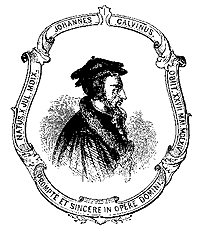
Every so often I read someone asserting that Protestants don't "know" the Church Fathers. Protestants are said to be completely ignorant of Church History. Well, maybe there is some truth here. I suspect many modern-day evangelicals begin their "study" of church history with the birth of Billy Graham.
Such cannot be said of John Calvin.
The following is a brief excerpt from: John Calvin, Institutes of the Christian Religion Vol. 1 (Philadelphia: Westminster Press), 18-23. Read for yourself how familiar Calvin was with the church fathers in relation to the 16th Century Roman Catholic Church. Calvin contrasts the church fathers with the Roman Church. Calvin's words will be in blue.
Moreover, (The Roman church) unjustly set the ancient fathers against us (I mean the ancient writers of a better age of the church) as if in them they had supporters of their own impiety. If the contest were to be determined by patristic authority, the tide of victory — to put it very modestly —would turn to our side. Now, these fathers have written many wise and excellent things. Still, what commonly happens to men has befallen them too, in some instances. For these so-called pious children of theirs, with all their sharpness of wit and judgment and spirit, worship only the faults and errors of the fathers. The good things that these fathers have written they either do not notice, or misrepresent or pervert. You might say that their only care is to gather dung amid gold. Then, with a frightful to-do, they overwhelm us as despisers and adversaries of the fathers! But we do not despise them; in fact, if it were to our present purpose, I could with no trouble at all prove that the greater part of what we are saying today meets their approval.
Yet we are so versed in their writings as to remember always that all things are ours, to serve us, not to lord it over us, and that we all belong to the one Christ, whom we must obey in all things without exception. He who does not observe this distinction will have nothing certain in religion, inasmuch as these holy men were ignorant of many things, often disagreed among themselves, and sometimes even contradicted themselves.
1. It was one of the fathers who said that our God neither drinks nor eats, and therefore has no need of plates or cups. (Acacius, bishop of Amida, addressing his clergy as he was about to melt the gold and silver vessels of the church to obtain food for captive Persians. Socrates, Ecclesiastical History 7:21 (MPG 67. 781-784; tr. NPNF 2 ser. 2. 164).
2. Another (father), that sacred rites do not require gold, and those things not bought with gold do not please with gold. (Ambrose, De officiis clericorum 2:28 (MPL 16. 140; tr. NPNF 2 ser. 10. 64). (The Roman Church) therefore transgress this limit when in their ceremonies they take so much delight in gold, silver, ivory, marble, precious stones, and silks; and think that God is not rightly worshiped unless everything swims with untoward splendor, or, rather, mad excess.
3. It was a father who said that he freely ate meat on the day others abstained from it, because he was a Christian. (From Sozomen’s description of Spyridion, bishop of Trimithus in Cyprus, Ecclesiastical History 1.11; Cassiodorus, Historia tripartita 1.10 (MPL 69. 895; tr. NPNF 2 ser. 2. 247). (The Roman Church) transgress the limits, therefore, when they execrate any person who has tasted of meat in Lent.
4. There were two fathers, one of whom said that a monk who does not labor with his hands must be considered equal to a thug, or (if you prefer) a brigand ( Serapion, head of a monastery near Arsinoe in Egypt, who required his monks to earn their food by labor. Sozomen, op. cit., 6:28; Cassiodorus, Historia tripartita 8. 1 (MPL 69. 1103; tr. NPNF 2 ser. 2. 365); the second, that it is not lawful for monks to live off the goods of others, even though they be assiduous in contemplation, in prayer, and in study (Augustine, On the Work of Monks 14-17 (MPL 40. 560-564; tr. NPNF 3. 511-513). They have also transgressed this limit when they have put the lazy, wine-cask bellies of monks in these stews and brothels to be crammed with substance of others.
5. It was a father who termed it a dreadful abomination to see an image either of Christ or of some saint painted in the churches of Christians (“Epistle of Epiphanius to John of Jerusalem,” translated by Jerome, in his Letters 51:9 (CSEL 54. 411; tr. NPNF 2 ser. 6. 89). Epiphanius, bishop of Salamis in Cyprus, tells how in a church at Anablatha he tore up a curtain bearing an image and replaced it by a plain curtain. He declares images in churches “contrary to our religion” (A.D. 394). Cf. 1. 11. 11, 16; 1. 12. 2). “What is reverenced is not to be depicted upon walls” was not the mere declaration of one man but the decree of an ecclesiastical council (Council of Elvira (Illiberitanum) in Spain, ca. A.D. 305, canon 36: ‘That there ought not to be images in a church, that what is worshiped and adored should not be depicted on the walls.” Hefele-Leclercq 1. 240; Mansi 2. 264). They are far from remaining within these limits when they leave not a corner free of images. Another father counseled that, after having exercised in burial the office of humanity toward the dead, we should let them rest (Ambrose, De Abraham 1. 9. 80 (MPL 14. 472). They break these limits when they stir up perpetual solicitude for the dead.
6. It was one of the fathers, who testified that in the Eucharist the substance of bread and wine remained and did not cease to be, just as in Christ the Lord the substance and nature of man remained, joined to the divine nature (Gelasius, Tract. 3. 14 (Epistolae Romanorum pontificum, ed. A. Thiel, 1. 541). Therefore, (the Roman Church) overstep(s) the bounds in pretending that when the Lord’s words are repeated the substance of bread and wine ceases and is transubstantiated into body and blood (Canon 1 of the Fourth Lateran Council, A.D. 1215, declares that in the sacrament of the altar the bread is by divine power transubstantiated into the body and the wine into the blood of Christ. (Mansi 22. 954; Hefele-Leclercq 5. 1325; tr. H. J. Schroeder, Disciplinary Decrees of the General Councils, p. 338.).
7. They were fathers who, as they set forth only one Eucharist for the whole church and consequently excluded wicked and criminal persons, most gravely condemned all those who though present did not receive it (Chrysostom, Commentary on Ephesians, ch. 1, hom. 3. 4, 5 (MPG 62.28-30; tr. NPNF 13. 63-65), and Calixtus as quoted by Gratian, Decretum (De consecratione) 3. 2:18 (Friedberg 1. 1320; MPL 187. 1759). How far have they removed the boundaries when they fill not only churches but also private houses with their Masses, admitting anyone at all to observe them, each one the more willingly the more he pays, however impure and wicked he may be! They invite no one to faith in Christ and believing communion of the sacraments; rather, they put their work on sale, as the grace and merit of Christ.
8. There were two fathers, one of whom decreed that those content with participation in one kind, but abstaining from the other, were to be excluded entirely from participation in the Sacred Supper of Christ (In a passage dubiously attributed to Pope Gelasius and found in Gratian (Decretum 3. 2:12; Friedberg 1. 1318; MPL 59. 141; 187, 1736), communicants are required to take the wine with the bread or abstain from both: “aut integra sacramenta percipiant, aut ad integris arceantur.” The withdrawal of the wine from the laity called forth the protests of Scriptural sects, especially the Hussites); the other strongly contends that one must not deny the blood of their Lord to Christian folk, who, in confessing him, are bidden to shed their own blood (Cyprian, Letters 57. 2 (CSEL 3. 2. 651 f.; tr. ANF 5. 337). They have removed these landmarks when they have commanded by an inviolable law the very thing that the former father punished by excommunication and the latter reproved with a valid reason (Council of Constance, session 13 (1415), definition on communion in both kinds. This was confirmed by Martin V’s bull In eminentis (1418) (Texts in Mansi 27. 727 f., 1215, 1219).
9. It was a father who affirmed it rashness, when judging of some obscure matter, to take one side or another without clear and evident witness of Scripture (Augustine, De peccatorum meritis et remissione et de baptismo parvulorum 2. 36, 59 (MPL 44. 186; CSEL 60. 128; tr. NPNF 5. 67f.): “In obscure matters where the Scriptures do not give guidance, rash judgment is to be avoided.” Cf. Augustine, Letters 140. 37. 85 (MPL 33. 576; tr. FC 20. 135). They forgot this limit when they established so many constitutions, canons, and doctrinal decisions, without any word of God.
10. It was a father who reproached Montanus for, among other heresies, being the first to impose laws of fasting (Apollonius, cited in Eusebius, Ecclesiastical History 5. 18 (MPG 1:472; tr. NPNF 2 ser. 1. 235 ff.). They also passed far beyond those limits when they ordained fasts by very strict law (Gratian, Decretum 3. 3. 9 (MPL 187. 1734; Friedberg I. 1354 f.).
11. It was a father who denied that marriage should be forbidden to the ministers of the church, and declared cohabitation with one’s wife to be chastity. And other fathers agreed with his opinion (Sozomen (Ecclesiastical History 1:23) records that Paphnutius the Confessor, an ardent ascetic, swayed the decision of the Council of Nicaea (325) against requiring clerical celibacy by the declaration here reported. Calvin probably used Cassiodorus’ text, op. cit., 2. 14 (MPL 69. 933; tr. NPNF 2 ser. 2. 256). By severely enjoining celibacy for their priests, they have gone beyond this limit.
12. It was a father who deemed that one must listen to Christ alone, for Scripture says, “Hear him” (Matthew 17:5); and that we need not be concerned about what others before us either said or did, but only about what Christ, who is the first of all, commanded (Cyprian, Letters 63:14 (CSEL 3. 2. 712; tr. ANF 5. 362).When they set over themselves and others any masters but Christ, they neither abode by this boundary nor permitted others to keep it.
13. It was a father who contended that the church ought not to set itself above Christ, for he always judges truthfully, but ecclesiastical judges, like other men, are often mistaken (Augustine, Contra Cresconium Grammaticum Donatistam 2:21 (MPL 43. 482; CSEL 52.385).When this boundary is also broken through, they do not hesitate to declare that the whole authority of Scripture depends entirely upon the judgment of the church (This view, asserted by John Eck, Enchiridion (1526), ch. 1:(1541, fo.76).
14. All the fathers with one heart have abhorred and with one voice have detested the fact that God’s Holy Word has been contaminated by the subtleties of sophists and involved in the squabbles of dialecticians (Tertullian, De praescriptione haereticorum 7 (CCL Tertullianus 1. 192; tr. LCC 5. 35 f.); Augustine, On Christian Doctrine 2. 31 (MPL 34. 57; tr. NPNF 2 550; also FC 4. 102-103). When they attempt nothing in life but to enshroud and obscure the simplicity of Scripture with endless contentions and worse than sophistic brawls, do they keep themselves within these borders? Why, if the fathers were now brought back to life, and heard such brawling art as these persons call speculative theology, there is nothing they would less suppose than that these folk were disputing about God!
Monday, December 19, 2005
Extra Extra! The New Fatima Crusader Arrived!

I often wonder what my mailman must think when he delivers my mail. Does he look to see from whom I get mail? If he does, he must be a little perplexed if he knows anything about “religion.” I get all sorts of religious things. Of course, I get a bunch of Reformed “type” things. But I also get some “fringe” literature.
I must admit, I do get a little charged up when I get the latest copy of The Fatima Crusader- which came yesterday. The Fatima Crusader is a small periodical dedicated to the Virgin Mary and her "message" given at Fatima. Now, my Catholic friends tell me the man who runs this little magazine is an apostate priest. Indeed, the articles about Mary, and the devotion poured forth on every page are outrageous. The Mariolatry is strikingly similar to the state of the church during and before the Reformation.
One article in the latest Fatima Crusader though stood out, because it’s content was very similar to a link (http://aomin.org/YouTell.html) that I’ve used for years from James White’s Alpha and Omega Ministries. Now, relax. I believe the information that Dr. White put forth in this link is helpful and accurate- I am not for a moment suggesting that Dr. White is in any way arguing in favor of the Fatima Crusader. If you know me at all, you know that I dig James White, a lot.
Dr White puts forth compelling historical information that shows that at one time, the Roman Catholic Church was very specific on whom went to Heaven. If you weren’t a member of the Roman Catholic Church, but were rather a heretic, Muslim, or of the Jewish faith, you were in big trouble- eternal trouble. Dr White notes:
“The Council of Florence, the 17th Ecumenical (and hence “infallible”) Council of the Roman Catholic Church, said the following:
It firmly believes, professes, and proclaims that those not living within the Catholic Church, not only pagans, but also Jews and heretics and schismatics cannot become participants in eternal life, but will depart "into everlasting fire which was prepared for the devil and his angels" [Matt. 25:41], unless before the end of life the same have been added to the flock; and that the unity of the ecclesiastical body is so strong that only to those remaining in it are the sacraments of the Church of benefit for salvation, and do fastings, almsgiving, and other functions of piety and exercises of Christian service produce eternal reward, and that no one, whatever almsgiving he has practiced, even if he has shed blood for the name of Christ, can be saved, unless he has remained in the bosom and unity of the Catholic Church. (Denzinger 714).
Now, that’s pretty plain. White goes on to show that the Roman Catholic Church no longer teaches this:
“…section 841 of the Catechism of the Catholic Church (1993) says: The Church's relationship with the Muslims. "The plan of salvation also includes those who acknowledge the Creator, in the first place amongst whom are the Muslims; these profess to hold the faith of Abraham, and together with us they adore the one, merciful God, mankind's judge on the last day."
Now, check this out from the latest Fatima Crusader. The Crusader is very angry at “Father Dupris” whose part of an “Interfaith Congress”. This “congress” is willing to have “interfaith” type of ceremonies at the (cough, cough…) "sacred shrine" of Fatima. The warriors of Fatima are not pleased to have Hindus and Buddhists at their shrine. Here is how the Fatima Crusader argues:
Against Catholic Truth
"Father Dupuis' assertions defy defined Catholic dogma. The Council of Florence defined infallibly that "Pagans, Jews, heretics and schismatics" are "outside the Catholic Church," and as such, "can never be partakers of eternal life unless before death, they are joined to the Catholic Church", the one true Church founded by Our Lord.
The Catechism of the Council of Trent, faithful to this truth, teaches, "infidels, heretics, schismatics and excommunicated persons" are "excluded from the church's pale." In other words, Protestants, Jews, Mohammedans, Hindus, Buddhists, etc., are not part of the Catholic church, which is the Kingdom of God on earth.
The Catechism of Pope Saint Pius X, centuries later, presents the same truth without change. It teaches, "Outside the true Church are: Infidels, Jews, heretics, apostates, schismatics and excommunicated persons." It states further, "No one can be saved outside the Catholic,
Apostolic, and Roman Church, just as no one could be saved from the flood outside the Ark of Noah, which was a figure of the Church."
This is the consistent teaching of the Church and the consistent teaching of the Popes
throughout the centuries.
Pope Gregory XVI taught "It is not possible to worship God truly except in Her (the Catholic Church); all who are outside of Her will not be saved."
Blessed Pope Pius IX taught likewise, "It must be held as a matter of faith that outside the Apostolic Roman Church, no one can be saved; that this is the only ark of salvation; that he who shall not have entered therein will perish in the flood."
Pope Pius XI, in his liturgical prayer for the Consecration of the Human Race to the Sacred Heart of Jesus, said, "Be Thou King of those who are still involved in the darkness of idolatry, or of Islamism, and refuse not to draw them into the light and Kingdom of God". This demonstrates that idolaters (such as Hindus) and Muslims are not part of the Kingdom of God, as Father Dupuis falsely asserts.
Further, Pope Pius XII in his 1950 Encyclical Humani Generis, complained against modernist theologians who "reduce to a meaningless formula the necessity of belonging to the true Church in order to gain eternal salvation.""
Pius XII further taught that neither sanctity nor salvation can be found outside of
the Catholic Church."
Source: The Fatima Crusader- Autumn 2005 (Issue 81) 27-28.
Now I can’t begin to tell you how many times I’ve posted the link from Dr. White, and I’ve had all sorts of Roman Catholics defend the belief that those outside the Roman Catholic Church can be saved. The argument goes: Only those who knowingly know the Roman Catholic Church is the true church but yet deny this will be lost eternally. This sounds somewhat silly- it doesn’t do justice to history. If the Roman Catholic Church previously taught that those outside the church are lost, saying now they are really found is an awful historical contradiction. It is a little bit of fallible-ness if you ask me.
John Mark Hits One Out Of The Ballpark: The Lutheran Understanding of Calvinists
There is significant value for Reformed folks to understand Luther’s “theology of the cross” (and probably at some point I will get into this one). It’s hard to sum this up quickly, but when I’m pressed to give an answer in ten seconds to someone who asks me about it, I ask this question:
“Which way has God most clearly revealed Himself?”
Sometimes the answer given is “in nature.” This would be a good try for a non-Christian, but the folks that have given me this answer are Christians! The answer of course, is “in Jesus Christ,” and this is the ten-second explanation to the “theology of the cross.” Luther would say something like, “If you want to know God, know Jesus Christ.”
Now, I’ve met quite a few cyber-Lutherans. I think in some cases, Luther’s “theology of the cross” is wrongly used by some of them against Reformed Christians. Many times if a Reformed person even mentions predestination, election, atonement, etc, some Lutherans will quickly take refuge behind the theology of the cross, and say that the Reformed are not talking about Jesus, but rather the hidden God. I always wonder if maybe the theology of the cross is being misapplied in order to maintain a tradition, or is either being misapplied due to a faulty understanding of Reformed theology. Now, I’m not pigeonholing all Lutherans, so please put your guns back in your holsters.
Probably motivated by this post from James White , John Mark over on his Sweet Tea And Theology blog, put something into words that I’ve never been able to relating to this subject. He applied a type of incorrect Lutheran hermeneutic to the Nicene Creed in which everything not mentioning Jesus was stricken from the creed.
Now of course, John Mark is using an example of argumentum ad absurdum, and doing so quite effectively. I doubt of course any Lutheran would agree with his findings. But this is the point isn’t it? Deuteronomy 29:29 says, “The secret things belong to the Lord our God, but the things revealed belong to us and to our children forever, that we may follow all the words of this law.” Of course, the primary meaning of this verse applies to the law, but secondarily, it is those things in the Scripture that have been revealed to us that tell us who God is. Yes, it’s true that God has most clearly revealed Himself in Jesus Christ, but this does not negate the Reformed doctrines of grace.
“Which way has God most clearly revealed Himself?”
Sometimes the answer given is “in nature.” This would be a good try for a non-Christian, but the folks that have given me this answer are Christians! The answer of course, is “in Jesus Christ,” and this is the ten-second explanation to the “theology of the cross.” Luther would say something like, “If you want to know God, know Jesus Christ.”
Now, I’ve met quite a few cyber-Lutherans. I think in some cases, Luther’s “theology of the cross” is wrongly used by some of them against Reformed Christians. Many times if a Reformed person even mentions predestination, election, atonement, etc, some Lutherans will quickly take refuge behind the theology of the cross, and say that the Reformed are not talking about Jesus, but rather the hidden God. I always wonder if maybe the theology of the cross is being misapplied in order to maintain a tradition, or is either being misapplied due to a faulty understanding of Reformed theology. Now, I’m not pigeonholing all Lutherans, so please put your guns back in your holsters.
Probably motivated by this post from James White , John Mark over on his Sweet Tea And Theology blog, put something into words that I’ve never been able to relating to this subject. He applied a type of incorrect Lutheran hermeneutic to the Nicene Creed in which everything not mentioning Jesus was stricken from the creed.
Now of course, John Mark is using an example of argumentum ad absurdum, and doing so quite effectively. I doubt of course any Lutheran would agree with his findings. But this is the point isn’t it? Deuteronomy 29:29 says, “The secret things belong to the Lord our God, but the things revealed belong to us and to our children forever, that we may follow all the words of this law.” Of course, the primary meaning of this verse applies to the law, but secondarily, it is those things in the Scripture that have been revealed to us that tell us who God is. Yes, it’s true that God has most clearly revealed Himself in Jesus Christ, but this does not negate the Reformed doctrines of grace.
Sunday, December 18, 2005
The Facts About Luther (Part Two): Sin Boldly

To the left: my 1916 copy of The Facts About Luther (At the bottom, the price says "25 Cents"). Below: The 1987 TAN reprint.

“The Luther research movement, which took its origin in recent years largely from Karl Holl's work, and which has produced a 'veritable Luther-renaissance' in our understanding of the reformer, has been based on two cardinal principles: first, Luther must be allowed to speak for himself, not through the mouths of later interpreters, whether friend or foe; and second, the touchstone in Luther's interpretation must be the reformer's central convictions, not his occasional remarks, which, when taken in isolation from his central convictions, can be used to build utterly perverse and misleading descriptions of his character.” [John Warwick Montgomery, In Defense of Luther (Wisconsin: Northwestern Publishing House, 1970), 129]
One such mis-interpreter of Luther was Father Patrick O’Hare. Luther’s statement “sin boldly” receives plenty of attention in his book, The Facts About Luther. Here is an excellent example of violating exactly what Montgomery sets out above. The “sin boldly” quote is an obscure saying of Luther’s from a fragment of a letter. The letter has no address, salutation, or signature. In other words, it has no beginning or ending, thus lacking a complete context. I strongly doubt anyone besides Melanchthon was aware of this remark until many years (if not a hundred or two or three) after Luther’s death. The letter was originally part of a private collection that was published, I believe in the 1800’s. After being published, Roman Catholic scholars (and some liberal protestant scholars) with a strong bent against Luther jumped all over it. Because Roman Catholic authors cited it out of context and blew it out proportion, common laymen (both Protestant and Roman Catholic) were given a faulty understanding of Luther’s theology of justification by faith alone. Thus, I blame anti-Luther writings (pre-Joseph Lortz) for causing the confusion over this quote.
Now in my paper, I took a look at Father O’Hare’s interpretation of Luther’s “sin boldly” O’Hare states:
"‘Be a sinner,’ [Luther] says, ‘sin boldly and fearlessly.’ The command embodied in the unsuspicious words set at naught all the laws of morality and gives wide scope to human freedom and to disorder. The thought of the degrading recommendation makes the blood run cold in the veins of decent, law-abiding people.”
“Luther's pronouncement, ‘Be a sinner and sin boldly,’ has only one meaning, namely, a command to transgress the Divine Law, insult God and open up the way to the commission of crime and iniquity.”O’Hare’s misinterpretation of Luther’s “sin boldly” is due to the gross literalism he applies to the text. By setting up a strawman interpretation, he then proceeds to hurl invective at Luther relentlessly for about two pages. Protestants who correctly avoid such gross literalism O’Hare says, “have edited and interpreted the recommendation so as to give it a turn and a meaning altogether unwarranted and untenable.”
Father O’Hare misrepresents Luther repeatedly. He holds Luther was not only mad, but also morally depraved and corrupt. He asserts that Luther in the Wartburg was in close touch with Satan. Luther lived an indecent life, disparaged celibacy and virginity, sanctioned adultery, dishonored marriage, authorized prostitution and polygamy, and was a drunkard found in the tavern. Luther was a blasphemer, a libertine, a revolutionary, a hater of religious vows, a disgrace to the religious calling, and the propagator of immorality and open licentiousness. O’Hare’s understanding of “sin boldly” serves as a good example why The Facts About Luther is one of the worst ever written. It shows that simply because someone has the “facts” doesn’t necessarily mean they’re presenting the truth.
Now a Roman Catholic Apologist recently pointed out to me that Father O’Hare does mention “…Luther's own stress on good works as part and parcel of saving faith…” To substantiate this, he directed me to pages 116-117 of O’Hare’s book:
“We do not wish to insinuate that [Luther] actually taught and approved sin, for we know that he did as a rule instruct men to avoid violations of the Law and repress the concupiscence leading thereto. But we do hold that his whole theory of justification by faith alone and his denial of moral freedom, making God 'the author of what is evil in us,' necessarily broke down the usual barriers against sin, and that his moral recommendations very often in the plainest of language did actually and openly encourage sin.”The Roman apologist pointed out that O’Hare is simply using a form of the reductio ad absurdum. In other words, O’Hare is really consistently saying that Luther did teach and preach good works, but the effects of justification by faith alone resulted in lawlessness.
The problem I see with this reading is that O’Hare consistently throughout the book portrays Luther as against good works. In my 1916 copy of The Facts About Luther, the book contains an index. Under the heading “Works” the reader is directed to the following entries “Luther opposed to good, 104; according to Luther not necessary, 107; denounced good, 111; disastrous results of opposition to good, 112, 128, 129, 134” Don’t bother trying to match up these pages references with the TAN reprint- these refer to my 1916 copy- the pages are numbered differently. By the way, these are the only entries listed under "Works". Nowhere do you find the index referring to Luther's teaching good works positively. The book is not trying to tell you that Luther consistently taught and preached about needed good works- It wants you to know that Luther was a deceptive minion of Satan that said one thing and practiced another.
This example from O’Hare should suffice:
"This view of justification [faith alone] was forthwith made the fundamental dogma of the new religion Luther formulated for the world's acceptance. From the time this false doctrine was first announced, his followers in heresy have been taught to believe that men are saved by faith alone and that good works are altogether unnecessary. "The Gospel," Luther falsely declares, "teaches nothing of the merits of works; he that says the Gospel requires works for salvation, I say, flat and plain, is a liar." {Table Talk, p. 137, Hazlitt}. If men believe in Christ, they are told, and accept Him as their personal Saviour, His justice will be imputed to them and they will go straight to Heaven. It does not matter what evil they have done during their lives; it does not matter whether or not they repent of their sins; it does not matter whether or not, at the moment of death, they have compunction, contrition or attrition, or are in a state of grace- if they have faith they will be saved” (101-102)Really, O’Hare’s understanding of Luther is not primarily to argue using a form of the reductio ad absurdum. Rather, O’Hare is intent on showing the contradictory nature of Luther’s theology. This is most plainly seen in his treatment of Luther’s understanding of the law on pages 107- 116. O’Hare notes that Luther “wanted the law announced.” “He preached it and taught it” (108). But then O’Hare spews a multitude of quotes implying Luther hated the law and sought to do away with it.
When O’Hare notes on 116-117 that Luther didn’t teach and approve of sin, he has to do so because of the overwhelming content of Luther’s works consistently say this. The picture O’Hare wants to draw of Luther is that of a deceptive theologian who inconsistently created a bogus theology. In other words, O’Hare’s Luther says one thing (Obey the law, do good works), and then says another: sin boldly. This is clearly shown in the discussion beginning on page 119, where O’Hare begins discussing moral questions that were asked of Luther by his friends. The picture of Luther painted by O’Hare is that of a gross sinner who hated morality and good works. On page 122 O’Hare states, “When we consider [Luther’s] own behavior and the dangerous advice he gave his friends, we are led to believe that only one devoid of his senses or one morally weak could condone, palliate, and defend sin…” Then, “It cannot be denied that Luther taught that ‘good works are useless’ that ‘they are sin’ and in fact ‘impossible.’ ” (122).
Saturday, December 17, 2005
The Facts About Luther (Part One)
Well, it only took about week, but a Roman Catholic apologist found my blog. He cordially e-mailed me and asked about my usage of Father Patrick O’Hare’s book, The Facts About Luther in my paper Did Luther Say "Be a Sinner and Sin Boldly"? Now the question posed was whether or not I treated Father O’Hare fairly in my paper. He raised an interesting quote from O’Hare, and I believe it deserves attention, as I have no desire to be unfair to Father O’Hare.
Before I even begin to address this issue, I think it would be helpful for those of you who don’t know about O'Hare's book to be brought up to speed. Consider this part one: a brief overview of The Facts About Luther. For a more complete review of O’Hare’s book see my paper, The Roman Catholic Understanding of Luther (Part One)
I consider The Facts About Luther one of the worst books on Luther ever written. Used as a strong dose of anti-Protestant prejudice, Roman Catholic laymen frequently refer to this book. This may be the single worst treatment of Luther in print today. This book was published on the 400th anniversary of the posting of the 95 Theses. The intent of the author was to provide a reasonably priced book to English speaking audiences expounding similar sentiments put forth by the hostile Catholic attitudes of Cochlaeus and the great German scholars Denifle and Grisar. The book received favorable reviews from many pro-Catholic publications. The book eventually sank below the surface and went out of print. It would have remained obscure, but the Catholic publisher Tan books resurrected it in 1987 with a new printing. With the rise of the Internet, The Facts About Luther is probably more popular now than it was in 1917. St Joseph’s Communications likewise recommends the book: “This is a popular exposé of Luther's life and work based on Protestant historians. Incredible history, fascinating evidence about Luther, and many important quotes are given.”
The book has wide popularity among Catholics. Numerous pro-Catholic websites give O’Hare’s work tremendous accolades, and cite it frequently. It is not uncommon to engage Catholics in discussion about Luther and hear the words, “Patrick O’Hare says…” or “Martin Luther is quoted as saying in The Facts About Luther…”.
In actuality, The Facts About Martin Luther is a complete vilification. One is left amazed at the earlier claims of fairness and truth the book makes when contrasted with O’Hare’s actual tone and obvious strong hostility that proceeds and develops quickly. One reads page after page of a man controlled by Satan destroying all that he touches. Luther is:
The “pretended Reformer,” with “depraved manners and utterances,” “perversity of principle coupled with falsity of teaching…” (310)
“That he was a deformer and not a reformer is the honest verdict of all who are not blind partisans and who know the man at close vision for what he was and for what he stood to sponsor.” (310)
Luther reasons “out of the depths of his depraved mind…” (311)
“Why, then call Luther a reformer- one who would not in our times be regarded fit to be entrusted with police duty in the worst slums of our cities, much less to be made the presiding officer of a vice purity committee?” (312)
“The serpent’s rattle made itself distinctly heard in his unholy utterances…” (312)
“As a matter of fact, he was openly blamed for his well-known and imprudent intimacy with Katherine Von Bora before his marriage…”(313)
(Directed at Luther):“Out upon your morality and religion; out upon your obstinacy and blindness! How have you sunk from the pinnacle of perfection and true wisdom to the depths of depravity and abominable error, dragging down countless numbers with you!” (313)
“That he was consumed by the fires of fleshly lust he admits himself.” (314)
“Did the corruption of his mind, as is plainly evidenced in his speech, induce to laxity of behavior and lead him to exemplify his teachings in grave moral delinquencies? Corrupt teaching begets corrupt action, and hence it is difficult to believe that anyone holding such principles and ‘consumed by the fires of his unbridled flesh’ could wholly escape in his own case the exemplification of his unhallowed pronouncements.” (316)
“…(T)o deify indecency, decry celibacy and virginity and dishonor the married state, was Luther’s satanic desire and diabolical purpose.” (318)
“The way in which this ‘glorious evangelist’ explains his beastly theories in his course Latin and in his still coarser German is such that it cannot be given here, ‘so full is it,’ …’not only of indelicacy but of gross filthiness.’” (319)
“The thoughts that filled his depraved mind and reflected on the greater part of mankind led him on, after his excommunication, to strive with diabolical energy to eradicate from the people’s hearts the love for and belief in the possibility of chastity outside of wedlock.” (322)
“The evidences of his depravity are so overwhelming and convincing that they are forced to the conclusion that this shameless advocate of brazen prostitution could not be and was not a ‘messenger of the all Holy God.’” (327)
“If a Catholic, especially a Jesuit, had ever played fast and loose with the truth as Luther did, what an outcry, and justly so, would be raised!” (334)
“Katherine Von Bora was only his companion in sin, and the children brought into the world through the unholy alliance were illegitimate children.” (340)
“His wild pronouncements wrecked Germany, wrecked her intellectually, morally, and politically. The havoc wrought directly or indirectly by him is almost without example in history.” (7)
“…(I)t behooves every serious man to know this charlatan for what he was and to learn that he has absolutely no claim to any consideration as a heaven-commissioned agent, as even an ordinary ‘reformer’ or ‘spiritual leader,’ or as in any respect a man above and ahead of the frailties of his age.” (18)
After putting forth the myth that Luther’s father was a murderer, O’Hare insinuates [through a quotation] that “Martin was a veritable chip of the hard old block.” (27)
O'Hare has created a text filled with citations from Luther and both Protestant and Catholic scholars on almost every page. Many times, references are not given. With those references that are given, many are not complete enough to provide any help for the researcher in tracking them down. This seems to not bother TAN publishers all that much, since they have been printing this book for about 15 years. It is indeed an irony that a book that claims to be filled with “facts” is not that concerned with making sure its readers have sufficient information to check the truthfulness of those “facts.” A Lutheran friend of mine once made this comment: “propaganda is not effective when proper documentation is given.” With TAN’s version of The Facts About Luther, I cannot help but agree.
The Facts About Luther (Part One)
Well, it only took about week, but a Roman Catholic apologist found my blog. He cordially e-mailed me and asked about on my usage of Father Patrick O’Hare’s book, The Facts About Luther in my paper Did Luther Say "Be a Sinner and Sin Boldly"? .
Funny, upon reflection, I think it was this particular Romanist's website that initially made me aware of Father O’Hare’s book. He had utilized the book for quotes from Luther. Subsequently, (I think after a dialog with me), He pulled O’Hare’s material from his website.
Now the question posed was whether or not I treated Father O’Hare fairly in my paper Did Luther Say "Be a Sinner and Sin Boldly"? . He raised an interesting quote from O’Hare, and I believe it deserves attention, as I have no desire to be unfair to Father O’Hare.
Before I even begin to address this issue, I think it would be helpful for those of you who don’t know about this book to be brought up to speed. Thus, consider this part one: a brief overview of The Facts About Luther. For a more complete review of O’Hare’s book see my paper, The Roman Catholic Understanding of Luther (Part One)
I consider The Facts About Luther one of the worst books on Luther ever written. Used as a strong dose of anti-Protestant prejudice, Roman Catholic laymen frequently refer to this book. This may be the single worst treatment of Luther in print today. This book was published on the 400th anniversary of the posting of the 95 Theses. The intent of the author was to provide a reasonably priced book to English speaking audiences expounding similar sentiments put forth by the hostile Catholic attitudes of Cochlaeus and the great German scholars Denifle and Grisar. The book received favorable reviews from many pro-Catholic publications. The book eventually sank below the surface and went out of print. It would have remained obscure, but the Catholic publisher Tan books resurrected it in 1987 with a new printing. With the rise of the Internet, The Facts About Luther is probably more popular now than it was in 1917. St Joseph’s Communications likewise recommends the book: “This is a popular exposé of Luther's life and work based on Protestant historians. Incredible history, fascinating evidence about Luther, and many important quotes are given.”
The book has wide popularity among Catholics. Numerous pro-Catholic websites give O’Hare’s work tremendous accolades, and cite it frequently. It is not uncommon to engage Catholics in discussion about Luther and hear the words, “Patrick O’Hare says…” or “Martin Luther is quoted as saying in The Facts About Luther…”.
In actuality, The Facts About Martin Luther is a complete vilification. One is left amazed at the earlier claims of fairness and truth the book makes when contrasted with O’Hare’s actual tone and obvious strong hostility that proceeds and develops quickly. One reads page after page of a man controlled by Satan destroying all that he touches. Luther is:
The “pretended Reformer,” with “depraved manners and utterances,” “perversity of principle coupled with falsity of teaching…” (310)
“That he was a deformer and not a reformer is the honest verdict of all who are not blind partisans and who know the man at close vision for what he was and for what he stood to sponsor.” (310)
Luther reasons “out of the depths of his depraved mind…” (311)
“Why, then call Luther a reformer- one who would not in our times be regarded fit to be entrusted with police duty in the worst slums of our cities, much less to be made the presiding officer of a vice purity committee?” (312)
“The serpent’s rattle made itself distinctly heard in his unholy utterances…” (312)
“As a matter of fact, he was openly blamed for his well-known and imprudent intimacy with Katherine Von Bora before his marriage…”(313)
(Directed at Luther):“Out upon your morality and religion; out upon your obstinacy and blindness! How have you sunk from the pinnacle of perfection and true wisdom to the depths of depravity and abominable error, dragging down countless numbers with you!” (313)
“That he was consumed by the fires of fleshly lust he admits himself.” (314)
“Did the corruption of his mind, as is plainly evidenced in his speech, induce to laxity of behavior and lead him to exemplify his teachings in grave moral delinquencies? Corrupt teaching begets corrupt action, and hence it is difficult to believe that anyone holding such principles and ‘consumed by the fires of his unbridled flesh’ could wholly escape in his own case the exemplification of his unhallowed pronouncements.” (316)
“…(T)o deify indecency, decry celibacy and virginity and dishonor the married state, was Luther’s satanic desire and diabolical purpose.” (318)
“The way in which this ‘glorious evangelist’ explains his beastly theories in his course Latin and in his still coarser German is such that it cannot be given here, ‘so full is it,’ …’not only of indelicacy but of gross filthiness.’” (319)
“The thoughts that filled his depraved mind and reflected on the greater part of mankind led him on, after his excommunication, to strive with diabolical energy to eradicate from the people’s hearts the love for and belief in the possibility of chastity outside of wedlock.” (322)
“The evidences of his depravity are so overwhelming and convincing that they are forced to the conclusion that this shameless advocate of brazen prostitution could not be and was not a ‘messenger of the all Holy God.’” (327)
“If a Catholic, especially a Jesuit, had ever played fast and loose with the truth as Luther did, what an outcry, and justly so, would be raised!” (334)
“Katherine Von Bora was only his companion in sin, and the children brought into the world through the unholy alliance were illegitimate children.” (340)
“His wild pronouncements wrecked Germany, wrecked her intellectually, morally, and politically. The havoc wrought directly or indirectly by him is almost without example in history.” (7)
“…(I)t behooves every serious man to know this charlatan for what he was and to learn that he has absolutely no claim to any consideration as a heaven-commissioned agent, as even an ordinary ‘reformer’ or ‘spiritual leader,’ or as in any respect a man above and ahead of the frailties of his age.” (18)
After putting forth the myth that Luther’s father was a murderer, O’Hare insinuates [through a quotation] that “Martin was a veritable chip of the hard old block.” (27)
O'Hare has created a text filled with citations from Luther and both Protestant and Catholic scholars on almost every page. Many times, references are not given. With those references that are given, many are not complete enough to provide any help for the researcher in tracking them down. This seems to not bother TAN publishers all that much, since they have been printing this book for about 15 years. It is indeed an irony that a book that claims to be filled with “facts” isn’t that concerned with making sure its readers have sufficient information to check the truthfulness of those “facts.” A Lutheran friend of mine once made this comment: “propaganda is not effective when proper documentation is given.” With TAN’s version of The Facts About Luther, I cannot help but agree.
Subscribe to:
Posts (Atom)

 Posts
Posts


