Monday, August 27, 2012

A most revealing post: A Muslim admits that Islam has parallels with Fredrick Neitzsche's "will to power"

This Parallel between Islam and Neitzsche is very revealing.  This was written by a Muslim.  Read it before he may take it down.  Someone in the combox even suggested that.

Addendum:  (Sept. 18, 2012) Sometime last week, somewhere between Sept. 10-15, the MDI took down the post, just as I thought they would.  Apparently, they could not handle my comments in the combox and my defense of the Bible and that the NT fulfills the OT.  Hopefully, I can re-construct the arguments in writing and Lord willing, try to write something on this issue.  

It reveals that Islam at it's main core is all about power and will - Allah in Islam is ultimate power and will, not personality or love or holiness.  Allah in Islam is not a person.  Remember Neitzsche's philosophy - "the will to power".   Allah in Islam is an "it", a "powerful will".  the main goal in Islam is not to know God, one cannot know God in Islam.  In Islam, the goal for the humans is just to obey the will of Allah by following His commands, doing His will, obeying the Sharia (law).  Islam is about conquering through force (جهاد  = Jihad - struggle/effort/striving;  قتل = Qatal - fighting until the death (Surah 9:5; 9:29; 8:39), killing; حرب  = Harb - war)

Neitzsche did not like weakness - the crippled, the sinners (only those in his view - the undisciplined and the weak-minded), the undisciplined, the weak, the weakness of Jesus in allowing Himself to be killed on the cross.   This is also what made Hitler so angry at Christianity and it's "weakness".  This is the ultimate self-righteousness.  Jesus came for those who understand and realize that they are sinners, not for those who are so blinded to think they are good and disciplined and can improve the world by their will power and "doing good" by force.  Luke 5:32 - "I came not to call the righteous, but sinners to repentance."  Jesus meant those that think they are righteous, because no one is truly righteous. (Romans 3:9-23), except the Lord Jesus Himself.


The true God, the Trinity reaches out and loves the weak and the sinner and ungodly.  Romans 5:6-11


http://thedebateinitiative.com/2012/08/25/islam-and-neitzsche/


Christ the Wisdom and Power of God

18 For the word of the cross is folly to those who are perishing, but to us who are being saved it is the power of God. 19 For it is written,
“I will destroy the wisdom of the wise,
    and the discernment of the discerning I will thwart.”
20  Where is the one who is wise? Where is the scribe? Where is the debater of this age? Has not God made foolish the wisdom of the world? 21 For since, in the wisdom of God, the world did not know God through wisdom, it pleased God through the folly of what we preach to save those who believe. 22 For Jews demand signs and Greeks seek wisdom, 23 but we preach Christ crucified, a stumbling block to Jews and folly to Gentiles, 24 but to those who are called, both Jews and Greeks, Christ the power of God and the wisdom of God. 25 For the foolishness of God is wiser than men, and the weakness of God is stronger than men.
26 For consider your calling, brothers: not many of you were wise according to worldly standards, not many were powerful, not many were of noble birth. 27 But God chose what is foolish in the world to shame the wise; God chose what is weak in the world to shame the strong; 28 God chose what is low and despised in the world, even things that are not, to bring to nothing things that are, 29 so that no human being might boast in the presence of God. 30 And because of him you are in Christ Jesus, who became to uswisdom from God, righteousness and sanctification and redemption, 31 so that, as it is written, “Let the one who boasts, boast in the Lord.”

1 Corinthians 1:18-31  (with my emphasis) 

Wednesday, August 22, 2012

Just one small correction for Carl Trueman

No Co Ever: Episode 1 from No Compromise Radio on Vimeo.

This was a very good video discussion, regarding the problems with modern Evangelicalism and "The Elephant Room 2" and compromises with T. D. Jakes and his modalism and anti-Trinitarian doctrines and his word of faith/prosperity theology, two very dangerous heresies.  And, as Phil Johnson says, "damnable heresies".

I agree with everything these gentleman said on the issues of doctrine and the problems with the Elephant Room 2

. . . except for one small side comment that Carl Trueman made that I think is important for Christians to understand.

The one small comment was one that Carl Trueman made and I am very surprised that he said it.   I really appreciate Carl Trueman, and I enjoy his blog at Reformation 21; and I tried to find his email at the Westminster Seminary Website, but I could not.  I respect him greatly, and his work in church history and historical theology is very important.  So nothing personal is meant here, and I know he is very mature and will take this for the merit of the issue.

When talking about the Christians at the Council of Nicea in 325 AD, Professor Trueman said they were Turks.  [around the 31 minute mark] Professor Trueman was right that the men at the Council of Nicea were not "white men", but they were not Turkish either.  They were Greeks and Egyptians and Syrians (The Syrians before the Arabs conquered them in the 600s AD.)  That is an amazing mistake by a church history professor, in my opinion.  They were mostly Greeks, Syrians, 2 Latins from Rome, and Egyptians (Athanasius, for one) and others from around the Roman Empire.  The Turks did not live in what is today called Turkey at the time of the Council of Nicea.   The Turks (Seljuk and Ottomans) did not come to that land until before the Crusades (1071 AD) and they did not completely conquer the area known as Anatolia and Constantinople until 1453 AD.  No Turks lived in these areas in the New Testament days nor in early church history until the 900s AD!  It is possible that there were some Turkic peoples there from the time of Attila the Hun in the 400s, but not that many, and not any in 325 AD.

It is amazing to me that people don't take the time to study what happened to the Greeks and the Byzantine Empire.  The Arabs first attacked after they conquered Syria/Palestine and Persia and N. Africa.  (632-722 AD)  They tried to take Constantinople in the 600s and 700s but failed.

The Arab Muslims converted the Persians by force (Jihad, Qatal, Harb)  from the 630s into the 900s.  Jihad جهاد  (struggle/effort/striving) and Qatal قتل (the word for "slay" or "fight" = "fighting to the death" in battle - Surah 9:5, 9:29) and Harb حرب (War) are integral aspects of Islam from the time Muhammad conquered Medina in 622 AD.

Then the Arab Muslims converted the Turkic peoples of Central Asia, starting in the 600s, and by the 900s AD, the animist Turks had become Muslim.  (Today these areas are called Turkmenistan, Azerbaijan, Uzbekistan, Kazakhstan, Kirghestan, etc.  Tajikistan is mostly a Persian speaking area - ethnically the Tajiks and southern areas of Uzbekistan are Tajik-Persian (Bukhara and Samarqand) ethnically and were part of the old Persian Empire.  The Arab Muslims also converted the Kurds to Islam by force.  Saladin ("Salah e din" = صلاح دین = "genuine religion"), the famous Muslim leader against the Crusaders, was Kurdish.  Today the Kurds are spread throughout western Iran, Northern Iraq, Eastern Turkey, and the top corner of Syria.

The Seljuk Turks were hired as the palace guards and military force for the Arabs in Baghdad.  The Turkic peoples became the dominant fighting force.  the Seljuk Turks attacked the Greek Byzantine Empire in 1071 AD at the Battle of Manzikurt near Van in the east (was part of Armenia).  The Byzantines were defeated by the Seljuk Turks.

This caused the emperor in Constantinople to call for help from the Pope in France.  The Crusades were launched.  (1095-1299)

After the Crusades, the Ottoman Turks became the dominant Turkish people and eventually conquered all of Anatolia and then Constantinople fell in 1453 and it was renamed Istanbul.

So, today, the area known as Nicea (The Turks call it Iznik today, and it is about one hour outside of Istanbul), where the Council of Nicea was held in 325 AD is in the same area as the country of Turkey; but at the time of Nicea there were no Turks there.

The Turks never heard the gospel.  The Crusades are still major stumbling block to Muslims, especially the Turks.  The Crusades were somewhat understandable in the sense of a "just war" and self-defense, but the horrible mistakes, and the slaughter of the Greek Eastern Orthodox by the Latin Crusaders is a major scandal and shame, as was the Crusading against Jews along the way to the "holy land".   Today the Turks are still 99 % Muslim and there is some outreach to them, but not much.  The Arab Muslims have not been evangelized much either in history.  The Persians were not much either.  The ancient Persian church before Islam was mostly the ethnic Assyrians in Mesopotamia (today's Iraq); not the ethnic Persians farther east.  Henry Martyn translated the first complete copy of the Persian NT in the 1800s.  He died in 1812.

Let us reach out with the gospel to Muslims.

Why make such a big deal about a minor comment not related to the main topic?

The reason why this so important to get right is that the Great Commission (Matthew 28:19; Luke 24:46-47) is to peoples, nations, ethnic people groups, not "countries" or "political boundaries".  The Greek word for "nation" is ethna (εθνη) and carries with it the idea of a cultural-ethnic people group that is unified by language and culture.  So even though the land of Turkey (and Egypt and N. Africa and Syria and Mesopotamia) had the gospel in earlier centuries, it was snuffed out by Islam in most of these areas, and eclipsed in places where there is some small evangelical witness left.

This is important because God is saving people from all the nations, peoples, tribes, and tongues, as the gospel goes out.  (see Revelation 5:9 and 7:9)   Some "nations" are spread over several political boundaries (countries) and some peoples/nations are within political boundaries and don't have their own country.  A classic example of this is the Kurdish people, who have never had their own political country and are spread over 4 countries.  (Iran, Iraq, Turkey, Syria)

The OT background of the Great Commission in Matthew 28:19 and Luke 24:46-47 is in Genesis 12:1-3; 18:18; 22:18; 26:4; 28:14; Psalm 2:8, 67:1-7, 96:3-6, 87:4-6, Isaiah 49:6 and many other passages that use the word "families" (Mishpakha = משפחה ) and "nations" = "goyeem" גוימ and peoples  עמימ  ("ameem") .

A good book that explains the Biblical idea of nations and peoples is John Piper's Let the Nations Be Glad! (Baker) and the articles by Ralph Winter and John R. W. Stott and others in Perspectives on the World Christian Movement.    The Perspectives book is, overall, a good missions book, but there are some articles in it that I would disagree with, just in case any one wonders.

Addendum: (August 31, 2012)
I want to apologize if it seems I was being too nit-picky on Professor Trueman's statement.  I think if someone reads the whole thing that I wrote above, they can see why I wrote what I wrote, and that it was not meant as a "potshot", but an honest pointing out of the importance of understanding that aspect of church history in relation to missions and the spreading of the gospel among unreached people groups.  A big problem is that missions people are weak in theology and historical theology and church history; but also sometimes theologians are weak in missions.  I noticed that in seminary also, they have their separate disciplines and yet there is a great need for more inter-connectedness of these disciplines because they all come together in the challenge of Islam in today's world.  Islam is what should cause us who believe the Bible to also understand it and evangelize Muslims and also integrate it with church history and historical theology. (and politics, culture, just-war theory, etc.)   The challenge of Islam will force us to deal with the implications of it to all of these areas of study and knowledge.

Someone (D. Waltz) pointed out an article that Professor Trueman wrote, in which he was a little more accurate on the situation:

"Still, let us go back to the fourth century and see how the `middle aged white guy' critique measures up.  Well, at the Council of Nicea in 325, many of the participants were no doubt middle aged -- which Paul in the Pastorals would actually seem to think is quite a good thing in a church leader.  But white?    I suspect they were ethnically more akin to modern day Turks or south eastern Europeans, not that racial categories really meant anything then.  The key category in the fourth century was that of Roman citizenship, not skin color."

The modern Turks are a mixture of many peoples.  But they originally came from Central Asia, and they were not at Nicea in 325 AD and they were not in those lands in NT days that is now called "Turkey"; and they were never reached with the gospel in history; as I pointed out earlier.  They did Islamic wars/Jihads/killing against the Byzantine and Armenian men, and probably took many of the women as wives from the original people groups that lived there.  So, there is probably some Greek, Syrian, Arab, Galatian, Armenian, and other ethnicities within the modern day Turks who live in Turkey.  Today, Turkey is officially 99 % Muslim and very unreached with the gospel.  


How to Preach from an Amillennial Perspective

This past Sunday the senior pastor of my church preached on Micah 4:1-5. The sermon was entitled, "In The Last Days." The sermon never mentions the word amillennial, nor does it focus on the end of the world, nor does it meander through various eschatological views.  The sermon was though, purely amillennial.

For those of you who are up-and-coming Reformed preachers, this sermon is a great example of how to use theology to preach Christ without delving into complicated end-times theological distinctions.

The sermon can be found here.

Tuesday, August 21, 2012

Muslim’s favorite conservative scholar proves them wrong


 Richard Bauchkam calls Mark 10:17-18 “a wonderful double entendre” and shows Jesus is actually claiming to be God!  (see below for exact place in a radio interview.)

A double entendre (literally: double meaning) is a figure of speech in which a spoken phrase is devised to be understood in either of two ways. Often the first (more surface) meaning is straightforward and direct speech, while the second meaning is indirect and "underneath the surface" and usually the real intention behind the bare words.  

Oriental cultures, Middle Easterners, especially Iranians, use this kind of language and technique all the time in their poetry and their culture of “saving face” and “honor vs. shame”; has made them over the centuries experts at “indirect speech”. 

Jesus is indirectly claiming to be God, using an eastern method of indirect speech; but westerners think it is straight forward speech. 

On the Unbelievable Radio program, on October 10, 2009,  there was an excellent discussion between James Crossley and Richard Bauckham, about his book, Jesus and the God of Israel.

Muslims love to use Richard Bauckham to try and cast doubt on the NT and the gospels.  While Bauchkam is not an inerrantist, and not as conservative as I am or as Dr. White is; Bauchkam is hardly a good source for Muslims to use, because on this particular radio discussion, Bauchkam believes Jesus is claiming to be God in Mark 10:17-18. 

Shabir Ally and Paul Bilal Williams use some quotes from Bauckham as somehow trying to show that the gospels are not reliable and changed, yet in this program, Bauckham takes Paul Williams’ favorite passage (Mark 10:17-19) and demonstrates that Muslims are wrong on its meaning.  Williams brings up Mark 10:17-19 many times at his own blog. see here:  

Update to this article, Sept. 28, 2015:  I took out the old url of Paul B. Williams old blogs, because there is some kind of malware/scam there.  
(No longer available as Williams keeps changing his blog; several times.  One time he even left Islam for a few days and then came back and repented.)  Williams new blog, as of Jan. 2015, is www.bloggingtheology.net


and here, What must I do to be saved? (no longer available)

and here, "Why do you call Me good?  (no longer available)

In all three of these articles, he leaves out verses 23-27.

At Williams' three different blogs which he has changed, if you could look around, it seems that he has a blog article on Mark 10 or the gospel of John and/or liberal scholars every several blog articles.  He especially likes Mark 10:17-19 about "Why do you call Me good?" or about "keep the commandments", and seeing that from a Muslim viewpoint, he thinks Jesus said that in order to teach that someone is able to keep the law and be saved.   His Islamic worldview has blinded him from seeing the real meaning of this great passage, especially if one reads all the way until verse 27.  Of course, only the Holy Spirit can lift the blinders off sinners' hearts.

Williams constantly quotes the Mark passage, but always leaves out verses 23-27 in his polemics.  Williams constantly uses Mark 10:17-18 to try and say that Jesus is denying His Deity; and he constantly uses Mark 10:19-22 to try and say that Jesus teaches that salvation comes by obeying the law of God.  He is wrong on both accounts.  By leaving out verses 23-27, Williams is avoiding the deeper meaning of why Jesus approaches the rich young ruler the way He does.  We will address that issue later, Lord willing.

Bauckham on “why do you call me good?”


I am not going to type out every word in this section of the interview; I invite the reader to listen to the whole thing.  However, I want to include key phrases and sentences of Bauckham, and intersperse with my own comments.

Beginning at the 43:31 mark – Richard Bauckham – “can I come back to Mark ?
because in Mark chapter 2 – who can forgive sins but God alone?”, he is “expressing precisely one of these uniquely divine qualities” - qualities of God .

Mark 6 – “What kind of man is this who the wind and waves obey his voice?  Only God can rule the chaos - Order out of chaos; a very OT idea about God.”

Mark 10:17 ff – “Why do you call me good, only God is good. Actually works the other way, Jesus is good, so Jesus is God.  Bauckham calls this a “wonderful double entendre”,  and “if you are not thinking, you would say that Jesus is saying I am not God”; but Jesus is actually trying to get the rich young ruler to think about true goodness.  Thus, Bauckham is confirming the orthodox position of how to interpret this passage.  Jesus is not denying that He is good or God, but in an indirect way, Jesus is actually claiming to be God.  In effect, Jesus is saying, “If you recognize Me as good and call Me good, then you should see that I am God, since only God is good.”  But the man didn’t really understand absolute goodness. 

Mark 14:61-64

This is a very clear passage that Jesus is claiming Deity.  Even the Jews know that the Messiah is going to be “the Son of the blessed one”!  The Jews know Psalm 2 and 2 Samuel 7:13-14 and Proverbs 30:4 and Psalm 110:1 and Daniel 7:13-14. 
Jesus quotes from Psalm 110:1 and Daniel 7:13-14 and the Jewish leaders tear their robes and say that Jesus has committed blasphemy by claiming to be the Messiah, the Son of God.  Jesus also said, “I am” ( ego eimi = εγω ειμι ) in verse 62.    Muslims and other skeptics like to make a big deal about the “I am” statements in John, and they claim that there are none of them in the Synoptic gospels.  Well, here is one.  Mark 6:50 is another “I am” statement. 

Bauckham says the clear claim of deity is there in Mark, so it is not only in the gospel of John, as some, particularly Muslims are saying, but the Deity of Christ is clear in Mark also.

Dr. White’s recent Five sermons on the Gospel according to Mark:

In his first message, “The Bookends of Mark” – he shows that Mark 1:1 (the Son of God – for an article about the textual variant here, see this.) and Mark 15:39 (“truly this man was the Son of God!”) – the centurions’ confession that Jesus is “the Son of God”, demonstrates Mark’s purpose of testifying that Jesus is the Son of God, the Messiah.  Dr. White made a great point about the Roman Centurion and his familiarity with death, in Mark 15:43-45.  The Roman Centurion better be sure Jesus was dead, since he had to give testimony to Pilate himself.  If he was wrong, he would have been executed.  The seriousness with which the Romans dealt with soldiers and guards who did not do their job well is seen in Acts 16:27.  The Philippian jailor was about to kill himself, because he had fallen asleep earlier, and he thought that Paul and Barnabas had escaped in Acts 16:27, after the earthquake. 

There are a lot of nuggets there that Dr. White brings out in these five sermons.  Because Muslims are not only using liberal scholars, but now they are using (and abusing) more conservative scholars to attack the New Testament and the gospels, we need to equip ourselves to be “ready to give an answer for the hope that is within us” to Muslims, and take up our cross in discipleship. (see Mark 8:34-38)

For two other articles on the unity of the gospel of Mark and the Deity of Christ in Mark, see here, and on the testimony to the resurrection of Jesus in Mark, see here. 

Credit goes to someone named "Monty" in the aomin chat channel, a few days ago (last week); for pointing to this particular Unbelievable Radio program, the discussion between Bauckham and Crossley.  

Tuesday, August 14, 2012

Historical Developments that led to the eclipsing of the doctrine of Justification by Faith alone


James Swan had linked to this book on Purgatory and I recently received it in the mail and it is really interesting and helpful in getting a handle on how this unbiblical doctrine developed in church history.
(see under point 5)

The biblical doctrine of justification by faith alone was eventually neglected, over-shadowed, and eclipsed by the slow development of other unbiblical doctrines and doctrines.

It (Justification by grace through faith alone) appears at times in the writings of early Christians and early church fathers; but because some of these others things (listed below) were also developing at the same time, and sometimes some early church writers were inconsistent in seeming to affirm the doctrine of justification by faith alone, and also some of the other things listed below; this is one of the great reasons for why it is so hard and complicated to figure out what the early church believed about the doctrine after the Biblical era, and until Wycliffe, Hus, and Luther questioned these things.

1.  The Mono-Episcopate:  Biblical elders of a plurality of leaders was changed into taking one of the gifted elders out of the college and making him the sole bishop over the other elders in a church; then, later, in an entire area/city.  We can see that elders and bishops were interchangeable in the NT and in the earliest extra-canonical writing 1 Clement (96 AD), the Didache, Shepherd of Hermas.  Then, later we see a change in Ignatius (107-117 AD) and then Cyprian (around 250 AD) takes it further, and beyond in history.  see here for an Evangelical Introduction to church history part 1; and then, Part 2 here, that fleshes it all out.   But even Ignatius knows he does not have authority like an apostle.  (see his epistle to the Magnesians, epistle to the Trallians paragraph 3, verse 3, Ignatius to the Romans, paragraph 4, verse 3, and Ignatius to the Ephesians, paragraph 3, verse 1.  See also here, John Bugay has many excellent articles on this issue here and at Triablogue.   Even Cyprian, though he championed the ideas of the mono-episcopate of a local area, and that "the bishop is the church"; even he, did not agree that the bishop in Rome was the bishop of bishops.  He and 86 other bishops from all over the Christian world at the time, clearly stood against Stephen, the bishop of Rome at the time, in 258 AD.   Much later, the jurisdiction of the bishop of Rome seems to have taken off some by Leo 1 in 440 AD, and then even more from Gregory the Great in 601 AD onward.  After Gregory the Great the power of the bishop of Rome kept developing, reaching a high mark of arrogance and false doctrine in Boniface VIII's statement in 1302 in the document, Unam Sanctum, ("It is necessary for every human creature to be in submission to the Roman Pontiff for salvation."); to the arrogance of Pius IX with "I am the tradition"; thus eventually developed into the Papal doctrines and dogma of infallibility in 1870.

2.  Baptismal Regeneration:  NT baptism as an outward evidence and sign/symbol of repentance and faith, an inward reality of regeneration/being born again/union with Christ by faith and repentance was changed into having power to actually cause one to be born again and regenerated. (baptismal regeneration)  The debate and discussion on that issue is still going strong in the com boxes here. 

3.  Penance:  Internal Repentance in the NT was changed into an outward penance, the work of satisfaction that one was assigned to do by a priest after confession.  William Webster has an excellent article on this the combines a lot of the other points also.    This was the first point of protest by Martin Luther in his 95 theses.  Later penance was developed along with private confession to a priest along with purgatory and then, with the treasury of merit of the saints into indulgences which really "took off" during the Crusades and was the spark that started Martin Luther questioning the Roman Catholic Church in 1517.

Addendum:  (January 3, 2014) - John Bugay made an excellent addition in the com box (on Aug. 15, 2012) to this issue on how the Latin mis-translation of the Greek word for repentance affected subsequent theology and church history. 

4.  Private Confession of sins to the priest for forgiveness:  Biblical confession of sin (1 John 1:9; James 5:16), and public confession of serious sin, developed into private confession of sins to a priest.  See also William Webster's article under point # 3.  Later, ex opere operato powers were given to the priests after the Donatist controversy.

5.  Purgatory - The idea of some kind of after death purging and cleansing was developed into Purgatory, starting with Clement of Alexandria and Origen and developing more after Augustine, especially by Gregory the bishop of Rome in 601 AD. See -
The Birth of Purgatory, by Jacques Le Goff. 

 James Swan has earlier linked to an excellent book called The Birth of Purgatory by Jacques Le Goff.   (Scroll down in this "Resources on Roman Catholicism" blog article)

6.  A NT office of priests.  This was wrong, as there is no NT office of "priest" in the local church.  None.  Jesus is our high priest.  For the NT church, there are
a. elders/overseers (same as bishops)/pastors and b.  deacons.  Every believer/saint is a priest to God.  (1 Peter 2:5-10; Revelation 1:6; 5:9-10.)   The word "priest" seems to be first applied to elders and ministers after they started applying OT language of sacrifice in worship to the thanksgiving and worship in the church and at the celebration of the eucharist.  (see # 13)

7.  Categories of mortal sins and venial sins and distinguishing between them. That seems to have started with Tertullian.

8.  Ideas of merit for good works, which is a contradiction to the Biblical teachings on grace.

9.  Gaining merit through Pilgrimages to graves and holy sites.  Simple remembering of martyrs' day of death as a "birthday" (going to heaven) and then venerating their bones (Would Polycarp have approved of such a practice?) , then to pilgrimages and visiting graves of dead saints and praying to them at their graves.

10.  Prayers to dead saints.  Whether at their graves or later, in front of pictures, later the icons, or statues.

11.  Prayers to Mary and the over-exalting of Mary as the greatest mediator, and then later other false dogmas such as Mary's Perpetual Virginity, her sinlessness, her Immaculate Conception(1854), and the Bodily Assumption (1950).  She is called, "co-mediatrix" - a clear contradiction to 1 Timothy 2:5.

12.  Almsgiving as a way of satisfaction for sins, often part of the penance assigned by a priest.

13.  Sacrificial language of the mass.  From using NT language of the sacrifices at the temple (Matthew 5:23-26), combining it with the need to reconcile with brothers before worship (Matthew 18:15-20) and taking the sacrificial language of the prophesy of Malachi 1:11 and applying all of that to the eucharist/Lord's supper in 1 Corinthians 11/Luke 22/Matthew 26. The sacrificial language of the OT (Malachi) and NT (Matthew 5:23-26) was not meant to say that the eucharist would be a sacrifice, but rather an application of OT language to worship/thanksgiving/memorial of Christ's death/celebration in the NT church.

14.   Transubstantiation:  From memorial/spiritual presence of Christ in communion/ eucharist (Biblical) to actual physical presence (Justin Martyr to Radbertus in the 800s) to transubstantiation (developed from the 800s into 1215 AD)

Sometimes the doctrine of justification by faith alone can be discerned in the early church, in the writings of Clement, The Epistle to Diognetes, and Ambrosiaster seem to be really clear references.  Also, later, in the writings of John Chrysostom seems clear, and in others, but they sometimes had some elements of the above practices and doctrines also.  So they were inconsistent.  These 14 practices/doctrines together (and probably with other issues not named here, too) combined to eclipse / hide the doctrine of justification by faith alone, like the moon hiding the sun in an eclipse.   All of these things combined together to over-shadow the doctrine of justification by faith alone over the centuries until Wycliff and Hus and Luther started questioning these things.

Sunday, August 12, 2012

Remembering My Father

I received quite a number of private e-mails from my cyber-friends over the past week. Thank you all so much for your concern and condolences. Thanks also to Ken for keeping the blog going this past week.

For those of you who have lost both parents, you probably know the feelings I'm experiencing. It's a strange thing to consider that the very people that brought you into the world are both no longer there, at least physically there. What goes along with this, at least for me, is the process now of going through my parents possessions and selling the house I grew up in. When I close my eyes and think of "home" my immediate memory is of the house I spent most of my childhood in. Not only have I lost my parents, I'm losing my concept of "home" in a sense. These are all just striking reminders that there is only one lasting comfort in life and in death.

My three siblings and I spoke at my father's funeral. Below is the brief eulogy I gave in my father's memory:

My sister has summed up aptly my father’s commitment to his family and to raising us in the truth of the gospel. As a child, I never understood this commitment. The only thing I understood as a child was that I wanted my way, and that using my parents was the means to getting my way. It’s only been upon reflection in my later years that I’ve come to understand my father's love for his family, and his love for me.

My father seemed so different than I was... perhaps it had to do with the fact that my dad was in his early 40’s when I was born. My father, a World War 2 veteran, the father of 4 older children already, found himself in the 1960's with another small baby. I’ve often wondered what he thought about raising a family, and then again having another small child to raise. I never once though heard him complain that I, whether I was planned or not, was born. He never seemed resentful that I was born. Quite the opposite. When I was born, it appears he began to work harder to provide for his family. My father worked excessively to provide for us. In fact, I can recall that I often didn’t see him because he was working to provide for us.

I’ve been told that our family was living in a rather volatile neighborhood in the 1960’s. As the culture changed, sometimes violently, my father moved his family to safety. My earliest memories are that of a big house with a built in swimming pool in a nice neighborhood. This is probably much different than what my siblings remember about their childhood.

We went on big vacations. In the early 1970’s he took the family to Florida: Now I was going to visit Florida’s Disneyworld. What my father didn’t tell me though, was that going to Disneyworld in 1970 was actually going to visit a construction site. The park had not been built. He did though take us, around the same time, to California: and there, I as a young child experienced all the joys of Disneyland, with my father accompanying me on the rides.

As I grew older, it became more apparent that my father and I were two very different people. He was an elder in a very conservative church. I was a teenager with long hair, playing electric guitar, very loudly. We had many special times together discussing music in which Dad expressed his view that the best music was not a distorted electric guitar playing so loudly the neighbors would call over and ask for it to be lower. These conversations were often brief: "Jimmy, turn that thing down, now!" He did though tolerate that which he did not like. While my “music” appears to have worked him up at times, he found out that while a loud guitar in the house was a burden, drums were even worse. He would say, “Jimmy- it’s so loud the cat can’t find a place to sit.” He was right: I would find my cat Titus sitting on top of the refrigerator when the whole band was over and the house shook. But he tolerated it. He may not have liked it, but he allowed me do it.

As his last child, I think my father had a strong desire to pass on the family business. He would take me house to house fixing appliances, trying to teach me how to fix a washer or dryer. This went on for years- throughout junior and senior high school. The only problem though is I have no natural aptitude to fix anything. In fact, if he allowed me to work on a machine, chances are it would be broken worse than it already was. I didn’t like getting grease and dirt on my hands, because it took too long to remove so I could play my guitar. I also had bad dust allergies, so going down into someone’s basement often meant I would be suffering hay fever most of the day.

I don’t think I realized he was trying to pass on his successful business to me. He hoped I would get it, but I never did. Sometimes now I wish I paid more attention to what he was teaching me. Those of you who knew my father knew how well he could diagnose and fix something. Now, when something breaks in my house, I can no longer call my father, nor can I summon up what he tried to teach me. This is a hard lesson- that playing guitar really didn't help me provide for my family when something breaks. 

My father and I differed in other ways as well. In Missouri I enjoyed nothing more than going to Crown Center, the big mall, and having my parents leave me in the bookstore, and then picking me up when they were done. My father rarely read books, I loved reading. We just seemed like two very different people. I was reading and playing music, he was fixing machines and watching TV to relax after a hard day.

Dad and I though loved each other. We may not have understood each other, but we loved each other. This was our relationship up until his last day: we were two men who didn’t understand the other, but both wanted the best for the other. We just differed on what that best was.

But music and books, as many of you know, are just that music and books. I learned a few weeks ago that a guy I took lessons from, a world renowned Chapman Stick player, died suddenly of a heart attack. What became of all his music skills and what was the result of his hours and years of practicing? Nothing. He left this world with nothing.

My father though, did leave this world with something: salvation in Jesus Christ. While my father and I were different in so many ways, these differences similarly amount to nothing, because we both share in the eternal Gospel of Jesus Christ. My father and I both agreed as to what the only lasting and true unity and comfort are  in life and in death:

That my father and I are not our own, but belong body and soul to our faithful savior, Jesus Christ.
He has fully paid for all our sins with his precious blood, and has set my father and I free from the tyranny of the devil. He also watches over us in such a way, that not a hair can fall from our heads without the will of our father in heaven. In fact, all things must work together for our salvation. Because my father and I belong to him, Christ by his Holy Spirit makes us wholeheartedly willing and ready from now on to live for him.

Guitars and washer machines are not eternal. At some point, they’ll rust and disintegrate. I’m so grateful for my Father raising me with that which will not pass away, the truth of the gospel.

**********

This is a picture of my father and I, circa 1989, underneath the grape trellis in the backyard of my first house.  Also pictured is my first German Shepherd (I miss him too.)

Thursday, August 09, 2012

Did God really say? (Part 2)


Another excellent panel discussion - this time on Inerrancy at the T4G (Together for the Gospel) conference back in April of this year.  I don't think I noticed the title of this one, "Inerrancy:  Did God Really Say?" - before I gave the same title to the article on Egalitarianism and Homosexuality and their discussion at T4g.  See Did God Really Say? (Genesis 3:1) (Part 1)

Participants were Mark Dever, Peter Williams, Simon Gathercole, John Piper, Al Mohler, and Ligon Duncan.

They start off by reading from the first 3 articles about what T4G believes about the Bible, under the "Affirmations and Denials" at the web-site.

Mark Dever points out that the phrase "the Bible is the Sole Authority" means
"sole final authority"; "sole ultimate authority"; and Al Mohler says, "We mean sole authority in the sense of the Sola's of the Reformation; it's not a naked authority, but it is the ultimate authority."  I think they should have added, "The Bible is the sole infallible authority", just to be even more clear; and flesh out what other secondary authorities are - ancient creeds, doctrinal statements, confessions of faith, local church, godly and qualified pastors, teachers, elders, seminary professors, good Biblically based books and commentaries - these are secondary authorities that are not infallible.

The names of some who are mentioned in this discussion and yet claim to be evangelical but have abandoned Inerrancy are Kent Sparks and Peter Enns.   Triablogue has written a lot on Enns.   (Go there and do a search for specifics.)   Fuller Theological Seminary was mentioned that it was in 1971 that they took out the word "inerrancy" from their doctrinal statement.  Fuller Seminary has been on a downward slide ever since.

What is interesting to me is that it was Professor Jack Rogers (along with the book he wrote with Donald McKim against Inerrancy) who was one of the main ones, if not the main one, who took Fuller down that road.  He has in recent years (at least since 2001, maybe earlier) come out for "same sex marriage" and affirmation of homosexuality.  See here in his blog totally given over the abomination of homosexuality and so called "gay marriage" and ordination of homosexuals.  He seems to be one of the driving forces behind the liberalism and ordination of homosexuals in the PCUSA.  He served as the moderator of 213th General Assembly of the PCUSA.  The footnotes point to articles written in 2001.

 James Barr was another liberal scholar who attacked Inerrancy in the 1970s.  Muslims are today still using Barr's book today to attack the Bible.  (especially Paul Bilal Williams)

So, it does seem that there is a subtle connection at least some of the egalitarian movement ( In Did God Really Say? Part 1), the pro-homosexual agenda in liberal churches (not so subtle by Rogers and his web-site), and liberalism and the denial of inerrancy.  They seem to be connected; and they probably started with a subtle denial of inerrancy and grew from there.


Monday, August 06, 2012

On the Death of a Parent.

Today I was notified my father died. I was prepared... as prepared as anyone can be can be for such a loss. My father did die in the faith. On request of the police, since I was the first family relative on the scene, I had to go into his house before the coroner arrived. My father appears to have died peacefully. I am so grateful my parents, now both deceased, raised me from infancy with the Gospel.

Some people I know, even Christian people, have problems seeing someone who has died. But, as the Apostles Creed states: I believe in the resurrection of the body. As Christians, we should not fear death, especially those who have died in the faith. While I mourn the loss of my dear father, I was grateful to see him one last time. I believe in the resurrection of the body, and the life ever lasting.

In The Gospel according to John, the apostle’s use of Psalm 69 implies that Psalm 69:8 is about Mary’s other sons.

This is re-publishing an older article I had written in 2009, with some changes.

Psalm 69:8-9 (English Standard Version)

"I have become a stranger to my brothers,
an alien to my mother’s sons.

For zeal for your house has consumed me,
and the reproaches of those who reproach you have fallen on me."
(also treated as Messianic in Romans 15:3 by the apostle Paul)

Since John is the one who is quoting and alluding to Psalm 69 so much:

John 2:17 (Psalm 69:9)

John 15:25 (Psalm 69:4)

John 19:28-29 (Psalm 69:21)

In addition, the context of John 7:3-5 is about his brothers not believing in Him, and then in verses 6-8, it becomes even more clear that John is saying that Psalm 69:8 is about Mary’s others sons. John 7:6, “Jesus therefore said to them, “My time is not yet at hand, but your time is always opportune.” John 7:7, “The world cannot hate you; but it hates me because I testify of it, that its deeds are evil.” Because verse 3 in the same context says, “His brothers therefore said to Him, “Depart from here and go into Judea, that your disciples also may behold Your works which You are doing.” – here is a clear distinction between Jesus’ brothers and Jesus’ disciples. He contrasts between the faith and love of the disciples and the hatred and unbelief of the world. He does the same thing in John 15:25, another quote from Psalm 69. “They hated Me without a cause”. Now the context of the cross and the giving of Mary to John to care of her becomes even more important and more clear that Mary had other children. And then in John 19:27-28, where Jesus says, “Behold, your mother!”, Jesus is clearly connected her with Psalm 69, because his real brothers have disowned Him and been estranged from Him and rejected Him, and hated Him, so therefore, He commits His mother to John. In verse 28 of John 19, the Scripture says, “. . . in order that the Scripture might be fulfilled, said, “I am thirsty”. Psalm 69:21 – with Matthew 27:34, 48, Mark 15:23, 36, and Luke 23:36.

In church history, some people began to make unreasonable deductions about Mary, going beyond Scripture, adding to Scripture, and contradicting Scripture.

These unreasonable deductions led to the whole series of unbiblical traditions about Mary (prayers to her, IC, BA, co-mediatrix, some even calling for co-redemptrix to be defined as dogma) and led to the over-exalting of Mary, the over-emphasis on virginity (even after marriage), and celibacy as a requirement for all ministers in the RCC in church history. It is called a “higher way of holiness”.  This implies that married folks cannot attain to a holy life, and it seems to exalt works over grace and faith.

Obviously, Psalm 69:5 is NOT about the Messiah, because He was sinless. (John 8:46; 2 Cor. 5:21; Heb. 4:15, Heb. 7:26; I Peter 1:19-20). This can be understood the same way that 2 Samuel 7:14a is about the Messiah, but 7:14b is not about the Messiah. So, it is possible that Psalm 69:8 is about Mary's others son who are against the Messiah and don't have faith until the resurrection and afterward, but Psalm 69:5 is not about the Messiah.

By the way, a great sermon on Psalm 69 and emotions, including other quotes in Romans 11 and Acts 1, in his series on some of the Psalms in "Thinking and Feeling with God" by John Piper is here.

The apostle John seems to want us to get the connection by looking at Psalm 69 and all the other quotes in his gospel. (and Acts 1 and Romans 11 and 15)

Moreover, "for" in Psalm 69:9 connects verse 8 and "my mother's sons" to his zeal; and John is showing the contrast between the faith of the disciples in John 2:12-22 and John 7:3-7 vs. His brothers who, because of their unbelief, are His enemies and "hated Him without a cause". (John 15:25 and alluded to in John 7:7 - the hatred of the world; from Psalm 69:4)

John 7:3-9 :

So his brothers said to him, "Leave here and go to Judea, that your disciples also may see the works you are doing. For no one works in secret if he seeks to be known openly. If you do these things, show yourself to the world." For not even his brothers believed in him. Jesus said to them, "My time has not yet come, but your time is always here. The world cannot hate you, but it hates me because I testify about it that its works are evil. You go up to the feast. I am not going up to this feast, for my time has not yet fully come." After saying this, he remained in Galilee.

One of the ways skeptics attack the resurrection is they say Jesus only appeared in His resurrection to His friends, believers, disciples.

Well, Jesus' brothers were not believing in Him, and so, they were His enemies in this sense, even hating Him, implied here; because they wanted Him to show Himself to the world; and it says the Jews were seeking to kill Him. (John 7:1)

They were His enemies in their unbelief; but they believed at the resurrection and afterward; especially, James (I Cor. 15:7; Galatians 1:19; Acts 15:13ff.)and Jude (writer of the epistle of Jude).

So Christ appeared to some enemies, namely His brothers, and Saul, who became Paul.

A powerful apologetic for the resurrection.

Seems clear that John and Jesus are making this connection between the sufferings of David in Psalm 69, that his own brothers, "my mother's sons are against me"; and also this is prophesied about the Messiah and it happen that way; and so it is clearly implied and alluded to by the way John uses Psalm 69, the connection "for" in verse 9, and the contrast between the faith of the disciples and lack of faith in His brothers in John 2:12-22; then the hatred and unbelief of His brothers in John 7.

Putting it all together, it makes perfect sense why Jesus committed His mother to John, and seeing the connection of John 19 with Psalm 69 and the other gospels and giving His mother to John; (the prophesy of the giving of gall to the Messiah fulfilled in all the gospels at the cross in the same context that Jesus gives His mother to John and not his physical half-brothers - Psalm 69:21 : Matt 27:48; Luke 23:36; John 19:29; Mark 15:23) makes it even stronger that he is saying Psalm 69:8 is about Jesus' brothers, the sons of Mary.

So, the virgin birth of Christ is protected, by Scripture alone; Matthew 1:18-25 and Luke chapters 1-2; but the Perpetual Virginity of Mary doctrine and dogma is un-Scriptural and not truth, therefore, it should be abandoned.

It is a man-made tradition.

Saturday, August 04, 2012

Left Wing Hypocrisy and Immoral Values vs. Conservative Values


Rahm Emanuel’s hypocrisy :

The racist and hate monger, Louis Farrakhan, leader of the American cult/heresy of Islam, "The Nation of Islam",  is welcomed in Chicago by mayor Rahm Emanuel.  (Who was also President Obama’s chief of staff and campaigned for Bill Clinton when he was running for President.) Not only is Louis Farrakhan a racist and anti-Semite and hate monger and claims to be some kind of a Muslim, most Sunni and Shiite Muslims repudiate him and his doctrines as a cult and heresy of Islam.    But all Islamic groups are much more intolerant of homosexuality than any Christian is, as when the Muslim community becomes the majority and they get political power and are able to enact Sharia (law), then homosexual acts are punishable by execution.  (As regularly happens in Saudi Arabia, Iran, Pakistan, and other Muslim majority countries.)


Even liberals and some who support “gay marriage” are pointing out the hypocrisy:


Something I heard Dennis Prager (an orthodox, conservative Jew) say on his radio show, as I was driving – either Wed. or Thursday about the “Chick-fil-A” appreciation day:

“Mitt Romney missed a great photo opt today – he should have had a chicken sandwich at Chick-fil-A (that promotes Christian, conservative values) and then an ice-cream at Ben and Jerry’s (that promotes liberal values) and celebrated freedom of speech and free-enterprise markets.”  Dennis Prager  (from my memory from hearing him on the radio as I was driving in my car, either Wed, August 1, or Thursday, August 2).

That attack on Dan Cathy and Chick-fil-A reveals the left’s hatred for moral standards, Biblical marriage, and Christianity; but the conservatives and others who supported Chick-fil-A are a combination of conservative types without respect to religion, Evangelicals, Roman Catholics, Mormons, other conservatives, libertarians, and probably some who are Democrats - who may be liberal in their politics, and some who support "same sex marriage"-  but who think clearly on the issue of freedom of speech,  who are showing their support mostly on the root principle of free-speech and free-enterprise market business economic values.  Certainly the Biblical standard of marriage is part of that motivation for Christians and many conservatives, but the main point is freedom of speech and our free market economy. 

It is ironic, in these troubled economic times, that these left wing mayors (of Chicago, Boston, Los Angeles) and a Chicago alderman * would try and block a good business that could stimulate the economy and create more jobs, without any need for government subsidies or raising of taxes, as in Obama’s failed Solyndra debacle. 

* I learned something new:
"An alderman is a member of a municipal assembly or council in many jurisdictions founded upon English law."


Addendum:
The political pundits at "The Five" on Fox News also make some other good points, on the massive increase of murder crime in Chicago, and that it seems Rahm Emanuel wanted to divert attention away from his crime and murder and violence problem to trying to discriminate against Chick-fil-A.  


Friday, August 03, 2012

Ex Opere Operato baptismal regeneration is not Biblical!

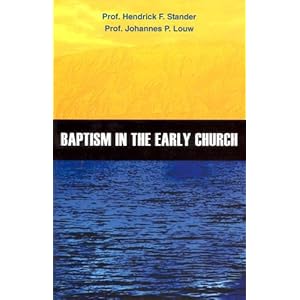
This is an excellent book that explores the issue of baptism, specifically infant baptism in the early church. Baptism in the Early Church, by Hendrick F. Stander, and Johannes P. Louw. My purpose here is not so much to argue against infant baptism, but to argue against baptismal regeneration of the Roman Catholic Church and it's priestly ex opere operato doctrine. But this subject will automatically likely animate Lutherans and other Protestants who have a different form of baptismal regeneration to want to comment on this issue. That's fine, as we have been doing in the com boxes here. And because this issue also tends to automatically bring in issues of infant baptism with it, I feel the need to mention this book up front. So, I mention this book up front (along with the other book shown at the end of the article) as the best defense I have seen, for believer's baptism being the original view of the apostles and the early church. It was written by 2 men who are paedo-baptists (practice infant baptism or are members of an infant baptism tradition church.) These 2 men admit that infant baptism was a historical tradition that started later. James Renihan summarizes in the Foreward:
"Essentially, they argue that infant baptism was not the practice of the Apostles and their immediate successors, but developed through the convergence of several factors. Gradually, paedobaptism came to be the majority position in the church, but probably not until the later part of the fourth century." (James Renihan, page 10, Foreward, Baptism in the Early Church)
Something else I wrote in the com box discussion when it was brought up that Luther would probably not have joined with Zwingli in his opposition to the Roman Catholic Church, because of their disagreement over the Lord's supper:
I think it is sad - the disunity that Luther had with Zwingli over the Lord's supper issue; and the statements that Luther made about Zwingli are scandalous and RC apologists use those statements all the time. I like the unity around the gospel that the movement of "together for the gospel" demonstrates - www.t4g.org - Baptists (Dever, Mohler, Piper), Presbyterians (Ligon Duncan, R. C. Sproul, Carl Truman), Charismatic Calvinists(C. J. Mahany, Matt Chandler), Dispensationalists(McArthur), etc. I am glad for that and that the old days of the wars of Europe over Christian doctrine are over.
So, we are unified in the gospel and in Christ against the errors of the Roman Catholic Church, and specifically here, ex opere operato and baptismal regeneration. Infant baptism is a secondary issue over which we can disagree about, and Evangelical Protestant churches are free to practice and teach their convictions about it and defend it biblically, but maintain gospel unity and fellowship in conferences and networks such at "together for the gospel" and "the gospel coalition", but RC baptismal regeneration is a doctrine and practice that divides us and that doctrine is a heresy and contrary to justification by faith alone in the Scriptures.

Now, to my main point of this post! 

 The Roman Catholic Church teaches that the work of the priest [* see at end] - performing the ceremony of baptism on the recipient (infants mostly, and adult converts who have never been baptized in the name of the Trinity, etc.) actually causes the person to be born again and confers grace on that person. They teach that the water of baptism literally washes their souls, when performed by the RC priest, when he says the words in Latin, "in the name of the Father, the Son, and the Holy Spirit". The Latin phrase, "ex opere operato" means "from the work, it works", which is to say that the action and duty and performance of the ceremony actually does something to the recipient.

 This is totally unbiblical. 

1 Corinthians 10:1-5
 For I do not want you to be unaware, brethren, that our fathers were all under the cloud and all passed through the sea; 2 and all were baptized into Moses in the cloud and in the sea; 3 and all ate the same spiritual food; 4 and all drank the same spiritual drink, for they were drinking from a spiritual rock which followed them; and the rock was Christ. 5 Nevertheless, with most of them God was not well-pleased; for they were laid low in the wilderness.

  Hebrews 3:16 -4:2
 16 For who provoked Him when they had heard? Indeed, did not all those who came out of Egypt led by Moses? 17 And with whom was He angry for forty years? Was it not with those who sinned, whose bodies fell in the wilderness? 18 And to whom did He swear that they would not enter His rest, but to those who were disobedient? 19 So we see that they were not able to enter because of unbelief. Therefore, let us fear if, while a promise remains of entering His rest, any one of you may seem to have come short of it. 2 For indeed we have had good news preached to us, just as they also; but the word they heard did not profit them, because it was not united by faith in those who heard.

 Note: “all were baptized” – I Cor. 10:2

 So all were baptized physically "into Moses" - but not all had faith. Internal faith is the key. All Jewish males were circumcised, but many did not have faith, and the NT says, "neither circumcision or uncircumcision means anything, what counts is a new creation" - Galatians 6:15 See also Romans 9:8 - "it is not the children of the flesh who are the children of God, but the children of promise . . . "

Note:
 “nevertheless, with most of them God was not pleased” – I Cor. 10:5
“we see they were not able to enter because of unbelief” – Hebrews 3:19
“the word did not profit them, because it was not united by faith in those who heard” – Hebrews 4:2

 “Without faith it is impossible to please God” – Hebrews 11:6
 “the just shall live by faith” – Romans 1:17; Romans 3:28-4:16; 5:1; Galatians 2:16, 20, chapter 3-5, etc.

 So, Luther’s justification by faith alone is the key, “the doctrine on which the church stands or falls” (whatever James Swan’s research revealed, if he actually said the exact words or others after him conflated several statements together.

 So, the Roman Catholic form of baptismal regeneration is totally unbiblical, and the ex opere operato understanding of performance/work/doing the motions of the ceremony is not Biblical either. Baptismal regeneration seems to be one of the earliest mistakes of the early church, which, as far as extant evidence goes, the earliest instance of it is in the writings of Justin Martyr (between 148-161 AD). But Justin does not teach infant baptism at all, in fact he says things like baptism is for those "who choose and repent" (First Apology 61, cited in the chapter by Steven McKinon, "Baptism in the Patristic Writings", in Believer's Baptism: Sign of the New Covenant in Christ. Edited by Thomas Schreiner and Shawn D. Wright, 2006, B & H; p. 171.) For a full book defense of Believer's Baptism -

TUAD ("Truth Unites and Divides), in the com boxes mentioned above,  added a reference to an article in Themelios on Baptismal Regeneration and Luther here.   It is very good, and also argues against the Federal Vision movement. 

[* ]  Addendum:  A Roman Catholic who goes by "TheDen" pointed out that others may baptize people, not just the priests.  I had forgotten about that.  Thanks for pointing that out; I sincerely desire to be accurate.  Here is what the Roman Catholic Catechism says:
1256 The ordinary ministers of Baptism are the bishop and priest and, in the Latin Church, also the deacon. In case of necessity, anyone, even a non-baptized person, with the required intention, can baptize, by using the Trinitarian baptismal formula. The intention required is to will to do what the Church does when she baptizes. The Church finds the reason for this possibility in the universal saving will of God and the necessity of Baptism for salvation.


Wednesday, August 01, 2012

After Darkness, Light!


Most people who visit this blog will know this information, but it is an excellent intro to Martin Luther. Historical introduction to Martin Luther -- R. C. Sproul recounts historical aspects of the beginning of Martin Luther's life and how he came to be an Augustinian monk.

"After Darkness, Light!"  - from the Latin phrase, "Post Tenebras Lux"  (On the Reformation Wall in Geneva)

What was the "Darkness" ?

The Roman Catholic teaching that had engulfed the whole European culture that salvation comes through the Sacerdotal (from the Latin word for "priest") system of dependence upon the Roman Catholic priest in the RC churches to dole out salvation through infant baptismal regeneration by the ex opere operato words of the priest, deeds of penances that were ordered by the priest such as saying 100 hail Mary's or climbing up the steps of St. Peter's Cathedral in Rome or giving alms to the poor, confession to the priest, partaking of the eucharist, thinking it to be changed into the literal blood and body of the Lord Jesus Christ, by the mere words spoken by the priest, etc.   Those were truly "Dark Ages" (beginning around 430 - 500 AD) until the Reformation, beginning in 1517 when Luther nailed the 95 theses to the church door in Wittenberg.
[scholars usually date the beginning of the "Dark Ages" as when the Goths and Vandals and other "barbarian tribes" conquered the city of Rome and N. Africa around 400-430 AD.
The Reformation brought light back in by pointing people back to the Scriptures as the only infallible rule of faith and practice.

Interesting tidbit about Jan Hus' trial and burning at the stake and his statement, that has become a popular story: Hus is reported to have said: "You may burn this goose (Hus in the Czech language means "goose") but after me will come a swan who you will not be able to silence."  And, according to Sproul, that under the very place where Luther was consecrated into the Augustinian order of monks, was the tomb of the bishop who ordered Hus' execution in 1415!
Addendum: James Swan blogged about that in 2010 here also. I should have known he would have researched it thoroughly before I pushed the publish button here! It was unclear to me if the sources are saying that Hus didn't say that at all; or that it was later exaggerated at Luther's funeral and afterward; but after I went back and read more carefully, it seems that Luther conflated 2 statements into one, one from Hus and the other from Jerome of Prague.
I had heard or read about this story before, I am pretty sure from listening to Sproul years ago; and it makes for a good story, but James Swan is to be commended for his historical research on Luther. It is still true that Hus was condemned for opposing some of the same traditions, un-biblical practices, and doctrines of the Roman Catholic Church that Luther later opposed.

HT: Justin Taylor - Sproul on Luther and the Reformation ___ Note: this article went through several changes after I first hit the publish button; so I apologize for anyone who read it right after I posted it; for the inaccuracies at the beginning.

Even My Computer Doesn't Trust the Blogs of Roman Catholic Converts

Warning: Something's Not Right Here!
abbaslittlegirl.blogspot.com contains content from followmebutton.com, a site known to distribute malware. Your computer might catch a virus if you visit this site.
Google has found malicious software may be installed onto your computer if you proceed. If you've visited this site in the past or you trust this site, it's possible that it has just recently been compromised by a hacker. You should not proceed, and perhaps try again tomorrow or go somewhere else.

Tyler McNabb's deleted post combox

The owner of the aforementioned bowling alley may have been displeased at the sight of the unwelcome interloper showing up all the regular club players. For whatever reason, he has decided to pack his ball and pins and close his doors.

Having learned a lesson from the recent Stellman post-then-remove incident, I had the presence of mind to save the page yesterday before it was taken down, so all of my comments and interactions with the club players remain intact.
I have reproduced them here sans the original article, which, out of respect for Mr. McNabb's wishes and recognition that it didn't have much of any substance to it, I will leave unpublished.


(See also TurretinFan's comment on the combox.)


**UPDATE: Mr. McNabb has apparently deleted his blog entirely. May the Lord Jesus be pleased to open his eyes to the truth.

Tuesday, July 31, 2012

Mister Rogers Remixed

Clever. The old folks like me will appreciate this.