
Recently a Roman Catholic stopped over here and took part in a lively discussion responding to my entry on Pope Damasus and the Canon of Scripture. He went by the nickname “Pope St. Peter”. His name is Frank G. Ramirez, and hosts a blog entitled, Sancta Mater Ecclesia. He mentioned that he had posted a paper critiquing The Reformed Protestant Doctrine of Inscripturation and The Fullness of Time. Also involved in the discussion was a person with the nickname “Iohannes”. Iohannes offered to take a look at Frank’s paper, and provide a critique. His response will be posted here in parts. To really appreciate this interaction, it is essential that one actually first reads the paper posted by Frank Ramirez, and then read the blog entries which will be found here in the next few days.
************************************
Greetings,
With apologies for the long delay, I offer now my response to “Pope St. Peter’s” paper on the Reformed understanding of Scripture. It was not immediately obvious to me what the best way would be in which to structure the following remarks, but in the end it seemed prudent to divide them into three parts: first, an answer to the general line of argument; second, an examination of the Scripture witness adduced for the Roman Church’s position; and third, a brief defense of the Protestant position, as over against that of Rome. I acknowledge that this will not be an exhaustive treatment of the paper and its contents, but I hope that it will serve in some way to advance our discussion toward the end of mutual edification. If there is anything that I pass by in the paper, on which comment is desired, I would gladly respond to it, once the deficiency is pointed out.
The basic drift of the paper appears to be reflected in this passage:
Jesus chastised the Pharisees for not realizing that He recapitulated the Old Testament: “You search the scriptures, because you think that in them you have eternal life; and it is they who bear witness to me” (Jn 5:39). In other words, the Word made Text points toward the Word made Flesh. And what happens next? Not Word made Text again! The Word made Flesh points toward His Bride with whom He has become one Flesh. Indeed, the Word became flesh, so that the Two could become one Flesh (cf. Jn 1:14; Eph 5:32)!
Before approaching the real issue, I would observe, as something which will be relevant later on, that the verse quoted from John’s Gospel can be read with the verb ‘to search’ in the indicative mood (as here translated) or in the imperative (as a command to ‘search the scriptures’). The former is the reading commonly given in modern versions, probably because it is thought to flow better with the next verse. Nevertheless, the imperative reading is well supported historically, with both Chrysostom and Augustine following it, as well as the translators of the Authorized Version and the Rheims New Testament. But in any case, it is not with this that we are presently concerned.
All Christians will agree that the written word in the scripture points to Christ the incarnate Word. In the passage above, the particular stress appears to be that the written word in the Old Testament anticipates a new fullness of revelation in Christ. With the coming of Christ, the manner of revelation is changed. For Christ founds his Church, and although he in the flesh is ascended into heaven, he remains present on earth in the body of his beloved, in whom he dwells by the Spirit, and with whom he is most intimately united. This is summarized in the chain depicted in the paper: Logos — Spoken Word — Inscripturated Word — Incarnated Word — Extension of Incarnate Word. (Son) (Patriarchs) (Old Testament writers) (Jesus) (Church) The problem with the Reformed doctrine is therefore that, not recognizing the whole of what is entailed in the culmination of all things in the incarnation of Christ, it does not terminate in Christ and his bride. Instead, mirroring the old covenant paradigm, it returns again to the inscripturated word.
In response, it is readily acknowledged that the coming of Christ constitutes a radical development in the history of revelation. This is the grand truth with which the Epistle to the Hebrews opens: “God, who at sundry times and in divers manners spake in time past unto the fathers by the prophets, hath in these last days spoken unto us by his Son.” All revelation prior to Christ’s coming, in whatever form it was given, looked forward to him—“to him give all the prophets witness”—and the focus gradually sharpened as his incarnation drew nearer. Then, “when the fullness of time was come, God sent forth his Son,” whose advent marked the beginning of the age in which God’s revelation would at last arrive in its true fullness. In contrast to what went before, this revelation would not be given ‘at sundry times’ or portion by portion; for through the ministry of Christ and his apostles, the faith was indeed “once for all delivered to the saints.” Nor would the diversity of ways in which God spoke to his people in the old covenant continue in the new; “those former ways of God’s revealing his will unto his people,” as the Westminster Confession says, “being now ceased.”
The coming of Christ is therefore of momentous import in the history of revelation. But the question remains, what is final form of this revelation? It has been contended that the Protestant teaching wrongly terminates in the scriptures, not in Christ and his bride. This, however, is a misunderstanding of the nature of scripture. Scripture is not an end in itself; it is a means, or a vehicle, by and through which God vouchsafed to give his revelation to his people. Just as the scriptures of the Old Testament constantly point men to the coming savior, the scriptures of the New Testament constantly direct men to the incarnate, dead and risen, ascended savior, who will come again in glory to judge the living and the dead. Moreover, in pointing men to Christ who in his flesh now sits at the right hand of the Father in heaven, the scriptures also lead men to the body of Christ on earth, the church, which as the ekklesia is the assembly of all those who have been called out of the darkness into the light of life in Christ.
The Protestant teaching is not that the Scriptures are the whole of Christianity; they have a specific office, which is that of being the only infallible rule of faith and life. They contain without error the whole doctrine taught and proclaimed by the apostles and prophets and Christ himself, which is the foundation of the church (see Eph. 2:20). That the written word is the rule of faith and life does not, however, in any way derogate from Christ, or from his incarnation, from any particular part of Christianity. In fact, there is no reason necessarily to disagree with the assertion made in the paper that “The Word made Flesh points toward His Bride with whom He has become one Flesh.” But it must be borne in mind that Christ, in pointing to the church, points to her as having her own proper office. This office is actively to be the extension of himself in carrying the message he gave the world (which is contained perfectly in the Scriptures) out into the world, teaching all nations, and baptizing them in the name of the Triune God. Is the Church removed from Christianity because its function differs from that of the Scripture? To borrow Paul’s analogy, “If the whole body were an eye, where were the hearing? If the whole were hearing, where were the smelling?” The Scriptures and the Church each have their place in Christianity, and while they are united closely together, their respective functions must not be confounded.
Sunday, January 07, 2007
Friday, January 05, 2007
Sproul: "The Bible is a fallible collection of infallible books."
 "I've read second-hand that R.C. Sproul said Christians have "a fallible list of infallible books." Do you believe this? How does this factor into Protestant certainty?"
R.C. Sproul has made this point multiple times (for those of you familiar with his work, you know he frequently recycles his material). I have at least three sources in which he makes this point. Probably though, the point wasn’t even Sproul’s to begin with. He was the pupil of John Gerstner, and I think this statement was probably originally from the pen of Gerstner.
Don Kistler points out:
"Though Luther did not challenge the infallibility of Scripture he most emphatically challenged the infallibility of the church. He allowed for the possibility that the church could err, even when the church ruled on the question of what books properly belonged in the Canon. To see this issue more clearly we can refer to a distinction often made by Dr. John Gerstner. Gerstner distinguishes between the Roman Catholic view of the Canon and the Protestant view of the Canon in this manner:
• ROMAN CATHOLIC VIEW: The Bible is an infallible collection of infallible books.
• PROTESTANT VIEW: The Bible is a fallible collection of infallible books.
The distinction in view here refers to the Catholic Church’s conviction that the Canon of Scripture was declared infallibly by the church. On the other hand, the Protestant view is that the church’s decision regarding what books make up the Canon was a fallible decision. Being fallible means that it is possible that the church erred in its compilation of the books found in the present Canon of Scripture.
When Gerstner makes this distinction he is neither asserting nor implying that the church indeed did err in its judgment of what properly belongs to the Canon. His view is not designed to cast doubt on the Canon but simply to guard against the idea of an infallible church. It is one thing to say that the church could have erred; it is another thing to say that the church did err.
Gerstner’s formula has often been met with both consternation and sharp criticism in evangelical circles. It seems to indicate that he and those who agree with his assessment are undermining the authority of the Bible. But nothing could be further from the truth. Like Luther and Calvin before him, Gerstner has been an ardent defender of the infallibility and inerrancy of Scripture. His formula is merely designed to acknowledge that there was a historical selection process by which the church determined what books were really Scripture and what books were not Scripture. The point is that in this sifting or selection process the church sought to identify what books were actually to be regarded as Scripture."
[Source: “The Establishment of Scripture” Sola Scriptura! The Protestant Position on the Bible. (Don Kistler, ed. Morgan, PA: Soli Deo Gloria, 1995), found in the electronic edition of Sproul’s Chapters in Symposium Volumes]
Do I agree with the statement, “The Bible is a fallible collection of infallible books”? Yes, because the heart of the statement is only meant to point out that the church is not infallible.
Sproul points out:
“Roman Catholics view the canon as an infallible collection of infallible books. Protestants view it as a fallible collection of infallible books. Rome believes the church was infallible when it determined which books belong in the New Testament. Protestants believe the church acted rightly and accurately in this process, but not infallibly.”[Source: R.C. Sproul, Grace Unknown: The Heart of Reformed Theology, 58].
For me to admit that the Bible is an “infallible collection” is really only a way of being cornered into admitting the Roman Catholic paradigm of an infallible extra-Biblical authority. Does that therefore mean that I believe the bible contains a book it shouldn’t? No.
I recognize the Christian Church received the Canon. It does not though, create the Canon, or stand above the Canon. In other words, I see no reason to grant the Church infallibility in order for the Church to receive the Canon. The Church was used by God to provide a widespread knowledge of the Canon. The Holy Spirit had worked among the early Christian Church in providing them with the books of the New Testament. This same process can be seen with the Old Testament and Old Testament believers. The Old Testament believer 50 years before Christ was born had a canon of Scripture, this despite the ruling from an infallible authority.
First century Christians had the Old Testament, and had “certainty” that it was the very word of almighty. Clement of Rome frequently quotes the Old Testament. He does so, with the understanding that the words of the Old Testament are the very words of God. He was certain of it, this despite the alleged infallible ruling of either Pope Damaus or Trent. His use of Old Testament passages show a certainty that the words were God’s words. Or, think of Paul’s exhortation to Timothy- Paul notes that from infancy Timothy “knew” the Holy Scriptures (2 Tim 3:15): “…and how from infancy you have known the holy Scriptures, which are able to make you wise for salvation through faith in Christ Jesus.” How was it Timothy could know the Scriptures were the words of God without an infallible Church council declaring which books were canonical?
Obviously, the notion that an infallible council can only provide Canon certainty cannot be accurate. To expand this, think of all the New Testament writers: they freely quote the Old Testament with the certainty that it was the Word of God. Yet, no infallible source defined the Canon for them. A “source” definitely received the Old Testament Canon, but that “source” was not infallible, nor do I recall Rome arguing that the Jewish Old Testament leadership was infallible. Hence, I see no reason why the entirety of the Bible needs an infallible body to declare the Canon. It wasn’t needed previous to Trent, Damasus, or the pre-Christ Jewish authority.
That being said, how was it that Timothy had “certainty” the Old Testament was the word of God? It is God’s sovereign power that reveals the canon to His church, for His purposes. The people of God are indwelt with the Holy Spirit. It is they, who are given spiritual life and continually fed by its words. Jesus did this himself, as recorded in Luke 24:45, “Then He opened their minds so they could understand the Scriptures.” As to how a Protestant can have certainty on the Canon, my certainty is in the providence and work of God. Only faith will read the Bible and hear the voice of God. God used means in giving us His Canon, but like the Old Testament believers, those means don’t need to be infallible for one to know they are reading and hearing God’s word.
Tuesday, January 02, 2007
Christmas Present: The Facts About Luther
 “The best ammunition a Catholics can use in a debate with a Protestant is Luther. His is the source/Founder of all 30,000 Protestant Denominations around the world and he was off his rocker.” [Source]
Well, if that's the best ammo, then those doing Catholic apologetics are in big trouble. Most Protestants don't even know who Luther was.
I no longer participate regularly over at Catholic Answers, but I do stop by on occasion. Once again, my least favorite Luther biography came up: Father Patrick O’Hare’s, Facts About Luther. The discussion can be found here- Book: The Facts About Luther. I’ve written about this book often because Roman Catholic laymen repeatedly present it as the definitive biographical source for the life and work of Martin Luther. Below are entries I’ve done on this book:
*The Roman Catholic Perspective of Martin Luther(Part One)*
*The Facts About Luther (Part One)*
*The Facts About Luther (Part Two)*
*O'Hare's Facts About Luther: Master Index of Outrageous Quotes *
Defending O'Hare's Facts About Luther
Defending O'Hare's Facts About Luther (Continued)
Catholic Apologist Art Sippo on Father O’Hare’s “Facts About Luther”
Father O'Hare's "Facts About Luther" Revisted
This time, A Catholic Answers participant got a copy for Christmas:
“So I asked and got it for Christmas. It was written in 1916 and DEFINITELY is not done in a tone of ecumenism. The author doesn't mince words or spare the feelings of anybody with a soft spot for him. But he does seem to do a pretty good job of citing his sources, and uses primary sources for the most part (I'm only about 15% through it so far). So far, I'm SHOCKED. I'd always assumed Luther was a well intentioned guy with genuinely sincere faith who went off the rails as an over-reaction to actual corruption and abuses he observed in the church of his day. But so far, I see a proud, two-faced, obstinate sufferer of scrupulosity who refused to take his superiors advice for dealing with his problem (scrupulosity) and instead abused and berated anyone who tried to explain things to him. He appears to have given credence to any ecclesial horror story told to him and calculatedly used the greed and power-lust of the local 'nobility' to avoid suffering consequences from the church. This is nothing like I expected to learn!Obviously, any protestant folks here are going to say this author must be a partisan catholic hack (since Luther is revered as much as a protestant can revere and dead human), but I'm curious to hear the opinions of any catholics who have read this book or have some scholarly knowledge of the period.”
Well, eventually my name came up. I guess I’m really the only one who’s taken the time to deal with this book. I even found a French discussion board discussing this book, and someone brought up my reviews. Let’s work through this paragraph.
1. “It was written in 1916 and DEFINITELY [sic] is not done in a tone of ecumenism. The author doesn't mince words or spare the feelings of anybody with a soft spot for him.”
The book had an early printing in 1916, but it is usually referenced to the updated 1917 version. O’Hare intended it to correspond with the 400th anniversary of Luther’s posting of the 95 Theses. There was a lot of hubbub with the anniversary going on, and O’Hare wanted to get the Catholic side out to the public. Yes, the book does not promote ecumenism. Protestants are heretics, and Luther is their heretical father, leading all Protestants to perdition. This of course, is much different to today’s modern Catholic, who simply sees a Protestant as a Christian who doesn’t have the fullness of the truth. O’Hare closes his book by stating: “May God hold in His hand the hearts of all, and who alone knows the bounds He has assigned to the rebellious sects and to the afflictions of His Church, cause all His wanderers soon to return to His unity! Separation from His Church means, logically and practically, no Church (for them). No Church means no Christianity. No Christianity, among intelligent men, means no religion at all, and no religion means ruin to the souls of men for time and eternity” [Source: The Facts About Luther, 362].
2. “But he does seem to do a pretty good job of citing his sources, and uses primary sources for the most part (I'm only about 15% through it so far).”
No, Father O’Hare actually does a poor job citing sources, and TAN publishers didn’t help the situation at all. Many of O'Hare's citations are incomplete. Many of O'Hare's citations are missing completely. Many of O'Hare's citations are references to Luther's Works in German and Latin- and these are often editions which aren't even available in many instances, or even available to the public (some date back to the 16th Century). None of O'Hare's references are to the standard 55 volume English edition of Luther Works. This set had not been compiled yet at the time he wrote. Many of O'Hare's secondary sources have the same characteristics of his Luther citaitons: incomplete, missing, or referring to works not readily available (he cites works from the 1800's, some in non-English languages as well). It can take me hours to check a single O'Hare quote. At present, I have 3 different sets of Luther's Works, and quite a few secondary sources, as well as access to 5 good college libraries. I also have a small collection of the secondary sources O'Hare used.
3. “So far, I'm SHOCKED. I'd always assumed Luther was a well intentioned guy with genuinely sincere faith who went off the rails as an over-reaction to actual corruption and abuses he observed in the church of his day. But so far, I see a proud, two-faced, obstinate sufferer of scrupulosity who refused to take his superiors advice for dealing with his problem (scrupulosity) and instead abused and berated anyone who tried to explain things to him. He appears to have given credence to any ecclesial horror story told to him and calculatedly used the greed and power-lust of the local 'nobility' to avoid suffering consequences from the church. This is nothing like I expected to learn!”
Of course you’re shocked. Father O’Hare presents a Luther who is not only mad, but morally depraved and corrupt. He asserts that Luther in the Wartburg was in close touch with Satan. Luther lived indecently, decried celibacy and virginity, sanctioned adultery, dishonored marriage, authorized prostitution and polygamy, and was a drunkard and frequenter of taverns who preached his theology in the fumes of alcohol in the midst of his fellow revolutionaries. He attributes to Luther a fickle and cunning character, an inordinate impudence, an unbridled presumption, a titanic pride, a despotic nature, and a spirit of blasphemy; Luther was a blasphemer, a libertine, a revolutionary, a hater of religious vows, a disgrace to the religious calling, an enemy of domestic felicity, the father of divorce, the advocate of polygamy, and the propagator of immorality and open licentiousness.
4. “Obviously, any protestant folks here are going to say this author must be a partisan catholic hack (since Luther is revered as much as a protestant can revere and dead human)…”
Actually, Father O’Hare represents a trend in Catholic Luther scholarship that lasted until the early 20th Century. The trend focused on Luther the person, putting a strong emphasis on vilifying Luther’s character as a means of discrediting the Reformation. The emphasis shifted in the Twentieth Century: Catholics began to study Luther as a sincere religious man and an honest theologian. In regard to Luther being revered by Protestants, I would speculate most don’t know who he is, and confuse him with Martin Luther King. Protestants who respect him realize he was a sinner. No bona fide Protestant argues that Luther was an infallible interpreter, divine authority, or immaculately conceived. We realize Luther was a man of many faults. Yet when he proclaims the gospel, he is absolutely correct because the Bible clearly teaches it. When he speaks out against the abuses of the Roman Catholic Church he is right because history shows this was the case.
One of the responses in the thread sent the Catholic Answers folks over here to some of my O’Hare blog posts. The guy who got the O’Hare book didn’t like that I pointed out typos. Actually, I can’t spell, and rely heavily on spell-check. I think it was a Roman apologist who prompted me to point out typos, way back when.
But what really gave me a chuckle was someone directed folks to read the discussion I had with Catholic apologist Art Sippo on Luther biographies. And, the guy who got the O’Hare book presented this amusing summary:
“Pshew! I got as far as page 4 of the Swan/Sippo thread before it degenerated into a furball. Gross Summarization:
Sippo: O'Hare is OK, but flawed. Better to read work by two other catholic contemporaries (I forget the names already).
Swan: Those guys' analysis of Luther is Freudian psyhcobabble dreck! Read these protestant biographers instead! Or this one by a catholic exNazi. Or this one by a catholic who doesn't seem to notice anything wrong with Luther's life or work.
Sippo: My authors present impeccable sources for their troubling revelations about Luther.
Swan: Yeah, but their analysis of his psyche is questionable. Let's stick with my authors who don't discuss all those embarassing issues yours raises...
Swan seems a smooth debater, but Sippo never seemed to take him to task for his authors' apparent failure to deal with the 'less than virtuous' aspects of Luther's life and writings. What I got out of all that was that I better go back and get those two author's names because Swan either wasn't able or failed to actually attack their actual findings on Luther, just their analysis of his psyche.”
To see what Sippo said about O’Hare, see my blog entry, Catholic Apologist Art Sippo on Father O’Hare’s “Facts About Luther”. Sippo says, “The book needs to be taken with a grain of salt” and “Some of the things it says about Luther are not accurate.” And, “Fr. O'Hare also imputed to Luther certain base motives that I don't think he had.” True, Sippo does say, “Generally, Fr. O'Hare's book is okay”. I would conclude that Dr. Sippo is simply inconsistent. A book “taken with a grain of salt” is not “generally okay.”
The analysis that I simply want Catholics to read Protestant biographies only is inaccurate. So is the charge that I only recommend works by ex-Nazi’s or by Catholics who don’t find anything wrong with Luther. The Catholic authors I recommended do indeed point out negative aspects of Luther, and I mentioned this to Sippo as well. For instance, Lortz holds Luther was a heretic, and also his theology was the result of subjectivism.
The bottom line seems to be that this guy over at Catholic Answers really isn't interested in the "facts about Luther." He's interested in being fueled in maintaining an outdated Catholic polemic.
Sunday, December 31, 2006
Pope Damasus and the Canon of Scripture (Part Two)
 Previously, I pointed out the inconsistency Roman Catholics face when positing Pope Damasus decreed the final canon of Scripture in the year 382. Recall, the Roman Catholic blog Crossed the Tiber stated:
“It was at the Council of Rome in 382 that St. Pope Damasus decreed the final canon of Scripture. Often, it is said that the Council of Trent codified the canon of Scripture after the reformation, but the evidence points to this early council as the when the canon was finalized. The Council of Trent reiterated the canon in a response to the reformer's revision of the historic canon.”
There are a few key words in this statement, particularly “codified” and “reiterated.” “Codified” is a term pertaining to arrangement in a systematic form. “Reiterated,” means, “to do over again.” What the statement above is saying is that Pope Damasus at the Council of Rome “codified” or “finalized” the final arrangement of the Canon, while the Council of Trent “reiterated” the Canon of Sacred Scripture, or just declared the same thing over. In other words, the Roman Catholic Church, according to this Roman Catholic blogger, needed to say the same infallible thing twice. Perhaps the news of the Canon wasn't disseminated well enough? Or perhaps there was not an infallible pronouncement on the canon for the Roman church, even as late as the 16th Century? It's the later. The New Catholic Encyclopedia states:
According to Catholic doctrine, the proximate criterion of the Biblical canon is the infallible decision of the Church. This decision was not given until rather late in the history of the Church (at the Council of Trent). Before that time there was some doubt about the canonicity of certain Biblical books, i.e., about their belonging to the canon. The Council of Trent definitively settled the matter of the Old Testament Canon. That this had not been done previously is apparent from the uncertainty that persisted up to the time of Trent (The New Catholic Encyclopedia, Vol. III Can to Col (New York: Mcgraw-Hill, 1967), p. 29).Here we find two Roman Catholic sources, one reputable, the other an opinion of a layman who swam across the Tiber, saying opposite things. True the Council of Trent was a reaction to issues raised by the Reformers. However, The New Encyclopedia doesn’t make that connection and leaves a bald statement inferring it was within the Roman Church proper that there was “doubt about the canonicity of certain Biblical books.” This link gives a good sampling of those rejecting the apocryphal books previous to the Reformation.
I did point some of this out to the Roman catholic blogger. He responded:
“I certainly wouldn't take my word over the Church's position in any issue! But perhaps, the issue you find here is the language which Trent used regarding the canon vs the language I used in my post. Perhaps Trent was the first Council to use the language "infallible decision" to finally and with its apostolic authority put an end to the debate reignited when the reformers rejected the canon that had been accepted since the early Church Councils. The Catholic Church has always had dissenters within its ranks but at the end of the day, when Rome speaks, that settles it (St Augustine).”This blogger's comments are like trying to paste two types of Jello together with a thumbtack. Recall in the alleged decree from Damasus, he is reported as saying:
"…the holy Roman Church has been placed at the forefront not by the conciliar decisions of other Churches, but has received the primacy by the evangelic voice of our Lord and Savior, who says: "You are Peter, and upon this rock I will build My Church, and the gates of hell will not prevail against it; and I will give to you the keys of the kingdom of heaven, and whatever you shall have bound on earth will be bound in heaven, and whatever you shall have loosed on earth shall be loosed in heaven."
This type of sentiment put forth sounds strikingly like what the Roman Church says "goes." According to the Roman Catholic blogger, the Canon of Scripture was finalized in 382, but needed to be given in infallible decision language at Trent. Are there any qualified Church Historians that state this? The Roman Catholic blogger went on to quote from the Old Catholic Encyclopedia:
During the deliberations of the Council there never was any real question as to the reception of all the traditional Scripture. Neither--and this is remarkable--in the proceedings is there manifest any serious doubt of the canonicity of the disputed writings. In the mind of the Tridentine Fathers they had been virtually canonized, by the same decree of Florence, and the same Fathers felt especially bound by the action of the preceding ecumenical synod. The Council of Trent did not enter into an examination of the fluctuations in the history of the Canon. Neither did it trouble itself about questions of authorship or character of contents. True to the practical genius of the Latin Church, it based its decision on immemorial tradition as manifested in the decrees of previous councils and popes, and liturgical reading, relying on traditional teaching and usage to determine a question of tradition. The Tridentine catalogue has been given above.Contrary to this statement from the Old Catholic Encyclopedia, there were indeed questions about the Old Testament canon at the Council of Trent. There was a group of scholars at the Council that were considered knowledgeable on this issue. One particular was Cardinal Seripando. The Roman Catholic historian (and expert on Trent) Hubert Jedin explained “…[H]e was aligned with the leaders of a minority that was outstanding for its theological scholarship” at the Council of Trent. These men lobbied for the non-inclusion of the apocryphal books. For more information on this, see: Who Were Some of the Best Scholars At Trent, and What Did They Think of the Apocrypha?
Even more significant as proof that it wasn’t only Protestants questioning the apocrypha, the very prominent papal legate, Cardinal Cajetan, the very man sent by the Pope to question Martin Luther at Augsburg, likewise denied their canonicity. In 1532, Cajetan wrote his Commentary on All the Authentic Historical Books of the Old Testament. In this work, Cajetan leaves out the entirety of the Apocrypha since he did not consider it to be Canonical. Cajetan wrote,
Here we close our commentaries on the historical books of the Old Testament. For the rest (that is, Judith, Tobit, and the books of Maccabees) are counted by St Jerome out of the canonical books, and are placed amongst the Apocrypha, along with Wisdom and Ecclesiasticus, as is plain from the Prologus Galeatus. Nor be thou disturbed, like a raw scholar, if thou shouldest find anywhere, either in the sacred councils or the sacred doctors, these books reckoned as canonical. For the words as well of councils as of doctors are to be reduced to the correction of Jerome. Now, according to his judgment, in the epistle to the bishops Chromatius and Heliodorus, these books (and any other like books in the canon of the Bible) are not canonical, that is, not in the nature of a rule for confirming matters of faith. Yet, they may be called canonical, that is, in the nature of a rule for the edification of the faithful, as being received and authorised in the canon of the Bible for that purpose. By the help of this distinction thou mayest see thy way clearly through that which Augustine says, and what is written in the provincial council of Carthage.But really, the Roman Catholic Church didn’t first determine the Canon anyway. Eric Svendsen points out:
The [Roman] Catholic Church did not first determine the canon. It was the Eastern Orthodox church that came up with the list of twenty-seven books [of the New Testament canon] first. The consensus by the Eastern church was decided in 367, and the twenty-seven books were included in Athanasius’ Easter letter from Alexandria. This decision was made twenty-six years before [the council of] Hippo. The Western (Roman) church accepted a canon that did not include the book of Hebrews, but eventually followed the East in including all twenty-seven books. In other words, the Roman church relied upon the Eastern Orthodox church for her canon. Far from making an infallible decision, the Roman church, at Hippo and Carthage, simply adopted the decision of the Eastern church. Therefore, the canon that we currently have is the work of the Eastern Orthodox church, which does not claim magisterial infallibility. Catholics must rely on the decision of the Eastern church and cannot claim to have determined the canon themselves.” [Eric Svendsen, Evangelical Answers: A Critique of Current Roman Catholic Apologists (New York: Reformation Press, 1999), p. 66]Revised February 2026
Saturday, December 30, 2006
If you would like to contact me, please leave a comment under one of my blog posts or visit the Beggars All Facebook page and use their Messanger feature.
Because of spam and trolls, Blog posts comments will not appear automatically; they are moderated and potentially approved or deleted. Facebook comments will typically appear instantly but are also subject to moderation.
Thanks, James
Thanks, James


Wednesday, December 20, 2006
Pope Damasus and the Canon of Scripture (Part One) "The Council of Rome"
 I’ve been stopping by a Roman Catholic blog, Crossed the Tiber (run by a person named “Tiber Jumper”). I was interested by their entry, St. Damasus and the Canon of Scripture. This entry asserts:
“It was at the Council of Rome in 382 that St. Pope Damasus decreed the final canon of Scripture. Often, it is said that the Council of Trent codified the canon of Scripture after the reformation, but the evidence points to this early council as the when the canon was finalized. The Council of Trent reiterated the canon in a response to the reformer's revision of the historic canon.”
This canon defined by Pope Damasus includes the Apocryphal books, so it's important for Roman Catholics this early Pope be seen as credible historical evidence. My questions and critique focuses on the consistency of Roman Catholic paradigms, and the certainty Roman Catholics claim to have. Upon closer scrutiny, it will be shown the distinct position held by this Roman Catholic blogger on the canon is not consistent, nor does the historical record provide any certainty for the beliefs espoused above.
1. The Council of Rome was not an Ecumenical Council
First of all, Roman Catholics are supposed (and required!) to believe that Conciliar statements which bind all Christians are those put forth by Ecumenical Councils. The Catholic Encyclopedia points out:
Ecumenical Councils are those to which the bishops, and others entitled to vote, are convoked from the whole world (oikoumene) under the presidency of the pope or his legates, and the decrees of which, having received papal confirmation, bind all Christians.
Was the Council of Rome an Ecumenical Council? No, it was not. It was a local council. Were the decrees issues by this council then infallible binding pronouncements for the universal church? No. The Catholic Encyclopedia states,
“….only the decisions of ecumenical councils and the ex cathedra teaching of the pope have been treated as strictly definitive in the canonical sense, and the function of the magisterium ordinarium has been concerned with the effective promulgation and maintenance of what has been formally defined by the magisterium solemne or may be legitimately deduced from its definitions.”
So: in terms of the Council of Rome being a binding council for all Christians, it was not. Here we find that whatever was said at the Council of Rome cannot bind all Christians. Whatever was said at the Council of Rome can provide no certainty for a Roman Catholic. Hence, it cannot be true, in a consistent Roman Catholic paradigm, that the Council of Rome infallibly decreed the final Canon.
2. Did Pope Damasus Speak Infallibly at the Council of Rome?
But the Pope was at the Council of Rome, was he not? Doesn’t this mean what he said at this local council binds the universal church? In the decree on the Canon, Damasus is reported as saying:
“…the holy Roman Church has been placed at the forefront not by the conciliar decisions of other Churches, but has received the primacy by the evangelic voice of our Lord and Savior, who says: "You are Peter, and upon this rock I will build My Church, and the gates of hell will not prevail against it; and I will give to you the keys of the kingdom of heaven, and whatever you shall have bound on earth will be bound in heaven, and whatever you shall have loosed on earth shall be loosed in heaven."Can it be inferred that the statement on the Canon issued by Pope Damasus is infallible? Here is a rarely cited fact by the defenders of Rome. The statement above, and indeed, the entire statement from Pope Damasus listing the Canonical books, probably didn’t come from him. F.F. Bruce states,
What is commonly called the Gelasian decree on books which are to be received and not received takes its name from Pope Gelasius (492-496). It gives a list of biblical books as they appeared in the Vulgate, with the Apocrypha interspersed among the others. In some manuscripts, indeed, it is attributed to Pope Damasus, as though it had been promulgated by him at the Council of Rome in 382. But actually it appears to have been a private compilation drawn up somewhere in Italy in the early sixth century (F.F. Bruce, The Canon of Scripture [Downers Grove, Illinois: InterVarsity Press, 1988], p. 97).This statement from Pope Damasus didn’t actually come from Pope Damasus! As far as I know, there isn’t a written formal record of the proceedings at the Council of Rome to have certainty exactly what was said or decreed. Much historical speculation then surrounds the decree of the Canon by Pope Damasus. The bottom line: Roman Catholics cannot have any certainty on the accuracy of this statement. Of course, they are free to believe it, but they do so on faith, not on historical verification. Thus to be deep in history, is not to be certain that the Roman Catholic Church infallibly defined the Canon in 382.
Revised, February 2026.
Tuesday, December 19, 2006
Guest Blog: Captivation of the Will and Mariology
 by Frank Marron (Lutheran)
Martin Luther gradually came out of medieval Roman Catholicism, which included an incorrect view of Mary in the role of salvation. Eventually, Luther’s writings reflect a man whose entire thinking became conformed to the Word of God, rather than held hostage to human traditions, empty philosophies, myths, legends, and human reason/logic. Luther matured to the point that whenever there was any apparent conflict between his human reason and the plain Word of God, the Scriptures always trumped the other.
Luther believed his greatest writing was The Bondage of the Will, and most theologians of all ages have had difficulty with this truth because their natural wills are bound and they cannot yield to the Holy Spirit. The bible is rather plain and easy to understand- the problem is that sinners do not want to receive the truths contained therein, including most theologians! Luther’s adversary during this confrontation was the genius Erasmus, who simply could and would not believe that all men are born with Satan as the rider of their wills. The Reformation was not intended to reform the Church, but rather reform preaching, The reason for this is that if one falsely believes men can choose correctly in spiritual matters, then sermons will always be oriented to encourage correct choices, as in many modern day lectures from Joel Osteen and Rick Warren, for example. On the other hand, if one believes all men are born DEAD in sin and in bondage to Satan(Ephesians 2:5; Col 1:13), then the sermons will preach Christ crucified for sinners and the emphasis will be on the accomplishment of Christ for sinners and the Means of Grace by which men are credited with His work. The emphasis in good preaching will be to allow the Holy Spirit to create and sustain faith by the Word of God so that the Holy Spirit becomes the rider of the human will rather than Satan. With the Lord in command of an individual’s will and a new heart, good works pleasing to God, referred to as fruits of the Holy Spirit, will automatically come forth.
What does this have to do with Mariology? Everything! If a person wishes to allow his human reason to be master over Holy Scripture, then it makes total sense that since Jesus was born without sin, his biological mother must also be sinless. Of course this ignores the domino-like reasoning which would say that the mother of Mary, Ann, would have of necessity also been sinless, as her mother before her, and so on and so forth. Human reason can readily accept such logic, even though Scripture clearly states that all are born dead in sin and slaves to Satan(Romans 3:23). The difficulty is that sinful men cannot accept the plain Word of God that Jesus was born sinless and that his biological mother was born in sin like all humans. Mary even confessed her need for the Savior (Luke 1:47).Humans continue to attempt to impose their fallible human reasoning in order to understand everything about God, whether revealed in Scripture or not. Most truth about God remains hidden from humans. Only that which God has deemed sufficient for salvation has been revealed in Scripture(2Tim 3:16; John 20:30ff). How the Son of God can become incarnate in the womb of the virgin and be unstained by sin is not something we humans can totally grasp with our brains, but instead we confess, or say back, to God what He has revealed to us. We are the pots and He is the master potter. When the Holy Spirit has created faith in our hearts, then it is easy to acknowledge what Scripture says about sin, death, Satan, Jesus, and Mary. Until saving faith is received it is difficult to deal with spiritual issues. In fact, unbelievers cannot understand anything spiritual(1Cor 2:14).
The entire issue of Mary and her sin is of the devil, who always attempts to tear our eyes off of Jesus, the author and perfecter of our faith(Hebrews 12:2). Sometimes Satan even works miracles to do so, referred to as signs and false wonders(2Thess 2:9). As Luther discovered, believers must cleave to Christ at all times and not be persuaded by emotion or reason but rather the plain Word of God. The entire issue of Mary is one inherited from the confusion of the medieval period. The reason Mary was a virgin was not that being a virgin is anything special spiritually speaking, but rather it demonstrates the miraculous from God. Being a virgin doesn’t necessarily denote purity because God has always been interested in a person’s heart condition and motives(e.g. Psalm 51:10; Psalm 73:1), not their physical stature. Sure, being a virgin prior to marriage is the will of God, but so are pure thoughts. Virgins are sinners with impure thoughts as much as those who abuse their gifts of sexuality. The hang-ups with virginity and Mary ignore the critical importance of a pure heart, which only God the Holy Spirit can generate in a person through the Means of Grace.
Was Mary saved? I believe she was saved in exactly the same fashion as any human. She heard the Word of God from the angel, the fetus Jesus and faith were spontaneously generated in her body heart, and her mind started to be renewed to this faith as she pondered everything. Her faith was able to generate love, trust, and obedience to God as the Holy Spirit filled her heart and controlled her will. As time passed she, like the apostles, grew in her human understanding of the revealed will of God as manifested in Jesus the Messiah/Christ. Mary’s righteousness was foreign to her human nature, one that was reckoned to her by Christ through faith. The righteousness of Christ became Mary’s ticket to heaven, not her own unrighteousness and sinfulness. Although she played a special role in salvation history, Mary was saved exactly the way anyone else is: by the grace of God through faith in Jesus alone(Ephesians 2:8-9).
********
Other blog entries by Frank Marron:
Guest Blogger: Frank Marron (Lutheran)
Guest Blog: Law & Gospel
Guest Blog: The Word Of The Lord Endures forever, Not The words Of Martin Luther!
Guest Blog:Why Are There So Many Christian Denominations?
Guest Blog: Bondage Of The Will
Guest Blog: Thoughts on “The Examination of the Council of Trent”
Guest Blog: Properly Dividing Law and Gospel
Guest Blog: The Purpose Driven Life- A Review
Monday, December 18, 2006
Martin Luther and Mary's Assumption
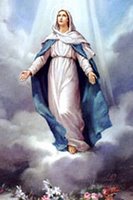 Here’s another one of those “Martin Luther was devoted to Mary” quotes. This time, Luther is said to believe in Mary’s assumption. Here’s the setup:
The Protestant Reformers on Mary
“When Fundamentalists study the writings of the "Reformers" (or founders of their particular sect) on Mary, the Mother of Jesus, they will find that the "Reformers" accepted almost every major Marian doctrine and considered these doctrines to be both scriptural and fundamental to the historic Christian Faith.
After going through perpetual Virginity, and the Immaculate conception, etc, we come to:
Assumption
Although he did not make it an article of faith, Luther said of the doctrine of the Assumption: "There can be no doubt that the Virgin Mary is in heaven. How it happened we do not know."[Martin Luther, Weimar edition of Martin Luther's Works (Translation by William J. Cole) 10, p. 268].
Source: The Protestant Reformers on Mary (see also the widespread Internet use of this quote).
First, begin with the documentation: William J. Cole did not have anything to do with the Weimar edition of Luther's Works. He was a Roman Catholic scholar who wrote an article on Luther's Mariology many years ago. So, whoever put this webpage together never actually read this quote in an authentic context. The quote is originally from WA 10(3), 268,13 to 269. The translation utilized is from Cole's old article from 1970, "Was Luther a Devotee of Mary?" [Marian Studies XXI].
The quote is from Luther's sermon of August 15, 1522. Cole mentions it was the last time Luther preached on the Feast of the Assumption, which should tip us all off on where Luther was heading with his "Mariology" (recall, Luther lived till 1546, thus this comment comes very early in his "Reformation."). Cole quotes Luther as saying,
"There can be no doubt that the Virgin Mary is in heaven. How it happened we do not know. And since the Holy Spirit has told us nothing about it, we can make of it no article of faith."
Now, one could say here that Luther leaves the door open for Mary's assumption. Perhaps he did in 1522. Cole doesn't give us enough of a context to know what Luther was talking about. Interesting though is the sentence, “And since the Holy Spirit has told us nothing about it, we can make of it no article of faith”. Here we find Luther living up to “Sola Scriptura.” One is not believe in the Assumption. It is not to be an article of faith.
In Luther's later writings on Genesis towards the end of his career though, he discusses how the Scriptures do not record the death of many Biblical women, including Mary. Luther is discussing how the Bible details the death and burial of Sarah:
“Then one should much rather consider how Abraham delivered a beautiful funeral address about Sarah. For in the Holy Scriptures no other matron is so distinguished. Her years, lives, conduct, and burial place are described. In the eyes of God, therefore, Sarah was an extraordinary jewel on whom extraordinary love was bestowed, and she is mentioned deservedly by Peter as an exemplar for all saintly wives. He says (1 Peter 3:6) that she called Abraham lord and that “you are her daughters.” To all Christian matrons Peter holds her up as a mother.
Scripture has no comments even on the death of other matriarchs, just as it makes no mention of how many years Eve lived and of where she died. Of Rachel it is recorded that she died in childbirth (Gen. 35:16–19). All the other women it passes over and covers with silence, with the result that we have no knowledge of the death of Mary, the mother of Christ. Sarah alone has this glory, that the definite number of her years, the time of her death, and the place of her burial are described. Therefore this is great praise and very sure proof that she was precious in the eyes of God."
Interestingly, Cole goes on to point out that Luther "used strong language....for the elimination of the Assumption as an aspect of the 'hypocritical church',” particularly in celebrating a feast for it. Cole cites Luther as saying in 1544:
“The feast of the Assumption is totally papist, full of idolatry and without foundation in the Scriptures. But we, even though Mary has gone to heaven, should not bother how she went there. We will not invoke her as our special advocate as the Pope teaches. The pope takes away the honor due to the Ascension of our Lord, Christ, with the result that he has made the mother like her Son in all things.”
In fairness to the work of William Cole, Cole doesn’t take a stance one way or the other if Luther ever held to the doctrine of Mary’s Assumption. He simply says that for Luther the Assumption was of “little importance…” and Luther never explicitly “denied” it either. I disagree with Cole based on the quote from Luther’s later commentary on Genesis. It is simply the case that people in the Bible died. Scripture doesn't tell us how many of them died. On Roman Catholic logic, one might as well suggest all the biblical characters that did not have their deaths mentioned were assumed into Heaven...or, one can simply cease and desist from sophistry.
Friday, December 08, 2006
Research I Would Toss Into The Elbe: Luther Believed in the Immaculate Conception of Mary
 The other day I stopped in a big chain bookstore and browsed the religious books section. I came across a Protestant/Catholic ‘debate’ book about Mary- two writers from differing perspectives fighting it out on Mary (sorry, but I don’t recall the title). I flipped to the back index to see if Martin Luther was mentioned. Sure enough, he was there. It was of course, the Roman Catholic side that repeatedly brought him up- as if, Luther is somehow relevant to what the Bible says about Mary!
The Roman Catholic writer brought up the alleged “fact” that Luther believed in Mary’s Immaculate Conception. His proof? Catholic historian Hartman Grisar’s book, Luther Vol. IV.[St Louis: B. Herder, 1913]. Did he actually read this old out-of-print book? Probably not, since he pointed out that he got the Grisar / Luther information from another book by a Catholic apologist who simply cited the quote. I’m simply amazed with this. Now, writers are going to print with what I believe is a Luther internet-generated myth. Alleged facts floating around cyber space are treated as truths to be printed and sold.
The Luther quote used was the following:
"It is a sweet and pious belief that the infusion of Mary's soul was effected without original sin; so that in the very infusion of her soul she was also purified from original sin and adorned with God's gifts, receiving a pure soul infused by God; thus from the first moment she began to live she was free from all sin" (Sermon: "On the Day of the Conception of the Mother of God," 1527")
This quote is frequently cited on Roman Catholic web pages attempting to prove Luther’s lifelong belief in Mary’s Immaculate Conception. Unfortunately, the quote is almost impossible to track down. The sermon is not included in the English edition of Luther’s Works, and to my knowledge, the complete sermon has not been translated into English.
But even more interesting is Hartmann Grisar’s information about the quote. Had the Catholic author in the Mary debate actually checked Grisar's book, I doubt he would’ve used the quote. Grisar cites the source as “Werke,” Erl. Ed., 15 Page 58. Of the quote he says,
“The sermon was taken down in notes and published with Luther’s approval. The same statements concerning the Immaculate Conception still remain in a printed edition published in 1529, but in later editions which appeared during Luther’s lifetime they disappear.”
The reason for their disappearance is that as Luther’s Christo-centric theology developed, aspects of Luther’s Mariology were abandoned. Grisar also recognizes the development in Luther's theology. In regards to the Luther quote in question, Grisar says (from a Catholic perspective),
“As Luther’s intellectual and ethical development progressed we cannot naturally expect the sublime picture of the pure Mother of God, the type of virginity, of the spirit of sacrifice and of sanctity to furnish any great attraction for him, and as a matter of fact such statements as the above are no longer met with in his later works.”
I doubt any of the modern-day Catholic apologists have ever read this entire sermon from Luther. I doubt they've ever even held the German version in their hand (by the way, I do have a German copy of this sermon). The origin of this quote in cyber-space stems from probably one Catholic apologist with a copy of Grisar's book, and that book wasn't read very carefully.
Irony upon irony, the other day I was tooling around Catholic apologetic sites, and I came across this recent posting by a Catholic apologist:
“The second thing to tell a Protestant wary about Mariology is the little-known fact that Martin Luther, the founder of Protestantism, believed in the Immaculate Conception (almost exactly the Catholic dogma before it was even required of Catholics). He had a very "high" Mariology. Some claim that he changed his mind later in life, but in my exhaustive research on the topic (in debate with a Reformed seminarian), I found at least 16 Lutheran scholars who contended that he never ceased believing the doctrine.
In 1544 (just two years before his death), he wrote: "God has formed the soul and body of the Virgin Mary full of the Holy Spirit, so that she is without all sins." And in 1545 he stated that the Virgin Mary "has not sinned and cannot sin for ever more." If even Martin Luther can accept the actual sinlessness of Mary and freedom from original sin, then any Protestant can do so, because nothing in this doctrine is contrary to Scripture at all, and indeed, "full of grace" (kecharitomene) in Luke 1:28 (rightly understood and deeply examined) is an explicit biblical proof of Mary's freedom from actual sin.”
Let’s work through this batch of mis-information slowly, point by point.
Point #1
“The second thing to tell a Protestant wary about Mariology is the little-known fact that Martin Luther, the founder of Protestantism, believed in the Immaculate Conception (almost exactly the Catholic dogma before it was even required of Catholics).”
Why is Luther’s opinion on Mary’s Immaculate Conception relevant to the truth or falsity of this Roman Catholic dogma? It shouldn’t factor into the discussion at all. The battle should be fought in the Bible- the place where the very words of almighty God reside. If ever a Roman Catholic apologist tries to tell you this “second thing”, stop him immediately and state, “Who cares what Luther believed about the Immaculate Conception!”
But, if the Catholic apologist insists on discussing Luther’s opinion on Mary, you can point out that Luther’s opinion was not “almost exactly the Catholic dogma before it was even required of Catholics”. A careful reading of Luther will not support the 1854 Roman Catholic version of the Immaculate Conception. Perhaps Luther believed something similar to the 1854 view early in his life, but the later position Luther held was that Mary was purified at Christ’s birth, not at her birth. Believing that Mary was purified at Christ's birth is not close to believing Mary lived a sinless life.
Point #2
“[Luther] had a very "high" Mariology. Some claim that he changed his mind later in life, but in my exhaustive research on the topic (in debate with a Reformed seminarian), I found at least 16 Lutheran scholars who contended that he never ceased believing the doctrine.”
First, Luther indeed had a Mariology (and it was not a "high Mariology"). It reflected his commitment to Christ, and stood in antithesis to popular Catholic belief in the sixteenth century. As Luther’s theology grew, elements of his Mariology were rejected, minimized, or reinterpreted as he clung to and developed his commitment to solus Christus. It would be incorrect to think that Luther spent a tremendous amount of time on writing about Mary. True, he wrote about her, but when this topic is compared to his vast literary output, one gets a good idea of how minimally he actually discussed Mary. For example, when one actually reads Luther’s Marian sermons, one finds that Mary is usually not the main subject, Christ is. Hence, Luther generally emphasized Mary far less than Roman Catholics do (both then and now). So, don't fall for this line about Luther having a "high Mariology". It simply isn't an accurate way to describe Luther on this subject.
Second, I know a little bit about reformed seminarians. These are the type that spend months researching this topic in multiple libraries for a very long time before writing on this subject. Some Catholic apologists seem to take about a week or so to throw up a webpage on Luther’s Mariology, but not the reformed seminarians I know (they actually try to locate contexts in which Luther said x or y before they write about it). I, being a reformed seminarian, actually wrote a paper one time on Luther's Mariology for a graduate level class, and had it graded by a Reformation expert: a published author with many books written about the Reformation. In other words, my paper was scrutinized by an expert. It appears to me, those Catholic apologists that have written on this subject just write whatever they want. Perhaps they should bring their materials to an expert before posting them on the world wide web.
Third, one can ask a Catholic apologist how truth is determined in historical studies. Is the study of history simply doing a head count of who says what? In my world, historical points are made by providing evidence, and making a point based on that evidence. While head-counts are interesting, they are not conclusive.
Point #3
“In 1544 (just two years before his death), he wrote: "God has formed the soul and body of the Virgin Mary full of the Holy Spirit, so that she is without all sins." And in 1545 he stated that the Virgin Mary "has not sinned and cannot sin for ever more."”
Of course, the first thing one should ask about these quotes is a simple one word question, “where?” Toward the end of his life in 1544 Luther denied any notion that Mary was purified at her conception. Rather she was purified at the conception of Christ:
“…Christ was truly born from true and natural flesh and human blood which was corrupted by original sin in Adam, but in such a way that it could be healed. Thus we, who are encompassed by sinful flesh, believe and hope that on the day of our redemption the flesh will be purged of and separated from all infirmities, from death, and from disgrace; for sin and death are separable evils. Accordingly, when it came to the Virgin and that drop of virginal blood, what the angel said was fulfilled: “The Holy Spirit will come upon you and overshadow you”. To be sure, the Messiah was not born by the power of flesh and blood, as is stated in John 1:13: “Not of blood nor of the will of a man, etc.” Nevertheless, He wanted to be born from the mass of the flesh and from that corrupted blood. But in the moment of the Virgin’s conception the Holy Spirit purged and sanctified the sinful mass and wiped out the poison of the devil and death, which is sin. Although death remained in that flesh on our account, the leaven of sin was nevertheless purged out, and it became the purest flesh, purified by the Holy Spirit and united with the divine nature in one Person. Therefore it is truly human nature no different from what it is in us. And Christ is the Son of Adam and of his seed and flesh, but, as has been stated, with the Holy Spirit overshadowing it, active in it, and purging it, in order that it might be fit for this most innocent conception and the pure and holy birth by which we were to be purged and freed from sin. Therefore these things are written for Christ’s sake. The Holy Spirit wanted Him to sink into sin as deeply as possible. Consequently, He had to be besmirched with incest and born from incestuous blood.”
Further, one should ask the Catholic apologist saying things like Luther said “that the Virgin Mary "has not sinned and cannot sin for ever more"” if they know how to read materials in context. It is obvious from the context that Luther’s statement on Mary is highly rhetorical and sarcastic. In context, Luther is actually calling the Pope “the pure Virgin Mary who has not sinned and cannot sin for ever more.” Using this reference to substantiate Luther’s lifelong commitment to the Roman Catholic dogma of the Immaculate Conception is quite a stretch. Not only is Luther insulting the pope, he isn’t even in the mode of presenting an explanation of doctrine. He’s using the phrase, “the pure Virgin Mary who has not sinned” as an insult.
Point #4
“If even Martin Luther can accept the actual sinlessness of Mary and freedom from original sin, then any Protestant can do so, because nothing in this doctrine is contrary to Scripture at all, and indeed, "full of grace" (kecharitomene) in Luke 1:28 (rightly understood and deeply examined) is an explicit biblical proof of Mary's freedom from actual sin.”
But it doesn’t matter what Martin Luther held about Mary. Luther is not the standard by which truth is determined for Protestants. He is not the litmus test for Biblical truth. For instance, Luther believed his generation would see the end of the world. His later writings have an intensity about the impending judgment day. Was Luther right? No.
Secondly, a particular theological point or perspective does not qualify as truth simply because it does not contradict Scripture. This is a mantra-like Catholic argument: “We believe it, it may not be in the Bible, but it doesn’t contradict the Bible, therefore it is true.” One must argue against these sophists that the Bible teaches us assertions. It gives us content. It is human sinfulness that seeks to add to that content, and will use whatever logic necessary to justify what one wants to believe.
Now, I don't mean to be unkind, but the more I study Roman Catholic issues, and the more I interact with their work, the more I'm convinced their materials are the "cunning and craftiness of men..." These are strong words, but those who attempt to supplement the Bible with materials that are tue because they aren't "contrary to Scripture" need to be avoided. Does that mean I hate Roman Catholics, or even those who write Catholic Apologetics? not at all. I have nothing personal against them. I do though think their materials need to scrutinized and shown to be in error.
I read a very apt quote from Albert Barnes recently:
"The truth is "to be spoken" - the simple, unvarnished truth. This is the way to avoid error, and this is the way to preserve others from error. In opposition to all trick, and art, and cunning, and fraud, and deception, Christians are to speak the simple truth, and nothing but the truth. Every statement which they make should be unvarnished truth; every promise which they make should be true; every representation which they make of the sentiments of others should he simple truth. "Truth is the representation of things as they are;" and there is no virtue that is more valuable in a Christian than the love of simple truth."
Thursday, December 07, 2006
On John Calvin's Mariology
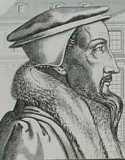 A defender of Rome named "Tiber Jumper" asks:
“Did Calvin also later on eschew his Marian devotion? I heard the same argument that he was a Marian devote but perhaps that isn't true as well?”
There is not a lot of detailed material on Calvin’s Mariology. One of the few is by Roman Catholic historian Thomas O’Meara in his book, Mary in Protestant and Catholic Thought [New York: Sheed and Ward, 1963]. Note what O’Meara states about Calvin's Mariology:
Martin Luther can hardly be said to have written a Marian theology, and yet he did compose works which center on Mary, a commentary on the Magnificat, sermons for her feast days. This is not the case with Calvin. Except for his commentaries on the early chapters of Luke and his sermons on this same area of the New Testament, Calvin treats Mary only in passing. [O’Meara, p. 125]The Protestant Reformers on Mary
But this lack of information doesn’t stop people from making claims about John Calvin’s Mariology. A few years back, the following was posted on a discussion board by a Roman Catholic. It appears to have been cut-and pasted from the popular article, The Protestant Reformers on Mary.
Protestant Father’s view of Mary
John Calvin: "Helvidius has shown himself too ignorant, in saying that Mary had several sons, because mention is made in some passages of the brothers of Christ."(Calvin translated "brothers" in this context to mean cousins or relatives.) [Bernard Leeming, "Protestants and Our Lady", Marian Library Studies, January 1967, p.9].
"It cannot be denied that God in choosing and destining Mary to be the Mother of his Son, granted her the highest honor." [John Calvin, Calvini Opera , Volume 45, 348.]
"To this day we cannot enjoy the blessing brought to us in Christ without thinking at the same time of that which God gave as adornment and honour to Mary, in willing her to be the mother of his only-begotten Son." [John Calvin, A Harmony of Matthew, Mark and Luke (St. Andrew's Press, Edinburgh, 1972), p.32.].
These quotes are supposed to demonstrate Calvin's robust and profound Mariology. Let's take a closer look at these quotes. In regard to the first Calvin quote:
"Helvidius has shown himself too ignorant, in saying that Mary had several sons, because mention is made in some passages of the brothers of Christ." (Calvin translated "brothers" in this context to mean cousins or relatives.) [Bernard Leeming, "Protestants and Our Lady", Marian Library Studies, January 1967, p.9].The source provided is not John Calvin, but rather, "Bernard Leeming, "Protestants and Our Lady", Marian Library Studies, January 1967, p.9." Leeming's article can be found here. He states,
Max Thurian says: "Calvin himself will have it that Mary had no other children, and attacks Helvidius---not, it seems, in order to defend the perpetual virginity of Mary so much as to affirm the plenitude of the gift of God in Jesus Christ. "Helvidius has shown himself too ignorant, in saying that Mary had several sons, because mention is made in some passages of the brothers of Christ". Calvin translates adelphoi by ’cousins’ or ’relatives’. We have already said in another place that according to the custom of the Hebrews all relatives are called ’brothers’"Leeming is quoting Thurian who is quoting Calvin! Here's what Thurian stated:

55. Is not this the carpenter’s son? It was, we are aware, by the wonderful purpose of God, that Christ remained in private life till he was thirty years of age. Most improperly and unjustly, therefore, were the inhabitants of Nazareth offended on this account; for they ought rather to have received him with reverence, as one who had suddenly come down from heaven. They see God working in Christ, and intentionally turn away their eyes from this sight, to behold Joseph, and Mary, and all his relatives; thus interposing a veil to shut out the clearest light. The word brothers, we have formerly mentioned, is employed, agreeably to the Hebrew idiom, to denote any relatives whatever; and, accordingly, Helvidius displayed excessive ignorance in concluding that Mary must have had many sons, because Christ’s brothers are sometimes mentioned.On this same topic, Calvin says in his commentary on Matthew 1:25,
25. And knew her not. This passage afforded the pretext for great disturbances, which were introduced into the Church, at a former period, by Helvidius. The inference he drew from it was, that Mary remained a virgin no longer than till her first birth, and that afterwards she had other children by her husband. Jerome, on the other hand, earnestly and copiously defended Mary’s perpetual virginity. Let us rest satisfied with this, that no just and well-grounded inference can be drawn from these words of the Evangelist, as to what took place after the birth of Christ. He is called first-born; but it is for the sole purpose of informing us that he was born of a virgin. It is said that Joseph knew her not till she had brought forth her first-born son: but this is limited to that very time. What took place afterwards, the historian does not inform us. Such is well known to have been the practice of the inspired writers. Certainly, no man will ever raise a question on this subject, except from curiosity; and no man will obstinately keep up the argument, except from an extreme fondness for disputation.Calvin’s point is to say that a necessary inference that Mary had other children cannot be made from the Biblical texts of Matthew 13:55 and 1:25. Calvin’s main point is that the gospel writer did not wish to record what happened afterwards to Mary. Calvin calls it “folly” at one point, when describing those who wish to make a text say more than it does. Those who would make a necessary inference where the Gospel writer has only made a possible inference engage in folly (according to Calvin). So it cannot really be concluded that Calvin is teaching here Mary’s perpetual virginity. It sounds more like Calvin is simply being careful. While I myself would make the inference from these passages that Mary had other children, It cannot be concluded from these comments that Calvin believed in Mary’s perpetual virginity, or her sinlessness, only that Calvin held the gospel writer does not explicitly say, one way or the other. This conclusion was reached similarly by William Bouwsma in his book, John Calvin: A 16th Century Portrait. He says in a footnote on p.275, "Among matters on which (Calvin) discouraged speculation were the order of angels and the perpetual virginity of Mary."
In regard to the second Calvin:
"It cannot be denied that God in choosing and destining Mary to be the Mother of his Son, granted her the highest honor." [John Calvin, Calvini Opera, Volume 45, 348].
The source given is "John Calvin, Calvini Opera, Volume 45, 348." Page 348 can be found here. The text in question states,

I doubt the person who compiled these Calvin quotes actually translated this text into English. The quote is found easily enough in Calvin’s commentary on the Harmony of the Gospels. The context is as follows:
Luke 11:27. Blessed is the womb. By this eulogium the woman intended to magnify the excellence of Christ; for she had no reference to Mary, whom, perhaps, she had never seen. And yet it tends in a high degree to illustrate the glory of Christ, that she pronounces the womb that bore him to be noble and blessed. Nor was the blessing inappropriate, but in strict accordance with the manner of Scripture; for we know that offspring, and particularly when endued with distinguished virtues, is declared to be a remarkable gift of God, preferable to all others. It cannot even be denied that God conferred the highest honor on Mary, by choosing and appointing her to be the mother of his Son. And yet Christ’s reply is so far from assenting to this female voice, that it contains an indirect reproof.What Calvin says, I know no Protestant would deny. I, as Calvinist know that in God’s providence Mary was chosen to be the mother of Jesus Christ. Indeed, that is a great honor. Calvin goes on though to the real point of this text. He says,
Nay, rather, blessed are they that hear the word of God. We see that Christ treats almost as a matter of indifference that point on which the woman had set a high value. And undoubtedly what she supposed to be Mary’s highest honor was far inferior to the other favors which she had received; for it was of vastly greater importance to be regenerated by the Spirit of God than to conceive Christ, according to the flesh, in her womb; to have Christ living spiritually within her than to suckle him with her breasts. In a word, the highest happiness and glory of the holy Virgin consisted in her being a member of his Son, so that the heavenly Father reckoned her in the number of new creatures. In my opinion, however, it was for another reason, and with a view to another object, that Christ now corrected the saying of the woman. It was because men are commonly chargeable with neglecting even those gifts of God, on which they gaze with astonishment, and bestow the highest praise. This woman, in applauding Christ, had left out what was of the very highest consequence, that in him salvation is exhibited to all; and, therefore, it was a feeble commendation, that made no mention of his grace and power, which is extended to all. Christ justly claims for himself another kind of praise, not that his mother alone is reckoned blessed, but that he brings to us all perfect and eternal happiness. We never form a just estimate of the excellence of Christ, till we consider for what purpose he was given to us by the Father, and perceive the benefits which he has brought to us, so that we who are wretched in ourselves may becomehappy in him. But why does he say nothing about himself, and mention only the word of God? It is because in this way he opens to us all his treasures; for without the word he has no intercourse with us, nor we with him. Communicating himself to us by the word, he rightly and properly calls us to hear and keep it, that by faith he may become ours.
In Calvin’s estimate, though it was an “honor” for Mary to bear Christ Jesus, much more important was that she was given spiritual life by our Lord. In fact all of us are blessed if we are given spiritual life by Jesus. To yank one sentence out of Calvin’s commentary about Mary and think it represents Calvin as a firm supporter of Roman Catholic Mariology is just not an accurate way to handle texts. Note how Calvin treats the Hail Mary, and what it means to call Mary blessed:
Next comes the third clause, that she (Mary) is blessed among women. Blessing is here putdown as the result and proof of the Divine kindness. The word Blessed does not, in my opinion, mean, Worthy of praise; but rather means,Happy. Thus, Paul often supplicates for believers, first “grace” and then “peace,” (Romans 1:7; Ephesians 1:2,) that is, every kind of blessings; implying that we shall then be truly happy and rich, when we are beloved by God, from whom all blessings proceed. But if Mary’s happiness, righteousness, and life, flow from the undeserved love of God, if her virtues and all her excellence are nothing more than the Divine kindness, it is the height of absurdity to tell us that we should seek from her what she derives from another quarter in the same manner as ourselves.
With extraordinary ignorance have the Papists, by an enchanter’s trick, changed this salutation into a prayer, and have carried their folly so far, that their preachers are not permitted, in the pulpit, to implore the grace of the Spirit, except through their Hail, Mary. But not only are these words a simple congratulation. They unwarrantably assume an office which does not belong to them, and which God committed to none but an angel. Their silly ambition leads them into a second blunder, for they salute a person who is absent.So much for Calvin, the great supporter of Roman Catholic Mariology! In regard to the third Calvin quote you provided:
"To this day we cannot enjoy the blessing brought to us in Christ without thinking at the same time of that which God gave as adornment and honour to Mary, in willing her to be the mother of his only-begotten Son."[John Calvin, A Harmony of Matthew, Mark and Luke (St. Andrew's Press, Edinburgh, 1972), p.32].
As opposed to the previous Calvin quote in Latin they opted for the English translation. Here is page 32. Let’s see the quote in context:
42. Blessed art thou. She seems to put Mary and Christ on an equal footing, which would have been highly improper. But I cheerfully agree with those who think that the second clause assigns the reason; for and often signifies because. Accordingly, Elisabeth affirms, that her cousin was blessed on account of the blessedness of her child. To carry Christ in her womb was not Mary’s first blessedness, but was greatly inferior to the distinction of being born again by the Spirit of God to a new life. Yet she is justly called blessed, on whom God bestowed the remarkable honor of bringing into the world his own Son, through whom she had been spiritually renewed. And at this day, the blessedness brought to us by Christ cannot be the subject of our praise, without reminding us, at the same time, of the distinguished honor which God was pleased to bestow on Mary, in making her the mother of his Only Begotten Son.This quote is similar to the second quote. Calvin again notes degrees of blessedness. There really isn’t anything shocking or non-Protestant at what Calvin says here about Mary. It was a great honor for Mary to be the Mother of Jesus. But is Calvin saying to honor Mary? Hardly. Is he saying to Venerate Mary? No. Is he saying to pray to Mary? No. He’s simply reminding his readers to remember what an honor it was for Mary to be the mother of Jesus.
Conclusion
Here's a pertinent closing comment to our study thus far from Calvin:
We all know the epithets which (the Papacy) applied to Mary — styling her the gate of heaven, hope, life, and salvation; and to such a degree of infatuation and madness had they proceeded, that they even gave her a right to order Christ! For still in many churches is heard the execrable and impious stanza, “Ask the Father; command the Son.” In terms in no respect more modest do they celebrate certain of the saints, and these, too, saints of their own making, i.e., individuals whom they, on their own judgment,have admitted into the catalogue of saints. For, among the multitude of praises which they sing to Claud, they call him “the light of the blind,” “the guide of the erring,” “the life and resurrection of the dead.” The forms of prayer in daily use are stuffed with similar blasphemies. The Lord denounces the severest threatenings against those who, either in oaths or in prayers, confounded his name with Baalim. What vengeance, then, impends over our heads when we not only confound him with saints as minor gods, but with signal insult rob Christ of the proper and peculiar titles with which he is distinguished, in order that we may bestow them on creatures? Were we to be silent here, also, and by perfidious silence call down on ourselves his heavy judgments?
Addendum (2017)
This blog entry is a revision of an entry I posted back in 2006. The original can be found here. Because so many sources are now available online, I'm revising older entries by adding additional materials and commentary, and also fixing or deleting dead hyperlinks. Nothing of any significant substance has changed in this entry from that presented in the former.
Subscribe to:
Posts (Atom)

 Posts
Posts


