Sunday, February 12, 2006

How To Eliminate Blog Readers: Bore Them With Tedium


I’m guessing a few you aren’t sure what Mary’s Immaculate Conception is- it is the Roman Catholic dogma that Mary was preserved free from all stain of original sin. In other words, Mary was born without the stain of original sin, and hence committed no personal sin. This isn’t a debatable point for Roman Catholics- “To think otherwise than has been defined by [The Roman Catholic Church], let him know and understand that he is condemned by his own judgment; that he has suffered shipwreck in the faith; that he has separated from the unity of the church.”

On a blog back, a Catholic Apologist stopped by to “refresh my memory” on his opinion of this subject (his self-imposed “loophole” allows him to interact with me, a notorious anti-catholic).

I’m tempted to say a great way for me to eliminate blog readers would be to launch into a deep analysis of Martin Luther’s understanding of Mary’s Immaculate Conception. I’ve always felt that only a few people even care about this subject. I really only find the subject interesting because Roman Catholics frequently bring it up. If they didn’t bring it up, I would probably not even have bothered to research it.

But why do they bring it up? Protestants should be somewhat familiar with Roman Catholic criticism of Martin Luther. Fairly common topics include: Luther’s alleged antinomianism, his rejection of certain canonical books, his alleged desire to be a Protestant pope, and some even argue Luther’s partial responsibility for Nazi Germany. But when it comes to the topic of Mary, Roman Catholic sentiment towards Luther shifts considerably. Luther becomes the staunch supporter of Mary; a leader that all contemporary Protestants should learn a great lesson in Mariology from.

In the same blog back, John Mark commenting on the Roman Catholic Luther quiz said, “What's interesting is that [the Roman Catholic author of the Luther quiz] wants to paint Luther as a bad guy as to the RCC. At the same time in the same context she wants to portray Luther as agreeing with the RCC so she could then argue that we should hold to certain doctrines since Luther did. That's playing both sides against the middle.”

As a Roman Catholic would say John Mark, “Bingo.”

This is exactly what I see one particular Romanist doing- though in fairness to him, his opinion of Luther has gotten better over the years. His original papers though on Luther definitely went in the direction John Mark suggests.

I have a strong level of certainty that the main reason in cyber-space that Luther’s “opinion” on the Immaculate Conception is even mentioned is because of certain Romanist websites. About 5 or 6 years ago I came across this Luther quote:

"It is a sweet and pious belief that the infusion of Mary's soul was effected without original sin; so that in the very infusion of her soul she was also purified from original sin and adorned with God's gifts, receiving a pure soul infused by God; thus from the first moment she began to live she was free from all sin" (Sermon: "On the Day of the Conception of the Mother of God," 1527")

Now if you were to try to track down this quote 5 or 6 years ago you would have a tough time. I know I did. The sermon it comes from isn’t available in English. It’s main source back then seemed to be one particular Romanist website. Had Romanists actually went out and read Luther’s sermon in German and then posted this quote? No, they didn’t. They found it in the work of Catholic historian Hartmann Grisar.

Grisar though points out that “As Luther’s intellectual and ethical development progressed we cannot naturally expect the sublime picture of the pure Mother of God, the type of virginity, of the spirit of sacrifice and of sanctity to furnish any great attraction for him, and as a matter of fact such statements as the above are no longer met with in his later works.” Now the Romanists left this information out. Oops.

Hence the debate between myself and Romanism. After I went out and got a hold of Grisar’s book, some Romanists were forced to actually research this topic since the very source they used denied Luther’s lifelong commitment to the Immaculate Conception. The content of a recent blog back is just that- a defense of Luther’s lifelong belief in the Immaculate Conception.

My analysis of Luther’s understanding of the Immaculate Conception is found here:

Luther’s Theology of Mary

Luther’s Theology of Mary: A Response


Counter replies of this subject can be found here:

Counter-Reply: Martin Luther's Mariology (Particularly the Immaculate Conception): Has Present-Day Protestantism Maintained the "Reformational" Heritage of Classical Protestant Mariology?

Second Reply Concerning Martin Luther's Mariology

Since I want to keep readers, not eliminate them, I would rather any of you actually interested in this subject simply read the above links. If you read through this material and have any questions, or you can find a point from these links that really begs to be responded to, let me know. The Romanist who wrote them says he re-posted his material in my blog back to “refresh my memory”. Again, after perusing through it, I’m reminded of what I wrote to him:

I have taken a fair amount of time to compare and contrast [his] comments to my paper, check his references, and cite the same sources he utilized…. Since I do not plan on writing any further responses to [his] material on Luther and Mary, I tried to be as thorough as possible…. my only desire is to exhaust the topic, and move on... Unless he presents some compelling relevant information, this will be my only response.”

By the way, the key word is “compelling”.

Saturday, February 11, 2006

A "Roman Catholic" Martin Luther Quiz

I found this Martin Luther Quiz from a defender of Roman Catholicism. The quiz was originally posted at (the no longer extant) discussion forum at CatholicView.com. Roman Catholic answers will be in red, mine in a regular black font. I wanted to send the quiz creator my answers, but this person stopped participating at Catholicview.com before I had the chance!

Question 1.
Luther tried unsuccessfully to get some inspired books of the New Testament kicked out of the Bible. Which NT books did he try to remove?

-James
-Revelations
-Hebrews
-Jude

Roman Catholic Answer: Luther tried to remove all four of these books from the Bible (because of their plain and clear teaching of Catholic doctrines)

My Answer: Overlooking the misnaming of Revelation, it is a verifiable historical fact that Luther’s translation of the Bible contained all of its books. Luther began translating the New Testament in 1521 and released a finished version in 1522. He published sections of the Old Testament as he finished them. He (and his team) finished the entire Bible by 1534. There was never an attempt or plan on Luther’s part to leave James, Jude, Hebrews, or Revelation out of his published Bible. For further information, see: Luther's View of the Canon of Scripture.

Question 2.
When Martin Luther wrote his German translation of the Bible, he added a word where it had never appeared in the text previously. What word was it?

-acorn
-alone
-ascetic
-asteroid

Roman Catholic Answer: THE ANSWER IS….alone. In Romans 3:28, Luther added the word “alone” after “faith” in his German translation of the Bible. Fortunately, this did not seep into our English version of the Bible. For more info, read “Where We Got the Bible” by Henry Graham. When people gave Luther grief for his adding of the word “alone” to the Bible, Luther replied: “If your Papist annoys you with the word (alone), tell him straightaway, Dr. Martin Luther will have it so: Papist and ass are one and the same thing. Whoever will not have my translation, let him give it the go-by: the devil’s thanks to him who censures it without my will and knowledge. Luther will have it so, and he is a doctor above all the doctors in Popedom.” (Amic. Discussion, I, 127, “The Facts About Luther” O’Hare, TAN Books, 1987, p.201).

My Answer: First, notice the Roman Catholic answer doesn't directly cite Luther. It refers to three hostile secondary Roman Catholic sources. I suggest reading the source from where the quote was pulled: Luther’s Open Letter on Translating (1530). Second, the reason for Luther's hostile rhetoric was fueled by Rome's defender Jerome Emser. He plagiarized Luther's translation while at the same time condemning it. In the same treatise, Luther goes on to give rational reasons for his translation. Luther's intention, a perfectly allowable intention, was to translate the Bible into an easily comprehended form of German. Word-for-word translations can be awkward and miss the meaning of the text. In translating Romans, Luther tried to present the “impact” of what the original Greek had on its first readers, and to present the German style and idiom equivalent for his readers. He therefore did not add any Greek words to Romans. Rather, he utilized the translating method of dynamic equivalence. Third, one of the reasons Luther mentions is that he was not the first one to find "faith alone" in the Bible:  "I am not the only one, nor the first, to say that faith alone makes one righteous. There was Ambrose, Augustine and many others who said it before me"(LW 35:196), In his book, Romans, A New Translation with introduction and Commentary, The Anchor Bible Series, pp. 360-361, the Roman Catholic scholar Joseph A. Fitzmyer proved Luther's point. He cites Origen, Hillary, Basil, Ambrosiaster, Chrysostom, Cyril of Alexandria, Bernard, Theophyylact, Theodoret, Aquinas, Theodore of Mopsuestia, Marius Victorinus, and Augustine, thus vindicating Luther. For further information see: Luther added the word “Alone” To Romans 3:28?”

Question 3.
After seeing how the Protestant movement (the “protest” of the Catholic Church) was causing a domino effect of division after division among Protestants, what did Martin Luther say would need to happen?

Roman Catholic Answer: THE ANSWER IS……After seeing the ripple effect of divisions, and the lack of unity that resulted when it came to interpreting Scripture within Protestant groups, Martin Luther said people would eventually have to return to abiding by the Catholic Church Councils. Unfortunately, the many characters of the Reformation were unable to agree even among themselves, and the return to the Catholic Church that they worked towards just never happened. Martin Luther wrote: "If the world lasts for a long time, it will again be necessary, on account of the many interpretations which are now given to the Scriptures, to receive the decrees of councils, and take refuge in them, in order to preserve the unity of faith." Epis. ad. Zwingli (ap. Balmes, p. 423). Luther saw the dangers and divisions that arose when people started interpreting Scripture apart from the first Church. He wrote: "There are almost as many sects and beliefs as there are heads; this one will not admit Baptism; that one rejects the Sacrament of the altar; another places another world between the present one and the day of judgment; some teach that Jesus Christ is not God. There is not an individual, however clownish he may be, who does not claim to be inspired by the Holy Ghost, and who does not put forth as prophecies his ravings and dreams." "An Meine Kritiker" (by Johannes Jorgensen, p. 181)

My Answer: First, I don’t know who "Johannes Jorgensen" is, but I do know who Johannes Janssen is, and he did write An Meine Kritiker, p. 181. He's a hostile secondary Roman Catholic source. "Balmes" or rather, Jaime Luciano Balmes is also a hostile secondary Roman Catholic source. Second, previous to his trial at the Diet of Worms Luther requested to be judged by a future council ("To be sure, the undeserved raging of your godless flatterers against me has compelled me to appeal from your see to a future council" (LW 31:334). Seeing the failure of Rome's fallible defenders in addressing his concerns at the Diet of Worms, Luther then sought to be scrutinized by the ultimate infallible judge: Sacred Scripture:

Unless I am convinced by the testimony of the Scriptures or by clear reason (for I do not trust either in the pope or in councils alone, since it is well known that they have often erred and contradicted themselves), I am bound by the Scriptures I have quoted and my conscience is captive to the Word of God. I cannot and I will not retract anything, since it is neither safe nor right to go against conscience.“I cannot do otherwise, here I stand, may God help me, Amen (LW 32:112-113).

Third, the first Luther quote used in the Roman Catholic answer is a notorious miscitation from Balmes (here is page 423). Luther's text actually reads,

If the world lasts much longer, men will, as the ancients did, once more turn to human schemes on account of this dissension, and again issue laws and regulations to keep the people in the unity of the faith. Their success will be the same as it was in the past (LW 37:16-17).

Notice the last sentence: “Their success will be the same as it was in the past.” Their success will be, according to Luther, failure, because “human schemes” “laws and regulations” are not the work of the Holy Spirit, but of men. The text goes on to say, “In short, the devil is too clever and too mighty for us” because “If we wish to stand upon the councils and counsels of men, we lose the Scriptures altogether and remain in the devil’s possession body and soul.” So rather than proving Luther wanted to “take refuge in the Church councils in order to preserve the unity of faith," Luther said the exact opposite. for more information on this quote see, this link.

Fourth, the quote "There are almost as many sects and beliefs as there are heads...", this quote comes from the Letter of Doctor Martin to the Christians of Antwerp (1525). The Roman Catholic answer interprets this letter as Luther seeing  Luther seeing "the dangers and divisions that arose when people started interpreting Scripture apart from the first Church." In context, Luther isn’t talking about the devastating effect of sola scriptura. He’s talking about the devastating effect of the devil, who, Luther says, was at peace in his papal fortress, but now with the gospel being loudly proclaimed, must find a different way to keep men enslaved to sin and darkness. Luther viewed the Bible as pure, but men are wicked and will misinterpret it because they are motivated by the Devil to do so: "...the pure doctrine of Scripture is not the reason for this; it is caused by the unclean thoughts which the devil has poured into the heretics" (LW 24:205).

Further, in regard to “sects”: Luther repeatedly pointed out how many sects there were in the Roman Catholic Church:

“…[T]here is no other place in the world where there are so many sects, schisms, and errors as in the papal church. For the papacy, because it builds the church upon a city and person, has become the head and fountain of all sects which have followed it and have characterized Christian life in terms of eating and drinking, clothes and shoes, tonsures and hair, city and place, day and hour. For the spirituality and holiness of the papal church lives by such things, as was said above.  This order fasts at this time, another order fasts at another time; this one does not eat meat, the other one does not eat eggs; this one wears black, the other one white; this one is Carthusian,  the other Benedictine;  and so they continue to create innumerable sects and habits, while faith and true Christian life go to pieces. All this is the result of the blindness which desires to see rather than believe the Christian church and to seek devout Christian life not in faith but in works, of which St. Paul writes so much in Colossians [2]. These things have invaded the church and blindness has confirmed the government of the pope” (LW 39:220-221).
This is important to point out because Rome's apologists are often oblivious to the sects within sixteenth century Roman Catholicism and the rank individualism within their own contemporary layman. The problem of "sects" is a universal problem, not solely a "Protestant" problem. 


Question 4.
Luther’s burial chamber was adorned with the image of…..

Roman Catholic Answer: According to Peter Stravinskas’ “Faith and Reason.” Luther’s “burial chamber in the Wittenberg church…. was adorned with the 1521 Peter Vischer sculpture of the Coronation of the Virgin.”

My Answer: This was typically used by Roman Catholics as proof Luther believed in the Assumption of Mary. Even if Luther's "burial chamber in the Wittenberg church…. was adorned with the 1521 Peter Vischer sculpture of the Coronation of the Virgin," it does not necessarily follow Luther believed in the Assumption of Mary.  However, this sculpture is not on Luther's tomb, but rather: "the plate is the tombstone for Henning Goden, Jurist and last Catholic Provost of the Castle Church." For more information see: Luther: The Assumption Was a Settled Fact?

Question 5.
Which of the following is NOT true about Luther?

A. He was devoted to the Blessed Mother
B. He believed in Baptismal regeneration
C. He believed the Body and Blood of Christ was truly present in the Eucharist
D. He referred to Mary as the “Mother of God.”
E. He thought our Lord´s mother gave birth to babies with two different fathers, God and Joseph.

Roman Catholic Answer: THE ANSWER IS…. E. (A, B, C and D are true about Luther, but not E)

My Answer: With close scrutiny, these Roman Catholic answers do not prove Luther was in harmony with Roman Catholicism. A is blatantly false: Luther saying nice things about Mary is not what Roman Catholics mean by devotion to Mary. B and C are true but not understood in the same way as Roman Catholicism. For B, Luther's baptismal regeneration emphasizes the creation of faith, while Rome emphasizes the removal of original sin. In Roman Catholicism, baptism is the initial process one begins in becoming (possibly) eventually saved with the necessary need to then do penance (and the other sacraments) to keep your baptism working. For Luther, if God has given his gifts in baptism, there is no need to do penance (and the other sacraments) to keep baptism working. Luther saw baptism as forgiving all sins, Rome does not. A helpful short video explanation can be found here. For C especially, Luther denied transubstantiation as impious, blasphemous and anathema, placing him succinctly against Roman Catholic dogma both then and now. While Luther believed in the body and blood being present in the Lord's Supper, he also believed the real bread and real wine were there also. This is flatly against Roman Catholic dogma. D is true but also understood differently in its scope than Roman Catholicism. Luther used the phrase  "Mother of God" occasionally but did not use it as a term of invocation or worship. When he used it, it was either an expression of the common vernacular of the sixteenth century, a term of respect for her as someone profoundly used by God in a significant way, or it was primarily to say something about Jesus, not Mary. I agree with the Roman Catholic answer that E is false, Luther did not believe Mary and Joseph had any other children besides Jesus. But: what was important to Luther was not Mary’s lack of children, but rather the child she did give birth to: Jesus Christ. Throughout his career, he would minimize the emphasis on popular Marian doctrine. 

Question 6.
All of these individuals believed and taught the perpetual virginity of Mary (i.e. that Mary remained a virgin after giving birth to Jesus) with the exception of:


-John Wesley (founder of Methodism)
-John Calvin
-Martin Luther
-Huldreich Zwingli
-Tammy Faye Baker

Roman Catholic Answer: THE ANSWER IS …….Tammy Faye Baker. That’s right, all of the founders of the Protestantism taught that Mary remained a virgin for life. Some Protestants are surprised to learn that most Protestant founders, including Martin Luther, also taught the Immaculate Conception (Mary conceived in St. Ann’s womb without original sin) Martin Luther wrote: "It is a sweet and pious belief that the infusion of Mary’s soul was effected without original sin; so that in the very infusion of her soul she was also purified from original sin and adorned with God’s gifts, receiving a pure soul infused by God; thus from the first moment she began to live she was free from all sin." [Martin Luther; "Sermon On the Day of the Conception of the Mother of God", 1527] Luther also wrote: “It is an article of faith that Mary is Mother of the Lord and still a virgin….” Calvin wrote: “There have been certain folk who have wished to suggest from this passage [Matt 1:25] that the Virgin Mary had other children than the Son of God, and that Joseph had then dwelt with her later; but what folly this is! For the gospel writers did not wish to record what happened afterwards….” Zwingli wrote: “I firmly believe that Mary, according to the words of the gospel as a pure Virgin brought forth for us the Son of God and in childbirth and after childbirth forever remained a pure, intact Virgin.” Luther: “Christ . . . was the only Son of Mary, and the Virgin Mary bore no children besides Him . . . ´brothers´ really means ´cousins´ here, for Holy Writ and the Jews always call cousins brothers. “ (Sermons on John, chapters 1-4, 1537-39)Luther: “Christ . . . was the only Son of Mary, and the Virgin Mary bore no children besides Him . . . ´brothers´ really means ´cousins´ here, for Holy Writ and the Jews always call cousins brothers. “ (Sermons on John, chapters 1-4, 1537-39)Luther: “God says . . . :´Mary´s Son is My only Son.´ Thus Mary is the Mother of God. “(Ibid.)Luther: “The infusion of Mary´s soul was effected without original sin . . . From the first moment she began to live she was free from all sin. (Sermon: "On the Day of the Conception of the Mother of God," 1527)

My Answer: First: during the Reformation period, Mariolatry was out of control, especially early on. it should surprise no one that the early Reformers maintained some of it, while later generations did not. They embraced Marian errors because they were engulfed in a world of excessive Mariolatry, caused by those Luther referred to as, "papists." While the early Reformers did not shed all of it during their lifetimes, most of those that came after them eventually did. The early Reformers were transitional. In all periods of church history, there is continuity and discontinuity with the period which preceded it and comes after it. Therefore, it should not be a surprise the early Reformers retained certain things later generations would reject. They were in a unique place in history, a place drenched in obsessive Mariolatry infecting both folk piety and elite belief.

Second, Luther did not hold a lifelong belief in Mary’s Immaculate Conception. The quote from Luther’s "Sermon on the Day of the Conception of the Mother of God” was probably not even written by him. For the details, see: Spurious Luther Quote: "It is a sweet and pious belief that the infusion of Mary's soul was effected without original sin..."  Luther did not write “It is an article of faith that Mary is Mother of the Lord and still a virgin.” See: Roman Catholics Botch Another Luther quote: "It is an article of faith that Mary is Mother of the Lord and still a virgin...Christ, we Believe, came forth from a womb left perfectly intact." As to his adherence to Mary's Perpetual Virginity, he did not do it to show devotion to Mary or promote the virtue of celibacy. In fact, he called those fixated on her virginity “stupid idolaters” who “practically make a false deity of her” by extolling her perpetual virginity (LW 45:205; WA 11:319). His strong adherence to Perpetual Virginity is but an example of historical continuity and discontinuity.

Third, it cannot be concluded that John Calvin is advocating the Perpetual Virginity in this quote. His point is to say that a necessary inference that Mary had other children cannot be made from Matthew 1:25. It would be more accurate to say John Calvin believed Mary and Joseph decided not to have any other children after Jesus. While this decision was the result of the birth of Christ, it was not a meritorious vow of Perpetual Virginity as we popularly held in sixteenth century Roman Catholicism.  

Fourth, Ulrich Zwingli did have a strong adherence to Mary's Perpetual Virginity, but it is again an example of historical continuity and discontinuity. Zwingli specifically denied the intercession of the saints, including Mary. Roman Catholics seem to treat this denial like it's no big deal. However, all the distinctive Roman Catholic Marian attributes (Perpetual Virginity, Assumption, Immaculate Conception, etc.) are symbiotically related to her ability to intercede. Take away Mary's ability to intercede, whatever is left becomes a curiosity of history rather than something profoundly meaningful.


Question 7.
What did Luther write was permissible in the Bible?


-marijuana smoking
-polygamy
-tattoos

Roman Catholic Answer: THE ANSWER IS….. Polygamy. Martin Luther, De Wette, II, 459: “I confess that I cannot forbid a person to marry several wives, for it does not contradict the Scripture. If a man wishes to marry more than one wife, he should be asked whether he is satisfied in his conscience that he may do so in accordance with the word of God. In such a case, the civil authority has nothing to do in such a matter.” As one of the first Sola Scriptura advocates, Luther interpreted the Bible on his own, apart from the Church, which resulted in this surprising Biblical conclusion.

My Answer: First, this Roman Catholic probably did not utilize De Wette vol. 2.
The quote in this form comes from the hostile Roman Catholic secondary source, The Facts About Luther by Father Patrick O'Hare. Second, it is true Luther does say "I confess that I cannot forbid a person to marry several wives, for it does not contradict the Scripture," but that is not the conclusion of the sentence (as O'Hare has it).  Luther goes on to immediately say,
...but I would not that such an example should be introduced amongst Christians, who ought to omit even lawful things for the sake of avoiding scandal and leading a pure life, as S. Paul demands. For it is very unbecoming to Christians, eagerly to pursue, for their own comfort, their liberty to its last consequences and yet to neglect the common and necessary duties of charity. Therefore I have not in my preaching opened this window, and I hardly believe, a Christian can be so far abandoned by God, that a man who by God's action is hindered (from the use of conjugal rights) should be unable to contain himself. But let things go where they go.
Third, it is true Luther allowed for polygamy, but only in a very narrow sense. Luther scholar Heinrich Boehmer points out that it was only to be in cases of
...severe necessity, for instance, if the wife develops leprosy or becomes otherwise unfit to live with her husband… But this permission is always to be restricted to such cases as severe necessity. The idea of legalizing general polygamy was far from the reformers mind. Monogamy was always to him the regular form of matrimony…” (Heinrich Boehmer, Luther and the Reformation in Light of Modern Research, pp. 213-214). 
Fourth, often Roman Catholic detractors point out Luther’s involvement in the bigamy of Phillip of Hesse, but they neglect Luther’s final opinion on the whole mess: “…if anyone thereafter should practice bigamy, let the Devil give him a bath in the abyss of hell" (Martin Brecht, Martin Luther, the Preservation of the Church (1532-1546), vol. 3, p. 214; WA 53:195-196).


Question 8
Fill in the blank for this famous Luther quote: “…with regard to God, and in all that bears on salvation or damnation, [man] has no ______________ but is a captive, prisoner and bondslave, either to the will of God, or to the will of Satan.”


Roman Catholic Answer: THE ANSWER IS…. Free will. This quote if from Luther’s “Bondage of the Will”). As you can imagine, it is regarded as heresy by the Catholic Church.

My Answer: Roman Catholicism is dogmatically opposed to Luther. It unequivocally affirms free will in the process of salvation. The Catechism of the Catholic Church states, 
1731 Freedom is the power, rooted in reason and will, to act or not to act, to do this or that, and so to perform deliberate actions on one's own responsibility. By free will one shapes one's own life. Human freedom is a force for growth and maturity in truth and goodness; it attains its perfection when directed toward God, our beatitude.
To deny free will, as the Roman Catholic answer states, is heresy Luther held that in regard to the way people treat each other, they in some way make free choices, in the sense that they act according to their nature. In regard to man's relationship to God, it is quite different: one is either enslaved to Satan or set free by God. But even in attaining this new freedom, one is still a slave, but a free slave of God. Luther stated,
In short, if we are under the god of this world, away from the work and Spirit of the true God, we are held captive to his will, as Paul says to Timothy [II Tim. 2:26], so that we cannot will anything but what he wills. For he is that strong man armed, who guards his own palace in such a way that those whom he possesses are in peace [Luke 11:21], so as to prevent them from stirring up any thought or feeling against him; otherwise, the kingdom of Satan being divided against itself would not stand [Luke 11:18], whereas Christ affirms that it does stand. And this we do readily and willingly, according to the nature of the will, which would not be a will if it were compelled; for compulsion is rather (so to say) “unwill.” But if a Stronger One comes who overcomes him and takes us as His spoil, then through his Spirit we are again slaves and captives—though this is royal freedom—so that we readily will and do what he wills. Thus the human will is placed between the two like a beast of burden. If God rides it, it wills and goes where God wills, as the psalm says: “I am become as a beast [before thee] and I am always with thee” [Ps. 73:22 f.]. If Satan rides it, it wills and goes where Satan wills; nor can it choose to run to either of the two riders or to seek him out, but the riders themselves contend for the possession and control of it [LW 33:65].
Slaves to sin do not have the free will to choose righteousness.  Galatians 3:22 describes everyone unregenerate as a “prisoner of sin.” John 8:34 states "Truly, truly, I say to you, everyone who commits sin is the slave of sin." Romans 6:16-20 describes regenerate Christians as former slaves to sin" "you used to be slaves to sin...When you were slaves to sin..." 2 Peter 2:19 describes false teachers as "slaves of corruption." Romans 3:11 says enslaved mankind does not seek God. This hardly sounds like freedom! 


Question 9
What book of the Bible was Luther referring to when he said: “I feel an aversion to it, and to me this is a sufficient reason for rejecting it.”


Roman Catholic Answer: THE ANSWER IS: the Book of Revelations. Here’s what he said about the Book of Revelations: “to my mind it bears upon it no marks of an apostolic or prophetic character… Everyone may form his own judgment of this book; as for myself, I feel an aversion to it, and to me this is sufficient reason for rejecting it.” (Sammtliche Werke, 63, p. 169-170, “The Facts About Luther,’ O’Hare, TAN Books, 1987, p.2-3).

My Answer: Revelation is again misspelled. The reference to The Facts About Luther is inaccurate: it is not “2-3” but rather page 203 in the 1987 edition. Luther’s Preface to the Revelation is frequently cited by Luther detractors, that is, in its original form written in 1522. Luther eventually rewrote it entirely in 1530; his opinion of the book had changed. Lutheran theologian John Warwick Montgomery points out,
Luther’s short and extremely negative Preface to the Revelation of St. John was completely dropped after 1522, and the Reformer replaced it with a long and entirely commendatory Preface (1530). Because “some of the ancient fathers held the opinion that it was not the work of St. John the apostle,” Luther leaves the authorship question open, but asserts that he can no longer “let the book alone,” for “we see, in this book, that through and above all plagues and beasts and evil angels Christ is with His saints, and wins the victory at last.” In his original, 1532 Preface to Ezekiel, Luther made a cross-reference to the Revelation of St. John with no hint of criticism; in his later, much fuller Preface to Ezekiel, he concludes on the note that if one wishes to go into prophetic study, more deeply, “the Revelation of John can also help.


Question 10
Fill in the blank for this 1523 Luther quote: “Whoever possesses a good faith, says the ______________ without danger.”

a. Lord’s Prayer
b. Hail Mary
c. Glory Be


Roman Catholic Answer: THE ANSWER IS……B……Hail Mary. Luther: “Whoever possesses a good faith, says the Hail Mary without danger. (Sermon, March 11, 1523)

My Answer: In context, Luther says the Hail Mary is not a prayer: "Inspice, quid sit Ave Maria, scilicet quod non est precatio, quia nec litera quae aliquid postulet ut in pater noster..." (the Hail Mary is not a prayer, for it contains no letter that asks for anything, as in the Our Father...). The original context of this statement is also replete with Luther explaining the abuses of using the Hail Mary. Luther states, 
First we will speak of the abuse. The whole world has taken to it and has prayed many rosary prayers and has especially honored the mother of Christ. Moreover, they fell into this error, if it were read by anyone, that it was said not to be read but to be prayed, pitten sein, if the Hail Mary were read. If anyone had said that Mary did not need to be adored, he would have been a heretic. But in the meantime Christ was neglected, and no one cared about this. We must return once more to the right path. For we know from the creed, or rather the Gospel, that Christ has done all things for us. I cannot say this of Mary, that I could put my faith in her; for if I were to say so, I would be blaspheming God. Therefore, that honor must be given to Christ alone. For we have no other mediator, neither Mary nor the apostles nor the prophets, but Christ alone (WA 11:60; English translation via DeepL).

1523 was early in Luther's Reformation career. Luther’s pro-Mariology decreased as the years went by, particularly praying to her. But even with these early comments on the Hail Mary, Luther was interpreting it differently against Roman Catholicism. Roman Catholic scholar Juniper Carol points out: 

Luther had set the style for Protestants when he attacked the Catholic prayer "Hail Holy Queen" which he regarded as blasphemous. "Your prayers, 0 Christian," he says, "are as dear to me as hers. And why? Because if you believe that Christ lives in you as much as in her, you can help me as much as she." Eventually Luther was led to limit the communion of saints to the Church on earth because of his complete rejection of any intercessory power on the part of the saints in heaven (Juniper B. Carol. Mariology vol. 2, p. 195).

Note Luther's later words comparing John 7:37-38 to the Hail Mary (“If anyone thirst, let him come to Me and drink. He who believes in Me, out of his heart shall flow rivers of living water”):
This is the correct and reassuring message of the blessed Gospel, which the pernicious and blasphemous see of Rome has trodden underfoot for several centuries, deluging all Christendom with its lies and demonic doctrines (1 Tim. 4:1) and instituting its worship and innumerable other abominations. As a consequence, Christendom neglected and, unfortunately, lost this chief fountain and source, which overflows with rich and full grace; and it substituted Christ’s mother Mary for Christ, praying to her for grace. Thus only the words “Hail Mary, full of grace!” remained current, and the words of our text passed into oblivion. But the words remain written: “And from His fullness have we all received, grace upon grace" (LW 22:136-137).

Question 11
In 1519, Luther wrote: I never approved of a ___________, nor will I approve of it for all eternity.”


a. Bible tax

b. curfew

c. schism

Roman Catholic Answer: THE ANSWER IS…..C…… Schism. LUTHER’s full quote: “I never approved of a schism, nor will I approve of it for all eternity. . . . That the Roman Church is more honored by God than all others is not to be doubted. St. Peter and St. Paul, forty-six Popes, some hundreds of thousands of martyrs, have laid down their lives in its communion, having overcome Hell and the world; so that the eyes of God rest on the Roman church with special favor. Though nowadays everything is in a wretched state, it is no ground for separating from the Church.” “On the contrary, the worse things are going, the more should we hold close to her, for it is not by separating from the Church that we can make her better. We must not separate from God on account of any work of the devil, nor cease to have fellowship with the children of God who are still abiding in the pale of Rome on account of the multitude of the ungodly. There is no sin, no amount of evil, which should be permitted to dissolve the bond of charity or break the bond of unity of the body. For love can do all things, and nothing is difficult to those who are united.” (SOURCE: Letter to Pope Leo X, January 6, 1519 more than a year after the Ninety-Five Theses quoted in The Facts about Luther, 356)

My Answer: The "Letter to Pope Leo X, January 6, 1519 more than a year after the Ninety-Five Theses" was never sent. The letter was the result of Luther’s meeting with the Papal nuncio Miltitz. Miltitz was attempting to reconcile Luther with the Pope. He spoke of how favorably the pope felt toward Luther, and how angry he was with Tetzel. He attempted to make this deal with Luther: Luther would cease with his part of this controversy- and he promised those who opposed Luther would also be silent. He also requested Luther write a letter to the pope. Miltitz specifically requested that Luther’s letter contain a confession. This scholar explains,
…that [Luther] had been too vehement and sharp although he had never thought of injuring the Roman Church, but was aiming only at the disgraceful preaching [of indulgences]…he would have a note sent out, exhorting everyone to be obedient to the Roman Church and also confessing that he had expressed the truth in an all too heated and, perhaps untimely fashion….The letter [was to] close with the characteristic words: "I am willing to do anything, provided I am not made to renounce anything more, for nothing will come of the recantation"(Heinrich Boehmer, Road to Reformation (Philadelphia: Muhlenberg Press, 1946), p. 254).
Boehmer notes the letter was written and presented to Miltitz, but Luther “absolutely refused to recant.” Miltitz then dropped the whole idea of the letter. Luther was under the impression the Miltitz would set up a meeting in which a learned bishop would evaluate Luther’s points. Luther writing to elector Frederic says,Miltitz will write the Pope at once, informing him how things stand, and asking him to recommend the matter to some learned bishop, who will hear me and point out the errors I am to recant. For when I have learned my mistakes, I will gladly withdraw them, and do nothing to impair the honor and power of the Roman Church.” Miltitz did write the Pope, informing him Luther was ready to recant everything. This never happened. The letter was never sent. For more information, see: Luther's Imaginary Letter to Pope Leo X, January 6, 1519.

Question 12
12. How did Luther describe contraception?

a. "a sin greater than adultery and incest"
b. "a sin equal to adultery and incest"
c "permissible if the husband is unable to refrain from relations one week each month."

Roman Catholic Answer: THE ANSWER IS……A….Luther said contraception was “a sin greater than adultery and incest.” Calvin called it “a monstrous thing.” Wesley and Zwingli also condemned contraception Protestants traditionally interpreted the story of Onan in Genesis as a condemnation of contraception. (until the 20th century)

My Answer: Luther did frown upon birth control, though I've not found any references to medieval contraceptive devices in his writings. The quote being cited in the Roman Catholic answer is the birth control method of withdrawal. Luther does say "It is far more atrocious than incest and adultery" (LW 7:20). Luther is commenting on Onan, who is told to take his brothers' wife, but he refuses to impregnate her and thus fulfill the duty of the demanded Leverite marriage (Duet. 25:5-6). 

I've always been puzzled why Roman Catholic polemicists use this text from Luther as being in agreement with the tenets of Roman Catholicism. Roman Catholicism endorses a method of birth control (NFP: natural family planning). In essence, Rome has said that contraception is wrong and contraception is right

I find this double standard fascinating. While Rome's defenders will cite Luther as being against birth control, Rome herself teaches that a method of birth control (NFP). If Roman Catholics really wanted to be consistent in their argument against Protestants on this issue, Roman Catholics would embrace Quiverfull ideology.


Question 13
Which book of the Bible did Luther call "an epistle of straw."

a. James
b. Philemon
c. Acts

Roman Catholic Answer: THE ANSWER IS….A…. Luther called the Book of James “an epistle of straw.” Referring to the book of Revelations, Luther said “Christ is not taught or known in it." Luther also said he wanted to toss the book of Esther into the Elbe River. “The book of Esther I toss into the Elbe. I am such an enemy to the book of Esther that I wish it did not exist, for it Judaizes too much and has in it a great deal of heathenish naughtiness. The history of Jonah is so monstrous that it is absolutely incredible. There are many things objectionable in this book [Revelation]. To my mind it bears upon it no marks of an apostolic or prophetic character.”

My Answer: First, an interesting fact about this quote “epistle of straw” is that it only appears in the original 1522 Preface to the New Testament. Lutheran scholar John Warwick Montgomery points out:

Few people realize — and liberal Luther interpreters do not particularly advertise the fact — that in all the editions of Luther’s Bible translation after 1522 the—Reformer dropped the paragraphs at the end, of his general Preface to the New Testament which made value judgments among the various biblical books and which included the famous reference to James as an “Epistle of straw"
 Montgomery finds that Luther showed a “considerable reduction in negative tone in the revised Prefaces to the biblical books later in the Reformer’s career.” For anyone to continue to cite Luther’s “epistle of straw” comment against him is to do Luther an injustice. He saw fit to retract the comment. Subsequent citations of this quote should bear this in mind.

Second, Luther's view of Revelation (not, Revelations!) was addressed in question 9 above . Third, in regard to the Esther quote, it's a variant / mistake in the Table Talk. Esdras was meant, not Esther. The definitive answer on Luther's view of the canonicity of the Book of Esther may reside in his translation of the Bible into German. Luther translated Esther and allowed it in his Bible without offering any negative criticism as to its non-canonicity in his delineated Bible prefaces. He translated it, not with the Apocryphal books, but rather with the canonical books. If he considered it Apocryphal, why didn't he translate it with Apocrypha? Why didn't he place it with the Apocrypha when he placed the Biblical books in order? In fact, in one place in his Bible prefaces, Luther distinguishes the particular noncanonical parts of Esther, and places them with the other apocryphal writings:

"Preface to Parts of Esther and Daniel (1534). Here follow several pieces which we did not wish to translate [and include] in the prophet Daniel and in the book of Esther. We have uprooted such cornflowers (because they do not appear in the Hebrew versions of Daniel and Esther)" [LW 35:353].

Fourth, "the history of Jonah is so monstrous that it is absolutely incredible…” is only being partially cited. Luther actually purported to have said, "The history of the prophet Jonah is almost incredible, sounding more strange than any poet's fable; if it were not in the Bible, I should take it for a lie..." I don’t really understand what the problem with Luther is here. Indeed, being swallowed by a giant fish is monstrous, and absolutely incredible!  Luther valued the Book of Jonah highly: 
I have therefore chosen to expound the holy prophet Jonah, for he… represents an excellent, outstanding, and comforting example of faith and a mighty and wonderful sign of God’s goodness to all the world. For who would not trust God with all his heart, proudly defy all the devils, the world, and all the fulminating tyrants, and exult over God’s kindness, when he contemplates this story and beholds how easily God’s power and grace are able to preserve Jonah in the midst of the deep sea, even in the belly of the whale, thus saving him not only from one death but from various deaths, deserted and forgotten as he is by all men and all creatures? (LW 19:36)

This entry was revised February 2026.  

Thursday, February 09, 2006

Sola Scriptura Argument

Here's an argument in 5 steps to try out on your Roman Catholic friends when they attempt to prove Sola Scriptura is a blueprint for anarchy:
1. Affirm and Define Sola Scriptura
I affirm that sola scriptura means that the Bible is the ultimate and only sufficient source as an authority for a Christian. There are though, lower authorites, like Church leaders and teachers (these must always though be judged by sacred Scripture).

2. Present the Usual Counter Charge
The counter charge (from Roman Catholics) seems to be that one needs an infallible tradition of Church hierarchy to be the ultimate and only sufficient source as an authority- this must be so because Protestants disagree with one another, so obviously sola scriptura is a failure. Without an infallible interpreter and authority like the Roman Catholic Church, one has doctrinal chaos.

3. Define the Point of Agreement: Apostolic Teaching
Now, Catholics and Protestants agree that Peter, Paul, and the apostolic teaching previous to New Testament inscripturation was an infallible, sufficient source for doctrine.

4. Use the Counter Charge To Evaluate Apostolic Teaching:
But yet we find that those who heard the teaching of Peter, Paul, and the apostolic teaching previous to New Testament inscripturation disagreed among themselves on the teaching they heard at times. In other words, there was error present in the early church while the apostles were teaching.

5.Present The Big Question:
Because those who directly heard the apostles teaching got it wrong and disagreed among themselves at times, does this mean that Peter, Paul, and the apostles were insufficient sources as an infallible authority for the early church?

The above argument will demonstrate that those who heard the very voices of infallibility in the first century made errors, but it does not follow that the apostles were insufficient as authorities.

Similarly, that some people misinterpret or twist the Bible is not the fault of the Bible, hence not a proof against sola scriptura. In the same way, that I may possibly configure my computer incorrectly is not the fault of the owner’s manual that comes with it. The misuse of a sufficient source does not negate the clarity of that sufficient source.

Rome has only explicitly defined a handful of passages, and allows their theologians to speculate and use their private judgment on the majority of Scripture. What this means to Catholic laymen, is that in actuality, they can’t really know what the Scriptures do mean in most cases. Rome has claimed infallible interpretive rights, but rarely use the right. At least with other sola ecclesia groups like the Mormons and Jehovah’s Witnesses, they constantly expound on passages, giving "infallible" interpretations. With Rome, very few infallible interpretations come forth. Why do Catholics always claim such certainty? I have no idea. It always sounds good in theory; it falls flat on its face in actual practice.


Protestants do though actually affirm the binding authority of apostolic tradition as delivered by the apostles. The content of this is what they preached and taught, and was subsequently written down in the Scriptures. Thus, I can “show” infallible tradition. Pull the Bible off your shelf. Open it up to Matthew, use your left hand as a bookmark. With your right hand, flip to the last page of Revelation. Now place your right there as a bookmark. Between your two hands is the content of the infallible teaching of Christ and the apostles.

Wednesday, February 08, 2006

Calvin vs. Melanchthon

Here's something that interested me over on a Roman Catholic blog. The basic point: Protestantism is a blueprint for anarchy. That Calvin and Melanchthon couldn't agree on issues relating to the will and Predestination is proof that Protestants desperately need the almighty Roman Catholic Church.

Most of this point is clouded by tedium as to whether or not Calvin was quoted accurately. The quote used contained a typo which causes a rather awkward reading. In this instance, The Romanist is correct on the typo. The typo is in the 1987 TAN reprint on page 293 of O'Hare's Facts About Luther (The worst book on Luther currently available in English). My 1916 edition of this book has the correct quote the Romanist is using on page 299 (the pages numbers are slightly different). Tan Publishers appear to be at fault.

Calvin and Melanchthon were disagreeing on the issues of the will and predestination.... What a shocker.

Here's an interesting excerpt from Calvin's letter to Melanchton:

"This, in all truth, we ought both to seek, viz., to come to an agreement on the pure truth of God. But, to speak candidly, religious scruples prevent me from agreeing with you on this point of doctrine, for you appear to discuss the freedom of the will in too philosophical a manner; and in treating of the doctrine of election, you seem to have no other purpose, save that you may suit yourself to the common feeling of mankind. And it cannot be attributed to hallucination, that you, a man acute and wise, and deeply versed in Scripture, confound the election of God with his promises, which are universal. For nothing is more certain than that the Gospel is addressed to all promiscuously, but that the Spirit of faith is bestowed on the elect alone, by peculiar privilege. The promises are universal. How does it happen, therefore, that their efficacy is no(t) equally felt by all? For this reason, because God does not reveal his arm to all. Indeed, among men but moderately skilled in Scripture, this subject needs not to be discussed, seeing that the promises of the Gospel make offer of the grace of Christ equally to all; and God, by the external call, invites all who are willing to accept of salvation. Faith, also, is a special gift. I think I have clearly expounded this whole question, involved and intricate though it be, in a book but very lately published. Indeed, the matter is so obvious, that no one of sound judgment can [feel] persuaded otherwise, than that you are giving out what is quite different from your real inclination. It increases my anxiety, and at the same time my grief, to see you in this matter to be almost unlike yourself; for I heard, when the whole formula of the agreement of our Church with that of Zurich was laid before you, you instantly seized a pen and erased that sentence which cautiously and prudently makes a distinction between the elect and the reprobate. Which procedure, taking into consideration the mildness of your disposition, not to mention other characteristics, greatly shocked me."

Source: Selected works of John Calvin Vol. 5, p.383-384 (Electronic Version, Ages Digital Sotware)

I think reading the extant material on Calvin and Melanchthon's letters would be an interesting discussion. Of course, I expect almost everyone to disagree with Calvinist theology (on predestination and election, that is). I expect it to cause divisions. I expect it to be offensive. I expect it to cause all sorts of problems. The shocker to me is not that Melancthon and Calvin had differences, the shocker to me is that they still maintained some type of friendship. What an incredible example of Christan brotherhood despite very important disagreements.

You can read some minor dialog I had with the Romanist in his blogback on this subject:here. What I would really like to have is a context for Melanchthon's response to Calvin, which this Romanist posits was : "All the waters of the Elbe would not yield me tears sufficient to weep for the miseries caused by the Reformation." There are only a few letters from Melanchthon to Calvin extant (8 or 9). If anyone has them, or can direct me to a source, I would be very grateful. Why would a disagreement over predestination cause Melanchthon to say this?

In regard to whether the almighty Roman Catholic Church could've helped Calvin and Melanchthon come to agreement on the issue of the Will and Predestination....well... what is the official RCC teaching on Predestination? I recall reading Catholic apologist Art Sippo point out there isn't one: Note the words of Sippo-

"One of the problems we have in catholic apologetics is indeed that there are a variety of positions taken within the Catholic fold on certian key questions. Similarly, there are a variety of positions taken by our prot opponents as well. In some correspondence I had with a "prot controverisalist of my acquiantence" (Pcoma), he complained to me that Gerry Matatics took a different view than I did on predestination. He demanded that I tell him what THE Catholic position was. I tried to explain to him that there was a range of views permissible within the limits of Catholic orthodoxy. Pcoma then complained that it seems our infallible Pope was not able to read the Scriptures and see that it clearly taught Calvinism. I retorted that this particular truth could not currently be reduced to a simplistic formula and quoted some biblical verses that make Calvinism impossible. "

Sunday, February 05, 2006

Luther Added the Word "Alone" to Romans 3:28?

Have you ever been in a discussion in which it was asserted that Martin Luther added words to the Bible? 

"Martin Luther ADDED words to the Bible that were not there. When he was confronted with this sin of adding to the Bible he replied: "Because Dr. Martin Luther will have it so!" This man was one ego-maniac with delusions of popehood." [Source]

This argument is simple: Martin Luther whimsically and deliberately inserted the word “alone” into Romans 3:28. He is painted as heretical and outrageous, showing a total disregard for the sacred Biblical text. He made it say what he wanted it to.

Here's How to respond:

1. First, locate the context.

The text of Luther comments is easy to find online: his Open Letter on Translating (1530). If you have the English edition of Luther's Works, this treatise is found in LW 35:175-201. In its original language, Ein sendbrieff D. M. Luthers. Von Dolmetzschen und Fürbit der heiligenn is found in WA 30.2:(627) 632-646. For Luther's context below, the English rendering from this link will be utilized.

Luther says in the introduction:
“…[T]here has been much discussion about the translating of the Old and New Testaments. It has been charged by the enemies of truth that the text has been modified and even falsified in many places, which has startled and shocked many simple Christians, even among the educated who do not know the Hebrew and Greek languages. It is devoutly to be hoped that with this publication the slander of the godless will be stopped and the scruples of the devout removed, at least in part. Perhaps it may even give rise to more writing on such questions and matters such as these. Therefore I ask all lovers of the truth to take this work to heart seriously, and faithfully to pray to God for a right understanding of the divine Scriptures, to the improvement and increase of our common Christendom.”
The first section of the treatise is angry, sarcastic... and humorous! Luther shows himself fed up with his Papal critics. His anger was fueled against them for an ironic reason: they rallied against his translation, while at the same time utilizing it for their own purposes! For example, a strong Papal critic of Luther, Jerome Emser, did just that "...he had plagiarized much of Luther’s translation and then palmed off the finished product as his own (LW 35:179). Luther writes,
We have seen that scribbler from Dresden [Emser] play the master to my New Testament. I will not mention his name again in my books, as he has his Judge now, and is already well-known. He admits that my German is sweet and good. He saw that he could not improve upon it. Yet, eager to dishonor it, he took my New Testament nearly word for word as it was written, and removed my prefaces and notes, replaced them with his own, and thus published my New Testament under his name!

2. Put this context into the quotes being misused.
With this context in mind, point out that Luther was blasting away at his Papal critics in anger for attacking his translation and then stealing his translation:
“If your papist wishes to make a great fuss about the word sola (alone), say this to him: "Dr. Martin Luther will have it so, and he says that a papist and a donkey are the same thing." …For we are not going to be students and disciples of the papists. Rather, we will become their teachers and judges. For once, we also are going to be proud and brag, with these blockheads; and just as Paul brags against his mad raving saints, I will brag against these donkeys of mine! Are they doctors? So am I. Are they scholars? So am I. Are they preachers? So am I. Are they theologians? So am I. Are they debaters? So am I. Are they philosophers? So am I. Are they logicians? So am I. Do they lecture? So do I. Do they write books? So do I.”
“I will go even further with my boasting: I can expound the psalms and the prophets, and they cannot. I can translate, and they cannot. I can read the Holy Scriptures, and they cannot. I can pray, they cannot. Coming down to their level, “I can use their rhetoric and philosophy better than all of them put together. Plus I know that not one of them understands his Aristotle. If any one of them can correctly understand one preface or chapter of Aristotle, I will eat my hat! No, I am not overdoing it, for I have been schooled in and have practiced their science from my youth. I recognize how deep and broad it is. They, too, are well aware that I can do everything they can do. Yet they treat me as a stranger in their discipline, these incurable fellows, as if I had just arrived this morning and had never seen or heard what they teach and know. How they do brilliantly parade around with their science, teaching me what I outgrew twenty years ago! To all their noise and shouting I sing, with the harlot, "I have known for seven years that horseshoe nails are iron.”
“Let this be the answer to your first question. Please do not give these donkeys any other answer to their useless braying about that word sola than simply this: "Luther will have it so, and he says that he is a doctor above all the doctors of the pope." Let it rest there. I will from now on hold them in contempt, and have already held them in contempt, as long as they are the kind of people (or rather donkeys) that they are.”
One can almost feel Luther’s anger towards his Papal critics dripping off the page. They discredited him as a Doctor of Theology, a degree he earned in a quick period of time. His academic abilities were above most. He had done the work necessary to be taken seriously. His critics criticized his German translation while at the same time stealing it for their own purposes. This infuriated him, and rightly so.


3. Present Luther's actual reasoning for using "alone" in Romans 3:28
There's an often-overlooked part of Luther's Open Letter on Translating. He actually goes on to give a detailed explanation of why he uses the word "alone" in Romans 3:28. In the same document in a calmer tone, Luther gives his reasoning for those with ears to hear:
I know very well that in Romans 3 the word solum is not in the Greek or Latin text — the papists did not have to teach me that. It is fact that the letters s-o-l-a are not there. And these blockheads stare at them like cows at a new gate, while at the same time they do not recognize that it conveys the sense of the text -- if the translation is to be clear and vigorous [klar und gewaltiglich], it belongs there. I wanted to speak German, not Latin or Greek, since it was German I had set about to speak in the translation.
Luther continues to give multiple examples of the implied sense of meaning in translating words into German. He then offers an interpretive context of Romans:
So much for translating and the nature of language. However, I was not depending upon or following the nature of the languages alone when I inserted the word solum in Romans 3. The text itself, and Saint Paul's meaning, urgently require and demand it. For in that passage he is dealing with the main point of Christian doctrine, namely, that we are justified by faith in Christ without any works of the Law. Paul excludes all works so completely as to say that the works of the Law, though it is God's law and word, do not aid us in justification. Using Abraham as an example, he argues that Abraham was so justified without works that even the highest work, which had been commanded by God, over and above all others, namely circumcision, did not aid him in justification. Rather, Abraham was justified without circumcision and without any works, but by faith, as he says in Chapter 4: "If Abraham were justified by works, he may boast, but not before God." So, when all works are so completely rejected — which must mean faith alone justifies — whoever would speak plainly and clearly about this rejection of works will have to say "Faith alone justifies and not works." The matter itself and the nature of language requires it.

4. Show previous Bible translations used the word “alone” in Romans 3:28

Luther offers another line of reasoning in his Open Letter on Translating that many of the current defenders of Rome ignore (and many Protestants are not aware of):
“Furthermore, I am not the only one, nor the first, to say that faith alone makes one righteous. There was Ambrose, Augustine and many others who said it before me.”
The Roman Catholic scholar Joseph A. Fitzmyer points out that Luther was not the only one to translate Romans 3:28 with the word “alone.”
At 3:28 Luther introduced the adv. “only” into his translation of Romans (1522), “alleyn durch den Glauben” (WAusg 7.38); cf. Aus der Bibel 1546, “alleine durch den Glauben” (WAusg, DB 7.39); also 7.3-27 (Pref. to the Epistle). See further his Sendbrief vom Dolmetschen, of 8 Sept. 1530 (WAusg 30.2 [1909], 627-49; “On Translating: An Open Letter” [LuthW 35.175-202]). Although “alleyn/alleine” finds no corresponding adverb in the Greek text, two of the points that Luther made in his defense of the added adverb were that it was demanded by the context and that sola was used in the theological tradition before him.
Robert Bellarmine listed eight earlier authors who used sola (Disputatio de controversiis: De justificatione 1.25 [Naples: G. Giuliano, 1856], 4.501-3):

Origen, Commentarius in Ep. ad Romanos, cap. 3 (PG 14.952).

Hilary, Commentarius in Matthaeum 8:6 (PL 9.961).

Basil, Hom. de humilitate 20.3 (PG 31.529C).

Ambrosiaster, In Ep. ad Romanos 3.24 (CSEL 81.1.119): “sola fide justificati sunt dono Dei,” through faith alone they have been justified by a gift of God; 4.5 (CSEL 81.1.130).

John Chrysostom, Hom. in Ep. ad Titum 3.3 (PG 62.679 [not in Greek text]).

Cyril of Alexandria, In Joannis Evangelium 10.15.7 (PG 74.368 [but alludes to Jas 2:19]).

Bernard, In Canticum serm. 22.8 (PL 183.881): “solam justificatur per fidem,” is justified by faith alone.

Theophylact, Expositio in ep. ad Galatas 3.12-13 (PG 124.988).

To these eight Lyonnet added two others (Quaestiones, 114-18):

Theodoret, Affectionum curatio 7 (PG 93.100; ed. J. Raeder [Teubner], 189.20-24).

Thomas Aquinas, Expositio in Ep. I ad Timotheum cap. 1, lect. 3 (Parma ed., 13.588): “Non est ergo in eis [moralibus et caeremonialibus legis] spes iustificationis, sed in sola fide, Rom. 3:28: Arbitramur justificari hominem per fidem, sine operibus legis” (Therefore the hope of justification is not found in them [the moral and ceremonial requirements of the law], but in faith alone, Rom 3:28: We consider a human being to be justified by faith, without the works of the law). Cf. In ep. ad Romanos 4.1 (Parma ed., 13.42a): “reputabitur fides eius, scilicet sola sine operibus exterioribus, ad iustitiam”; In ep. ad Galatas 2.4 (Parma ed., 13.397b): “solum ex fide Christi” [Opera 20.437, b41]).

See further:

Theodore of Mopsuestia, In ep. ad Galatas (ed. H. B. Swete), 1.31.15.

Marius Victorinus (ep. Pauli ad Galatas (ed. A. Locher), ad 2.15-16: “Ipsa enim fides sola iustificationem dat-et sanctificationem” (For faith itself alone gives justification and sanctification); In ep. Pauli Ephesios (ed. A. Locher), ad 2.15: “Sed sola fides in Christum nobis salus est” (But only faith in Christ is salvation for us).

Augustine, De fide et operibus, 22.40 (CSEL 41.84-85): “licet recte dici possit ad solam fidem pertinere dei mandata, si non mortua, sed viva illa intellegatur fides, quae per dilectionem operatur” (Although it can be said that God’s commandments pertain to faith alone, if it is not dead [faith], but rather understood as that live faith, which works through love”). Migne Latin Text: Venire quippe debet etiam illud in mentem, quod scriptum est, In hoc cognoscimus eum, si mandata ejus servemus. Qui dicit, Quia cognovi eum, et mandata ejus non servat, mendax est, et in hoc veritas non est (I Joan. II, 3, 4). Et ne quisquam existimet mandata ejus ad solam fidem pertinere: quanquam dicere hoc nullus est ausus, praesertim quia mandata dixit, quae ne multitudine cogitationem spargerent [Note: [Col. 0223] Sic Mss. Editi vero, cogitationes parerent.], In illis duobus tota Lex pendet et Prophetae (Matth. XXII, 40): licet recte dici possit ad solam fidem pertinere Dei mandata, si non mortua, sed viva illa intelligatur fides, quae per dilectionem operatur; tamen postea Joannes ipse aperuit quid diceret, cum ait: Hoc est mandatum ejus, ut credamus nomini Filii ejus Jesu Christi, et diligamns invicem (I Joan. III, 23) See De fide et operibus, Cap. XXII, §40, PL 40:223.

Source: Joseph A. Fitzmyer Romans, A New Translation with introduction and Commentary, The Anchor Bible Series (New York: Doubleday, 1993) pp. 360-361. I have looked into the pedigree of some of Fitzmyer's quotes in this blog entry

Even some Roman Catholic versions of the New Testament also saw "faith alone" in the Bible as did Luther. The Nuremberg Bible, 1483 (Gal. 2:16): “nur durch den glauben” and the Italian Bibles of Geneva (1476) and of Venice (1538) say “per sola fede.” [source].

The eighth century Irish Würzburg glosses written in Gaelic and Latin have a gloss in Latin at Romans 3:24 stating, “per fidem solam" (source).


Addendum #1 Debate: Did Martin Luther Mistranslate Romans 3:28?
In 2008 I participated in a written debate with a Roman Catholic on Luther's use of the word alone on Romans 3:28. This debate can be found here.


Addendum #2 "Dr Martin Luther will have it so... my will is reason enough." "Sic volo, sic iubeo, sit pro ratione voluntas" 

In Martin Luther's Open Letter on Translating, Rome's defenders are keen on citing Luther writing, "Dr Martin Luther will have it so... my will is reason enough."This comment is directed toward his translation of Romans 3:28 and the inclusion of "alone." The phrase, "Dr Martin Luther will have it so... my will is reason enough" is based on Luther's remark, 
"Dr. Martin Luther will have it so, and he says that a papist and a donkey are the same thing." Sic volo, sic iubeo, sit pro ratione voluntas.
The Latin phrase, "Sic volo, sic iubeo, sit pro ratione voluntas" translates to "I will it, I command it, my will is reason enough."  This Latin sentence "...is line 223 from the famous sixth satire of the Roman poet Juvenal (ca. A.D. 60–140), directed against the female sex. Luther used the quotation when he wanted to characterize the capricious unlimited power of the pope" (LW 35:185-186, fn. 21). So rather than this Latin sentence being Luther's claim of infallible authority, he's mocking the pope!
"But to return to the matter in hand! If your papist wants to make so much fuss about the word sola (alone) tell him this, “Dr. Martin Luther will have it so, and says that a papist and an ass are the same thing.” Sic volo, sic jubeo; sit pro ratione voluntas. We are not going to be the pupils and disciples of the papists, but their masters and judges" (LW 35:185-185).
German text: Und das ich widder zur sachen kome, Wenn ewer Papist sich viel unnütze machen wil mit dem wort 'Sola Allein' so sagt ihm flugs also:  Doctor Martinus Luther wils also haben  und spricht,  Papist und Esel sey ein ding.  Sic volo,  sic iubeo, sit pro ratione voluntas. (WA 30.2:635).

Addendum #3 Jerome Emser's Plagiarization of Luther's Bible
Outwardly it looked almost identical with the folio edition of Luther’s translation, even down to some of the Cranach woodcuts. But its introductions and glosses were all designed to cancel out those which accompanied Luther’s version. The text of Emser’s New Testament was based not on the original Greek text of Erasmus, which Luther had used, but on the Latin Vulgate and the late medieval German Bible. With these traditional sources as his base, Emser proceeded to “correct” the errors in Luther’s German New Testament; he did not claim to offer wholly a “new” version.
Emser’s translation, however, was not as traditional as might be supposed. Actually he had plagiarized much of Luther’s translation and then palmed off the finished product as his own. Hence the deep scorn and hostility which surges through Luther’s open letter, here before us (LW 35:179-180).

Addendum #4: Arguments (Roman) Catholics Shouldn’t Use
The following excerpt was written by a few pop-Roman Catholic online apologists that see the typical Roman Catholic canard against Luther is a bad historical argument: 
Avoid making hay about Martin Luther adding the word "alone" to Romans 3:28. While the word is indeed absent from the Greek text, Luther was not the first to regard it as a justifiable gloss. That it is not in fact justifiable makes Luther's addition an exegetical error, but this is not the same thing as a blatant perversion.

Addendum #5: Various Quotes Against Luther from the Depths of Cyber Space

"Romans 3:28 states, "Therefore we conclude that a man is justified by faith apart from the deeds of the law" (NKJV). Martin Luther, in his German translation of the Bible, specifically added the word "allein" (English 'alone') to Romans 3:28-a word that is not in the original Greek. Martin Luther reportedly said, "You tell me what a great fuss the Papists are making because the word alone in not in the text of Paul…say right out to him: 'Dr. Martin Luther will have it so,'…I will have it so, and I order it to be so, and my will is reason enough. I know very well that the word 'alone' is not in the Latin or the Greek text" (Stoddard J. Rebuilding a Lost Faith. 1922, pp. 101-102; see also Luther M. Amic. Discussion, 1, 127). This passage strongly suggests that Martin Luther viewed his opinions, and not the actual Bible as the primary authority--a concept which this author will name prima Luther." [Source]

"By September 1522, Luther had translated the New Testament into his version of the German Bible. It is to be noted that Luther taught a false doctrine that man was saved by faith alone, and upon his own recognizance and without any authority, he added the word "alone" to Romans 3:28, ... thereby ignoring all of the verses which admonish anyone not to add to or take away from, the Holy Word of GOD. He displayed his inflated ego and total arrogance, when he wrote the following regarding his addition:"If your Papist annoys you with the word (alone), tell him straightway, Dr. Martin Luther will have it so: Papist and ass are one and the same thing. Whoever will not have my translation, let him give it the go-by: the devil's thanks to him who censures it without my will and knowledge. Luther will have it so, and he is a doctor above all the doctors in Popedom."Amic. Discussion, 1, 127. Demonizing again! My My, tsk tsk, such language Dr Luther, and didn't he elevate himself above everyone on earth?This is the example set by the first Protestant, for his version of the command of Jesus Christ of, "Thou shalt love thy neighbor as thyself" (Matthew 22:36-40)." [Source]

"...Luther insists on his own (in effect) absolute infallibility. In defending his addition of the word "alone" to Romans 3:28 ("faith alone"), Luther railed: Thus I will have it, thus I order it, my will is reason enough . . . Dr. Luther will have it so, and . . . he is a Doctor above all Doctors in the whole of Popery. (O'Connor, 25; Letter to Wenceslaus Link in 1530)One wonders whether Luther uttered these absurd sentiments with a smile on his face, or with tongue in cheek. In any event, such boastful, essentially silly and foolish rhetoric is not uncommon in Luther's voluminous writings." [Source]

Friday, February 03, 2006

R.T. Kendall on John Calvin, (For Ray)


OK, so I’ve been trying to work through Ray’s comments in the blogback in order, but this one get thrust to the top of the line:

Ray Says: “Your claim that Olson & Geisler have fabricated a quote of Calvin seems a bit strong. If they both simply quoted Kendall, it's hard to fault them as Kendall is no slouch.”

Swan Replies: Ray is referring to the article I have over on James White’s AOMIN site found here. It is easy to fault Dr. Geisler and Mr. Olson here, because it appears they did not actually read the writings of John Calvin, but rather mis-copied down Kendall’s research. Ray, if one going to print a book and have an entire chapter on John Calvin, don’t you think Geisler should have at least read John Calvin? I don’t think either Olson or Geisler actually read any of the contexts of the quotes they utilized. Shame on them.

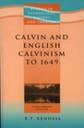
Do I value Kendall’s work? Absolutely not. One doesn’t have to read to far into the book to find glaring mistakes. For instance, on page 13 of his book Calvin and English Calvinism to 1649 Kendall claims that Calvin held to unlimited atonement, and “this view of Calvin’s breaks with Luther’s. Luther holds that ‘Christ did not die for absolutely all.’” Now I know Luther’s writings, and Kendall’s claim is blatantly false. Luther repeatedly proclaimed an unlimited atonement.

Ray Says: “Further, as Olson has shown in Appendix E of C&A(Quotations of John Calvin on General Redemption)there are many instances where Calvin is very clear that the atonement is universal. I noticed that you haven't addressed any of these quotes. It would be helpful if you did provide some commentary on why so many quotes seem to support Olson's position."

Swan Replies: How fortunate you are! I have actually worked through almost the entirety of Calvin quotes used by Norman Geisler (most of which are used by Gordon Olson as well). Let me attempt to finish up some other things first. It would be really easy for me to post this information and bore every to tears. However, in the meantime, here is a basic introduction to the entire controversy on Calvin’s view of the atonement by Roger Nicole: John Calvin's View of Limited Atonement from the 1985 Westminster Theological Journal. Considered one of the quintessential treatments of this issue, it traces the history of those who hold Calvin believed in a universal atonement, and also provides a good overview of Calvin’s atonement doctrine.

Thursday, February 02, 2006

Acts 13:48- Eavesdropping at CARM

Acts 13:48

Now when the Gentiles heard this, they were glad and glorified the word of the Lord. And as many as had been appointed to eternal life believed.”

This is one of those verses that should make you stop and think, for a long time. The verse plainly says that God appoints particular individuals for salvation. Case closed. If you believe in free will, libertarianism, Dispensationalism, or some form of semi-Pelagianism, it must be tough trying to find a place for this verse in your theology!

Some of you may remember a few years back when Dave Hunt attempted to re-translate the word TASSW (“appointed”) in Acts 13:48 to say “disposed themselves to believe.” James White responded with full force (found here). James pointed out that only one translation (…err, cough, cough), the New World Translation of the Jehovah’s Witnesses uses such a rendering:

NWT: and all those who were rightly disposed for everlasting life became believers

Over on the CARM boards, a couple guys are discussing this verse (discussion found here). One particular non-Reformed guy named Swordsman53 loves to discuss this verse. I recall a few years back dialoging with him on whether or not the rendering “disposed themselves to believe” was accurate. He said it was, and argued that the middle voice meaning of TASSW was a good translation:

I would suggest that a middle voice translation of the participle provides us with a statement that is consistent with Paul's overall theme within his letters - that salvation is open to all persons of faith, to the Jews first, and also to the Greeks.”

If I recall, he had talked with a Greek professor who gave it two thumbs up. Of course none of the major Bible translations use such a rendering:

KJV:and as many as were ordained to eternal life believed.
NASB:and as many as had been appointed to eternal life believed
NIV: and all who were appointed for eternal life believed.
ASV: and as many as were ordained to eternal life believed.
ESV: and as many as were appointed to eternal life believed.
ISV: Meanwhile, all who had been destined to eternal life believed.
NET:and all who had been appointed for eternal life believed.
NAB:All who were destined for eternal life came to believe.
NKJV:And as many as had been appointed to eternal life believed.
NLT:and all who were appointed to eternal life became believers.
NRSV:and as many as had been destined for eternal life became believers.
GNB:and those who had been chosen for eternal life became believers
Jerus.: all who were destined for eternal life became believers.

I was interested to see in this CARM discussion that Swordsman53 now denies the middle voice translation, This was the same guy who a year two back spent a whole lot of time arguing that word “appointed” was an inaccurate translation. Now though, he accepts it and argues as follows:

I still favor a passive voice view from a narrative perspective. (It is a close call but I think this has the edge.) But that does not mean that the passage says what the Reformers want it to mean. TASSW is the not the word used for predestination or election or a pre-appointment. Luke is very careful in his writing and his writings are more in line with classical Greek and he uses other words for that idea (he does have extensive use of the middle voice in his texts). Narratively, the appointment is related to those to whom Paul is specifically set aside to preach to - the Gentiles. Read the entire context of the first missionary journey and you will see this distinctive pattern of turning towards the Gentiles. That is, through the appointment of Paul at the beginning of the journey, the Gentiles are the target audience for the gospel (see 13:47 - which is the climax of the narrative of the first journey).”

Many of you are probably saying, “What in the world is he saying here?” Helpfully, a very well informed pastor John Stevenson, took the time to work through Swordsman53’s position:

I agree with the passive use of the term -- that is the most natural reading of the text as there is nothing in the context to suggest the middle voice. As to Luke use of TASSO, he regularly uses the term to describe an appointment or determination or choosing that was made. For example, in Acts 22:10, Paul is told that God has APPOINTED certain things for Paul to accomplish (the same perfect tense is used as is found in Acts 13:48).Just as God had pre-appointed a ministry for Paul in Acts 22:10 using this same term TASSO, so also here in Acts 13:48 we see that certain Gentiles had been APPOINTED to eternal life. Who did this appointing? The suggestion that this appointment was made either by Paul or Barnabas or by the people themselves seems to be a deliberate stretch to avoid what is obviously implied by the text -- that it is God who had appointed them.Furthermore, note that it is only those who had been appointed to eternal life who believed. Paul and Barnabas preached to everyone there and there were some who did not believe among both the Jews and the Gentiles. But those who had been appointed to eternal life DID believe.This in itself shows that it had to have been God who did the appointing.”

Wednesday, February 01, 2006

"Luther Examined and Reexamined: A Review of Catholic Criticism and a Plea for Reevaluation" Back In Print

A week or so back I mentioned one of the few full-length books (in English) that directly respond to Roman Catholic criticism of Martin Luther:

W.H.T. Dau, Luther Examined and Reexamined: A Review of Catholic Criticism and a Plea for Reevaluation (St Louis: Concordia Publishing House, 1917)

Copies of this book are extremely rare, or were rare. Within the last few weeks, reprints of this book have shown up on on-line used bookstore sites. For instance:

http://dogbert.abebooks.com/servlet/SearchResults?an=Dau&y=10&tn=plea&x=43

Now the prices are still a little steep: the cheapest goes for around $53, the most expensive up near $75. I'm not sure who's responsible for the printing, but whoever it was, thank you.

I already have my copy of this book (an original from 1917), but any of you that dialog with Roman Catholics about the Reformation will enjoy this resource.