
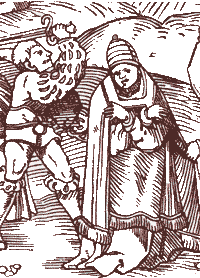
 Martin Luther: "Stab, smite, slay, whoever can. If you die in doing it, well for you! A more blessed death can never be yours, for you die obeying the divine Word and commandment in Romans XIII, "As a result, thousands died when the German nobility, spurred by Luther's words attacked and killed those they disagreed with in the Peasant's War."
This quote above has a history of use by Roman Catholics denigrating Luther. I think one of the reasons they see the shock value of this quote is from not keeping the historical zeitgeist of sixteenth century in view. One should not apply twenty-first century standards to medieval people! Countless arguments indicting Luther could be dismissed with this realization! This is not meant to excuse Luther’s words or behavior from a Christian perspective (that can be debated), but one should not see him through the lens of a speech-sensitive democracy driven American with a bent towards a contemporary view of tolerance. If Luther’s overall theology is dismissed or denigrated for his comments on the Peasant’s War, this would result in historical anachronism. Luther’s attitude toward the peasants demonstrates he was a medieval man. It does not demonstrate his theology was somehow responsible for medieval civil unrest, the blueprint for anarchy, or demonstrative of a sub-Christian morality.
Also, to indict Luther with no study of his writings on the peasants is unfair. He first published The Admonition to Peace prior to the Peasant’s War of 1525. In the first section, Luther blames the princes and rulers for the unstable state of affairs. Luther wrote to them:
We have no one on earth to thank for this disastrous rebellion, except you princes and lords, and especially you blind bishops and mad priests and monks, whose hearts are hardened, even to the present day. You do not cease to rant and rave against the holy gospel, even though you know that it is true and that you cannot refute it. In addition, as temporal rulers you do nothing but cheat and rob the people so that you may lead a life of luxury and extravagance. The poor common people cannot bear it any longer. The sword is already at your throats, but you think that you sit so firm in the saddle that no one can unhorse you. This false security and stubborn perversity will break your necks, as you will discover (LW 46:19).Also previous to the Peasant’s War, Luther ventured into peasant lands to preach against the false prophets that were provoking them to rebellion. They heckled him and interrupted his sermons. He mentions he was fortunate to get away from them without injury or death. It was after this encounter he wrote Against the Robbing and Murdering Hordes of Peasants. Even in this treatise, Luther was only exhorting bad peasants, particularly those who were using the Gospel as a means of causing societal chaos. He was also convinced that the peasants that produced the Twelve Articles were lies presented in the name of the Gospel. It is against those peasants that were using the Gospel to cause rebellion that Luther opposed. For Luther, they were the devil’s agents, leading people away from the Gospel. Luther said:
Well, then, since you are the cause of this wrath of God, it will undoubtedly come upon you, unless you mend your ways in time (LW 46:19).
If it is still possible to give you advice, my lords, give way a little to the will and wrath of God. A cartload of hay must give way to a drunken man—how much more ought you to stop your raging and obstinate tyranny and not deal unreasonably with the peasants, as though they were drunk or out of their minds Do not start a fight with them, for you do not know how it will end. Try, kindness first, for you do not know what God will do to prevent the spark that will kindle all Germany and start a fire that no one can extinguish (LW 46:21).
The peasants are not content with belonging to the devil themselves; they force and compel many good people to join their devilish league against their wills, and so make them partakers of all of their own wickedness and damnation. Anyone who consorts with them goes to the devil with them and is guilty of all the evil deeds that they commit, even though he has to do this because he is so weak in faith that he could not resist them. A pious Christian ought to suffer a hundred deaths rather than give a hairsbreadth of consent to the peasants’ cause (LW 46:54).
Some do not realize these inflammatory words from Martin Luther's treatise Against the Robbing and Murdering Hordes of Peasants were actually published after the Peasant's War began. The treatise was delayed and did not have an immediate causal role in provoking the German Nobility to begin slaughtering the peasants. Therefore, the German nobility was not motivated by Luther's words. They were motivated by the peasants that lurched society towards anarchy and civil unrest.
This blog entry was revised January 2026 for wording, grammar, dead hyperlinks, and references. The original can be found here.


 Posts
Posts


No comments:
Post a Comment