Tuesday, August 25, 2020

Luther's Theology of Mary... Facebook Style

 This meme was posted in a Facebook Group:


Typically, here would be an opportunity to launch into excessive amounts of text and documentation. Since most of us now have the reading concentration of a squirrel, here is the modern-day response (probably still too long): 

The first quote is supposed to prove Luther's acceptance of Mary's immaculate conception. The tedious details of why it doesn't prove it are found here. The quote appears to be an insertion into Luther's sermon by the editor who first published it in 1527. The quote was taken out of the sermon the following year by Luther.

The second quote was written before Luther's position on Mary's sinlessness changed. Rather than discussing Mary’s sinlessness, Luther's later writings insist Christ’s sinlessness was due entirely to the miraculous work of the Holy Spirit during his conception, not Mary's.

Finally, the meme goes on to say, "Despite his schism from the Catholic church, Luther maintained a passionate devotion to the Mother of God his whole life." What exactly does "passionate devotion" mean? Luther saying nice things about Mary is not the same thing as Roman Catholic Marian devotion, both then and now.  

Thursday, August 20, 2020

Augustine's "On The Unity of the Church" reposted

Granted, I have not had time to post here much in recent years, but here is a repost of an article, because I noticed the link has changed over at William Webster's excellent web-site.

Augustine's "On the Unity of the Church" 

https://christiantruth.com/articles/articles-roman-catholicism/deunitateintroduction/

I am reposting this because the link changed.  Everyone in recent years is updating their web-sites, and with those new codes, etc. comes new links.

Here is my older article with the old links.

http://beggarsallreformation.blogspot.com/2014/12/augustines-unity-of-church-finally.html


At William Webster's web-site, I discovered the full text of Augustine's "On The Unity of the Church" vs. the Donatists.   For the first time in history, the full text has been translated into English. (Amazing that it took so long !! Centuries!) I look forward to reading this, studying it, and possibly writing blog articles on this in the future.


New Link:


Some choice selections from Webster's Introduction:


Augustine
Introduction:  “The question has been proposed: Is the Church of Christ among the Catholics or among the Donatists? This needs to be determined from specific and clear citations in Holy Scripture. First, evidence is brought forth from the Old Testament and then from the New Testament.”  (Augustine, Introduction, On the Unity of the Church. My emphasis)

. . . 

"But, as I had begun to say, let us not listen to “you say this, I say that” but let us listen to “the Lord says this.” Certainly, there are the Lord’s books, on whose authority we both agree, to which we concede, and which we serve; there we seek the Church, there we argue our case" (Chapter 5). (My emphasis)

Webster says that Augustine basically says, 

“Since both parties adhere to the truth of Scripture and believe them to be the word of God, it is scripture which should be the final arbiter.”

Augustine writes, “just as this doesn't need an interpreter” several times in his appeal to the Donatists.  Augustine believed that theses Scriptures were clear and perspicuous, and did not need an infallible interpreter to settle the dispute.  

In one of his sermons Augustine gives this exegesis of the rock of Matthew 16:

"Remember, in this man Peter, the rock. He’s the one, you see, who on being questioned by the Lord about who the disciples said he was, replied, ‘You are the Christ, the Son of the living God.’ On hearing this, Jesus said to him, ‘Blessed are you, Simon Bar Jona, because flesh and blood did not reveal it to you, but my Father who is in heaven. And I tell you’...‘You are Peter, Rocky, and on this rock I shall build my Church, and the gates of the underworld will not conquer her. To you shall I give the keys of the kingdom. Whatever you bind on earth shall also be bound in heaven; whatever you loose on earth shall also be loosed in heaven’ (Mt 16:15–19). In Peter, Rocky, we see our attention drawn to the rock. Now the apostle Paul says about the former people, ‘They drank from the spiritual rock that was following them; but the rock was Christ’ (1 Cor 10:4). So this disciple is called Rocky from the rock, like Christian from Christ.    Why have I wanted to make this little introduction? In order to suggest to you that in Peter the Church is to be recognized. Christ, you see, built his Church not on a man but on Peter’s confession. What is Peter’s confession? ‘You are the Christ, the Son of the living God.’ There’s the rock for you, there’s the foundation, there’s where the Church has been built, which the gates of the underworld cannot conquer"
(John Rotelle, O.S.A., Ed., The Works of Saint Augustine (New Rochelle: New City Press, 1993), Sermons, Volume III/6, Sermon 229P.1, p. 327).

This treatise is of great interest historically because of what Augustine does not say constitutes unity. These words by Johann Joseph Ignaz von Dollinger, the most renowned Roman Catholic historian of the 19th century, who taught church history for 47 years, are very telling:

St. Augustine has written more on the Church, its unity and authority, than all the other Fathers put together. Yet, from all his numerous works, filling ten folios, only one sentence, in one letter, can be quoted, where he says that the principality of the Apostolic Chair has always been in Rome—which could, of course, be said then with equal truth of Antioch, Jerusalem, and Alexandria. Any reader of his Pastoral Letter to the separated Donatists on the Unity of the Church, must find it inexplicable...that in these seventy–five chapters there is not a single word on the necessity of communion with Rome as the centre of unity. He urges all sorts of arguments to show that the Donatists are bound to return to the Church, but of the Papal Chair, as one of them, he says not a word (Janus (Johann Joseph Ignaz von Dollinger), The Pope and the Council (Boston: Roberts, 1869), pp. 70-74).

Augustine says, 'Whoever dissents from Holy Scripture concerning the head is not in the Church' (Paragraph 7). (my emphasis)

He repeats this passage:

But, as I had begun to say, let us not listen to “you say this, I say that” but let us listen to “the Lord says this.” Certainly, there are the Lord’s books, on whose authority we both agree, to which we concede, and which we serve; there we seek the Church, there we argue our case (Augustine, On the Unity of the Church, Chapter 5).

"I do not wish the holy Church to be founded on human evidence, but on divine oracles" (Augustine, ibid., Chapter 6). (My emphasis)

"All such things then removed, let them demonstrate their Church, if they can, not in the speeches and murmurs of African, not in the councils of their bishops, not in the epistles of whatever debates, not in false signs and prodigies, since we are prepared and cautioned against them by the word of the Lord, but in the precept of the law, in the predictions of the prophets, in the songs of the psalms, in the utterances of the one shepherd himself, in the preaching of the evangelists, that is in all the canonical authority of the holy books, and not such that they might gather and cite things that are spoken obscurely or ambiguously or metaphorically which anyone might interpret according to his own opinion as he wishes. Such things cannot be properly understood and explained unless first those things that are said most openly are held with a strong faith (Chapter 47).

Monday, August 17, 2020

Luther's "Calvinism"? (Part One)

JS: Over on the blog sidebar there's a link to a paper entitled, Luther's Calvinism? Is Luther's Doctrine of Predestination "Reformed"?  This paper was put together back in 2011. Currently, it's available via the Internet Archive. The plan is to post it in sections here on the blog proper.   

Was Luther a "Good Calvinist"? 
There appears to be nothing more infuriating to a Lutheran than to suggest that Luther was fundamentally a "Calvinist" in his view of sovereignty and predestination. Back in 2009, Executive Director of Concordia Publishing House Reverend Paul McCain wrote, 
“Whenever the question of why are some saved and not others comes up, it is common for Calvinists who advocate for the view that God has predestined some to hell, and others to heaven, to try to drag Martin Luther into their argument and claim that they are actually being faithful to what Martin Luther taught. Let this much be clear: Martin Luther did not teach double-predestination”[1].
McCain could have any number of Reformed authors in mind. For instance, in his book Chosen By God, R.C. Sproul lays out his past intellectual resistance to the doctrine of predestination. “My struggle with predestination began early in my Christian life. I knew a professor of philosophy in college who was a convinced Calvinist. He set forth the so-called ‘Reformed’ view of predestination. I did not like it. I did not like it at all. I fought against it tooth and nail all the way through college”[2]. Part of Sproul’s argumentation for eventually embracing the Reformed view includes a list comparing those who held a similar Reformed type of predestination view against those who do not. Augustine, Aquinas, Luther, Calvin, and Edwards are stacked against Pelagius, Arminius, Melanchthon, Wesley, and Finny. Sproul points out that such a comparison doesn’t prove one view correct over the other, but “we must take seriously the fact that such learned men agreed on this difficult subject” [3]. Sproul states,
It is important for us to see that the Reformed doctrine of predestination was not invented by John Calvin. There is nothing in Calvin’s view of predestination that was not earlier propounded by Luther and Augustine before him. Later, Lutheranism did not follow Luther on this matter but Melanchthon, who altered his views after Luther’s death. It is also noteworthy that in his famous treatise on theology, The Institutes of the Christian Religion, John Calvin wrote sparingly on the subject. Luther wrote more about predestination than did Calvin [4].
Luther wrote more about predestination than Calvin? Melanchthon altered the Lutheran view on predestination for subsequent Lutherans? Such statements could easily lead to equivocating Luther and Calvin’s view of predestination, as well as Luther’s view with the so-called "five points of Calvinism."  Some in the Reformed camp have done precisely this. Lorraine Boettner’s The Reformed Doctrine of Predestination asserts Luther “went into the doctrine as heartily as did Calvin himself” and “He even asserted it with more warmth and proceeded to much harsher lengths in defending it than Calvin ever did.”[5]. Duane Edward Spencer’s popular primer on Calvinism places Luther among those “stalwart theologians” that have held “to the precious doctrines of grace known as Calvinism”[6] Edwin Palmer’s introduction to Calvinism refers to Luther as a “good Calvinist.”[7] The classic Steele and Thomas overview of Calvinism includes Luther as a champion listed on the “role call of Calvinists.”[8]

This series of blog entries will examine Luther’s views compared to the Reformed doctrine of predestination, giving attention as well to the Calvinistic slogans of total depravity, unconditional election, limited atonement, effectual calling, and perseverance. While Luther’s theology may be Reformation theology, it is not Reformed theology. If one fails to take into account Luther’s underlying presuppositions as well as his explicit statements on predestination, the atonement, perseverance, etc., blatant errors against his theology occur. While there are similarities between Luther’s views and the Reformed view, important differences still separate both sides. When the Reformed haphazardly appeal to Luther as one of her own, they do so at the expense of historical accuracy.

Notes
1. Paul McCain, Refuting Calvinist Claims that Luther Taught Double Predestination, available from the Internet Archive.

2. R. C. Sproul, Chosen by God (Wheaton: Tyndale House Publishers, 1986), 11-12.

3. Ibid., p. 15.

4. Ibid.

5. Lorraine Boettner, The Reformed Doctrine of Predestination (Phillipsburg: Presbyterian and Reformed Publishing Company, 1932), 1.

6. Duane Edward Spencer, Tulip: The Five Points of Calvinism in the Light of Scripture (Grand Rapids: Baker Books, 1979), 6-7.

7. Edward H. Palmer, The Five Points of Calvinism (Grand Rapids: Baker Books, 1980), 19.


8. David Steele, and Curtis Thomas, The Five Points of Calvinism Defined, Defended, and Documented (Phillipsburg: Presbyterian and Reformed Publishing Company, 2004), 74.


Saturday, August 15, 2020

Luther on the Feast of the Assumption of Mary

 August 15 is the official Feast of the Assumption, in which Mary was bodily assumed into heaven (either dead or alive, depending on who you're talking to!). There have been a number of Beggars All posts on Luther and the Assumption of Mary... simply because of the propaganda perpetuated by Rome's defenders claiming he believed it. Here are a few of those entries working through Roman Catholic claims:

Revisiting Luther on the Assumption of Mary  

Luther on the Assumption of Mary: "There can be no doubt that the Virgin Mary is in heaven. How it happened we do not know"

Luther Celebrated The Feast of the Assumption?

Luther and the Assumption

 In a 1532 sermon (WA 52:681-682), Luther is said to have preached, 

The feast of the ascension of Mary is completely papist, that is, full of blasphemy and established without any grounding in Scripture. For that reason we have let it lapse in our churches and have used the day to preach about how Mary went over the mountain to visit her relative Elizabeth and what happened there. In the first place there is no sign in Scripture of the feast of the ascension of Mary so that the papists themselves just use a saying from Jerome, who is supposed to have said: "I do not know whether she ascended into heaven in her body or out of her body." And how is anyone supposed to know this when there is nothing in Scripture about it? The most annoying and dangerous thing about making this ascension into a feast is that people honor the Virgin Mary and call to her, as they sing in the response: "O you pure Mother of God, we ask that you, because you were taken up to heaven, be gracious to us and make us citizens in heaven."
But we Christians do not know of any ascension that we can enjoy except for that of our dear Lord Jesus Christ, who ascended into heaven and sits at the right hand of God, and intercedes for us. For that reason we can console ourselves in his Ascension and know that we will enjoy this, that we will also come to heaven and shall be heard here on earth by him in everything we ask for in his name. for that reason it is a wonderful, exalted and comforting feast, the Ascension of Christ, that the Virgin Mary enjoyed just as we do. We however, even if she has already gone to heaven, cannot enjoy her ascension, and should not for that reason call to her or to take comfort in her intercession as the pope teaches and through this shames and dishonors the Ascension of our Lord Christ, because he wants to make the mother equal to the son in everything. [Translation from Susan C. Karant-Nunn and Merry E. Wiesner-Hanks  Luther on Women: A Sourcebook (New York: Cambridge University Press, 2003), p. 46-47]


Monday, August 03, 2020

Luther: Every week I preach justification by faith to my people, because every week they forget it.

Did Luther say, "Every week I preach justification by faith to my people, because every week they forget it"? Sometimes the quote is stated as "we need the gospel every day because we forget the gospel every day."

This is a murky Luther quote that seems like something he would have said, yet finding an exact reference isn't easy. A couple of people have searched for this quote uncovering interesting clues and theories of its origin (see for instance, About That Great Luther Quote and also the discussion here). Piggybacking on their efforts, I have my own theory of how this quote became popular: it's in the form it's in because singer-song writer Derek Webb was quoting Charles Spurgeon quoting Luther... whether he knew it or not!

Derek Webb, The House Show 
It was posited by this blogger that the quote popularly stems from Derek Webb's, The House Show CD. That seems possible. In this 2003 article from the Christian Post,  Webb is quoted as saying, 
Martin Luther was once quoted when a member of his congregation came in and said, "Pastor, why is it week after week you preach to us the Gospel? We've read your books, we know you to be a brilliant man. Why do we never move on? When do we get past this, on to something else?" And he said, "Beloved, because week after week, you forget it. You will never be without your need for the Gospel, so I will never cease to preach it to you."
In another version, Webb states:
There’s a great quote by Martin Luther in the sixteenth century. He had a church that he was the pastor of and some came to him and said, “Pastor, why is it that week after week after week all you ever preach to us is the gospel?” – implying that “we’re ready to move on to something else. Certainly we know this by now.” Luther’s response was, “Well, because week after week you forget it, because week after week you walk in here looking like a people who don’t believe the gospel. And until you walk in looking like people who are truly liberated by the truth of the gospel, I’m going to continue to preach it to you.” And, until his dying day, he did.
The blogger who uncovered Derek Webb's use states, "...what I think has happened is that Derek Webb put a bit of a story to an actual Luther quote...". He's right that the story was "jazzed up a bit," but I don't think Webb was jazzing up Luther directly. One year earlier, this 2002 author states, "A frustrated parishioner once asked Martin Luther why he preached the gospel of grace every Sunday. Luther replied, “Because every week you forget it.” Was this 2002 book on "Devotion for Dating Couples" the source Derek Webb used?  I don't know. I suspect one  (or both) of these people may have been "jazzing up" Luther via Charles Spurgeon.  

Charles Spurgeon
I've been through a few popular Luther quotes that are the result of Charles Spurgeon. This doesn't surprise me. Spurgeon's writings were widely published in English, he's still widely read, and he's extremely quotable! Spurgeon alluded to or quoted Luther from memory, though he typically did not quote Luther verbatim but rather summarized something from Luther in his own words. 

From an 1855 sermon, Spurgeon is recorded as saying, 
...the whole Bible tells us, from beginning to end, that salvation is not by the works of the law, but by the deeds of grace. Martin Luther declared that he constantly preached justification by faith alone, "because," said he, "the people would forget it; so that I was obliged almost to knock my Bible against their heads, to send it into their hearts." So it is true; we constantly forget that salvation is by grace alone.
The question then becomes: what source did Spurgeon use? Spurgeon's primary language was English. During his time period, there was only a limited pool of Luther's writings available in English. During Spurgeon's lifetime, one of the most popular of Luther's writings available in English was his commentary on Galatians. This blogger rightly identifies a comment from Luther's commentary that seems very likely what Spurgeon had in mind. Luther states,   
Bur here will some men say, the law is divine and holy. Let the law have his glory, but yet no law, be it never so divine and holy, ought to teach me that I am justified, and shall live through it. I grant it may teach me that I ought to love God and my neighbour; also to live in chastity, soberness, patience, etc., but it ought not to show me, how I should be delivered from sin, the devil, death, and hell. Here I must take counsel of the gospel. I must hearken to the gospel, which teacheth me, not what I ought to do, (for that is the proper office of the law,) but what Jesus Christ the Son of God hath done for me : to wit, that He suffered and died to deliver me from sin and death. The gospel willeth me to receive this, and to believe it. And this is the truth of the gospel. It is also the principal article of all Christian doctrine, wherein the knowledge of all godliness consisteth. Most necessary it is, therefore, that we should know this article well, teach it unto others, and beat it into their heads continually. for as it is very tender, so it is soon hurt. This Paul had well tried, and of this have all the godly also good experience. 

Conclusion
The quote in its current popular form does not appear to be an exact quote from Martin Luther, but rather a quote that was originally from his Galatians commentary, used extemporaneously by Spurgeon, and then picked up by a few people in the early 2000's. The only exact way to connect these dots is to specifically ask Derek Webb or the authors of Devotions for Dating Couples about it. Till then, here is Luther from one of his sermons:
The devil is ever on the alert to insinuate all kinds of wickedness into our hearts, and would fain make them as cold as ice. Where God’s Word is not repeatedly proclaimed in sermons, in hymns, in private conversation, so that we may not forget it or become callous towards it, there it is impossible for our hearts, which are burdened with many an earthly pain and sorrow, with wicked purposes and the devil's malicious instigations, not to fail and to fall from Christ. Thus it is an urgent necessity that the preaching of the Gospel continue among us, that we may hear and retain it, otherwise we would soon forget our Lord. 

Sunday, August 02, 2020

Luther: Lord Jesus, You are my righteousness, I am your sin. You took on you what was mine; yet set on me what was yours. You became what you were not, that I might become what I was not

Did Luther say, "Lord Jesus, You are my righteousness, I am your sin. You took on you what was mine; yet set on me what was yours. You became what you were not, that I might become what I was not"?

This quote has a healthy cut-and-paste life throughout cyberspace. Unlike many of the spurious sayings of Luther covered on this blog, this one is genuine! The only minor debate about the quote is whether Luther intended it to be part of prayer or praise. There are a number of websites (and also books) that say it's a prayer written by Luther. We'll see, it was not intended as a prayer, although it certainly would function as a good prayer!

Documentation
Most often the quote is cited without documentation; fortunately, there are exceptions, making this an easier investigation. There are two frequent references. The first is to Luther's Letters of Spiritual Counsel, a collection put together by Theodore Tappert (Louisville: Westminster Press, 1955), p. 110 (Library of Christian Classics series). The second is to Luther's Works 48:12 (LW). The original English translation was done by Tappert. LW utilized it with "minor changes." Tappert is the one who translated it as a prayer.

The context is a letter from Luther to the Augustinian friar George Spenlein, April 8, 1516. The original Latin text can be found here. The text reads, 


Context
Now I should like to know whether your soul, tired of its own righteousness, is learning to be revived by and to trust in the righteousness of Christ. For in our age the temptation to presumption besets many, especially those who try with all their might to be just and good without knowing the righteousness of God, which is most bountifully and freely given us in Christ. They try to do good of themselves in order that they might stand before God clothed in their own virtues and merits. But this is impossible. While you were here, you were one who held this opinion, or rather, error. So was I, and I am still fighting against the error without having conquered it as yet.
Therefore, my dear Friar, learn Christ and him crucified. Learn to praise him and, despairing of yourself, say, “Lord Jesus, you are my righteousness, just as I am your sin. You have taken upon yourself what is mine and have given to me what is yours. You have taken upon yourself what you were not and have given to me what I was not.” Beware of aspiring to such purity that you will not wish to be looked upon as a sinner, or to be one. For Christ dwells only in sinners. On this account he descended from heaven, where he dwelt among the righteous, to dwell among sinners. Meditate on this love of his and you will see his sweet consolation. For why was it necessary for him to die if we can obtain a good conscience by our works and afflictions? Accordingly you will find peace only in him and only when you despair of yourself and your own works. Besides, you will learn from him that just as he has received you, so he has made your sins his own and has made his righteousness yours. (LW 48:12-13)
Conclusion
Tappert's original translation reads slightly different, making the quote a prayer:
Therefore, my dear brother, learn Christ and him crucified. Learn to pray to him and, despairing of yourself, say: "Thou, Lord Jesus, art my righteousness, but I am thy sin. Thou hast taken upon thyself what is mine and hast given to me what is thine. Thou has taken upon thyself what thou wast not and hast given to me what I was not."
Tappert translates, "disce ei cantare et de te ipso desperans dicere ei" as "Learn to pray to him and, despairing of yourself," whereas LW says "Learn to praise him and, despairing of yourself." LW appears to be a more accurate translation.

An interesting aspect of this letter and quote is its date of 1516 (previous to the posting of the Ninety-Five Theses of 1517). Many probably do not realize there's been a long debate as to the exact dating of Luther's evangelical breakthrough and his understanding of Romans 1:17-18. It's not uncommon to find Luther's detractors putting forth the myth of Luther discovering justification by faith alone on the toilet. More meaningful and scholarly debate focuses on the year. There are three main perspectives:

View A: 1514 or earlier
View B: 1515 or 1516
View C: 1518 (after the Ninety-Five Theses).

Some years ago I listened to lectures by Dr. Kolb. He stated that Luther discovered something about the grace of God quite early (perhaps in his early lectures on Peter Lombard's Sentences in 1509). One finds a strong emphasis on the grace of God in these early lectures. Dr. Kolb said that Luther's theology finally came together in 1518 and 1519 with his solidifying his concepts of promise, faith, justification, and the proper distinction of the law. Dr. Kolb said the contemporary debate on this topic originated with Roman Catholic historian Hartmann Grisar, and was furthered by the scholarship of Saarnivaara, Bizer, and Green.
The dating of Luther’s discovery and its meaning for his theology have been the subject of wide discussion and debate. In his Road to Reformation (Philadelphia, 1946, pp. 87–117) Heinrich Boehmer says that Luther’s discovery took place in April or May, 1513. Uuras Saarnivaara argues that the great discovery took place as late as the autumn or winter of 1518–1519. He makes this assertion in his book, Luther Discovers the Gospel (St. Louis, 1951, especially pp. 92–120). In Luther’s Progress to the Diet of Worms (Greenwich, 1951, p. 39) Gordon Rupp says, “It is clear, in all essentials, his [Luther’s] theology was in existence before the opening of the church struggle in 1517.” Robert Herndon Fife, siding with Boehmer’s dating, provides documentation, bibliography, and discussion of Luther’s discovery in The Revolt of Martin Luther (New York, 1957, pp. 197–202). For introductory and interpretive material, cf. WA 54, 176–178, and Ernst Stracke’s Schriften des Vereins für Reformationsgeschichte (Leipzig, 1926), Vol. 44, No. 140: “Luthers groszes Selbstzeugnis 1545 über seine Entwicklung zum Reformator historisch-kritisch untersucht.” (LW 34:326)
Whichever date it may be, the quote in question from the young Martin Luther certainly highlights Luther's grappling with sin and the righteousness of Christ as the possession of a sinner!

Friday, July 24, 2020

Luther: A Christian is never in a state of completion but always in a process of becoming.

(Revised 1/02/22)
Did Martin Luther say, "A Christian is never in a state of completion but always in a process of becoming"?  The picture to the left is one of many found on the Internet popularizing its link to Luther. The attribution to Luther has gone beyond seemingly endless cut-and-pastes of cyberspace and also finds its way into published books. Let's take a look. 

Documentation
In my cursory search, of the scores of webpages using this quote, I found no documentation other than the simple attribution to Luther. The oldest use of it I found was to a Lutheran publication: Kent Gilbert (ed.), Confirmation and Education (Fortress Press, 1969). In a chapter entitled, The Purpose of confirmation Education, Richard Evanson writes on page 48,
Grow in the life of the community and its mission. Christians have always understood that God works with man through other men. Through his experience with the pastoral and educational ministry of the congregation, the confirmand is to gain such learning as:
a. Understanding that the that the church is the people of God and that it has the following God-given functions: worship, witness, education, service, fellowship.
b. Understanding that Christian growth is a lifelong process and that the Christian is never in a state of completion but always in a process of becoming.
c. Understanding that all believers in Christ are members of the Body of Christ and are joined in a fellowship that transcends race, nationality, age, and time.
d. Feeling that he is genuinely a part of the body of Christ and experiencing the fellowship which this implies.
e. Finding those tasks within the church for which he is fitted and accepting responsibility to fulfill them.
It's interesting that almost the exact wording is used (except, "the Christian" vs. "a Christian"). Evanson doesn't document the quote but presents himself as the author of the words; that Christian growth is to be understood as "a lifelong process and that the Christian is never in a state of completion but always in a process of becoming."  It's within the realm of possibility that Evanson simply arrived at the same formula independently of the current Luther attributed quote, or that someone mis-attributed to Luther what was original to Evanson.  

Conclusion (Revised 1/02/22)
When I originally wrote this entry, I concluded,
"This is yet another 'Martin Luther' quote best classified as apocryphal. No, Luther probably did not coin this phrase in this form.  The sentiment is so popular, that virtually anyone from any religion could have said it. In fact, "We are always in a process of becoming" is popularly attributed to Bruce Lee! Unfortunately, I was not able to determine who first attributed the quote to Luther."
Since then, I've found two instances of Luther using something very close. First, in a comment below under this entry, someone pointed out LW 67:213. Luther has a discussion about the journey of a Christian life. He says,  
"... [W]hoever has begun to be a Christian, this is what remains: to consider that he has not yet become a Christian and to seek to become a Christian, so that he can boast with Paul: 'Not that I am, but that I desire to be' [Phil. 3:12]. And 'As many of us as are perfect, let us remain in this rule' [Phil. 3:15]. For a Christian is having not yet become, but is becoming, for to him is said, 'Seek, ask, knock,' not 'You have, you have found, you have entered,' but 'seek, ask,' etc. ;Matt. 7:7]." 
Recently in re-reading the Defense and Explanation of All the Articles (1521) Luther says,
"The second parable is in Matthew 13:33 It is that of the leaven which the woman mixes in three measures of meal until it is leavened through and through. The new leaven is the faith and grace of the Spirit, who does not leaven the whole lump through at once, but gently and slowly makes us altogether like Himself, new bread of God. This life, therefore, is not righteousness but growth in righteousness, not health but healing, not being but becoming, not rest but exercise; we are not yet what we shall be, but we are growing toward it; the process is not yet finished, but it is going on; this is not the end, but it is the road; all does not yet gleam with glory, but all is being purified." (PE 3:30-31)
As I said originally, it wouldn't be at all uncommon to find the notions of becoming and completion in Luther's writings.  On the other hand, what makes Luther unique is the concept of simul justus et peccator, that at the same time, a Christian is seen covered in the righteousness of Christ, but yet still a sinner, in the process of becoming. 

The concepts of "process of becoming" and "state of completion" are not unique to Luther. The sixth century B.C. Greek philosopher Heraclitus saw all of reality in the "process of becoming" while Parmenides delved into examining the state of "being." In more recent times, Process Theology views all of reality, including God, in perpetual process unto a final goal.  

In religious parlance, the paradigm of becoming and completion are almost thoroughly ingrained into whatever system one looks at.  In Christian theologies specifically, a Roman Catholic could just as easily say "A Christian is never in a state of completion but always in a process of becoming" as a Protestant, but with different nuances: Roman Catholic theology sees sanctification unto eventual justification, whereas typical Protestant theology sees justification unto eventual complete sanctification. Eastern Orthodoxy has its emphasis on theosis and apotheosis, similarly seeing the Christian life as a process of becoming to eventual arrival.

In commenting on the inherent sin within the church, Luther speaks of judgment day "when we shall then rise pure," then in passing, mentions "the Aristotelians say, we are in process of becoming holy and not in the state of having become holy" (LW 12:243, "Luther’s phrases are in fieri and in facto"). In one of his early responses to the papal bull exsurge domine, he states,
This life, therefore, is not godliness but the process of becoming godly, not health but getting well, not being but becoming, not rest but exercise. We are not now what we shall be, but we are on the way. The process is not yet finished, but it is actively going on. This is not the goal but it is the right road. At present, everything does not gleam and sparkle, but everything is being cleansed (LW 32:24).
In Luther's Disputation on the Works of the Law and of Grace (1537), Luther says, "Our justification is not yet finished. It is neither something which is actually completed nor is it essentially present. It is still under construction"  (WA 39.1:252 (LW 71); cf, Paul Althaus, 245, fn 96), but is finally completed in the resurrection ("Sed complebitur tandem in resurrectione mortuorum").

Addendum: simul justus et peccator
Sometimes simul justus et peccator is misunderstood as a Christian being 100% sinner and 100% saint at the same time, in which case, a Christian would not be, in essence, in "a process of becoming," but rather simply awaiting to shed off the sinful man at death. Such Christian anthropology can veer towards antinomianism, seeing any doctrine of sanctification abhorrent.  This link presents a fascinating study of Luther's simul justus et peccator.  The author quotes Luther saying, "we die unto sin and live unto righteousness, beginning and growing here on earth and perfecting it beyond" (LW 41:113-114).

Monday, July 20, 2020

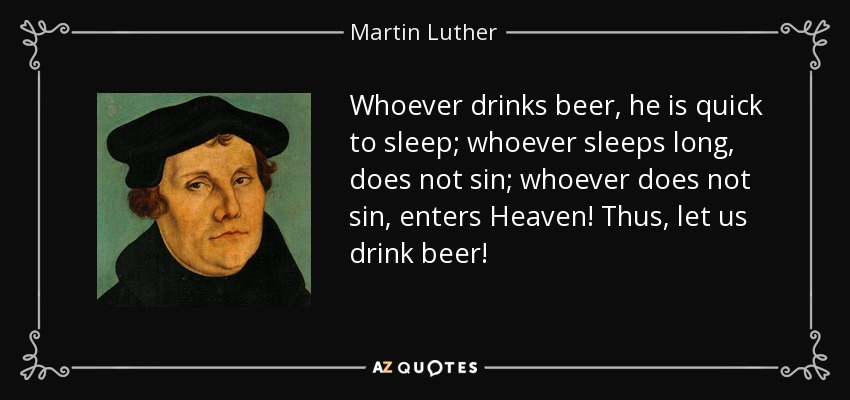
Luther: "Whoever drinks beer, he is quick to sleep; whoever sleeps long, does not sin; whoever does not sin, enters Heaven! Thus, let us drink beer!"


Here's a Luther quote pulled from a Lutheran discussion group:
Whoever drinks beer, he is quick to sleep; whoever sleeps long, does not sin; whoever does not sin, enters Heaven! Thus, let us drink beer!
This is another one of those Luther quotes splattered all over the internet.  It appears to be particularly an obvious favorite of beer websites and beer enthusiasts. One site states,  "I not 100% sure that the following quote is truly from Martin Luther; however I’ve seen it attributed to him enough that I willing to do the same." One page considers the quote one of 50 Profound Martin Luther Quotes About Faith.  A basic book search reveals it's gone to print as well. Let's take a closer look. No, it wasn't Luther, but it is surprising to find out that one of Luther's closest associates was using a version of it.

Documentation
Typically, there is no documentation other than attributing the quote to "Martin Luther." Others have sought to verify this quote. This author claims the quote "seems to have appeared suddenly in 2007 on a blog" but doesn't provide a link to substantiate the claim.  An intriguing clue is found on Wikipedia, dating the phrase in Latin to 1658:

Whoever drinks beer, he is quick to sleep; whoever sleeps long, does not sin; whoever does not sin, enters Heaven! Thus, let us drink beer!
  • Widely attributed to Luther, but actually is an example given in 1658 book Ἑρμηνεια logica of faulty logic. In Latin:
    • Si vero termini in sorite sunt causae subordinatae per accidens, sorites non valet; ut ia hoc, Qui bene bibit, bene dormit; qui bene dormit, non peccat; qui non peccat, est beatus; ergo: qui bene bibit est beatus. Vitium est, quod bene bibere sit causa per accidens somni.
  • Translated via Fauxtations:
    • If, however, the conclusions in the sorite are subordinate by accident, the sorites is not valid; as in this one, He who sleeps well, drinks well; he who sleeps well, does not sin; he who does not sin, is blessed; therefore, he who drinks well is blessed. The problem is that to drink well is a cause of sleep only by accident.

The 1658 book / page cited by Wikipedia can be found here.  Wiki, as admitted, absorbed this information from this source, a blog entitled, Fauxations, because sometimes the Internet is wrong. Kudos to this source for at least determining the quote has an old pedigree that need not necessarily be linked to Martin Luther. Unfortunately, while 1658 may appear at first glance to be the oldest use of the quote found via Google Books, this does not determine if its the actual origin of this quote or if Luther originally said it or not.

An interesting clue that Fauxations points out is the aspect of the "syllogism"... that the quote was not intended to be a cute saying, but rather an example of a logical problem.  This nineteenth-century source refers to it as a "classic canticle" citing it as: Bene vivit. Qui bene vivit Bene dormit. Qui bene dormit Non peccat. Qui non peccat In cælum venit. Ergo qui bene bibet In cælum venit. Another nineteenth-century text refers to it as "the syllogism," another, "the formula."  This text refers to it as "a profane syllogism obtained by Lord John Russell from an old Spanish priest": Qui bene bibet bene dormit, qui bene dormit non peccat, qui non peccat salvatus erirt (the incident appears to be recorded here and here).  This text puts the syllogism in a narrative form. The one thing these texts at least have similarly in is that the syllogism existed as common knowledge.

Philip Melanchthon?
One can go deeper than 1658 and find the syllogism being toyed with by none other than Luther's associate... Philip Melanchthon!  In a Google book from 1529 from Melanchthon one finds


This text reads, Qui bene bibet, bene dormit, Qui bene dormit, non peccat, qui no peccat erit beatus, ergo qui bene bibet erit beatus. There appears to be correlation of this Latin syllogism to the German jingle, Zu nacht wohl essen, macht wohl schlafen, und wohl leben, macht wohl sterben.


Conclusion
I doubt Luther coined the phrase in it's typical logical formula or in the form Melanchthon presented. It is fascinating though that Philip Melanchthon, a close associate, was using it in his logic textbooks and Luther was well aware of his publications.  It is therefore, not out of the possibility that Luther could have repeated it, or a version of it, say in a Table Talk (my cursory search though didn't find anything). It would be interesting to determine if the syllogism existed previous to Melanchthon (I suspect it may have) in a book on logic.

The version that currently circulates the Internet is the obvious work of an editor, perhaps unintentionally or humorously, making the syllogism specific to beer and specific to Luther.   But hey, maybe tacking on "Luther" can actually generate $$$.


Friday, July 17, 2020

Luther on the Papists: "Why do we not rather assault them with arms and wash our hands in their blood?"

In going through the Beggars All archives, I came across a series of old posts examining Martin Luther's call for the deaths of Roman Catholics. Luther is quoted as saying,
It seems to me that if the Romanists are so mad the only remedy remaining is for the emperor, the kings, the princes to gird themselves with force of arms to attack these pests of all the world and fight them, not with words, but with steel. If we punish thieves with the yoke, highwaymen with the sword, and heretics with fire, why do we not rather assault these monsters of perdition, these cardinals, these popes, and the whole swarm of the Roman Sodom, who corrupt youth and the Church of God? Why do we not rather assault them with arms and wash our hands in their blood?- Martin Luther June 25, 1520
Other English versions of this quote, typically shorter, exist as well. It's not uncommon to find snippets of this quote on amateur apologetcs web-pages... but also in many books, some done by respected authors. Realizing that my older entries are a bit top-heavy, let's take a concise and fresh look at this quote. We'll see that Luther went on to explain he was speaking rhetorically, not literally.

Documentation
Back in 2008 I went through a detailed footnote from a defender of Rome documenting this quote. This time, simply, the quote in the English form above originates from Roland Bainton's Here I Stand.

Bainton cites WA 6:347. The quote comes from Epitoma Responsionis ad Marinum Lutherum. It was originally a book published by one of Luther's Roman Catholic opponents, Sylvester Prierias. As a response to it, Luther republished it with his own annotations, introduction and conclusion. The quote in question comes from Luther's conclusion. To my knowledge, no official English translation of the entire work is available.  However, It is scheduled to be released in an upcoming volume of Luther' Works.

Context


Conclusion
Back in 2008 I provided a detailed explanation of this quote. It's enough to simply know that Luther's Roman Catholic opponent, Sylvester Prierias was an advocate of papal absolutism. Prierias was a high official in the Roman Church. He charged Luther with offending the Pope's majesty in questioning indulgence preaching, in essence, questioning the authority of the one who granted indulgence preaching. Against this position of papal absolutism Luther declares:
"If these opinions and this teaching prevail at Rome, with the knowledge of the Pope and the Cardinals, I pronounce that Antichrist sits in the temple of God, and that the Roman Court is the synagogue of Satan. If the Pope and the Cardinals do not demand a retraction of these opinions,I declare that I dissent from the Roman Church, and cast it off as the abomination standing in the holy place."
"When the Romanists see that they cannot prevent a Council, they feign that the Pope is above a Council, is the infallible rule of truth, and the author of all understanding of Scripture. There is no remedy, save that Emperor, Kings, and Princes should attack these pests and settle the matter, not by words but by the sword. If we punish thieves by the gallows, and heretics by fire, why not attack Pope, Cardinals, and the brood of the Roman Sodom with arms, and wash our hands in their blood?" [source]
Not too long afterward, Luther explained exactly what he meant in response to another Roman controversialist, Jerome Emser. Luther explained it was a rhetorical argument: since heretics are burned, then it should be fair as well to physically attack the papists. He goes on to elaborate he didn't approve of burning heretics, so he wasn't advocating killing the papists.  In LW 39: 172-174, Luther states:
Emser’s second lie is that I wanted the hands of the laymen washed in the blood of the priests. His holy priesthood and Christian love seek nothing but fire. If I were dead he could spread such lies as truth, just as happened to Huss. This is the way I have written against Sylvester, “in contrast,” as this noble poet and rhetorician well knows: if heretics are burned, why should we not much rather attack the pope and his sects with the sword and wash our hands in their blood, if he teaches what Sylvester writes, namely, that Holy Scripture has its power from the pope. But since I dislike burning heretics, or killing even a single Christian, and since I know full well it is against the gospel, I merely indicated what they deserve if heretics deserve the fire. Nor is it necessary to attack you with the sword. The nobility and worldly powers, if they just despise your tyrannical shamming and false ban, can certainly advise you womanish and childish people with a single letter and command. They can say to you, “This is the way it must be,” and you have no choice but to obey. The way you react to it, with burning, banning, raging, and raving against the clear truth, it seems you would really like to have a Bohemian example made of yourselves and fulfill the prophecy which says that the priests should be slain. If this should happen to you, you cannot blame me. Just continue as you are, you are on the right track! Where advice is not possible, help is not possible. You will very soon find out if you can end the game in that way, even if it rains and snows nothing but bishops, Emsers, Ecks, and popes. I trust you have foreseen that no one will destroy the pope but you yourselves, his own creatures, as the prophet says.
But tell me, dear Emser, if you may write that it is necessary and right to burn heretics and think you do not thereby soil your hands with Christian blood, why should it not also be right to strangle you, Sylvester, the pope, and all your sects in the most scandalous way? For not only do you write in the manner of a heretic and of the Antichrist, but you also say what all the devils are not allowed to say, namely, that the gospel is confirmed by the pope, its power is dependent on the pope’s power, and the church has done what the pope does? What heretic has ever so completely condemned and destroyed God’s word in one stroke? That is why I still say, “If heretics have deserved the fire, you and the pope should be killed a thousand times.” Still I do not want it to happen. Your judge is not far off. He will find you in good health and nimble. Do not get bored in the meantime. Yet I would prefer you to come before him with remorse and penance. God help you to do this, Amen. Nevertheless, I would like the Roman courtiers to be repelled with force just like other thieves and robbers, if they cannot be stopped in any other way.
So that I may not be ridiculed along with you I shall ignore your babbling that I put the priesthood to shame and your claim that St. Paul was consecrated by the apostles and St. Peter had a tonsure; I shall also ignore all the useless talk you spew forth about consecration and priestly estate and the threefold meaning of “spiritual”-spirituale, ecclesiasticum, religiosum-and that not all Christians are spiritual, spirituales. You probably also would like to say that the laying on of hands on the head meant more than consecration. Who can stop you if you intend to do nothing but lie and preach, as some do, that St. Bartholomew prayed the rosary and the psalter of our dear lady? I do not need any logic here: I call spiritual spirituales, devout Christians ecclesiasticum, and do not know religiosum in this context. I thought that for once the naked sword would strike me with the blade, but neither sheath nor sword nor man is at hand. You also lie that I have made all laymen bishops, priests, and spiritual in such a way that they may exercise the office without a call. But, as godly as you are, you conceal the fact that I added that no one should undertake this office without a call unless it be an extreme emergency. And what shall I say, since there is almost one lie after another in your book? I am afraid you will lie, blaspheme, hate, and rave yourself to death. In previous times it was easy to write against heretics. For even though they erred, as honest people they did not need to lie and stuck to the heart of the matter. My persecutors let the matter drop and, like knaves, rely solely upon lies. But to keep you from being displeased at hearing nothing but your lies, let us deal again with something good-the Spirit and the letter, which is the main theme of your book.
It depends on where  you fall on the "I hate or Love Luther" spectrum as to whether or not one grants his explanation.  Roland Bainton says, "The disavowal was genuine." I suspect for many of Rome's defenders, it isn't.

Addendum
In the entries of 2008, I highlighted the various ways Rome's defenders use this quote. Since that time, I've come across some of Rome's defenders using it against current ecumenical trends in their own church (see here and here). They are concerned with current Roman authorities having positive interaction with a group whose founder appears to have hated their very existence and called for their deaths.

Friday, July 10, 2020

Luther Didn't Know What an Indulgence Was?

This was posted by one of Rome's defenders via social media:
Luther, in his thesis number (35), referred to indulgences as a way of “buying souls out of Purgatory or to buy confessional licenses.” Years later, Luther admits the fact that he didn’t actually know what an indulgence was. “In two different places in his pamphlet entitled “Hans Worst” written about 1541, when he [Luther] was blinded by rage against the Church, he solemnly declared that,
‘As truly as Our Lord Jesus Christ redeemed me, I did not know what an indulgence was’” (The Facts About Luther pg. 77 – Erlander, 26, 50, 51).
This has been covered previously here at Beggars All. It's still making the rounds.  Leslie Rumble's use of it works as a popular cut and paste source. Fatima.org uses it.  This article, claimed to be written by "an expert in Catholic apologetics" (I've never heard of him!) uses it... to name a few. Let's take a fresh look.

Documentation
Rome's defender cites "The Facts About Luther pg. 77 – Erlander, 26, 50, 51." This reference is to an old hostile Roman Catholic secondary source: Patrick O'Hare, The Facts About Luther (Illinois: Tan Books), 1987 (reprint). Father O'Hare states,
It is interesting to note that later on, in looking back over the days that were gone, Luther had the audacity to state that “he hardly knew what an Indulgence was.” In two different places in his pamphlet entitled Hans Worst, written about 1541, when he was blinded by rage against the Church, he solemnly declares that, “As truly as Our Lord Jesus Christ has redeemed me I did not know what an Indulgence was.” (Erlanger, 26, 50, 51.)
We'll return to Father O'Hare in the conclusion below, but for now, let's simply deal with the tidbits offered. First, notice O'Hare cites "Erlanger" not " Erlander" as Rome's defender did. In actuality, it's the Erlangen edition of Luther's writings (though "Erlanger" is acceptable). Sometimes this set is referred to as "Dr. M. Luthers Samtliche Werke" or "E." Here is volume 26, 50-51. The text reads,


O'Hare probably didn't translate this German text himself, he blatantly used secondary sources for the majority of his citations. The English rendering used certainly preceded O'Hare's use (see for example,  J. Verres, 1884).  

This text has been translated into English: Against Hanswurst (LW 41:179-256). The quote is on pages 231-232. This treatise was written towards the end of Luther's life. In the section under scrutiny, Luther reflects back on the beginning of the indulgence controversy.

Context
It happened, in the year 1517, that a preaching monk called John Tetzel, a great ranter, made his appearance. He had previously been rescued in Innsbruck by Duke Frederick from a sack—for Maximilian had condemned him to be drowned in the Inn (presumably on account of his great virtue)—and Duke Frederick reminded him of it when he began to slander us Wittenbergers; he also freely admitted it himself. This same Tetzel now went around with indulgences, selling grace for money as dearly or as cheaply as he could, to the best of his ability. At that time I was a preacher here in the monastery, and a fledgling doctor fervent and enthusiastic for Holy Scripture.
Now when many people from Wittenberg went to Jütterbock and Zerbst for indulgences, and I (as truly as my Lord Christ redeemed me) did not know what the indulgences were, as in fact no one knew, I began to preach very gently that one could probably do something better and more reliable than acquiring indulgences.(86) I had also preached before in the same way against indulgences at the castle and had thus gained the disfavor of Duke Frederick because he was very fond of his religious foundation. Now I—to point out the true cause of the Lutheran rumpus—let everything take its course.
(86) See, for example, a sermon Luther preached on February 24, 1517. LW 51, 26–-31. See also two Lenten sermons he preached in March, 1518. LW 51, 35-–49.
[LW 41:231-232]
Elsewhere in the same document, Luther says something similar:
So my theses against Tetzel’s articles, which you can now see in print, were published. They went throughout the whole of Germany in a fortnight, for the whole world complained about indulgences, and particularly about Tetzel’s articles. And because all the bishops and doctors were silent and no one wanted to bell the cat (for the masters of heresy, the preaching order, had instilled fear into the whole world with the threat of fire, and Tetzel had bullied a number of priests who had grumbled against his impudent preaching), Luther became famous as a doctor, for at last someone had stood up to fight. I did not want the fame, because (as I have said) I did not myself know what the indulgences were, and the song might prove too high for my voice (LW 41:234; WA 51:541; Halle, 52).
Conclusion
LW 41 translates the sentence: "I (as truly as my Lord Christ redeemed me) did not know what the indulgences were..." Luther does not say: I did not know what an indulgence is. A much more practical way to read the sentence from Against Hanswurst  is that Luther was not aware of what the details were of the particular indulgences that were being hawked in Jütterbock and Zerbst. Luther was certainly familiar with indulgences previous to the 1517 controversy. My earlier entry on this goes into the details of Luther's comments on indulgences previous to 1517.

Now back to Father O'Hare: those sources that use this Luther tidbit via O'Hare actually ignore what Father O'Hare goes on to say. O'Hare admits that Luther did know what an indulgence was at the time, but then proceeds to attack him on other grounds:
This statement, notwithstanding the sacred affirmation with which he introduces it, is to say the least, of very doubtful veracity. To express himself in this way is, however, rather a poor compliment for a Professor and Doctor of Theology to pay to himself, nor can it be considered as very prudent, that a man should talk about and inveigh against things of which he confesses his ignorance. Indeed, he could hardly have meant what he said had he recalled at the moment the teachings and sermons of his earlier days, when he held and asserted with absolute conviction the mind of the Church on the doctrine of Indulgences. If Luther, however, was really ignorant of the matter he had plenty of opportunities of learning the unadulterated teaching of the Church. He could have been accommodated within the walls of his own University. The nature of Indulgences was clearly defined in ordinary manuals for the use of the clergy, then in print, such as the “Discipulus de Eruditione Christi Fidelium,” issued at Cologne in 1504, and many other learned theological works. Luther, however, needed no enlightenment on the subject. He knew what an Indulgence was, its nature, its authority, its place in the spiritual order, and was quite familiar with its practice in the Church. He knew that an Indulgence was simply a remission in whole or in part, through the superabundant merits of Jesus Christ and His saints, of the temporal punishment due to God on account of sin after the guilt and eternal punishment have been remitted in the Sacrament of Penance. He knew that it gave no license to commit sin of any kind or in any form. He knew that no abuse could affect an Indulgence in itself, that an Indulgence is legitimate apart from an abuse, and that it would be a sacrilegious crime in any one whomsoever, from the Pope down to the most humble layman, to be concerned in buying or selling Indulgences. He knew that Indulgences were never bartered for money in Germany or elsewhere for sińs yet to be committed. He knew they were not marketable commodities and that ro traffic or sale of Indulgences was ever authorized or countenanced by the authorities of the Church. He knew all this as well as any enlightened member of the Church in his day for he studied the whole ins-and-outs of the matter in his earlier career. His onslaught on Indulgences was not made from any lack of knowledge of their meaning and value.
Father O'Hare was certainly hostile toward Luther, as are typically those who use Father O'Hare's book.  Here we see a clear instance of bias by those who can't even cite their own hostile sources against Luther correctly!

Saturday, July 04, 2020

Martin Luther: History is like a drunk man on a horse. No sooner does he fall off on the left side, does he mount again and fall off on the right.

Here's a colorful saying attributed to Martin Luther:
“History,” Martin Luther said, “is like a drunk man on a horse. No sooner does he fall off on the left side, does he mount again and fall off on the right.” (source)
Documentation
Most often the quote is not documented. Curiously, an article found on the Christian History Institute website presented an entire article expounding what Luther meant, by taking a "closer look" at "both at Luther’s remarks and Luther himself".... without actually documenting the quote!

I'm not the first to come across this documentation problem. This old discussion post asks for help locating the source, and they actually arrived at the source: Luther's Table Talk.  The Table Talk is a collection of second-hand comments written down by Luther's friends and students, published after his death. Luther didn't write the Table Talk. Since the statements contained therein are purported to have been made by Luther, they should serve more as corroborating second-hand testimony to something Luther is certain to have written.

This particular second-hand comment was recorded by Veit Dietrich in 1533. There is no context surrounding the remark.  The German text can be found at WA Tr 1:298 (631). The text reads:


This text is included in LW 54:111. My electronic copy of LW 54 lists this Table Talk entry as 630.  This is an error: it's actually 631. 


Context 
No. 630: The World Is Like a Drunken Peasant
Fall, 1533
“The world is like a drunken peasant. If you lift him into the saddle on one side, he will fall off on the other side. One can’t help him, no matter how one tries. He wants to be the devil’s.” (LW 54:111)

Conclusion
There are various versions of this quote:

1800: Human reason is like a drunken man on horseback; set it up on one side, and it tumbles over on the other.

1952: Luther surely spoke very good sense when he compared humanity to a drunkard who, after falling off his horse on the right, falls off it next time on the left.

1992: Human nature is like a drunk peasant. Lift him into the saddle on one side, over he topples on the other side.

1993: Martin Luther said that humanity is like a drunk man on a horse. First he falls off on one side, then he climbs back up and falls off the other side.

2007: Martin Luther - an intemperate and hasty man, but far from a fool- once remarked that humanity is like a drunken peasant trying to ride a horse. We mount, fall off on one side, remount, and fall off on the other.

2014: Martin Luther said history is like a drunk man on a horse going from one ditch to the other, and it seems that is the case with us.

I'm sure many other examples of this quote are available. This is only a brief sampling. In the earliest version, it's "human reason" which is like a drunk person on horseback.  Then, it's humanity or "human nature." Finally, it's "history" which is like a drunk person on a horse.

According to the primary source, it's the "world."

Sunday, June 07, 2020

The Loss of Steve Hays (1959-2020)

http://triablogue.blogspot.com/2020/06/steve-hays-1959-2020.html

I don't completely recall how I first "met" Steve Hays. I think he e-mailed me sometime in the early 2000's in regard to something about John Calvin. What I remember about the e-mail is that the content was well-written and more complex than what I was able at the time to converse on.  That sort of summarizes how I've viewed Steve's writing abilities over the years. It's not that everything he wrote was above my academic level, it's that his writing demonstrated to me over and over that he was a much deeper thinker than I am. Bluntly: he was more intelligent and verbally capable than most of us. When someone, friend or enemy, would lump me in with Steve, I felt embarrassed. It's like putting a toddler next to the starting quarterback on the high school football team.

To his cyber-opponents,  watching them squirm at the end of his verbal sword,...well...  I enjoyed that probably more than I should have! Yes, it was a guilty pleasure. Steve would show up on my blog from time to time. He typically was able to find the exact spot of weakness that a detractor was fixated on and take them apart. I don't ever recall Steve losing his cool, at least it never came across that way.

One thing I've discovered over the years is that the people I become friends with or gravitate towards are those who can make me laugh. Steve had a great sense of humor. His wit, in both his planned out written blog posts and his random comments appears to have flowed naturally.  Easily, he could have made a living as a satirist!

Others have mentioned this already: as much as those of us in cyberspace "knew" Steve, I didn't know him at all. I also thought "Steve Hays" may have not been his real name! I never knew anything about him, how old he was, what his job was, if he had family... this never bothered me. Rather, I greatly appreciated that he wasn't a cyber-narcissist. I never recall him looking for any $$ or promoting himself.  He easily could have used Triablogue to earn a living. What he did though was allow us to benefit from his insight for free. He gave to us freely.

As I grow older, death creeps closer and closer. My parents have died. Some of my brothers have died. Close friends have died. My pets have died. Each loss now, however minor, really hits hard. The older we get, the more the words of Lord's Day 1 of the Heidelberg Catechism grow larger and larger on the page. They pulsate: they hit that certain spot each of us has when we consider our lives and all the gifts of family and friends loaned to us from the Lord. It all slowly gets peeled away, until finally, the only real solid thing you have for your comfort, never leaving you, is the Lord Jesus Christ. I'm not sure many of us would ever learn this truth if it were not for being "peeled."

I find it embarrassing in my own spiritual growth that often it's only by loss, even the loss of a blogger I've never met in-person, that I really take the time to consider the brevity of life and the eternal promises of God fulfilled in the life and death of Jesus Christ. This side of  eternity, I will miss Steve. I'm grateful to God to have given him to us for this brief time.