Showing posts with label Islam. Show all posts

Wednesday, February 07, 2018

Explaining "the Son of God" terminology to Muslims


This is a repost of the content of an earlier article I wrote.  In the earlier one, the photo is gone; so I thought I would repost the content here again.  Also, I have added a video of David Wood's at the end that is very good on the issue of dealing with Jesus as "the Son of God" with Muslims.
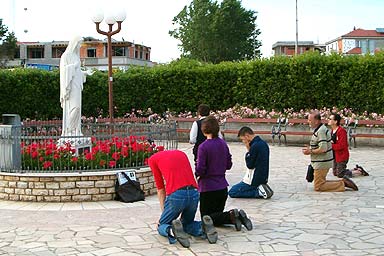
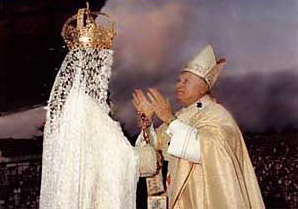


Bad Witness: Praying to and bowing down to Mary

Someone recently (around September of 2009) called into the Dividing Line Pod-cast Program (Dr. James White of Alpha & Omega Ministries; see www.aomin.org)  and asked for help on witnessing to Muslims. He told of his experience in a Muslim area in Africa (Uganda) and that the Muslims kept saying, “God cannot reproduce!”; How many times have I heard this over the last 26 years in witnessing to Muslims?!: “God cannot have a wife!” “God cannot have a son!” “God did not lust after Mary and marry her and have sex with her!”

To our Roman Catholic and Orthodox readers – see, here we have a living example of recent history of Muslims who still believe the Trinity is “Father, Son, and Mother”. (Surah 5:116) This is very common all over the Muslim world. I know from experience also. So, the Marian dogmas and practices and praying to her and having statues and icons and exalting her too much are still contributing to that mis-understanding. The Qur’an defines for them what we believe – Surah 6:101 – they don’t really care what the official doctrine of the Trinity is. 

“Wonderful Originator of the heavens and the earth; How can He have a son when He hath no consort [spouse, mate, sexual partner]?” He created all things, and hath full knowledge of all things.” ( Qur’an 6:101, with my own parenthetical comments) 

Pictures of John Paul 2 (and other Popes and other Roman Catholics) bowing down before a giant statue of Mary just confirms in their minds and hearts what the Christians really believe. 


Only very educated Muslims who take the time to read and study find out what the doctrine of the Trinity is; and it is usually their “apologists” who are trained to come to the west to seek to win westerners to Islam.

I would like to suggest that believers in Jesus Christ slow things down a bit for the Muslims and, to use a mathematical learning analogy, instead of trying to teach them Calculus (the eternal Sonship of Christ and the Trinity); we should begin with simple math: like addition, subtraction and multiplication. We will get to Calculus, don’t worry, but don’t move there too quickly. 

1. With passion and conviction, agree with your Muslim friend that it is Blasphemy to think God took a wife !! Get worked up over this and show them with passion that we do not believe this. There is a fun Arabic phrase that many Muslims know and use when someone says something wrong, "Estaqfr'ullah !" استغفرالله   (Literally in Arabic, this means "I seek the forgiveness/pardon of Allah", but it seems to be saying to the person who said something like "Jesus is the Son of God" as a response to that - ie, "May God forgive you!"; "May it never be!") I have used this and it is effective to show how strongly the Bible is against their idea of what "the Son of God" or the Trinity means. Focus like a laser beam and spend time on this with your Muslim friend before you try and explain the “eternal Sonship” of Christ and “eternally begotten” language, or the Trinity.  Most Muslims are so strong in their belief in monotheism, that if you move too fast and try to explain the doctrine of the Trinity, they will not hear what you are saying, because you have not convinced them first of your own monotheism, that there is only one God.   As it is, only the Spirit of God can open people's hearts, whether they are an atheist or Muslim or a teenager American who is the son of a Turkish father and Swedish mother.  (see John 6:44, 65; Ezekiel 36:26-27; John 3:1-8; Acts 16:14; Luke 24:45;  2 Timothy 2:24-26)  Even so, that does not give an excuse for being rude or short with people and for not sincerely trying to explain things to them.  God works through the means of patience, explaining, teaching, suffering, praying, hospitality, non-verbal communication, tone, attitude, etc.  You have to work on these truths first - and show them verses from the Bible -  1. You don’t believe God got married or had sex with Mary; and 2. You don’t believe in three gods. It is also effective to stay on monotheism for a while and quote and use Mark 12:29 (Jesus quoting the Shema in Deut. 6:4). 

Muslims are fun people to witness to! They are willing to talk about God and spiritual things. They believe in right and wrong and heaven and hell, and judgment day. I have had many Muslims say to me, "I respect you Mr. Ken, because you believe in your book as the truth." "Most of the other Christians we meet don't really believe they have the truth." 

They are incredibly hospitable and we need to learn how to reach out in friendship evangelism, along with apologetics and debate; and one time "contact" evangelism. Jesus was the friend of sinners and tax-collectors, eating with them. We need to show Christ's love by being willing to have meals of shish kebab and hummus and drink strong Arabic/Turkish coffee with them. 

Trying to explain the Trinity and the eternal Sonship of Christ too soon for Muslims is like trying to explain Calculus before addition, subtraction, and multiplication. You can and should eventually get to those truths; but it is better to start on the basic issues to help the Muslim overcome them; all the while praying that God will open their eyes and heart to understand and believe. ( John 6:44; Acts 16:14) It may not happen in one setting either. Many missionaries to Muslims have said that the average Muslim usually needs to hear the gospel 100 times over a period of 1 year in friendship with a true Christian. Obviously God can open the heart and draw in only one hearing of the gospel. We are only saying that this is the experience of many missionaries who have spent lots of time with Muslims; including this writer. 

2. Point out that the Qur’an also uses metaphoric language of filial terms, “son” and “mother”.The Arabic phrase, “son of the road” ( Ibn ol sabeel ) = “traveler”, “wayfarer”; “mother of the book” ( um ol kitab ) = source of revelation; “Mother of villages” = Mecca. (Surah 6:93, 42:7, Pickthall’s footnote) In Egypt, the Arabic expression, “son of the Nile” – “one who lives on the Nile River.

“Son of the Road” (Qur’an 2:177; 4:36; 8:41; 9:60), “Mother of Book” (Qur’an 13:39; 43:3-4; 3:7) “Mother of Villages” – (Qur’an – 6:92; 28:59; 42:7)

Can roads, villages, rivers, or books have sex or get married? Asking this question will confound and silence the Muslim for his attacks and lack of listening to our explanations of "the Son of God".

This proves that metaphoric language is used by the Qur'an, and the Muslims should then give respect and a ear to us when we are also using the term metaphorically.

This proves that is not blasphemous to call Jesus, "the Son of God", because the Bible does not mean it in the way that Muslims think when they hear the phrase.

The Qur'an affirms the virgin birth of Christ. (Surah 3:47; 19:19-22) Affirm that Jesus had no human father; therefore, in this sense, God was His Father. 

Luke 1:34-35 sounds very similar to the Qur'anic passages on the Virgin Birth of Jesus. It is powerful to use passages in the Bible that are similar to verses in the Qur'an to begin with to establish understanding, and then go forward. 

3. Show them some specific Scripture. If possible have them read it in their heart language, whether it is Arabic, Farsi, Turkish, Urdu, Pushtun, Kazakh, Malaysian, or Fulani.

I have found that Luke 1:34-35 along with Hebrews 10:5 to be very effective in answering the “Son of God” terminology. 

Luke 1:35 - “ . . . for this reason, the Holy offspring will be called the Son of God”
For what reason? Because Jesus had no human father; and because of the “power of the Most High” and “the Holy Spirit” who conceived, unified, joined spiritually inside the womb of Mary – so, it is NOT from marriage and sex; that is blasphemy (and what Mormons and Greek mythology believed). Rather, the phrase “Son of God” describes the close eternal spiritual relationship that the Father and Son have always had from all eternity past, being of the same nature, but in personal relationship. God is personal, not an impersonal force or principle. God is Spirit (John 4:24), so there can be no physical sex or marriage. This is what Surah 112 and 6:101 and 5:72-73 and 5:116 are speaking against, they are speaking against understanding God and terms like “father”, “son”, and “begotten” in a physical, sexual way. 

I have found that Hebrews 10:5 is very effective. - “a body You have prepared for Me”. This shows that Jesus existed before He was born and that God the Father prepared a body for Him. 

4. Then you can go to John 1:1 and 1:14 and proceed from there. John 1:1, 14 are powerful for the Muslims because they clearly are calling Jesus “the Word”. In the Qur’an, Isa (the Arabic Islamic word for “Jesus”) Al Masih is called “the word” in Arabic. (Kalimat’allah) (Qur’an 4:171; 3:45) This is a powerful tool. Focus on “the Word” of God before you focus on the “Son of God”. “Allah’s word was with Him from all eternity, right?” You can ask your Muslim friend these kinds of questions: “Did Allah ever exist without His word (His mind expressing itself)? And what about Allah’s Spirit? Was there ever a time where Allah was without His Spirit?” Jesus is also called “a spirit from Allah”. (Ruh min Allah) in Qur’an 4:171. That verse denies the Islamic understanding of the Trinity and the Deity of Christ and the Sonship of Christ; but it does call him, Al Massih (the Messiah), the son of Mary, the Word, and a spirit from Allah; so it is useful to begin with Muslims from where they are coming from; and then go to Scriptures in the New Testament that we emphasized above. We can communicate the "eternal Son of God" (into the past in relationship with the Father) by focusing on the eternalness of the Word of God in eternity past.

David Wood's excellent video on the issue:

Tuesday, July 18, 2017

Are patriotic political Christians making the same mistake of idolatry and adding man-made traditions as early church did?

I am reposting this article I did back in 2009, with a new picture and updated links.  (both the old photo link was broken, and I felt it needed to have the links to the other articles I was referring to.)

http://beggarsallreformation.blogspot.com/2009/08/church-converted-into-mosque.html

Be sure to review all the articles linked to at the end of that article.

Now, in the light of all the controversy over Dr. White's dialogue with Yasir Qadhi, and the impression that many conservative political / patriotic Christians give to Muslims,

see here:
https://bloggingtheology.net/2017/07/16/the-real-god-of-american-christians/#comment-52592

the question I have is this:  Are American patriotic / political Christians making the same mistake in a different area that the early church did by the over-exalting of Mary, neglect of the doctrine of justification by faith alone in the NT; and the additions of other man-made traditions?

It seems to me the same root of idolatry and leaving our first love.  Revelation 2:4-5

See more of my responses to the Dr. White / Yasir Qadhi controversy over at my other blog:
www.apologeticsandagape.wordpress.com
(see many articles on this issue and responses, go to date archive from January to July 2017; since January 2017, since Dr. White's apologetic dialogue with Dr. Yasir Qadhi.)

Wednesday, February 15, 2017

Luther Preferred Islam to Papism? The Turks Exhibit Greater Devotion Than Christ?

Luther preferred Islam over the Papacy? Luther commended their devotion as being above and beyond that of Jesus Christ?  I came across the following comment left on an old entry from the What's Wrong with The World website:
When it comes to seeing Islam as preferable to Papism, Luther can speak for himself:
"From this book, accordingly, we see that the religion of the Turks or Muhammad is far more splendid in ceremonies -- and, I might almost say, in customs -- than ours, even including that of the religious or all the clerics. The modesty and simplicity of their food, clothing, dwellings, and everything else, as well as the fasts, prayers, and common gatherings of the people that this book reveals are nowhere seen among us -- or rather it is impossible for our people to be persuaded to them. Furthermore, which of our monks, be it a Carthusian (they who wish to appear the best) or a Benedictine, is not put to shame by the miraculous and wondrous abstinence and discipline among their religious? Our religious are mere shadows when compared to them, and our people clearly profane when compared to theirs. Not even true Christians, not Christ himself, not the apostles or prophets ever exhibited so great a display. This is the reason why many persons so easily depart from faith in Christ for Muhammadanism and adhere to it so tenaciously. I sincerely believe that no papist, monk, or cleric or their equal in faith would be able to remain in their faith if they should spend three days among the Turks. Here I mean those who seriously desire the faith of the pope and who are the best among them." -- Martin Luther, preface to the Tract on the Religions and Customs of the Turks, published in 1530.
As I said above I expect that Luther's purposes were polemical; but it is some polemic that can draw a comparison to Islam and find "even Christ himself" lacking. (N.b. it might be interesting to see alternate English translations of this passage, if any exist.).
Here were some responses to the quote:
"That Luther quotation is really appalling." (link)
"The Luther quotation is _so_ bad that I really do not believe any translation could make any difference, as long as the one given is reasonably accurate, which we can assume. I haven't seen much to equal it. A polemical purpose is no excuse. One assumes he meant what he said, regardless." (link)
The person originally posting this quote was "Zippy" (who appears to be the same author of the Zippy Catholic website). "Zippy" has posted this quote elsewhere: here and here. In these other postings, "Zippy" has placed these words from Luther in bold, "Not even true Christians, not Christ himself, not the apostles or prophets ever exhibited so great a display." That Jesus Christ is mentioned (seemingly negatively) in comparison to the works of the Turks appears to be that which irked Zippy. In fairness, "Zippy" does point out that the entirety of Luther's remarks here appear polemical, but he (she?) goes on to state, "...it is some polemic that can draw a comparison to Islam and find 'even Christ himself' lacking." Below, let's look at this polemical remark and see if it really is offensive.


Documentation
The documentation provided refers to "Martin Luther, preface to the Tract on the Religions and Customs of the Turks, published in 1530." A link is also provided to an English translation from which this quote is taken: Martin Luther—Translations of Two Prefaces on Islam:Preface to the Libellus de ritu et moribus Turcorum (1530), and Preface to Bibliander’s Edition of the Qur’an (1543) by Sarah Henrich and James L. Boyce (updated link). I commend "Zippy" (a Roman Catholic) for providing a useful reference (often lacking from Rome's defenders).  The link contains a translation of the entire short treatise from which the quote was taken from.  Originally, the quote can be found in WA 30 (2):206,


At the time this quote was originally posted (2007), the link provided appears to be the first complete English translation of this short preface from Luther (1996). Since that time, an English translation appeared in LW 59:255-262 (2012).

Context
Therefore, from this book we see that the religion of the Turks or of Mohammed, in its ceremonies (I might almost say in its behavior), is much more attractive in appearance than our own, even among our religious and clerics. The modesty and simplicity [of the Turks] in food, clothing, buildings, and all things, as this book declares—as also in fasts, prayers, and common assemblies of the people—are not to be seen anywhere among us. Indeed, it is impossible to persuade our people to do likewise. Then there are the miracles and marvels of abstinence and discipline among their religious—who among our monks, whether he be a Carthusian (who wish to be regarded as the best) or a Benedictine, is not embarrassed in the face of these things? Our religious are only a shadow compared to them, and our people are simply profane in comparison to theirs. Not even true Christians nor Christ Himself nor the apostles nor the prophets ever presented such a fine appearance. And this is why so many people readily abandon faith in Christ for Mohammed and cling to him so stubbornly. To be plain: I believe that no Papist, monk, cleric, or anyone else sharing their faith would remain steadfast in their faith if they lived three days among the Turks. I am speaking here about those who take seriously the faith of the pope and are the best among them. The rest of the crowd and the greater part of them, particularly the Italians—because they are "swine from Epicurus' herd" and believe nothing whatsoever—are protected from all heresy and error and are strong and invincible in their Epicurean faith, as much against Christ as against Mohammed, and even against their own pope himself. (LW 59:259).

Conclusion
The ultimate comparison Luther is making is between those who profess the outward demonstration of religiosity, particularly the works righteousness of "those who take seriously the faith of the pope and are the best among them."  As a subset, he includes "among us" "true Christians" (evangelicals). Of the first group, Luther repeatedly attacked Rome for works righteousness. Of the second group, Luther would make repeated (and lifelong) exhortations that those with the Gospel demonstrate its possession by true good works done out of gratitude to God. Compared to both groups, Luther saw the outward display of religious devotion by the Turks to their convictions surpassing the outward demonstrations of the papists and the evangelicals.  One author states of the Luther quote in question:


Why though would Luther include in the comparison "Christ Himself nor the apostles nor the prophets ever presented such a fine appearance"? Nowhere in the immediate context does Luther explain the remark. The defender of Rome who posted the quote is on the right track: the comment is indeed polemical. When Luther mentions the "fine appearance" of religion, that's exactly what I think he means: the external outward appearance of religiosity. As he goes on to say in the very writing in question,
For the gospel teaches that the Christian religion is by far something other and more sublime than showy ceremonies, tonsures, hoods, pale countenances, fasts, feasts, canonical hours, and that entire show of the Roman church.
When Jesus walked the earth, he and his disciples were judged by the religious authorities of his day. Consider his interaction with the Pharisees in Matthew 15:1-10. They judged that Christ was allowing his disciples to break the tradition of the elders. Think of the scandal that provoked the Pharisees when they noticed Jesus allowed his disciples to eat food with unwashed hands (Mark 7). Or think of the judgment of John's disciples when in Matthew 9:14 they ask, “How is it that we and the Pharisees fast often, but your disciples do not fast?” The teachers of the law judged Jesus to be a blasphemer in Mark 2:6-7. Jesus defied the religiosity of the Pharisees by picking grain on the Sabbath (Mark 2:23-27). this was followed by Jesus healing a man on the Sabbath (Mark 3:1-6), such a violation of religiosity that the Pharisees  began plotting to kill Jesus. When Luther is comparing Christ and the apostles to Islam, the comparison is in regard to those with the outward appearance of religion. According to Luther, the Turks had a stellar appearance of religion. When it comes to keeping the rules and the appearance of religion, Luther is saying that they excel over and above anyone, including Jesus, the apostles, and the prophets.

 Luther says elsewhere:
Human works appear attractive outwardly, but within they are filthy, as Christ says concerning the Pharisees in Matt. 23[:27]. For they appear to the doer and others good and beautiful, yet God does not judge according to appearances but searches “the minds and hearts” [Ps. 7:9]. For without grace and faith it is impossible to have a pure heart. Acts 15[:9]: “He cleansed their hearts by faith.” [LW 31:43].
It's surprising to me that more of Rome's defenders have not used this quote against Luther. I suspect the reason is that the quote may have escaped older generations of Rome's anti-Luther writers, and the current-day cyber-apologists haven't come across it in any of their typical secondary-source research. One of the only instances I could find of the quote being used in the blogosphere was from an ex-defender of Rome.

Sunday, January 15, 2017

Calvin and Luther justified Christians Killing Muslims and Pagans? (Part One)

The title of this post "Calvin and Luther justified Christians Killing Muslims and Pagans?" takes its name from an "Atheism/Agnosticism/Sec Humanism" discussion board comment. At some point on this particular forum a secularist inferred that Calvin and Luther advocated killing Muslims and pagans. The secularist was challenged to provide evidence. To challenge someone for evidence and documentation is justifiable. On the other hand, to do so while boldly claiming "all the atheists around here falsely claiming [Luther] advocated killing Muslims" and "neither one ever advocated killing Muslims, you screwed up," demonstrates that the inquisitor is not fully aware of Reformation history. 

Let's take a brief survey of Luther's attitude towards the Muslims. Luther was in favor of suppressing the Turks invading Europe. See On War Against the Turk, 1529 (LW 46:155-205), so in a basic sense, Luther was in favor of Christian Europe (through the authorities) "killing Muslims." The editors of LW 46 state:
Luther makes it clear that a war against the Turks cannot and must not be a crusade or religiously motivated and led by the church. Emphatically he states that it is not the business of church and clergy to promote and wage warfare. Luther’s concern throughout the book is to teach men how to fight with a clear conscience. In so doing he develops two major points. There are, he says, only two men who may properly fight the Turk. The first of these is the Christian, who by prayer, repentance, and reform of life takes the rod of anger out of God’s hand and compels the Turk to stand on his own strength. The second man who may wage war is the emperor. The Turk has wrongfully attacked the emperor’s subjects, and by virtue of the office to which God has appointed him, the emperor is duty-bound to protect and defend the subjects with whose care God has entrusted him (LW 46:159).
In an eschatological sense, Luther believed that the Muslim's were the tool of the Devil and would suffer an eternal death, so, in that sense Luther was in favor of "killing Muslims" because they were the agents of Satan. See his Preface and Afterword to Brother Richard (1542) in LW 60:251ff. If the inquisitor is looking for some sort of quote from Luther in which he says "A Christian should kill a Muslim walking down the street," I don't recall ever seeing anything like that. What Luther did say was that soldiers were within their right to defend the empire against Islam. Here are a few citations from On War Against the Turks:
"...there are some stupid preachers among us Germans (as I am sorry to hear) who are making the people believe that we ought not and must not fight against the Turks." (LW 46:161)
"I must write so that innocent consciences may no longer be deceived by these slanderers and made suspicious of me or my doctrine, and so they may not be deceived into believing that we must not fight against the Turks."(LW 46:162)
"The second man who ought to fight against the Turk is Emperor Charles, or whoever may be emperor; for the Turk is attacking his subjects and his empire, and it is his duty, as a regular ruler appointed by God, to defend his own." (LW 46:184)
"In the first place, if there is to be war against the Turk, it should be fought at the emperor’s command, under his banner, and in his name. Then everyone can be sure in his conscience that he is obeying the ordinance of God, since we know that the emperor is our true overlord and head and that whoever obeys him in such a case obeys God also, whereas he who disobeys him also disobeys God. If he dies in this obedience, he dies in a good state, and if he has previously repented and believes in Christ, he will be saved." (LW 46:185)
"I do not advise men to wage war against the Turk or the pope because of false belief or evil life, but because of the murder and destruction which he does." (LW 46:198)
"Nevertheless, the emperor should do whatever he can for his subjects against the Turk, so that even though he cannot entirely prevent the abomination, he may nonetheless try to protect and rescue his subjects by checking the Turk and holding him off. The emperor should be moved to do this not only by duty, his office, and God’s command, nor only by the un-Christian and vile government the Turk brings, as has been said above, but also by the misery and wretchedness that befalls his subjects. Doubtlessly they know better than I how cruelly the Turk treats those whom he takes captive. He treats them like cattle, dragging, towing, driving those that can move, and killing on the spot those that cannot move, whether they are young or old."(LW 46:200)
For a helpful overview of Luther's writings against Islam, see, Mark U. Edwards, Luther's Last Battles (Ithica: Cornell University Press, 1983), p.97-114. I suspect Luther would not have any problems with a Muslim who converted to Christianity.

Luther's comments on paganism (particularly witchcraft) will have to wait for another day (in fact, this will certainly be a future blog post). The most popular quote is from Luther's 1526 Exodus sermon in which he translates Exodus 22:18 something like "you shall not permit a witch to live" (WA 16:551). In the same sermon Luther calls killing witches "just" because of the evil and havoc they cause. There are a number of less than charitable comments from Luther about witchcraft. These will be explored in the future.   

It's important to try to avoid anachronism in historical studies. I'm fond of the Reformers, particularly Luther and Calvin, but they were people of their particular time period. The task for those of us in the Reformation tradition is to chew the meat and spit out the bones. Simply because I embrace the Reformation principles of sola fide and sola scriptura and I applaud their efforts against Rome does not mean I have to agree with or condone everything they said or did.


Addendum: Luther Was Pro-Islam?
Contrary to the discussion above, Shoebat.com presents yet another batch of spin in their 2013 entry, Exposing Martin Luther’s Love Affair With Islam. Shoebat.com is some sort of Anti-Islam pro-Roman Catholic website. Their Reformation information is typically horrid. In this entry they assert, "This will again come as a shock to those whom hold Martin Luther in high esteem, but Luther held Islam and her armies in admiration." They assert Luther only "appears... opposed to Islam on theological grounds" and Luther "is more tolerant towards Islam than he is towards the Jews." Quoting Luther, Shoebat states:

Let the Turk believe and live as he will, just as one lets the papacy and other false Christians live. (On War Against the Turk).

This quote is from On War Against the Turks and can be found at LW 46:185-186. Note what Luther says in context, that the reasons to go to war against Islam is to be based on secular grounds, not spiritual: 
Therefore the urging and inciting with which the emperor and the princes have been stirred up to fight against the Turk ought to cease. He has been urged, as head of Christendom and as protector of the church and defender of the faith, to wipe out the Turk’s religion, and the urging and exhorting have been based on the wickedness and vice of the Turks. Not so! The emperor is not the head of Christendom or defender of the gospel or the faith. The church and the faith must have a defender other than emperor and kings. They are usually the worst enemies of Christendom and of the faith, as Psalm 2 [:2] says and as the church constantly laments. That kind of urging and exhorting only makes things worse and angers God deeply because it interferes with his honor and his work, and would ascribe it to men, which is idolatry and blasphemy.
And if the emperor were supposed to destroy the unbelievers and non-Christians, he would have to begin with the pope, bishops, and clergy, and perhaps not spare us or himself; for there is enough horrible idolatry in his own empire to make it unnecessary for him to fight the Turks for this reason. There are entirely too many Turks, Jews, heathen, and non-Christians among us with open false doctrine and with offensive, shameful lives. Let the Turk believe and live as he will, just as one lets the papacy and other false Christians live. The emperor’s sword has nothing to do with the faith; it belongs to physical, worldly things, if God is not to become angry with us. If we pervert his order and throw it into confusion, he too becomes perverse and throws us into confusion and all kinds of misfortune, as it is written, “With the crooked thou dost show thyself perverse” [Ps. 18:26]. We can perceive and grasp this through the fortune we have had up to now against the Turk. Think of all the heartbreak and misery that have been caused by the cruciata,  by the indulgences, and by crusade taxes. With these Christians have been stirred up to take the sword and fight the Turk when they ought to have been fighting the devil and unbelief with the word and with prayer. (LW 46:185-186)
Shoebat.com goes on to say:

But that is not all. He even goes so far as to claim that a Muslim ruler (a Turkish ruler) is better than a Christian ruler: A smart Turk makes a better ruler than a dumb Christian.

The probable reason why Shoebat may have not provided a reference is because the statement is apocryphal. Shoebat.com goes on to say:

It is no accident since Luther hated Jews and the Pope more than he did the Islamic religion and therefore, despite knowing what was wrong with the Islamic religion theologically and also in terms of what it would do given full swing over Europe, he urged his followers to side with the Muslim Turks in defeating Europe. After calling the Jews and the Pope some foul names such as “Antichrist” and “Devil incarnate”, he then urged his followers to look at the Turks in the best manner and even went so far as to say that some of his German contemporaries (read traitors), “actually want the Turk to come and rule, because they think that our German people are wild and uncivilized – indeed that they are half-devil and half-man” (Found in The Ottoman Empire and early modern Europe, by Daniel Goffman, Cambridge University Press, 2002, p110).

Here is what Goffman actually stated: 

It appears Shoebat's comments are a weird reworking of Goffman in which they took the author's comments and turned them into Luther being thoroughly  pro-Islam. It appears to me that both Goffman and Shoebat have missed the real Luther. Goffman says Luther said the Turk is "the servant of  the devil," and this is somehow supposed to be less condemning than "antichrist" or "devils incarnate"! It is true that Luther did not "consider Mohammend to be the Antichrist" (LW 60:264), but in LW 60 (which came out many years after Goffman's book), Luther refers to "the beast— the vile Mohammed— to deceive and torment the world" and"the devil's son, Mohammed" (LW 60:263). Luther's view was not halfhearted. 

Did Luther (as Shoebat says)  "urge his followers" to look to the Turks "in the best manner"? If Shoebat took this from Goffman, he doesn't say this. Here is the text from Luther:
Grace and peace in Christ Jesus our Lord and Savior.
Serene, highborn prince, gracious lord, for the past five years certain persons have been begging me to write about war against the Turks, and to arouse and encourage our people. Now that the Turk is actually approaching, even my friends are urging me to do this, especially since there are some stupid preachers among us Germans (as I am sorry to hear) who are making the people believe that we ought not and must not fight against the Turks. Some are even so foolish as to say that it is not proper for Christians to bear the temporal sword or to be rulers. Furthermore, some actually want the Turk to come and rule because they think our German people are wild and uncivilized—indeed, that they are half-devil and half-man. The blame for this wicked error among the people is laid on Luther and must be called “the fruit of my gospel,” just as I am blamed for the rebellion, and for every bad thing that happens anywhere in the world. My accusers know better, but—God and his word to the contrary—they pretend not to know better, and they seek occasion to speak evil of the Holy Ghost and of the truth that is openly confessed, so that they may earn the reward of hell and never repent or receive the forgiveness of their sins. (LW 46:161)
In context Luther is mentioning the people negatively provoking him to write, and included in the group is the category described by Shoebat and Goffman. There is no urging to look favorably towards Islam.

Shoebat goes on to blame Lutheran and Protestants in general for the advancement of Islam, and then takes a few closing shots at Luther:

That is why it was so easy for Luther’s followers and the followers of John Calvin to collaborate with the Islamic forces attacking Europe. Luther laid the groundwork for this in his half-hearted statements regarding Islam along with his actions. 

...the followers of Luther and Calvin were willing allies and traitors to the forces of Islam due to the groundwork laid by the Reformers.

... Luther and his evil fruit have been responsible for the Islamic threat that is now threatening the West more than ever before. 


Another evil fruit of Luther’s duplicity with Islam is that many of the Lutheran churches today are anti-Israel and pro-Islamic terrorist.

Suffice to say, Luther has not only been worthy of Lucifer, but also Judas Iscariot and the Antichrist and has shown so by his sympathetic gestures to Islam, despite knowing their theological errors. Any Christian in Lutheran circles today who does not wish to participate in either Luther’s hatred of Jews or his pandering to the antichrist religion of Islam should have the courage to name him as a “firstborn of Satan”, as the Blessed St. John the Apostle named Cerinthus, and hopefully, leave Lutheranism for a genuine Christianity.

For Shoebat.com, Luther's allegedly less than condemning attitude toward the Turks led future generations of Protestants to have a sympathy towards Islam! This charge is untrue at its foundation. Luther supported war against the Turks and throughout his writings considered them to be the servants of Satan.  He ended his 1542 treatise saying, "So, then, may God give us his grace and punish both the pope and Mohammed along with their devils" (LW 60:266).

Wednesday, December 14, 2016

Dr. White's correct rebuke of Dr. Robert Morey (with update - part 2)

Dr. White's correct rebuke of Dr. Robert Morey on the first 26 minutes of the Dividing Line on December 13, 2016. Also, I included Dr. White's Facebook response. This was very needed as clear communication and needed rebuke of Dr. Morey. He lost his credibility a long time ago. I hope many Muslims will see the proper Christian attitude come through here; and that other Christians will learn to pray for Muslims and learn to witness and reach out to Muslims and stop being afraid of them. https://apologeticsandagape.wordpress.com/2016/12/14/dr-whites-correct-rebuke-of-robert-morey/ _______________________ Update: Part 2 of Dr. White's rebuke of Robert Morey.

Wednesday, May 18, 2016

Debate on the Doctrine of the Trinity: Adnan Rashid vs. James White, with quotes by Tertullian

https://apologeticsandagape.wordpress.com/2016/05/17/debate-on-the-trinity-james-white-vs-adnan-rashid/

The Bible is clear on the Deity of the Holy Spirit - Acts 5:3-5; and see the whole chapter that Dr. White wrote on this issue in his book, The Forgotten Trinity. And Dr. White made a great point about the Holy Spirit sovereignly willing which spiritual gifts to give to each believer, in 1 Corinthians 12:11, "just as He wills". This points to the Deity and personality of Holy Spirit. Excellent point! Adnan asked for a church father on the Deity of the Holy Spirit. See here at the link to apologetics and Agape, where I show 2 famous quotes from Tertullian on the Deity of the Holy Spirit and personhood of the Holy Spirit. Where Tertullian in 208 AD uses Trinitas (three-ness) and Unitas (One) substance/essence and persona for person and the 3 persons.

Tuesday, April 05, 2016

The Dividing Line earlier today

Dr. James R. White discusses 4 different issues:
1. the Popes and the change of Roman Catholic Theology since Vatican 2; (Francis is different than Benedict XVI (Joseph Ratzinger) But why didn't Benedict XVI (Ratzinger) say any of this while he was Pope? 
2. Rachel Held Evans and her liberalism and support for Trans-genderism;
3. a troubling article at Desiring God (by Nick Roen) about homosexuality and same sex desires (I also had trouble with this article when I read it; Dr. White nails the problems); (parts of the article by Roen are right; and it is no way like the Rachel Held Evans article; but it is troubling nonetheless. It needs to be re-written and clarified.)
4. the issue of "Do Christians and Muslims worship the same God" with Joseph Cumming and Nabeel Qureshi on Unbelievable Radio Program. 


Addendum:
From the article about Pope Benedict XVI, that Dr. White referenced:


Pope Benedict reminds us of the formerly indispensable Catholic conviction of the importance of the salvation of souls:“The missionaries of the 16th century were convinced that the unbaptized person is lost forever. After the [Second Vatican] Council, this conviction was definitely abandoned. The result was a two-sided, deep crisis. Without this attentiveness to the salvation, the faith loses its foundation.”He also speaks of a “profound evolution of dogma” with respect to the dogma that there is no salvation outside the Church. This purported change has led, in the Pope’s eyes, to a loss of the missionary zeal in the Church — “any motivation for a future missionary commitment was removed.”Pope Benedict asks this piercing question: “Why you should try to convince the people to accept the Christian faith when they can be saved even without it?” As to the other consequences of this new attitude in the Church, the Catholics themselves, in Benedict’s eyes, have become less attached to their faith: If there are those who can save their souls with other means, “why should the Christian be bound to the necessity of the Christian faith and its morality?” asks the Pope Emeritus. And he concludes: “But if faith and salvation are not any more interdependent, even faith becomes less motivating.”Benedict also refutes both the idea of the “anonymous Christian” as developed by Karl Rahner, as well as the indifferentist idea that all religions are equally valuable and helpful to attain eternal life.He says: “Even less acceptable is the solution proposed by the pluralistic theories of religion, for which all religions, each in its own way, would be ways of salvation and, in this sense, must be considered equivalent in their effects.”


Link to Rachel Held Evans article.

Link to the Desiring God by Nick Roen article that has many of us troubled.

In the section on Joseph Cumming vs. Nabeel Qureshi:
Who is Joseph Cumming?   (former missionary in North Africa and one of the founders of the Evangelical Yale Reconciliation Movement)  

Sunday, February 28, 2016

In an age of Jihad and political fear-mongering, Jesus said, "I will build My Church" - "among all peoples" - sermon by John Piper

This an excellent missions sermon from Matthew 16:13-26, that is very applicable and timely to today's American Christians and the threat of Islamic terrorism and Jihad and the comments that the Jihadism and terrorism of Islam will cause the true believers to live for His kingdom and stop putting their trust in economic strength and military power and politics.  (in light of the current political circus.)


Please listen to Piper's sermon; he says some convicting things that are not all written out in the print version.  Here is an excerpt from the print version:

I listened to Oscar's message last Sunday by tape as soon as I got home from England. It was, as I knew it would be, a powerful call to make disciples and prepare elders for new churches in the age of Jihad, by avoiding unnecessary controversy, being saturated with the Bible, and throwing yourself into difficult ministry where boldness in the Word is necessary. He said the outrageous truth that Jihad is a gift to the American church. Why?
  1. Because it forces the nominal Christian bluff; either we get make disciples and plant churches or we will be converted. Islam is out to take the world.
  2. It produces economic instability so we are pressed toward the wartime lifestyle we should have been living all along.
  3. It helps us identify with the church in the rest of the world, which has known this threat and instability all along. Now we can learn how to prepare elders for the real church.
  4. It presses us to center the discipling of our children in the home, because the church building and Pastor John may be blown up anyway. You can't lean on the building or the preacher.
  5. It wakes us up to the glorious truth that in the end what matters is the resurrection with Christ. To live is Christ and to die is gain.
Some of my own general comments, inspired by Piper's sermon:

Jesus said, "I will build My Church, and the gates of hades will not prevail against it."  Matthew 16:18

The "Church" is not a building, as buildings can be blown up by Jihadists.  Jesus' Church is not local churches, although Jesus Church is made up of true believers who are members of local churches.  Christ gave Himself for the Church and purchased the Church with His blood (Ephesians 5:25; Acts 20:28; Revelation 5:9), so though the first church in Jerusalem was local and visible (Acts 2:37-46) and local visible churches were started and built all over the Roman Empire and all through history, Jesus' statement about His Church has to be interpreted in the light of those three key passages.  The apostle Paul described "the Church' in very cosmic and universal terms.  (Ephesians 1:22-23; 2:19-22; 3:8-10; 3:20-21)

This has been proven in history by the fact that many local and visible churches have disappeared from history - especially by the advance of Islam in North Africa and the Middle East and Turkey; and the advance of liberal theology in western Europe and USA.  Liberal churches are not true churches anymore.  The Roman Catholic Church is not a true church anymore, since it condemned the Biblical doctrine of Justification by Faith Alone at the Council of Trent in 1545-1563.  Part of the "rock" of the message is that one must repent and trust in Christ alone for salvation, apart from the merit of good works. (Romans 1:17; 3:28; 4:1-16; 5:1; 10:9-10; Galatians 2:16; Acts 15:9; 16:31; John 5:24; 3:16; 11:25; 20:30-31; Ephesians 2:8-9; Philippians 3:9; Acts 13:38-39)  Christ Himself is the rock and foundation (1 Corinthians 10:4; 3:11); and the apostolic doctrine about Christ (Ephesians 2:19-20).

The Church is all the true believers from all nations and cultures who have been purchased by the blood of Christ, those who are truly born again.  (Revelation 5:9; Ephesians 5:25-27, 32; Acts 20:28)

Hades means death.  Hades does not mean the devil or demons or heresies or false doctrines.  Local churches disappeared in history.  (Revelation 2:1-7)  But the one who perseveres and overcomes, that one will be saved.  (verse 7)
Jesus enters the gates of hades and rescues people out of death, because He has the keys of death and hades.  (Revelation 1:18; 20:14-15)

Jesus promised eternal life out from death to true believers.  John 5:24; 11:25  Spiritual Death in hell (the lake of fire) will not overtake true believers - Revelation 20:14-15.

The rock that Jesus builds His church upon is the firm foundational truth of the doctrinal statement that Peter spoke:  "You are the Messiah, the Son of the Living God."  (Matthew 16:16) That was the apostolic message that was also given to the other apostles and they preached this, and the doctrine of the Deity of Christ and Trinity are natural truths that are implied by the phrase "the Son of the Living God", along with the explanation of more details of many other verses.

Addendum (Monday, Feb. 29, 2016):  To trust in the Messiah, the Son of the Living God alone, means by necessity, not trusting in one's own good works, and not trusting in Mary or prayers to Mary or other saints also.  It carries with it an implicit confirmation of the doctrine of justification by faith alone.  No wonder Luther said statements that were close to this sentiment, "justification by faith alone is the doctrine by which the church stands or falls.".  It means that Roman Catholicism, with it's emphasis on external rituals and the doctrine of faith plus the merit of works in order to be finally saved out of the possibility of committing mortal sin and winding up in hell and out of purgatory after a "good" RC has to have his/her venial sins purged, and the doctrines of the Papacy, is impossible with a full and genuine trust in Christ alone, as the Messiah, the Son of the Living God.

Friday, October 16, 2015

Two respectful discussions about the Qur'an and the Bible - Dr. James White and Imam Muhammad Musri

The world at this time needs this kind of discussion and debate.  We can disagree without resorting to sinful anger, ad hominem arguments, insults or violence.

Dr. White did an excellent job; and the Imam was very respectful and showed better knowledge of the issues than most Muslims.  He had to be corrected on the common mistake that Muslims repeat that "The Council of Nicea and Constantine decided which books belong in the canon".

https://apologeticsandagape.wordpress.com/2015/10/15/two-respectful-and-peaceful-discussions-about-the-bible-and-the-quran/

Canon Issues have to be constantly talked about, because:
1.  Liberal scholarship constantly attacks the dates of the NT books and distorts the canon process.
2.  The claims of the Roman Catholic Church put the Church over the canon, and that needs to be challenged also.

Dr. White gave the Imam 2 books on the canon by Dr. Michael J. Kruger.

The Canon Revisited

The Question of Canon

These are two good blog series also by Michael J. Kruger on the canon:

http://michaeljkruger.com/the-complete-series-10-misconceptions-about-the-nt-canon/

http://michaeljkruger.com/the-complete-series-ten-basic-facts-about-the-nt-canon-that-every-christian-should-memorize/

Friday, May 22, 2015

Dr. Dan Wallace and Dr. White respond to Yusuf Ismail's mis-quoting and mishandling of Dan Wallace's Greek Grammar text

Dan Wallace and Dr. White respond to Yusuf Ismail's mis-quoting and mis-construing of John 1:1 comments in Dan Wallace's book, Greek Grammar Beyond the Basics. (page 269)

Please listen carefully to the Garage Band sound file that Dr. Wallace sent to Dr. White.

Basically,
1.  Yusuf Ismail mis-quoted Dan Wallace and butchered the quote.
2.  Yusuf Ismail added the word necessarily, making it, "not necessarily" and left out "not at all"; conveying a totally opposite meaning.
3.  He did not give the page number so people can look it up.
4.  He based his argument on an English idiom that we sometimes use, "this food is divine".
5.  He did not base his argument on the Greek text, but made it seem that he was.
6.  He ignored the part of Dan Wallace's argument that Dr. Wallace specifically wrote that the English "this food is divine" is not valid because it is not the meaning of the Greek text.

For more on John 1:1, see here:
1.  Muslim admits that John 1:1 means "God" by nature.
and
2.  Greek Grammar points to the doctrine of the Trinity and Sola Scriptura


To see the full debate in October of 2014:

Wednesday, February 18, 2015

Dividing Line on Tuesday, Feb. 17, 2015 - keep your balance !

Dr. White keeps a good balance between the power of prayer and the power of the gospel for Muslims;
and
supporting just war/ self-defense principles against the evils of Islamic terrorism/Jihadism.

It is discouraging to see some Christians and conservatives to just have a response to Islam as "Bomb them all!"

We must keep our balance:

1.  Pray for Muslims.  Pray for God to make more and more Muslims disillusioned with Islam and all the violence and evil of the Global Jihadism, and that more and more regular Muslims will be drawn to the true Jesus Christ.
1 Timothy 2:1 says  "first of all" = our first priority should be to pray.  "pray for all men" " 'υπερ παντων ανθρωπων" means "for all kinds of men/people".  (see samples of videos below of prayer for different nations and countries and cultures.)   We usually jump to the praying for leaders and those in authority, but first it says, "pray for all kinds of people".

Matthew 9:36-38 - Jesus' insides turned with compassion for the masses of people that were like sheep without a shepherd; and He exhorted us to pray for God, the Sovereign Lord of the harvest, to send forth more laborers (evangelists, pastors, missionaries, teachers, etc.) into the harvest.

2.  We can be patriotic and desire justice and support just war principles against evil Muslim Jihadist types.

3.  But the gospel is still powerful to reach Muslims, even some who are Jihadist types (though it rarely happens; as their hearts are very hardended; but Dr. White pointed out the guy named Saul in Acts 8-9 who was watching the coats and watching Stephen get stoned.); but more importantly the gospel is powerful to reach other Muslims who are not the Jihadist types; so don't avoid all Muslims and don't think they are all like the Jihadi types.

4.  Don't let fear or anger or prejudice lead you into a heart attitude of "Bomb them all" and hatred and never being willing to reach out to a Muslim.   Remember Matthew 5:21-26 - "If you have anger and hatred in your heart, you are guilty of murder, and liable to go to hell."  "the anger of man does not achieve the justice/ righteousness of God" - James 1:20

"perfect love casts out fear" - 1 John 4:18


In order to understand Dr. White's points, one also needs to read his previous very thoughtful article here.

By the way, it was Marie Harf who said the root cause of the violent Jihad is lack of jobs.  That is not the root cause, (maybe a symptom of why some others join in with them, as in Iraq, the Sunnis were alientated and lost lots of jobs by the Malaki Shiite government, but is the not the root of the leadership of Jihadism, as many Jihadist leaders were rich people - like Ben Laden, Al Zawahiri, the doctors and engineers, who commit suicide bombings, etc.) but liberals in our USA government like to use it as a way of avoiding the religious motivations of people.

Some examples of prayer for other nations by national believers: It is neat to hear people from those countries praying for their own land.   The point is to develop a burden and heart for people and praying for these nations held in bondage by Islamic culture.

Egypt  (there are some Evangelical Coptic Christians)


Iran - many Iranians are disillusioned with Islam today.


Saudi Arabia


See here for many other videos of other countries and prayer for them.

You can pray for places like North Korea, Syria, Iraq, Lybia, Israel, Palestinians, Kurds, Russia, China, India, Ukraine, Nigeria, Somolia, Afghanistan, etc. in the same way.


See also the listing of countries and text information about each country for information for fuel for prayer. 

Turkey


Monday, February 02, 2015

Romans 3:21-26 answers Islam, Secularism, and Roman Catholicism


Dr. John Piper applies Romans 3:21-26 to the secular mindset and to the Muslim mindset.  

To be more clear, Dr. Piper does not address Roman Catholicism.  I am making that application, since Roman Catholicism also rejects penal substitutionary atonement.  So, listen to the sermon and see how this passage also shows Roman Catholicism wrong.

Commentors must demonstrate they listened to the whole sermon.  This requires a lot of meditation on the text and deep thinking on the issues that Dr. Piper brought up; and furthermore, why Roman Catholicism rejects penal substitutionary atonement.

Addendum:
Dr. Piper mentions the wall of the 99 names of Allah that he was shown in Dubai and his translator translated one of the names as "capricious".  I think it may be "Al Jabbar", الجبار - from Jabr, جبر , which is the concept of fatalism and destiny.  Al Jabbar means "the irresistable one, the enforcer, the compeller", many times translated more softly to "The Almighty".  Algebra الجبر , Al -Jabr also is from this root.  The idea is, if you plug in the right number, you always get a certain result.  If you do good works for Allah, He rewards you"; but even that is, "Inshallah", "if God wills".  Even that is no guarantee, but Allah is more like an impersonal mathematical formula, but He can explode in anger on you any time He wants.   Combined with other attributes of deception and no standard of who He will forgive, the capriciousness and arbitrariness comes out in daily life in the Muslim world.  Many Muslims have said to me, "we have no standard, no rules; everyone breaks the rules; if you don't get caught, it is considered a high praise."  "Allah knows best"; "what can we do?  everything is decided beforehand by Allah", etc.  I have emailed Desiring God wanting to know which one of the Arabic words that was, for they usually don't translate any of them that way into English, even though  Allah's capriciousness is a practical outworking of Allah's sovereignty and His arbitrary and caprious nature of just forgiving who He wants to and sending to hell who He wants to.  The Christian God (The Holy Trinity) is so different, by giving Himself (the Son voluntarily coming, being incarnated, and voluntarily going to the cross to take our punishment), provides the righteousness/justice at the cross for sin, satisfies God's anger and justice against sin, and provides love for sinners who don't deserve grace. Romans 5:8.  The God of the Bible is both Justice and Love.  The cross and penal substitutionary atonement is the answer to the insecurity and lack of peace and lack of assurance in Islam's caprious Allah.
Here is an article that shows the capricious and deceptive nature of Allah in Islam's texts, the Qur'an and the Hadith and other sources.  See at the bottom of that article also, for more links to other articles on Allah's deceptive nature.  "Allah is the very best deceiver" - الله خیر المکارین Surah 3:54; 8:30: 10:21-22

See also, Allah, the greatest deceiver of them all. 

It is so wonderful that we have the true God, who cannot lie (Titus 1:2; Hebrews 6:18) and cannot sin (1 John 1:5; James 1:13-14; Habakkuk 1:13).  The true God cannot do anything that is against His nature.  At the cross, both His holiness and justice against sin is demonstrated and His love for sinners is demonstrated.  "that He might be both just and the justifier of those who have faith in Jesus"  Romans 3:25-26.  Amazing!

Addendum 2:


Romans 3:25 -

ὃν προέθετο ὁ θεὸς ἱλαστήριον διὰ τῆς πίστεως ἐν τῷ αὐτοῦ αἵματι εἰς ἔνδειξιν τῆς δικαιοσύνης αὐτοῦ διὰ τὴν πάρεσιν τῶν προγεγονότων ἁμαρτημάτων
"whom God displayed publicly as a propitiation in His blood through faith. This was to demonstrate His righteousness, because in the forbearance of God He passed over the sins previously committed;"
Romans 3:25 NASB

"Whom God hath set forth to be a propitiation through faith in his blood, to declare his righteousness for the remission of sins that are past, through the forbearance of God; (KJV)

It is translated at the mercy seat in Hebrews 9:5, true; as OT historical background and context demands; but the mercy seat was the place from where mercy is given (from God, when He met with them in the holy of holies in the temple after the sacrifices were performed, after the sacrifice and blood was sprinkled on the mercy seat, etc. thus appeasing and satisfying God's anger against sin; after propitation took place - averting the wrath of God or satisfying the wrath of God or satisfying justice.

The Verb form of this root is used in Luke 18:13 - "O God, be propitious to me, the sinner!"  ("have mercy on me" is possible because God provided the propitiation in the temple sacrifices - context of 2 men going to the temple.)

Hebrews 2:17 - the incarnation and atonement were both necessary - "it was necessary for Him to become flesh and blood, in order that He might be a faithful and merciful high priest in making propitiation for the sins of the people."

related words in
1 John 2:2
1 John 4:10

Revelation 5:9 and 7:9 explains 1 John 2:2 "propitiation for the sins of the whole world"  - that some people from every nation, language, people group, and tribe have been purchased (Rev. 5:9 - "You were slain and did purchase/redeem" = Aorist past tense) by the blood of the lamb. )

Rev. 7:9 and 7:14 - they are clothed in white robes, washed in the blood of the lamb. This shows imputation of Christ's righteousness being counted/imputed to them by their faith in Christ and His atonement.  Romans 3:24-26 - "through faith, justified by the atonement/propitiation in His blood" 

Sunday, February 01, 2015

Questions for Muslims to think about

In my opinion, one of the most effective passages in the Bible to begin with when in evangelism with Muslims, is Mark 7:1-23.  (especially Mark 7:14-23)

After He called the crowd to Him again, He began saying to them, “Listen to Me, all of you, and understand: there is nothing outside the man which can defile him if it goes into him; but the things which proceed out of the man are what defile the man.  [ If anyone has ears to hear, let him hear.”] When he had left the crowd and entered the house, His disciples questioned Him about the parable. And He *said to them, “Are you so lacking in understanding also? Do you not understand that whatever goes into the man from outside cannot defile him,  because it does not go into his heart, but into his stomach, and is eliminated?” (Thus He declared all foods clean.)  And He was saying, “That which proceeds out of the man, that is what defiles the man.  For from within, out of the heart of men, proceed the evil thoughts, fornications, thefts, murders, adulteries,  deeds of coveting and wickedness, as well as deceit, sensuality, envy, slander, pride and foolishness.  All these evil things proceed from within and defile the man.” Mark 7:14-23


I would like to see a debate with Muslims that takes Mark 7:1-23 and explores:

1.  Can external religious ritual washings (using physical water) cleanse the internal heart/soul from sin?

2.  What is the root of human sin?

3.  Where do sinful actions come from?  
use also Jeremiah 17:9 and Genesis 6:5 and Jeremiah 13:23

4.  Did we get sinful hearts and guilt from Adam?

5.  Why do human beings always die?  
Genesis 2:17

Genesis 3:1-8

Romans 5:12

Romans 3:23


Muslim scholars would likely disagree with his analysis, using Qur'an, Surah 30:30.  Surah number 30 is called "Romans".  

فَأَقِمْ وَجْهَكَ لِلدِّينِ حَنِيفًا ۚ فِطْرَتَ اللَّهِ الَّتِي فَطَرَ النَّاسَ عَلَيْهَا ۚ لَا تَبْدِيلَ لِخَلْقِ اللَّهِ ۚ ذَٰلِكَ الدِّينُ الْقَيِّمُ وَلَٰكِنَّ أَكْثَرَ النَّاسِ لَا يَعْلَمُونَ

Sahih International
"So direct your face toward the religion, inclining to truth. [Adhere to] the fitrah of Allah upon which He has created [all] people. No change should there be in the creation of Allah . That is the correct religion, but most of the people do not know."

Yusuf Ali translation:
" So set thou thy face steadily and truly to the Faith: (establish) Allah´s handiwork according to the pattern on which He has made mankind: no change (let there be) in the work (wrought) by Allah: that is the standard Religion: but most among mankind understand not."'  See Surah 30 in Yusuf Ali translation.

This on-line translation is different than my own book copy of Yusuf Ali's translation of the Qur'an, so I assume that the translation committee has made an updated translation.  My older Qur'an/book says, "nature, being upright" for Fitrah.  The word "pattern" appears to be the new way they are translating Fitrah.  


There are two different Arabic words that are translated as "religion" - حنیفا (Hanifeh - usually understood as "original monotheism" (of Abraham).  In Islamic history, the people before Islam started who were searching for the true religion of Abraham, were known as the "Hanifeh".
The second one is "deen" (or Al-Deen", the religion, الدین ).

"fitrah" فطرت  is also translated as "upright nature" or "nature".  


But, Sam makes a good case for this, for some kind of teaching similar to the Christian doctrine of original sin, that is in the Islamic texts.  

6.  How do Muslims deal with the weight of all that evidence from both the Qur'an and Hadith?

7.  How do Muslims explain this issue, without avoiding all those texts that Sam has provided, both from Hadith sources and the Qur'an?