Tuesday, September 30, 2014
Do Not Pray To Fulton Sheen, Just Yet.
As opposed to: Vatican theologians approve Fulton Sheen miracle
"In March, a seven-member board of physicians convoked by the Congregation for the Causes of the Saints agreed that there was no natural explanation for why the child’s heart started beating over an hour after his birth. The child, James Fulton Engstrom, is now three years old and developing normally. His mother, Bonnie Engstrom, said she had no precomposed prayer asking for help from Archbishop Sheen. “I just kept repeating his name over and over in my head: Fulton Sheen, Fulton Sheen, Fulton Sheen,” said Ms Engstrom."
Addendum: Heidelberg Catechism, Lord's Day 11
Q. 30. Do such then believe in Jesus the only Saviour, who seek their salvation and welfare of saints, of themselves, or anywhere else?
A.They do not; for though they boast of him in words, yet in deeds they deny Jesus the only deliverer and Saviour; (a) for one of these two things must be true, that either Jesus is not a complete Saviour; or that they, who by a true faith receive this Saviour, must find all things in him necessary to their salvation. (b)
(a) 1 Cor.1:13,30,31; Gal.5:4.
(b) Heb.12:2; Isa.9:6; Col.1:19,20; Col.2:10; 1 John 1:7,16.
Monday, September 22, 2014
Buddhist Incorruptibles vs. Rome's Incorruptibles
When it comes to incorruptibles, Rome isn't the only game in town:
Scientists try to solve mystery of Hambo Lama Itigilov in Buryatia
Sunday, February 19, 2012
"Saint" Luther and the not-so-"Saint Luther" Depending on the Website
The Episcopal Church places Martin Luther on their Liturgical Calender (Feb. 18). Here's a web page noting what those in the Episcopal Church are to pray on that day:
O God, our refuge and our strength, who didst raise up thy servant Martin Luther to reform and renew thy Church in the light of thy word: Defend and purify the Church in our own day and grant that, through faith, we may boldly proclaim the riches of thy grace, which thou hast made known in Jesus Christ our Savior, who, with thee and the Holy Spirit, liveth and reigneth, one God, now and for ever.Calvin also makes it on the calender, as does Loyola, Newman, and Barth.
Not-So-Saint Luther
Contrarily, here's the flip side, a website entitled, List of Most Evil People of the Last 2000 Years. Luther makes this list, as does John Calvin and Loyola. Barth and Newman though failed to make the list.
Monday, December 05, 2011
Roman Catholic Propaganda on Luther Invoking the Saints
Only a few years after Luther wrote his exposition of the Magnificat (some of which is cited above), He wrote to a group of Bohemians,
“… I certainly would not call you heretics, as our sophists do, because you do not honor or call upon the mother of God or any of the saints, but cling alone to the only mediator, Jesus Christ, and are satisfied that in heaven as well as on earth each one is obligated to pray for the other. For there is nothing in the Scriptures about the intercession of dead saints, nor about honoring them and praying to them. And no one can deny that hitherto through services for these saints we have gone so far as to make pure idols out of the mother of God and the saints. We have placed more confidence in them, on account of the services and works which we have done for them, than we have placed in Christ himself, with the result that faith in Christ has perished.” [LW 36:299]
Wednesday, November 30, 2011
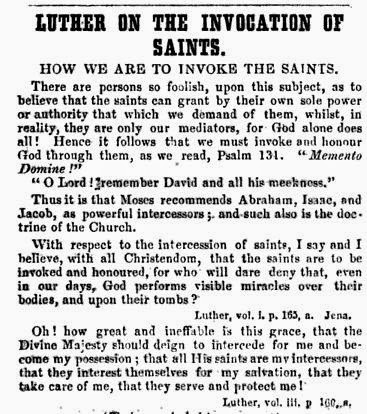
Luther: "When in his frailty, a man invokes the saints, he invokes Christ, and without fail he will reach Christ whenever he calls upon their name"
"When in his frailty, a man invokes the saints, he invokes Christ, and without fail he will reach Christ whenever he calls upon their names, for wherever they are, they are in Christ and Christ is in them, and their name in Christ's name and Christ's name in their name."Most of the relevant hits you'll get on this one are back to the Tiber Jumper blog (and a few others citing it without a reference). The Tiber Jumper blog uses it for an "All Saints Day" post: "All Christendom since the first century after the disciples have taken advantage of the intercession afforded them through the martyrs and saints who have gone before them and the earliest recorded date of a worldwide remembrance of all saints day is recorded in 373 AD. Even Luther had this to say regarding the communion of saints", and then follows the mystery Luther quote.
There are a handful of quotes from Luther affirming the invocation of the saints. Those quotes typically date pre-1521 or 1522. Typically, after that, Luther did not approve of or teach such a practice. For instance, in a sermon from August 15, 1516, Luther says, “O blessed mother! O most worthy virgin! Remember us, and grant that the Lord do such great things to us too.” In 1519, Luther still could exhort his congregation to “call upon the holy angels, particularly his own angel, the Mother of God, and all the apostles and saints” as a comfort in the hour when each was to face their own death. By 1522 things were changing. Erfurt Evangelists questioning Luther on the intercession of saints received this response,
I beseech in Christ that your preachers forbear entering upon questions concerning the saints in heaven and the deceased, and I ask you to turn the attention of people away from these matters in view of the fact…that they are neither profitable nor necessary for salvation. This is also reason why God decided not to let us know anything about His dealings with the deceased. Surely he is not committing a sin who does not call upon any saint but only clings firmly to the one mediator, Jesus Christ [Martin Luther, “Letter to Erfurt evangelists July 10, 1522,” What Luther Says, Vol. III, 1253].It took me awhile to track this mystery quote down. It was this citation from What Luther Says that intrigued me about the quote and if whether or not it was from the same context. Plass also states, "A few paragraphs later Luther says: 'Let them [the weak] call upon the names of the saints if they are bent on it, but under the condition (so fern) that they know how to guard themselves against lacing their trust and confidence in any saint. They must trust only in Christ' " (Ibid.). The thought about "the weak" was similar to the mystery Tiber Jumper quote.
Julius Köstlin presented a helpful overview on this topic. He states:
He had still, in the year 1519, spoken in unquestioning simplicity of the Invocation of the Saints, although he had already exposed the fallacy of the Catholic theory as to the meritoriousness of such prayers, and refused to give any countenance to the canonization of saints. As late as the year 15 21, when undertaking to expound the Magnificat, he, in the same spirit in which it was customary, in the sermons of the day, to interject the Ave Maria as an ejaculatory prayer, expresses the devout wish: "Would that the same tender Mother of God might secure for me the spirit to properly and thoroughly expound this her song," etc. Yet, in this very work, he applauds especially the humility of the holy Virgin. She does not herself desire that we should honor her or expect to receive good from her. Only God should be praised in her. Although we are permitted to call her the Queen of Heaven, yet she is not a goddess, to bestow gifts or help. She gives nothing, but God alone gives. The Sermon in the Church Postils upon the Epistle for the Second Sunday in Advent shows us further the path by which he advanced to a total rejection of saint-worship. He here avails himself (though in the Latin postil he had not yet done so) of the words of the apostle glorifying the Father of our Lord Jesus Christ, to emphasize a warning against any worshiping of saints in which the worshiper does not press on into the presence of God Himself. He is filled with anxiety lest an abominable idolatry may by such means be introduced. He grants that some employ the worship of saints and of the Mother of God in a proper spirit. Nevertheless, it seems to him to be a dangerous custom, which should not be observed in the general congregation. Though there were nothing wrong in the practice otherwise, it seems to him at the outset, a suspicious circumstance that it has the support of no scriptural text or example, but that it rather contradicts those passages which teach us to place all our confidence in God. With reference to the miracles, which were commonly adduced in support of the custom, and which he had still acknowledged in his Unferricht auf etliche Artikel, etc.,' he now declares, that we are to build, not upon these, but only upon the doctrine of Christ; and that the miracles in question may have been wrought upon the saint-worshipers by the devil himself." Luther, therefore, accords at once in principle with the Wittenberg agitators, who wished to have saint-worship entirely abandoned. He fears it more than the worship of images, which was at most but a rare occurrence. He wishes here too, however, first to see only such an efficient use of the Word as may set free the consciences of men. It would have been his desire, indeed, that this question might be allowed to rest for a while, since its agitation was not a pressing necessity, and Satan was already trying by useless questions to draw the attention of men away from faith and love. If it be only once established that saint-worship is nothing, it will fall into disuse without any special additional effort upon our part, and Christ will then remain alone upon Tabor. This, says Luther, was his own experience ; he does not know how nor when he ceased to address prayers to the saints, contenting himself with the one Christ and God the Father.He then comments on the 1522 letter to Erfurt:
In harmony with this is the advice given in 1522 to the Christians at Erfurt, among whom a dispute had been occasioned by "certain sermons upon unnecessary things, namely, upon the worship of saints." He writes to them that, although it is not necessary to honor the saints (that is, by invoking them), he yet does not think that one who does so should be condemned, if he only do not place his confidence in them, since what such a one does to them is done to Christ, because Christ is in them and they in Christ. We should, therefore, bear with the weak. We must, at any rate, all at last forsake the saints and ourselves, to know nothing but of Christ, and let all else go.' But when the evangelical teaching, which by its very nature could lend no sanction to saint-worship, had become thoroughly established in preaching and in the life of the people, and when, upon the other hand, such worship was cultivated but the more assiduously by the adversaries of the Gospel, Luther finally announced, as his position and advice, an entire and absolute rejection of the practice. It is true, he still, in a Sermon upon the Day of John the Baptist (June 24), which he also included unaltered in his Postils, granted that one might say to such a saint as Peter, " Pray for me," and only advised that it would be better to address one's self to Christ alone, inasmuch as the Scriptures say nothing about such a prayer as the one mentioned, and we are only thereby led into a whole series of fruitless and improper questions concerning the condition of departed saints. But in the year 1523, he expresses his decided approbation of the Bohemian Brethren for their course in not calling upon saints at all, but resting content in Christ. It was probably in the same year that he advised Urban Rhegius at Augsburg to abandon the worship of saints, because it was an uncertain thing, and we should confine ourselves to that which is certain. He gives this advice when sending to his friend a sermon of Carlstadt upon the intercession of Mary (which appeared in 1523), in which the latter had declared the invocation of Mary to be not only unnecessary, but "not good."' Moreover, he insisted that the invocation of the saints should no longer find a place in the regulations or hymns of the Church.' The opinion that, according to I.k. xvi. 9, the saints may " receive us into everlasting habitations" is combated expressly, in 1522, in a sermon preserved in the Church Postils, It is, he maintains, the poor living with us upon the earth who are there spoken of, who are standing witnesses of the faith which we have manifested in our treatment of them. We are to serve them, and in general all our fellowmen upon earth. The saints require no service upon our part, no foundations, etc.Tiber Jumper's mystery quote appears to be from Luther's letter July 10, 1522 to Erfurt. I'm uncertain as to which secondary source he got it from. The quote appears to be found in WA 10 (2), 166. I find it surprising this short letter has (to my knowledge) never been translated into English. A helpful overview of the letter can be found here:
As to Karlsladt and Gabriel Didymus, who had occasioned the Wittenberg disturbances, it must be remarked that the latter had retraced his steps and become a different man, concerning Karlstadt, however, it was not known what he would do. He felt himself aggrieved that Luther had set aside his regulations, though the latter had not rejected his doctrines, having only declared his dissatisfaction that Karlstadt had busied himself wholly with ceremonies and outward things, and on account of these had neglected the true Christian doctrine concerning faith and love. Luther was now only concerned that they might imitate the Wittenberg tumult at Erfurt, in the removal of the images, the abolition of the mass, of one kind in the sacrament, and all the other matters. He accordingly repeatedly wrote to John Lange, and it being especially the invocation of the saints about which they were at variance at Erfurt, he drew up the writing: "Concerning the Saints. An epistle or instruction to the Church at Erfurt, assembled in God." In it he exhorts the ministers to avoid the questions concerning the saints in heaven and concerning the dead, and to draw the people off from them, because there would be no end to questions here. That it was the object of Satan to detain them with that which is unnecessary, in order thus to hinder that which is necessary. That he did no sin who did not invoke the saints, but relied firmly upon the only Mediator, Jesus Christ, yea, that such a one was perfectly right and secure. That the others, however, should not be despised in their weakness. "Let them call upon the name of the saints if they will do so, only let them know and be on their guard that they do not put their confidence and trust in any saint but alone in Christ. For confidence is the highest honour which is due to God alone, who is the truth himself." He in particular warns them against insurrection, saying: "There are many inconsiderate men who imagine themselves able to help the cause of the Gospel by means of the sword and the arm of flesh, thinking to have attained their object if they weaken or injure priests and monks. But they do not know that our warfare is not against flesh and blood, but against the wicked spirits of the air. (2 Cor. x. 3, 4.) Satan is a spirit, having neither flesh nor bone, wherefore iron and an arm of flesh will accomplish nothing. The hearts of men must first be torn from his grasp by means of the Word of truth; that is our sword and might which no one can resist: with it the friends of Christ divide Behemoth and cut him asunder. Behold wherewith I defeated the papacy and the spiritual power, which before was a terror to all the world, when all men acknowledged: Who can prevail against the beast? For it had power to make war even upon the saints, and to overcome them. (Rev. xiii. 4, 7.) Yet I never raised a finger against it, and Christ has destroyed it with the sword of his mouth." (2 Thess. ii. 8.) Finally, he adds: "I fear, too, that much of all the evil is owing to ourselves, because we preach a great deal of our inability to do anything without the grace of God, and yet attempt to begin and to accomplish all manner of things of ourselves, without first, in humble prayer, beseeching God that he would begin and accomplish them through His Spirit. Thus it happens then, that we journey to Egypt, and begin the work in obedience to our own spirit, never first asking at His mouth concerning it. Therefore, my dear friends, let us act as we teach, committing all things to God, and without ceasing praying Him to direct us, to counsel and to help us, both in great and small matters, and not to permit us to follow our own opinion and reason in beginning anything."Conclusion
The quote in question comes from a transitional writing from Luther. Therefore, citing it as a support text for invoking the saints is unjustified.
Tuesday, May 10, 2011
Saint Pilate and Mrs. Saint Pilate?
The tendency, already discernible in the canonical Gospels, to lay stress on the efforts of Pilate to acquit Christ, and thus pass as lenient a judgment as possible upon his crime, goes further in the apocryphal Gospels and led in later years to the claim that he actually became a Christian. The Abyssinian Church reckons him as a saint, and assigns 25 June to him and to Claudia Procula, his wife. The belief that she became a Christian goes back to the second century, and may be found in Origen (Hom., in Mat., xxxv). The Greek Church assigns her a feast on 27 October. Tertullian and Justin Martyr both speak of a report on the Crucifixion (not extant) sent in by Pilate to Tiberius, from which idea a large amount of apocryphal literature originated. Some of these were Christian in origin (Gospel of Nicodemus), others came from the heathen, but these have all perished. [source]
Addendum: I've yet to locate Origen (Hom., in Mat., xxxv). I have though noticed, after about 45 minutes of searching, that no one else appears to have it either. There are plentiful references to Origen (Hom., in Mat., xxxv), but not any pay-off. I'm open to suggestions... I'm tempted to say... it doesn't exist, or is some sort of typo. This document is numbered "35" by Migne, but doesn't appear to be the source.
Tuesday, July 27, 2010
Lutheran pastor on the intercession of the saints: it's okay!
Luther himself was quite devoted to the Virgin Mary, but the abuse of the cult of the saints in his time led him to encourage a new focus on recourse to Christ himself. Once an abuse is corrected, though, it’s okay to stress again the underlying truth that the abuse exaggerated in such a way as to render false — in this case, the truth that it is the proper work of Christians, in heaven and on earth, in time and out of time, to pray for one another.This reminded me of a those who argue Luther was “extraordinarily devoted to the Blessed Virgin Mary.” The key of course, is the word "devoted." What exactly does it mean in the context of Luther and the saints?
Luther didn’t place a profound emphasis on Mariology. I would deny "Luther himself was quite devoted to the Virgin Mary." This is far too strong when one actually delves into Luther’s Works. Roman Catholic scholar William Cole concurs: “…it would be a mistake to think of Luther as being preoccupied with Mary.” Cole's statement comes from one of the most detailed Roman Catholic studies of Luther's Mariology in English (found here).
It is striking how little Luther launches into deep theological discussions about the Virgin Mary, and even when he does, they are in most instances, sparse, inconsequential, passing references, or tangential comments. One would think that Luther’s "devotion" would be overly obvious, spelled out in detailed numerous treatises similar to St. Alphonsus Ligouri. Such is not the case. Treatises and passages with the depth of Luther’s early exposition on the Magnificat are few in the totality of Luther’s overall work. The main point of Luther's work on the Magnificat was not even Mariological per se, but rather a treatise to understand God’s work in law and gospel.
True, the reason for this lack of emphasis on Mary is that Luther abandoned the most significant aspect of Roman Catholic Mariology: the intercession of Mary. Truly, this is the doctrine that defines Roman Catholic Mariology. It helps defines the “devotion” Roman Catholics partake in, making Mary crucial to the Roman Catholic layman’s normal Christian life. Roman Catholics invoke Mary for help, protection, and praise her attributes. For them, the invocation of Mary gives deep significance to such things like Theotokos, perpetual virginity, and the Immaculate Conception. These attributes are seen as worthy of praise, and serve to show the great divide that separates a saint from an average mortal.
Luther knew that prayers to, and faith in the saints violated the First Commandment. In his understanding, the role of faith or trust in the First Commandment determines whether one worships the true God, or an idol. To have a God is nothing else than to trust and believe in Him with the whole heart. This trust and the faith of the heart alone make either God or an idol. If faith and trust are “right,” then your god is the true God. If it is wrong, then you do not have the true God. That to which the heart clings is really your God. If your heart clings and entrusts itself to something God has made, then your faith is wrong, and you are caught in your sin, and you stand under the crushing condemnation of God’s law.
Luther said,
No one can deny that by such saint worship we have now come to the point where we have actually made utter idols of the Mother of God and the saints, and that because of the service we have rendered and the works we have performed in their honor we have sought comfort more with them than with Christ Himself. Thereby faith in Christ has been destroyed. [E 28:415; quoted in MartinLuther, What Luther Says, Vol. III, ed. Ewald Martin Plass (St Louis: Concordia Publishing House, 1959), 1254; cf. LW 36:299-300].The Roman Catholic work, Mariology Vol. 2 notes,
Luther had set the style for Protestants when he attacked the Catholic prayer "Hail Holy Queen" which he regarded as blasphemous. "Your prayers, 0 Christian," he says, "are as dear to me as hers. And why? Because if you believe that Christ lives in you as much as in her, you can help me as much as she." Eventually Luther was led to limit the communion of saints to the Church on earth because of his complete rejection of any intercessory power on the part of the saints in heaven [Juniper B. Carol (ed.) Mariology Volume 2, 195].
If the Lutheran pastor has any historical information that Luther was simply attacking the abuse of "the proper work of Christians" in praying to dead saints, I'd like to see it. That is, if Luther positively affirmed the practice of a correct way to pray to saints for their intercession, I'd like to see it.
In a sermon of August 15, 1516, Luther was to say, “O blessed mother! O most worthy virgin! Remember us, and grant that the Lord do such great things to us too.” In 1519, Luther still could exhort his congregation to “call upon the holy angels, particularly his own angel, the Mother of God, and all the apostles and saints” as a comfort in the hour when each was to face their own death. By 1522 things had changed. Erfurt Evangelists questioning Luther on the intercession of saints received this response,
I beseech in Christ that your preachers forbear entering upon questions concerning the saints in heaven and the deceased, and I ask you to turn the attention of people away from these matters in view of the fact…that they are neither profitable nor necessary for salvation. This is also reason why God decided not to let us know anything about His dealings with the deceased. Surely he is not committing a sin who does not call upon any saint but only clings firmly to the one mediator, Jesus Christ. [Martin Luther, “Letter to Erfurt evangelists July 10, 1522,” What Luther Says, Vol. 1, 1253. ]Addendum
"I certainly would not call you heretics, as our sophists do, because you do not honor or call upon the mother of God or any of the saints, but cling alone to the only mediator, Jesus Christ, and are satisfied that in heaven as well as on earth each one is obligated to pray for the other. For there is nothing in the Scriptures about the intercession of dead saints, nor about honoring them and praying to them. And no one can deny that hitherto through services for these saints we have gone so far as to make pure idols out of the mother of God and the saints. We have placed more confidence in them, on account of the services and works which we have done for them, than we have placed in Christ himself, with the result that faith in Christ has perished."Luther, M. (1999). Luther’s works, vol. 36: Word and Sacrament II. (J. J. Pelikan, H. C. Oswald, & H. T. Lehmann, Eds.) (Vol. 36, pp. 299–300). Philadelphia: Fortress Press.
Friday, May 21, 2010
A prayer to our Blessed Mother, from us, poor children of Rome
Preserve me, O God, Mary, and ye saints, for I take refuge in you. I said to Blessed Virgin, “You are my mediator and rescue; I have no good besides you.”
As for the saints who are in the earth and those who have passed on to the heavens (to the latter of whom I speak daily), They are the majestic ones in whom is all my delight.
The joys of those who have bartered for another object of piety will be multiplied; I shall indeed pour out their drink offerings of Messiah's blood, Surely will I take their names upon my lips.
The Blessed Mother is the portion of my inheritance and my cup; You support my lot.
The lines have fallen to me in pleasant places; Indeed, my heritage is beautiful to me.
I will bless my Blessed Mother and the saints who have counseled me; Indeed, my mind instructs me in the night.
I have set my Mother continually before me; Because she is at my right hand, I will not be shaken.
Therefore my heart is glad and my glory rejoices; My flesh also will dwell securely.
For she will not abandon my soul to Sheol, only to Purgatory (for what are mere billions of years in comparison to eternity?); Nor will she allow her Holy Son to undergo decay.
You will make known to me the path of life; In your presence is fullness of joy; In your right hand there are pleasures forever.
(Hat tip: Psalm 16)
Saturday, March 13, 2010
Mitch Pacwa's Series on the Reformation, Continued
Here's another troubling factoid to go along with my recent post on Mitch Pacwa's upcoming Reformation video series. Pacwa was recently on Catholic Answers to discuss the project. He's looking to do a ten part series on the Reformation from a Roman Catholic perspective.In this mp3 clip, Pacwa describes the hostile rhetoric and dialog that both sides used toward each other. He goes on to point out that there were Roman Catholic apologists that responded to Luther, minus the abusive rhetoric, and these men went on to become saints. They responded to Luther with respect, not vitriol. Pacwa says this contributed to making them saints.
As I work through the list of Romanist-apologist contemporaries of Luther in my own mind, this list of those not responding with abusive rhetoric, or even mildly abusive rhetoric is quite small. At this point, I can only think of Cajetan, but even then, I'd have to go back and check further. This Cajetan is on the list of saints, but isn't the one who interacted with Luther (I have to thank the Beggars All troll for catching that, I earlier thought the saint was Thomas de Vio Cajetan).
So exactly whom is Mitch Pacwa referring to? Saint Erasmus? Saint Cochlaeus? Saint Eck? Saint Wimpina? Saint Tetzel? Saint Prierias? Saint Alveld? Someone with more time on their hands can search the list of saints.
I'm having doubts as to how fair and balanced Pacwa's series is going to be.
Wednesday, May 27, 2009
Are you on your way to Sainthood?

Are you on your way to Sainthood? Well, if your spouse or child dies and it causes you despair or depression, Matthew Bellisario says: no deal:
Luther could not deal with death in his own family at all, in fact it brought him despair. The Saints did not act like this when faced with obstacles such as these. They looked to God in their trials of life, while Luther looked to himself. In fact after his daughter died it was said that instead of being at peace with God he went into depression. One writer says, "Whilst the plague was sweeping Europe, the untimely death of his daughter Magdelena sets him off into a deep depression and ruminations on the signs of the End Days."
Of course, one does wonder how Matthew deals with John 11: 35-
33When Jesus saw her weeping, and the Jews who had come along with her also weeping, he was deeply moved in spirit and troubled. 34"Where have you laid him?" he asked. "Come and see, Lord," they replied. 35Jesus wept. 36Then the Jews said, "See how he loved him!"
Jesus wept? What? Why didn't Jesus act with the same stoic demeanor of one of his saints? Death impacted him, he wept and was "deeply moved in spirit and troubled." The Bible presents death a dreadful thing, even the Lord realized this. That someone feels the pain of loss is not a sign of spiritual weakness. If Roman Catholicism really teaches this is what it means to be a saint, to not feel the pain of loss, then I consider Catholicism not only theologically wrong, but morally wrong. Perhaps Bellisario has yet to suffer loss. I dare him to find a Catholic who's recently lost a child or a spouse, and put forth this type of stupidity, to let them know if they don't claim "peace" but are rather depressed, they aren't acting like one of the saints.
Among [Luther's] children, his Lenchen, a pious, gentle, sensible child, who clung to him with her whole heart, was his especial favorite. We still possess a pleasant picture in which, according to an old tradition, she was painted by Cranach, the family's friend.
But she was taken from him by death in the bloom of her youth after a long and severe sickness on the 2Oth of September, 1542. What he had already felt at the death of his little Elizabeth, he now had to feel more deeply and sorely. While she was lying sick, he said: " I love her dearly; but, O God, if it is thy will to take her hence, I will be content to have her with thee." And to her he said : " Lenchen, my dear daughter, you would like to remain with your father here, and still would like to depart to the Father beyond ; " and she answered: " Yes, my dear father, as God wills." And when she was in her last moments, he kneeled before her bed, wept bitterly and prayed for her salvation, upon which she departed in his arms. When she was lying in her coffin, he looked at her and said: " O dearest Lenchen, you will arise again and shine like a star, yes, like the sun ;" and again: " In my spirit I am indeed joyful, but according to the flesh I am full of grief; the flesh will not be content; the separation pains me exceedingly. It is a strange thing that, although she certainly is at rest and it is well with her, we are yet so sorrowful." To the many who were mourning, he said: "I have sent a saint to heaven; O, that we would have such a death! such a death I would welcome this very hour."
The same sorrow and the same exaltation above sorrow he expresses in his letters to his friends. Thus he writes to Jonas: "You will have heard that my dearest daughter Magdalena has been born again into Christ's eternal kingdom; and although my wife and I should only be joyfully grateful for her blessed departure, through which she has escaped the power of the flesh, the world, the Turk and the devil, yet the power of nature's love is so great that we cannot do it without tears and heart-felt sighs and even a severe death within us; so deeply and firmly the features, words and actions of the living and dying, the obedient and submissive child, are engraved in our hearts that not even Christ's death can entirely expel this grief." His son John, whom the sick sister was anxious to see once more before her death, had been called home from Torgau two weeks before, and he wrote in this connection to Crodel: " I would not that my conscience should later blame me for having neglected anything." But when the boy several weeks later, about Christmas time, influenced by his continued grief and by the tender words his mother had spoken to him, wanted to leave Torgau for good and remain at home, his father exhorted him manfully to overcome his grief and not to increase his mother's sorrow by it, and to obey God who had sent him there through his parents. [source]
Luther s Epitaph on Magdalene.
DORMIO cum sanclis hie Magdalena Lutheri Filia, et hoc strato tefta quiesco meo. Filia mortis eram, peccati semine nata, Sanguine sed vivo, Christe, redempta tuo.
(IN ENGLISH.)
HERE sleep I, Lenichen, Dr. Luther's little daughter, Rest with all the Saints in my little bed : I who was born in sins, And must forever have been lost. But now I live, and all is well with me, Lord Christ, redeemed with Thy blood. [source][source]
To Nicolas Amsdorf Reply to letter of consolation on Magdalene's death. October 29, 1542 (about a month after Magdalena's death).
Grace and peace ! Many thanks, most excellent friend, for trying to console me on my dearest daughter's death. I loved her not only because she was my flesh, but for her placid and gentle spirit and her dutifulness to me. But now I rejoice that she is sleeping sweetly in her Heavenly Father's home till that day. Alas, for the days in which we live ! And they are daily becoming worse. I pray that we and all dear to us may be granted such a blessed hour of departure as was her lot. I would call this really sleeping in the Lord, not experiencing one pang of fear. This is the time of which Isaiah speaks, " The righteous is taken away from the evil to come ; they shall rest in their beds, each one walking in his uprightness," just as when one gathers the wheat into the barn, and commits the chaff to the flames, a punishment the world has deserved for her ingratitude.
To Justus Jonas Luther tries to comfort his friend on the death of his amiabte wife. December 25, 1542. (a few months after Magdalena's death)
Grace and peace in Christ, who is our salvation and consolation, my dear Jonas ! I have been so thoroughly prostrated by this unexpected calamity that I do not know what to write. We have all lost in her the dearest of triends. Her bright presence, her eye so full of trust, all drew forth our love, especially as we knew that she shared both our joys and sorrows as if they had been her own. A bitter parting in very deed, for I hoped that after I was gone she would have been the best of comforters for those I left behind. The deep longing after one so distinguished by piety, propriety, and ami- ability makes me weep. Therefore I can easily imagine your feelings. Temporal consolation is of no avail here. One must look solely to the unseen and eternal. She is our precursor into the regions beyond, where we shall all be gathered on our dismissal from this vale of tears and this corrupt world. Amen.
Mourn, therefore, as you have good cause to do, but at the same time comfort yourself with the thought of the common lot of humanity. Although according to the flesh the parting has been very bitter, nevertheless we shall be reunited in the life beyond, and enjoy the sweetest communion with the departed, as well as with Him who loved us so, that He purchased our life through His own blood and death. It is very true that God's mercy is better than life. What does it matter though we should suffer a little here, when there we shall partake of joy unutterable Oh, what a gulf separates those Turks, Jews, and, still worse, those Papists, Cardinals Heinz and Mainz, from this glory ! Would they could weep now, so that they may not mourn eternally ! For we, after mourning a little while, shall enter into joy, whither your Kathie and my Magdalena have gone, and are now beckoning us to follow. For who is not weary of the abominations of our time, or rather of this hell, which pains spirit and eye day and night ? I am too grieved on your account to write more. My wife was thunderstruck when she heard the news, for she and your wife were as one soul. We pray God to give you temporal consolation. For you have good cause to rejoice when you know your pious wife has been snatched from your side to enjoy everlasting life in heaven. And of this you cannot doubt, as she fell asleep in Jesus _ with so many pious expressions of her faith in Him. Thus also slumbered my little daughter, which is my great and only consolation. God, who has tried you, will comfort you now and for ever. Amen. Martin Luther. [source]
...if the devil notices that you have the Word and are confident that your life is pleasing and acceptable to God on account of the Word, he will not rest but will put in your way trials and afflictions of every kind even in the most trivial matters. You will experience faithlessness on the part of the household, the hatred of your neighbors, and the death of your children or of your wife.(2) All these things will happen in order that your faith may be exercised. But if the Word is not there, impatience and displeasure follow because of such an irksome and miserable kind of life, just as we hear many who exclaim that they entered into marriage not because God led them but because the devil urged them to do so.
(2) Luther’s daughter Elizabeth died on August 3, 1528; his daughter Magdalena on September 20, 1542.
Luther, M. (1999, c1968). Vol. 5: Luther's works, vol. 5 : Lectures on Genesis: Chapters 26-30 (J. J. Pelikan, H. C. Oswald & H. T. Lehmann, Ed.). Luther's Works (5:5). Saint Louis: Concordia Publishing House.
Friday, March 13, 2009
On a related note, Dr. White reviewed another clip from Jimmy Akin that we've been calling, "We Don't Need No Stinking Bible Verses!" This clip may be my all time favorite from Jimmy Akin.
Here is the MP3 clip, Jimmy Akin: We Don't Need a Verse . However, I'd suggest listening to Dr. White's review as well.
Tuesday, March 10, 2009
Can You Pray To Whoever You Want To? Let's Ask Jimmy Akin
O far be from us the dreary thought that death cuts off our friends entirely from us! Far be from us the heartless creed which declares a perpetual divorce between us and the just in heaven! Do not imagine when you lose a father or mother, a tender sister or brother, who die in the peace of Christ, that they are forgetful of you. The love they bore you on earth is purified and intensified in heaven. Or if your innocent child, regenerated in the waters of baptism, is snatched from you by death, be assured that, though separated from you in body, that child is with you in spirit and is repaying you a thousand-fold for the natural life it received from you. Be convinced that the golden link of prayer binds you to that angelic infant, and that it is continually offering its fervent petitions at the throne of God for you, that you may both be reunited in heaven.
Monday, August 25, 2008
It is Monday, after all
O All-holy James and EA, light of my darkened soul, my hope, my shelter, my refuge, my consolation and my joy: I thank y'all that y'all hast accounted me worthy, although unworthy, to be a partaker of the immaculate Body and precious Blood of the Son of God. But do y'all, who know the true Light, enlighten the mental eyes of my heart; O y'all who witness to the fountain of immortality, quicken me who lie dead in sin. O compassion-loving servant of the merciful God, have mercy upon me, and grant me humility and contrition of heart, and meekness in my thoughts, and deliverance from the bondage of my vain imaginings. And account me worthy, even unto my last breath, to receive without condemnation the sanctification of the immaculate Mysteries, unto the healing of both soul and body. And grant unto me tears of repentance and confession, that I may hymn y'all and glorify y'all all the days of my life: for blessed and glorified art y'all unto all ages.
Amen.
Sunday, August 24, 2008
It is Sunday, after all
O All-holy Lady Theotokos, light of my darkened soul, my hope, my shelter, my refuge, my consolation and my joy: I thank thee that thou hast accounted me worthy, although unworthy, to be a partaker of the immaculate Body and precious Blood of thy Son. But do thou, who gavest birth to the true Light, enlighten the mental eyes of my heart; O thou who didst bear the fountain of immortality, quicken thou me who lie dead in sin. O compassion-loving Mother of the merciful God, have mercy upon me, and grant me humility and contrition of heart, and meekness in my thoughts, and deliverance from the bondage of my vain imaginings. And account me worthy, even unto my last breath, to receive without condemnation the sanctification of the immaculate Mysteries, unto the healing of both soul and body. And grant unto me tears of repentance and confession, that I may hymn thee and glorify thee all the days of my life: for blessed and glorified art thou unto all ages.
Amen.
(Source: A Pocket Prayer Book for Orthodox Christians, according to the use of the Antiochian Orthodox Christian Archdiocese of North America, Copyright 1956, 12th printing: 1999)
Tuesday, February 19, 2008