Showing posts with label Luther and the Law. Show all posts

Thursday, May 08, 2014

Luther: The substance of Christ’s teaching is unimportant?

I was recently sent  link to a website named The Twelve Tribes. The web site doesn't easily give up information as to who exactly they are. They appear to be some sort of quasi-Messianic Jewish group that practices flee the organized church, and  if Wiki is correct, they have quite a sordid past. A good example of the confusion of what this group believes can be found in this pdf they put together. The website has a lot of anti-Luther and anti-reformation propaganda.

In an article entitled, Martin Luther: Did He Pass the Litmus Test? they make the following statement and present a quote from Luther:
Luther firmly believed in and relied upon the Bible as the source of truth. In his study of the epistles of the Apostle Paul he had come across verses which had given him the understanding that only through faith in Christ’s redeeming passion does the Christian receive salvation. Luther’s perception of the gospel was this: Christianity consists entirely in the belief in Christ; the substance of Christ’s teaching is unimportant. Or in his own words, “The Gospel does not teach us what we must do or leave undone, but says: God has done this for you, has made His Son flesh for you, has had Him gone to death for you” (unterrichtung wie sich Christen in Mosen sollen schiicken, vol. XVI, p. 367).
Documentation
Twelve Tribes* documents the quote as  unterrichtung wie sich Christen in Mosen sollen schiicken, vol. XVI, p. 367. This is a reference to Weimarer Ausgabe: WA 16:367. In English, the reference is to How Christians Should Regard Moses, 1525 (LW 35:162). This treatise is one of Luther's expositions on law and gospel. Luther writes against those who would erect following Mosaic law a requirement for salvation.

Context
After comparing two public sermons from heaven (Exodus 19-20; Acts 2), Luther makes the following comment:
Now the first sermon, and doctrine, is the law of God. The second is the gospel. These two sermons are not the same. Therefore we must have a good grasp of the matter in order to know how to differentiate between them. We must know what the law is, and what the gospel is. The law commands and requires us to do certain things. The law is thus directed solely to our behavior and consists in making requirements. For God speaks through the law, saying, “Do this, avoid that, this is what I expect of you.” The gospel, however, does not preach what we are to do or to avoid. It sets up no requirements but reverses the approach of the law, does the very opposite, and says, “This is what God has done for you; he has let his Son be made flesh for you, has let him be put to death for your sake.” So, then, there are two kinds of doctrine and two kinds of works, those of God and those of men. Just as we and God are separated from one another, so also these two doctrines are widely separated from one another. For the gospel teaches exclusively what has been given us by God, and not—as in the case of the law—what we are to do and give to God. Luther, M. (1999). Vol. 35: Luther's works, vol. 35: Word and Sacrament I (J. J. Pelikan, H. C. Oswald and H. T. Lehmann, Ed.) (162). Philadelphia: Fortress Press.

Conclusion
The typical problem with quoting Luther's How a Christian Should regard Moses  to prove Luther was some sort of antinomian is that the document is being taken out of its historical context. Luther directed this treatise towards those like the enthusiasts (Andreas Karlstadt, and the Sacramentarians, etc.). Luther had men in mind who were attempting to introduce Mosaic law into the civil code. This provoked Luther to not only refute such civil notions but to put forth a sharp distinction between law and Gospel  in which the Gospel was expounded upon in relation to the law. Christ has fulfilled the law and has given His people the Gospel.

The Twelve Tribes article goes on to state:
To Luther the teachings of Christ were not important because all that he knew about works was that they were of no benefit or merit in regard to salvation. By this thinking, he reduced the gospel to only the redeeming and atoning sacrifice of Christ on behalf of sinners. It became the gospel of going to heaven. However Christ and His apostles preached the gospel of the Kingdom of Heaven. Therefore to the apostles the teachings of Christ were very important, because teaching others to keep the commandments of Christ would establish His kingship or the Kingdom of Heaven.
The confusion groups like Twelve Tribes have with Luther is that they typically operate with a gospel that has law mixed into it and then judge that Luther is antinomian. They never take the time to figure out where the law fit into Luther's theology. Even the context of the Luther quote would have helped them, had they actually read, for Luther goes on to state: "For the gospel teaches exclusively what has been given us by God, and not—as in the case of the law—what we are to do and give to God." Luther’s theology indeed has a place for the Law of God and its use in the life of a Christian. Most recently an exposition on Luther and the law has been put out by Concordia- Edward Engelbrect's Friends of the Law: Luther's Usoe of the Law for Christian Life. The author demonstrates that Luther adhered to what later theologians described as a "third use of the law."

Luther held that grace, faith, and the work of Christ are essential ingredients that justify, and that justification is a gift as well as the very faith involved. God judges a man by Christ’s perfect works which are imputed to a sinner, and that sinner is seen as completely righteous. This does not though mean: Eat, drink, and be merry, for tomorrow we die. Salvation is unto good works. Good works are not unto eventual justification. We are saved in order to perform good works, not by performing them. Luther held that faith is a living faith, and it shows its life by what it does. For Luther, we are not saved by works; but if there be no works, there must be something amiss with faith. Luther defines good works as those “works that flow from faith and from the joy of heart that has come to us because we have forgiveness of sins through Christ.” Luther taught a life under the cross, which is a life of discipleship of following after Christ. Our crosses though, do not save. They serve the neighbor. We are called to be neighbor to those around us.

* It's possible that the Twelve Tribes website took their article on Luther from here.

Monday, January 20, 2014

Did Luther Deny Faith Alone in Favor of Faith and Works for Justification?

I came across these links written by a "California litigation attorney in practice for thirty years" who studied "Classical Greek and Latin and achieved designation as a Classical Language Scholar":

Did Luther in 1537 Condemn Paul As A False Prophet?

Preface

Did Paul Negate The Law's Further Applicability?

The author of these links claims "Luther radically but quietly changed his salvation-doctrine by 1541. At that point, he too rejected faith alone as sufficient for believers." What appears to be meant is that early on Luther held that faith alone saves but then went on to hold salvation is attained by a combination of faith and works. Sometimes this author refers to this as "double justification" (and also he calls it the view of Erasmus). The author best explains what he's talking about by documenting Tyndale's supposed abandoning of faith alone for faith alone initiating salvation and then subsequently works must join faith to complete the process. If works do not accompany faith, salvation is lost. The works are keeping the law obediently. Of Luther, the author states:
"Faith alone was all that was required to receive God’s forgiveness at all times, according to the young Luther."
"Did Tyndale turn Luther around to accept double justification, and abandon faith alone as justification of a believer? Yes, he did."
The author argues that Luther had great respect for Tyndale, and it was Tyndale's influence on Luther that provoked him to change his doctrine of faith alone for that of faith and works:
Could that tremendous respect have moved Luther to himself change his own doctrine on faith alone? It most certainly appears to be the best explanation for what happened to Luther in mid-1531 to the end of his life. The evidence can be found in four primary places: (1) the Catechisms of 1531; (2) Luther’s revolution on his view of the Mosaic Law in 1537; (3) the Lutheran agreement proposed at the Regensburg Diet of 1541; and (4) the actions of Luther’s close aid, Melancthon, in 1548 after Luther’s death, where he led the Lutheran Church to accept double justification as official doctrine from 1556 to 1580. (It was overturned in 1580.)
A thorough response to the information presented by this author would take quite some time, and in essence, it has already been achieved by Edward Engelbrecht's recent book, Friends of the Law. Englebrecht works historically through Luther's career and analyzes his comments on the use of the law. One particular writing from Luther singled out by Engelbrecht is a sermon originally appearing in Luther's popular 1522 Winter Postil, Epistle For New Year's Day (Galatians 3:23-29). There Luther says,
Thus faith redeems us from the Law not in a bodily way, so that we go here and the Law goes there, and thus we part ways from each other so that we are never under it. Rather [faith redeems us in such a way] that we have done enough [to satisfy] its demands. We now know and have what [the Law] wants us to know and have, namely, the Holy Spirit, who causes us to love it. The Law does not want to be worked, and it is not content with works; it wants to be loved and is satisfied with love. without love it would not set us free nor be paid off. Thus we had to remain uder it with all our loveless works; we had no peace in our conscience toward it; it always punished us as sinners and transgressors, and threatened us with death and hell- until Christ came and gave us His Spirit and love through faith which is preached in the Gospel. Then we were set free from the Law, so that it never demands, never punishes, but lets the conscience rest, never terrifies with death and hell, and has become our friend and companion. (LW 76: 12-15)
In other words, a person who is saved by faith alone is given the Holy Spirit, and that Spirit changes the heart from a Law hater to a Law lover.  Luther says a bit later that whoever believes by faith in Christ "puts Him on":
Therefore, faith is such a great thing that it saves and justifies a person, for it brings him all the blessings in Christ, in which the conscience takes comfort and trusts. Because of that it must become happy in Christ, eager to do all good and avoid all evil. It never fears death or hell or any evil, since it is very richly clothed in Christ. That is what "satisfying the Law" and "never being under it" means, for the Holy Spirit is there with clothes for the soul, which results in a completely different person. (LW 76:20-21).
Many more examples could be provided, and as I've read Luther, this has been the position I've found consistently throughout his writings. Certainly Luther believed that faith alone saves, but he never taught that faith and the Holy Spirit leave a person enslaved to their sins and haters of God and His Law. Of the early Luther Engelbrecht states,
[Luther] emphasized that justification changed the believer's attitude toward and use of Moses so that the believer no longer keeps the Law from compulsion. The Law, kept by Christ, could now be kept by those who were righteous through Christ... The believer has a new status by grace through faith so that he may now look upon the natural, moral law as a friend. He becomes a living tables of Moses and keeps the Law both inwardly and outwardly without constraint. (Friends of the Law, p.89).
I found the author of the links in question because he had cited one of my blog entries. I suggest that if he feels the need to respond to this entry, he throw this tadpole back and focus on Engelbrecht's study.

Wednesday, February 15, 2012

Luther Coined the Term "Antinomian?

I came across an interesting Luther-related fact: Luther actually coined the word "antinomianism." This one popped up in a discussion thread which stated: "Luther actually coined the word 'Antinomianism' to describe Agricola's beliefs."

Wikipedia states it's "a term coined by Martin Luther", so regardless if it's true or not Wikipedia will guarantee it will travel all over cyberspace as undisputed fact!

There's also a few books mentioning it. The Evangelical Dictionary of Theology states, "In fact, it was Luther who actually coined the word antinomianism in his theological struggle with his former student, Johann Agricola." The Collected Writings of James Henley Thornwell states, "The word was coined in the sixteenth century to denote the peculiar opinions of John Agricola and his followers in regard to the Law." The old Catholic Encyclopedia begins its entry on antinomianism  by stating,
"The heretical doctrine that Christians are exempt from the obligations of moral law. The term first came into use at the Protestant Reformation, when it was employed by Martin Luther to designate the teachings of Johannes Agricola and his sectaries..."
Update 7/2020: As per LW 73:3, "An Antinomian (a term coined by Martin Luther from the Greek anti ["against"] and nomos ["law"] is one who rejects God's Law in some way."

Wednesday, January 04, 2006

Luther And The Law: Did Martin Luther Abhor God's Law? (Part Two)

Rome's defenders say:


“Luther of course wanted the Law announced. He preached and taught it; he inserted it in his catechism and he exhorted his followers to recite it daily. Nevertheless, he, at the same time, warned against allowing the Law to have any influence on the conscience, for then it would become, as he said, “a sink of heresies and blasphemies” [Father Patrick O’Hare, The Facts About Luther (Illinois: Tan Books, 1987), 108].

“The Law and the Gospel are not opposed to each other. Jesus and Paul taught that the Law by itself never saved anyone - it was always faith and grace. But that is not the same thing as saying that Law is antithetical to the Gospel. That was Luther's error (one of many) and it is simply unbiblical. Matthew 5:17-20 is sufficient in itself to nail this point down. Salvation is a lifelong process, free will does cooperate after the initial pure act of grace by God. It can't be otherwise.” [ The Interpretation and Exegesis of Romans 2-4]

Contrary to these polemicists, Luther’s theology indeed had a place for the Law of God and its use in the life of a Christian. The Law for Luther was dual purposed: it first drives one to see their sin and a need for a savior. Secondly, it functions in the life of a Christian to lead one to a correct understanding of the good one ought to do. The polemicists above should have had at least a cursory knowledge of how important Moses and the law was in his theology. For instance, Luther taught that anyone who is to preach must be able to preach the law:
First, he must preach the Law so that the people may learn what great things God demands of us; of these we cannot perform any because of the impotence of our nature which has been corrupted by Adam's fall. [Sermons of Martin Luther Volume 1 (Michigan: Baker Books, 2000), 1:131].
Luther also points out that only by knowing God’s Law does one even "know" what a good work is:
…[O]nly those things are good works which God has commanded, just as only that is a sin which God has forbidden. Therefore, he who wants to know and do good works need only know God’s Commandments… These Commandments of God must teach us how to distinguish among good works. [Ewald Plass, What Luther Says Volumes 1-3 (St. Louis: Concordia Publishing house, 1959) 3:1499; cf. Works of Martin Luther. Vol. 1, p. 187].
These examples show that Luther valued the law. Luther scholar Paul Althaus points out for Luther, “The Ten Commandments have their place not only ‘before’ but also ‘after’ justification; thus they not only exercise the Christian in the theological function of the law but also lead him to a right knowledge of the good he ought to do according to God’s will.” [Paul Althaus, The Theology of Martin Luther (Philadelphia: Fortress Press, 1963), p. 272].

Althaus points out Luther composed a hymn on the Ten Commandments in which he states, “To us come these commands, that so- Thou son of man, thy sins mayst know- And make thee also well perceive- How before God man should live.” [LW 53:279] Elsewhere Luther said of the Ten Commandments, “They are the true fountain from which all good works must flow.” [Paul Althaus, The Theology of Martin Luther (Philadelphia: Fortress Press, 1963), p. 272, footnote 124; Book of Concord, p. 401].

In Luther’s Small Catechism the Ten Commandments were placed first to demonstrate immediately that God is wrathful against sin. The negative prohibitions in the Ten Commandments were to show the need for a savior. Also in the Small Catechism, Luther suggests a daily regiment of prayer and includes a verbal reading of the Ten Commandments. In the reciting of the Ten Commandments along with the Apostles Creed and Lord’s Prayer, one hears both law and gospel at the beginning and ending of each day. Luther says,  "…[N]o man can progress so far in sanctification as to keep even one of the Ten Commandments as it should be kept, but that the Creed and the Lord’s Prayer must come to our assistance, as we shall hear, through which we must continually seek, pray for, and obtain the power and strength to keep the Commandments" [What Luther Says 3:1501; cf Book of Concord, p. 402].

Luther placed a strong emphasis on the First Commandment. It was one of the key factors in the shape of his entire theology. He believed God spoke the word of creation bringing human creatures into existence, and this creative word was repeated in the First Commandment. Further, the whole of the Scripture could be summarized in the First Commandment. It was both law and gospel. It is law because it invokes a demand with a burden that can crush us. This command is also gospel: it is good news that God says He is our Father, protector-provider, Lord and Savior. As Roland Bainton has rightly said,
One might have expected the great line of demarcation for [Luther] to have lain between the Old Testament and the New. It did for some Protestants, like the Anabaptists, who rejected the wars of Yahweh and took literally the ethic of the Sermon on the Mount. Luther on a different count might have used his distinction of law and gospel to repudiate Moses as law, but Luther did not. Law and gospel, said he, lie side by side throughout the whole Bible. That which relies on man's good works is law. That which relies on God's good grace is gospel. The Ten Commandments can witness to grace and the Sermon on the Mount can be treated as a new law. Therefore, the Old Testament is not to be rejected or relegated to a lower rank. Here one must recall that Luther interpreted the Old Testament in terms of the pre-existent Christ, who was speaking through Moses and through David [Roland Bainton, Studies on the Reformation, (Boston: Beacon Press, 1963) 6-7].

Luther said of the entire Old Testament, “Christ must first be heard in the Gospel, then it will be seen how beautiful and lovely the whole Old Testament is in harmony with him, so that a man cannot help giving himself in submission to faith and be enabled to recognize the truth of what Christ says in John 5: 46, "For if ye believed Moses, ye would believe me, for he wrote of me.” [Sermons of Martin Luther Volume 1 (Michigan: Baker Books, 2000), 1:151].

Addendum 2006
This blog entry is a revision of an entry I posted back in 2006. The original can be found here. Because so many sources are now available online, I'm revising older entries by adding additional materials and commentary, and also fixing or deleting dead hyperlinks. Nothing of any significant substance has changed in this entry from that presented in the former. 

Luther And The Law: Did Martin Luther Abhor God's Law? (Part Two)

Rome's defenders say:


“Luther of course wanted the Law announced. He preached and taught it; he inserted it in his catechism and he exhorted his followers to recite it daily. Nevertheless, he, at the same time, warned against allowing the Law to have any influence on the conscience, for then it would become, as he said, “a sink of heresies and blasphemies” [Father Patrick O’Hare, The Facts About Luther (Illinois: Tan Books, 1987), 108].

“The Law and the Gospel are not opposed to each other. Jesus and Paul taught that the Law by itself never saved anyone - it was always faith and grace. But that is not the same thing as saying that Law is antithetical to the Gospel. That was Luther's error (one of many) and it is simply unbiblical. Matthew 5:17-20 is sufficient in itself to nail this point down. Salvation is a lifelong process, free will does cooperate after the initial pure act of grace by God. It can't be otherwise.” [ The Interpretation and Exegesis of Romans 2-4]

Contrary to these polemicists, Luther’s theology indeed had a place for the Law of God and its use in the life of a Christian. The Law for Luther was dual purposed: it first drives one to see their sin and a need for a savior. Secondly, it functions in the life of a Christian to lead one to a correct understanding of the good one ought to do. The polemicists above should have had at least a cursory knowledge of how important Moses and the law was in his theology. For instance, Luther taught that anyone who is to preach must be able to preach the law:
First, he must preach the Law so that the people may learn what great things God demands of us; of these we cannot perform any because of the impotence of our nature which has been corrupted by Adam's fall. [Sermons of Martin Luther Volume 1 (Michigan: Baker Books, 2000), 1:131].
Luther also points out that only by knowing God’s Law does one even "know" what a good work is:
…[O]nly those things are good works which God has commanded, just as only that is a sin which God has forbidden. Therefore, he who wants to know and do good works need only know God’s Commandments… These Commandments of God must teach us how to distinguish among good works. [Ewald Plass, What Luther Says Volumes 1-3 (St. Louis: Concordia Publishing house, 1959) 3:1499; cf. Works of Martin Luther. Vol. 1, p. 187].
These examples show that Luther valued the law. Luther scholar Paul Althaus points out for Luther, “The Ten Commandments have their place not only ‘before’ but also ‘after’ justification; thus they not only exercise the Christian in the theological function of the law but also lead him to a right knowledge of the good he ought to do according to God’s will.” [Paul Althaus, The Theology of Martin Luther (Philadelphia: Fortress Press, 1963), p. 272].

Althaus points out Luther composed a hymn on the Ten Commandments in which he states, “To us come these commands, that so- Thou son of man, thy sins mayst know- And make thee also well perceive- How before God man should live.” [LW 53:279] Elsewhere Luther said of the Ten Commandments, “They are the true fountain from which all good works must flow.” [Paul Althaus, The Theology of Martin Luther (Philadelphia: Fortress Press, 1963), p. 272, footnote 124; Book of Concord, p. 401].

In Luther’s Small Catechism the Ten Commandments were placed first to demonstrate immediately that God is wrathful against sin. The negative prohibitions in the Ten Commandments were to show the need for a savior. Also in the Small Catechism, Luther suggests a daily regiment of prayer and includes a verbal reading of the Ten Commandments. In the reciting of the Ten Commandments along with the Apostles Creed and Lord’s Prayer, one hears both law and gospel at the beginning and ending of each day. Luther says,  "…[N]o man can progress so far in sanctification as to keep even one of the Ten Commandments as it should be kept, but that the Creed and the Lord’s Prayer must come to our assistance, as we shall hear, through which we must continually seek, pray for, and obtain the power and strength to keep the Commandments" [What Luther Says 3:1501; cf Book of Concord, p. 402].

Luther placed a strong emphasis on the First Commandment. It was one of the key factors in the shape of his entire theology. He believed God spoke the word of creation bringing human creatures into existence, and this creative word was repeated in the First Commandment. Further, the whole of the Scripture could be summarized in the First Commandment. It was both law and gospel. It is law because it invokes a demand with a burden that can crush us. This command is also gospel: it is good news that God says He is our Father, protector-provider, Lord and Savior. As Roland Bainton has rightly said,
One might have expected the great line of demarcation for [Luther] to have lain between the Old Testament and the New. It did for some Protestants, like the Anabaptists, who rejected the wars of Yahweh and took literally the ethic of the Sermon on the Mount. Luther on a different count might have used his distinction of law and gospel to repudiate Moses as law, but Luther did not. Law and gospel, said he, lie side by side throughout the whole Bible. That which relies on man's good works is law. That which relies on God's good grace is gospel. The Ten Commandments can witness to grace and the Sermon on the Mount can be treated as a new law. Therefore, the Old Testament is not to be rejected or relegated to a lower rank. Here one must recall that Luther interpreted the Old Testament in terms of the pre-existent Christ, who was speaking through Moses and through David [Roland Bainton, Studies on the Reformation, (Boston: Beacon Press, 1963) 6-7].

Luther said of the entire Old Testament, “Christ must first be heard in the Gospel, then it will be seen how beautiful and lovely the whole Old Testament is in harmony with him, so that a man cannot help giving himself in submission to faith and be enabled to recognize the truth of what Christ says in John 5: 46, "For if ye believed Moses, ye would believe me, for he wrote of me.” [Sermons of Martin Luther Volume 1 (Michigan: Baker Books, 2000), 1:151].

Addendum 2006
This blog entry is a revision of an entry I posted back in 2006. The original can be found here. Because so many sources are now available online, I'm revising older entries by adding additional materials and commentary, and also fixing or deleting dead hyperlinks. Nothing of any significant substance has changed in this entry from that presented in the former. 

Tuesday, January 03, 2006

Luther And The Law: Did Martin Luther Abhor God's Law? (Part One)


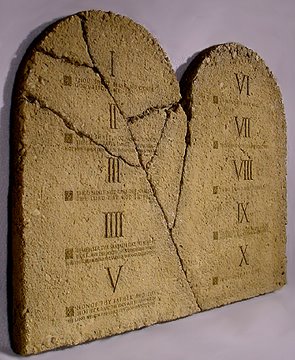
It’s common in cyber space to find Roman Catholics putting forth a negative image of Luther. It’s often insinuated that Luther was a gross sinner, often promoting sin and lawlessness. The argument typically goes: did not Luther teach salvation by faith alone? If salvation is by faith alone, it doesn’t matter what one does. Holy living isn’t important. God’s law is not important. Related to this, a common charge against Luther is that he also despised the Old Testament law. Such Luther quotes like these find there way into Roman Catholic books and web pages:
"We must remove the Decalogue [Ten Commandments] out of sight and heart."
"We have no wish either to see or hear Moses."
"If we allow them- the Commandments- any influence in our conscience, they become the cloak of all evil, heresies, and blasphemies"
"If Moses should attempt to intimidate you with his stupid Ten Commandments, tell him right out: chase yourself to the Jews."
You'll get plenty of hits if you put any of these quotes in a search engine. What you may not find is a context. Below is a closer look at these quotes, as well as examples of their usage (or rather, mis-usage) from Roman Catholic web pages. One should never fear a context, especially with Luther. Many times, what seems so awful really isn't when you've got the entire passage in front of you. If you've come across these quotes, one of the major writings that's popularized them in cyberspace was Patrick O'Hare's The Facts About Luther (Illinois: Tan Books, 1987). This old book was reprinted in 1987 and was heavily used by Rome's cyber-defenders in the late 1990's - early 2000's.

1. “We must remove the Decalogue [Ten Commandments] out of sight and heart.”
Probable Cyber-Source: Luther as cited by Patrick O’Hare, The Facts About Luther (Illinois: Tan Books, 1987), 311. For an example of a Roman Catholic webpage using this quote, see, Catholic Culture. This quote is from a letter Luther wrote to Jerome Weller, 1530. A thorough treatment of the context can be found here.  When Luther makes strong statements against the Law, it's always the Law considered as a means of salvation or justification. For instance, consider how the same statement is used here in Luther’s Commentary on John. Luther’s point is to hear Christ and his gospel only as the way of salvation. Commenting on John 14:10, Luther says,
“ ‘John 14:10. Do you not believe that I am in the Father and the Father in Me? The words that I speak to you I do not speak on My own authority; but the Father who dwells in Me does His works.’ As I have said, it is the purpose of these words to impress on and drum into us this chief article. Where the relationship of man to God or the ascertainment of God’s will is involved, we are to learn to dismiss everything else from our sight and heart, whatever may be taught and preached, even in the Law of Moses, and still more everything that proceeds from human reason and imagination. We must learn this one thing: to have a clear conception of Christ and let nothing tempt us away from this or lead us astray, be it a good work or an evil one, a good life or an evil life, holiness or sin. This is the knowledge in which St. John, an outstanding evangelist with regard to this theme, and St. Paul instruct more than the others do. They join and bind Christ and the Father so firmly together that we learn to think of God as only in Christ. As soon as we hear the mention of God’s name, or of His will, His works, His grace, or His displeasure, we must not judge these as the voice of our heart or man’s wisdom may discourse on them, or as the Law may suggest to us; but we must nestle and cuddle on the lap of Christ, like dear children on their mother’s lap or in her arms, and close our eyes and ears to everything but Him and His words. Or we must see Him as the faithful Savior, who sheds His blood so richly on the cross, rises again, subdues the devil and hell, treads death underfoot, proclaims this to you both personally and through the apostles, and grants all this to you. Thus He affirms abundantly that He harbors no anger or disfavor toward you but does everything to help and comfort you, all that He should and can do, if you but believe and accept this” [LW 24:64].

2. “We have no wish either to see or hear Moses.”
Probable Cyber-Source: Luther as cited by Patrick O’Hare, The Facts About Luther (Illinois: Tan Books, 1987), 202. For Roman Catholic webpage examples using such quotes, see Gary Hoge: Common Objections. O'Hare does not provide a reference. This quote  may originally come from a few places, as I documented here. It may  come from Luther’s treatise Against The Heavenly Prophets In The Matter Of Images And Sacraments. It is a writing against Luther’s former colleague Andreas Bodenstein von Karlstadt who joined with radical factions of the Anabaptists. When Luther did not support Karlstadt’s violent expunging of all images, Karlstadt accused Luther of disobeying God’s law given through Moses: “You shall not make yourself a graven image, or any likeness …” Luther responded by pointing out that Karlstadt misunderstood his position, as well as misinterpreted Moses. Luther, well heated up says:
Now then, let us get to the bottom of it all and say that these teachers of sin and Mosaic prophets are not to confuse us with Moses. We don’t want to see or hear Moses. How do you like that, my dear rebels? We say further, that all such Mosaic teachers deny the gospel, banish Christ, and annul the whole New Testament. I now speak as a Christian for Christians. For Moses is given to the Jewish people alone, and does not concern us Gentiles and Christians. We have our gospel and New Testament. If they can prove from them that images must be put away, we will gladly follow them. If they, however, through Moses would make us Jews, we will not endure it”[LW 40:91].
The “teachers of sin and Mosaic prophets” are Karlstadt and the Anabaptists. Luther viewed these people as denying the gospel and imposing law on people. The editors of Luther’s works have included an excellent overview of Luther’s opinion on Moses:
Anyone who, like the enthusiasts, erects Mosaic law as a biblical-divine requirement does injury to the preaching of Christ. Just as the Judaizers of old, who would have required circumcision as an initial requirement, so also the enthusiasts and radicals of this later era do not see that Christ is the end of the Mosaic law. For all the stipulations of that law, insofar as they go beyond the natural law, have been abolished by Christ. The Ten Commandments are binding upon all men only so far as they are implanted in everyone by nature. In this sense Luther declares that “Moses is dead [LW 35:158].

3. "If we allow them- the Commandments- any influence in our conscience, they become the cloak of all evil, heresies, and blasphemies.”
Probable Cyber-Source: Luther as cited by Patrick O’Hare, The Facts About Luther (Illinois: Tan Books, 1987), 311. For Roman Catholic webpage examples using such quotes, see, Luther: Exposing the Myth. I've done a full exposition of this quote here. This quote is from Luther’s Galatians Commentary:
From this you should learn, therefore, to speak most contemptuously about the Law in the matter of justification, following the example of the apostle, who calls the Law “the elements of the world,” “traditions that kill,” “the power of sin,” and the like. If you permit the Law to dominate in your conscience instead of grace, then when the time comes for you to conquer sin and death in the sight of God, the Law is nothing but the dregs of all evils, heresies, and blasphemies; for all it does is to increase sin, accuse, frighten, threaten with death, and disclose God as a wrathful Judge who damns sinners [LW 26:365].
Father O’Hare is engaging in a fallacious selective citation process. Luther is here speaking with a law /gospel distinction in regards to justification. Just a paragraph later Luther says, “Apart from the matter of justification, on the other hand, we, like Paul, should think reverently of the Law. We should endow it with the highest praises and call it holy, righteous, good, spiritual, divine, etc.”[LW 26:365].

4. "If Moses should attempt to intimidate you with his stupid Ten Commandments, tell him right out: chase yourself to the Jews.”
Probable Cyber-Source: Luther as cited by Patrick O’Hare, The Facts About Luther (Illinois: Tan Books, 1987), 311. For Roman Catholic webpage examples using such quotes, see, Catholic Truths. I've done an extensive treatment of this quote here. This quote may be from the 1525 treatise How Christians should regard Moses. Luther says,
Now if anyone confronts you with Moses and his commandments, and wants to compel you to keep them, simply answer, “Go to the Jews with your Moses; I am no Jew. Do not entangle me with Moses. If I accept Moses in one respect (Paul tells the Galatians in chapter 5[:3]), then I am obligated to keep the entire law.” For not one little period in Moses pertains to us [Source: LW 35:165].
The editors of Luther’s Works explain,
How, then, is “Moses” Word of God, and how is “Moses” law? How do Word of God and law relate to each other? Here Luther makes sometimes the most contrary statements. On the one hand “Moses” is completely abolished: “Moses does not pertain to us.” On the other hand we hear Luther expressing the wish “that [today’s] lords ruled according to the example of Moses.” Anyone who, like the enthusiasts, erects Mosaic law as a biblical-divine requirement does injury to the preaching of Christ. Just as the Judaizers of old, who would have required circumcision as an initial requirement, so also the enthusiasts and radicals of this later era do not see that Christ is the end of the Mosaic law. For all the stipulations of that law, insofar as they go beyond the natural law, have been abolished by Christ. The Ten Commandments are binding upon all men only so far as they are implanted in everyone by nature. In this sense Luther declares that “Moses is dead [Source: LW 35:158].

Addendum 2017
This blog entry is a revision of an entry I posted back in 2006. The original can be found here. Because so many sources are now available online, I'm revising older entries by adding additional materials and commentary, and also fixing or deleting dead hyperlinks. Nothing of any significant substance has changed in this entry from that presented in the former.