Monday, February 14, 2011

The Dark Origins Of Valentine's Day


The Dark Origins Of Valentine's Day

Though no one has pinpointed the exact origin of the holiday, one good place to start is ancient Rome, where men hit on women by, well, hitting them.

Those Wild and Crazy Romans

From Feb. 13 to 15, the Romans celebrated the feast of Lupercalia. The men sacrificed a goat and a dog, then whipped women with the hides of the animals they had just slain.

Sunday, February 13, 2011

tidbits

These are a just a few tidbits currently in front of me...

1. Going Beyond "I'm a 5-Point Calvinist"
For those of you that faithfully attend a Reformed church, here's something you should check out if you haven't done it already: track down a copy of your church order, and read through it. This past week I've been memorizing my own church order: Church Order of the United Reformed Churches in North America Second Edition, 1997. If you go to a URCNA church, take a moment or two to see what your current pastor probably had to go through to have the responsibility of preaching to you each week and the responsibilities he's taken on (along with the consistory). Then, thank him, pray for him, and have a renewed vigor to attentively listen to his sermons.

2. How is Luther seen today in North American Roman Catholicism?
And now for something completely different. Here's a link to a video of the Luther 2017 Countdown Lecture of 2010. It's a two hour lecture entitled "How is Luther seen today in North American Roman Catholicism?" from a Roman Catholic Priest: Rev. Dr. Donald Bolen, Bishop of Saskatoon. The video needs to be advanced to 16 minutes to begin.

This lecture is a bit subdued, but if you can hang in there, it really makes a great contrast between current trends in educated Romanism and the typical Roman Catholic bloggers and websites we deal with here.

The first hour of the lecture is an ecumenical explanation of the relationship of Romanism to Protestantism, and how wonderfully we can learn from each other. This isn't Catholic Answers, that's for sure. The second hour addresses what can positively be learned from Luther, and how wonderful Luther was. This certainly isn't Catholic Answers either. Now before someone says he's just a priest, note he was on the Pontifical Council for Promoting Christian Unity. I point this out because many recent comments have noted how out of touch many of the Roman e-pologists are with current Roman Catholic scholarship. I would suggest that many of the Roman e-pologists are actually out of touch also with trends coming out of Rome, like with Rome's ecumenical approach to interpreting Luther and the Reformation.

3. Even Liberal Media Can Be Interesting
And for something even more different. Here's a good link for general religion stories: NPR's Religion page. Yes, I know, NPR, liberal, etc. But they do manage to put forth some interesting stories. Their recent story on The Church Of Scientology, Fact-Checked was very interesting. Also they recently did some things on the Roman Catholic confessing sin over the phone stuff: Confessing Sin In The Age Of The iPhone and Catholic Church OKs 'Confession App,' But You Still Have To See A Priest.

4. It is Settled: Called To Communion Has Spoken!
I simply couldn't pass this tidbit up from the CTC Magisterium:

The Catholic Church, however, believes that she has been gifted with a participation in the divine authority of her Head. Thus, the Church can and has definitively adjudicated the matter of which writings are, and which are not, Sacred Scripture.

CTC may wish to contact Catholic apologist Gary Michuta. He says that certain books not included in the current catholic canon, yet included in the Septuagint, may be canonical, or possibly not, because Trent left particular books undecided as to their canonicty. So, according to Michuta, the matter was not definitively adjudicated.

Saturday, February 12, 2011

Luther's Counsel to the Man who Thought he was a Rooster

A good friend of mine just called me up and asked me if I had ever heard about Luther giving psychological counsel to a man who thought he was a rooster. My friend had just returned from a week-long conference for Christian counselors. One of the speakers apparently was fond of Luther and did a study on Luther as a counselor. If I recall correctly from our conversation, "Luther and the rooster-man" was said to be an early instance of pastoral counseling done on someone with an organic disorder, that is, according to the lecturer.

I did locate this story. Luther's famous biographer Roland Bainton states,

A melancholic claimed to be a rooster and strutted about crowing. The doctor said he, too, was a rooster and for several days crowed with him. Then he said, "I am not a rooster any more, and you are changed too." It worked [Here I Stand, p. 231].

Bainton took this from Luther's Table Talk (2889a-b). If anyone wants to work through the Latin, it can be found here.

I haven't heard the lecture, so It's hard to comment on someone using this to prove an early instance of pastoral counselling done on someone with an organic disorder. I will say, Luther lived in a time period that was prone to see the devil behind such behavior rather than organic psychological maladies. Then of course, there's the problem of this being from the Table Talk. But the most important fact to remember is that Luther did indeed give counsel, particularly spiritual counsel, and one can read a number of examples of this in his letters. If it were me, I'd go for information from Luther's pen rather than the Table Talk.

Friday, February 11, 2011

Luther: women are made to be either wives or prostitutes

The following is from the web page Luther, Exposing the Myth, under the heading "Marriage and Women":

"The word and work of God is quite clear, viz., that women are made to be either wives or prostitutes" [On Married Life].

Luther Exposing the Myth says their stated purpose is to show that "from Luther’s own words we shall see him for what he really was, that is a rebellious apostate, who abandoned the faith and led many into apostasy from God under the guise of “reformation” in order to follow his perverse inclinations." With this quote, they attempt to show Luther degraded women.

Documentation
Luther, Exposing the Myth cites "On Married Life." They may have taken the quote from this secondary source. Notice the similarities:


Peter F Wiener may also be the source being used: "Nothing sacred about marriage Luther knows of. But what he has to say about women is still worse. 'The word and work of God is quite clear, viz. That women were made either to be wives or prostitutes' (W12, 94) [Peter F Wiener, Martin Luther, Hitler's Spiritual Ancestor]. The reference used by Luther, Exposing the Myth is inaccurate.The quote is not from "Of Married Life" but rather (as Wiener notes) from  Luther's Commentary on 1 Corinthians 7, 1523 (WA 12:94 ; also in Erl. 51:6). The quote is found in the following paragraph:


 In the English version of Luther's Works, the quote can be found at LW 28:5 (Luther's Commentary on 1 Corinthians 7).

Context
This comment from Luther was written in 1523, in a treatise designed to defend Christian marriage against celibacy, and to promote the freedom to marry or not marry. Luther went through 1 Corinthians 7, one of the primary proof-texts used by those in favor of priestly celibacy. In fact, the treatise was dedicated to a friend's wedding, a wedding that Luther himself performed. Luther states his intention:
I have taken it upon myself to interpret the seventh chapter of the First Epistle of St. Paul to the Corinthians—this I do as a service to you and as an aid to all those who take a liking to it. My reason for this choice is that this very chapter, more than all the other writings of the entire Bible, has been twisted back and forth to condemn the married state and at the same time to give a strong appearance of sanctity to the dangerous and peculiar state of celibacy. And to tell the truth, none have given themselves such airs with this chapter as the very people who have been least chaste. I, too, once considered chastity as ordinary as they pretend it to be. But, thank God, the last three years have taught me how little chastity there is in the world outside marriage, both in convents and monasteries. But God has laid it upon me to preach about marriage and to tear the veil from the chastity which is of the devil, so that there may be less fornication and our poor youth may not be so pitiably and dangerously misled by falsely glorified chastity. Therefore I must take particular care that this chapter, which is their principal defense, no longer remain to cover their shame but be understood according to the true meaning of St. Paul.[LW 28:1]
Luther presents the view he's critiquing:
These fellows view the state of marriage as a superfluous, presumptuous human thing that one could dispense with and do without, just as I can do without an extra jacket or coat. Then they fill the world with their foolish and blasphemous scribbling and screeching against the married state, advising all men against it, although they themselves feel—and abundantly demonstrate by their actions—that they cannot do without women, these being created specifically for marriage; instead they run after and plague themselves with whores day and night.. [LW 28:5]
Then Luther identifies the specific person he's writing against: John Faber’s 1521 Opus adversus nova quaedam eta christiana religione prorsus aliena dogmata Martini Lutheri:
Of this kind is that arch-fool, Johann Schmid of Constance, that renowned whoremonger, who has written an immense book, recently printed in Leipzig, against the state of matrimony. He tries to talk everyone out of it but says nothing more than that there is much effort and labor connected with it, as though this were not sufficiently known throughout the world and as if this ass must first teach us what every village peasant knows. If I were chastity herself, I could think of no greater and more unbearable shame and disgrace than to be praised by such rascals, whoremongers, and enemies of chastity. They rail against us, charging that we are enemies of chastity and promoters of marriage who prefer to see men married; and we are to consider them extremely wise, though they cannot but devote themselves to incessant fornication and though they praise chastity with their pens only and defame the married state.. [LW 28:5]
Luther then argues that God intended there to be marriage. God didn't simply create women in order for sex:
They are rascals, not only on the surface but in the bottom of their hearts, and they are unworthy of an answer. And what matter if the whole world were to complain about the state of matrimony? We see right before our eyes that God daily creates not only men but also women and maintains their lives; and yet it is certain that he does not create any woman for the purpose of fornication. [LW 28:5]
Then comes the obscure quote:
But since God’s work and Word stare us in the face, declaring that women must be used either for marriage or for fornication, these heathenish pretenders should shut their blasphemous mouths and leave God’s Word and work uncriticized and unhampered; unless perhaps they would like to teach us according to their own famed sagacity and contrary to God that all women should be strangled or banished. This would make a fine fool of God: what He does is no good; what we do is well done. [LW 28:5]
The point is that biologically, people are typically designed with the desire to procreate. In fact, "God's work and Word" prove this, and this desire can either be carried out in a God pleasing way (marriage) of a non-God pleasing way (fornication). Then in a hyperbolic argument, Luther suggests those who argue for celibacy might as well argue that women should be strangled or banished in order to maintain a celibate life because the desire for sex is so strong. This would be the only way to avoid unchastity.

Luther continues:
Now therefore since God created woman that she should and must be with man, it should suffice us that God is on our side, and we should honor the married state as a divine and noble institution. And if the wiseacres do not want to enter it, then let them continue in their heathenish blindness to practice rascality and fornication so long as God may allow it. We have God’s Word on our side; that will remain and not be moved by such blundering Smiths, though they were more numerous than the sands of the sea. Still it is a great sin and shame that we Christians have become such great fools that we first have to ponder and decide whether women ought to be married or not, just as though someone should ask whether he ought to eat and drink in this life. [LW 28:5]
Conclusion
It's interesting to see how far this quote has traveled in cyber space by a simple Google search. When one of Luther's most severe Roman Catholic critics, Hartmann Grisar defends Luther on this quote, it's a good sign that the quote is out of context. Grisar states,
One sentence of Luther's, which, as it stands, scarcely does honour to the female sex, runs as follows : "The Word and work of God is quite clear, viz. that women were made to be either wives or prostitutes." By this statement, which so easily lends itself to misunderstanding, Luther does not mean to put women in the alternative of choosing either marriage or vice. In another passage of the same writing he says distinctly, what he repeats also elsewhere: " It is certain that He [God] does not create any woman to be a prostitute." [source]

Thursday, February 10, 2011

The Popes Against the Jews, Part 5: “You will recognize them by their fruits.”

Roman Catholics certainly will identify this “The Popes Against the Jews” series as falling within the realm of “outside the circle” – that is, it is not a “doctrinal” issue. But as was shown in the last posting, Roman Catholic councils in the 1200’s specified certain forms of treatment of the Jews that lasted into the 20th century, and that were fostered by the official Roman Catholic Church all along.

This is a clear case, as Jesus spoke, of knowing a tree by its fruit:
“Beware of false prophets, who come to you in sheep’s clothing but inwardly are ravenous wolves. You will recognize them by their fruits. Are grapes gathered from thornbushes, or figs from thistles? So, every healthy tree bears good fruit, but the diseased tree bears bad fruit. A healthy tree cannot bear bad fruit, nor can a diseased tree bear good fruit. Every tree that does not bear good fruit is cut down and thrown into the fire. Thus you will recognize them by their fruits.


In his introduction, Kertzer notes, “the legislation enacted in the 1930s by the Nazis in their Nuremberg Laws and by the Italian Fascists with their racial laws—which stripped the Jews of their rights as citizens—was modeled on measures that the [Roman Catholic] Church itself had enforced for as long as it was in a position to do so” (9).

But Roman Catholic involvement extended far beyond mere laws. It was Roman Catholic practices that led to the shaping of public opinion, public holidays, public traditions, public festivities. We’ll soon see remnants of this even today, as Mardi Gras and Ash Wednesday are soon to come upon us.
Unfortunately for the Jews, one of Carnival’s [that is, the public celebrations prior to Lent] most popular features was the ritual degradation of the people of the ghetto.

Among the first historical references we have to such rites is a description from 1466, when for the amusement of the Romans, in festivities sponsored by Pope Paul II, Jews were made to race naked through the streets of the city. A particularly evocative later account describes them: “Races were run on each of the eight days of the Carnival by horses, asses and buffaloes, old men, lads, children, and Jews. Before they were to run, the Jews were richly fed, so as to make the race more difficult for them, and at the same time, more amusing for the spectators. They ran from the Arch of Domitian to the Church of St. Mark at the end of the Corso at full tilt, amid Rome’s taunting shrieks of encouragement and peals of laughter, while the Holy Father stood upon a richly ornamented balcony and laughed heartily. Two centuries later, these practices, now deemed indecorous and unbefitting the dignity of the Holy City, were stopped by Clement IX. In their place the Pope assessed a heavy tax on the Jews to help pay the costs of the city’s Carnival celebrations.

But various other Carnival rites continued. For many years the rabbis of the ghetto were forced to wear clownish outfits and march through the streets to the jeers of the crow, pelted by a variety of missiles. Such rites were not peculiar to Rome. In Pisa in the eighteenth century, for example, it was customary each year, as part of Carnival, for students to chase after the fattest Jew in the city, capture him, weigh him, and then make him give them his weight in sugar-coated almonds.

In 1779, Pius VI resurrected some of the Carnival rites that had been neglected in recent years. Most prominent among them was the feudal rite of homage, in which ghetto officials, made to wear special clothes, stood before an unruly mob in a crowded piazza, making an offering to Rome’s governors.

It was this practice that occasioned the formal plea from the ghetto to Pope Gregory XVI in 1836. The Jews argued that such rites should be abandoned, and cited previous popes who had ordered them halted. They asked that, in his mercy, the Pope now do the same. On November 5, the Pope met with his secretary of state to discuss the plea. A note on the secretary of state’s copy of the petition, along with his signature, records the Pope’s decision: “It is not opportune to make any innovation.” The annual rites continued.
“When all is said and done, the [Roman Catholic] Church’s claim of lack of responsibility for the kind of anti-Semitism that made the Holocaust possible comes down to this: The Roman Catholic Church never called for, or sanctioned, the mass murder of the Jews. Yes, the Jews should be stripped of their rights as equal citizens. Yes, they should be kept from contact with the rest of society. But Christian Charity and Christian theology forbade good Christians to round them up and murder them.”

The comments sections have been quiet throughout this series. I would like to know from sincere Roman Catholics, why is the Roman Catholic Church exempt from this:
“Either make the tree good and its fruit good, or make the tree bad and its fruit bad, for the tree is known by its fruit. You brood of vipers! How can you speak good, when you are evil? For out of the abundance of the heart the mouth speaks. The good person out of his good treasure brings forth good, and the evil person out of his evil treasure brings forth evil. I tell you, on the day of judgment people will give account for every careless word they speak, for by your words you will be justified, and by your words you will be condemned.”
How can a “tree” such as the Roman Catholic Church, which produced such fruit as I’ve described in detail in these last five posts, also be said to have produced “the pure doctrine of the faith” which the gloriously infallible, papally-led Roman Catholic Church, “the Church which Christ Founded,” has put out, which we see in the form of promulgations on “the seven sacraments” and “transubstantiation” and papal supremacy, and the Roman doctrines of purgatory and penance [with its ties to mistranslations in the Vulgate, whatever the source and nature of them], the entire Roman Catholic doctrine of justification, the corresponding anathema of the Gospel of the New Testament, the Immaculate Conception of Mary, “papal infallibility,” the Assumption of Mary as a dogma, the liberal infiltration of Vatican II (at least the Protestants rejected liberalism in its own ranks), a soon-to-be-beatified Pope who denied Roman involvement in the brutal treatment and murder of the Jews (even though he lived through it), and finally, a pope quoting Teilhard de Chardin to the effect that “the world itself shall become a living host, a liturgy. This is also the great vision of Teilhard de Chardin: in the end we shall achieve a true cosmic liturgy, where the cosmos becomes a living host”?

Yes, as Dei Verbum ironically notes, there is truly “one source” for these two wellsprings – the uniquely Roman Catholic doctrine and the equally uniquely Roman Catholic treatment of the Jews.

Wednesday, February 09, 2011

Sproul: "The Bible is a fallible collection of infallible books"

I noticed Jason Engwer recently addressed R.C. Sproul's statement that the Bible is a fallible collection of infallible books. I  wrote about this a few years ago, beginning with the charge against Sproul's view:

"I've read second-hand that R.C. Sproul said Christians have "a fallible list of infallible books." Do you believe this? How does this factor into Protestant certainty?"


R.C. Sproul has made this point multiple times. I have at least three sources in which he makes this point. Probably though, the point wasn’t even Sproul’s to begin with. He was the pupil of John Gerstner, this statement might have been originally his.

Don Kistler points out:

Though Luther did not challenge the infallibility of Scripture he most emphatically challenged the infallibility of the church. He allowed for the possibility that the church could err, even when the church ruled on the question of what books properly belonged in the Canon. To see this issue more clearly we can refer to a distinction often made by Dr. John Gerstner. Gerstner distinguishes between the Roman Catholic view of the Canon and the Protestant view of the Canon in this manner:
• ROMAN CATHOLIC VIEW: The Bible is an infallible collection of infallible books.

• PROTESTANT VIEW: The Bible is a fallible collection of infallible books.
The distinction in view here refers to the Catholic Church’s conviction that the Canon of Scripture was declared infallibly by the church. On the other hand, the Protestant view is that the church’s decision regarding what books make up the Canon was a fallible decision. Being fallible means that it is possible that the church erred in its compilation of the books found in the present Canon of Scripture.
When Gerstner makes this distinction he is neither asserting nor implying that the church indeed did err in its judgment of what properly belongs to the Canon. His view is not designed to cast doubt on the Canon but simply to guard against the idea of an infallible church. It is one thing to say that the church could have erred; it is another thing to say that the church did err.
Gerstner’s formula has often been met with both consternation and sharp criticism in evangelical circles. It seems to indicate that he and those who agree with his assessment are undermining the authority of the Bible. But nothing could be further from the truth. Like Luther and Calvin before him, Gerstner has been an ardent defender of the infallibility and inerrancy of Scripture. His formula is merely designed to acknowledge that there was a historical selection process by which the church determined what books were really Scripture and what books were not Scripture. The point is that in this sifting or selection process the church sought to identify what books were actually to be regarded as Scripture.
[Source: “The Establishment of Scripture” Sola Scriptura! The Protestant Position on the Bible. (Don Kistler, ed. Morgan, PA: Soli Deo Gloria, 1995), found in the electronic edition of Sproul’s Chapters in Symposium Volumes]
Do I agree with the statement, “The Bible is a fallible collection of infallible books”? Yes, because the heart of the statement is only meant to point out that the church is not infallible.

Sproul points out:
Roman Catholics view the canon as an infallible collection of infallible books. Protestants view it as a fallible collection of infallible books. Rome believes the church was infallible when it determined which books belong in the New Testament. Protestants believe the church acted rightly and accurately in this process, but not infallibly.[Source: R.C. Sproul, Grace Unknown: The Heart of Reformed Theology, 58].
For me to admit that the Bible is an “infallible collection” is really only a way of being cornered into admitting the Roman Catholic paradigm of an infallible extra-Biblical authority. Does that therefore mean that I believe the bible contains a book it shouldn’t? No.

I recognize the Christian Church received the Canon. It does not though, create the Canon, or stand above the Canon. In other words, I see no reason to grant the Church infallibility in order for the Church to receive the Canon. The Church was used by God to provide a widespread knowledge of the Canon. The Holy Spirit had worked among the early Christian Church in providing them with the books of the New Testament. This same process can be seen with the Old Testament and Old Testament believers. The Old Testament believer 50 years before Christ was born had a canon of Scripture, this despite the ruling from an infallible authority.

First century Christians had the Old Testament, and had “certainty” that it was the very word of almighty. Clement of Rome frequently quotes the Old Testament. He does so, with the understanding that the words of the Old Testament are the very words of God. He was certain of it, this despite the alleged infallible ruling of either Pope Damaus or Trent. His use of Old Testament passages show a certainty that the words were God’s words. Or, think of Paul’s exhortation to Timothy- Paul notes that from infancy Timothy “knew” the Holy Scriptures (2 Tim 3:15): “…and how from infancy you have known the holy Scriptures, which are able to make you wise for salvation through faith in Christ Jesus.” How was it Timothy could know the Scriptures were the words of God without an infallible Church council declaring which books were canonical?

Obviously, the notion that an infallible council can only provide Canon certainty cannot be accurate. To expand this, think of all the New Testament writers: they freely quote the Old Testament with the certainty that it was the Word of God. Yet, no infallible source defined the Canon for them. A “source” definitely received the Old Testament Canon, but that “source” was not infallible, nor do I recall Rome arguing that the Jewish Old Testament leadership was infallible. Hence, I see no reason why the entirety of the Bible needs an infallible body to declare the Canon. It wasn’t needed previous to Trent, Damasus, or the pre-Christ Jewish authority.

That being said, how was it that Timothy had “certainty” the Old Testament was the word of God? It is God’s sovereign power that reveals the canon to His church, for His purposes. The people of God are indwelt with the Holy Spirit. It is they, who are given spiritual life and continually fed by its words. Jesus did this himself, as recorded in Luke 24:45, “Then He opened their minds so they could understand the Scriptures.” As to how a Protestant can have certainty on the Canon, my certainty is in the providence and work of God. Only faith will read the Bible and hear the voice of God. God used means in giving us His Canon, but like the Old Testament believers, those means don’t need to be infallible for one to know they are reading and hearing God’s word.

Tuesday, February 08, 2011

The Popes Against the Jews, Part 4: Church Councils Against the Jews

Keep in mind that the Roman Catholic defense of itself in this matter relies on its own definitions and a distinction between them. As Kertzer notes:

* * *

And so, according to the report, a crucial distinction must be made. What arose in the late nineteenth century, and sprouted like a poisonous weed in the twentieth, was “anti-Semitism, based on theories contrary to the constant teaching of the Church” This they contrasted with “anti-Judaism,” long-standing attitudes of mistrust and hostility of which “Christians also have been guilty,” but which, in the Vatican report, had nothing to do with the hatred of the Jews that led to the Holocaust. (Kertzer, 4)

This, again, is how the Vatican report put it: Thus we cannot ignore the difference which exists between anti-Semitism, based on theories contrary to the constant teaching of the Church on the unity of the human race and on the equal dignity of all races and peoples, and the long-standing sentiments of mistrust and hostility that we call anti-Judaism, of which, unfortunately, Christians also have been guilty.


How realistic is this distinction? For the official, institutional Roman Church, it is enough to wash its own hands from any culpability. For a trained historian like Kertzer, it’s enough to make him drop his cookies.
When I read the news story of the Vatican press conference, and later read the text of the Commission report, I knew that there was something terribly wrong with the history that the Vatican was recounting. It is a history that many wish had happened, but it is not what actually happened. It is the latter story [what actually happened], sometimes hard to believe, often sad, that I try to tell in the pages that follow. (Kertzer, 4)
Some time ago Steve Hays touched briefly on this topic. In one posting, he reprinted verbatim the Canons of the 4th Lateran Council. (And note that other councils have ruled on treatment of the Jews as well):
CANON 67

Summary. Jews should be compelled to make satisfaction for the tithes and offerings [to the] churches, which the Christians supplied before their properties fell into of the Jews.

Text. The more the Christians are restrained from the practice of usury, the more are they oppressed in this matter by the treachery of the Jews, so that in a short time they exhaust the resources of the Christians. Wishing, therefore, in this matter to protect the Christians against cruel oppression by the Jews, we ordain in this decree that if in the future under any pretext Jews extort from Christians oppressive and immoderate interest, the partnership of the Christians shall be denied them till they have made suitable satisfaction for their excesses. The Christians also, every appeal being set aside, shall, if necessary, be compelled by ecclesiastical censure to abstain from all commercial intercourse with them. We command the princes not to be hostile to the Christians on this account, but rather to strive to hinder the Jews from practicing such excesses. Lastly, we decree that the Jews be compelled by the same punishment (avoidance of commercial intercourse) to make satisfaction for the tithes and offerings due to the churches, which the Christians were accustomed to supply from their houses and other possessions before these properties, under whatever title, fell into the hands of the Jews, that thus the churches may be safeguarded against loss.

CANON 68

Summary. Jews and Saracens of both sexes in every Christian province must be distinguished from the Christian by a difference of dress. On Passion Sunday and the last three days of Holy Week they may not appear in public.

Text: In some provinces a difference in dress distinguishes the Jews or Saracens from the Christians, but in certain others such a confusion has grown up that they cannot be distinguished by any difference. Thus it happens at times that through error Christians have relations with the women of Jews or Saracens, and Jews and Saracens with Christian women. Therefore, that they may not, under pretext of error of this sort, excuse themselves in the future for the excesses of such prohibited intercourse, we decree that such Jews and Saracens of both sexes in every Christian province and at all times shall be marked off in the eyes of the public from other peoples through the character of their dress. Particularly, since it may be read in the writings of Moses [Numbers 15:37-41], that this very law has been enjoined upon them.

Moreover, during the last three days before Easter and especially on Good Friday, they shall not go forth in public at all, for the reason that some of them on these very days, as we hear, do not blush to go forth better dressed and are not afraid to mock the Christians who maintain the memory of the most holy Passion by wearing signs of mourning.

This, however, we forbid most severely, that any one should presume at all to break forth in insult to the Redeemer. And since we ought not to ignore any insult to Him who blotted out our disgraceful deeds, we command that such impudent fellows be checked by the secular princes by imposing them proper punishment so that they shall not at all presume to blaspheme Him who was crucified for us.

[Note by Schroeder: In 581 the Synod of Macon enacted in canon 14 that from Thursday in Holy Week until Easter Sunday, .Jews may not in accordance with a decision of King Childebert appear in the streets and in public places. Mansi, IX, 934; Hefele-Leclercq, 111, 204. In 1227 the Synod of Narbonne in canon 3 ruled: "That Jews may be distinguished from others, we decree and emphatically command that in the center of the breast (of their garments) they shall wear an oval badge, the measure of one finger in width and one half a palm in height. We forbid them moreover, to work publicly on Sundays and on festivals. And lest they scandalize Christians or be scandalized by Christians, we wish and ordain that during Holy Week they shall not leave their houses at all except in case of urgent necessity, and the prelates shall during that week especially have them guarded from vexation by the Christians." Mansi, XXIII, 22; Hefele-Leclercq V 1453. Many decrees similar to these in content were issued by synods before and after this Lateran Council. Hefele-Leclercq, V and VI; Grayzel, The Church and the Jews in the XIlIth Century, Philadelphia, 1933.]

CANON 69

Summary. Jews are not to be given public offices. Anyone instrumental in doing this is to be punished. A Jewish official is to be denied all intercourse with Christians.

Text. Since it is absurd that a blasphemer of Christ exercise authority over Christians, we on account of the boldness of transgressors renew in this general council what the Synod of Toledo (589) wisely enacted in this matter, prohibiting Jews from being given preference in the matter of public offices, since in such capacity they are most troublesome to the Christians. But if anyone should commit such an office to them, let him, after previous warning, be restrained by such punishment as seems proper by the provincial synod which we command to be celebrated every year. The official, however, shall be denied the commercial and other intercourse of the Christians, till in the judgment of the bishop all that he acquired from the Christians from the time he assumed office be restored for the needs of the Christian poor, and the office that he irreverently assumed let him lose with shame. The same we extend also to pagans. [Mansi, IX, 995; Hefele-Leclercq, III, 7.27. This canon 14 of Toledo was frequently renewed.]

CANON 70

Summary. Jews who have received baptism are to be restrained by the prelates from returning to their former rite.

Text. Some (Jews), we understand, who voluntarily approached the waters of holy baptism, do not entirely cast off the old man that they may more perfectly put on the new one, because, retaining remnants of the former rite, they obscure by such a mixture the beauty of the Christian religion. But since it is written: "Accursed is the man that goeth on the two ways" (Ecclus. 2:14), and "a garment that is woven together of woolen and linen" (Deut. 22: ii) ought not to be put on, we decree that such persons be in every way restrained b the prelates from the observance of the former rite, that, having given themselves of their own free will to the Christian religion, salutary coercive action may preserve them in its observance, since not to know the way of the Lord is a lesser evil than to retrace one's steps after it is known.

http://www.fordham.edu/halsall/basis/lateran4.html

Roman Catholic Teaching makes clear distinctions about how the Jews ought to be treated. In a posting, some time later, Steve provided comments made by Jonathan Ray, the Samuel Eig Assistant Professor of Jewish Studies at Georgetown University:
The very short answer to your question is “yes,” the sections of the 4th Lateran Council that you cite are generally taken by historians to represent the anti-Jewish stance of the medieval Church.

The slightly more long-winded, though not full, response is as follows:

The 3rd and 4th Lateran Councils represent the high-water mark of the power and energy of the medieval Papacy. This was the time that a series of dynamic and capable popes sought to standardize and centralize Catholic religious practice and, more generally, enhance papal authority throughout the Latin West. Part of this effort included a renewed dedication to the implementation of a number of rules and policies that had been part of ecclesiastical doctrine for centuries but that had not been regularly (or, in some cases, even minimally) enforced by local bishops, kings, or town councils. The canons you cite need to be read against this general backdrop of centralization and reform.

The idea of separating Jews (and Muslims) from the body of Catholic society has its roots in Roman legislation. One can argue that the antiquity of such “separate and unequal” laws does not erase their underlying anti-Jewishness. The decision to enforce them with vigor, and to reproach those Christians that had heretofore ignored them does seem to signal a change in outlook of the medieval Church. Whether this was a much-needed reform instituted by hardliners, or a destabilizing attack on a society that had built bridges connecting religious communities depends on your stance.

Clearly, the language and the accusations (do they represent fact?) of Jewish “treachery” and “mocking” of Christians are touched with a certain measure of anger and malice. Moreover, the canons give credence to “reports” of Jewish wrongdoing such as anti-Christian taunts during Easter that were non-existent. On the contrary, medieval Jews typically shut themselves securely within their walled Jewish Quarters during Easter week to try and avoid the nearly perennial anti-Jewish violence that the holiday provoked among the Christian masses.

The canons also hint at the underlying and ongoing struggle for power between the Papacy and the various secular lords of medieval Europe. Popes were forever threatening kings and other lords (including bishops) to toe the line or risk retribution. Most kings saw these as empty threats, and refused to bow to papal pressure. England, Portugal Castile and Catalonia-Aragon were notorious in this regard. The Holy Roman Emperor, Frederick II, also locked horns with Pope Innocent IV not long after the promulgation of these canons. The kings were not necessarily friends of the Jews, but they refused to allow the Church to tell them how to govern their subjects. Ironically, nearly all the popes of this era followed royal practice in appointing Jews to positions of power, despite their own prohibitions in this regard.

If you are interested, I deal with the subject in greater depth with regard to Spain in my book The Sephardic Frontier.

Hope this helps.

All best,
JR


Jonathan Ray
Samuel Eig Assist. Professor of Jewish Studies
Georgetown University

[Jonathan Ray is the Samuel Eig Assistant Professor of Jewish Studies in the Theology Department. Professor Ray specializes in medieval and early modern Jewish history, focusing on the Sephardic world. His research explores the "convivencia" or coexistence between Christian, Muslim and Jewish societies in Iberia and throughout the broader Mediterranean world. His courses include: Under Crescent and Cross: Jewish Middle Ages; Jews of Spain in the Middle Ages; and Jews and Judaism in the world of Islam.]

http://medievalstudies.georgetown.edu/faculty/

Sunday, February 06, 2011

Regular Programming Interrupted

Everyone needs a chuckle now and then. I'd like to momentarily interrupt our regularly programming for the following:


I had my first taste of Beef Bourguignon last night. Wonderful!

...And for those of you who love complaining about church, see the following thread from a Lutheran discussion forum "I can't stand it when..."

Here's one I found over on Patrick Madrid's blog: “What is the Internet, anyway?” a clueless Bryant Gumbel asks his equally clueless co-hosts on the “Today” show, way back in 1994-


...And for those of you who enjoy Roman Catholic mud wrestling, the Catholic Champion offers, More from the Jerk Mark Shea. The Champion also recently lovingly called my fellow beggar John a "venomous ex-Catholic." Meanwhile, the love-fest toward John over on the Catholic Answers forum is under constant moderator scrutiny. Are they watching for all the "venomous" words uttered by John? No they're deleting a lot of venomous comments from their own team.

And here's a tip that isn't funny (unless of course you're a technology geek and enjoy mocking those who aren't). Those of us who are typically five years behind the latest technology craze won't be getting a Kindle (or similar device) till they're sold at Walmart for around twenty-five bucks. In the meantime, you can still read Kindle books on your PC with this free program from Amazon. I purchased my first Kindle book yesterday.

Greg Bahnsen on YouTube

I just stumbled upon a Greg Bahnsen YouTube page. I'm sure many of you already knew about this, but well, no one told me. Here's a sample:

Saturday, February 05, 2011

The Popes Against the Jews, Part 3: Positing the “Big Lie,” and getting people to believe it.

In his introduction, Kertzer opens his work by discussing the document which I presented at some length in my last post.
* * *

It was March 16, 1998—eleven years after Pope John Paul II had asked the Commission [for Religious Relations with the Jews] to determine what responsibility, if any, the Church bore for the slaughter of millions of European Jews during World War II. For the Church, a more explosive subject could hardly be imagined …

At the heart of the problem, as the Vatican commissioners recognized, was the fact that the Holocaust had taken place “in countries of long-standing Christian civilization.” Might there be some link, they asked, between the destruction of Europe’s Jews and “the attitudes down the centuries of Christians toward the Jews”?

Those who feared that the report might criticize past popes or past Church actions were soon relieved to learn that the Commission’s answer to this question was a resounding “no.” True, the report admitted, Jews had for centuries been discriminated against and used as scapegoats, and, regrettably, certain misguided interpretations of Christian teachings had on occasion nurtured such behavior. But all this regarded an older history, one largely overcome by the beginning of the 1800s.

In the Commission’s view, the nineteenth century was the key period for understanding the roots of the Holocaust and, in particular, the reasons why the Church bore no responsibility for it. It was in that turbulent century that new intellectual and political currents associated with extreme nationalism emerged. Amid the economic and social upheavals of the time, people started to accuse Jews of exercising a disproportionate influence… (David Kertzer, “The Popes Against the Jews: The Vatican’s Role in the Rise of Modern Anti-Semitism”, New York: Vintage Books, ©2002, originally published New York: Alfred A. Knopf, ©2001, pgs 3-4)
Here is a point at which typical Roman obfuscation is evident.

Kertzer brings out this point later in the book. The actual verbiage from the Vatican Commission’s document is, “But in that same historical context, notably in the 19th century, a false and exacerbated nationalism took hold. In a climate of eventful social change, Jews were often accused of exercising an influence disproportionate to their numbers. Thus there began to spread in varying degrees throughout most of Europe an anti-Judaism that was essentially more sociological and political than religious.”

What the Vatican fails to report is the very fact that it was a pope, and a work sanctioned by a pope, (approved of and distributed by the Vatican’s own theological journal – and reprinted with the explicit approval of the pope at the time) and a report by the “Holy Office of the Inquisition”, that made these charges, that led to this “sociological and political” anti-Semitism.

After describing the election of a new pope in 1823, Leo XII, Kertzer noted that shortly after his election,
he launched a stern morality campaign: He ordered the police to prevent taverns from serving alcohol, he attacked the waltz as obscene, he ordered that statues of naked women be removed from public view, and he ordered the arrest of any man found walking too closely behind a woman.…

The Jews occupied a central place in this “rechristianizing” campaign. Embracing the virtues of the past, and purging the present of all the excrescences of modern times, meant ensuring that the Jews were confined to their divinely ordained place. As cardinal vicar of Rome, Della Genga [the new Pope Leo XII] had been outraged to discover that not all of the Holy City’s Jews had returned to their ghetto following the restoration of the papal regime. One of his major projects as cardinal vicar had been to oversee a modest enlargement of the ghetto, to undermine the Jews’ complaint that it was impossible for them all to fit in the densely packed space within the old ghetto walls. Now, as pope, he redoubled these efforts. In 1823, in one of his first pontifical acts [though this is not “a teaching,” to be sure, and this act is not infallibly protected and thus “the Church” can officially dismiss it as if it were nothing], Leo XII ordered the Jews back into the ghetto, “to overcome the evil consequences of the freedom that [they] have enjoyed….

Among the beneficiaries of the new Pope’s policies was the Holy Office of the Inquisition [later, Congregation for the Doctrine of the Faith, of which Ratzinger became the overseer for many years], which Leo XII turned to for help in his efforts. In the first year of his papacy, he had the Holy Office investigate the extent to which the old restrictions on the Jews in the Papal States were still being enforced. The goal as an internal Inquisition report expressed it, was “to contain the wickedness of the obstinate Jews so that the danger of perversion of the Catholic faithful” could be avoided. The report expressed dismay that some Jews lived outside the ghettoes, some traveled from place to place without the special permits they were required to get from the local office of the bishop or the inquisitor, and some had opened stores and businesses beyond the ghetto’s walls. The list of scandals went on: Jewish men were reported to be having relationships with Christian women; Jewish families were employing Christian servants and wetnurses; and Jews could be seen hiring coachmen and riding around in carriages, an offense to Christian sensibilities. “In a word,” the report concluded, “today Christians are found to be subject to the Jews, or at least put on equal footing with them, so that there hardly remains any distinction between them. We are not far, at this point, from seeing them admitted to Citizenship.”
Keep in mind that this “report” was the Congregation for the Doctrine of the Faith, er, the “Holy Office of the Inquisition,” at the request of a pope.

The new Pope’s efforts to enforce these restrictions on the Jews relied on the bureaucracy of control provided by the Inquisition and by various other agencies of the Papal States. But it also had an ideological component. One of the first signs of this new ideological offensive was the publication, in 1825, of a long treatise on the Jews in Rome’s Ecclesiastical Journal, which was subsequently published as a separate booklet and went through four printings in 1825-26. Written by the procurator general of the Dominican order, Father Ferdinand Jabalot, it had been directly inspired by Della Genga when he was still cardinal vicar of Rome.

The booklet resurrected many of the traditional Catholic accusations against the Jews. Jews were guilty of deicide, and crazed with the lust for lucre and the desire to bring about the ruin of Christians. So intense was their hatred of Christianity that no evil was to great for them: “They wash their hands in Christian blood, set fire to churches, trample the consecrated host … kidnap children and drain them of their blood, violate virgins,” and on and on. [More later on the kidnapping of children and draining them of their blood.”]

The exiguous number of Jews in Italy—they constituted less than 0.2 percent of the population—did not deter Jabalot from attributing to them a huge—and pernicious—influence. [See the 1998 Vatican report to the effect that “In a climate of eventful social change, Jews were often accused of exercising an influence disproportionate to their numbers.”] In many parts of our land the Jews have become the richest property owners. In some cities money cannot be had, except through them, and so great has the number of mortgages they hold over Christians become, that it is only barely that the Christians have not yet become their vassals.” As for the Jews’ character, the portrait could scarcely be worse: Everywhere one hears of deceptions and frauds they have committed.” Many of them are “pickpockets, thieves, swindlers, assassins,” and their houses “are the general deposits for all kinds of stolen goods.” The Jews are ever busy “cheating and hoodwinking Christians ... at every opportunity ...”

Along with the traditional Catholic charges, Jabalot’s text provides some of the germs of what would become the major focus of later-nineteenth-century Catholic characterizations of the Jews. Wherever they live, wrote the Dominican, the Jews “form a state within a state.” Unless Christians act quickly, the Jews “will finally succeed in reducing the Christians to be their slaves. Woe to us if we close our eyes! The Jews’ domination will be hard, inflexible, tyrannical….The year was 1825. The Jews had not yet been given equal rights in any part of Itly, nor in most of the rest of Europe.

The pope was pleased with Jabalot’s work, and not long after its publication appointed him head of the Dominican order worldwide.

The Holy Office’s request in 1823 that the bishops and inquisitors report on the situation of the Jews in their jurisdiction unleashed an outpouring of complaints against the Jews
(63-65).
Of course, we know about Popes and bishops working together on things. From the Catechism:
2032 The Church, the "pillar and bulwark of the truth," "has received this solemn command of Christ from the apostles to announce the saving truth." "To the Church belongs the right always and everywhere to announce moral principles, including those pertaining to the social order, and to make judgments on any human affairs to the extent that they are required by the fundamental rights of the human person or the salvation of souls."

2033 The Magisterium of the Pastors of the Church in moral matters is ordinarily exercised in catechesis and preaching, with the help of the works of theologians and spiritual authors. Thus from generation to generation, under the aegis and vigilance of the pastors [i.e. the Popes and the Holy Office of the Inquisition, the Congregation for the Doctrine of the Faith, etc.], the "deposit" of Christian moral teaching has been handed on, a deposit composed of a characteristic body of rules, commandments, and virtues proceeding from faith in Christ and animated by charity. Alongside the Creed and the Our Father, the basis for this catechesis has traditionally been the Decalogue which sets out the principles of moral life valid for all men.
Nevertheless, none of this made it into “the circle,” and so, as Rubinstein made clear to us in his First Things article, the Nazis owed “precisely nothing” to “the Catholic Church and its teachings” for their murderous campaign against the Jews.

Or, maybe Hitler and his henchmen owed precisely, “the ability to posit the Big Lie and get away with it”, to official Roman Catholic teaching.
All this was inspired by the principle--which is quite true within itself--that in the big lie there is always a certain force of credibility; because the broad masses of a nation are always more easily corrupted in the deeper strata of their emotional nature than consciously or voluntarily; and thus in the primitive simplicity of their minds they more readily fall victims to the big lie than the small lie, since they themselves often tell small lies in little matters but would be ashamed to resort to large-scale falsehoods. It would never come into their heads to fabricate colossal untruths, and they would not believe that others could have the impudence to distort the truth so infamously. Even though the facts which prove this to be so may be brought clearly to their minds, they will still doubt and waver and will continue to think that there may be some other explanation. For the grossly impudent lie always leaves traces behind it, even after it has been nailed down, a fact which is known to all expert liars in this world and to all who conspire together in the art of lying.

—Adolf Hitler , Mein Kampf, vol. I, ch. X
So, to review, then, repeat after me: the Roman Catholic Church and Roman Catholic Teaching contributed “precisely nothing” to the Holocaust of the Jews.

Thursday, February 03, 2011

The Popes Against the Jews, Part 2: Roman Catholic Defenses and the Evasion of Responsibility

In the first installment of this series, I noted that William Rubinstein had defended Roman Catholicism by saying, “Nevertheless, the author never actually discusses what Nazism owed to the Catholic Church and its teachings, which is, of course, precisely nothing.”

What a bold, chest-thumping statement. An unwatchful reader might come off thinking that the Roman Catholic Church played absolutely no role whatsoever in attitudes that led to the killing of the Jews during Hitlers’s regime.

But nothing could be further from the truth.

Rubinstein here is lumping “the Catholic Church” together with “its teachings”. Even here, “the definition of the word ‘church’” comes into play.

I’ve been asked why I picked up this series, “The Popes Against the Jews” just now, and I think that some of the Roman Catholics who wander over here may find this interesting. It’s something that’s hit very close to home with me.

In my “resignation letter” to my parish priest, dated July 1999, I wrote this:
I am deeply disillusioned with the Catholic Church, and I have been for a long time. Not that I believe that, in a moral sense, the Church is too strict or anything like that. I would have to say my disillusionment has more to do more with the Church’s attitude about itself.

Over the years, my life has been marked by some degree of devotion to Christ. A friend of mine, [name], noticed this and invited me to an “evening of recollection,” sponsored by Opus Dei. I was amazed by the number of relatively young men who sought to follow Christ in such a complete way, in their daily lives.

I had mentioned to you once, in passing, that I had been attending these evenings of recollection. At any rate, the guys at Opus Dei started quoting out of the new Catechism the way Baptists quote out of Scripture. I mentioned this to [name], and eventually we got into a friendly religious argument. The basis for the argument was that I believed the Protestant Reformers were justified in protesting the (many) abuses of the Church of the day, and that it was Rome’s response to them that caused most of the schisms.

Things got a bit heated (mostly via e-mail), [name] asked to stop the discussion, and I have been quiet about it ever since. But because of that discussion, I looked more intently at the Catholic/Protestant debates (current and past), and I decided that the Catholics are on the short end of that argument.
See how naïve I was back then. I thought it was “the Church’s attitude toward itself,” when really, it was “the way the Church defined itself” that was the problem. (Or maybe I was just being kind calling it an “attitude.”)

In fact, it is the “official” Roman Catholic response in this matter which speaks as directly to what I am talking about as almost anything except for the massive cover-up of abusive priests by bishops. Generally speaking, these are held to be things outside of the circle, not doctrinally related, except insofar as they stem from the Roman Catholic Church’s definition of itself. This is precisely the “attitude” which is to be condemned.

This struck me especially while reading Pope John Paul II’s encyclical Veritatis Splendor, which introduced the Catechism of the Catholic Church “which contains a complete and systematic exposition of Christian moral teaching.”

The thing that struck me was this phrase:
At all times, but particularly in the last two centuries, the Popes, whether individually or together with the College of Bishops, have developed and proposed a moral teaching regarding the many different spheres of human life. In Christ's name and with his authority they have exhorted, passed judgment and explained (Section 4, emphasis in the original).
My thought was, where were you, where was this “moral teaching” prior to these “last two centuries”?


Rome defines itself in Lumen Gentium,” Vatican II’s “Dogmatic Constitution of the Church. This is Rome’s official definition of itself.
Christ, the one Mediator, established and continually sustains here on earth His holy Church, the community of faith, hope and charity, as an entity with visible delineation through which He communicated truth and grace to all. But, the society structured with hierarchical organs and the Mystical Body of Christ, are not to be considered as two realities, nor are the visible assembly and the spiritual community, nor the earthly Church and the Church enriched with heavenly things; rather they form one complex reality which coalesces from a divine and a human element. For this reason, by no weak analogy, it is compared to the mystery of the incarnate Word. As the assumed nature [that is, Christ’s flesh] inseparably united to Him, serves the divine Word as a living organ of salvation, so, in a similar way, does the visible social structure of the Church serve the Spirit of Christ, who vivifies it, in the building up of the body. (LG 8)
Note what is being said here. Christ is both God and man. In the Incarnation, he “assumed” a human nature that is “inseparably united to Him.” In a similar way, the church hierarchy that we have seen throughout history, which claims to be affirmed in itself through an unverifiable “apostolic succession,” – “the visible social structure” of the Church, is “comparably” “inseparably united” to Christ.

Just in case there is any question about what this means:
This is the one Church of Christ which in the Creed is professed as one, holy, catholic and apostolic, which our Saviour, after His Resurrection, commissioned Peter to shepherd, and him and the other apostles to extend and direct with authority, which He erected for all ages as “the pillar and mainstay of the truth”. This Church constituted and organized in the world as a society, subsists in the Catholic Church, which is governed by the successor of Peter and by the Bishops in communion with him, … (LG 8)

Basing itself upon Sacred Scripture and Tradition, it teaches that the Church, now sojourning on earth as an exile, [and defined as it is] is necessary for salvation. Christ, present to us in His Body, which is the Church, is the one Mediator and the unique way of salvation. In explicit terms He Himself affirmed the necessity of faith and baptism and thereby affirmed also the necessity of the Church, for through baptism as through a door men enter the Church. Whosoever, therefore, knowing that the Catholic Church was made necessary by Christ, would refuse to enter or to remain in it, could not be saved. (LG 14)
“The Roman Catholic Church” here defines and identifies itself, (and subsequent statements have affirmed this), as “the one church of Christ” – founded instantly at the moment the words of Matt 16:18 were spoken – in majestic and glorious authority from that moment till the present.

But right here, at the heart of its definition of itself, that Rome not only makes, but emphasizes, another one of its fundamental misunderstandings of what the Scripture is saying. The hierarchy of the Roman Church so completely identifies itself with “Christ” that it has completely cut off its own ability to repent, lest it accuse Christ of sin.

As I’ve noted, this identification found its articulation in the Reformation. Turretin described it this way:
Thus this day the Romanists (although they are anything but the true church of Christ) still boast of their having alone the name of church and do not blush to display the standard of that which they oppose. In this manner, hiding themselves under the specious title of the antiquity and infallibility of the Catholic church, they think they can, as with one blow, beat down and settle the controversy waged against them concerning the various most destructive errors introduced into the heavenly doctrine. (Francis Turretin, “Institutes of Elenctic Theology, translated by George Musgrave Giger; edited by James T. Dennison, Jr.: Phillipsburg, NJ, P&R Publishing, ©1997, Vol. 3, pg 2).
This was a not-so-cutesy way of trying to “define” itself out of a problem. In defining itself as “the one Church of Christ” or “the Church that Christ Founded”, the Roman hierarchy, in one fell swoop, sought to remove from itself any notion of accountability for what Turretin called “destructive errors introduced into the heavenly doctrine.”

Being “the pillar and foundation of the truth” is not a call to authoritatively uphold teaching in some infallible way. It is a call to holy living. It is precisely here, as James says, “Show me your faith apart from your works, and I will show you my faith by my works” and “You see that a person is justified by works and not by faith alone.” This is the true place where in Rome’s definition of “the faith” fides quae -- “the teaching” (see Rubinstein above) -- the Roman hierarchy has failed grievously.

Back to this issue of “The Popes Against the Jews.”

In its own official document responding to the Holocaust, We Remember: A Reflection On The Shoah, Rome shifts the blame away from itself.

Before this horrible genocide, which the leaders of nations and Jewish communities themselves found hard to believe at the very moment when it was being mercilessly put into effect, no one can remain indifferent, least of all the Church, by reason of her very close bonds of spiritual kinship with the Jewish people and her remembrance of the injustices of the past. The Church's relationship to the Jewish people is unlike the one she shares with any other religion. However, it is not only a question of recalling the past. The common future of Jews and Christians demands that we remember, for "there is no future without memory". History itself is memoria futuri. …

Later, when the Emperors themselves converted to Christianity, they at first continued to guarantee Jewish privileges. But Christian mobs who attacked pagan temples sometimes did the same to synagogues, not without being influenced by certain interpretations of the New Testament regarding the Jewish people as a whole. "In the Christian world—I do not say on the part of the Church as such—erroneous and unjust interpretations of the New Testament regarding the Jewish people and their alleged culpability have circulated for too long, engendering feelings of hostility towards this people". Such interpretations of the New Testament have been totally and definitively rejected by the Second Vatican Council. [Oh, the poor, poor Church, getting blamed for these “certain interpretations”.]

Despite the Christian preaching of love for all, even for one's enemies, the prevailing mentality down the centuries penalized minorities and those who were in any way "different". Sentiments of anti-Judaism in some Christian quarters, and the gap which existed between the Church and the Jewish people, led to a generalized discrimination, which ended at times in expulsions or attempts at forced conversions. In a large part of the "Christian" world, until the end of the 18th century, those who were not Christian did not always enjoy a fully guaranteed juridical status. Despite that fact, Jews throughout Christendom held on to their religious traditions and communal customs. They were therefore looked upon with a certain suspicion and mistrust. In times of crisis such as famine, war, pestilence or social tensions, the Jewish minority was sometimes taken as a scapegoat and became the victim of violence, looting, even massacres.

By the end of the 18th century and the beginning of the 19th century, Jews generally had achieved an equal standing with other citizens in most States and a certain number of them held influential positions in society. But in that same historical context, notably in the 19th century, a false and exacerbated nationalism took hold. In a climate of eventful social change, Jews were often accused of exercising an influence disproportionate to their numbers. Thus there began to spread in varying degrees throughout most of Europe an anti-Judaism that was essentially more sociological and political than religious.

At the same time, theories began to appear which denied the unity of the human race, affirming an original diversity of races. In the 20th century, National Socialism in Germany used these ideas as a pseudo-scientific basis for a distinction between so called Nordic-Aryan races and supposedly inferior races. Furthermore, an extremist form of nationalism was heightened in Germany by the defeat of 1918 and the demanding conditions imposed by the victors, with the consequence that many saw in National Socialism a solution to their country's problems and cooperated politically with this movement.

The Church in Germany replied by condemning racism. The condemnation first appeared in the preaching of some of the clergy, in the public teaching of the Catholic Bishops, and in the writings of lay Catholic journalists….

Thus we cannot ignore the difference which exists between anti-Semitism, based on theories contrary to the constant teaching of the Church on the unity of the human race and on the equal dignity of all races and peoples, and the long-standing sentiments of mistrust and hostility that we call anti-Judaism, of which, unfortunately, Christians also have been guilty.

We deeply regret the errors and failures of those sons and daughters of the Church….

At the end of this Millennium the Catholic Church desires to express her deep sorrow for the failures of her sons and daughters in every age. This is an act of repentance (teshuva), since, as members of the Church, we are linked to the sins as well as the merits of all her children.


This is not repentance. At its most fundamental level, the call of Jesus to “repent” (Matthew 4:17) is just simply Christ’s call to take accountability for the one serious moral issue that we all face, sin, and to reject it. Man sins and offends God; the one and only response that Christ asks of us is to “repent” in the face of this sin. It is the only response.

Rome not only fails to repent. It has irrevocably defined itself out of both the need to and the ability to repent. It shifts blame to “the sons and daughters” of “the Church”. “The Church” itself refuses to repent. And in doing so, it exhibits “the fruit” by which it is recognized (Matt 7:16).

In our day, what do we call a person who refuses to take responsibility for his own actions? We have a word for that. I just can’t think of it right now.

Wednesday, February 02, 2011

Beggars All and Yours Truly Featured at Catholic Answers forum

I wanted to let y'all know that little old me has been featured in a thread at the Catholic Answers forum in a thread entitled:

John Bugay and Beggars All Website - How to Deal with His Anti-Catholicism

Back in the old days, I used to spend quite a bit of time in Roman Catholic forums, in discussions with folks who are fairly adamantly convinced that I'm wrong about things. I try to "make a defense to anyone who asks you for a reason for the hope that is in you," to "jus-grin-bakatum" and to make the best of things for those who may have some honest questions.

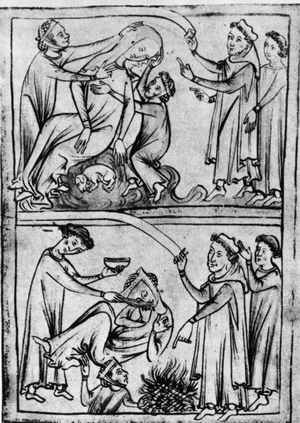
The artwork here, by the way, is by my dear and life-long friend Dale Crum.

Monday, January 31, 2011

“The Popes Against the Jews,” Part 1

William D. Rubinstein is professor of modern history at the University of Wales, Aberystwyth. He wrote a review of the work, The Popes Against the Jews: The Vatican’s Role in the Rise of Modern Anti-Semitism, by David L. Kertzer, a professor at Brown University, which appeared in the journal First Things. I will rely on Rubinstein to set out the scope of what I hope to write about in the coming week or so:
there has until now been no general history of Catholic hostility to the Jews in modern times which argues for the importance of the Catholic Church, especially the Vatican, in engendering modern forms of anti-Semitism.

This gap is not coincidental. Modern “racial” anti-Semitism, emphasizing the ethnic separateness and evil of Jews in European societies, has always been distinguished from premodern forms of anti-Semitism, which were religious in nature, founded in the rejection by Jews of the divinity of Jesus. Although there is widely admitted to be some overlap between the two, post-1870 racialist anti-Semitism, culminating in the Nazi Holocaust, is also almost always seen as categorically different from previous varieties of anti-Semitism, often anti-Christian and “pagan,” and founded in social Darwinist pseudo-science and national xenophobia.

It is the argument of David Kertzer’s The Popes Against the Jews that there was less difference between the two forms than has previously been understood. The author argues for a consistent pattern of Catholic, indeed direct Vatican, involvement in engendering modern forms of anti-Semitism. Professor Kertzer focuses on events that are well-known, such as the Mortara case and the Dreyfus Affair, and on aspects of this question that are less well-known, such as the Church’s response to “ritual murder” charges (the absurd claim, first advanced in the Middle Ages, that Jews murder Christian children at Passover in order to use their blood to bake matzoh) and the thoroughgoing anti-Semitism of much of the Catholic press. Prof. Kertzer skillfully and not unsubtly traces the differences in attitude towards the Jews among the Popes between about 1740 and 1940.
First of all, note what Rubinstein is saying here. Even though it is not subtle, Kertzer’s account is a skillful one. His work is historically accurate, (though note the title of the piece, suggesting that Kertzer’s account is merely one side, the “prosecuting” side.) What follows is a true story, and the events, as they are reported, are not in question, even from First Things, which, in its defense of Roman Catholicism in this regard, has been highly vocal.

History, to my knowledge, seeks to uncover the facts and tell the story of what happened. Even if Kertzer does only tell “the prosecuting” side, Rome has had ample time and space to “tell its side of the story.”

So Rubinstein’s piece here seeks to provide “the other side of the story,” the “defense” of Roman Catholic treatment of the Jews during this time. It seems as if the heart of Rubinstein’s complaint about the work is that Kertzer wasn’t nice to the Roman Catholic Church. He continues:
Although an excellent and well-written piece of historical research, [emphasis added] The Popes Against the Jews goes out of its way to magnify the role of anti-Semitism within the Catholic Church. Indeed, it greatly magnifies the importance of the Jews for the Church, and compounds this by viewing every aspect of the Church's attitude towards the Jews with post-Holocaust eyes.
So, the Jews weren’t high on the radar screen of the official Church. They weren’t a danger to the Church, and so, the Church (meaning the hierarchy) wasn’t paying very much attention to them. And yet, as Kertzer notes, some popes focused keen attention on their posture toward the Jews.

* * *

Norman Davies, in his “Europe, A History” (Oxford, New York: Oxford University Press, 1996) writes about the history of the treatment of the Jews by the Roman Catholic Church, and treatment of the Jews throughout Catholic Europe:
In many Italian cities, walled and gated quarters reserved for Jews had existed at least since the eleventh century. They resulted from the concordance of view between the municipal magistrates, who demanded segregation, and the Jews’ own religious laws, which forbade residence among Gentiles. In Venice, the Jewish quarter was called Il Ghetto, either from a contraction of borghetto or ‘little town’ or from a deformation of the gietto or ‘foundry’ which had once existed there. The name [“Ghetto”] came to be used across Europe. Major ghettos were created in Prague, Frankfurt, Trieste, and in Rome, where the ghetto was maintained from 1536 to 1870….

To escape from the ghetto was no simple matter. Would-be escapees had to defy the laws and customs both of the Gentile and of the Jewish communities, and to risk dire penalties. Until modern times, formal conversion was often the only practical way out (pg 338).
In his First Things piece, Rubinstein defends Roman Catholicism this way:
The Popes Against the Jews ends pointedly with the roundup of over a thousand Roman Jews by the Nazis for Auschwitz. Yet Kertzer never clarifies the connection between the Church’s view of the Jews and the Holocaust. Prof. Kertzer understands perfectly well that the resemblances between the attitudes of the Church towards the Jews and Nazi anti-Semitism are extremely minimal, and, indeed, quite rightly takes pains to point out that “the Nazi goal of a racially purified society . . . is clearly contrary to Catholic theology.” He also, to his credit, warns us “to be careful not to view history backwards.” Most pointedly, he tells us that he does not “mean to suggest that the Roman Catholic Church is alone to blame for the Holocaust. Such a conclusion would be ludicrous.” Nevertheless, the author never actually discusses what Nazism owed to the Catholic Church and its teachings, [emphasis added] which is, of course, precisely nothing.
What is he saying here? It sounds like this: “Even though the Catholic Church had for centuries rounded up the Jews, forced them to live in ghettos and to identify themselves by wearing yellow badges on their clothing, and even though this activity conditioned 20th century Europeans not to be alarmed when Jews did get rounded up and herded off in this way, at least we never tried to kill them. At least Roman Catholic teaching never specifically identified ‘a final solution’.”

In truth, centuries of Roman (and papal) treatment of the Jews provided the deadness of conscience to the spectacle of Jews wearing yellow badges and being rounded up and herded off to the ghettos. If not for centuries of precisely this kind of treatment, the Nazis would not have gotten nearly so far as they did.

Rubinstein seems to want to make that distinction between official Roman Catholic teaching and everything else the official Roman Catholic Church did. It’s the Alias Smith and Jones defense. For all the trains and the banks they robbed, they never taught anyone. Or in this case, For all the mistreatment of the Jews, they never articulated “a final solution” in official Roman Catholic teaching. “No, the Nazis were never taught by way of official Roman Catholic doctrine that it’s ok to kill the Jews. Therefore the Roman Catholic Church is not culpable in any way.”

This is precisely the nature of the Roman Catholic defense of itself.

For those who are interested in looking ahead, James Swan has referred me to his article Luther and the Jews, which looks specifically at some of Luther's writings on the topic of the Jews, and puts them into context.

Sunday, January 30, 2011

The Underlying Rift

It's not all a White Horse Inn love fest between the Lutheran and Reformed out in cyber space. Some of you are probably aware of the underlying rift between Lutherans (that take their Lutheranism seriously) and the Reformed (those people not afraid to refer to themselves as "Calvinists").

I rarely get involved with this dispute. I'm not a Lutheran, and I don't plan on becoming one anytime soon. On the other hand, I'm not going to spend my sparse blogging time fighting with Lutherans over predestination, the extent of the atonement or the sacraments.

Here's a blog post though for my Reformed friends with time on their hands: Luther & His Tower Experience:

The most dangerous enemy of the Lutheran confessions is not so much Rome who is obvious but Reformed doctrine which is more clandestine.

Here's another similar tidbit from a CyberBrethren comment box:

As a former Calvinist doctrine was a philosophical matter. We were proud to show how well our i’s were dotted and our t’s were crossed. Everything was done in the Divine Council before the beginning of time. Your life on earth was about your gratitude and your glorifying God. The reformed worship is a play of things past, it is not about what is happening in this very moment.

Speaking of CyberBrethren, recently Pastor McCain posted a comment from Doug Wilson he found uplifting. I like Pastor McCain (and his blog), but if I recall correctly, he's not a big fan Calvinism. So, posting a comment from a post millennial federal vision Calvinist was somewhat surprising:

‎Jesus promised us that the gates of Hades would not prevail against the Church. It is not often noted that the gates of Hades are not an offensive weapon. Hades is being besieged by the Church; it is not the other way around. We need to learn to see that biblical worship of God is a powerful battering ram, and each Lord’s Day we have the privilege of taking another swing. Or, if we prefer, we might still want to continue gathering around with our insipid songs, dopey skits, and inspirational chats in order to pelt the gates of Hades with our wadded up kleenex.” ~ Douglas Wilson

I left this brief comment: If this is the Doug Wilson I’m familiar with, you’re quoting not only a Calvinist, but a post-millennialist. I haven’t seen this quote in context, but for a post-millennialist, of course "Hades is being besieged by the Church."

Pastor McCain responded, "Well whatever he meant by the comment, I thought it was still good. A broken watch is correct at least twice a day."

Well, the next time either I, or one of my fellow Reformed minions quote Dr. Luther’s De Servo Arbitrio on predestination and a Lutheran complains, I’m going to say, “Well whatever he meant by the comment, I thought it was still good. A broken watch is correct at least twice a day.” (:
Doug Wilson is a great writer. I have some serious disagreements with him, but he is an excellent communicator, and highly quotable. Why… even Lutheran pastors quote him!

Saturday, January 29, 2011

In the Ghetto

Every once in a while you just come across a topic that's just really, well, larger than life. It's something that's so moving and so mind-boggling that you just have to talk about it.

So I just want to change gears here for a bit -- and talk about something really important, that's just a little bit different, but it's the kind of history that we just can't (or shouldn't) try to avoid talking about. Meanwhile, since I've been serving up "theme music", here's something that kind of can serve as a theme for my next few posts.

Friday, January 28, 2011

Which Writings of Luther Did Hitler Use?

Here's a Luther related discussion maybe someone can help with. I'm interested in finding out which Luther documents Hitler quoted.

On the CARM history board, a recent topic delved into Christians in Hitler's Germany. Of course, you guessed it, Luther's comments about the Jews came up, and here are few excerpts:

Since the OP deals with Christians, Hitler, and Germany, I thought I'd ask you whether you considered Martin Luther a true Christian. His writings were a favorite of Hitler, and inspiration in his crusade of persecution against Jews in particular. Anti-semitism is sad.

"Favorite of Hitler" is a bit unfair. Anything that could be used against the Jews by Hitler was "favorite." Hitler wasn't at all following Luther's theology, or a supporter of Luther's theology.

Its no wonder Hitler liked many of Martin Luther's writings some sound like they were written for Hitler himself.

Just curious, in your studies, which writings of Luther did Hitler like? If so, where is this documentation found, and did Hitler use any of the quotes you provided?

Where did I state that I had studied which sayings of Luther Hitler liked? I assumed the poster above me had a point that Hitler must have liked much of what Luther wrote about the Jews because much of what Luther accused the jews of Hitler did too...for example it is historic fact that Hitler wanted to remove the Jews from Germany ..he originally wanted to send them all to Palestine but because of the British and Arab resistance he failed to do this, and that is why he came up with the final solution to the Jewish question .......... Luther wanted the Jews gone too.... or so his writings would strongly suggest....but then eject them forever from this country. For, as we have heard, God's anger with them is so intense that gentle mercy will only tend to make them worse and worse, while sharp mercy will reform them but little. Therefore, in any case, away with them!
-Martin Luther (On the Jews and Their Lies)

So when you stated, "Its no wonder Hitler liked many of Martin Luther's writings some sound like they were written for Hitler himself" you really don't know which of Luther's writings Hitler liked, read, or cited in his writings.

Then a bunch of comments from Luther's "On The Jews and Their Lies" was posted with this comment:

You [you'all] decide.

What's the issue to be decided on? There's no denying Luther later in life said some terrible things about the Jews. Do you have some actual issue to decide on?

A Messianic Jew I know calls Luther the "Theologian of the Holocaust."

If that's the "issue" to be decided on, your Messianic friend needs to do a better job with history.

I see many parallells between what Hitler said and did to the Jews with the opinions Luther expressed in his writings...I don't need a written confession from Hitler confirming his liking or disliking of Luther's writings...his acts and words are confirmation enough for me...

So which "act" do you mean?

The systematic ejection of Jews from the Father land is one action I can think of but then eject them forever from this country. For, as we have heard, God's anger with them is so intense that gentle mercy will only tend to make them worse and worse, while sharp mercy will reform them but little. Therefore, in any case, away with them!-Martin Luther (On the Jews and Their Lies)

The Jews in Saxony had been driven out of the area by the decree of John Frederick, some years before Luther wrote "On the Jews and Their Lies." To my knowledge, no one "acted" on Luther's words. If you know of some ruler in the 16th century who followed Luther's advice, I'd be interested in knowing who it was. John Frederick had a new mandate in 1543- though severe toward the Jews, it wasn't the result of Luther's writings, if I recall correctly. In 1546, Jews were still living unmolested in the Mansfeld area.

In fact, most of Luther’s proposals in On The Jews and Their Lies are paralleled in the other anti-Jewish literature of the period. Luther was just one voice among a choir of people against the Jews. Luther's writings though against the Jews, were not followed:

The question of Protestant acceptance or rejection of Luther's writings on the Jews is focused on his late, hate-filled polemics. Oberman has pointed out that Luther's close associate, Philipp Melanchthon, ‘was just as unhappy over the harsh writings on the Jews of the late Luther as were some of the leading city reformers.’ The Nuremberg Reformer and disciple of Luther, Osiander... wrote an anonymous apology for Luther's polemics. And Luther's lifelong colleague Justus Jonas used his role as Latin translator of Luther's writings against the Jews to do ‘his utmost to offset Luther's exasperated disenchantment with the mission to the Jews and in the process manages to draw an entirely novel and positive picture of them.’ This selective rejection of Luther is evident in the refusal of evangelical political authorities to follow through on Luther's recommendations. Because Luther was such an authority figure for Lutherans, it is striking that in 1611 when the Lutheran city of Hamburg asked the theological faculties of Jena and Frankfurt an der Oder whether the Jews fleeing from Portugal should have the right to remain in the city, both faculties answered in the affirmative. The Jena opinion self-consciously chose Luther's early, tolerant opinions over his later, intolerant ones. More important for future developments was the fact that Luther's portrayals and recommendations were not incorporated into the Lutheran confessional writings and Lutheran devotional literature. ‘For the decades after Luther's death all the evidence seems to support Lewin's thesis that Luther's late works on the Jews failed to achieve their intended effect’”[Carter Lindberg, “Tainted Greatness: Luther’s Attitudes Toward Judaism and Their Historical Reception,” in Nancy A Harrowitz (ed.), Tainted Greatness: Antisemitism and Cultural Heroes (Philadelphia: Temple University Press, 1994), 23].

Again, which "act" do you mean?

Would this be the same John of Saxony who was influenced greatly by his personal relationship with Martin Luther and his writings?

It would be your historical responsibility to prove any of John's actions toward the Jews were the result of Luther's influence.