Saturday, July 08, 2006

When Music and Advertising Enter The Beggar's Den

To Sean Dietrich,

Recently, in Frank Marron’s guest blog entry on Chemnitz and the Council of Trent, you left the following comment in response:

"Hey, I enjoyed your blog. Thanks for being honest and open about everything. I love Jesus and love reading about people who know him too. I am a musician and I would be honored if you would check out my music. All my music is free for download. Anyway, I don't mean to be a pest, just thought I'd share.Thanks,-Seanwww.SeanDietrich.com"All my muisc is free."

I was initially suspicious your comment above is spam. I found your same comment on two other blogs. While, I don’t think you are bulk spamming Blogger, I do think your comment still qualifies as spam. You’re advertising your music on blogs by responding to articles that have nothing to do with the topics. Now, I visit other blogs and comment sometimes. Out of respect for the hard work people do in keeping up a blog, I comment on what they’ve written.

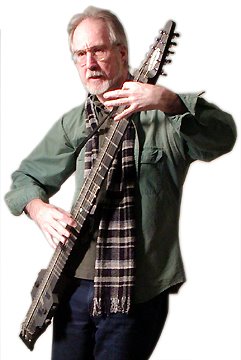
Of course, you are welcome here to post comments, or even direct folks to songs you think are relevant to the discussion. I’m not against music- I began playing guitar when I was 13 (which means I’ve been playing for a long time). I have a Gibson Les Paul and a Gibson L-4. In the last ten years I’ve been interested in mastering an instrument called the Chapman Stick (pictured Left being played by Emmett Chapman).

But, the insight for you comes from Frank Marron. Frank responded to your music using Luther’s Glory/Cross paradigm, a paradigm that I find profound and most Biblical:

Sean,

I checked out your tunes. Thanks for inviting me to listen to your music! I am a gust blogger on this site, and so I may not speak for everyone who reads and posts here. But since you asked my opinion, let me be honest with you.

First, you are obviously a talented musician with a God given gift for music. I am not blessed in this department, although I sing to the best of my ability in church each week.

I was not born a Lutheran, but joined the Lutheran Church-Missouri Synod in 1978. I did not enjoy traditional Lutheran hymns at that time and when I relocated back to Seattle for job related reasons in 1984, it wasn’t long before I left that church body. I spent several years in different church homes and was very satisfied with a musically inclined Charismatic church, where the music was contemporary Praise and wonderful. Years and a lot of heartache later I rejoined the LCMS for theological reasons. I came to realize that most contemporary church music, while appealing to modern ears, is theologically incorrect and not in tune with orthodox beliefs. I maintain that if a talented individual such as yourself could ever bridge the gap between modern tunes and Word-of-God lyrics, the product would be tremendous. Don’t get me wrong, there are certain modern songs that are just fine, such as Josh Groban’s hit a couple of years ago(You Lift Me Up). Let me explain. Your tunes and voice are just great, but the lyrics will not appeal to a Lutheran because they are the words of a Theology of Glory. Your words largely exemplify Decision Theology rather than the Theology of the Cross. Here are some examples:

1. “I Wanna Be A Christian”. Certain lyrics used indicate that if you don’t do what God says in His Word you are a fake and not a true Christian. This is Theology of Glory, not the Cross because God’s Word says no one can keep God’s Law the way he must, which is perfectly in thought, word, and deed. In fact, the Law of God, although perfect, is intended primarily to show us that we cannot keep it and to drive us to despair and ultimately Christ! Obedience to God’s commandments does not determine if a person is a Christian, but rather REPENTANCE over their sin and constant awareness of the need for the Savior, Jesus Christ. Christians are no different than other people, except they are aware of their sin and are continually REPENTANT over this.

2. “Will I Give My Best”. This song’s lyrics indicate that a person should give his best for Jesus because Jesus did that for him. Once again, this is Theology of Glory stuff. The Scriptures are clear that all we have to offer God is our sin. That is the only thing we really have to offer. As the Psalm says, God does not want sacrifices and offerings from us, but rather a broken and contrite heart. God is interested in an entirely New Creation, because our old self prior to conversion is only worthy of condemnation.

3. “Here I am”. There was one good line here “Nothing you can do can make Me love you less”. This is true. God IS love and has shown this by dying for sinners who were hostile to him, not “good” people who welcomed him. However, the line that contained the words that God wants to be our friend is theologically lame. God is our Father.He sent His Only Begotten Son to die for us. He doesn’t merely want to be an earthly “friend” but our Savior. He wants to clothe us with His blood, His Righteousness, which becomes ours through the vehicle of Faith. Which in turn comes by hearing the Gospel.

4. “Nothing Special”. I wasn’t sure of the lyrics here but kept hearing “I’m nothing special…it feels so right”. Theologically, since Christ died for us, we are extremely valuable. We are His adopted sons, inheritors of all the promises of God, which are Yes! And Amen! In Christ. Our bodies are now the temple of the Holy Spirit. Christians are indeed very special to God. We are His holy nation, chosen people, where He lives on earth, etc…

I hope you take these comments in the manner they were intended, which is in Christian honesty and love. You see, a lot of Christian denominations will love your songs, including the lyrics. But not Lutherans, for the reasons mentioned above.

Frank Marron

Sean, take the time to read through Frank's comments and digest them, and by all means respond to them. Don't simply think Frank's comments are "sectarian". The better your theology is, the better your music will be. I suggest getting involved in a church with pastors who can read over your lyrics to make sure they're theologically correct. Also take the advise from Churchmouse:

"Have you read Steve Camp's The 107 Theses: A Call for Reformation for Contemporary Christian? I think you will find it very interesting. If you haven't done so already, you can read it here."

Friday, July 07, 2006

July 4th 2006. A day I will Remember

This is just a quick update to note i've been working on a response to some of Catholic Apologist Bob Klaus's points about Romans 3:28 and, you guessed it, Martin Luther. I'm reaching one of those points where i've had a lot of the historical Luther, and I would take anything different at this point, even the Puritans. But Luther is always a hot topic, and I guess its what i'm good at.

It's been taking me longer than usual in my response to Klaus because I can't see all that well. Now, I normally have excellent vision.

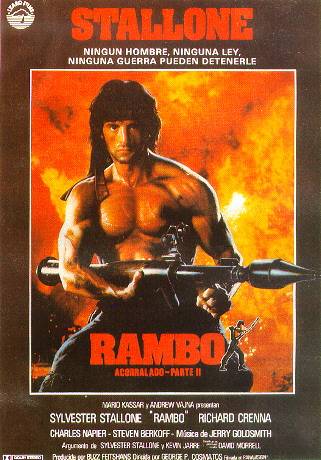
No, I wasn't playing with firecrackers on July 4th. I was doing what I refer to as "Rambo Yard Work". In other words, I go out solo into my overgrown yard on a search and destroy mission. I try to subdue and conquer my environment. The yard drew first blood, that's for sure. "It's Never Over!" I managed to pull out bushes, small trees, and I even cut all the grass in one shot. I used trimmers, weed wackers, a leaf blower, the hose- and a host of other yard weapons. Overall, people walking down the street are no longer laughing at my house as was usual. No, I conquered the yard, or so I thought.
.
Well, during the battle, I was given an almost fatal blow from the yard that I hadn't realized- I contracted poison "something"- i'm not sure if it was poison ivy or sumac, or whatever. Now, I have a high tolerance for pain, so a normal episode of poison ivy is no big deal

However this time, I contracted poison ivy(?) around my eyes, causing them to swell to shut. I look at little bit like this poor guy whose picture I found on medical web site.
Now Rambo would've set the yard on fire and had a helicopter pick him up. I on the other hand will be making a white "surrender flag" and making peace with my yard.

While I try to be cautious and precise with theology, my yard skills are pitifull. Lesson learned. Full scuba suit next time I do yard work.

Wednesday, July 05, 2006

Guest Blog: Thoughts on “The Examination of the Council of Trent”


By Frank Marron

The Title "Sceleratissimus Lutheranus" (meaning "the most villianous Lutheran") was "awarded" to Martin Chemnitz by his Roman Catholic adversaries after the publication of his exhaustive critique of the Council of Trent.

In response to the 16th century Reformers’ Confessions, which are contained in the Book of Concord, the Roman church conducted the Council of Trent(COT). This council formalized the set of beliefs which established the Roman Catholic Church, in addition to attempts at refuting the claims of the Reformation. Upon the death of Martin Luther, the Roman church had high hopes that any problems in the provinces would soon come to an end and things would return to normal.

However, that was not to be the case. Martin Luther had predicted that upon his death men would attempt to tear apart the Reformed churches by attacking the key biblical doctrine of Justification by Grace through Faith in the atonement of Christ ALONE. As predicted, there arose disagreements over doctrinal issues and various factions indeed threatened the unity of Faith within the Reformed churches. Fortunately, God was at work in the hearts and minds of several eminent Reformed theologians to ensure the continuity of what began under the leadership of Luther.

One such giant of the Faith was Martin Chemnitz. The Roman Jesuit order was totally surprised at the caliber of this theologian and it is often said “if Martin Chemnitz had not come along, Martin Luther would hardly have survived”. Among Chemnitz’ various responsibilities was to be the official observer and respondent to the claims of the Council of Trent. His 4 volume treatise “Examination of the Council of Trent” contains the theological exegesis and historical analyzes rebutting the claims of the Roman church. Volume I of the Examination addressed the key theological issues of Holy Scripture, Traditions, Original Sin, Free Will, Justification, Faith, and Good Works.

Upon reviewing the section of the Examination dealing with Traditions, I noticed parallels with statements contained within the Catechism of the Catholic Church dealing with salvation of pagans. Chemnitz clearly laid out the historicity of a proper use of traditions as compared to an improper use: all traditions are to be compared against the Word of God to determine the appropriateness of retaining them. Of course the Roman church disagreed, contending that many “unwritten traditions” pertaining to both faith and morals and which cannot be proved with any testimony of Scripture may also be received with the same authority of Holy Writ. The Roman church claim was that many unwritten traditions were handed down over the ages beginning with men who knew Christ and the apostles from first-hand experience.

Chemnitz brilliantly demonstrates the folly of this approach by illustrating how men such as Polycarp maintained orthodoxy by submitting every tradition to a Scriptural test, while Papias advocated many unwritten traditions resulting in the establishment of all sorts of corruptions, abuses, and superstitions, such as chiliasm. As Chemnitz put it: “…because of the admiration of the unwritten traditions certain seeds about a more perfect knowledge than is delivered in the Scripture clung also to great and learned men in the church.”

Other false teachings based upon spurious teachings concerned the critical doctrine of Justification. Clement of Alexandria was one who embraced many secret, or mystical unwritten traditions still present in the Catechism of the Catholic Church. Clement believed rightly, as the Scriptures say, that the Law of God was a custodian to the Jews until Christ appeared. However, Clement also taught that human philosophy was the vehicle by which Greeks were justified!

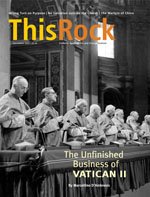
Upon closer examination, one can see here the beginning of errant beliefs contained in the RCC Catechism, such as paragraph 847 which states that pagans who have not heard the Gospel of Jesus Christ can achieve eternal salvation merely by following their consciences to the best of their ability. I recall reading an article in the December 2005 edition of the Roman Catholic periodical “This Rock”, in which similar claims were made. The article was titled “No Salvation Outside the Church” and was written by Fr. Ray Ryland, an Episcopal Priest holding a PhD in theology from Marquette University. Fr. Ryland quotes the Catholic Catechism:

Every man who is ignorant of the Gospel of Christ and of his Church but seeks the truth and does the will of God in accordance with his understanding of it can be saved. ..”

Fr. Ryland continues to emphasize “That which opens the salvation of Christ to them is their conscious effort, under grace, to serve God as well as they can on the basis of the best information they have about him.”

Now, as a Lutheran I could not merely read this article without a comment. For one thing, as Chemnitz demonstrated in his Examination, the word “Grace” in Scripture refers to the attitude of God towards sinners on account of the atonement of Christ. It does not refer to any “infusion” of power by which a man can live a God-pleasing life, primarily because only the sacrifice of Christ is meritorious for the forgiveness of sins and this Righteousness is imputed to men through the vehicle of faith, a gift from God. Consider the following interchange between “This Rock” and myself on the issue:

My Question:

Fr. Ryland’s article “No Salvation Outside the Church”(December 2005) raised questions in my mind. He made the point that the Catholic Church consists of believers and all those ignorant of Christ who “seek truth”. But Holy Scripture says that no man is “good”, no one seeks truth, and all have turned to their own way(Psalm 53:2-3; Is 53:6). Ryland also makes the point that when Christ says he has “other sheep that are not of this fold”(John 10:16), he is referring not only to future believers but also to those who will never hear the gospel. If this is the case, why would the Catholic Church be concerned with missionary activities? After all, if unbelievers who “seek truth” can be saved, why jeopardize their chances of salvation by presenting the gospel, which they could reject, thereby risking their salvation?

This Rock Response:

Fr. Ray Ryland replies: Thank you for your question. Responding to it enables me to make further distinctions that perhaps should have been in the article itself.

The quotations from Psalm 53 and Isaiah 53, in my opinion, are somewhat hyperbolic, intended as such to make a strong point. Sin is indeed universal, which means all of us repeatedly-but not always-turn to our own ways. Though the human race has not sought truth as assiduously as it should, great numbers of people have indeed sought the truth as best they could in their circumstances.

Vatican II and recent pontiffs have taught that the Church by its very nature is inherently missionary-oriented. The primary reason is because our Lord categorically commanded it(Matt. 28:20).

Unbelievers who truly seek the truth need and have a right to hear the gospel for several reasons. The gospel properly proclaimed to them can put the truth they have received in proper context and point that truth toward Christ, who is the fullness of truth. Another reason is that proclaiming the gospel can enable the “unbelievers” to sift the truth they have received from the error they have unwittingly embraced along with the truth. Moreover, hearing the gospel puts them on notice that as human beings they must do the best they can to order their lives in accord with the will of their Creator
.”

Concluding Comments by Frank Marron

You the reader can judge whether of not “This Rock” adequately responded to my initial question. In my opinion they did not. Fr. Ryland merely restated his original arguments and never responded to the illogical position confronted by my letter. To any serious student of Scripture, all men are born totally spiritually depraved and it is impossible for them to please God, contrary to what Fr. Ryland says. He would do well not to discount Scripture and consider the fact that God says what is required is a New Creation entirely, not a man who searches after truth. The Old Adam must be buried in Baptism and an entirely New Creation conformed to Christ must emerge. It is easy to see how embracing “unwritten traditions” and the thoughts of men(Vatican II) over the clear Word of God, can result in weird and inconsistent theology. The false teachings of human philosophy and elevation of so called “unwritten traditions” that Martin Chemnitz confronted centuries ago is alive and well in the 21st century.

Frank Marron
July 2006

***********

Other articles by Frank Marron:

Guest Blogger: Frank Marron (Lutheran)

Guest Blog: Law & Gospel

Guest Blog: The Word Of The Lord Endures forever, Not The words Of Martin Luther!

Guest Blog:Why Are There So Many Christian Denominations?

Guest Blog: Bondage Of The Will

Monday, July 03, 2006

Guest Blog: Ray Aviles Responds to Robert Sungenis On Jerome And The Canon

Here's another question and response from the from the CAI Q&A page, home of Catholic apologist, Robert Sungenis:

Question 6- St Jerome and the Canon

"Robert, I have come across this article in which the writter claims that St Jerome never did accept certain books as canonical. The same books that Martin Luther kept in his German translation but also said were not canonical. I have always been under the impression that St Jerome submitted to the authority of the Church and accepted the books, whereas this author shows that he did not. Would you mind reading this article and comment on it? I believe that this article needs to be refuted and I do not have the knowledge to do so. Here it is: Guest Blog:Did Jerome Change His Mind on the Apocrypha ? By Ray Aviles

R. Sungenis: "Peter, besides the fact that none of us may really know the true story behind what Jerome thought about the deuterocanonicals, the fact remains that it means very little to us now. There have been Catholics who have contested the canon all the way up to Trent's infallible proclamation in 1563. In fact, it was Cardinal Cajetan who, along with Luther, precipitated Trent's final decree on this matter because he, too, was questioning the canonicity of the deuterocanonicals. As for Jerome, we should not be suprised that he would question their status. The Church herself didn't make the final infallible proclamation until 10 centuries after him. Moreover, Trent said it was bound by the consensus of the tradition, whether it was Hippo and Carthage or Pope Innocent I or the Council of Florence. That is all that matters now. I would hope that those who are vigorous in pointing out Jerome's doubts would be just as vigorous in acknowledging that Jerome answered to a higher authority, and that authority is everyone's authority. "

Ray Responds:

Hi Peter,I don’t know if this was amongst the “package” of emails that you sent to Shea, Sippo, etc. and not that you are still looking for some sort of concurrence, but Sungenis didn’t refute anything I said.

My point was merely to correct those who claimed that Jerome changed his mind on the matter and, as far as Shea goes, to correct his error that the term “judgment of the churches” applied to a declaration by the African Synods. Sungenis agrees that there were issues leading to Trent, but here is where we part company: Sungenis claims that none of us know the story behind Jerome, but this is appealing to silence. Although silence can sometimes speak louder than words, the factors point elsewhere.

Sungenis makes it seem as if Cajetan, along with Luther, spurred Trent’s reaction, but that’s not correct. Again, there were other contemporaries of Trent, such as Ximenes, Seripando, and his group, who were adherents of Jerome’s view as well. What this tells me is that this view was still very much extant and these folks KNEW Jerome never reneged on his position.

Sungenis also claims that Trent’s infallible declaration sealed the deal as far as the canon went, but the question must be asked:

WHY would it take almost 1,200 years to declare a canon, especially if various views existed throughout church history leading up to Trent? Wouldn’t the Church have positioned herself better especially after the African Synods? IOW, they allegedly made a decision on canon and others disagreed, so why take 1,200 years before making an “infallible” proclamation on canon?

WHY would there be contestation at Trent by the group headed by Seripando if the church had indeed decided on a canon approximately 1,200 years before AND the “judgment of the churches” was indeed in effect?

Sungenis states that one should be as vigorous in acknowledging that Jerome answered to a higher authority and that this authority is everyone’s authority. I assume that this authority is the Church, in particular Rome, but that’s an entirely different matter altogether and, not surprisingly, not one that I agree with. It’s beside the point. Rome didn’t make a decision and Jerome was free to indulge his position. His prefaces to the Vulgate were never changed and, in them, he was clear about these books being “ecclesiastical” but NOT Scripture. One would assume that if Jerome did indeed answer to that “higher authority” that he would have had to renege on anything which put skepticism on these added books, but that’s not the case and the prefaces remained. As far as the council of Trent and the goings-on regarding the canon, Roman Catholic scholar Hubert Jedin’s account (Cardinal Seripando: Papal Legate at the Council of Trent) is probably the best. Jim can send you a copy of the relevant chapter, in text format, via email if you’d like. Read it, mull it over, and ask yourself if Rome’s “infallible” declaration doesn’t seem more like a reaction to you—especially in light of the fact that the best scholars, albeit a minority, set themselves on the side which opposed the books. God gave us minds in which to think and discern. I don’t believe in Rome’s infallibility and declaring a canon under the pretense of it really means nothing to me.

Peter, on another note, my advice to you would be that you spend more time studying these issues for yourself rather then looking to those who can only give you opinion. Cast your all before God, read His Word, and pray for the illumination of the Holy Spirit to guide you. As always, I’ll keep you in my prayers.

*******************
For Further Reading:

Response From Catholic Apologist Mark Shea on "Did Jerome Change His Mind On The Apocrypha?"

Who were Some Of The Best Scholars at Trent, And What Did They Think Of The Apocrypha?

On Bob Klaus And The Catholic Legate

I’ve been trying to abide by Catholic apologist Bob Klaus’s request to wait until he returns from his vacation to continue interacting with him. But some of his comments in the blogback need responding to.

First, I greatly appreciate Bob Klaus (pictured Right) stopping over here. Of course, he’s welcome to post anything he wants- I will not edit him. I’ve never heard of Bob before- and I’m sure it’s mutual on his part, he's probably never heard of me. Of course, I consider myself a theological-cyber-space “beggar” (hence, “beggars all”)- so I wouldn’t really expect him to be familiar with this blog or my interest in the Reformation.

I am though familiar with the Catholic Legate website which he is part of. I’ve linked to the Legate website for quite some time now (along with many other “Glory” websites). I do this because one of the best ways to learn about the Reformation is to have the presence of its antithesis. One of the primary ways I learn about my faith is to study that which opposes it.

Bob serves as webmaster and editor of the Catholic Legate site. This link provides some background information on him. I’m really hoping Bob’s not anything like his associate from Catholic legate, Dr. Art Sippo. Bob needs to understand upfront, any group of Roman Catholics that take Art Sippo seriously and will host his materials on their web site gets a suspicious Swan eyebrow raised. In other words, I’m hopeful it’s just a fluke that Sippo’s on the Catholic legate site, and Sippo doesn’t represent the typical approach from the Catholic legate folks. It is quite possible that the other cyber-staff members of Catholic Legate are cordial and have a grip on reality. In fact, I’m hoping this is the case. I don’t mean this to be insulting to Bob or the other staff members, but if they take the time to read my blog entries dealing with Art Sippo, they should be able to understand where I’m coming from.

Anyway, for those of you playing along, Bob took some shots at me from the OBOB impenetrable bunker. "OBOB" is a Roman Catholic discussion board that (allegedly) allows no counter responses from Protestants, especially a guy like me. It was very frustrating on my end not be allowed to respond on OBOB, since my links were being scrutinized. Of course, they have their rules, which say I can’t. I had posted on OBOB once before and was given immediate warnings- I posted an old warning in the blog back for all to see. Well, Bob noted that I deserved the warnings because I violated the “rules”. Bob pointed out:

I will point out that even in the case of your January 2005 warning, your post was not one of fellowship or inquiry as to the Catholic faith (which is the purpose of OBOB), but rather one of telling Catholics why our doctrine of indulgences is supposedly wrong. Hence it was a post designed to debate us and therefore against the rules that apply to ALL Congregational Forums. Were I to post a similar message in a Lutheran or Baptist Congregational Forum (i.e., being critical of their beliefs) I would have been warned too.”

After I was warned by the OBOB folks, I respected their warning and never posted on their board again. I really don’t know how to pretend fiction is fact and keep my mouth shut. I simply concluded they need their own impenetrable bubble to perpetuate whatever false information makes them feel good. If posting solid facts means “debate” then I guess I might as well go do something else. Their rules state no Protestant interference. Ok, fine. Have a nice day.

Now, I could go along with Bob’s explanation above- except for one thing: the OBOB moderators are not consistent. If one were to take a look at the recent thread in which I was not allowed to defend myself, other non-Catholics are participating, making some of the same arguments I would. Guess what? It appears they are not being silenced. Hence, It’s really hard for me to understand exactly why my voice was squelched.

Bob, who is one of the board moderators, posted an apology, and he also noted he revised some of his comments. I greatly appreciate that, and it makes me hopeful that if we do interact on any topics, we can keep it at this level. I’ve appreciated his cordial demeanor here on this blog, and I would ask those of you who stand over in my corner to treat Bob Klaus as a guest. In fact, treat all the Roman Catholics who stop by here as guests. I like the fact that Roman Catholics will stop by the beggar camp every now and then. I know, every so often I cross the line and get polemical- sometimes things get too silly to take seriously. But in Bob’s case, he’s got my attention and my respect.

Sunday, July 02, 2006

A Response To Robert Sungenis On Church History, Luther, and the Doctrine of Justification

Here’s another question and response from the from the CAI June Q&A page, home of Catholic apologist, Robert Sungenis:

Question 38- Church History, Luther, and the Doctrine of Justification

"Hello Robert:

I sent some an e-mail last week regarding a blog site run by a Mr James Swan. Did you get a chance to visit it yet? Since then, I came across a quote that I wanted to get your opinion on it. Here it is:
*The Catholic View of Justification Previous To Trent * Again, I am Catholic to the marrow, but I do not know how to respond to the above. I would appreciate your input on this, too, if you don't mind."

R. Sungenis: "Peter, I'm afraid Dr. Pelikan is speaking much of this analysis from his own Lutheran bias. There was no teaching of "faith alone" in the patristics or medievals. Trent was following the tradition of the Church. This is precisely why Luther said he rejected the Fathers, since none of them taught faith alone. I have reams of quotes from him to this effect in my book Not By Faith Alone. We only have two or three references to the phrase "faith alone" in the patristics, and when you read them in context (e.g., Clement of Rome) you understand that they were not speaking of Luther's concept. Moreover, if there was some doubt as to how the Church was to understand justification, Luther did the Catholic Church a favor, as all heretics do, in that he made her sit down, cogitate, and write down her doctrines so that everyone would know what, precisely, the boundaries were. That is the way most Catholic doctrine is formulated and codifed -- the Church is squelching some heretic who tries to refute the traditional teaching. You really need to get a copy of my book Not By Faith Alone and read Chapter 9. You'll find out what the score is. "

Peter, I’m afraid Robert Sungenis dismissed Pelikan’s point rather than interact with his point. For further documentation of the wide range of perspectives on justification previous to the 16th Century, see Heiko Oberman’s book, The Harvest of Medieval Theology, particularly Chapter VI: The Process Of Justification (146-184). Whether or not Trent was able to define the actual doctrine of Justification depends on how much one trust's Trent. Roman Catholics implicitely trust Trent, so history will be interpreted to prove Trent's statements.

That there was a great ambiguity as to what exactly "justification" was even at Trent is documented by Alister McGrath:

"The Council of Trent was faced with a group of formidable problems as it assembled to debate the question of justification in June 1546. The medieval period had witnessed the emergence of a number of quite distinct schools of thought on justification, clearly incompatible at points, all of which could lay claim to represent the teaching of the Catholic church." [Source: Alister McGrath, Iustitia Dei: A History of the Christian Doctrine of Justification (New York: Cambridge University Press, 259)].

It is ironic that Sungenis appeals to the "tradition of the church", as each of the groups represented at Trent seems to have not been on the same page in regards to the doctrine of justification. McGrath goes on to point out "...[T]here was considerable disagreement in the immediate post-Tridentine period concerning the precise interpretation of the decretum de iustificatione" [ibid. 268]. In another words, even after Trent made its decree on Justification, Catholics were confused as to how to interpret it!

One needs to sit back a moment and reflect on this confusion before and after Trent. The "tradition of the church" was not a clear and concise understanding of....the Gospel, for about 1600 years, and then even immediately after Trent's infallible decree. A further irony is that Sungenis strongly critisizes Protestants for having differences as to how "faith alone" is understood among Protestants in his book, Not By Faith Alone. But, would Sungenis be willing to note the confusion inherent in the Roman Catholic Church up until Trent and the following it? I highly doubt it.

In his response to Peter, Sungenis also provides an excellent example of Catholic apologetic double standards. Sungenis says that Trent was following the tradition of the church, and there was no teaching of “faith alone” previous to Luther. In other words, Luther invented “justification by faith alone”. It didn’t exist until Luther. It can’t be verified in church history. It can’t be true.

On the other hand, when the same historical standard is applied to certain Roman Catholic dogmas, like Mary’s Bodily Assumption, Purgatory, Indulgences, etc., this same historical standard is swept under the rug and hidden. One has to seriously question why a standard that Catholic apologists hold Protestants to is not likewise applied to their own beliefs. Wade through the corridors of church history and search for the threads of all Roman Catholic dogma. One falls flat of linking many of them back to the early church, or in some instances, even the Bible.

Now, this alone should be enough of a refutation of the answer provided by Sungenis. If the type of argument and answer he uses is applied to his own belief system, and that argument leaves his belief system fatally wounded, it would be wise for him to think of another form of argumentation in the future.

While Sungenis hasn’t done this in his answer, some attempt to use “development of doctrine”-to get out of this double standard. But one has to immediately scrutinize such a presupposition. Where has the standard of “development of doctrine” come from? Certainly, in the Bible, we find a progressive clarity on the revealing of its central figure: Jesus Christ. But search through the New Testament, and attempt to uncover where the Bible clearly informs us that doctrine will continue to develop after the period of inscripturation. Jude 3 speaks of "the faith which was once delivered to the saints." He doesn’t speak of delivering an acorn that will blossom into an oak tree. In other words, even the notion of “development of doctrine” doesn’t meet the historical test set up by Roman Catholic apologists. Like other paradigms, it appeared later in the course of Church history, popularized of course by Cardinal Newman.

I admit, the historical aspect of sola fide is a difficult issue, but applying a historical test to the Catholic notion of justification has its problems as well. Historically, one can make a case that Augustine didn't know Greek and the entire direction of the Church was redirected away from what the Bible says on sola fide. Commenting on a point made by Alister McGrath, R.C. Sproul notes,

McGrath sees Augustine’s treatment of justification as pivotal to the subsequent development of the doctrine of justification in the Roman Catholic Church: “Augustine understands the verb iustificare to mean ‘to make righteous,’ an understanding of the term which he appears to have held throughout his working life. In arriving at this understanding, he appears to have interpreted -ficare as the unstressed form of facere, by analogy with vivificare and mortificare. Although this is a permissible interpretation of the Latin word, it is unacceptable as an interpretation of the Hebrew concept which underlies it.” [R.C. Sproul, ). Faith alone : The Evangelical Doctrine of Justification, 99]

All I’ve done here is sift through presuppositions. Protestants live by the principle, sola scriptura. In other words, history doesn’t prove what is true and what is not, the Bible does. Sungenis argues that history proves justification by faith alone is not true. Protestants argue that the Bible proves what is truth. I would rather trust in God's words rather than history.

Saturday, July 01, 2006

The Bubble Known As "OBOB"

There are probably more than a few places in cyber-space that have environments prone to creating non-discussions. One such place is a Roman Catholic forum known as “One Bread, One Body” (OBOB). I rarely visit this forum because of this rule:

Those with disagreements or issues about Catholic faith and doctrine are asked to post respectfully and politely; you may "agree to disagree", but you may not disparage, denigrate, or libel Catholicism, nor may you post anything anti-Catholic, links to anti-Catholic websites, pictures, etc. This is a discussion forum, not a debate forum. Feel free to ask questions; but do not slam Catholicism, or the Catholic Church or you will be asked to leave.”

What this rule translates to is this: no one is allowed to counter respond to anything posted on OBOB. I know this first hand. A few years back on this forum, I was invited to take a look at a Luther-bashing thread on OBOB. Of course, I joined in the discussion and responded in my usual demeanor to a few of the posts, correcting blatant error and historical misrepresentation. My posts were quickly deleted, and I was warned by the moderators to “cease and desist”. Ok, fine. I guess everyone needs an environment to just be themselves without being challenged as to what is, or is not, truth. I wasn’t attacking anybody, I was just presenting some facts and counter-responses. After that experience, I now direct Roman Catholics to go and join the OBOB forum when they complain against my responses. If one doesn’t like to hear my responses, go onto OBOB and dialog in a place where one will not be challenged.

Recently I came across an OBOB thread here:

Almost have Protestant friend converting - Need Quick Help

Now, I didn’t expect to find any reason to join in this thread. I had no idea that one of my writings on Luther was being discussed. Well, I disregarged my own past experience with OBOB and posted this in the thread:

I found this discussion interesting. Unfortunately, in the past, the once or twice I tried to respond here on OBOB I was given multiple warnings, and my posts were deleted. So, based on past experience, I suspect that even if I attempt to interact with the comments directed toward my writing, I’m expecting the same will happen again. My posts will be deleted, and I will be given warnings. So really, there is no point. There is also a strong possibility this very post will probably be deleted, and I’ll again be warned.

Well, call me Miss Cleo, I was right. My post was deleted. The OBOB moderator explained:

James,Your post…was in violation of rule 3.8, which states; "You will not discuss Staff actions in the open forums". Since you have no previous staff action on your account, we decided to be lenient with you and just send this friendly pm reminder of the rules. Please adhere to the rules from this point forward. You may post fellowship posts in OBOB, and sometimes we will even allow some level of debte[sic], so long as it is done respectfully. But publically[sic] questioning moderator actions are strictly prohibited. Thank you.

My response: Can you please explain why you're allowing me to be publicly slandered on OBOB? Why is my name "James Swan" being slandered by Newman in the thread my post was deleted from? In other words, why can I not defend myself? Why don't you delete the posts slandering me? I am offended. You folks owe me either a good explanation or an apology. I expect neither, as Roman Catholics usually don't care enough to treat me with even an ounce of respect (Patrick Madrid excluded). Explain.

OBOB Response:
James,Perhaps if you could point out the post and comments in question, where you believe NewMan slandered you. I reviewed the thread, but did not see any instance of this. What I saw was a simple rebuttal of some of your claims, but I did not see any personal attacks. Please remember, OBOB is not a place for non-Catholics to debate. I hope you can appreciate and respect these rules, especially when someone posts a rebuttal of your work. If you would like to address it, I'm sure you will do so on your site and/or on other forums that allow for debate. Also, I'm sorry to see that you believe Catholics have treated you badly. If this is the case, then I apologize for them. And I would ask you to try not to project your discontent towards other Catholics, who have made no such offense to you.

My Response: Try this:
"Here is something that Fitzmyer wrote (page 361) but Swan did NOT copy (for obvious reasons) on his website:"

"So, far from a smoking gun, the context of Fitzmyer's book actually paints a very different picture than that which Swan tries to convey."

"Fitzmyer explains this in his book (funny that Swan didn't copy that part of Fitzmyer's book)."

"I own a copy of Fitzmyer's book and I suspect strongly that Mr. Swan is taking his comments somewhat out of context."

These comments imply deception on my part- as if I simply took what I wanted for propaganda sake- utter nonsense and slander. Even worse, you guys allow it and wont give me a chance to defend my writing. I thus include you folks as part of the problem, not part of any type of fair solution. I don't usually get this heated up, but the alleged "moderation" is just a sham so no one will pop the big OBOB "bubble."

OBOB Response:
James, As I said, we are generally lenient with those who post respectively (we even allow for some level of debte[sic]), but not those who come into OBOB and publically[sic] denigrate the OBOB moderators. If you have a problem with something that NewMan said, then I would advise that you follow protocol and contact him privately about it. From my standpoint, nothing he said was a clear flame. We don't take action on posts unless they are blatant violations. If we took action on every post that someone got offended by, then most of CF would be in the trash bin. If you want to debate Newman, then I'm sure that he would be more than happy to arrange something, in another forum that allows for debate. I would also remind you that the same rules that apply to the public fora, also apply to pm's as well. So please be careful about calling our moderation a "sham". I have been lenient with you thus far, and hope that you can extend the same respect to me that you expect from others.

My Response: From your response, it seems quite clear that you are going to allow Newman to insinuate I did poor research and mis-cited Fitzmyer. Hence, you are allowing Newman to publicly denigrate my work. Heaven forbid I'm allowed to respond to his charges- why it might cause....a disagreement! This angers me greatly. If I posted something on a well-read Protestant board that implied your research was poor, and then told you that you can't defend yourself on that forum, and that the comments denigrating your work would remain, how would you feel? How would you feel about the intent and care of the "moderation"?I don't expect the OBOB moderators to see my side on this. But then again, I’m used to Roman Catholic apologetic polemics, so it doesn't surprise me. This will be my last attempt at rational dialog with you. No need to respond, I will not bother you about this anymore, nor will I go into your OBOB forum. Ban me, warn me, It really makes no difference. I have to speak openly and honestly with you. If doing this provokes you to action, then do what you must. These are just discussion forums, they are not life and death.

OBOB Response:
Newman is doing what any apologist does; responding to the work of another apologist. You are upset because you can't respond directly in the forum, which is against the rules. There is nothing I can do about this. I don't make the rules. I enforce them. If I were to go into the Lutheran sub-forum and try to defend an article I wrote, my post would be deleted as well. These are the rules here, so please respect them.

I'm sorry you feel unjustly persecuted. You clearly do not know what it is like to be Catholic. Try going to other christian forums (like christianity.com, for example), tell them you're Catholic and see how long it takes for you to get banned. We're the whore of babylon remember?

James,No one is going to ban you. You don't even have any staff record on your account (and I hope it continues this way).

Also, FYI; http://www.christianforums.com/showp...3&postcount=29


The link above states the following:

"I would like to state for the record that my earlier critical observations of James Swan's blog in no way meant to impugn his character as a Christian or an apologist. I did not mean to imply that Mr. Swan was trying to mislead any of his readers or intentionally (key word) misrepresent the works of Fitzmyer.

That being said, I will reiterate that I disagree with Mr. Swan's conclusions on the subject matter. Once one analyzes the totality of Fitzmyer's work (and not just the brief excerpt in Mr. Swan's blog), it becomes apparent the Fitzmyer falls far short of saying that Luther's use of the phrase "faith alone" was in lock-step with the more ancient patristic use of it.

If Mr. Swan's point was to illustrate (via Fitzmyer's book) that Luther was not the first to use the phrase "faith alone" - then I agree. If, however, the point was to imply that the patristic use of it was the same as Luther's use of it - then I disagree...and so does Fitzmyer. Whether Mr. Swan intended for his readers to "connect the dots" or not is something only his readers can speculate for themselves about. I merely wanted to illustrate for those in this thread that Fitzmyer never intended to convey that the patristic use of the phrase and Luther's use of it were the same.

But I am perfectly content to say for the record that Mr. Swan and I merely disagree as to the conclusions we draw on the topic at hand. I do not doubt his integrity nor did I intend to convey any disrespect for him personally. I apologize to him if my words seemed too critical of him or his work."

Wednesday, June 28, 2006

A Response to Catholic Apologist Robert Sungenis on Luther Inserting The Word "Alone" In Romans 3:28

I never thought I’d see the day when I’d be given an opportunity to respond to comments from Catholic apologist Robert Sungenis. Here’s a question and response from the CAI June Q&A page:

Question 37- Martin Luther Quotes

Hi Robert;

My name is Peter Porcellato. I have contacted you in the past for apologetcs help and I own some of your works. I just finished reading some of your dialogue with Dr Michael S. Horton titled "Is Justification by Faith Alone?". I came over to see what you had to say with this issue because I was on James Swan's Blog (do you know him?) and have been reading some of his papers refuting Catholic comments about Luther. The reading has shaken me somewhat in that he very compentently reveals the faultiness of Catholic Apologists' research into Martin Luther and shows where they are in error regarding the accusations that they levy against him. I want to provide you with
a link to a paper I just read of his where he offers explanation as to why Luther put the word alone after faith in his Romans translation.

I am a devout Catholic and enjoy being so so please don't think that I am trying to set you up or anthying like that. I respect and admire men such as you, Patrick, Karl, and Scott, but if you guys are taking Luther quotes out of context and are inadvertantly using faulty sources then I must admit that this has me a little flumoxed. Would you mind taking a look at a small sample of his writting? I have posted the link to his paper that I just finished reading. I would ask you to parouse his blog to understand why I take his writting seriously.

I look foreward to your comments
.

R. Sungenis: Peter, tell Mr. Swan he needs to read my book Not By Faith Alone. In it he will find the following quote from Martin Luther on page 527, which is taken from Protestant Philip Schaff's History of the Christian Church, p. 363:

"Are they doctors? So am I. Are they learned? So am I. Are they preachers? So am I. Are they righteous? So am I. Are they disputors? So am I. Are they philosophers? So am I. Are they writers of books? So am I. And I shall further boast: I can expound Psalms and Prophets; which they cannot. I can translate; which they cannot....Therefore the word allein shall remain in my New Testament, and though all the pope-donkeys should get furious and foolish, they shall not take it out."

Again, Schaff notes Luther's words on p. 362: "If your Papist makes much useless fuss about the word sola, allein, tell him at once: 'Dr. Martin Luther will have it so,' and says, 'Papist and donkey are one thing....For we do not want to be pupils and followers of the Papist, but their masters and judges."


Let’s stop right here and look at the quotes Sungenis is using. Here again is an opportunity to show Peter the “faultiness of Catholic Apologists' research into Martin Luther.” The selective citation offered by Sungenis portrays Luther as maliciously inserting the word “alone” into Romans 3:28. Luther is painted as outrageous- he shows a total disregard for the sacred text, simply making it say what he wanted it to. Frankly, I am shocked that Sungenis would put forth such a bogus method of citation.

Peter, please tell Mr. Sungenis that he needs to actually read the link provided to him. Had he read it carefully, he would’ve seen I used the same quotes from Luther that Sungenis is directing me toward from his book, Not By Faith alone. Rather than direct people to a secondary source (Schaff), I provided a link to the actual text from Luther, his Open Letter on Translating (1530). This letter has been widely available for many years now. In the link Peter provided, I work through the letter, placing Luther’s comments in a context.

The first section of the treatise is actually fairly angry, sarcastic, and humorous. Luther is fed up with his Papal critics. His anger was fueled against them for an ironic reason- they rallied against his translation, while at the same time utilizing it for their own new translations. A strong Papal critic of Luther (Emser) did just that. Schaff points out,

“…And yet even in the same chapter [Romans 3] and throughout the whole Epistle to the Romans, Emser copies verbatim Luther’s version for whole verses and sections; and where he departs from his language, it is generally for the worse.” Source

Luther’s anger is clearly seen in the quotes Sungenis uses. In their context, they show Luther blasting away at his Papal critics. One can almost feel Luther’s anger towards them. They discredited him as a doctor of theology and his academic abilities were above most. Indeed, he had done the work necessary to be taken seriously. His critics criticized his German translation while at the same time stealing it for their own translation- this infuriated him, and rightly so.

But the most troubling aspect of Sungenis’s Luther quotes, is that had he actually read Luther’s Open Letter on Translating, he would have seen that Luther actually goes on to give an explanation of why he uses the word "alone" in Romans 3:28-

I know very well that in Romans 3 the word solum is not in the Greek or Latin text — the papists did not have to teach me that. It is fact that the letters s-o-l-a are not there. And these blockheads stare at them like cows at a new gate, while at the same time they do not recognize that it conveys the sense of the text -- if the translation is to be clear and vigorous [klar und gewaltiglich], it belongs there. I wanted to speak German, not Latin or Greek, since it was German I had set about to speak in the translation.”

Luther continues to give multiple examples of the implied sense of meaning in translating words into German. He then offers an interpretive context of Romans:

So much for translating and the nature of language. However, I was not depending upon or following the nature of the languages alone when I inserted the word solum in Romans 3. The text itself, and Saint Paul's meaning, urgently require and demand it. For in that passage he is dealing with the main point of Christian doctrine, namely, that we are justified by faith in Christ without any works of the Law. Paul excludes all works so completely as to say that the works of the Law, though it is God's law and word, do not aid us in justification. Using Abraham as an example, he argues that Abraham was so justified without works that even the highest work, which had been commanded by God, over and above all others, namely circumcision, did not aid him in justification. Rather, Abraham was justified without circumcision and without any works, but by faith, as he says in Chapter 4: "If Abraham were justified by works, he may boast, but not before God." So, when all works are so completely rejected — which must mean faith alone justifies — whoever would speak plainly and clearly about this rejection of works will have to say "Faith alone justifies and not works." The matter itself and the nature of language requires it.”

Sungenis continues:

"Schaff goes on to say that Luther claimed to add allein to Romans 3:28 for the sake of clarity, but he did not do so for Gal 2:16. Schaff then cites Meyer and Weiss whom he references among 19th century Protestant exegetes who affirm that allein has "no business in the text [of Rm 3:28] as a translation." In John Eadie's The English Bible, p. 292, he cites Coverdale's 19 NT notes in his 1535 edition of the Bible, upon which Coverdale writes concerning Luther's addition of allein to Romans 3:28: "Romans 3:28, Some reade, By faith onely -- Luther. Text is 'through faith' -- Tnydale."

Schaff raises an interesting point. One has to wonder though, exactly what Sungenis thinks it proves. What image of Luther is Sungenis trying to put forth? Sungenis began by presenting out-of-context quotes that show Luther as a raving madman disregarding the Biblical text and inserting words for no other reason than because he wanted to. Now, we see that Luther could’ve inserted ‘allein’ into Galatians 2:16, but did not. This shows…what? Probably Sungenis thinks it proves Luther was inconsistent. But stop and think for a moment. Had Luther actually inserted ‘allein’ into Galatians 2:16, Sungenis would still be criticizing him! If anything, that Luther did not put ‘allein’ into Galatians 2:16 should show that Luther was not trying to maliciously tamper with the Biblical text. His was not the method of the Jehovah’s Witnesses, attempting to “doctor” the text.

But the question remains, why did Luther not insert ‘allein’ into Galatians 2:16? I can only speculate, but I think that understanding Luther’s view of the priority of the New Testament books may shed some light here. Luther considered Romans the heart of the Bible. In other words, the book was the key to all the others. All the other Biblical books were to be interpreted by Romans. Luther says of Romans:

This epistle is really the chief part of the New Testament, and is truly the purest gospel. It is worthy not only that every Christian should know it word for word, by heart, but also that he should occupy himself with it every day, as the daily bread of the soul. We can never read it or ponder over it too much; for the more we deal with it, the more precious it becomes and the better it tastes” [LW 35:365].

In this epistle we thus find most abundantly the things that a Christian ought to know, namely, what is law, gospel, sin, punishment, grace, faith, righteousness, Christ, God, good works, love, hope, and the cross; and also how we are to conduct ourselves toward everyone, be he righteous or sinner, strong or weak, friend or foe—and even toward our own selves. Moreover this is all ably supported with Scripture and proved by St. Paul’s own example and that of the prophets, so that one could not wish for anything more. Therefore it appears that he wanted in this one epistle to sum up briefly the whole Christian and evangelical doctrine, and to prepare an introduction to the entire Old Testament. For, without doubt, whoever has this epistle well in his heart, has with him the light and power of the Old Testament. Therefore let every Christian be familiar with it and exercise himself in it continually. To this end may God give his grace” [LW 35:380]

So, there really was no need to insert ‘allein’ into Galatians 2:16. If one followed Luther’s advise, and became thoroughly familiar with the theology of Romans, when one reads Galatians, one already knows what Paul means.

Sungenis concludes by recommending his book:

"I suggest you get a copy of Not By Faith Alone. I have a whole section on Luther at pages 517-554."

I would suggest that one reads this book like I read books: critically. If you’re a Roman Catholic, don’t be afraid to check the facts. It’s obvious with the quotes used by Sungenis above, his was not an accurate presentation of Luther’s reasoning. I don’t have a problem with anyone being critical of Luther’s insertion of ‘allein’ into Romans 3:28, but at least argue against Luther’s reasoning, rather than misusing a context in order to prove Luther simply inserted the word because he wanted to, devoid of reasoning.

Tuesday, June 27, 2006

Who were Some Of The Best Scholars at Trent, And What Did They Think Of The Apocrypha?

The Council of Trent made the official pronouncement on the Canon of Sacred Scripture, and in that pronouncement determined, once and for all, that the apocryphal books were indeed Sacred Scripture (for Roman Catholics). What criteria did the Council of Trent use to determine which books of the Bible were canonical? The basic answer I’ve been given is, Trent did not determine the canon, they simply reaffirmed the canon; and: The Holy Spirit determined the outcome of Trent by His presence among this infallible council. The basic idea is that a group of people got together at Trent and harmoniously "reaffirmed" affirmed an earlier decision... led by the Holy Spirit.

This is not what happened.  There were a group of scholars at the Council of Trent that were considered knowledgeable on the canon. One particular was Cardinal Seripando. The Roman Catholic historian (and expert on Trent) Hubert Jedin explained “…[H]e was aligned with the leaders of a minority that was outstanding for its theological scholarship” at the Council of Trent. These Roman Catholic scholars argued for the exclusion of the apocrypha (Deuterocanonicals)... because... there were competing traditions within the Western church on the contents of the Old Testament. Trent picked one tradition over the other.

Jedin is worth quoting at length:
(Seripando was) Impressed by the doubts of St. Jerome, Rufinus, and St. John Damascene about the deuterocanonical books of the Old Testament, Seripando favored a distinction in the degrees of authority of the books of the Florentine canon. The highest authority among all the books of the Old Testament must be accorded those which Christ Himself and the apostles quoted in the New Testament, especially the Psalms. But the rule of citation in the New Testament does not indicate the difference of degree in the strict sense of the word, because certain Old Testament books not quoted in the New Testament are equal in authority to those quoted. St. Jerome gives an actual difference in degree of authority when he gives a higher place to those books which are adequate to prove a dogma than to those which are read merely for edification. The former, the protocanonical books, are "libri canonici et authentici"; Tobias, Judith, the Book of Wisdom, the books of Esdras, Ecclesiasticus, the books of the Maccabees, and Baruch are only "canonici et ecclesiastici" and make up the canon morum in contrast to the canon fidei. These, Seripando says in the words of St. Jerome, are suited for the edification of the people, but they are not authentic, that is, not sufficient to prove a dogma. Seripando emphasized that in spite of the Florentine canon the question of a twofold canon was still open and was treated as such by learned men in the Church. Without doubt he was thinking of Cardinal Cajetan, who in his commentary on the Epistle to the Hebrews accepted St. Jerome's view which had had supporters throughout the Middle Ages.” Hubert Jedin, Papal Legate At The Council Of Trent (St Louis: B. Herder Book Co., 1947), 270-271
“For the last time [Seripando] expressed his doubts [to the Council of Trent] about accepting the deuterocanonical books into the canon of faith. Together with the apostolic traditions the so-called apostolic canons were being accepted, and the eighty-fifth canon listed the Book of Sirach (Ecclesiasticus) as non-canonical. Now, he said, it would be contradictory to accept, on the one hand, the apostolic traditions as the foundation of faith and, on the other, to directly reject one of them.” Hubert Jedin, Papal Legate At The Council Of Trent (St Louis: B. Herder Book Co., 1947), 278.
Jedin also documents a group of excellent scholars that stood against “tradition” as being on the same level of authority as scripture:
“In his opposition to accepting the Florentine canon and the equalization of traditions with Holy Scripture, Seripando did not stand alone. In the particular congregation of March 23, the learned Dominican Bishop Bertano of Fano had already expressed the view that Holy Scripture possessed greater authority than the traditions because the Scriptures were unchangeable; that only offenders against the biblical canon should come under the anathema, not those who deny the principle of tradition; that it would be unfortunate if the Council limited itself to the apostolic canons, because the Protestants would say that the abrogation of some of these traditions was arbitrary and represented an abuse… Another determined opponent of putting traditions on a par with Holy Scripture, as well as the anathema, was the Dominican Nacchianti. The Servite general defended the view that all the evangelical truths were contained in the Bible, and he subscribed to the canon of St. Jerome, as did also Madruzzo and Fonseca on April 1. While Seripando abandoned his view as a lost cause, Madruzzo, the Carmelite general, and the Bishop of Agde stood for the limited canon, and the bishops of Castellamare and Caorle urged the related motion to place the books of Judith, Baruch, and Machabees in the "canon ecclesiae." From all this it is evident that Seripando was by no means alone in his views. In his battle for the canon of St. Jerome and against the anathema and the parity of traditions with Holy Scripture, he was aligned with the leaders of a minority that was outstanding for its theological scholarship.” Hubert Jedin, Papal Legate At The Council Of Trent (St Louis: B. Herder Book Co., 1947), 281-282.

Sunday, June 25, 2006

Discussion With Catholic Apologist Art Sippo on Luther Biographies

Catholic apologist Art Sippo and I discussed which were the best and worst biographies on Luther to read. Needless to say, Dr. Sippo and I agreed on nothing. The conversation shows that Sippo begins with Luther as an arch-villain, and any book that says otherwise is propaganda. The discussion took place on Patrick Madrid's Envoy Forums.


I. On Dialoging With Catholic apologist Art Sippo on Luther Scholarship

II. Catholic Apologist Art Sippo on Father O’Hare’s “Facts About Luther”

III. Catholic Apologist Art Sippo on Luther Scholarship and Research (Part 1)

IV. Art Sippo on Catholic Historians Grisar and Denifle and Luther’s Demon Possession (part 2)

V. Using Psychohistory To Interpret Luther (A Response To Catholic Apologist Art Sippo (part3)

VI. Catholic Apologist Art Sippo Takes The Time To Thank Me For My Luther Research

VII. Luther Between God and the Devil: Catholic Apologist Art Sippo on Heiko Oberman

VIII. Catholic Apologist Art Sippo on Roland Bainton's "Here I Stand"

IX. Catholic Apologist Art Sippo on Richard Marius

X. Catholic Apologist Art Sippo on Catholic Historian Joseph Lortz

XI. A Last Look At Catholic Apologist Art's Sippo's View Of Luther Biographies

XII. Art Sippo on Luther Biographies Revisited: Marius on Denifle

Sippo vs Lortz Revisted: Cardinal Ratzinger help Dr. Sippo understand Joseph Lortz

Sippo, Lortz, Ratzinger, and Luther

Saturday, June 24, 2006

Response From Catholic Apologist Mark Shea on "Did Jerome Change His Mind On The Apocrypha?"


Recently I posted a guest blog entry from my friend Ray Aviles:

Guest Blog:Did Jerome Change His Mind on the Apocrypha ?

Ray did a masterful job at taking a look at Jerome's opinion of the canonicity of the apocrypha. His article was strongly critical of Catholic apologist Mark Shea's understanding of this issue. Shea argued that Jerome at first rejected the canonictiy of the Apocrypha, but later changed his mind. Ray proves this was not true. Bookmark Ray's article. It is probably the best thing on this blog.

Mark Shea actually read Ray's article. Someone, unknown to me, wrote him and told him about it. Mark's response is as follows:

"...[F]rom what I read of the critique of my article on the apocrypha in the materials forwarded me, it would appear that I did indeed misread Jerome (not wilfully, as the article suggests, but nonetheless erroneously). That is, it would appear that Jerome, although he did include the deuterocanon in his Vulgate, did so grudgingly and never really bought the idea they should be in the canon of Scripture. That's the breaks. I make mistakes. It does not mean everything I've written is worthless, it doesn't even mean that the central point of my article--that the only authority we have for canonizing Scripture is the Church and not some guy named Ray Aviles--is wrong. But it certainly does mean that St. Paul is emphatically right when he urges us "test everything, hold on to what is good." I'm as prone as the next guy to passing on pseudo-knowledge. So are James Swan and Ray Aviles."[source]

Kudo's to Mark Shea. I'll be adding a link to his blog on my sidebar.

A Last Look At Catholic Apologist Art's Sippo's View Of Luther Biographies

"Mr. Swan claims that he came here it interact with me because I was a Catholic apologist. I must say that I do not believe him. He is on a one-man crusade to defame the critics of Luther and to push forward the work of certain scholars who misrepresent him and who give a favorable report to him. Mr. Swan's agenda is to eliminate from every-one's consideration that long standing tradition which found Luther to be a morally dubious and seriously disordered person who is not worthy of any-one's allegiance." - Catholic apologist, Art Sippo

"Unfortunately, at the moment, one Catholic is repeatedly responding to [James Swan] in ways which qualify for virtually every bad trait so often (sadly) observed in the apologetics sub-community (if defined as "anyone who does apologetics on the Internet")."- another Catholic Apologist 

"Art, we've been through this so many times now, I don't know how else to say it. Please drop the invective and ad hominem and just make your case, critique the other guy's, and move forward with the conversation. All the egregious stuff is just plain unedifying and it has no power to persuade, only provoke."- Catholic Apologist, Patrick Madrid

Some of you have probably wondered when I would shake the dust from my feet and walk away from Catholic apologist Art Sippo. It's been about a month since I first began my attempt to interact with Dr. Sippo. The interaction definately wasn't a "debate", and it barely resembles a dialog. The interaction reminded me more of two lawyers attempting to a control a context. He who controls the context generally comes across better in a disagreement.

After about a month, the discussion found here went about 10 Envoy pages with approximately 175 posts and 2600 views. I contributed 38 posts. My posts were usually long and detailed, and I attempted to pick out only those points I thought were relevant.

I tried to stay focused on what this thread was originally about: Luther and Calvin biographies. This is really the only thing I wanted to discuss, and that only with Art Sippo, or anyone else who has knowledge in this area. I limited myself to this for one reason: time constraints. While it might take Art or one of his supporters 10 seconds to cut and paste something negative about Luther, it takes me a few hours to verbalize a detailed, accurate, historical response. Even with my responses to Art, they took time. It might've taken him two minutes to write something, but each of my posts on Luther biographies took anywhere between 2 to 3 hours. For the most part, I’ve not simply popped over to someone else’s web site and did the ol' cut and paste. I had about 15 books piled on my desk all related to the discussion. Many of the citations I utilized I typed in (very time consuming!) from my own personal collection of journal articles and books, not a web site.

Sippo and I will never agree on any of the "facts" about Luther. The question I’m interested in is "why"? The sources Sippo used (and the sources he disdained) for his information explained a great deal about his perspective- thus rendering any discussion between he and I about the "facts" of Luther’s life an exercise in futility. I've written about many topics on Luther -including some of the issues Art attempted to bully me into veering off into. A partial listing can be found here.

Sippo Repeatedly attempted to discuss Luther’s involvement with the Philip of Hesse bigamy issue: "I want everyone to notice that Mr. Swan has refused to deal with the issue of Luther and the bigamy of Phillip of Hesse. he is still harping on his personal assessment of the works of Rix, Smith, Marius, Denifle, Grisar et al. Sad." I avoided it, not because I’m “scared” of a discussion, but because it was not relevant. I have a brief link on this issue here:

Perspectives of Luther: Luther a Polygamist? - A response to the charge that Luther sanctioned polygamy for political purposes.

My focus though, remained on the sources. Sippo tried repeatedly to dissuade me from this, but if I was going to spend my time with Art, I was determined to try and make it worth my while. In other words, I ignored his repeated tangents and rabbit trails.

Sippo’s particular polemic against the Reformation and Luther is not "particular" at all. One can find countless cyber-discussions about the "evil" Martin Luther. Most of the time, those going against Luther have little or no knowledge of the books written about Luther from which their perspective comes. Sippo is unique, in that he at least had some familiarity with the sources from which his perspective comes.

I knew that a discussion about the sources with Art Sippo is somewhat of an exercise in futility- He didn’t seem to be listening, nor care what I said. He ignored my evaluations in many instances, and attacked the authors I mentioned rather than what they wrote. He defended his champions by hurling invective rather than interacting with my criticisms. In some instances, I have more to say about Art's position, particularly his take on Bainton. Thus, I will be adding to the blog entry here in which I discussed Bainton.

My evaluation of Art Sippo's take on Luther is really an exercise in presuppositional apologetics. Sippo begins with flawed presuppositions, therefore his conclusions are flawed. Sippo’s approach is an extreme version of the majority of pop-Catholic apologetics. Sometimes though, dealing with the extreme is an excellent way to be prepared to analyze those in the same vein that have less intensity.

The original question asked was “I wish to research the lives of Martin Luther and John Calvin, can anyone recommend books on these men?” The person who asked this question disappeared into the depths of cyber space. Hopefully, he has gotten a taste of the difficulties in studying Martin Luther. Luther biographer Richard Marius has rightly noted,

Martin Luther is a difficult and inexhaustible subject…He remains daunting. Luther wrote and talked with almost the regularity of breath, and anyone who sets out to know him well must climb a mountain of his literary output. In the great Weimar edition of his work, in progress for more than a century, we now have some sixty volumes of theological and devotional treatises in Latin and German, fourteen volumes of correspondence, and twelve volumes that include his German translations of and prefaces to the Bible. In addition we have six volumes of his table talk, recorded by students who boarded in the Luther household and wrote down the great mans rambling monologues to sell to printers eager for anything that bore Luther's name. One could easily spend ones own life reading and reading again all that Luther wrote, and all scholars of the man realize soon enough that they cannot read all his work if they are to have any life left to write anything of their own. I am no exception….

Another major and obvious difficulty arises in writing about Luther. For centuries devout scholars, evangelical and Catholic, studied Luther to extol or condemn him. Evangelicals made him a colossus and hero who cleansed the gospel and gave light and freedom to the soul. Catholics portrayed him as demon-possessed, a sex-crazed monk of furious temper, a liar and fraud willing to tumble down the great and beautiful edifice of Catholic Christianity for no better motives than lust and pride. The religious indifference of modern secular culture has cooled these passions, and an ecumenical spirit now prevails in studies of Luther and the sixteenth century.”

Source: Richard Marius, Luther: The Christian Between God and Death [Massachusetts: Belknap Press, 1999, xi-xii].

Marius is indeed correct. It is not only a difficult undertaking to read Luther ad fontes, but reading books about him is just as ominous of a task. Each biographer comes from a particular perspective. The task of the historian is to record the facts as impartially as possible. Many times, they fail miserably at this task. Of course, I don’t believe even the best Reformation historians are completely able to disassociate themselves from their subjects- their opinions spill out into their books. Have they though, presented the facts accurately, or have they made wild speculative interpretations about their subject? This later has been my argument against some of the books on Luther suggested by Dr. Art Sippo.


Sippo And The Psychohistorians

Art Sippo states,

"...all the negative things that are documented by Fr. Denifle, Fr. Grisar, Fr. O'Hare, Preserved Smith, Eric Erickson, Paul Reiter, Peter Weiser, Herbert David Rix, and Richard Marius are all taken out of context."

I never said this, and I asked Sippo twice to show me where. Search through the discussion and you won't find it. What I did argue was Art Sippo relies on psychohistory in his approach to Luther biographies. This approach posits history can be understood by applying the science of psychoanalysis to a historical figure. This view holds that history is more than simply “facts”- it is also the result of psychological forces that drive people to do what they do. Very early on in this discussion, Sippo provided a brief overview of how he saw Luther:

Luther began having serious bouts of depression and poor self esteem around 1509 when he was 26 years old. He would spend upwards of 1-3 HOURS in the confessional everyday obsessing about his internal doubts and rebelliousness. His was an excess of scrupulosity which in his day look pious but in ours would be considered pathological. A religious superior today would identify Luther as psychologically disturbed and he would likely have been started on anti-depressant medications. We could have been spared the whole Deformation if only Fr. Martin had taken some St. John's Wort from an herbalist.

In any case, his bouts of depression got so deep that they sometimes immobilized him. He had these bouts all of his life up until the end. He speaks of them in his autobiographical material where he was so depressed that he couldn't get out of bed.

He became depressed and anxious because he perceived himself as a miserable sinner and God as an overbearing judge waiting to damn him. If you rad[sic] what he writes about these moods, they are classic for depressed patients who never remember anything good and always obsess about what is bad. He felt so strongly about this that he hated God for sitting in judgment on him which made him even more anxious and depressed.”

Sippo’s opinion is speculative at best: he mixes in historical facts and then provides diagnosis’s- this is the way of the psychohistorians. In the case of Luther, they begin fundamentally with the presupposition that Luther did not consider deeply and passionately the holy and perfect God and the dreadful sinfulness of man. They think if you pop some pills you’ll be “normal” and get your “self esteem” pumped up to where it needs to be. Don’t sweat about coming into contact with the perfect and holy God of the universe. Take a pill- you’ll be fine. God is your “buddy”. Isn’t it amazing that many psychohistorians rule out the validity of religious experience, and thus never consider it as a possible psychological explanation? Why? Because psychohistory is the child of atheism.

Those scholars Sippo relies on, and also his own comments about Luther, demonstrate Sippo’s reliance on psychohistory. Sippo's champions are men like Denifle (Luther was a depraved sex maniac), Grisar (Luther was a psychopath), Reiter (Luther was a manic-depressive), Erikson (Luther is best understood via “crisis development). Sippo says: “It seems critically important to Mr. Swan's apologetic for Luther that two things be accomplished: 1) Everybody must ignore any conclusions drawn from the tradition of Luther Scholarship that sees psychopathology as an important factor in the development of Luther's religion.” I have not argued this. I have said that psychohistory is speculative, sometimes it can be interesting, but it is never definitive. That those who have undertaken the arduous task of psychoanalyzing Luther do not agree among each other proves it is unreliable in providing definitive answers.

It is the speculative nature which is the Achilles heel of psychohistory. This is why I referred to it as “guessing” throughout my discussion with Dr. Sippo. Judge for yourself if the books recommended by Art Sippo produced a unified, historically verifiable understanding of Luther, or if they’re... guessing. They all arrive at different psychological conclusions! Further, how can someone do psychology on a dead man? One cannot. It’s bad enough that the “pychologizing” is done on a dead man, but even worse: Luther is now over 500 years old! How can the art and science of psychology be applied to a 500+-year-old dead man? Are there any current living psychologists that ever treated a medieval German man? No of course not. While the findings of psychohistory may be interesting, they’re speculative at best. I’m far too honest to give this approach of psychohistory more merit than it deserves. Thus you, the discerning reader, should likewise be cautious in reading the conclusions of some of the authors recommended by Art Sippo.

Curiously, I wonder what conclusions a psychologist would come to by simply reading Art Sippo’s posts from this Envoy discussion board. Suppose a Psychologist got hold of Art’s 2000 *plus* Envoy posts, and decided to diagnose him. He sees in this very discussion that Art veered off topic and gravitated repeatedly to the subjects of bigamy and Nazi’s, and that he hurled invective at anyone in his way. Why? Is Dr. Sippo hiding a secret “something” about these topics in his own life? Why is he so angry? Is he holding something in he doesn’t want anyone to know about? Now, please, put down your swords, machine guns, and light sabers. I do not for a moment believe that Art Sippo is a Nazi or he longs for two wives. I’m simply suggesting that doing psychology on a person one has never met via what they’ve written is no way to do history either.

Sippo and Catholic Historian Joseph Lortz
Sippo also mentions, that my arguments against him was to prove “The Nazi view of Luther as given by Joseph Lortz must remain inviolate!” I’m convinced that Dr. Sippo doesn’t even understand my well-defined position on Lortz given in the discussion, which I won’t repeat here. I noted my fundamental disagreements with Lortz, and I also noted his generally accepted importance in the role of Catholic research on Luther.

Lortz stands as one of the first Catholic theologians to treat Luther respectfully- and this respect infuriates Sippo. Lortz’s work inspired many other Catholic scholars- thus, I’ve recommended his work for historical significance. Catholics should be aware that there is an entire genre of Catholic writers who are not at all like Father O’Hare or Art Sippo. I have a blog entry on Sippo’s view of Lortz, which I plan on adding to.

I spent on time on Lortz for one reason: the tactic Art Sippo used to discredit Lortz was primarily an example of poisoning the well. Sippo says, “Lortz was a Nazi and as a Nazi he wrote books and papers extolling Luther as a German hero just like his fellow Nazis did. Everyone admits that his was a departure from the traditional Catholic understanding of Luther.” Everyone? No, not everyone. Even Catholic apologist Patrick Madrid found Sippo's argumentation against Lortz flawed. He said to Dr. Sippo:

"...[S]urely you see the exquisite irony in your double claim that James Swan "slander[s] Fr. Denifle and other Luther scholars whose work [he does] not like," and "The only reason [he] like[s] Lortz is because he says some things that [Swan] as a Protestant want a Catholic to say about Luther. But this is bias."You are guilty of exactly the thing you berate him for doing: You have attacked Lortz and his scholarship relentlessly because you don't like his national politics, or his weltanshauung, or his views of Luther, while you uphold other scholars and their conclusions because "they say some things a Catholic wants a Protestant to say about Luther."Art, I hope you'll take your own statement to heart: "It is Luther who is the issue not his biographers."

To prove His point, Sippo took a biographical account of Joseph Lortz, and made it say what he wanted it to. Contrary to Dr. Sippo, Lortz’s life cannot be summed up by the word “Nazi.” He produced no Catholic studies or Catholic scholars that held this, nor did he produce any who completely disregarded Lortz, other than that of a footnote to study Sippo probably never read by Otto Pesch. Sippo says, “Betcha Dr. Pesch's study can give you more references if are inclined to look it up.” In other words, Sippo has no idea what the study says! I’m guessing it probably does what I do: critique and interact with arguments, and note that even those considered in the genre of the “Lortz movement” have moved beyond him. I highly doubt though, Pesch would minimize the importance of Lortz’s studies in Catholic approaches to Luther. When I produced actual statements from Pesch speaking of the importance of Lortz, Sippo completely ignored them. He had to because it refuted his position. Best to ignore it- maybe it will go away.

Dr. Sippo seems to think that current Catholic scholars don’t recognize the importance of Lortz’s work. I strongly suggest Dr. Sippo read the essay by Catholic theologian Patrick W. Carey, “Luther in an American Catholic Context.” From, Timothy Maschke, Franz Posset, and Joan Skocir, Ad fonts Lutheri: Toward the Recovery of the Real Luther: Essays in Honor of Kenneth Hagen’s Sixty-Fifth Birthday (Milwaukee: Marquette Press, 2001). Carey notes what I have all along- Lortz has historical significance in Catholic Luther studies. He notes that Lortz’s books “reversed the picture of Luther created by Denifle and Grisar and presented him as homo religious” (p. 48).

Also, Michael Lukens wrote a detailed article in 1990 entitled, “Lortz’s view of the Reformation and the Crisis of the True Church” (Archiv Fur Reformations Geschicte 81, 1990). Guess what, he doesn’t spend his time searching for in the article: Nazism’s in Lortz’s work. This guy is a specialist in Post-Holocaust Theology and Catholic theological responses and movements within Third Reich. He notes,

Joseph Lortz (1887-1975) ranks as one of the premier Catholic church historians in this century, and that is probably the only statement about him on which there exists general agreement today” (p.20).

“…Lortz was a pioneer in forcing within Catholicism a sharp focus upon the historical causes and development of the Reformation, when the normative posture was to ignore its legitimacy on the basis of Tridentine theological orthodoxy” (p. 30)

Most important, Lukens explains why Catholic historians have moved away from some of Lortz’s point- this though is explained without devaluing his work:

But in Catholicism, the ecclesial establishment found Lortz difficult to deal with, because his work operated within an orthodox arena of ecclesiology while at the same time it raised a host of impermissible historical judgments. As Catholic Reformation historiography matured, the quandary of the Lortz-evaluation has continued but differently. As Lortz's historical contribution continues to draw positive attention, in fact is now credited as pioneering work that spawned a wide and fruitful range of both Catholic and Protestant reform studies, his theological orientation and ecclesial model have been largely dropped, to the effect that, if the thesis here is accurate, the central focus to which Lortz committed himself has been set aside. This may also mean, however, because these confessional loyalties are no longer operating so strongly in Reformation scholarship today, that perhaps we are now ready to decide justHow pioneering Lortz may have been” (p.31).

All I’ve been trying to point out is that Lortz’s work has significance in Catholic scholarship. Sippo touts, “I am not interested in Mr. Swan's chicanery about "sources." The issue is not the "sources" but Luther himself.” Since Sippo can’t be trusted with the “sources”- why should I even bother to discuss Luther with him? He misused Krieg’s Catholic Theologians In Nazi Germany. I defy anyone to get that book and prove Krieg holds Lortz was a lifelong Nazi. Sippo’s probably banking on the fact that no one will get the book.

Final Remarks
I dialoged with Dr. Art Sippo for really only one reason: Dr. Sippo is considered a “Catholic apologist.” Catholic laymen look to him as an authority, particularly with his views on Luther and the Reformation. My opinion after dialoging with Art, is that his opinion should not seriously be considered on these topics. Sippo himself should agree. He stated, “Mr. Madrid himself is just an[sic] another guy with an opinion. So was Lortz. So are you. So am I. Our opinions don't count.” Agreed, I’m just another guy. I am not a Luther expert. Obviously, neither is Art Sippo. However, I write what I do in the hopes that people will actually be motivated either by thankfulness or displeasure to do their own research. Don’t take my word for things. Go get the books, check out what I’ve said. Definitely check out what Art Sippo has said. Check out what everyone says. Be Berean in your studies.

I’m not scared of people checking my facts. Art Sippo is. He says, “By definition, all prot works are heretical. They are untrustworthy and cannot be compared to books written from the perspective of normative Christianity. Catholics need to start from the perspective of truth of the Catholic Faith. If they do so, they have no need of heretical prot misrepresentations.” Of course, Sippo isn’t even consistent with himself, as some of the books he recommends are by people who aren’t even “Christian,” hence not members of “normative Christianity.” He tells his followers, “My challenge to Catholic readers is to read solid Catholic Scholarship on Luther, not the works of the ecumanical fringe.” Yes by all means, keep your heads buried in the sand, according to Dr. Sippo. It’s Lord Of The Flies mentality. It’s Orwellian. It’s the same stupidity that leads cultures and countries to hate and fight each other. By all means, don’t understand what the other side believes. When you find a witch, yell “witch!” and burn her. Don’t ask any questions.