Showing posts with label Walch Edition of Luther's Works. Show all posts

Saturday, December 03, 2022

Dr. Martin Luther's Complete Writings (Walch set in English)

The Internet Archive has a 23-volume set of the Walch edition of Luther works..... in English. This was a set of Luther's works originally published 1740-1753 by Johann Georg Walch (then revised in the next century). This set was originally in German.  I do not recall there ever being a complete English translation done of Walch. Mystery solved: the Internet Archive states, "This is an English machine translation (by DeepL Translator) of the original German book, available at Google Books and HathiTrust."

Volume 1: Interpretations of the first book of Moses, Genesis (part one) 

Volume 2:  Interpretations of the first book of Moses, Genesis (part two)  

Volume 3: Interpretation of the Old Testament (continued)

Volume 4: Interpretation of the Old Testament (continued)

Volume 5: Interpretation of the Old Testament (continued)- Interpretation of the Psalms (continued), Ecclesiastes, the Song of Solomon

Volume 6: Interpretation of the Old Testament (continued)- Interpretations of the major and some of the minor prophets, namely Hosea, Joel and Amos

Volume 7: New Testament interpretation

Volume 8: New Testament Interpretation (continued)- John (continued), Acts 1, 1 Corinthians 15, 17, Shorter interpretation of Galatians, Luther's marginal glosses on the Bible Old and New Testament 1545, collection of Proverbs from Luther's writings

Volume 9: New Testament interpretation (conclusion)- Galatians, etc.

Volume 10: Catechetical writings and sermons

Volume 11:  The Church Postils, Gospels Section

Volume 12: Church Postil Epistle section, miscellaneous sermons 

Volume 13: The House Postils according to Veit Dietrich

Volume 13b: The House Postils according to Georg Rorer

Volume 14:  Preface to the German Bible, forwards to other books, Luther's historical and philological writings

Volume 15: Reformation writings

Volume 16: Reformation writings

Volume 17: Documents related to the history of the Reformation

Volume 18: Disputes with the Papists

Volume 19: Disputes with the Papists

Volume 20: Disputes with the Sacramentarians and other Enthusiasts 

Volume 21a: Dr. Luther's Letters (part one)

Volume 21b: Dr. Luther's Letters (part two)

Volume 22: Colloquia or Table Talk

Volume 23: Main index 

Friday, August 05, 2016

Luther "did not have to wait long to see the havoc his ideas would unleash"

Here's a Roman Catholic blogger blaming Luther for today's "God is dead morality" and that "Western Civilization" is "adrift from the solid mooring of the anchor of Truth."  The Blogger states that the "havoc" we see today was immediately seen by Luther:
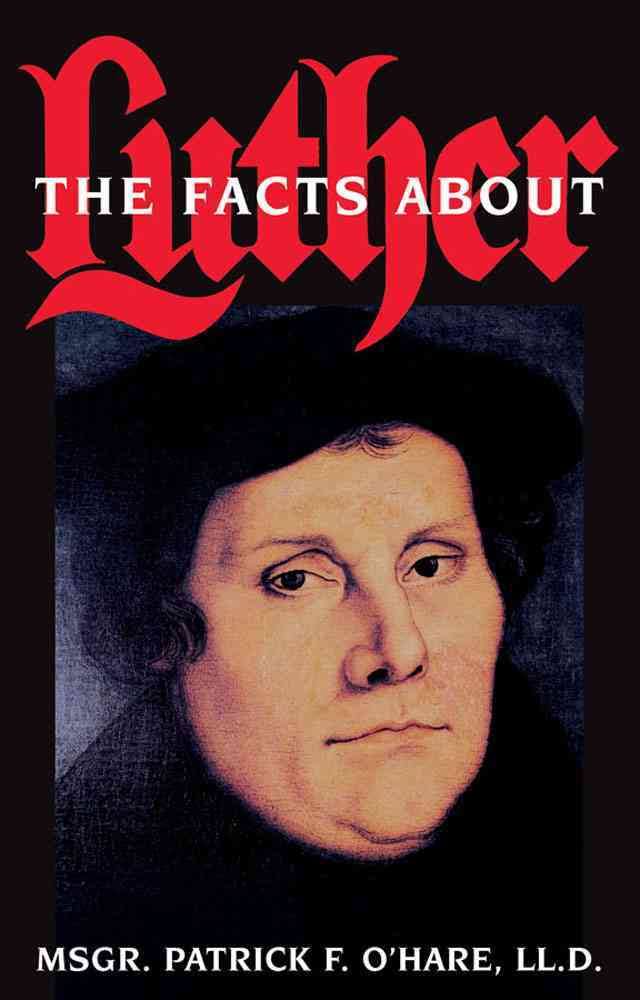
Martin Luther did not have to wait long to see the havoc his ideas would unleash. He himself lamented that “the people feel they are free from the bonds and fetters of the Pope, but now they want to get rid also of the gospel and of all the laws of God.” He also wrote that “if we succeed in expelling one devil, he immediately is replace by seven other who are much worse. We can then expect that after having driven away the monks, we shall see arise a race seven time worse than the former.”[4- Msgr. Patrick F. O’Hare, “The Facts about Luther”, Tan Publishing, 1916] [Today’s “God is Dead” Morality: Opening Act — Martin Luther]
There are two specific Luther quotes provided, both said to be from "Msgr. Patrick F. O’Hare, 'The Facts about Luther', Tan Publishing, 1916."  Though not provided, the page in question from Father O'Hare can be found here. Let's take a look at these quotes and see if they support the conclusions of this defender of Rome.

Documentation: Quote One
"The people feel they are free from the bonds and fetters of the Pope, but now they want to get rid also of the gospel and of all the laws of God."
O'Hare documents the first quote as "Walch IXV. 195." This refers to a set of Luther's works published between 1740-1753 by Johann Georg Walch. This page can be found here (see paragraph #2 beginning on page 194). This page can also be found in WA 50:119:


This first quote was translated into English in LW 60:149-150, Preface to Ambrosius Moibanus, The Glorious Commision of Jesus Christ, Our Lord and Savior (Mark 16 [:15]). This preface was written in 1537 for a work against schwärmer (enthusiasts) that were emphasizing the inner work of the Holy Spirit at the expense of the sacraments (LW 60:147-149).

Context: Quote #1
I have no doubt that the Last Day is not far away, though the highly intelligent and super-rational world is not concerned about this, being are that there is no need for that for a long time. As time goes on it is becoming so callous and wicked that, even if no Last Day were supposed to come, still it itself—highly intelligent reason—would have to say that it may not and cannot continue or remain this way for long; rather, either a flood must take place or else what happened to Sodom as an example, if it is really true that there is a God who punishes injustice. Innumerable examples of this are manifest since the beginning of the world and are still before our eyes every day, if only reason, so highly intelligent and so profoundly blind, could see such horrible punishment and would allow itself to be moved thereby.
It is an old saying, repeated by many teachers, that after the revelation of the Antichrist the people will become so dissolute that they will thereafter be unwilling to know or to believe anything about any god. Rather, each one will do or not do according to his own pleasure, as the devil and the flesh teach. We see such a time being fulfilled here before our eyes. For now that the horrible, dreadful lies and deception of the abominable Antichrist, the papacy, have been revealed and come to the light of day through God's amazing and exceptional grace, the people are beginning to believe nothing at all any longer. And because they feel freed and released from the bonds and strictures of the papacy, they want to be released and freed from the Gospel and all of God's commandments as well. From now on whatever pleases them and seems good is to be good and right By rights, this will be the end of the song, if God so wills.  [LW 60:149-150].
As the first sentence from Luther's pen demonstrates, in his mind, it was the end times. For Luther, it was the end of the world. Things were indeed going to get worse. The Gospel was going to be fought against by the Devil with all his might. The true church was a tiny flock in a battle against the world, the flesh, and the Devil. He hoped the people would improve with the preaching of the Gospel, he often admitted he knew things were going to get worse because of the Gospel, which is exactly what this context demonstrates.


Documentation: Quote #2
The second quote states, "if we succeed in expelling one devil, he immediately is replace by seven other who are much worse. We can then expect that after having driven away the monks, we shall see arise a race seven time worse than the former." It is documented by Father O'Hare as "Erl. XXXVI, 411." This page can be found here. O'Hare is wrong with his documentation.


This German text being cited is from Luther's comments on Deuteronomy 9:25 (1529). It's the last paragraph of the sermon. I've covered this German text previously: Luther: Our evangels are now sevenfold more wicked than they were before.  This paragraph has been translated as,
Moses is thus a fine teacher; he has well expounded the first commandment, and led the people to a knowledge of themselves, and humbled the proud and arrogant spirits, besides which he upbraided them with all kinds of vices, so that they had merited anything but the promised land. If we do not abide by our beloved Gospel, we deserve to see those who profess it, our Gospellers, become seven times worse than they were before. For, after having become acquainted with the Gospel, we steal, lie, cheat, we eat, drink, and are drunken, and practise all sorts of iniquity. As one devil has been driven out of us, seven others, more wicked, have entered in; as may be seen at the present time with princes, noblemen, lords, citizens, and peasants, how they act, without shame and in spite of God and His threatenings.
True, this German text above does say something like, "if we succeed in expelling one devil, he immediately is replace by seven other who are much worse," but it does not say, " We can then expect that after having driven away the monks, we shall see arise a race seven time worse than the former." I believe the reason for this discrepancy is that O'Hare mis-documented the quote.  He may have had either a Table Talk statement in mind or Luther's comments on Galatians 5:13 (LW 27:50) from 1535 (or some other source!). The quote certainly is not from Erl. XXXVI, 411 as O'Hare states.

Context: Quote #2
How it standeth with the Christian Church.
IT standeth with the Christian church, no otherwise than with a, silly sheep, which the wolf already hath catched by the wool to devour it. Our nobility, our gentry, citizens, etc. will not hear aright, they think (when we preach the Gospel, and reprove the Papists concerning their confidence in works) that as then we preach of good and easy days, and, that they have leave now to live, and to do what and how they please. O, they sin too highly, insomuch that if we drive out one devil, then there come seven others in his stead. If we should drive away all these Friars, then other, seven times worse than these, would come [Table Talk].
Of course, it is impossible to teach or persuade unspiritual people of this teaching about the love to be mutually observed among us. Christians comply with it voluntarily. But when the others hear this freedom proclaimed, they immediately draw the inference: “If I am free, then I have the right to do whatever I please. This thing belongs to me; why should I not sell it for as much as I can? Again, if we do not obtain salvation on account of good works, why should we give anything to the poor?” In their great smugness such people shrug off this yoke and obligation of the flesh, and they transform the freedom of the Spirit into the license and lust of the flesh. Although they will not believe us but will make fun of us, we make this sure announcement to these smug despisers: If they use their bodies and their powers for their own lusts—as they are certainly doing when they refuse to help the poor and to share, but defraud their brethren in business and acquire things by fair means or foul—then they are not free, as they loudly claim to be, but have lost both Christ and freedom, and are slaves of the devil, so that now, under the title of “Christian freedom,” their state is seven times as bad as it used to be under the tyranny of the pope (Matt. 12:43–45). For when the devil who has been cast out of them returns to them, he brings with him seven spirits more evil than himself. Therefore their last state becomes worse than the first (LW 27:50).

Conclusion
The overall argument from this Roman Catholic blogger is too big in its scope: he blames one sixteenth century person for just about... everything at the expense of Luther's point in his own time period. For Luther, it wasn't his teaching that caused "havoc," but rather he thought it was the devil responding to the pure preaching of the Gospel causing havoc. This Roman blogger thinks these quotes demonstrate Luther was lamenting over "the havoc his ideas would unleash." If there is a lament, it was not a lament of sorrow for his teaching or seeking the reform of the church. Rather, it was a lament over the work of Satan against the tiny flock (the true church).

One other thing does jump out from this little context exploration: this educated Roman Catholic blogger may have never actually read these quotes in their immediate context, their historical context, or with any sort of attempt in keeping Luther's theological framework in view. Using Patrick O'Hare's The Facts About Luther typically leads far away from the actual facts about Luther.

The blogger also included a comment with a cut-and-paste from another old spurious source (but it was probably taken from something like either this or this rather than an actual book).  He prefaced with a comment leading one to conclude he actually did the work of finding the quotes in their context:
I give you Luther’s own assessments. The source is The Walch edition of “Luther’s Own Works” which was published by Gebauer, Halle, in 24 volumes, between 1740 and 1753. The work was carried on under the supervision of Professor D. Johann Georg Walch, of Jena.
Beware of someone in English claiming they've pulled quotes from an eighteenth century source written in German and Latin. There's no need to go to such obscure out-of-print sources when there are modern editions of Luther's Works readily available.

Saturday, October 24, 2009

The Walch Edition of Luther's Works

The Walch Edition of Luther's Works dates from 1740-1753 and was compiled by Johann Georg Walch. It is a collection of 24 topical volumes. This set is German, and Walch translated many of Luther's Latin writings into German. Sometimes this set is referred to as the St. Louis version, the St. Louis-Walch version, or the Halle edition, and Luthers Samtliche Werke, herausgegeben von J. G. Walch. This set also includes writings by others, friends and foes of Luther. The set was revised from 1885-1910 (in St. Louis), and may not match up with the earlier set. Sometimes the revision is referred to as St.Lb or St.L. Volumes 15-17 contain rare Reformation history texts, and contemporary letters.

I've found many obscure quotes referring back to Walch, often without noting which particular treatise is being cited. What follows is a brief collection of some of the treatises found in each volume. Page numbers are both to the old Walch set, and sometimes to the St. Louis edition, without noting which is which. I'll update this entry from time to time.

Volume 1:
Lectures on Genesis

Volume 2:
Lectures on Genesis

Volume 5:
The Eighty Second Psalm Translated and Explained (1530), pp. 696-731

Volume 6:Treatise Concerning The Blessed Sacrament of the Holy and True Body of Christ and Concerning the Brotherhoods, p. 522

volume 10:Sermon on Threefold Righteousness by Martin Luther; from Philippians 2 (1518).
A Brief Explanation of the Ten Commandments, The Creed, and the Lord's Prayer (1520), p. 182; 149
An Open Letter to the Christian Nobility of the German People Concerning the Reform of the Christian Estate (1520), p. 296-399, 266-351.

Whether Soldiers Too, Can Be Saved p. 488.
On Trading and Usary and The Treatise on Usary (1524), pp. 914-937, 825-854
Preface to an Ordiance of a common Chest (1523), 954-977
The Three Symbols or Creeds of The Christian Faith, pp.992-1019.
The Disputation Concerning The Passage: “The Word Was Made Flesh”, 1168–1173.
Two Kinds of Righteousness pp. 1262-1277.
The Right and Power of a Christian Congregation or community to Judge all Teaching and to Call, Appoint, and dismiis Teachers, Established and Proved From Scripture (1523), pp. 1538-1549
Concerning The Ministry, 1548ff.
Admonition Concerning The Sacrament Of The Body And Blood Of Our Lord, 2170–2209.
An Order Of Mass And Comunnion For The Church At Wittenberg,2230 ff.

Volume 11:The True and False Worship of God, 404

Volume 14:Preface To Galeatius Capella’s History, pp. 376-381.
Preface To The Wittenberg Edition Of Luther’s German Writings, pp.
420–427; or 432–437.
Preface To The Complete Edition Of Luther’s Latin Writings, pp. 1740–1753 or 438–449.

Volume 15:Proceedings at Augsburg 448-625
Let Your Sins Be Strong: A Letter from Luther to Melancthon. Letter no. 99, 1 August 1521, pp. 2585-2590.


Volume 16
Letter 215 To Philip Melanchthon[Coburg,] June 29, 1530, 901 ff
An Admonition to Peace: A Reply to the Twelve Articles of the Peasants in Swabia (1525), pp. 45-70
Against The Robbing and Murdering Hordes of peasants (1525), pp. 71-76
An Open Letter Concerning The Hard Book Against The Peasants, pp.77-98
Exhortation To All Clergy Assembled At Augsburg, pp. 1120–1179 or(945) 946–992.
On The Councils and the Church (1539), p.1247.

Counsel Of A Committee Of Several Cardinals With Luther’s Preface, pp. 1971-1994
Commentary On The Alleged Imperial Edict, pp. 2016–2062; or (1665) 1666–1700.


Volume 17
This seventeenth volume of the new edition of Luther's works may be divided into two parts. First of all, it contains the documents against the Papists which belonged to the conclusion of the Reformation history, namely, between the years 1528 and 1546. Secondly, it contains the documents against the Reformed, from the year 1524 on. Among the documents against the Papists are those relating to Nuremberg League of 1538, those relating to the Convention at Brunswick and the following year, those relating of the renewed Schmalcald League, from 1536 to 1538, those relating to the transactions of the King of England in reference to the protesting estates, between 1535 and 1539, those relating to the transactions of King Francis I of France with the members of the Schmalcald League in 1535, those relating to the conventions at Frankfort, Schmalcald, Hagenau, those relating to the colloqium at Worms in 1540. and the Diet at Regensburg in 1541, with its colloqium, those relating to the Diet at Spires in 1542 and to the Diets again held at Spires, Worms, and Regensburg, 1544 to 1546, also those relating to the expedition of the Emperor Charles V against the members of the Scbmalcald League, 1546. Among the documents against the Reformed are those relating to the controversy concerning the Lord's Supper, the transactions of the disputation at Berne, the efforts of Philip of Hesse to secure a union, the Wittenberg Concord, the great Sacramentarian controversy in 1542, with the action of Luther subsequent thereto, and letters concerning various other controversies.With this volume the revision of the old Walch edition of Luther's works has been completed to the twenty-first volume, which contains the letters of Luther, to which the editor of the German edition will now give attention, being able to rely on the sources which have recently been made public in Europe.

Against The Thirty Two Articles of the Louvain Theologians, pp. (1494) 1497–1505.
On Rebaptism (1528),2644

Zwingli: Letter to Matthew Alber, published in 1525, p. 1512.

Bucer: Preface to the Fourth Volume of Luther’s Postil, Containing a Summary of the Doctrine of Christ. Letter by the Same Author [Bucer], Expounding the Passage of I Corinthians 10 [9:24–10:5], With a Few Annotations on Certain Expressions of Luther. Letter of Martin Luther to John Herwagen Complaining of the Above. Martin Bucer’s Reply to This, Also Amends to Bugenhagen Concerning the Version of the Psalter, 1527. Bucer’s Preface appears in German translation in St. L. 17, 1584 ff. In March, 1527, Bucer republished his additions to Luther’s Postil, defending himself against Luther’s and Bugenhagen’s reproaches, and rebuking their wrath. Luther appears to have been informed of Bucer’s intentions prior to the publication.

Volume 18
Disputation Against Scholastic Theology, pp. 18-27.
Heidleberg Disputation, pp. 36-71.
95 Theses, pp. 72-81.
Explanations of the Ninety-Five Theses or Explanations of the Disputation Concerning the Value of Indulgences pp. 299-533.
Eck's Obelisks (an attack thirty-one of Luther’s Ninety-five Theses). Luther answered with Asterisks in March, 1518. pp. 536–589.
The leipzig Debate 718-721


Volume 19:
Treatise Concerning The Blessed Sacrament of the Holy and True Body of Christ and Concerning the Brotherhoods, p. 426(st.l)
On Translating, an Open Letter, p. 968 (st.l)
A Treatise Concerning the Ban (1520), p. 1089 or 884.
The Private Mass And The Consecration Of Priests, 1220-1285.
A Letter Of Dr. Martin Luther Concerning His Book On The Private Mass, 1286–1299.
The Disputation Concerning Man, pp. 1462-1467.
The Licentiate Examination Of Heinrich Schmedenstede pp. 1468–1473 or 1782–1787.
Theses Concerning Faith And Law, pp. 1745–1761; or 1486–1450.
The Disputation Concerning Justification, pp. , 1761–1768; or 1450–1455.
The Babylonian Captivity of the Church

Volume 20:
Wolfgang Capito:What One Should Think and Answer Concerning the Dissension Between Martin Luther and Andreas Karlstadt, late 1524. St. L. 20, 340 ff. A brief German pamphlet.

Zwingli: Commentary on True and False Religion, 1525. pp. 441 ff.
Zwingli: Reply to the Letter of John Bugenhagen of Pomerania, 1525. pp. 506 ff.

Oecolampadius:Reasonable Answer to Dr. Martin Luther’s Instruction Concerning the Sacrament, Together with a Brief Summary Against the Treatise of Certain Preachers in Swabia Regarding the Words of the Lords Supper, 1526. St. L. 20, 582 ff. A lengthy rebuttal, in German, of Luther’s German Preface to the Swabian Syngramma (1526); the second part is a brief excerpt from the Antisyngramma.

Oecolampadius: Apologetics: Two Sermons on the Dignity of the Eucharist; Reply to Theobald Billican …; Antisyngramma, to the Swabian Clergymen, 1526. Billican had written a refutation of Oecolampadius in December, 1525; the Swabian Syngramma had been published in January, 1526. The reply to Billican, in German translation, appears in St. L. 20, 634 ff. rebuttal of Oecolampadius earlier in the same year.

That These Words Of Christ, “This Is My Body,” Etc., Still Stand Firm Against The Fanatics 1527, pp. 762-893.
Confession Concerning Christ’s Supper, 894-1105.

Zwingli: Answer to Strauss’ Pamphlet Concerning Christ’s Supper, January, 1527. pp. 1494

Brief Confession Concerning The Holy Sacrament, 1764–1791.
On War Against The Turk p.2108.

Eight Sermons by Dr. Martin Luther (1522)


Volume 21:
The Burning of Frian Henry in Dithmarschen (1525), pp. 94-121.
An Italian Lie Concerning Martin Luther's Death, pp. 252-256 (or 3374–3377).
Luther's Will, pp.270-273 (or 273-274)


Volume 22: The Tabletalk
Early editions of the works of Martin Luther did not include the Table Talk. It was with some misgivings that Johann Georg Walch finally decided to incorporate the Table Talk in his edition, which was published in twenty-four volumes in Halle between 1739 and 1753. Walch was aware that many Protestants were embarrassed by some things in the Table Talk—for instance, the earthy language which Luther occasionally employed and the freedom with which he criticized the composition and contents of some books of the Bible. It was feared that Protestants in general and Lutherans in particular would be exposed to damaging attacks at the hands of Roman Catholic polemicists if the Table Talk were included in an edition of Luther’s works. Attempts were even made to deny its genuineness, to claim that it was an unfriendly fabrication and forgery.(D. Martin Luthers Sämtliche Schriften, herausgegeben von Johann Georg Walch (24 vols.; Halle: J. J. Gebauer, 1739–1753), XXII, 4, 15, 21, 23–24, 30–38).


Volume 23: contains an index of key words.


Addendum 3/11/15
A lot more has surfaced in cyberspace in regard to the  Walch / St Louis Edition of Luther's Works. A blog entitled Back to Luther (from a somewhat fanatical Lutheran) has put together some very helpful posts in regard to these volumes.

Luther Index, online resources for Luther's works

St. Louis Edition of Luther's (German) Writings – complete text

The following links are the result of the labors of Back to Luther. I'm posting them here because I got tired of  going though his blog to get to them, I'm grateful for his hard work:

St. Louis Edition of Luther's Works
or
Dr. Martin Luthers Sämmtliche Schriften  

St. Louis Edition
volume
HathiTrust Text?
(single pgs only)
all line breaks are soft returns –good for proofing but must manually add hard returns every paragraph!
Google Books?
Plain Text?
editions:YIGSJf7E28IC 
---
---
Archive.org
(all txt files are gibberish)


01
Good

02
Good
snippet; no

03
Fair - Good; > ~2% errors
yes; yes
04
Good
snippet; no
05
Good
snippet; no


06
Good
snippet; no
07
no
--- none ---
snippet; no
08
Good
snippet; no

09
Good
snippet; no

10
Good
yes; yes


11
Fairly Good, ~1% error pg 86

12
Good
yes; yes
13-1
no
--- none ---
yes; yes
13-2
Good
no; no

14
Good
yes; yes


15
Fair to Good (jump 50, 100)
snippet; no

16
Good
yes; yes
17
Good
snippet; no

18
Good
yes; yes

19
Good
yes; yes


20
Fair - Good ( jump 50, 100)
yes; yes

21a
Good
yes; yes
21b
Good
yes; yes
22
Good
yes; yes

23
Good
yes, yes


http://catalog.hathitrust.org/Record/006111124

Dr. Martin Luthers' sämmtliche Werke / hrsg. von Joh. Georg Plochmann.

Main Author:Luther, Martin, 1483-1546.
Other Authors:Irmischer, Johann Conrad, 1797-1857., Plochmann, Johann Georg.
Language(s):German
Published:Erlangen : C. Heyder, 1826-1857.
Note:Bd. 44-67 published by Heyder & Zimmer, 49-67 at Frankfurt a. M. und Erlangen.
Bd. 1-20 edited by Joh. Georg Plochmann, 21-67 by Dr. Johann Konrad Irmischer.
Physical Description:67 v. ; 18 cm. 
Locate a Print Version:Find in a library