Showing posts with label Antonin Eymieu. Show all posts

Wednesday, November 24, 2010

Luther: Moses is an executioner... Let us send Moses packing forever

The following is from the web page Luther, Exposing the Myth, under the heading "The Commandments":

"Moses is an executioner, a cruel lictor, a torturer a torturer [sic.] who tears our flesh out with pincers and makes us suffer martyrdom . . . Whoever, in the name of Christ, terrifies and troubles consciences, is not the messenger of Christ, but of the devil . . . Let us therefore send Moses packing and for ever"[D. Martini Lutheri Exegetica Opera Latina, published by Elsperger (Erlangen, Heyder, 1829-84), Vol. 18 pg. 146].

Luther Exposing the Myth says their stated purpose is to show that "from Luther’s own words we shall see him for what he really was, that is a rebellious apostate, who abandoned the faith and led many into apostasy from God under the guise of “reformation” in order to follow his perverse inclinations." With this quote, they attempt to show Luther blatantly rejected Moses and devalued the law of God.

Documentation
Luther, Exposing the Myth cites "D. Martini Lutheri Exegetica Opera Latina, published by Elsperger (Erlangen, Heyder, 1829-84), Vol. 18 pg. 146." This reference is only partially correct because the quote being cited is not one quote, but two quotes. The first part of the quote is on page 142.


The second part of the quote is on page 146-147.
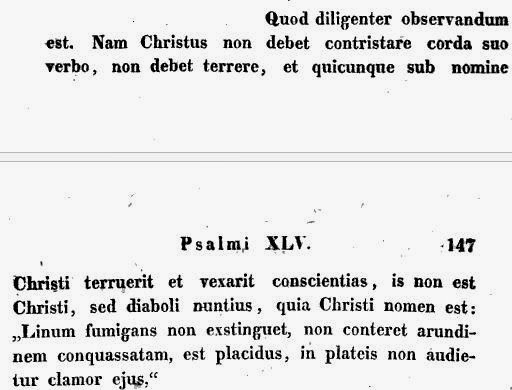

It's highly unlikely Luther, Exposing the Myth actually mined this quote out of the original Latin. Rather, it probably came from a secondary source. I'm fairly confident the secondary source is: Antonin Eymieu, Two Arguments for Catholicism (Burns, Oates and Washbourne, 1928 ) p. 44. This book documents the quote as "Opera exeget. XVIII, 146 seq." The "D. Martini Lutheri Exegetica Opera Latina, published by Elsperger (Erlangen, Heyder, 1829-84)" part used by Luther, Exposing the Myth is on page 37. Luther, Exposing the Myth appears to have a taken a number of quotes from this secondary source.

These two quotes being cited are from "Psalmi XLV" (Luther's classroom lectures on Psalm 45, 1532). Technically, Luther did not write this text. They are the result of  Luther's scribe, Georg Rörer. LW 12 points out that Luther's commentary on Psalm 45 was published in 1533-1534 but with reluctance on Luther's part. His health issues did not allow him to any  revisions of the text (LW 12, Introduction to Volume 12).  This text has been translated into English in LW 12 "Selected Psalms."  These two quotes in question can be found in LW 12:207 and LW 12:211.


Context
The caricature presented by Luther, Exposing the Myth is that Luther despised Moses and slandered Moses. The context though says something quite different. Luther is commenting on Psalm 45:2. It is a comparison is between "King" Moses and the Law (imperfect) and "king" Jesus and the Gospel. The first part: "Moses is an executioner, a cruel lictor, a torturer who tears our flesh out with pincers is found here:
This is the first sweet and delightful thing in this lyric, which sings about and promises a kingdom with such a King. There will be no imperfections in Him, but a will full of virtues and a mind full of wisdom, with glowing love toward all miserable, damned, and sorrowful sinners. Moses is not such a king. He is a tormentor and cruel executioner and torturer, who torments us and troubles us with his terrors, threatenings, and displays of wrath. He forces us to do good outwardly; or, if we do our best, he inwardly humbles us and makes us long for grace. But our King, who is celebrated here, is full of mercy, grace, and truth. In Him love for mankind is to be found and the greatest sweetness; a person who, as we find in Isaiah 42:2, “does not cry in the streets,” is not austere and rough, but patient and long-suffering. He exercises judgment against the wicked and blasphemers, and shows mercy toward sinners. Therefore He is a most pleasant and fair King, and there is no one like Him in the whole world. In Him is to be found the highest virtue and the highest love toward God and men. It is with these adornments that His person is decorated, so that there is no overweening pride, desire, lust, or any other base affection in Him. We see Him described this way in the Gospels, and the facts themselves point to His having been so. He did not keep company with the holy, powerful, and wise, but with despicable and miserable sinners, with those ruined by misfortune, with men weighed down by painful and incurable diseases; these He healed, comforted, raised up, helped. And at last He even died for sinners. He did not frighten, and He did not kill, as Moses did, but He drew, gladdened, comforted, cured, and aided all who came to Him. He is therefore the King of kings, without equal. Yet this is true only if you look at the spirit and not at the external appearance of the flesh. This is simply one aspect of the description of His person, pointed out briefly and with few words. The holy Evangelists and St. Paul in his Epistles describe it more fully and enlarge upon it; they paint this King in His true colors and point out what kind of person He is, and these things are most helpful for those of us who find ourselves in difficulties and vexations of conscience [LW 12:207].
The second part: "Whoever, in the name of Christ, terrifies and troubles consciences, is not the messenger of Christ, but of the devil . . Let us send Moses packing and forever" is found here:
So Christ should not be depicted with gall or a sword in His mouth, as they always portray Him, unless it is to be understood spiritually. He should be depicted in such a way that His lips seem to be pure sugar or honey. Whoever depicts His mouth otherwise errs, and we should rather listen to this poet than to the papists and Satan, the authors of this horrible picture. For this poet will not deceive us when he ascribes to Christ the loveliest mouth. This must be noted carefully. For Christ should not make hearts sad with His words, He ought not to terrify. Whoever terrifies and vexes consciences in Christ's name is not a messenger of Christ but of the devil, for Christ's name is: "A bruised reed He will not break, and a dimly burning wick He will not quench." He is gentle: "He will not cry or lift up His voice or make it heard in the street" (Is. 42:3, 2). He is not rough, severe, biting like Moses, who looks like the very devil and speaks in a way that our heart almost vanishes before him. For he has lips overflowing with gall and wrath, that have been embittered with laurel and gall, in fact, with hellish fire. So away forever with Moses! But our King has pleasant lips; that is, His Word is the Word of the remission of sins and of comfort for the lowly, the Word of life and salvation to recall the damned and dying [LW 12:211].

Conclusion
Contrary to Luther, Exposing the Myth, Luther’s theology did have place for the Law of God and its use in the life of a Christian. The Law for Luther was dual purposed: it first drives one to see their sin and a need for a savior; secondly it functions in the life of a Christian to lead one to a correct understanding of the good one ought to do. Moses and the law were important in his theology. Luther taught that anyone who is to preach must be able to preach the law:
First, he must preach the Law so that the people may learn what great things God demands of us; of these we cannot perform any because of the impotence of our nature which has been corrupted by Adam's fall [The Complete Sermons of Martin Luther Vol. 1 (Michigan: Baker Books, 2000), 1:131].
Luther also points out that only by knowing God’s law does one even "know" what a good work is:
O]nly those things are good works which God has commanded, just as only that is a sin which God has forbidden. Therefore, he who wants to know and do good works need only know God’s Commandments… These Commandments of God must teach us how to distinguish among good works [Ewald Plass, What Luther Says Volumes 1-3 (St. Louis: Concordia Publishing house, 1959) 3:1499].
These examples show that Luther valued the law. Luther scholar Paul Althaus points out for Luther:
The Ten Commandments have their place not only ‘before’ but also ‘after’ justification; thus they not only exercise the Christian in the theological function of the law but also lead him to a right knowledge of the good he ought to do according to God’s will [ Paul Althaus, The Theology of Martin Luther (Philadelphia: Fortress Press, 1963), 272].
Luther composed a hymn on the Ten Commandments in which he states, “To us come these commands, that so- Thou son of man, thy sins mayst know- And make thee also well perceive- How before God man should live” [LW 53:279]. Elsewhere Luther said of the Ten Commandments, “They are the true fountain from which all good works must flow” [Martin Luther, as cited by Paul Althaus, The Theology of Martin Luther (Philadelphia: Fortress Press, 1963), 272, footnote 124].

In Luther’s Small Catechism the Ten Commandments were placed first because he wanted people to understand that God is wrathful against sin. The negative prohibitions in the Ten Commandments clearly showed our need for a savior. also in the Small Catechism, Luther suggests a daily regiment of prayer and includes a verbal reading of the Ten Commandments. In the reciting of the Ten Commandments along with the Apostles Creed and Lord’s Prayer, one hears both law and gospel at the beginning and ending of each day. Luther says,
[N]o man can progress so far in sanctification as to keep even one of the Ten Commandments as it should be kept, but that the Creed and the Lord’s Prayer must come to our assistance, as we shall hear, through which we must continually seek, pray for, and obtain the power and strength to keep the Commandments" [What Luther Says 3:1501].
Luther placed a strong emphasis on the First Commandment, which was one of the key factors in the shape of his entire theology. Luther believed God spoke the word of creation bringing human creatures into existence was repeated in the First Commandment. The whole of the Scripture can be summarized in the First Commandment. It was both law and gospel. It is law because it invokes a demand with a burden that can crush us. When we do not place God at the center of our lives, we are lost not living the full life of a human creature. This command is also gospel: it is good news that God says He is our Father, that He is our God, protector-provider, Lord and Savior. It is His gift of being His child. The implication of this for Luther’s entire theology is that he derived all of God’s gracious promises from the First Commandment. As Roland Bainton has rightly said,
One might have expected the great line of demarcation for [Luther] to have lain between the Old Testament and the New. It did for some Protestants, like the Anabaptists, who rejected the wars of Yahweh and took literally the ethic of the Sermon on the Mount. Luther on a different count might have used his distinction of law and gospel to repudiate Moses as law, but Luther did not. Law and gospel, said he, lie side by side throughout the whole Bible. That which relies on man's good works is law. That which relies on God's good grace is gospel. The Ten Commandments can witness to grace and the Sermon on the Mount can be treated as a new law. Therefore, the Old Testament is not to be rejected or relegated to a lower rank. Here one must recall that Luther interpreted the Old Testament in terms of the pre-existent Christ, who was speaking through Moses and through David [Roland Bainton, Studies on the Reformation, (Boston: Beacon Press, 1963), p. 6-7].
Luther said of the entire Old Testament,
Christ must first be heard in the Gospel, then it will be seen how beautiful and lovely the whole Old Testament is in harmony with him, so that a man cannot help giving himself in submission to faith and be enabled to recognize the truth of what Christ says in John 5: 46, "For if ye believed Moses, ye would believe me, for he wrote of me [The Complete Sermons of Martin Luther Vol. 1 (Michigan: Baker Books, 2000), 1:151].

Addendum (2016)
This blog entry is a revision of an entry I posted back in 2010. The original can be found here. Because so many sources are now available online, I'm revising older entries by adding additional materials and commentary, and also fixing or deleting dead hyperlinks. Nothing of any significant substance has changed in this entry from that presented in the former.

Thursday, September 09, 2010

Luther: A Good Life from Good Works Leads to Damnation

The following is from the web page Luther, Exposing the Myth, under the heading "Faith and Good Works":

"There is no scandal greater, more dangerous, more venomous, than a good outward life, manifested by good works and a pious mode of life. That is the grand portal, the highway that leads to damnation" [Denifle’s Luther et Lutheranisme, Etude Faite d’apres les sources. Translation by J. Paquier (Paris, A. Picard, 1912-13), VOl. II, pg. 128].

Luther Exposing the Myth says their stated purpose is to show that "from Luther’s own words we shall see him for what he really was, that is a rebellious apostate, who abandoned the faith and led many into apostasy from God under the guise of “reformation” in order to follow his perverse inclinations." With this quote, they attempt to show Christ valued works as part of salvation, while Luther held leading a good life based on good works leads to damnation.

Documentation
Luther Exposing the Myth cites "Denifle’s Luther et Lutheranisme, Etude Faite d’apres les sources. Translation by J. Paquier (Paris, A. Picard, 1912-13), VOl. II, pg. 128." I have a hard time believing Luther Exposing the Myth actually used this source. My speculation is that it used a source that quoted Denifle / Paquier. Luther Exposing the Myth cites Denifle / Paquier four times. Each citation and reference is also used in this book: Two Arguments for Catholicism (1928) by Antonin Eymieu. This particular quote can be found on page 46:
The great danger is the doing of good works. It is what the Papists call the practice of virtue. "There is no scandal greater, more dangerous, more venomous, than a good outward life, manifested by good works and a pious mode of life. That is the grand portal, the highway that leads to damnation [(Footnote 5) Dollinger III, 124].
Luther Exposing the Myth does not mention or refer to Eymieu, but I would be surprised if Two arguments for Catholicism was not (ultimately) the source used for this quote. In fact, it becomes more probable when one notices that footnote four (documenting a quote previous to the one in question) in Eymieu refers to "Denifle II, 128."  In other words, Luther, Exposing the Myth mis-documented the quote during its probable plagiarization of  Eymieu (the quote was actually supposed to be documented with "Dollinger III, 124"). Luther et Lutheranisme II:128 can be found here. Checking page 128 of Denifle’s Luther et Lutheranisme II, one is hard pressed to discover exactly what's being cited, for it doesn't appear the quote is cited on the page. The quote does appear though on page 124 of the French edition of Dollinger's  La réforme III (it is on page 128 in Dollinger's German). Here is what Dollinger says:


Here is the German:


In the French edition, Dollinger cites "L.c. XI, 349 et suiv" as his reference for this Luther quote. This refers to Walch vol. xi, p. 349 and what follows. This was a set of Luther's works published 1740-1753 by Johann Georg Walch. The set was revised from 1885-1910 and is also known as the St. Louis edition. Volume XI refers to Kirchen-Postille Evangelien-Predigten, or Luther's Church Postil.  Here is page 349. These Postil sermons have a tedious and complicated legacy (see the introduction to LW 75). The text in question appears to be:


The text being cited is a section from Luther's sermon Am Sonntage nach dem Christtage (Luc. 2, 33-40). This sermon is available in English. It can be found in Lenker's Church Postil: Sunday After Christmas Sermon (Luke 2:33-40)., and it can be found in LW 52:102.

Context

Lenker:
51. Finally Simeon says that all this will happen that thoughts out of many hearts may be revealed. What a blessed and necessary fruit of this falling and speaking against! But in order to understand this we must notice that there are two different kinds of temptation among men. There is the temptation to gross sins, as for instance to be disobedient to parents, to kill, to be unchaste, to steal, to lie and blaspheme, etc., which are sins against the second table of the law. The people who do these things need not take offense at a sign which is spoken against; their thoughts are sufficiently revealed by their evil life. The Scriptures speak little of this temptation.

52. But the most dangerous temptation is prefigured by Cozbi the daughter of Zur, a prince of Midian, because of whom twenty-four thousand were slain in Israel, as Moses writes in Numbers 25, 15. This is the temptation through the bright and shining sins of good works and the service of God, which bring misfortune upon the whole world and against which nobody can guard sufficiently. These are the sins against the first table of the law, against faith, the honor of God and his works.
53.For a life of good works, blameless conduct and outward respectability is the greatest, most dangerous and destructive stumbling-block. The people leading such lives are so upright, reasonable, honorable and pious that scarcely a single soul could have been preserved or saved, if God had not set up a sign against which they might stumble and by which the thought of their hearts might be revealed. Thus we see their hearts behind their beautiful words and good works, and find that these great saints and wise men are pagans and fools; for they persecute the faith for the sake of their works and will not suffer their ways to be rebuked. Thus their thoughts are laid bare and they become manifested as trusting in their own works and themselves, sinning not only continually against the first commandments, but endeavoring also in their enmity against God to exterminate and destroy all that belongs to God, claiming to do this for the sake of God and to preserve the truth. Behold, such are the pope, the bishops and almost all the priests, who have filled the world with innumerable snares and stumbling-blocks by making an external glitter of the spiritual life. Among them there is no faith, but only works,the Gospel does not prevail, but only human laws.
54. The whole Scriptures speak of this stumbling-block,and God with all his prophets and saints contends against it.This is the true gate of hell and the broad highway to eternal damnation, wherefore this harlot is well called Cozbi, "mendacium meum," my lie. Everything that glitters lies and deceives, but her beautiful ornaments and embellishments deceive even the princes of Israel, and so she is not merely called "mendacium," but "meum mendacium," my lie, because with her deception she attracts and tempts almost everybody. (Lenker, 277-278).
LW 52:

For there is no bigger, more dangerous, more poisonous stumbling block than the external good life lived in good works and blameless conduct. The people living such lives are such upright, sensible, honorable, pious people, that not a single soul could be saved or remain unseduced, if God had not set up his sign and target, over which they stumbled and revealed the thoughts of their hearts. Through their beautiful words and good works we see into their hearts and discover that these eminent saints and wise men are heathen and fools; for they persecute the faith for the sake of their works and they want to be unpunished in their conduct. Thus their thoughts are discovered and become visible, showing how they trust in their works and in themselves and how they not only sin unnecessarily against the first commandments, but also, full of hatred, strive to blot out and to destroy everything pertaining to faith and to God. They always behave as if they were doing so for the sake of God and in order to preserve the truth. The pope, the bishops, and almost all the clergy are of this disposition; they have filled the world with their snares and offenses by turning the spiritual life into external glitter. And yet there is no faith, but only works; the gospel does not rule here, but only human laws.
All of Scripture speaks of this offense and God fights against it with all his prophets and saints. This is the true gate to hell and the broad highway leading to damnation. Thus, this harlot is aptly named Cozbi, mendacium meum, “my lie.” Everything that glitters is falsehood and deception, but her beautiful adornment and jewels deceive even the rulers of Israel. She is named not only mendacium, but meum mendacium, “my lie,” because her deception entices and tempts everybody [LW 52:120-121].

Conclusion
This quote has some history. It was reviewed by in the 1800's in Luther Vindicated. Charles Hastings Collette examined the quote being used out of context by Reverend S. Baring-Gould:
Having examined a passage from which the rev. gentleman has dropped two words from Luther's text, and thereby made it appear that he preached adultery, I now will note a deliberate shifting of a couple of words, by which an equally atrocious sentiment is attempted to be fixed on the Great Reformer.
In page 15, n. 44, we are referred to vol. xi., col. 346, Walch edition of Luther's works, the correct column is 349. Here Luther not only exposed the heresy of advancing good works as a meritorious cause of justification; but, like Paul, he warns us against those who have "a form of godliness," and by an outward life and show,—in fact, what he called " coloured hypocrisy,"—deceive others as well as themselves. This deceit, he tells us, is still more destructive to the soul. Luther's words are :—
"There is no scandal greater, nor more dangerous, nor more venomous than the outward good life in good works and holy conversation. That is clear, the very gate and the broad highway which leads to destruction. Oh, what a horrid abomination of unbelief and ungodliness underlies this fine life, a wolf in sheep's clothing, a harlot underneath the bridal garland !"
The reader will be somewhat surprised to find what the rev. gentleman has been enabled to make of this by a skillful shifting of the position of words which I have placed in italics, making the "good life manifested externally by good works," to be condemned by Luther, instead of the sham or pretence and hypocrisy veiled by a show of good works. The Rev. S. Baring-Gould says were most dangerous, as they prevented man from a total surrender of himself to God to do with him as He saw fit. And he laid down that it is far more dangerous for a man to remain till death in a state of grace and good living than to be plunged in profligacy and stained in innumerable crimes. 'There is no scandal greater,' says he, ' nor more dangerous, nor more venomous, than a good life manifested exteriorly by good works and a pious conduct. It is the carriage-gate to damnation.'" "Charity rejoiceth not in iniquity, but rejoiceth in the truth." The rev. gentleman, however, seems to take a special delight in attributing iniquity to Luther, and this at the expense of truth [source].
The context clearly shows those whom Luther was talking about: "trusting in their own works and themselves, sinning not only continually against the first commandments, but endeavoring also in their enmity against God to exterminate and destroy all that belongs to God, claiming to do this for the sake of God and to preserve the truth." These are the people Luther had in mind who are on "the highway that leads to damnation" with their pious works.


Addendum (2016)
This blog entry is a revision of an entry I posted back in 2010. The original can be found here. Because so many sources are now available online, I'm revising older entries by adding additional materials and commentary, and also fixing or deleting dead hyperlinks. Nothing of any significant substance has changed in this entry from that presented in the former.

Thursday, September 02, 2010

Luther: Perform a Big Sin to Quiet Your Conscience

The following is from the web page Luther, Exposing the Myth, under the heading "On Sin":

"Do not ask anything of your conscience; and if it speaks, do not listen to it; if it insists, stifle it, amuse yourself; if necessary, commit some good big sin, in order to drive it away. Conscience is the voice of Satan, and it is necessary always to do just the contrary of what Satan wishes" [J. Dollinger, La Reforme et les resultants qu’elle a produits. (Trans. E. Perrot, Paris, Gaume, 1848-49), Vol III, pg. 248].

Luther Exposing the Myth says their stated purpose is to show that "from Luther’s own words we shall see him for what he really was, that is a rebellious apostate, who abandoned the faith and led many into apostasy from God under the guise of “reformation” in order to follow his perverse inclinations." With this quote, they attempt to show Christ says those who commit any sin are children of the Devil, while Luther says to quiet your conscience from convicting you of sin and also go out and perform a big sin. Hence contrary to Christ, Luther espoused a weak view of sin.

Documentation
Luther Exposing the Myth cites "J. Dollinger, La Reforme et les resultants qu’elle a produits. (Trans. E. Perrot, Paris, Gaume, 1848-49), Vol III, pg. 248." Johann Joseph Ignaz von Döllinger was a Roman Catholic scholar. Page 248 of his book can be found here. While Luther's view of sin and the Devil are discussed, the exact form of this quote isn't provided. The closest thing from Dollinger p. 248 is this synopsis of a letter Luther wrote to Jerome Weller:


There's are two Latin quotes at the bottom of the page. The first contains a portion of text of Luther's letter to Jerome Weller in 1530. The second Latin quote is from the Table Talk. Neither of these quotes exactly match that put forth by Luther, Exposing the Myth.


There is a strong possibility Luther, Exposing the Myth took this quote from Antonin Eymieu, Two Arguments for Catholicism (Burns, Oates and Washbourne, 1928 ) p. 48. Eymieu uses the same English quote in question, but the reference is slightly different: "Dollinger, III. Cf. 37-58." The "Cf. 37-58" is instructing readers to see also Dollinger III 37-58 (that's 21 pages of text!).

I suspect the quote is ultimately Eymieu's summary statement of Luther's view with some of Luther's letter to Jerome Weller from 1530 mixed in.  Luther's letter can be found in De Wette, I V. 188 (the fourth volume of Luther's letters). The letter can also be found in WA BR 5:518-520. In English, this letter was not included in LW 49,  it has though been cited either in full or partially in a number of books. The letter itself has quite a polemical history, cited by numerous Roman Catholic sources, as well as even being cited by PBS. A full translation was provided by W.H.T. Dau, Luther Examined and Reexamined: a Review of Catholic Criticism and a Plea for Revaluation (Concordia Pub. House, 1917), pp. 119-122. Another translation can be found here. There is a partial translation provided by Preserved Smith, The Life and Letters of Martin Lutherp. 324 - 325.  Dau dates the letter "sometime in July." Others date the letter to November. Hartmann Grisar goes with July and points out, "In the older reprints the letter was erroneously put at a later date" [source].


Context
Accordingly, whenever this affliction [of conscience from the Devil] befalls you, beware lest you enter into an argument with the devil, or muse upon these death-dealing thoughts. For this means nothing else than to yield to the devil and succumb to him. You must rather take pains to treat these thoughts which the devil instills in you with the severest contempt. In afflictions and conflicts of this kind contempt is the best and easiest way for overcoming the devil. Make up your mind to laugh at your adversary, and find some one whom you can engage in a conversation. You must by all means avoid being alone, for then the devil will make his strongest effort to catch you; he lies in wait for you when you are alone. In a case like this the devil is overcome by scorning and despising him, not by opposing him and arguing with him. My dear Jerome, you must engage in merry talk and games with my wife and the rest, so as to defeat these devilish thoughts, and you must be intent on being cheerful. This affliction is more necessary to you than food and drink.
-snip-
Therefore, be cheerful and brave, and cast these exceedingly terrifying thoughts entirely from you. Whenever the devil worries you with these thoughts, seek the company of men at once, or drink somewhat more liberally, jest and play some jolly prank, or do anything exhilarating. Occasionally a person must drink somewhat more liberally, engage in plays, and jests, or even commit some little sin from hatred and contempt of the devil, so as to leave him no room for raising scruples in our conscience about the most trifling matters. For when we are overanxious and careful for fear that we may be doing wrong in any matter, we shall be conquered. Accordingly, if the devil should say to you: By all means, do not drink! you must tell him: Just because you forbid it, I shall drink, and that, liberally. In this manner you must always do the contrary of what Satan forbids. When I drink my wine unmixed, prattle with the greatest unconcern, eat more frequently, do you think that I have any other reason for doing these things than to scorn and spite the devil who has attempted to spite and scorn me? Would God I could commit some real brave sin to ridicule the devil, that he might see that I acknowledge no sin and am not conscious of having committed any. We must put the whole law entirely out of our eyes and hearts,--we, I say, whom the devil thus assails and torments. Whenever the devil charges us with our sins and pronounces us guilty of death and hell, we ought to say to him: I admit that I deserve death and hell; what, then, will happen to me? Why, you will be eternally damned! By no means; for I know One who has suffered and made satisfaction for me. His name is Jesus Christ, the Son of God. Where He abides, there will I also abide.

Conclusion
I've covered this quote before here. I also came across a very helpful overview on Luther and Conscience. Section three of the link has an overview on Conscience and the Devil. The author states,
For Luther the conscience can be an instrument of the devil, the device to make his assaults, his Anfechtungen, real. Here law and death become allies of the devil trying to make the sinner rely on his or her own good works and accomplishments. But relying on their own righteousness human beings are lost and driven into sadness. He writes:
Therefore we should be on our guard, lest the amazing skill and infinite wiles of Satan deceive us into mistaking the accuser and condemner for the Comforter and Savior, and thus losing the true Christ behind the mask of the false Christ, that is, of the devil, and making Him of no advantage to us.
-snip-
For Luther, conscience is the place where the law, death, and the devil encounter the human being and drive him into despair. The guilty conscience is one of the most terrifying human experiences. But this is not Luther's final word on conscience. As early as his Romans commentary, he could also say "He who believes in Christ is secure in his conscience and righteous and, as the Scripture says, 'bold as a lion'(Prov. 28:1)." In 1513 in an exposition of Psalm 118 he wrote: "Where could there be a higher or greater joy than in a happy, secure, and fearless conscience, a conscience that trusts in God and fears neither the world nor the devil?" In a sermon preached at Leipzig in 1519 Luther had said:
One must know how one stands with God, if the conscience is to be joyful and be able to stand. For when a person doubts this and does not steadfastly believe that he has a gracious God, then he actually does not have a gracious God. As he believes so he has. Therefore no one can know that he is in grace and that God is gracious toward him except through faith. If he believes it, he is saved; if he does not believe it, he is damned. For this confidence (zuvorsicht) and good conscience is the real, basically good faith, which the grace of God works in us.


Conclusion
I simply couldn't find any direct verification to the validity of this exact quote in the form it is in based on the documentation given. I suspect if this quote exists at all, it's a sort of Roman Catholic interpretation of Luther's letter to Weller. Even without a conclusive context, the quote itself can still be interpreted according to Luther's theological paradigms. It appears to me to be another hyperbolic statement like "sin boldly." Like that quote, the point is to trust in the work of Christ, who took sin upon himself. If you're a believer, your sin has already been punished and atoned for by the death of Christ. Left in our sins we will face nothing but death and damnation. By Christ’s victory over sin, death, and the world, we stand clothed in His righteousness, the recipients of His grace, no matter what we have done.

If Luther's letter to Weller is in view, this letter is one of three letters typically used by Rome's defenders (and others) to prove Luther was an antinomian. W.H.T. Dau provides the contexts for all three letters. Dau concludes his analysis of these letters with pertinent observations that suffice to demonstrate the quote is typically taken out of its historical context:
When Luther advises Weller to drink somewhat more liberally, that does not mean that Luther advises Weller to get drunk. This, however, is exactly what Luther is made to say by his Catholic critics. They make no effort to understand the situation as it confronted Luther, but pounce upon a remark that can easily be understood to convey an offensive meaning. Neither does what Luther says about his own drinking mean that he ever got drunk… Luther's remarks about jesting, merry plays, and jolly pranks in which he would have Weller engage are likewise vitiated by the Catholic insinuation that he advises indecent frivolities, yea, immoralities. Why, all the merriment which he urges upon Weller is to take place in Luther's home and family circle, in the presence of Luther's wife and children, in the presence of Weller's little pupil Hans, who at that time was about four years old. The friends of the family members of the Faculty at the University, ministers, students who either stayed at Luther's home, like Weller, or frequently visited there, are also included in this circle whose company Weller is urged to seek. Imagine a young man coming into this circle drunk, or half drunk, and disporting himself hilariously before the company! We believe that not even all Catholics can be made to believe the insinuations of their writers against Luther when all the facts in the case are presented to them. [source]
In Luther's remarks about sinning to spite the devil we have always heard an echo from his life at the cloister. One's judgment about the monastic life is somewhat mitigated when one hears how Dr. Staupitz and the brethren in the convent at Erfurt would occasionally speak to Luther about the latter's sins. Staupitz called them "Puppensuenden." It is not easy to render this term by a shortand apt English term; "peccadillo" would come near the meaning. A child playing with a doll will treat it as if it were a human being, will dress it, talk to it, and pretend to receive answers from it, etc. That is the way, good Catholics were telling Luther, he was treating his sins. His sins were no real sins, or he had magnified their sinfulness out of all proportion. This same advice Luther hands on to another who was becoming a hypochondriac as he had been. When the mind is in a morbid state it imagines faults, errors, sins, where there are none. The melancholy person in his self-scrutiny becomes an intolerant tyrant to himself. He will flay his poor soul for trifles as if they were the blackest crimes. In such moments the devil is very busy about the victim of gloom and despair. Luther has diagnosed the case of Weller with the skill of a nervous specialist. He counsels Weller not to judge himself according to the devil's prompting, and, in order to break Satan's thrall over him, to wrench himself free from his false notions of what is sinful. In offering this advice, Luther uses such expressions as: "Sin, commit sin," but the whole context shows that he advises Weller to do that which is in itself not sinful, but looks like sin to Weller in his present condition. When Luther declares he would like to commit a real brave sin himself as a taunt to the devil, he adds: "Would that I could!" That means, that, as a matter of fact, he could not do it and did not do it, because it was wrong. What bold immoral act did Weller commit in consequence of Luther's advice? What immoralities are there in Luther's own life? Luther's letters did not convey the meaning to his morbid young friend that Catholic writers think and claim they did. [source]

Addendum (2016)
This blog entry is a revision of an entry I posted back in 2010. The original can be found here. Because so many sources are now available online, I'm revising older entries by adding additional materials and commentary, and also fixing or deleting dead hyperlinks. Nothing of any significant substance has changed in this entry from that presented in the former.