Showing posts with label Catholic Apologist Jimmy Akin. Show all posts

Monday, November 20, 2023

Did Luther Believe Justification is a Process?

An anonymous participant left this comment: "Luther believed justification is an ongoing process and not a one-time-event like most Protestants today hold to as part of their interpretation of faith alone." In support of this claim, the following citations were provided:

Luther said: “We perceive that a man who is justified is not yet a righteous man, but is in the very movement or journey toward righteousness,” - Disputation on Justification, thesis 23, in Luther’s Works 34:152.

“Our justification is not yet complete.... It is still under construction. It shall, however, be completed in the resurrection of the dead.” - D. Martin Luthers Werke. Kritische Gesamtausabe (Weimar, 1883), 39I:252 (cited in Althaus, 237 n. 63).

With these citations, Luther is put forth as an advocate of the process of justification... which is notoriously a Roman Catholic theological construct. Let's take a closer look at these quotes and see where they come from and what they are actually saying. We'll discover that the lines between what Luther and Rome are saying about Justification and the final judgment are being obfuscated. 

Documentation
The immediate red flag that this may be a blatant drive-by cut-and-paste are the English citations of Luther and accompanying German references. The cut-and-paste of these quotes is suspiciously similar to an old article by Rome's defender, Jimmy Akin, but more precisely material from Akin's later book, The Drama of Salvation, p. 29.  
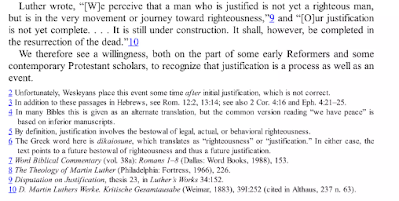

It looks like Mr. Akin recycled his old article and made additions and corrections when he published his book (for instance, the first Luther quote is expanded in the book form and the documentation was corrected).  Mr. Akin has relied heavily on a section from Paul Althaus, The Theology of Martin Luther, (particularly page 226) in this presentation of Luther, with both quotes cited by Althaus on page 237 (Althaus translation of the first quote is slightly different than LW 34). Akin uses this material drawn from Althaus to conclude that "a number of recent Protestant scholars" recognize that Justification is a process and "in doing so they are retrieving a concept that was present in the thought of some of the early Reformers" (p.28). 

Mr. Akin argues for the Roman Catholic "process" of justification rather than the imputation of Christ's righteousness. For Akin, it's only "the final, consummating declaration of our righteousness" done in the future that will be the deciding factor if one is actually justified before God or not.  

Quote #1 "We perceive that a man who is justified is not yet a righteous man, but is in the very movement or journey toward righteousness"

This quote comes from a series of disputation statements based on Romanns 3:28, While this is the extent of the statement (it is point #23), the explanation of what Luther means in regard to justification is contained in the surrounding theses and subsequent explanations. In Theses #4, Luther says, "A man is truly justified by faith in the sight of God, even if he finds only disgrace before man and in his own self" (LW 34:151). For Luther, this is profound, for it is human nature to expect to earn salvation by works.  For Luther, our works do not contribute to standing before God as justified. In the same set of Theses, Luther says, "Therefore, whoever is justified is still a sinner; and yet he is considered fully and perfectly righteous by God who pardons and is merciful" (Theses #24).  Luther says the righteousness of Christ "cannot be laid hold of by our works" (Theses # 27) and that "faith alone justifies without our works " because one cannot say "I produce Christ or the righteousness of Christ" (Theses #28).

Luther says that God, in essence, tolerates sin in people until they enter his heavenly eternal kingdom. It is there he states, "For we perceive that a man who is justified is not yet a righteous man, but is in the very movement or journey toward righteousness." Is Luther saying that justification is a journey of the "process" of gaining righteousness toward some sort of eventual justification to stand before a holy God? Not at all. Luther says that good works done by the regenerate are the "start of a new creature" "in the battle against the sin of the flesh" (Theses #35).


Quote #2 “Our justification is not yet complete.... It is still under construction. It shall, however, be completed in the resurrection of the dead.” 

The document this quote comes from (Die Promotionsdisputation von Palladius und Tilemann [Rom 3:28] On the Works of the Law and of Grace [1537]) is scheduled to be released in a future volume of Luther's Works for English readers. The original text can be found here. Similar to the first quote, when Luther speaks of justification as "under construction" and then "completed in the resurrection of the dead," the emphasis is not on process-journey of gaining righteousness to stand before a holy God. The earthly existence is only the mere beginning of intrinsic personal righteousness.  As Paul Althaus explains of Luther, "The condition of being righteous in ourselves can be described in the present tense only as having begun, but its completion lies only in the future; we are only becoming righteous" (Althaus, 237). 


Conclusion
This blog entry is one of those keep your eyes on the ball exercises. For Luther, it's the one-time event in a person's life, in which the righteousness of Christ is imputed to a sinner that allows one into the saving presence of the Holy God, and to savingly remain forever in the presence of Holy God. In the final court room scene in each person's life, God declares a person righteous because the righteousness of Christ entirely covers that person.

The confusion that the anonymous commenter seized and applied to Romanism is that, according to Lutheran scholar Paul Althaus, "Luther used the term 'to justify' in [iustificare] and 'justification' [justificatio] in more than one sense" (Althaus, 226). Sometimes Luther used it to mean that sense in which a sinner stands before God and is judged according to the righteousness of Christ, imputed by faith. Other times he uses it to mean a person actually intrinsically becoming righteous. Althaus explains, "Justification in that sense remains incomplete on this earth and is first completed on the Last Day. Complete justification in this sense is an eschatological reality" (Althaus, 226).     By being made "perfectly righteous" Luther means being given a glorified body. Althaus later says of Luther's view, "This already present righteousness is both a complete and a partial righteousness, depending on the way in which it is viewed. It is complete when viewed as acceptance by God and as a participation in Christ's righteousness; Christ's righteousness is a totality and the believer participates in that totality. It is partial as man's new being and new obedience" (Althaus, 236). That new obedience culminates in the future: For Luther, in the final court room scene, a person is given a new existence: "Sin remains, then, perpetually in this life, until the hour of the last judgment comes and then at last we shall be made perfectly righteous" (LW 34:166).

For Rome, in the eternal state, God will look at person and judge whether or not that person is completely righteous. If that person is not completely infused with personal righteousness, that person is not given a glorified body, but is sent off to purgatory until personal righteousness is complete. In this world, therefore, a strong emphasis is placed on participating in the sacraments and gathering up as much righteousness as one can. Note Jimmy Akin's comment from his old article
[T]he ultimate and final courtroom declaration concerning the believer does not occur until he stands before God (at his death and at the end of the world). So we may infer that the ultimate and final pronouncement of the believer as righteous does not lie in this life.
In Luther's view, it is the righteousness of Christ given to a person that allows a sinner to enter into God's holy presence... and stay there. There is no need to be sent off to purgatory to be made righteous. In The Disputation Concerning Justification, Luther comments on the view of Erasmus that captures some of the nuances under scrutiny here: 
By faith we are justified and by faith we receive forgiveness of sins and the beginning of obedience, as Erasmus also argues. He distinguishes between faith and works in this way. Faith alone begins the forgiveness of sins, but works obtain salvation or merit and the kingdom of heaven or eternal life. He says that faith in this life removes sins and gives remission of sins, afterward he ascribes salvation to works. This is most excellent and plausible, and this argument pleases reason. For reason rushes in blindly and thinks thus: Eternal salvation is something else than Christian righteousness. It concludes that it can by its own works merit eternal salvation, as if we obtained justification through faith and salvation through works. So it seems plausible enough, since the text clearly said, “Man believes with his heart and so is justified, and he confesses with his lips and so is saved” [Rom. 10:10]. But this is absurd in the first place, because then Christ must be an incomplete and not a perfect savior. They wish thereby to make us more perfect than our Savior, because they attribute that which is the greatest to works and that which is least to Christ and faith. Even if Christ merits forgiveness of sins for us, we must still save ourselves. Likewise, we need Christ for justification, as if for the least important reason, afterward we need obedience for our salvation, as if for the most important reason. Who says such things? Beware of these arguments and of such men, since this now makes Christ less highly esteemed a savior, but detracts from his honor, that he has made us righteous by his death, since we ourselves can obtain eternal life by our works. These absurdities bring darkness into the minds of men. For they assume that Christ must not be the Savior, that he made us safe from original sin, and that we must later become perfect by ourselves. [LW 34:163]
In this life, if works are done, they are not done to gain favor with God.  In the Disputation in which the first quote was extracted, Luther repeatedly argues,
Works only reveal faith, just as fruits only show the tree, whether it is a good tree. I say, therefore, that works justify, that is, they show that we have been justified, just as his fruits show that a man is a Christian and believes in Christ, since he does not have a feigned faith and life before men. For the works indicate whether I have faith. I conclude, therefore, that he is righteous, when I see that he does good works. In God’s eyes that distinction is not necessary, for he is not deceived by hypocrisy. But it is necessary among men, so that they may correctly understand where faith is and where it is not. [LW 34:161].

Addendum

“Official Roman Catholic theology includes sanctification in the definition of justification, which it sees as a process rather than a single decisive event and affirms that while faith contributes to our acceptance with God, our works of satisfaction and merit contribute too. Rome sees baptism, viewed as a channel of sanctifying grace, as the primary instrumental cause of justification, and the sacrament of penance, whereby congruous merit is achieved through works of satisfaction, as the supplementary restorative cause whenever the grace of God’s initial acceptance is lost through mortal sin. Congruous, as distinct from condign, merit means merit that it is fitting, though not absolutely necessary, for God to reward by a fresh flow of sanctifying grace. On the Roman Catholic view, therefore, believers save themselves with the help of the grace that flows from Christ through the church’s sacramental system, and in this life no sense of confidence in God’s grace can ordinarily be had. Such teaching is a far cry from that of Paul.” (J.I. Packer Concise Theology)

Wednesday, November 12, 2014

Is Tradition God-Breathed in the Roman Catholic Church?

Over on the Catholic Answers Forums I was part of an interesting exchange on the relationship between Scripture and Tradition. A link was posted to a review of Louis Bouyer's The Spirit and Forms of Protestantism. The article explains that Bouyer believed that sola gratia, sola fide, and sola scriptura were on a certain level, correct doctrines for the Roman Catholic Church. How Bouyer explains this is not exactly what I as committed Protestant mean when I use the same terms. I can appreciate that rather than the usual negative polemical campaign against Protestantism Bouyer is trying another way: taking distinctly Protestant slogans and attempting to synthesize them into Roman Catholicism. On the other hand, I'm leery of attempts of taking historic terms and redefining them so as to fit into another system of thought (Norman Geisler on Calvinism, anyone?).

In regard to his treatment of sola scriptura, the article states:
Bouyer also sees a negative principle that the Reformation unnecessarily associated with sola Scriptura or the sovereignty of the Bible. Yes, the Bible alone is the Word of God in the sense that only the Bible is divinely inspired. And yes the Bible’s authority is supreme in the sense that neither the Church nor the Church’s Tradition "trumps" Scripture. But that doesn’t mean that the Word of God in an authoritative form is found only in the Bible, for the Word of God can be communicated in a non-inspired, yet authoritative form as well. Nor does it mean that there can be no authoritative interpreter of the Bible (the Magisterium) or authoritative interpretation of biblical doctrine (Tradition). Repudiation of the Church’s authority and Tradition simply doesn’t follow from the premise of Scripture’s supremacy as the inspired Word of God. Furthermore, the Tradition and authority of the Church are required to determine the canon of the Bible.
The debate, as I understand it, is that the Roman Catholic side finds the "Word of God" in another form besides Scripture (Tradition, the Magisterium). In the discussion I mentioned I was unsure what was meant above by "the Word of God can be communicated in a non-inspired, yet authoritative form as well." My genuine concern  was whether or not the article wanted to go so far and say infallible Tradition is not divinely inspired. If so, they've set up a situation in which Tradition (and any infallible pronouncement from the Magisterium) is infallible but not divinely inspired.

In response, the following undocumented quote, alleged to be from Jimmy Akin, was provided:
The Catholic Church teaches that the Bible alone is the inspired word of God, where inspired refers to the action of the Holy Spirit in guiding the human authors to write what God wanted written, in the precise way he wanted it written. Sacred Tradition, though also the word of God, does not come to us in an inspired (or "God-breathed") form (cf. 2 Pet. 3:16). Theologians talk about sacred Tradition being "assisted" by the Holy Spirit in the life of the Church, to be sure, as they do the teaching ministry or magisterium of the Church. But only Scripture has God as its primary author and in that sense only Scripture is divinely inspired.
I have no reason to believe this quote is not Jimmy Akin's, but without a context, the following comments are speculative. The position being put forth by Akin appears to be as follows:

1. There is only one inspired Word of God: the Bible.

2. There is another Word of God called Tradition which is not inspired by God but is "assisted by the Holy Spirit."

3. Only the Bible has God as it's primary author, and only if something has God as it's primary author can it be described as inspired.

4. Tradition (and the Magisterium) are the primary authors of themselves with God assisting, therefore if God acts as an assistant, he is not inspiring either because He is not the primary author.

Now if I've got this position correct, the popular Roman Catholic proof-text for Tradition, 2 Thes. 2:15 would imply that what was passed down by word of mouth was not God-breathed (or inspired by God), but rather assisted by the Holy Spirit. I don't consider myself any sort of expert on the relationship between Scripture and Tradition in the Roman church, but in what I have read, I don't recall ever coming across a dogmatic pronouncement making a distinction between a Word of God that is assisted rather than inspired.

The crucial phrase (as I see it) from Mr. Akin's quote is "Theologians talk about sacred Tradition being 'assisted' by the Holy Spirit in the life of the Church...". Had the position been a perspicuous dogmatic declaration (if there really is such a thing), I don't think Mr. Akin would've used the word "Theologians." It appears to me the position being put forth is an interpretation of (at least) Dei Verbum, and perhaps some other official Roman statements.

Another of Akin's articles was brought into the discussion. After a number of points about how to use and explain Tradition, Mr. Akin states, "While these considerations may be useful as an apologist explores the relationship between Scripture and Tradition, he ultimately will have to decide how he thinks they fit together. So far, the Church has left him considerable latitude." Indeed. Here was a good example that  "Tradition" will be explained somewhat differently depending on which Roman Catholic one is engaging. Some years ago I posted “Tradition” as Viewed by Popular Roman Catholic Apologists… and a Response. There I stated,

There is not a consensus opinion as to the exact content of Tradition, the precise relationship between scripture and Tradition, and exactly how the vehicle of Tradition functions and becomes known by the church. Rome’s official statements do not explicitly define whether Tradition is the second of a two-part revelation (known as partim-partim), or if both forms of revelation contain the entirety of God’s revealed truth. Does Tradition function as the interpreter of scripture, or is it interpreted by scripture, or do they interpret each other? Is the content of Tradition confirmed by historical scrutiny, or is it an unwritten opinion only confirmed by a movement within the developing church? Vatican II commands Catholics to accept and honor something quite ambiguous. One wonders if individual Catholics attempting devotion and reverence toward Tradition actually have the same or a differing concept in view. While dogmatic statements from official Roman Catholic councils are put forth to clarify truth, their statements on Tradition have done quite the opposite. 

Wednesday, July 10, 2013

Jimmy Akin: Are most Catholics in America going to hell?

From the private interpretation of one of Rome's apologists:


How Many People Go To Hell?
We can’t really know this.
Different figures in Church history have had different viewpoints on the question, and the Church itself does not have a teaching on the matter.
Some passages of Scripture seem to have a pessimistic tone but others seem to have an optimistic tone. We also should be careful in taking the pessimistic ones and applying them directly to our own age, because they were written in and about an age in which the world was swallowed in pagan darkness and the knowledge of the true God and his Son was severely limited compared to today. For its part, the Church teaches the real possibility of dying in mortal sin and of eternal damnation, but it does not teach how many people experience this in practice.

[source]

Tuesday, July 09, 2013

Jimmy Akin Dates the Book of Revelation, Without the Help of the Magisterium

Roman apologist Jimmy Akin has an article on the dating of the book of Revelation, dating it before 70 A.D. Dating Revelation previous to 70 A.D. is all the rage these days, particularly with the rise of preterism.  It would be very interesting to call Catholic Answers and ask Mr. Akin which Protestant sources he read to arrive at this view.

Thursday, April 04, 2013

Jimmy Akin Goes Viral Over Pope's Foot-Washing

I followed a rabbit trail from The Bellarmine Report (Robert Sungenis) over to a story entitled,"Pope's foot-wash a final straw for traditionalists." The article states,

The church's liturgical law holds that only men can participate in the rite, given that Jesus' apostles were all male. Priests and bishops have routinely petitioned for exemptions to include women, but the law is clear. Francis, however, is the church's chief lawmaker, so in theory he can do whatever he wants. "The pope does not need anybody's permission to make exceptions to how ecclesiastical law relates to him," noted conservative columnist Jimmy Akin in the National Catholic Register. But Akin echoed concerns raised by canon lawyer Edward Peters, an adviser to the Vatican's high court, that Francis was setting a "questionable example" by simply ignoring the church's own rules.

Now, Google search the quote from Jimmy Akin, and notice that a lot of news sites picked it up. The quote in context can be found here. He states,

2. How does Pope Francis's decision relate to this?
 Pope Francis's decision goes beyond what is provided in these texts in at least one respect: Instead of washing the feet of adult males, he decided to wash the feet of young women as well. The fact that one of them was a Muslim does not go beyond what the letter of the text specifies, since it does not indicate that the chosen men are to be Catholics (or other Christians). One would expect that they would be Catholics, and one could argue that this is implied in the text, but since Pope Francis is now the individual who is ultimately responsible for interpreting the text, if he judges that it does not prevent washing the feet of non-Christians then it doesn't. His decision does go beyond the text in the matter of men, however.

3. Can Pope Francis just do things that aren't provided for in the law?
Yes. The pope does not need anybody's permission to make exceptions to how ecclesiastical law relates to him. He is canon law's ultimate legislator, interpreter, and executor. And it's not uncommon, at least in recent decades, for a pope to make exceptions to the law in how papal ceremonies are performed.

John Paul II frequently held liturgies that departed from what the Church's liturgical texts provide, particularly when he was making a form of dramatic outreach, and Pope Francis seems to be following in his footsteps.

Saturday, March 09, 2013

Jimmy Akin on Why an Atheist May Be in Heaven

Here's another old post of Carrie's I just came across from the archives-

Below is a clip of Jimmy Akin on Catholic Answers Live back in April stating that atheists can be saved. The full-length MP3 can be found here. I have transcribed his words below:
“It’s also possible for a person to die in God’s friendship even if the person didn’t consciously know God during life. Someone could, through no fault of their own, be unaware of God or not have ever been given sufficient evidence that they concluded God is true, through no fault of their own, and if they otherwise cooperated with his grace, then God won’t hold their ignorance of him against them. So, it’s possible for an atheist to be saved, it’s still through Jesus Christ and through God’s grace, but they can still die not knowing God and still be on their way to heaven as long as they otherwise cooperated with his grace.”
This is justification by works alone, without faith, and contrary to Scripture.
"For God so loved the world that he gave his one and only Son, that whoever believes in him shall not perish but have eternal life. For God did not send his Son into the world to condemn the world, but to save the world through him. Whoever believes in him is not condemned, but whoever does not believe stands condemned already because he has not believed in the name of God's one and only Son." John 3:16-18
Jimmy would also do well to read through Romans 1 before stating "Someone could, through no fault of their own, be unaware of God or not have ever been given sufficient evidence that they concluded God is true, through no fault of their own".
"The wrath of God is being revealed from heaven against all the godlessness and wickedness of men who suppress the truth by their wickedness, since what may be known about God is plain to them, because God has made it plain to them. For since the creation of the world God's invisible qualities—his eternal power and divine nature—have been clearly seen, being understood from what has been made, so that men are without excuse." Romans 1:18-20

Sunday, March 03, 2013

Comforting Thoughts on Electing the Next Pope...

....from Jimmy Akin:

God Guides the Church
We can be confident of the general principle that God guides his Church. This is something we have biblical assurance of. But his guidance does not prevent human free will from operating, and that means there is the potential for humans to abuse their free will. That applies to the college of cardinals, too, even when they are electing a pope. They do not lose their free will.

Human Failure in History
 We have been very fortunate in recent times to have a series of very holy, wise popes, but this has not always been the case. If you look at history, certain popes have been real scoundrels, like Pope Benedict IX (first elected in 1032). He was elected pope when still a boy. His reign was scandalous. He insisted upon monetary compensation in order to get him to resign. And then he didn't stay resigned. He was the only man to ever hold the papacy more than once. (In fact, he may have held it as many as three times.) Without going into all the scandals attributed to him, the Catholic Encyclopedia states: "He was a disgrace to the Chair of Peter."

Saturday, March 24, 2012

Why do some Bibles omit portions of Daniel and Esther? Akin Says: Luther

Here's one I found over on the Catholic Answers Facebook page: "Why do some Bibles omit portions of Daniel and Esther? Catholic Answers Senior Apologist Jimmy Akin explains:"


The question given to Mr. Akin concerns why Protestant Bibles do not have Daniel 14. The question actually begins abruptly, so it's a little confusing. The question concerns all the additional material in Daniel  (those sections that find their home in contemporary Roman Catholic versions of the Bible).

Akin begins his answers by presenting the standard response: the alleged additional material is found in the Septuagint. Rather than reinvent the wheel, I'll refer to earlier blog entries: Daniel's Susanna: Why Isn't it Biblical? (see particularly Jason Engwer's comments), and Francis Beckwith: ETS Shows Sympathies for the Catholic Canon. Akin infers that Protestant reliance on the Masoretic text (which excludes the additional material in Daniel) is relying on "modern Judaism." Previous to this, there were multiple canons used by the Jews. The only thing Akin sees as certain is that the early church used the Septuagint. What exactly was contained in the Septuagint though is a little murky (as discussed in the links above). For Akin, the testimony of the early church's acceptance of the Septuagint is that which confirms the inclusion of the extra material in Daniel.

Why then do Protestant bibles not have the additional material in Daniel?  It was the devious work of that rascal Martin Luther (begin Akin clip at 3:10): "Martin Luther decided he didn't like certain things that were in the Catholic Bible... and...so he looked for a way to exclude those things." What were the certain things? Akin doesn't say. He says that the easiest way for Luther to remove things from the Bible was to look at what the Jews used for the Old Testament, and the the only Jews Luther was aware of were "modern Jews."

Completely missing from Akin's answer is any of the testimony from Jerome and the reason why many think the extra material in Daniel is a later addition to the text. In responding to Porphyry's claims against the entire book of Daniel, Jerome grants he's made some good points in regard to the apocryphal additions:
But among other things we should recognize that Porphyry makes this objection to us concerning the Book of Daniel, that it is clearly a forgery not to be considered as belonging to the Hebrew Scriptures but an invention composed in Greek. This he deduces from the fact that in the story of Susanna, where Daniel is speaking to the elders, we find the expressions, "To split from the mastic tree" (apo tou skhinou skhisai) and to saw from the evergreen oak (kai apo tou prinou prisai), a wordplay appropriate to Greek rather than to Hebrew. But both Eusebius and Apollinarius have answered him after the same tenor, that the stories of Susanna and of Bel and the Dragon are not contained in the Hebrew, but rather they constitute a part of the prophecy of Habakkuk, the son of Jesus of the tribe of Levi. Just as we find in the title of that same story of Bel, according to the Septuagint, "There was a certain priest named Daniel, the son of Abda, an intimate of the King of Babylon." And yet Holy Scripture testifies that Daniel and the three Hebrew children were of the tribe of Judah. For this same reason when I was translating Daniel many years ago, I noted these visions with a critical symbol, showing that they were not included in the Hebrew. And in this connection I am surprised to be told that certain fault-finders complain that I have on my own initiative truncated the book. After all, both Origen, Eusebius and Apollinarius, and other outstanding churchmen and teachers of Greece acknowledge that, as I have said, these visions are not found amongst the Hebrews, and that therefore they are not obliged to answer to Porphyry for these portions which exhibit no authority as Holy Scripture...
But even Origen in his Vulgate edition (of the Greek Old Testament) placed asterisks around the work of Theodotion, indicating that the material added was missing (in the Septuagint), whereas on the other hand he prefixed obeli (i.e., diacritical marks) to some of the verses, distinguishing thereby whatever was additional material (not contained in the Hebrew). And since all the churches of Christ, whether belonging to the Greek-speaking territory or the Latin, the Syrian or the Egyptian, publicly read this edition with its asterisks and obeli, let the hostile-minded not begrudge my labor, because I wanted our (Latin-speaking) people to have what the Greek-speaking peoples habitually read publicly in the regions of Aquila and Symmachus. And if the Greeks do not for all their wealth of learning despise the scholarly work of Jews, why should poverty-stricken Latins look down upon a man who is a Christian? And if my product seems unsatisfactory, at least my good intentions should be recognized. [source].
Commenting on Daniel 13:54 Jerome says,
'Tell me under which tree thou sawest them conversing with each other.' And he answered, 'Under the mastic tree.' And Daniel said to him, 'Well hast thou lied against thine own head; for behold, the angel of God, having received His sentence from Him, shall cleave thee in twain.' And a little while later the other elder said, 'Under the holm tree.' And Daniel said to him, 'Well hast thou lied against thine own head; but the angel of the Lord waiteth with a sword to sever thee in twain.'" Since the Hebrews reject the story of Susanna, asserting that it is not contained in the Book of Daniel, we ought to investigate carefully the names of the trees, the skhinos and the prinos, which the Latins interpret as "holm-oak" and "mastic-tree," and see whether they exist among the Hebrews and what their derivation is ---- for example, as "cleavage" [Latin (scissio) is derived from "mastic" [Greek skhinos], and "cutting" or "sawing" [Latin sectio, serratio] is derived from "holm tree" [Greek prinos, which resembles the Greek word for "to saw": prio] in the language of the Greeks. But if no such derivation can be found, then we too are of necessity forced to agree with the verdict of those who claim that this chapter [Greek pericope] was originally composed in Greek, because it contains Greek etymology not found in Hebrew. [That is, because Daniel twice makes a sinister wordplay based upon the Greek names of these two trees, and a similar pun could not be made out from the Hebrew names, if any, of these trees, the story itself could never have been composed in Hebrew.] But if anyone can show that the derivation of the ideas of cleaving and severing from the names of the two trees in question is valid in Hebrew, then we may accept this scripture also as canonical.
Commenting on chapter 14, Jerome says:
"And as soon as he had opened the door, the king looked upon the table and cried out with a great voice: 'Great art thou, O Bel, and there is no deceit with thee.'" The statement of Scripture in this passage, "He cried out with a great voice," may seem, because of its reference to an idolator ignorant of God, to refute the observation put forth a little previously, that the expression "great voice" is found only in connection with saints. This objection is easily solved by asserting that this particular story is not contained in the Hebrew of the Book of Daniel. If, however, anyone should be able to prove that it belongs in the canon, then we should be obliged to seek out some answer to this objection.
Dead Sea Scroll manuscript fragments have been found of the book of Daniel. To my knowledge, these fragments do not contain any of the Greek additions (the Prayer of Azariah, the Song of the Three Young Men, and the Story of Susanna). Jerome's appeal for proof has yet to be answered.

Why did Luther remove the additions to Daniel? He didn't. He actually translated them into German and included them in his translation of the Bible.
Preface to Parts of Esther and Daniel 1534
Here follow several pieces which we did not wish to translate [and include] in the prophet Daniel and in the book of Esther. We have uprooted such cornflowers (because they do not appear in the Hebrew versions of Daniel and Esther). And yet, to keep them from perishing, we have put them here in a kind of special little spice garden or flower bed since much that is good, especially the hymn of praise, Benedicite, is to be found in them. But the texts of Susanna, and of Bel, Habakkuk, and the Dragon, seem like beautiful religious fictions, such as Judith and Tobit, for their names indicate as much. For example, Susanna means a rose, that is, a nice pious land and folk, or a group of poor people among the thorns; Daniel means a judge, and so on. Be the story as it may, it can all be easily interpreted in terms of the state, the home, or the devout company of the faithful. [LW 35:352].
As I pointed out in my previous entry, Luther actually enjoyed some of the additional material. Susanna "seem[ed] like beautiful religious fiction." If someone wanted to use it, Luther said "it can all be easily interpreted in terms of the state, the home, or the devout company of the faithful" [LW 35:353]. Luther being consistent with this either quotes or refers to Susanna in LW 11:112; 12:201; 18:330; 37:322; 44:223.

Monday, September 12, 2011

"We Have Apostolic Tradition"- The Unofficial Catholic Apologist Commentary #2

Originally appeared on the aomin blog, 01/28/2009

Catholic apologists often let us know how crucial it is to have an infallible magisterium and church Tradition in order to interpret the Bible correctly. With so many Catholic apologists now commenting on sacred scripture, I thought it would be interesting to provide their commentary on the Bible. Let's see how they've been able to rightly divide the word of truth. I'll post their interpretations as I come across them.

In this MP3 clip, Catholic apologist Jimmy Akin was asked if the offering of Issac by Abraham in Genesis 22 was in accord with "reason":

Jimmy Akin Interprets Genesis 22

Instead of consulting "Tradition," Akin first consults the philosopher, Søren Kierkegaard (so much for consulting the Church Fathers). Ironically, Kierkegaard wasn't a Roman Catholic, but was raised a Lutheran. Akin explains Kierkegaard's interpretation of the offering of Isaac as "If God says Abraham should offer Isaac on the alter, then it's morally legitimate for Abraham to do that." In case this interpretation isn't satisfactory, Akin provides another: "He [God] is also showing Abraham and his descendants that you shouldn't commit child sacrifice because God stops him [Abraham] from actually slaying his son.... There could be an object lesson here that child sacrifice is ultimately not what God wants."

The most interesting aspect of Akin's answer on this passage is his lack of mentioning Christ, as well as the ram caught in the thicket. Rather than locating my old copy of Kierkegaard's Fear and Trembling, notice how others in church history like Augustine have interpreted the passage:

"And on this account Isaac also himself carried to the place of sacrifice the wood on which he was to be offered up, just as the Lord Himself carried His own cross. Finally, since Isaac was not to be slain, after his father was forbidden to smite him, who was that ram by the offering of which that sacrifice was completed with typical blood? For when Abraham saw him, he was caught by the horns in a thicket. What, then, did he represent but Jesus, who, before He was offered up, was crowned with thorns by the Jews?" [source]

"But let us rather hear the divine words spoken through the angel. For the Scripture says, "And Abraham stretched forth his hand to take the knife, that he might slay his son. And the Angel of the Lord called unto him from heaven, and said, Abraham. And he said, Here am I. And he said, Lay not thine hand upon the lad, neither do thou anything unto him: for now I know that thou fearest God, and hast not spared thy beloved son for my sake." It is said, "Now I know," that is, Now I have made to be known; for God was not previously ignorant of this. Then, having offered up that ram instead of Isaac his son, "Abraham," as we read, "called the name of that place The Lord seeth: as they say this day, In the mount the Lord hath appeared." As it is said, "Now I know," for Now I have made to be known, so here, "The Lord sees," for The Lord hath appeared, that is, made Himself to be seen. "And the Angel of the Lord called unto Abraham from heaven the second time, saying, By myself have I sworn, saith the Lord; because thou hast done this thing, and hast not spared thy beloved son for my sake; that in blessing I will bless thee, and in multiplying I will multiply thy seed as the stars of heaven, and as the sand which is upon the seashore; and thy seed shall possess by inheritance the cities of the adversaries: and in thy seed shall all the nations of the earth be blessed; because thou hast obeyed my voice." In this manner is that promise concerning the calling of the nations in the seed of Abraham confirmed even by the oath of God, after that burnt-offering which typified Christ. For He had often promised, but never sworn. And what is the oath of God, the true and faithful, but a confirmation of the promise, and a certain reproof to the unbelieving?"[source]

Was the sacrifice of Isaac by Abraham in accord with "reason"? Akin is right, there is an object lesson here. If one keeps in mind the entire Bible has Christ as it's central focus, one has found the "reason" for Genesis 22.

Saturday, June 04, 2011

Rome's New Statue: "Wow is it ugly"

http://www.jimmyakin.org/2011/05/romes-new-ugly-john-paul-ii-statue.html


"I have to say that this statue is even worse than the one inside the entrance of the Vatican museums. That statue, titled “Varcare la soglia” (Crossing the Threshold), is a slab of marble with a bas relief of John Paul II on each side, apparently shoving a goofy-looking, modern, cell-phone clutching man out of the block of marble. I was stunned when I first saw it."

Sunday, May 29, 2011

Catholic Apologist Jimmy Akin is a "Semi-Calvinist"?

http://ronconte.wordpress.com/2011/05/07/a-summary-of-the-heresies-taught-by-jimmy-akin/

It's true, you can find anything on the Internet. This Roman Catholic writer (in the link above) was angered by Jimmy Akin's article: A TIPTOE THROUGH TULIP. After setting forth the five points of Calvinism, Akin's detractor states,

This set of ideas has been substantially rejected by the Council of Trent and by the teaching of the Magisterium since that time. But Akin insists that a Catholic may accept each of these ideas, with only limited modification. All five Calvinist doctrines on salvation are explained by Akin in such a manner that Calvinist doctrine and Catholic doctrine are merged. His resulting position on soteriology is part Calvinist, and part Catholic, and fundamentally incompatible with sound Catholic teaching on grace and salvation.

I can't help but recall Geisler's Chosen But Free. It's true, Akin does indeed modify TULIP to be palatable for Romanism, as Geisler tried to make it palatable for Evangelical Arminians.

Here are a few excerpts from Akin:

Total Depravity: What would a Catholic think of this teaching? While he would not use the term "total depravity" to describe the doctrine, he would actually agree with it. The accepted Catholic teaching is that, because of the fall of Adam, man cannot do anything out of supernatural love unless God gives him special grace to do so. Thomas Aquinas declared that special grace is necessary for man to do any supernaturally good act, to love God, to fulfill God's commandments, to gain eternal life, to prepare for salvation, to rise from sin, to avoid sin, and to persevere.

Unconditional election: What would a Catholic say about this? He certainly is free to disagree with the Calvinist interpretation, but he also is free to agree. All Thomists and even some Molinists (such as Robert Bellarmine and Francisco Suarez) taught unconditional election.

Limited Atonement: This is not to say there is no sense in which limitation may be ascribed to the atonement. While the grace it provided is sufficient to pay for the sins of all men, this grace is not made efficacious (put into effect) in the case of everyone. One may say that although the sufficiency of the atonement is not limited, its efficiency is limited. This is something everyone who believes in hell must acknowledge because, if the atonement was made efficacious for everyone, then no one would end up in hell.

Irresistible Grace: A Catholic can agree with the idea that enabling grace is intrinsically efficacious and, consequently, that all who receive this grace will repent and come to God. Aquinas taught, "God's intention cannot fail... Hence if God intends, while moving it, that the one whose heart he moves should attain to grace, he will infallibly attain to it, according to John 6:45, 'Everyone that has heard and learned from the Father comes to me.'"

Perseverance of the saints: A Catholic must affirm that there are people who experience initial salvation and who do not go on to final salvation, but he is free to hold to a form of perseverance of the saints. The question is how one defines the term "saints"--in the Calvinist way, as all those who ever enter a state of sanctifying grace, or in a more Catholic way, as those who will go on to have their sanctification (their "saintification") completed. If one defines "saint" in the latter sense, a Catholic may believe in perseverance of the saints, since a person predestined to final salvation must by definition persevere to the end. Catholics even have a special name for the grace God gives these people: "the gift of final perseverance."

Akin fleshes this out in greater detail. I guess in Akin's defense against his fellow Romanist, Akin would probably argue from the old cliche that Romanism has 100% of the truth, while Calvinism has some other less percentage, so his setup is acceptable. On the other hand, like Geisler, Akin takes accepted terms and pours different meaning into them. This is simply a ridiculous way to do historical theology. I wonder if Akin could just as easily take doctrines from Mormonism and do the same thing: make an acceptable Romanist version of Latter Day Saint theology.

From my Reformed perspective, Akin's article suffers because of his basic definitions of TULIP. As I skimmed the article, I didn't see any confessional statements, say from the Westminster Confession, or the Three Forms of Unity (If they are there somewhere, I missed them in my quick reading, but I don't think they are). Take for instance, Akin's explanation of Total Depravity:

Despite its name, the doctrine of total depravity does not mean men are always and only sinful. Calvinists do not think we are as sinful as we possibly could be. They claim our free will has been injured by original sin to the point that, unless God gives us special grace, we cannot free ourselves from sin and choose to serve God in love. We might choose to serve him out of fear, but not out of unselfish love.

Akin documents this with end note #9, which simply gives more explanation about the Romanist correctness of serving God in fear, not an actual doctrinal standard or source.

Akin's first few sentences appear to be trying to make the distinction between total and utter depravity, but even this is muddled. The Reformed hold total depravity refers to the fact that our whole humanity is fallen. Every part of a human being has been affected by the Fall (will, heart, mind, body, etc). As to the rest of Akin's definition, The Reformed hold Romans 3:10-12 describes how no one does good. The ultimate standard for goodness by which mankind is judged is the law of God, which reflects his perfect character. Judged against that standard, no one does good.  So, contrary to Akin, men are always and only sinful.

The Reformed don't typically use language like "free will has been injured by original sin." We don't speak of injured free will, we speak of the enslaved will or dead in sin. The Canons of Dort declare,

"Therefore, all people are conceived in sin and are born children of wrath, unfit for any saving good, inclined to evil, dead in their sins, and slaves to sin; without the grace of the regenerating Holy Spirit they are neither willing nor able to return to God, to reform their distorted nature, or even to dispose themselves to such reform."

The Westminster Confession states, "Man, by his fall into a state of sin, hath wholly lost all ability of will to any spiritual good accompanying salvation; so as a natural man, being altogether averse from that good, and dead in sin, is not able, by his own strength, to convert himself, or to prepare himself thereunto."

Akin says some sort of "special grace" is given so men can free themselves from sin and choose to serve God. This isn't Reformed either. Akin's paradigm appears to posit a spiritually sick man that needs a little help to get himself going. The Reformed though posit the grace of the regenerating Holy Spirit raises a spiritually dead man to spiritual life.

Throughout Akin's entire definition of total depravity, he either misrepresented Calvinism, or didn't use words that expressed the theological point accurately. Perhaps if he had used confessional statements, this could have been avoided. According to Akin's procedure, I might as well discard my copy of the Catechism of the Catholic Church and just make up what I want to about Romanism.

Monday, May 09, 2011

How does Mary Hear Prayers?

On Catholic Answers Live, Jimmy Akin explains how Mary is aware of prayers:


Jimmy Akin: How does Mary Hear Prayer? (mp3)

If doctrine doesn't need to be grounded in Scripture, anything goes! Actually, Jimmy doesn't even bother to offer a Scripture, which in a way, is rather honest.

Sunday, May 01, 2011

Dei Verbum Strikes Again

Dei Verbum states:

107. The inspired books teach the truth. "Since therefore ALL that the inspired authors or sacred writers affirm should be regarded as affirmed by the Holy Spirit, we must acknowledge that the books of Scripture firmly, faithfully, and without error teach that truth which God, for the sake of our salvation, wished to see confided to the Sacred Scriptures." [Vatican II DV 11]

This statement itself is prone to multiple interpretations with the Roman community. Conservative Roman Catholic apologists see this as a clear statement that the entirety of Scripture is without error. Some Roman Catholic scholars though (like R.A.F. MacKenzie and Raymond Brown) see the phrase “for the sake of our salvation” as limiting inerrency to only those sections of Scripture that teach about salvation.

Eric Svendsen notes, “No one can tell us what the ‘official’ Roman Catholic teaching is on this issue, and Rome’s ‘infallible interpreter’ is of absolutely no advantage to the Roman Catholic apologist, for he has remained silent on the matter. [Source: Eric Svendsen, Upon This Slippery Rock, 24]. Thus, the actual teachings of the Roman Catholic Church are prone to interpretation. The Catholic apologist must use his own private interpretation to determine what the meaning of Roman Catholic teaching is. The conservative and liberal Roman Catholic can read the same document and come to two differing opinions.

So on a fundamental issue- what are, or are not, the very Words of God, Catholics are not unified.

Jimmy Akin has an update here: Biblical Inerrancy Under Discussion! Your Prayers Needed! On the statement from Dei Verbum, Akin states, "the bottom line is that it is not as clear as it should be and is basically a compromise text worked out at the council between parties on different sides of the debate."

-snip-

"When the 2008 synod of bishops came around, I was quite concerned how this topic would be handled, because while the synod is a function of the magisterium and thus is guided by the Holy Spirit, we do not have a guarantee of its infallibility. Consequently, though human weakness, the synod could conceivably have muddled the waters on this question even further or, God forbid, said something false regarding biblical inerrancy."

But Akin says things look good that the Bible may actually be finally clearly declared inerrant. According to Akin, another chunk of the big showdown on this topic will be May 2-6. He covets your prayers for Rome as they try to continue to determine if the Bible is inerrant. Akin states,

"It may be some time—years even—before we see what the PBC comes up with (if we ever see it), but the issue of biblical inerrancy is an important one."

Yeah, it's much easier to declare John Paul II a saint than to figure out if the Bible is inerrant.

Sunday, November 21, 2010

Jimmy Akin Comforts the Flock...

"Okay, first of all, this is an interview book. The pope is being interviewed. He is not engaging his official teaching capacity. This book is not an encyclical, an apostolic constitution, a papal bull, or anything of the kind. It is not published by the Church. It is an interview conducted by a German-language journalist. Consequently, the book does not represent an act of the Church’s Magisterium and does not have the capacity to “change the Vatican’s official stance” on anything. It does not carry dogmatic or canonical force. The book (which is fascinating and unprecedented, though that’s a subject for another post) constitutes the Pope’s personal opinions on the questions he is asked by interviewer Peter Seewald. And, as Pope Benedict himself notes in the book:

It goes without saying that the Pope can have private opinions that are wrong.

I don’t point this out to suggest that what Pope Benedict says regarding condoms is wrong (we’ll get to that in a moment) but to point out the status of private papal opinions. They are just that: private opinions. Not official Church teaching. So let’s get that straight." [source]

Addendum

Of course, Jimmy Akin is fallible, even possibly with these posted comments. Jimmy is serving as the interpreter of infallibility here.

It's also interesting to watch Roman Catholics get a taste of what it's like to defend quotes either without a context, or taken out of context. Fun, isn't it?

Tuesday, November 10, 2009

Exsurge Domine: An Exercise in Ambiguity From Jimmy Akin

Here's an interesting article from Catholic apologist Jimmy Akin: Identifying Infallible Statements. For those of you engaging Roman Catholic apologetics, this is a good read to see what sort of logical hoops one must jump through when tackling this subject.

Akin goes through the papal bull Exsurge Domine, the bull condemning Luther's teachings. Akin seemingly works hard to interpret the document to not mean anything specific. Akin argues:

1) Luther was not condemned for violating infallibly defined dogmas.

2) Luther was condemned by a whole series of propositions in globo. These propositions were [1] heretical or [2] scandalous or [3] false or [4] offensive to pious ears or [5] seductive of simple minds and [6] in opposition to Catholic truth. The Pope doesn't say which proposition holds which characteristic. The Latin of Exsurge Domine makes it clear one cannot determine the kind of censure being applied to the individual propositions.

3)One cannot even infer that the pontiff’s mind was that all of the propositions were false. The censures "heretical" and "false" both imply falsity, but "scandalous," "offensive to pious ears," and "seductive of simple minds" do not.

4) One can only speculate which censure should be applied to each proposition.

If I recall correctly, Exsurge Domine said that the Pope could, "without any further citation or delay, proceed against [Luther] to his condemnation and damnation..." The bull condemns 41 errors in Luther's writings, calling him to recant withing 60 days or be excommunicated, and decrees his writings should be burned. If ever I had to pick a lawyer to represent Luther, I would've picked Jimmy Akin.

The Magisterium: Luther, we condemned you via the reasons put forth in Exsurge Domine.

Akin: Objection! Exsurge Domine was not an infallible bull, nor did Luther violate any infallible dogma.

The Magisterium: Luther, your writings are heretical or scandalous or false or offensive to pious ears or seductive of simple minds and in opposition to Catholic truth.

Akin: Objection! Exsurge Domine doesn't say which is which, so it can't be applied to my client, and the document doesn't even infer all Luther's writings condemned are false. In fact you haven't specified anything, but have only put forth non-infallible vague statements about my client's guilt. If this doesn't make sense to you, you can call a staff apologist at Catholic Answers for further information.

Addendum:

Roman Catholic writer John Todd states,

"The bull [Essurge Domine] was contradictory,lacking in clarity, and incidentally far less effective than it might have been. It relied solely on Luther's writings prior to the Leipzig disputation. Thus the bull had in it the notorious statement that it is heretical to say that 'to burn heretics is contrary to the will of the Holy Spirit' and the anomalous statement that it is heretical to say that 'secular and spiritual princes would do well if they would put an end to mendicancy'."

"Eck came into the committee [preparing Exurge Domine] half way through, much o Cajetan's disgust., and was largely responsible for bulldozing a decision and the miserably incompetent text through the committee. Subsequently Eck himself said the bull was hopelessly inadequate and pointed out that in fact the committee knew very little about Luther's 'errors'. No attempt was made to refute Luther by reference either to the Bible or to the Fathers, a remarkable and unusual omission. "

Source: John M. Todd, Luther (New York: Paulist Press), 1964 p.166

Jimmy Akin Delivers The Good News


Here a short mp3 clip from Catholic Answers: Jimmy Akin Delivers The Good News. I highlighted this clip just to point out that I consider this a different gospel (Galatians 1:8-9).

Akin's not saying anything new.

Cardinal Cajetan: "Everyone remains in doubt in this life, in accord with the ordinary norm that one does not know whether he is in God's grace or not. Nor is anyone certain he is sufficiently disposed through the grace of God granted through absolution." [Jared Wicks, ed. and trans., Cajetan Responds: A Reader in Reformation Controversy (Washington D.C.: Catholic University of America Press, 1978), p. 52].


Luther responds: "I have indicated in a variety of ways that the Christian man must believe for a certainty that he is in a state of divine grace, and that he has the cry of the Holy Spirit in his heart, especially when he is performing his proper function, which is to confess or to suffer for confessing. I did this in order that you might utterly repudiate the wicked idea of the entire kingdom of the pope, the teaching that a Christian man must be uncertain about the grace of God toward him. If this opinion stands, then Christ is completely useless. For whoever doubts the grace of God toward him this way must necessarily doubt the promises of God and therefore the will of God, as well as the birth, suffering, death, and resurrection of Christ. There is no greater blasphemy against God than to deny the promises of God and God Himself, Christ, etc" [LW 26:385].

"Let us thank God, therefore, that we have been delivered from this monster of uncertainty and that now we can believe for a certainty that the Holy Spirit is crying and issuing that sigh too deep for words in our hearts. And this is our foundation: The Gospel commands us to look, not at our own good deeds or perfection but at God Himself as He promises, and at Christ Himself, the Mediator. By contrast the pope commands us to look, not at God as He promises, not at Christ our High Priest, but at our own works and merits. From the latter course, doubt and despair necessarily follow; but from the former, certainty and the joy of the Spirit. For I am clinging to God, who cannot lie. He says: “I am giving My own Son into death, so that by His blood He might redeem you from sin and death.” Here I cannot have any doubts, unless I want to deny God altogether. And this is the reason why our theology is certain: it snatches us away from ourselves and places us outside ourselves, so that we do not depend on our own strength, conscience, experience, person, or works but depend on that which is outside ourselves, that is, on the promise and truth of God, which cannot deceive. The pope does not know this; therefore he and his furies have the wicked notion that no one, not even those who are righteous and wise, can know whether he is worthy of love. But if they are righteous and wise, they surely know that they are loved by God; otherwise they are not righteous and wise" [LW 26:386].

Monday, August 03, 2009

Akin: "This isn't exegetical rocket science"

Here's a "Blueprint For Anarchy" excerpt from Jimmy Akin, (snippets only). Akin concludes his treatment of John 6 by evaluating the misinterpretations of his priests by stating, "This isn't exegetical rocket science."

"Right now in the Sunday liturgy we're working our way through John 6, which contains the feeding of the 5,000 (John's version of it) and the Bread of Life discourse. Last Sunday contained the feeding of the 5,000, and I was annoyed when the priest at the Mass I was attending emphasized a perceived "sharing" aspect of the passage. He didn't go so far as to fully subvert the miracle. That is, he didn't say that it was a "miracle of sharing" where people's hearts were moved to share what they had rather than hording it for themselves--a repudiation of the physical miracle that occurred. But he seemed to be skirting the edge of that idea, without saying anything that would explicity [sic] mandate this interpretation."

"This Sunday there was a new priest, and he did the same thing. He didn't spend as much time on feeding (that was last week's reading, natch), but he did stress the generosity of the little boy sharing his lunch. He also misinterpreted the loaves as probably like rolls instead of probably like pitas or tortillas in form, though we can let that pass.
"

"And it's just annoying when preachers get so wrapped up in a sickly sweet, Hallmark card spirituality that they go off rhapsodizing about human sharing and generosity in a way that flies in the face of the text."

Well, its good thing Catholics don't have any problems with private interpretation. That infallible magisterium sure puts them at an advantage when they go to church. It's interesting to me that Akin corrects his priests by an appeal to... Scripture, and Scripture passages that lack an infallible interpretation. Perhaps instead of blogging his problems with his priests, he should contact a bishop? It all seems downright Protestant to me, but I'm biased.

Tuesday, March 10, 2009

Can You Pray To Whoever You Want To? Let's Ask Jimmy Akin

Over on CARM forums there was a discussion on the similarities and dissimilarities between Roman Catholics praying to deceased saints and the spiritualist practice of consulting spirits. Someone brought up the point that "[Roman] Catholics can only ask for the intercessory prayers of a saint." I had always thought that as well, until I heard the magisterium's unofficial interpreter, Jimmy Akin, head apologist for Catholic Answers, say that isn't necessarily the case. In fact, Akin prays to his deceased relatives. Here is a short MP3 clip with Mr. Akin:


 Dr. James White also reviewed this statement from Jimmy Akin on the Dividing Line broadcast a few weeks ago.  This program can be found here. (Dividing Line 2-10-2009) The discussion is in the later part of the show.

...Compare Mr. Akin's view with these words from James Cardinal Gibbons, Archbishop of Baltimore. Gibbons seems to limit those who hear prayers only to those in residing in heaven: 
O far be from us the dreary thought that death cuts off our friends entirely from us! Far be from us the heartless creed which declares a perpetual divorce between us and the just in heaven! Do not imagine when you lose a father or mother, a tender sister or brother, who die in the peace of Christ, that they are forgetful of you. The love they bore you on earth is purified and intensified in heaven. Or if your innocent child, regenerated in the waters of baptism, is snatched from you by death, be assured that, though separated from you in body, that child is with you in spirit and is repaying you a thousand-fold for the natural life it received from you. Be convinced that the golden link of prayer binds you to that angelic infant, and that it is continually offering its fervent petitions at the throne of God for you, that you may both be reunited in heaven.
Mr. Akin appears not to limit prayers only to those in heaven. Mr. Akin refers to a state in which a dead person is able to pray for you. He could mean: one does not know if they've been released from purgatory, so go ahead and give it shot, they may be now in heaven. Or, he could mean that, somehow, God allows those still in purgatory to hear your prayers and intercede on your behalf since these people are still members of the universal church. I think Mr. Akin means the later, but... well... I'm using my fallible interpretation to ascertain the meaning. Mr. Akin did though say "sure" in response to being asked if one could pray to someone deceased who is not yet a saint.

Revised 3-14-2023, removal of dead links, minor editing. 

Tuesday, August 19, 2008

Catechismal Confusion

In light of some of the discussions here recently, I was quite amused to read Jimmy Akin’s latest post.

We are told by Catholic e-pologists that we need an infallible interpreter (magisterium) to provide clarity and certainty with regards to faith and morals, something the Bible (Sola Scriptura) cannot provide. Usually, a modern day example like contraception is used to illustrate our need for a "living voice" to define what is right or wrong.

Below is an excerpt from Akin’s post and a portion of the original question he was asked by one of his readers. Apparently this person sells items on Ebay for a profit, but was concerned that this activity might be prohibited by paragraph #2409 of the Catholic catechism:

2409 Even if it does not contradict the provisions of civil law, any form of unjustly taking and keeping the property of others is against the seventh commandment: thus, deliberate retention of goods lent or of objects lost; business fraud; paying unjust wages; forcing up prices by taking advantage of the ignorance or hardship of another

The reader asks:
"...I think this assumes ignorance when there may be none, but still to error on the side of doing good what does the Catholic Church teach? Ultimately what is most desirable is an clear explanation of what the CCC means with regards to those paragraphs.”

Here is Akin’s response:

"I'd like to provide such an explanation, but I don't know that I can. The CCC contains a substantial amount of material on economic matters that is not easy to cash out (pardon the pun) in concrete terms.

Part of the reason for this is that we are at an intersection between basic moral principles and how they are to be applied to real world situations in a way that requires the use of discernment. Part of the problem also is that the Church does not presently have a detailed theology of economics; it has a piecemeal system in which some matters are clearer than others, which has been developed over the course of time to address particular economic situations.

A fundamental problem, though, is that the folks in the hierarchy are not economists and are doing their best, based on real economic concerns, to provide pastoral guidance in an area that they don't have extensive familiarity with. The result is that they often write in an unclear manner.

It would be helpful if they provided examples to illustrate what they are talking about in passages like this, but either due to the concision with which the Catechism needed to be written or due to the fact that they had trouble thinking up clear and indisputable examples, we don't have any. Neither does turning to parallel texts, like the Bible verses cited in the footnote or the Compendium of the Social Doctrine of the Church or the Compendium of the Catechism of the Catholic Church, help.

As far as I can tell, the clause in blue is simply de novo to the Catechism. It's a first-pass attempt at expressing this, without clear parallels (at least ones that I've been able to find) in other relevant documents. (There may be some in papal encyclicals, but since these aren't cited in the footnote, I don't know where to look them up, and I am under an economy of time in composing blog posts, so I can't just go read all the economic-related encyclicals and addresses.)"


Here we have a Catholic who cannot get a clear answer to a moral issue from either the Catechism or Akin. In fact, he is left to “the use of discernment”, not to be mistaken with private judgment I am sure. Hopefully there are not too many Catholic Ebayers in a holding pattern of confusion over this one, especially in the aftermath of the prohibition on selling relics on Ebay.

But what struck me as funny were some of the admissions Akin has made about the Catechism considering the types of arguments Catholics use against Sola Scriptura (underlined above)

I realize the Catechism is not an infallible document, but if we were to judge the Catechism by the same results-oriented measure that Catholics use against Sola Scriptura (unity in ultimate understanding, clarity), it appears the Catechism could soon become a blueprint for anarchy. Here is at least one real life example of how the magisterium has not provided the clarity that so many Catholics insist is needed.

Sunday, August 10, 2008

Pop Apologetics

Jimmy Akin answered a question on his blog recently about answering Evangelicals on prayers for the dead. Considering Akin is a professional apologist with Catholic Answers, I would have expected him to be a bit better educated on canon history than his answer portrays.

"I therefore would question whether citing Maccabees is "not enough" as proof of prayer for the dead. It may not be enough for Protestants, because this book was removed from their Old Testament precisely in order to get rid of the passage dealing with prayer for the dead, but since this passage remains in the Catholic Bible, it should be enough for Catholics.

A Catholic thus might say to an Evangelical,'This passage is in my Bible. I accept it. So it is enough for me. It may not be enough for you because you do not find it in your Bible, but you should think about why that is: The reason is that your religious forebears took this passage out of the Protestant Old Testament precisely because they didn't like what it said.'" source