Showing posts with label Melanchthon. Show all posts

Friday, December 25, 2020

Calvin to Melanchthon: "It is indeed important that posterity should not know of our differences" and Melanchthon's Tears

From a discussion entitled, The ruinous Protestant Deformation of Catholic Christendom in Europe, comes the following alleged interaction between Protestant Reformers John Calvin and Philip Melanchthon:
"It is important" said the heretic Calvin in a letter to Melanchton [sic], "that posterity should not know of our differences. For it is indescribably ridiculous that we, who are in opposition to the whole world, should be, at the very beginning of the Reformation, at variance among ourselves." And Melanchton [sic] replied "All the waters of the Elbe would not yield me tears sufficient to weep for the miseries caused by the Reformation". The most regrettable Protestant Deformation of Catholic Christendom was a manifest tragedy from the very beginning.
This Calvin / Melanchthon pericope has been around for many years in various forms (typically perpetuated by Rome's defenders). The basic thrust is that Calvin and Melanchthon's lack of unification proves "the most regrettable Protestant Deformation of Catholic Christendom was a manifest tragedy from the very beginning."  In the quote above, Calvin appears as attempting to cover up his differences with Melanchthon for "posterity" (deliberate deception?), while Melanchthon is portrayed as responding distraught over the disunity and the overall results of the Reformation (severe regret).  In essence, Calvin appears to want a cover up which provokes Melanchthon to seek out an endless box of tissues to wipe his tears due to the "miseries caused by the Reformation." Let's take a closer look at this interaction:  it's basic Roman Catholic propaganda seeking to present the Reformers in the worst possible way.  

Documentation: Calvin's Letter to Melanchthon 
This particular bit of rhetoric has been around over one hundred years. I suspect it gained its cyber- popularity for English speaking audiences through Father Patrick O'Hare's The Facts About Luther.  The book was originally published in 1916, then again by the Roman Catholic publisher Tan Books in 1987.  O'Hare states,
The other reformers were not a whit better than Luther in regard to toleration. The injury done their cause by their bickerings, disunions and hostilities did not escape their own notice. Calvin, for instance, fully aware of the disastrous results accruing from the specious principles of universal liberty by which the reformers had allured multitudes to their standard, wrote to Melanchthon: “It is indeed important that posterity should not know of our differences; for it is indescribably ridiculous that we, who are in opposition to the whole world, should be, at the very beginning of the Reformation, at issue among ourselves.” Melanchthon wrote in answer that "the Elbe with all its waters could not furnish tears enough to weep over the miseries of the distracted Reformation.” [source]
The 1987 reprint includes an ironic typo in this section: "It is indeed important that posterity should now know of our differences" (p. 293). That's quite a difference in meaning! One of Rome's more popular defenders appears to have noticed the error / difference when citing it and used brackets: "[not]". O'Hare's English rendering was probably not his own: the exact same English translation appears in this 1881 text.  O'Hare was a master at nineteenth-century cut-and-paste... the majority of citations in his book were taken from secondary sources.  

Contrary to most modern on-line occurrences of this pericope, O'Hare's main thrust was that Calvin made his comment because he was "fully aware of the disastrous results accruing from the specious principles of universal liberty by which the reformers had allured multitudes to their standard." That "universal liberty" which "allured multitudes" was, as he goes on to say, "the lawless anarchy into which Protestantism in its various forms had sunk...". For O'Hare, Calvin wanted a major cover-up because of moral failure perpetuated by those adhering to Protestantism. How ironic, given that Calvin is often chastised for being the disciplinarian tyrant of Geneva, beating people down when they violated the Genevan moral code!

O'Hare had many sources to choose from: Calvin's part of this pericope circulated heavily in English texts in the nineteenth century (typically without Melanchthon's reply), for example: "It is of great importance that the divisions which subsist among us should not be known to future ages: for nothing can be more ridiculous than that we, who have broken off from the whole world, should have agreed so ill among ourselves from the very beginning of the Reformation." That O'Hare utilized it is typical of Roman Catholic anti-reformation propaganda of that time period.    

This Calvin quote is genuine. It does indeed come from a letter written to Melanchthon (November 28, 1552). It can be found in the Corpus Reformatorum 14:415 (this scan is poor, this PDF download link here is better). The text reads, 


This Latin text has been translated into English in Dr. Jules Bonnet's Letters of John Calvin Volume 2, p. 375-381, with the quote occurring on pages 376-377


Context: Calvin's response to Melanchthon
Jules Bonnet points out that Melanchthon's correspondence to Calvin had gone through a period of "long silence" probably due to wars in Germany. The letter Calvin was responding to was written October 1, 1552. It's a short two-paragraph Latin letter (C.R. 7:1085).  Philip Schaff translates the relevant first paragraph:
“How often," wrote Melanchthon, Oct. 1, 1552, "would I have written to you, reverend sir and dearest brother, if I could find more trustworthy letter carriers. For I would like to converse with you about many most important matters, because I esteem your judgment very highly and know the candor and purity of your soul. I am now living as in a wasp's nest; but perhaps I shall soon be called from this mortal life to a brighter companionship in heaven. If I live longer, I have to expect new exiles; if so, I am determined to turn to you. The studies are now broken up by pestilence and war. How often do I mourn and sigh over the causes of this fury among princes." 
 Calvin's reply is much longer, the opening includes the quote:
Nothing could have come to me more seasonably at this time than your letter, which I received two months after its dispatch. For, in addition to the very great troubles with which I am so sorely consumed, there is almost no day on which some new pain or anxiety does not occur. I should, therefore, be in a short time entirely overcome by the load of evils under which I am oppressed, did not the Lord by his own means alleviate their severity; among which it was no slight consolation to me to know that you are enjoying tolerable health, such at least as your years admit of and the delicate state of your body, and to be informed, by your own letter, that your affection for me had undergone no change. It was reported to me that you had been so displeased by a rather free admonition of mine which, however, ought to have affected you far otherwise—that you tore the letter to pieces in the presence of certain witnesses. But even if the messenger was not sufficiently trustworthy, still, after a long lapse of time, his fidelity was established by various proofs, and I was compelled at length to suspect something. Wherefore I have learned the more gladly that up to this time our friendship remains safe, which assuredly, as it grew out of a heartfelt love of piety, ought to remain for ever sacred and inviolable. But it greatly concerns us to cherish faithfully and constantly to the end the friendship which God has sanctified by the authority of his own name, seeing that herein is involved either great advantage or great loss even to the whole Church. For you see how the eyes of many are turned upon us, so that the wicked take occasion from our dissensions to speak evil, and the weak are only perplexed by our unintelligible disputations. Nor, in truth, is it of little importance to prevent the suspicion of any difference having arisen between us from being handed down in any way to posterity; for it is worse than absurd that parties should be found disagreeing on the very principles, after we have been compelled to make our departure from the world. I know and confess, moreover, that we occupy widely different positions; still, because I am not ignorant of the place in this theatre to which God has elevated me, there is no reason for my concealing that our friendship could not be interrupted without great injury to the Church. And that we may act independent of the conduct of others, reflect, from your own feeling of the thing, how painful it would be for me to be estranged from that man whom I both love and esteem above all others, and whom God has not only nobly adorned with remarkable gifts in order to make him distinguished in the eyes of the whole Church, but has also employed as his chief minister for conducting matters of the highest importance. And surely it is indicative of a marvelous and monstrous insensibility, that we so readily set at nought that sacred unanimity, by which we ought to be bringing back into the world the angels of heaven.

Documentation: Melanchthon's Response to Calvin
Father O'Hare does not document Melanchthon's response to Calvin that "the Elbe with all its waters could not furnish tears enough to weep over the miseries of the distracted Reformation." This book which preceded his by a year or so uses a different wording for the Calvin quote followed by the exact Melanchthon quote (also noting it was a response to Calvin). 

The two quotes appear to have originally been placed together for polemical reasons but not as a written correspondence between the two Reformers. This 1874 Roman Catholic source uses both quotes but does not indicate Melanchthon was responding to Calvin. This book from 1895 uses both quotes, but similarly does not indicate the words are a response to Calvin (and also places a quote from Beza in-between). Note the following example of Roman Catholic propaganda from Our Sunday Visitor, March 19,1916:


Nineteenth century English texts have a number of instances of Melanchthon's tears and the ElbeThis text from 1849 reads, "Could I but shed as many tears as our Elbe pours of waves when in full stream, my grief would not be drawn dry." This nineteenth century book attributes the quote from Melanchthon to Luther: "The Elbe with all its waters, wrote Melanchthon, to his dear master Luther, would not supply me with tears enough to lament all the evils of the Reformation." This text has "the Elbe with all its streams..." weeping over "the divided reformation." In an 1828 text, the quote is put forth as "The Elbe (wrote he in confidence to a friend) 'the Elbe with all its waves could not furnish tears enough to weep over the miseries of the distracted reformation.'" Was Calvin 'the friend"? That a defender of Rome would pass up Calvin's name seems unlikely! This 1828 text was originally in French (1824), put forth as "l'Elbe avec tous ses flots ne sauroit me fournir assez de larmes pour pleurer les malheurs de la réforme divisée." The translation of this French text may be the the English source of this quote that ultimately wound up in O'Hare's book. 

It's difficult to locate an exact reference for Melanchthon's quote as presented by Father O'Hare. Often nineteenth century texts document versions of  the quote as "Epist. lib. ii, EP 202" (I've yet to find this).  The reason the reference and original source are so elusive is that Melanchthon used the "Elbe + tears" imagery a number of times. Johannes Janssen says that in a September 1545 letter Melanchthon said, "Had I as many tears as the waters of the Elbe... still they would not cease to flow." Janssen's source appears to be this 1545 letter to Dr. Theodore Vitus, "Si tantum lacrymarum fundere possem, quantum undarum noster Albis pleno vehit alveo, non posset exhauriri meus dolor ortus ex hac dissensione."  In 1548 Melanchthon wrote to  Archbishop Cranmer
I do not, however, desire in this letter to do any thing more than express my grief, which is so great, that it could not be exhausted, though I were to shed a flood of tears as large as our Elbe or your Thames.
In in a letter from September 1, 1554, Melanchthon writes: 


This source cites this letter, saying that Melanchthon "wrote to Joannes Timannus (c.1500-c. 1577) in Amsterdam that he wished that he had as many tears as there was water in the Elbe to cry grief about the dispute regarding the Lord's supper." In a letter dated September 5, 1555, Melanchthon says, 


In a letter dated April 18, 1556, Melanchthon writes:


Note that Melanchthon's Elbe tears are linked to "propter dissensionem in Ecclesia."

Conclusion
I came across this bit of propaganda back in 2006, then questioning where the letter from Melanchthon back to Calvin could be found. Now, with so many sources available, it has been much easier to solidify my suspicion that no such letter exists. In its popular form, the pericope is not a back and forth dialog between Calvin and Melanchthon, but appears rather to be the result of English anti-Reformation rhetoric from the nineteenth and early twentieth century that placed the two comments together. 

While Calvin and Melanchthon did have written correspondence,  Melanchthon did not respond back with this comment. While Calvin and Melanchthon did have disagreements, they did have mutual respect for each other. Calvin was not advocating or perpetuating a cover-up, and whatever regret Melanchthon did have over aspects of the Reformation, it was not regret that it ever happened.  

Monday, July 20, 2020

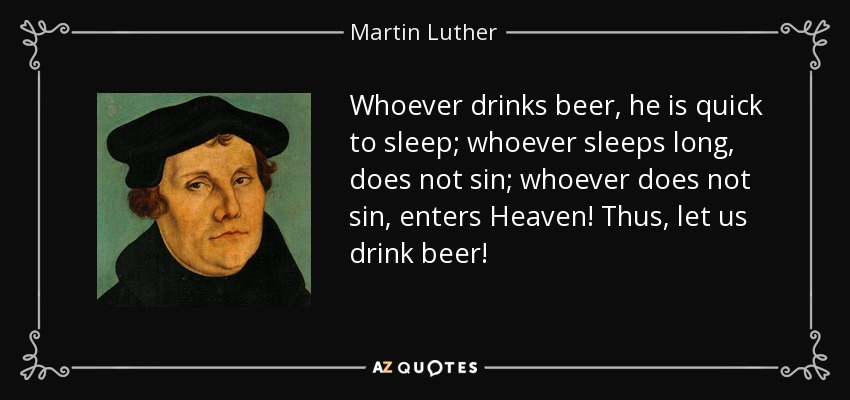
Luther: "Whoever drinks beer, he is quick to sleep; whoever sleeps long, does not sin; whoever does not sin, enters Heaven! Thus, let us drink beer!"


Here's a Luther quote pulled from a Lutheran discussion group:
Whoever drinks beer, he is quick to sleep; whoever sleeps long, does not sin; whoever does not sin, enters Heaven! Thus, let us drink beer!
This is another one of those Luther quotes splattered all over the internet.  It appears to be particularly an obvious favorite of beer websites and beer enthusiasts. One site states,  "I not 100% sure that the following quote is truly from Martin Luther; however I’ve seen it attributed to him enough that I willing to do the same." One page considers the quote one of 50 Profound Martin Luther Quotes About Faith.  A basic book search reveals it's gone to print as well. Let's take a closer look. No, it wasn't Luther, but it is surprising to find out that one of Luther's closest associates was using a version of it.

Documentation
Typically, there is no documentation other than attributing the quote to "Martin Luther." Others have sought to verify this quote. This author claims the quote "seems to have appeared suddenly in 2007 on a blog" but doesn't provide a link to substantiate the claim.  An intriguing clue is found on Wikipedia, dating the phrase in Latin to 1658:

Whoever drinks beer, he is quick to sleep; whoever sleeps long, does not sin; whoever does not sin, enters Heaven! Thus, let us drink beer!
  • Widely attributed to Luther, but actually is an example given in 1658 book Ἑρμηνεια logica of faulty logic. In Latin:
    • Si vero termini in sorite sunt causae subordinatae per accidens, sorites non valet; ut ia hoc, Qui bene bibit, bene dormit; qui bene dormit, non peccat; qui non peccat, est beatus; ergo: qui bene bibit est beatus. Vitium est, quod bene bibere sit causa per accidens somni.
  • Translated via Fauxtations:
    • If, however, the conclusions in the sorite are subordinate by accident, the sorites is not valid; as in this one, He who sleeps well, drinks well; he who sleeps well, does not sin; he who does not sin, is blessed; therefore, he who drinks well is blessed. The problem is that to drink well is a cause of sleep only by accident.

The 1658 book / page cited by Wikipedia can be found here.  Wiki, as admitted, absorbed this information from this source, a blog entitled, Fauxations, because sometimes the Internet is wrong. Kudos to this source for at least determining the quote has an old pedigree that need not necessarily be linked to Martin Luther. Unfortunately, while 1658 may appear at first glance to be the oldest use of the quote found via Google Books, this does not determine if its the actual origin of this quote or if Luther originally said it or not.

An interesting clue that Fauxations points out is the aspect of the "syllogism"... that the quote was not intended to be a cute saying, but rather an example of a logical problem.  This nineteenth-century source refers to it as a "classic canticle" citing it as: Bene vivit. Qui bene vivit Bene dormit. Qui bene dormit Non peccat. Qui non peccat In cælum venit. Ergo qui bene bibet In cælum venit. Another nineteenth-century text refers to it as "the syllogism," another, "the formula."  This text refers to it as "a profane syllogism obtained by Lord John Russell from an old Spanish priest": Qui bene bibet bene dormit, qui bene dormit non peccat, qui non peccat salvatus erirt (the incident appears to be recorded here and here).  This text puts the syllogism in a narrative form. The one thing these texts at least have similarly in is that the syllogism existed as common knowledge.

Philip Melanchthon?
One can go deeper than 1658 and find the syllogism being toyed with by none other than Luther's associate... Philip Melanchthon!  In a Google book from 1529 from Melanchthon one finds


This text reads, Qui bene bibet, bene dormit, Qui bene dormit, non peccat, qui no peccat erit beatus, ergo qui bene bibet erit beatus. There appears to be correlation of this Latin syllogism to the German jingle, Zu nacht wohl essen, macht wohl schlafen, und wohl leben, macht wohl sterben.


Conclusion
I doubt Luther coined the phrase in it's typical logical formula or in the form Melanchthon presented. It is fascinating though that Philip Melanchthon, a close associate, was using it in his logic textbooks and Luther was well aware of his publications.  It is therefore, not out of the possibility that Luther could have repeated it, or a version of it, say in a Table Talk (my cursory search though didn't find anything). It would be interesting to determine if the syllogism existed previous to Melanchthon (I suspect it may have) in a book on logic.

The version that currently circulates the Internet is the obvious work of an editor, perhaps unintentionally or humorously, making the syllogism specific to beer and specific to Luther.   But hey, maybe tacking on "Luther" can actually generate $$$.


Friday, December 15, 2017

Melanchthon: Luther was so immoral "that he wished they would remove him from the office of preaching”

Here's a Martin Luther-related excerpt that appeared on the Catholic Answers Forums:

“He was so well aware of his immorality,” we are informed by Melanchthon, “that he wished they would remove him from the office of preaching.” (Sleidan, Book II, 1520).

With this snippet, alleged testimony from Melanchton is brought forth indicting Luther not only of immorality, but of being so sinful that Luther wanted to be removed "from the office of preaching." Melanchthon was one of Luther's closest friends, so here would be compelling testimony not only of Luther's depravity, but also a demonstration that he was in no way qualified to usher in a reformation of the church.  A closer look at this quote though will show Melanchthon never said or wrote this. Further, we'll see that the quote ultimately amounts to propaganda: the historical context of the quote is being ignored in order to perpetuate a false historical paradigm.

Plagiarism
The person who posted the quote provides obscure documentation ("Sleidan, Book II, 1520"). Such obscurity usually indicates that the material was not taken from an actual straight reading of text written by Luther . This person also stated,
I am a convert from Protestantism who used to idolize Luther until I read his writings (eventually). Before, and while undertaking my doctorate (early music history + performance), I had learned to read primary sources, this is what also lead me to the Catholic Church - the Apostolic Fathers + St Augustine + Aquinas. Today many people will watch a movie about Luther and think they are well informed about him.
I do question the validity of this testimony of learning, especially the claim of reading Luther's writings and the ability to read primary sources to form opinions. Of the two posts of Luther material this person presented in this discussion (#1#2), neither demonstrates a straight reading of Luther. The material was probably taken from a few web-pages, then cut-and pasted over on to the Catholic Answers discussion forum. I suspect this pagethis page, and perhaps this page was utilized. Unless the person posting this material on Catholic Answers wrote these links, much of the content of these posts is blatant plagiarism. For this quote particularly, this web-page appears to be that which was plagiarized.

Even if he (she?) did compose this web page (or one of the others), I still doubt any of the material came from a straight reading (or "studying") of the "primary sources" for Luther. Some of what was posted was directly plagiarized from Father Patrick O'Hare's, The Facts about Luther, most likely, the quote above under scrutiny as well. The quote appears in a similar form in Father O'Hare's book on page 319. O'Hare states, "He was so well aware of his immorality," as we are informed by his favorite disciple, "that he wished they would remove him from the office of preaching." (Sleidan, Book II, 1520)." It appears Father O'Hare himself plagiarized this sentence. The earliest I've traced it  back is to the English translation of Jean François Marie Trévern's Amicable Discussion (1828). Trévern's original French can be found here:


Trévern similarly documents the quote as "Sleid. liv. II, an 1520." What was posted on the Catholic Answers discussion forum (and this web-page also) is an obvious plagiarism of something Father O'Hare published over one hundred years ago, and something Father O'Hare took from something published long before him. Whether the person at Catholic Answers took the quote from O'Hare's book or not, someone at some point did, and that's why it's on the Internet (now being disseminated by cut-and-paste plagiarism). To borrow from this Catholic Answers participant: today many people will read a biased and poorly researched web-page or book about Luther and think they are well informed about him.

Documentation
The documentation refers to "Sleidan, Book II, 1520." No explanation from O'Hare or Trévern is provided as to what this reference means. I searched a number of texts using the quote under scrutiny, and I found no explanation as to what the reference is pointing to.

The reference appears to be to the author Johann Sleidan (Johannes Sleidanus), a sixteenth-century Reformation historian (1506–56). Sleidan put together "a chronological narrative of the reformation from 1517 until 1555." It was a series of twenty-five books. "Book II" therefore is just that: the second volume of the series.  "1520" is not a page number. It refers to the content of Book II: the year 1520. The series was entitled, De Statu Religionis Et Reipublicae, Carolo Quinto, Caesare, Commentarii: Cum Indice luculentissimo. pars altera. Volume 2 can be found here. The relevant text reads as follows:


This entirety of Sleiden's series was translated into English by Edward Bohun:
The general history of the Reformation of the Church from the errors and corruptions of the Church of Rome, begun in Germany by Martin Luther with the progress thereof in all parts of Christendom from the year 1517 to the year 1556 / written in Latin by John Sleidan ; and faithfully englished. To which is added A continuation to the Council of Trent in the year 1562 / by Edward Bohun.
Published in English in 1689, the whole series is available online here in English and here . Book Two is available here and here. Amazon sells a reprint of the English translation. It's probable that Trévern relied on a French translation of Sleidan, the relevant text can be found here. Below is the English translation of the text in question.


Context
To the same effect, on the same day, Luther writes to the Bishop of Mersburgh, that as to his Doctrin, his Conscience bore him witness that it was the same that Christ and his Apostles had taught:* But because his Life and manners were not in all things answerable to the Purity of his Profession, he could even wish that he were silenc'd from Preaching, as being unworthy to exercise that Sacred Function: That he was not moved either by the hopes of Gain or Vain-glory; but that the End to which all his Endeavours were directed, was to imprint a-fresh in the minds of Men those eternal Truths, which were now almost utterly defaced, or else obscured by a gross and wilful stupidity; That those who condemn his Writings, were hurried on by the violence of their Passions; and promoted their own ambitious designs, under the specious pretence of upholding the Authority of the Bishop of Rome: That a great many Foreigners, famous both for Parts and Learning, had by their Letters approved of his Works, and thanked him for his obliging the Publick with them: That this confirm'd him in his Opinion, that his Doctrin was Orthodox: He beseeches him therefore to shew some Fatherly tenderness towards him; and if he had hitherto erred, to guide him now into the right way: That he could not as yet get his Cause to be heard, although he had been importunate in requesting it: That he should think it a great happiness to be convinced of any of his Errours, and they should find he had been mis∣represented by those who had possessed the World with a belief of his Obstinacy.
Conclusion
The immediate thing to notice first is that the very source being cited (Sleidan), does not say Melanchthon said or wrote what's purported. Patrick O'Hare and Jean François Marie Trévern are also wrong when they stated, "as we are informed by his favorite disciple." According to Sleidan, the comment was written by Luther in a letter to "the Bishop of Mersburgh." It wasn't being reported by anyone.  Even if it was the bishop's comment, that bishop was no disciple of Luther, but rather a high-ranking Roman Catholic bishop. The second thing to notice is that Sleidan doesn't mention sexual immorality. He says specifically "life and manners" in comparison to the "Purity of his Profession." Given Luther's meticulous conscience of his own sin and his awareness of the office of minister of the Gospel, this comment need not mean anything as outrageous as Luther's detractors speculate.

A third aspect is to determine if Luther actually wrote a letter admitting his immorality and his wish to be removed from the office of preaching. On February 4, 1520 Luther wrote two similar letters: one to Albrecht, archbishop of Mayence, and another to Adolphus, bishop of Merseburg. These letters can be found in WAbr 2:398-403. While a lengthy section of the letter to Albrecht was translated into English, the letter to Adolphus has not (as far as I can determine). In the letter to Bishop Adolphus, Luther says in part:


One notices that the letter opens with a fair amount of zealous flattery, as if one were addressing royalty. He then mentions all the charges being brought against him by his detractors, and they should not be believed.  Luther eventually says:"usque hodie opto a publicj moveri, relicto docendi negotio,... Scio, quod non vivo, quae doceo, ideoque taedet me officii hujus: tantum abest, ut gloriam quaeram, ut multi mihi imponunt." The immediate question that should come to mind is: why would Luther write a letter to a Roman Catholic bishop, a bishop that was hostile to Luther's plight, and say this? It doesn't make any sense.

The answer comes in understanding this historical context of February 1520. Luther was stirring up a reformed movement in a number of ways, and not all of his ideas were met with approval. For instance, at the time he was arguing that the cup should be given to the laity in the Lord's Supper. Heinrich Boehmer explains,
His suggestion regarding the restoration of the cup to the laity caused such offense at the Dresden court that Duke George denounced him to the Elector on December 27 as a secret Hussite. Moreover, Duke George immediately mobilized the bishops of Meissen and Merseberg against the "very Pragueish" Treatise on the Lord's Supper.  The bishop of Meissen responded by issuing a mandate of his own against the sermon on January 24 [Martin Luther: Road to Reformation, p. 303].
Boehmer says that the Elector found all this "exceedingly disagreeable" and asked Luther to write an "immediate pacifying explanation to the archbishop of Mainz and the bishop Merseberg and probably several other prelates." Before sending the letters, the Elector wanted to look over what Luther had written. After a series of other events that further complicated the relationship between Luther and the bishop of Meissen, "on February 22, Luther brought himself to the point of signing the letters to the archbishop of Mainz and the bishop of Merseburg" (Boehmer, p.304).  An excerpt from one of these letters can be found here.  When Luther writes that "his Life and manners were not in all things answerable to the Purity of his Profession, he could even wish that he were silenc'd from Preaching," he's not making bold personal confessions to his friends, he's attempting to smooth over the bishop by humbling himself (at the order of the Elector). Boehmer explains the response Luther received:
The two prelates were apparently surprised beyond measure at Luther's wholly unexpected readiness to be corrected by them. The bishop of Merseburg could not keep from imparting a sort of censure in his response, but in the conclusion he was very friendly and suggested a personal meeting with Luther [Boehmer, p.304-305].
For a slightly different explanation of the historical context, see Martin Brecht's discussion in Martin Luther: His Road to Reformation, 1483-1521, pp. 357-358. Brecht thinks it may have been  Karl von Miltitz acting "on behalf of Electoral Saxony" who contacted Bishop Adolf of Mersburg to see if it was he who was complaining about Luther to the Pope. Brecht says "Luther was instructed by the court to write letters to bishop Adolf of Mersburg and Albrecht of Mainz about the accusations raised against him." Brecht says the letter "would scarcely mollify the bishop of Mersburg." Miltitz was a papal nuncio and active in attempting to reconcile Luther with the Papacy during this time period. Miltitz was also responsible in getting Luther to write a letter to the Pope, in "the conventional, curialistic style," but the letter was not sent.

Despite the clarity of this historical information, the quote has been used, whole or in part, by those who typically who hold an untenable historical view of Luther. This view paints Luther as grossly antinomian. Those espousing this view are often defenders of the Roman church (but not limited to them).  Historically, such shocking quotes served as propaganda used by pre-1930 Roman Catholic controversialists. The champion of this view was Heinrich Denifle (1844-1905), an Austrian Roman Catholic historian. For Denifle, one of Luther's major problems was lust and immorality. It was Luther's craving for sex that led him to not only break his monastic vows, but to revolt against the established Roman church.   Denifle would use statements like this to prove Luther invented the doctrine of justification to excuse his gross immorality.  Denifle's Luther was an immoral, lust, and sex crazed monk. A section of the very quote in question makes it into Denifle's analysis
“As I knew,” says Solomon, “that I could not otherwise be continent, except God gave it, * * * I went to the Lord and besought him." The Church opposes a spiritual to the carnal “uri.” “Burn, O Lord, with the fire of the Holy Ghost, our reins and our heart, that we may serve thee with a chaste body and please with a clean heart,'' is the prayer in the "Missa in tentatione carnis." Our Saviour Himself counsels watching and constant prayer as a means of not succumbing to temptation. Indeed, Luther a short time before knew this well too. As the strongest weapon against evil desire, he recommends "prayer, contemplation of the Passion of Jesus Christ, as well as the word of God," and a few years earlier he holds up watching and fervor of spirit as an unfailing remedy against carnal lust. I have said that he then still knew this, but not that he still put it into practice. From and after 1516, on his own confession, he seldom found time to acquit himself of the prescribed prayers, the hours, and to celebrate Mass. What he acknowledged in 1520 was even then already verified of himself: "I know that I do not live according to what I teach." ["Scio quod non vivo quae doceo." To Bishop Adolf of Merseburg, February 4, 1520, " Brief wechsel," 2, p. 312].
Notice for Denifle, there's not any sort of mention about either the context or the historical situation that provoked the letter. Rather, Denifle rips it from its context and uses it to propel his predetermined interpretation of Luther. Another Roman Catholic historian, Hartmann Grisar, fair only a little better:
Yet Luther speaks ably enough in 1517 of the urgent necessity of spiritual exercises, more particularly meditation on the Scriptures, to which the recitation of the Office in Choir was an introduction: " As we are attacked by countless distractions from without, impeded by cares and engrossed by business, and as all this leads us away from purity of heart, only one remedy remains for us, viz. with great zeal to 'exhort each other' (Heb. iii. 13), rouse our slumbering spirit by the Word of God, reading the same continually, and hearing it as the Apostle exhorts." Not long after he is, however, compelled to write: "I know right well that I do not live in accordance with my teaching." ["Scio quod non vivo quae doceo." To Bishop Adolf of Merseburg, February 4, 1520, " Brief wechsel," 2, p. 312].
One could easily dismiss the comments from the Catholic Answers discussion forum which opened this blog post, for the Internet is filled with unsubstantiated nonsense. One could even go so far as to give Father O'Hare a pass. He was a popular priest living in a time period in which anti-Reformation polemic was standard. He was a pop-apologist before there was such a thing as Catholic Answers. Denifle and Grisar though were trained historians. They should have been able to navigate correctly through the facts. Their use of the quote demonstrates that for all of us, worldview determines interpretation, sometimes at the expense of accuracy.  

Monday, February 09, 2015

Don't Be a Nitpicker

A Facebook comment states,

I agree that Swan is nit-picking, but best stay away from Will Durant. His footnotes are impressive looking, but I remember trying to follow up some dubious claim Durant made about Bucer and finding it hard to do. Part of the problem is that just because he's an older source himself, his secondary sources are hard to find. That doesn't make him wrong. (I don't remember what the claim was about Bucer, but I remember finding it completely unbelievable as a Bucer specialist.) It seems to me that Durant impresses people just because no one else has really done what he did. But someone ought to, because it should be done better.

This was a reaction from an Anglican to my recent entry, Melanchthon: Under cover of the Gospel, the princes were only intent on the plunder of the Churches. According to his general information at Catholic Answers, this Anglican is "seeking admission to the Catholic Church." Despite his swimming of the Tiber, I've read a number of comments from this person over the years in regard to Reformation-related issues, many of which I've found helpful. Even his very Facebook comment verifies that my finding on Durant aren't so outrageous. Frankly though, this criticism that I've engaged in "nit-picking" is bogus, and leads me to believe that either my entry wasn't read carefully (if at all), or that perhaps I didn't explain the background of the post well enough.

First, my scrutiny of the Melanchthon quote was primarily in regard to a comment in a recent CARM post which used the Melanchthon quote. If you follow this CARM discussion,  notice that a Lutheran challenged the quote here saying, "I am not familiar with Durant, is there something online about his citation or works?" The same Lutheran also stated, "After doing a little checking it seems that Will Durant is problematic where appeals are concerned. James Swan Beggarsallreformation blogspot, just go to the main page and search Will Durant for a number of examples. Thanks again for the citation, but can you offer another perhaps more reliable source for the same claim?" To Which the CARM Roman Catholic responded in part, "That is my only source. I'm sure you could study Melanchthon's works and letters and see for yourself. I'm sure you'll understand if I don't. The history of Germany after the Reformation speaks volumes. I don't need further evidence." The Lutheran responded, "I'm not familiar with this caricature of Melancthon. I'm neither denying nor affirming and your source is suspect." And so, I took a look at the quote, demonstrating in my blog post that the polemical point being made originally was inaccurate and the Melanchthon quote used not only didn't support his point, but was itself of a bogus construction. This isn't "nitpicking," it's checking out the facts put forth to substantiate a polemical point.

Second, I did eventually reply on CARM in regard to this issue. The person who initially posted the quote had claimed he got the quote directly from Durant. I demonstrated that he cut-and-pasted it from a webpage, and that webpage constructed the Melanchthon quote from two different pages in Durant's book (which would be enough to demonstrate the quote was spurious). I then demonstrated Durant probably didn't read Melanchthon, but took it from two different volumes in Janssen's set on Germany. In checking Janssen, it became obvious Durant wasn't even correctly quoting Melanchthon. This isn't "nitpicking," it's checking out the documentation put forth to substantiate a polemical point.

Third, I recently read a statement by Robert W. Jenson who inadvertently described how the Reformers are often quoted by both Protestants and Roman Catholics:
Active participants in the continuing theological argument are inevitably and properly cannibals of their predecessors. They dismember predecessors’ systems or structures of intuition, and use bits and pieces for their own purposes.
We're all guilty of this, for better or for worse. Some people are able to use those "bits and pieces" in a more fair and honest way than others. Some people take those "bits and pieces" and put them into their own theological worldview without at least trying to understand how they fit in the theological system in which they live to their fullest. Roman Catholics do this with the Reformers, Protestants do this with aspects of Roman Catholic theology as well. What I've found is that many of Rome's defenders create historical caricatures when they read books on the Reformation, as was the case with the Melanchthon quote. Rome's defenders have a popular notion that the Reformers were saddened by the Reformation at best, or at worst regretted it and their role in reform. This is a caricature. Neither Melanchthon or Luther (or Calvin and Zwingli for that matter) regretted the reform of the church. They were not gleefully ecstatic over every facet of change brought on by the reform movement, but they certainly were not always longing for the days previous to their reform work. So when I demonstrate that one of Rome's defenders "dismembered" and "cannibalized" Melanchthon's words, this is not nitpicking, It's demonstrating the shoddy work of those putting forth propaganda.


Addendum
Here's what one of Rome's defenders thinks of all this:

Swan is an obsessive-compulsive pest situated somewhere on the autistic spectrum whose mania is to the search the Internet for poorly understood religious odds and ends that, he imagines, bolster his idiosyncratic Fundamentalist delusions. He periodically does data dumps on his blog. No one needs Swan. We all have search engines of our own.

There is one thing I agree with here: Rome's cyber-defenders also have search engines. With these modern marvels of technology like Google and Bing they should be able to put forth accurate citations.

Tuesday, February 03, 2015

Melanchthon: Under cover of the Gospel, the princes were only intent on the plunder of the Churches

Here's one from the CARM boards. It seems simple enough- a short quote from Melanchthon was offered to make a polemical point:

Luther turned power over to the princes who leaped at the opportunity to cut ties with the Church and solidify their own. Things went down hill fast from there. Melanchthon, the right hand man of Luther, lamented about the outcome of the Reformation: “They do not care in the least about religion; they are only anxious to get dominion into their hands, to be free from the control of bishops . . . Under cover of the Gospel, the princes were only intent on the plunder of the Churches.”(Durant, 438, 440)

This is typical of Rome's defenders— to blame an entire period of political and social history on the theological concerns of a man who stood defiantly against the papacy. It's debatable if things "went downhill" when "Luther turned power over to the princes who leaped at the opportunity to cut ties with the Church and solidify their own." I'm sure from this defender of Rome's perspective, the loss of social and religious power of the Roman church is negative.  While he was influential, Luther was not the Emperor, nor did he have any legal authority to turn "power" over to any of the German princes. The Reformation was a complex series of events that can't be so easily pigeonholed as this CARM Roman Catholic did. It wasn't as if all was well with the empire until Luther came along and "turned power over to the princes." There were political power struggles with the papacy and empire long before Luther came on the scene. This defender of Rome would do well to study "centralization," or perhaps read the book he (?) claims to have (Durant).

This would be enough of a response, but along with the point about Luther was a quote from Melanchthon. Tracking down Melanchthon quotes isn't as easy as finding the contexts of Luther's words. Below you'll see the tedious detail that one must at times go through because of the sloppy work of Rome's cyber-apologists. Here's the quick version: The person from CARM cut-and-pasted a Melanchthon quote taken from an anti-Reformation web page. That web page took the quote from a secondary source that had the quote on two separate pages. That secondary source took the quote(s) from another secondary source in which the quote is from two different volumes. Part of the quote from one of these volumes isn't even the direct words of Melanchthon. Conclusion: the quote is bogus.  


Will Durant, The Reformation
Two things jumped out to me out about this quote: 1) the source was Will Durant, a secondary source; 2) the quote was from two different pages in Durant's book. The defender of Rome claims he (?) got the quote from Durant: "That is my only source. I'm sure you could study Melanchthon's works and letters and see for yourself. I'm sure you'll understand if I don't. The history of Germany after the Reformation speaks volumes." Most likely, he didn't pull this quote from Durant's book, but rather took it from a polemical anti-Reformation web page that cites it like this:


The quote as presented is a typical method of citation by Rome's defenders: the creation of a single quote from two different pages, taken from a secondary source, and that secondary source took the quotes from a secondary source (Janssen). This again, displays Rome's apologists at their best. As we'll see below, part of this quote isn't even a direct citation of Melanchthon.

 Here's what Durant says:
438: But by 1527 the Lutheran "heresy" had become orthodoxy in half of Germany. The cities found Protestantism profitable; "they do not care in the least about religion," mourned Melanchthon; "they are only anxious to get dominion into their hands, to be free from the control of the bishops"; (1) for a slight alteration in their theological garb they escaped from episcopal taxes and courts, and could appropriate pleasant parcels of ecclesiastical property. (2) Yet an honest desire for a simpler and sincerer religion seems to have moved many citizens. At Magdeburg the members of St. Ulrich's parish met in the churchyard and chose eight men who were to select the preacher and manage the affairs of the church (1524); soon all churches in
439: the city were administering the Lord's Supper in the Lutheran mode. Augsburg was so fervently Protestant that when Campeggio came there as papal legate the populace dubbed hirn Antichrist (1524). Most of Strasbourg acccpted the new theology from Wolfgang Fabricius Capito (1523), and Martin Bucer, who succeeded him there, also converted Ulm. In Nuremberg great business leaders like Lazarus Spengler and Hieronymus Baumgärtner won the city coündil to the Lutheran creed (1526); the Sebalduskirähe and the Lorenzkirche transformed their ritual accordingly, while keeping their Catholic art. In Brunswick the writings of Luther were widely circulated; his hymns were publicly Sung; his version of the New Testament was so earnestly studied that when a priest misquoted it he was corrected by the congregation; finally the city council ordered all clergymen to preach only what could be found in the Scriptures, to baptize in German, and to serve the sacrament in both forms (1528). By 1530 the new faith had won Hamburg, Bremen, Rostock, Lübeck, Stralsund, Danzig, Dorpat, Riga, Reval, and almost all the Imperial cities of Swabia. Iconoclastic riots broke out in Augsburg, Hamburg, Brunswick, Stralsund. Probab!y some of this violence was a reaction against the ecclesiastical use of statues and paintings to inculcate ridiculous and lucrative legends. 
The princes, gladly adopting Roman law— which made the secular ruler omnipotent as delegate of the "sovereign people"—saw in Protestantism a religion that not only exalted the state but obeyed it; now they could be spiritual as well as temporal lords, and all the wealth of the Church could be theirs to administer or enjoy. John the Steadfast, who succeeded Frederick the Wise as Elector of Saxony (1525); definitely accepted the Lutheran faith, which Frederick had never done; and when John died (1532) his son John Frederick kept Electoral Saxony firmly Protestant. Philip the Magnanimous, Landgrave of Hesse, formed with John the League of Gotha and Törgau (1526) to protect and extend Lutheranism. Other princes fell in line: Ernest of Lüneburg, Otto and Francis of Brunswick-Lüneburg, Henry of Mecklenburg, Ulrich of Württemberg. Albert of Prussia, Grand Master of the Teutonic Knights, following Luther's advice, abandoned his monastic vows, married, secularized the lands of his order, and made himself Duke of Prussia (1525). Luther saw himself, apparently by the mere force of his personality and eloquence, winning half of Germany.  
Since many monks and nuns now left their convents, and the public seemed unwilling to support the remainder, the Lutheran princes suppressed all monasteries in their territory except a few whose inmates had embraced the Protestant faith. The princes agreed to share the confiscated properties and revenues with the nobles, the cities, and some universities, but this pledge was very laxly redeemed. Luther inveighed against the application of ecclesiastical wealth to any but religious or educational purposes, and condemned
440: the precipitate seizure of church buildings and lands by the nobility. A modest part of the spoils was yielded to schools and poor relief; the princes and nobles kept the rest. "Under cover of the Gospel," wrote Melancthon (1530), "The princes were only intent on the plunder of the churches." (3)
Footnotes
1. Janssen IV, 62,
2.  CF. Camb. Mod. Hy, II, 159.
3. Janssen VI, 534.

Before addressing the bogus cyberspace construction of the Melanchthon quote in question, was Melanchthon lamenting the outcome of the Reformation? Durant does say Melanchthon "mourned" in regard to the first sentence in the quote. Of the second sentence in the quote this author says that Melanchthon "complained," as does this author. Even  Dave Hunt checked in saying that Melanchthon "sadly declared..." (No, I don't trust Mr. Hunt either). Why quibble over one word? Rome's defenders have a popular notion that the Reformers were saddened by the Reformation at best, or at worst regretted it and their role in reform. From the actual primary source from which Melanchthon's words were taken, it doesn't appear to me to be either mourning or lamenting, but rather frustration during the proceedings of the complicated Diet of Augsburg (1530). One thing though is certain, neither Melanchthon or Luther (or Calvin and Zwingli for that matter) regretted the reform of the church. They were not gleefully ecstatic over every facet of change brought on by the reform movement, but they certainly were not longing for the days previous to their reform work.


Johannes Janssen: History of the German People
It would not surprise me to discover that Will Durant had actually never read the primary sources for Melanchthon's words. His footnotes are to a polemical Roman Catholic source, Johannes Janssen, not the primary sources for Melanchthon's words. Janssen's work belongs to the period of destructive criticism of Luther and the Reformation. Janssen viewed Luther and the Reformation as destroying German culture and piety (see, Gregory Sobolewski, Martin Luther: Roman Catholic Prophet, p. 22-23). Janssen's bias does not mean he didn't record the facts correctly. One simply needs to keep in mind the framework an author like Janssen puts his facts into.

The quote in question is from two different pages in two different volumes of Janssen's History of the German People. Notice in the second citation below that "Under cover of the Gospel the princes were only intent on the plunder of the churches" are not the words of Melanchthon proper, but are  probably Janssen's description of what Melanchthon is purported to have said.

Janssen IV, 62
In order to establish the 'pure and clear Gospel' it was above all things necessary to effect a change in the existing constitution of the Church, and to transfer ecclesiastical jurisdiction from spiritual to secular authorities. Roman jurists had already advocated a measure of this sort in the fifteenth century. The town magistrates, and the princes also, aimed a strengthening their own territorial might by the establishment of a secular Church government, independent of ecclesiastical power, which should control Church property, appoint and depose 'preachers of the Gospel ' — in short, treat the clergy generally as much as possible as subservient officials of the commonwealth. 'The imperial cities do not care in the least about religion,' said Melanchthon; ' they are only anxious to get dominion into their own hands and to be free from the control of the bishops.' 1

1. 'Maxime oderunt illam dominationem [of the bishops] civitates imperii. De doctrina religionis nihil laborant; tantum de regno ct libertate sunt solliciti' (letter to Luther in the Corp. Reform. ii. 328).

Janssen VI, 534
Melanchthon had been the first and the most vehement in complaining that the princes and municipal authorities who had taken the church management into their own hands had no real interest in religion or in the promotion of Christian discipline.  The imperial cities,' he wrote, 'do not trouble themselves about religion: all they care for is emancipation from the dominion of the bishops.' 'The princes do not concern themselves at all about these matters; one creed is as good in their eyes as another.' Under cover of the Gospel the princes were only intent on the plunder of the churches, on gambling, drinking, and other degrading pursuits. 'What state of things shall we bequeath to posterity if the authority of the bishops is abolished? Even were it allowable to overthrow the organization of the Church, it would be scarcely salutary. What will become of the parishes if the old customs and usages are done away with, and no more regular church overseers appointed? '
Melanchthon was now witnessing the fulfillment of these words of his written in 1530, and all that he saw grieved him so deeply that in his confidential letters he spoke of a strong yearning for death. And yet he was the foremost among those theologians who in May 1554, at a religious convention at Naumburg, planned by the Elector Augustus of Saxony, declared the transference of church management to the civil authorities to be not only an unavoidable necessity, as Luther had long maintained, but a divine command. In his memorandum of advice, which had been approved by the other theologians, he said that the rite of ordination and the juridical powers claimed for the bishops both by themselves and by great potentates, could not be conceded to them because they were persecutors of the Gospel. The gates of the temples are the gates of the princes. Secular lords are the 'feeders of the churches,' and it was their business to provide for right doctrine and Christian discipline; this exalted and divine task belongs to their office. This religious assembly was ruled by the selfsame spirit which two years later inspired a synod at Greifswald to petition the ruling prince 'to remain, next to Christ, the supreme head of the church and the clergy.'
Janssen provides documentation on page 62 of volume IV. In the English edition, he does not provide documentation for Melanchthon's words on page 534 of Volume VI.  One thing is certain: the partial sentence "Under cover of the Gospel the princes were only intent on the plunder of the churches" is not a sentence from Melanchthon proper, but are probably Janssen's description of what Melanchthon is purported to have said. and, as we'll see below, wherever this description of Melanchthon comes from, this description does not come from the same primary source as cited in volume IV, 62 (letter to Luther in the Corp. Reform. ii. 328). The corresponding German version of this text from Janssen VI (p. 725) reads as follows:


The last sentence in the paragraph in question does provide a reference: "vergl die stellen oben s 180. 183. 494-495." These are references to previous pages in Janssen's book. Page 180 refers to the English page here; 183, here. 494, here; 495, here. After looking over these pages, still missing is any actual reference to Janssen's description of Melanchthon's words, "Under cover of the Gospel the princes were only intent on the plunder of the churches, on gambling, drinking, and other degrading pursuits."


Corpus Reformatorum, Volume 2
Here is the actual primary source for Melannchthon's letter to Luther, August 29, 1530. Janssen used this as a reference for the first sentence in the quote. The sentence in question appears toward the end ('Maxime oderunt illam dominationem civitates imperii. De doctrina religionis nihil laborant; tantum de regno ct libertate sunt solliciti):


One will notice there's nothing in this short letter that says, "Under cover of the Gospel the princes were only intent on the plunder of the churches, on gambling, drinking, and other degrading pursuits." But perhaps Janssen is summarizing Melanchthon. He's not directly citing Melanchthon  as Rome's cyber-defenders say. Where is it from? Janssen doesn't say. It's probably from another 1530 letter related to Melanchthon's involvement at Ausburg.


Conclusion
Yes, tracking all this down took some time. If "to be deep in history is to cease being Protestant," I guess Rome's defenders must have a different notion as to what "deep into history" actually means. For them, it must mean creating bogus quotes. I welcome Rome's cyber-defenders to take these bibliographical facts above and figure out exactly what Melanchthon said and where he said it. I've done a lot of the work for you already. Till then, would you folks please document your historical arguments better? Quoting a secondary source who quotes a secondary source only serves to obfuscate whatever points you think you're making.


Addendum  (2/6/15)
Interestingly, the exact form of the questionable Melanchthon quote was published in this book: Protestantism: Critical Reflections of an Ecumenical Catholic (2007), p. 96. This book includes the quote under the heading of what Melanchthon was purported to have said in 1545. How did the author determine the year was 1545 for these words from Melanchthon?

Friday, May 09, 2014

Luther: It is easier to live as a Protestant, but better to die as a Catholic

I was sent the following quote from a Roman Catholic website:
The quotation, “it is easier to live as a Protestant but better to die as a Catholic,” is ascribed variously to Martin Luther or one of Luther’s wavering followers. One reason it is better to die as a Catholic, for someone not convinced about going straight to heaven, is the ability to take advantage of the special sacraments for the sick and dying, as recommended in the epistle of James (5:14-15), for healing and/or the forgiveness of sins.
There are various versions of this saying: "It is good to live as a Protestant but better to die Catholic." "It is good to live as a Protestant, but it is good to die as a Catholic." "For a man to be happy in this world and the next, he must live a Protestant and die a Catholic." The saying appears to be based on an old proverb: Katholish ist gut sterben."—"It is good to die Catholic."

Older generations of Roman Catholic apologists used Luther's death for polemical purposes. One of Luther's earliest opponents described Satan dragging Luther to hell. Denifle put forth an image of Luther as glutton and drunk, and these abuses (along with a myriad of others) led to his death. Some even contend Luther committed suicide. For instance, here's a 1907 review on anti-Luther historian Heinrich Denfile's book on Luther describing the deaths of Protestants:
Death often reveals the secrets of the human heart. It manifests the hidden feelings of joy or sorrow, peace or despair. Luther always feared death. He envied the very beast because it "fears no king or master, neither death nor bell, nor the devil, nor the wrath of God." His death was very mysterious, but certainly not the death of a saint. Many of his most prominent followers had the same sad experience. Dollinger enumerates a long list of them. A Protestant theologian describes them well when he says: "They became like the heathen, vain, melancholy desperates, and they closed their lives with fear and trembling. Others facing death returned to the Catholic Church." "There were many of them," again says a Protestant author, "who could never console themselves with Protestantism, indeed, some despaired in their sadness, and gladly returned to the Catholic Church." It happens frequently that Protestants become Catholics on their deathbed, but in the hour of death no practical Catholic becomes a Protestant. That fact proves the truth of the old proverb: "Katholish ist gut sterben."—"It is good to die Catholic." How beautiful was the death of the great convert, Frederick Leopold, Count of Stolberg, who having received the last sacraments said to his children: "Children, let us sing to the Lord and be happy." And to his wife he said: "I have come much nearer to the goal." When she answered: "God may spare you to us," he, dying, folded his hands, lifted his eyes toward Heaven and replied: "Oh, could I but say, 'Lord as Thou wilt,' but I would rather die, for death is my gain. Oh, do not pass by, but take my soul with you." In order to die well we must live well. To die the death of a Catholic we must live the life of a Catholic. The best preparation for a happy death and life everlasting, for all those who have a calling, is a religious life.
This reviewer points to the old proverb: "Katholish ist gut sterben."—"It is good to die Catholic." Denifle uses this old proverb in his book on Luther as well.  In an old book from the early 1800's James Doyle, Roman Catholic Bishop of Kildare, used the saying:
It is not unusual to find the old Protestant who for years has been as regular an attendant at church as the sexton, and in some cases the sexton himself when he has closed his accounts with this world, and has no more to expect from the parson, to send for the priest, in order to settle with him the affairs of that other world to which he is about to depart: it has passed into a proverb with a certain class amongst us, that for a man to be happy in this world and the next, he should live a Protestant and die a Catholic.
Interestingly, the saying has been applied to Melanchthon's mother's death and also Melanchthon's death, not Luther's. This old Roman polemical work states: "The end of life not being to amass riches, I might simply refer the author to Melanchton. He said to his mother, who desired to become a Protestant: 'If it is best to live a Lutheran, it is preferable to die a Catholic.'" Melanchthon's biographer Clyde Manschreck though notes "There is no evidence that Melanchthon tried to persuade his mother to forsake Catholcism nor indeed was there any reason to do so, for Melanchthon considered himself a reformer within the church."  This old Lutheran newspaper from 1897 ascribes the quote to Melanchton;s death:


Melanchthon Did Not Say It: The approaching 400th anniversary of Philip Melanchthon's birthday brings to mind an old falsehood, invented by an enemy of the Reformation, which still occasionally appears in Roman Catholic papers; namely, that in his last moments he said to his mother, who was near his bedside, "It is good to live as a Protestant, but it is good to die as a Catholic." To nail this slander it suffices to mention that Philip died April 29,1560, when his mother had been long at rest, for she died in 1529. To attend him on his deathbed her dost must therefore have risen from the grave. Besides, how could it be better or more agreeable to the flesh, for that is what it meant, to live a Protestant as one of the minority with loss of reputation and honor and often in peril of death, while the Pope's adherents kept, humanly speaking, on the safe side with the great majority; and how again can it be better or more comfortable to die a "'Catholic'' when their most devoted members are taught to believe that they cannot enter into the saints' rest until they shall have served out their time in the fires of purgatory while the Protestant confidently hopes is that, as the Bible teaches, he will go, immediately after his departure, to be with Christ? At that time it was certainly more convenient to live a "Catholic'' and it is always more comfortable to die as a Protestant in the joyous hope of an immediate entrance into everlasting rest.
This spurious sentence appears to be neither from Luther or Melanchthon. Whomever first said it, I can't think of any plausible reason why either Luther or Melanchthon would say it. What we do have though are these words from Luther's Small Catechism:

The Seventh Petition: But deliver us from evil.

What does this mean?

Answer: We pray in this petition, as in a summary, that our Father in heaven would deliver us from all manner of evil, of body and soul, property and honor, and at last, when our last hour shall come, grant us a blessed end, and graciously take us from this vale of tears to Himself into heaven. Amen.