Showing posts with label Mariolatry. Show all posts

Tuesday, February 16, 2021

Bernard of Clairvaux: "Holy Scripture was written for Mary, about Mary, and on account of Mary"

What is the purpose of Holy Scripture? According to this website, via a quote attributed to St. Bernard of Clairvaux, "Holy Scripture was written for Mary, about Mary, and on account of Mary." This statement is part of a pro-Roman Catholic cumulative case of quotes from church history alleging to prove, "devotion to Mary is necessary for salvation." The page is representative of the worst of Roman Catholic propaganda: historical quotes devoid of references are used to bolster a pernicious Mariolatry. 

True, St. Bernard was known at times for excessive Mariology. It's ironic that Bernard's Marian views played a role in the sixteenth century Reformation.  Luther mentioned him a number of times, sometimes fondly, other times critical of his Mariology: that the church of his day put forth a warm and friendly Mary while Christ was portrayed as a harsh judge.  It's in the realm of possibility, therefore, that Bernard penned an excessive Marian comment. We'll see though, there is reason to doubt he wrote it. While some of Rome's defenders may believe "Holy Scripture was written for Mary, about Mary, and on account of Mary," it doesn't help their credibility when they use spurious quotes from church history. Let's take a closer look.   

Documentation
In the link I utilized, no documentation is provided. However, in an 1948 English translation of a seventeenth century Roman Catholic work from Jean Eudes, comes the following:  
1. The all-surpassing love of God for Mary causes Him to become entirely hers: "My beloved to me;' by His thoughts, words and actions. By His thoughts, because she has been from all eternity the first object of His love, after the sacred humanity of His Word, and the first and worthiest subject of His thoughts and designs: "The Lord possessed me in the beginning of his ways." (4) By His words, because St. Bernard declares that the whole of Sacred Scripture was written "for Mary, about Mary and on account of Mary."(5) By His works, because everything that God has done in the world of nature, grace and glory, and everything He has accomplished in the God-Man and through Him is more for the sake of this admirable Virgin, than all other creatures together as He loves her alone above all His creatures.
 (4) Proverbs 8,22                                                                                                                                                         (5) De hac, et ob hanc, et propter hanc omnis Scriptura facta est. Serm. 1 in Salve.
The only difference in the English wording is the use of the word "sacred" rather than "holy." This text therefore may be the origination used to create this popular English version cyber-quote. This text from Jean Eudes was originally written in French in 1681:


The French version similarly provides Bernard's text in Latin (De hac, et ob hanc, et propter hanc omnis Scriptura facta est), and provides the same reference: "Serm. 1 in Salve." "Serm. 1" refers to "sermon one," while "in Salve" refers to "Salve Regina" (Hail, Holy Queen, Marian Hymn). The reference then is to St. Bernard's first sermon on the Salve Regina (there are four sermons in total).  When searching out this Latin text, I discovered Eudes was correct that the quote was from Bernard's Salve Regina sermon, but he was in error as to which one it was. It's from Bernard's third sermon, not the first.


Context 

2. Non solum autem coelum et firmamentum, Domina rerum intelligitur, sed aliis nominibus convenienter appellatur, et rerum vocabulis designatur. Ipsa tabernaculum Dei, ipsa templum, ipsa domus, ipsa atrium, ipsa cubiculum, ipsa thalamus, ipsa sponsa, ipsa filia, ipsa arca diluvii, arca testamenti, urna aurea, ipsa manna, virga Aaron, vellus Gedeonis, porta Ezechielis, civitas Dei, ipsa coelum, ipsa terra, ipsa sol, ipsa luna et stella matutina, aurora ipsa et lucerna, tuba et mons, fons quoque hortorum, et lilium convallium; desertum ipsa, et terra repromissionis lacte et melle manans, stella maris, navis quoque, via in mari, sagena, vinea, ager, arca, horreum, stabulum, praesepe subjugale, apotheca, aula, turris, castra, acies, populus, regnum, sacerdotium. Ovis est, pascua est, paradisus est, palma est, rosa est, fluvius est, potus est, columba est, columna est, vestis est, margarita est, candelabrum est, mensa est, corona est, sceptrum est, panis est, oleum est, vinum est, arbor est, virga est, cedrus est, cypressus est, platanus est, cinnamomum est, balsamum est, myrrha est, thus est, oliva est, nardus est, crocus est, fistula, calamus, et storax est, soror et mater est. Et ut breviter concludam, de hac et ob hanc, et propter hanc omnis Scriptura facta est, propter hanc totus mundus factus est, et haec gratia Dei plena est, et per hanc homo redemptus est, Verbum Dei caro factum est, Deus humilis, et homo sublimis.

A partial English translation can be found here:

“ O Lordess, Holy Mary, thou art heaven, earth, pasture, paradise, bread, drink, manna, oil, wine, cinnamon, balm, myrrh, frankincense, olive, spikenard, saffron, gum, a temple, a house, a bed-room, a bride, a lamp, a kingdom, a priesthood, a trumpet, a mountain, a wilderness, a field, a vine, a floor, a barr, a stable, a manger, a warehouse, a ball, a tower, a camp, an army, a bird, a palm, a rose, a river, a pigeon, a garment, a pearl, a candlestick, a table, a crown, a sceptre, a tree, a cedar, a cypress, a pipe, a reed, a daughter, a sister, a mother, a sun, a moon, a star, the city of God, the rod of Aaron, the fleece of Gideon, the gate of Ezekiel, the morning-star, the fountain of gardens, the lily of the valley, and the Land of Promise flowing with milk and honey.” 

And here:

His saintship, in the same elegant and edifying style, calls her ladyship, heaven, earth, pasture, paradise, bread, drink, manna, oil, wine, cinnamon, balm, myrrh, frankincense, olive, spikenard, saffron, gum, a temple, a house, a bed-room, a bride, a lamp, a trumpet, a mountain, a wilderness, a field, a vine, a floor, a barn, a stable, a manger, a warehouse, a hall, a tower, a camp, an army, a kingdom, a priesthood, a bird, a palm, a rose, a river, a pigeon, a garment, a pearl, a candlestick, a table, a crown, a sceptre, a tree, a cedar, a cypress, a reed, a daughter, a sister, a mother, a sun, a moon, a star, the city of God, the rod of Aaron, the fleece of Gideon, the gate of Ezekiel, the star of the morning, the fountain of gardens, the lily of the valley, and the land of promise flowing with milk and honey.
And here:
St. Bernard shows that the most orthodox faith finds no exaggeration in the words of the Rabbins, when he cries : 'It is for Mary that all Scripture has been made, for her the universe has been created. Full of grace, it is by her that the human race has been bought, the Word made flesh, God human and man God.'”.

Conclusion
The line that Eudes appears to be citing is "De hac, et ob hanc, et propter hanc omnis Scriptura facta est, propter hanc totus mundus factus est." This translates to, "The Scriptures were intended for her, and the world made for her sake.

There is reason to doubt Bernard is the author of this quote. It's generally accepted that Bernard's four sermons on the Salve Regina are wrongly attributed to him. As far back as the seventeenth century, the Salve Regina sermons have been flagged as dubious. Jean Mabillon released a set of Bernard's collected works and included these sermons in his volume, Opera dubia, notha et supposititia (dubious, spurious, and inauthentic works).  In his 1891 Bibliographica Bernardina cataloging Bernard's writings, Leopold Janauschek lists the four Salve Regina sermons as falsely attributed to St. Bernard:
92. Sermones IV in (antiphonam) "Salve Regina" (qui Bernardum Totelanum auctorem habent).
Others have also noted the sermons are not from St. Bernard:
"And the spurious St. Bernard, “ De hac, et propter hanc omnis Scriptura facta est, propter hanc totus mundus factus est,” &c. "The Scriptures were intended for her, and the world made for her sake.'" (source)
"But, be this as it may, they cite the sermons on the Salve Regina, and represent St. Bernard as having said—“innocens fusti ab originalibus et ab actualibus peccatis—Thou wast innocent, oh Queen, of all sin, whether actual or original.” But, as to this, the answer is, that the four sermons on the Salve Regina, attributed in some old collectors to St. Bernard, so far from being known to be his, are quite indisputably recognized as the work of another, as may be seen in the preface to the Paris folio edition. This is an important fact.
(d) Although thus marked as spurious by their own highest authorities, (as in the late Benedictine edition, in large octavo, vol. iv. p. 1442,) would it be believed that this passage is quoted, at large, as St. Bernard's, in a book published in Boston (Patrick Donahoe, 1855,) and approved by Bishops Neuman and Fitzpatrick? The work abounds in similar deceptions." (source)
Here's an irony I came across while looking into this quote: not only is the quote used unchecked to promote Mariology, it's also used by Rome's detractors to combat Mariolatry. When I first saw the quote, I immediately placed it in the "this quote sounds too good to be true" category... which provoked me to track it down.  Protestant apologists / lay-apologists are also responsible for the arguments they use against Roman Catholicism. If Protestants also use bogus information to refute Rome, shame on them! 

Friday, July 15, 2016

Friday, January 02, 2015

συγγενις και ανεψιος

The New Testament writers would have used the words for "cousin" if they had meant "cousin" in passages about Jesus' brothers and sisters

Persistent commentor "Guy Fawkes" / Jim wrote:
"Brothers" does not have to mean uterine brother. 

Ken Temple:  (with addition comments)

Except when the context demands it.  

συγγενις 

Also, Luke calls Elizabeth a relative or cousin of Mary - sungenis = συγγενις = kinswoman, relative

Luke 1:36

The Greek has words for cousin, kinsman/kinswoman and relative.


καὶ ἰδοὺ Ἐλισάβετ ἡ συγγενίς σου καὶ αὐτὴ συνειληφυῖα υἱὸν ἐν γήρει αὐτῆς, καὶ οὗτος μὴν ἕκτος ἐστὶν αὐτῇ τῇ καλουμένῃ στείρᾳ·

"And behold, even your relative Elizabeth has also conceived a son in her old age; and she who was called barren is now in her sixth month" Luke 1:36

sungenis / συγγενις means "kinswoman", "relative" 

ανεψιος

If the "brothers and sisters of Jesus" were cousins, the NT writers would have used those words.

But it would make no sense for Jesus to be making the spiritual application and saying, "My true cousins are those that do the will of God"
Matthew 12:46-50 and parallels in Luke 8:19-21 and Mark 6:3; see also, John 7:3-10; cf. Matthew 13:55-57  

only uterine/blood brothers makes sense.

ανεψιος / anepsios 

John Mark is Barnabas' cousin. Colossians 4:10
anepsios = cousin

καὶ Μᾶρκος ὁ ἀνεψιὸς Βαρναβᾶ 

Mark, the cousin of Barnabas

That is an even more specific word; so the NT writers would have used those words if the passages of "brothers and sisters" of Jesus meant "cousins".  

Your argument is refuted and defeated again.

Thursday, January 01, 2015

The heos hou / ἕως οὗ construction in the New Testament proves the RC Perpetual Virginity of Mary dogma wrong


Who is My Mother? by Eric Svendsen

I answered the very persistent and redundant "Guy Fawkes" / Jim, who lives in Portugal and apparently has lots of time to keep repeating himself, after being refuted many times, in a combox: (with additional comments)

Regarding Matthew 1:18 - "before they came together"
and
Matthew 1:25 - Joseph "kept her a virgin until" (heos hou / ἕως οὗ ) "she gave birth to a son"

 "but kept her a virgin until she gave birth to a Son; and he called His name Jesus."


"And Joseph awoke from his sleep and did as the angel of the Lord commanded him, and took Mary as his wife25  but kept her a virgin until she gave birth to a Son; and he called His name Jesus."  Matthew 1:24-25

24 ἐγερθεὶς δὲ  Ἰωσὴφ ἀπὸ τοῦ ὕπνου ἐποίησεν ὡς προσέταξεν αὐτῷ  ἄγγελος κυρίουκαὶ παρέλαβεν τὴν γυναῖκα αὐτοῦ· 
25 καὶ οὐκ ἐγίνωσκεν αὐτὴν  ἕως οὗ  
ἔτεκεν υἱόν· καὶ ἐκάλεσεν τὸ ὄνομα αὐτοῦ Ἰησοῦν.  (I don't know why the Greek font gets smaller after the embolding of ἕως οὗ )

Note:  For those who don't know Greek, the mark above the letter that is like a backwards apostrophe is a breathing mark, "he" or "h" sound. (above the ε in the first word, and above the υ in the second word.)

Guy Fawkes / Jim,
I just don't have much time to keep repeating this stuff; you seem to have too much time on your hands.  You have not done research on the differences between "heos" / 'εως by itself, "heos hou" / 'εως 'ου,  and the other prepositional phrases (heos hotou / 'εως 'οτου ; and heos an / 'εως αν, and ἄχρι οὗ / axri hou - see 1 Cor. 15:25) and syntactical constructions - the Greek NT has many different ones, and all the examples that Roman Catholics bring to mean "until, but continuing on after that also" are NOT the heos hou / 'εως 'ου construction .  They are other constructions.

Guy Fawkes/Jim wrote: 
The passages from Matthew you mention are based on the words "before/until". 
It is important to stress Jesus had no human father so the word "before" says that and nothing more.

"before they came together" is in the context of marriage - so that means "having sexual intercourse" in marriage.  " [ see context: (verse 18) - "betrothed" with intention of getting married; "Joseph, do not be afraid to take Mary as your wife" (verse 20); "Joseph did as the angel commanded him, and took her as his wife" (verse 24), "but kept her a virgin until she gave birth to a son . . . " (verse 25)]

Guy Fawkes / Jim wrote:
"Until" does not need to mean a change took place after a particular event.

But it does in this context.  As Eric Svendsen has definitively demonstrated,

"This construction [of heos hou / 'εως 'ου] is used in Matthew 1:25 and so is of special interest here.  It occurs only seventeen times in the NT, and all are temporal.  Two of these have the meaning "while" (Matthew 14:22; 26:36), whereas the other 15 occurrences are instances in which the action of the main clause is limited by the action of subordinate clause and require the meaning, "until a specific time, (but not after)".
(Svendsen, Who is My Mother?  page 52)

On page 251 he lists all the occurrances in the NT of the heos hou / 'εως 'ου construction with the English verses typed out.  It is a lot to type out, but with the verse thingy that James put in here, I can type the verse references and then you can hover over them to see:

Matthew 1:25

Matthew 13:33

Matthew 14:22 (while)

Matthew 17:9

Matthew 18:34

Matthew 26:36 (while)

Luke 13:21

Luke 15:8

Luke 22:18

Luke 24:49

John 13:38

Acts 21:26

Acts 23:12

Acts 23:14

Acts 23:21

Acts 25:21

2 Peter 1:19


You will have to go to http://biblewebapp.com/study/

or some other place to see the Greek constructions.

Svendsen also goes through all the LXX constructions; but this is enough to prove you wrong.

Monday, December 15, 2014

More Proof For Rome's Version of Mary

Crowds flock to see ‘Virgin Mary’ image in a tree (Fox News)

"A likeness of the Virgin Mary has been spotted on a tree trunk, which locals believe is nothing short of a Christmas miracle, reports the Daily Mail. Though you may have to squint hard to see, the shape is similar to that of some representations of Jesus’ mother, with a gentle head tilt to the side."


Thursday, November 13, 2014

If it looks like a duck . . .

Lydia McGrew wrote: "One point that occurs to me is that if idolatry creeps into a Christian group or into the life of a Christian (or Jew, for that matter), it will do so in some way that can be explained away."


Benedict XVI praying to a statue of Mary.  Looks like idolatry to me!


John Paul 2 and several other Roman Catholic priests bowing down to a statue of Mary and praying to her.  Looks like idolatry to me! 

Benedict XVI and John Paul 2 were not just poor uneducated peasants in Fatima, Portugal, but rather suppossedly the "infallible interpreter" of the whole "true" Christian Church.

A Roman Catholic may counter with, "they are just asking the real Mary in heaven to pray for them" and " they are only using the statues to help them visualize her.  They are not really talking to the stone or plastic statue and they are not really bowing down to the stone or plastic or wood carving."

or "We can distinquish between dulia and hyperdulia and latria in our minds, and we don't give latria to Mary or the saints, when we pray to them."

or

"unless you have entered into that experience, you cannot judge it."  

or

"Idolatry, occurs internally in the heart, primarily. Human beings can explain away idolatry in their hearts and minds, because human beings have a massive capacity for self-deception.  Humans are skilled at rationalization and justify things within themselves.    Someone has to consciously and deliberately choose to be committing idolatry in the heart.  Someone has to consciously and deliberately choose to replace God in their prayers with Mary or St. Joseph or St. Teresa or St. Patrick, or else it isn't truly idolatry. It may be an extreme case of a lack of diligence, or spiritual laziness, but not idolatry."

A question for the Roman Catholic who makes these rationalizations:
"Do you think the apostle John was consciously and deliberately committing idolatry when he bowed down to the angel and was rebuked for it in Revelation 19:10 and 22:8-9?

"Then I fell down at his feet to worship him, but he said to me, “You must not do that! I am a fellow servant with you and your brothers who hold to the testimony of Jesus. Worship God.” For the testimony of Jesus is the spirit of prophecy. "  Revelation 19:10

 I, John, am the one who heard and saw these things. And when I heard and saw them, I fell down to worship at the feet of the angel who showed them to me, but he said to me, “You must not do that! I am a fellow servant with you and your brothers the prophets, and with those who keep the words of this book. Worship God.” Revelation 22:8-9

See many past articles I have written on the issue of Roman Catholic Marian Piety and the bad witness it has given to Muslims for centuries, and continues to this day. 

Roman Catholics continue to give bad witness to Muslims

http://beggarsallreformation.blogspot.com/2014/08/a-truly-blasphemous-prayer-to-mary-by.html

http://beggarsallreformation.blogspot.com/2014/01/marian-dogmas-began-with-fiction-and.html

http://beggarsallreformation.blogspot.com/2010/12/muslims-quoting-coptic-and-roman.html

http://beggarsallreformation.blogspot.com/2009/08/church-converted-into-mosque.html

http://beggarsallreformation.blogspot.com/2009/09/witnessing-to-muslims-answering-son-of.html


Sunday, November 09, 2014

A more honest way of viewing Roman Catholic Marian Prayers

http://triablogue.blogspot.com/2014/11/marian-prayers.html

Written by a High Continuing Anglican, assessing Roman Catholic prayers to Mary.


Lydia McGrew said...
A couple of illustrations. Here are a couple of very ancient prayers to the Virgin Mary:

We fly to thy patronage,
O holy Mother of God;
despise not our petitions in our necessities,
but deliver us always from all dangers,
O glorious and blessed Virgin. Amen.
3rd Century; Oldest Known Prayer to Mary

Loving Mother of the Redeemer,
Gate of heaven, star of the sea,
Assist your people
who have fallen yet strive to rise again,
To the wonderment of nature you bore your Creator,
yet remained a virgin after as before,
You who received Gabriel's joyful greeting,
have pity on us, poor sinners.
Ancient Liturgy of the Hours Prayer\

Many, many more examples could be found. One would _never_ speak of asking for the prayers of a friend on earth, however godly, in those terms.

Imagine that Jones is a very godly man and that Smith is his less godly Christian friend. Smith has some problems in his life. One would never say to Smith, "Fly to Jones for refuge and ask him to deliver you from all dangers" meaning by that, "Ask Jones to pray for you." It wouldn't matter how great a person Jones was, how great a Christian, how much the passage in James could be presumed to apply to Jones. To talk about Jones in those terms would be to treat him as a superbeing or a magician, not just an especially godly man.

And all the more so if you were telling the person to do this by mental prayer, which God would convey to Jones in the form of some sort of supernaturally aided ESP.

If one asserts that the saints' knowledge of our prayers is made possible by divine miracle rather than being due to a natural power, but if all liturgical practice encourages people to *take it as a given* that they can speak from anywhere on earth to Mary or the other saints and be heard, then the term "miracle" is irrelevant to the impression given. This is a "miracle" that is always done by God and can be taken for granted in practice to be in force--they will hear your prayers. The effect of all of this is, unfortunately, very much what I felt bound to assert in the main post. I speak here as someone who once was more sympathetic to prayers for the saints.

IMO it would be better for Catholic apologists to bite the bullet. Instead of telling Protestants that it's just like asking a godly friend for prayers, which feels like a bait and switch in light of actual Catholic practice (not just of ignorant Catholics, but uniform and church-endorsed Catholic practice), it would be better just to say outright: There is an admittedly thin but bright line in Catholic theology between what we do w.r.t. * [with respect to] the saints and worship. You Protestants should just get over your squeamishness over the thinness of that line, rely on its brightness, and cross the Tiber.
*[with respect to] - my addition

Thursday, October 09, 2014

Just as the Reformation was Gaining Momentum... Mary appeared and Converted 9 Million Indians

Here's an interesting anti-Reformation argument from the New Oxford Review, May 2014 by Frederick Marks.* The following excerpt is part of a larger article presenting an apologetic for the importance of the Roman Catholic Mary:

Of special interest from the standpoint of history is the fact that hostility to Marian devotion is a post-Reformation phenomenon that appears to have arisen in response to an event that occurred in faraway Mexico. When Luther and Calvin launched their reform movement, they subscribed to all that the Church practiced and taught on the subject of Mary. But fourteen years after Luther nailed his ninety-five theses to the door of the castle church in Wittenberg, just as the Reformation was gaining momentum, Mary appeared to Juan Diego at Guadalupe, triggering the conversion of nine million native Indians. The year was 1531, and Christians were on the fence theologically. Should they leave the Church? If they had already done so, should they return? Suddenly, Mary appears to a Catholic and asks him to approach a Catholic bishop to have a Catholic church built in her honor so that people may approach her Son in the Eucharist.
Over the years, evidence for Mary’s New World apparition mounted, and Protestant reformers found themselves in a quandary. How could they admit that the mother of Jesus had come down on the opposite side of the theological fence? Subsequent apparitions, such as those at Lourdes (1858) and Fatima (1917), undeniably authentic, did little to ease the pain. Consequently, some Protestants wound up denying the importance of the Blessed Mother while others questioned the existence of post-apostolic miracles and advised folks to go “straight to Jesus.” 


1. "Hostility to Marian devotion is a post-Reformation phenomenon that appears to have arisen in response to an event that occurred in faraway Mexico."

The key word here is devotion. If devotion is nothing more than saying nice things about Mary, then Protestants are not hostile to Mary (even those in the 17th century). On the other hand, if devotion includes the intercession of the saints, and the cult of the virgin, then hostility to Marian devotion is a Reformation phenomenon, not a post-Reformation phenomenon.


2. "When Luther and Calvin launched their reform movement, they subscribed to all that the Church practiced and taught on the subject of Mary."

 Both Luther and Calvin denied the intercession of the saints, thus changing their theology of Mary drastically and radically compared to popular Roman piety then and now. Neither would pray to Mary, and would tell those people listening to them not to pray to her either. Yes, in 1517, Luther appears to have held the typical Marian piety of medieval Christianity. By 1522, one can find written evidence that he was instructing people away from the intercession of the saints, and not soon thereafter emphasizing to his hearers to move away from the cult of the saints. If the statement is true that Luther "subscribed to all that the Church practiced and taught on the subject of Mary" in 1517, I would include the popular notion that Christ was the cruel judge and Mary was the merciful advocate turning away His wrath.

I've not found any evidence that Calvin held to the intercession of the saints or the cult of the saints during his Reformation career. Then there were Marian issues that weren't official teachings of the Roman church during the Reformation period that both did not embrace- like Mary's assumption. Then there were issues like the immaculate conception in which Luther changed his view on, and Calvin did not adhere to at all. Then there's the fact that Calvin's position on Mary's perpetual virginity is that the Gospel writer did not wish to record what happened afterwards to Mary- so Calvin doesn't decide one way or the other. This is hardly subscribing to "all that the Church practiced and taught on the subject of Mary."


3. "But fourteen years after Luther nailed his ninety-five theses to the door of the castle church in Wittenberg, just as the Reformation was gaining momentum, Mary appeared to Juan Diego at Guadalupe, triggering the conversion of nine million native Indians."

Well, because of the Reformation there have been more than 9 million Protestants. I doubt the author intends to argue that the number of conversions = truth.

One source I looked at said the written tradition of the 1531 event "cannot be traced earlier than the work of Fr. Miguel Sanchez in 1648..." I don't claim to be a knowledgeable person on Mary's alleged appearances- probably because rarely if ever in all my years of Internet encounters with the defenders of Rome have I come across any of them using these appearances for apologetic purposes. One can spend hours on dissecting the source material and debate of Juan Diego and Mary. The way it typically comes down is that Rome did an investigation and declared him a saint, so whatever disparaging evidence is presented won't do much good to one of Mary's defenders. One fact though did bother me enough to look into: the nine million Indian converts. The majority of sources I looked at say it was eight million, not nine,  during the seven year period of 1531-1538. Some sources say 9 million in little over a decade. I have sought out verification of this- and so far, I haven't come across any actual historical evidence documenting this mass conversion due to Mary, nor have I found any indication of what such a conversion entails and how it was determined. Most often, the pro-Roman sources simply say it happened, and happened because of Mary's appearance. The conversion of South America to Christianity may in fact be a lot more complicated than the appearance of Mary (yes, that's sarcasm). See or instance, this article.


4. "The year was 1531, and Christians were on the fence theologically. Should they leave the Church? If they had already done so, should they return? Suddenly, Mary appears to a Catholic and asks him to approach a Catholic bishop to have a Catholic church built in her honor so that people may approach her Son in the Eucharist."

I'm not exactly sure which Christians on the fence in 1531 the author is describing. If he's describing people in Europe, I'm not familiar with any documentation of European Christians in 1531 that were pushed one way or other because of a report of Mary's appearance in Mexico.


5. "Over the years, evidence for Mary’s New World apparition mounted, and Protestant reformers found themselves in a quandary. How could they admit that the mother of Jesus had come down on the opposite side of the theological fence?"

I'm not sure exactly which Protestant Reformers the author has in mind. I know of no statements from either Luther or Calvin on Juan Diego's story.


6. "Subsequent apparitions, such as those at Lourdes (1858) and Fatima (1917), undeniably authentic, did little to ease the pain. Consequently, some Protestants wound up denying the importance of the Blessed Mother while others questioned the existence of post-apostolic miracles and advised folks to go 'straight to Jesus.'"

The miracles of Lourdes and Fatima are undeniably authentic... if one is a Roman Catholic. Protestants did not and have not denied "the importance of the Blessed Mother." Mary played her role in the gospel story, and is therefore an important person (as was Peter, Paul, James, Abraham, etc.). What the author is getting at is that Protestants have denied the intercessory role of Mary, devotion to Mary, and Mary's alleged miracles, and would rather "go straight to Jesus." Well, yes, we would rather go straight to Jesus... and the problem is...?

*The link to the article from the New Oxford Review requires a subscription. The article appears to have been cut-and-pasted here.


Addendum 
Here's an interesting pro-Juan Diego source and it's anti-Reformation polemic:
She declared to Juan Diego that she was the Immaculate Virgin Mary, Mother of the True God.  This doctrinal statement contradicted emphatically the ideas of the leaders of the Protestant Reformation then turning all Europe into two camps.  She called Juan Diego her very dear son, and proclaimed herself a loving mother to all who would come to her with their problems and cares; in other words, substantiating the Church's traditional teaching that Our Lord, from the Cross, in giving her to St. John as his mother and appointing St. John as her son, was creating for her a universal role as Mother of us all.  This was being denied by the Protestant Reformers:  Mary was for them simply the historic mother of Jesus and had no other role to play.
She offered her intercession—as a mediatrix of graces—to all who should ask for it.  This, too, was of course denied by the Reformers, and where "national churches" were being set up, taking over the magnificent churches of the "Old Faith" as in England, the many little German kingdoms and the Scandinavian countries, the images of the Blessed Virgin, as well as those of the Saints, were being thrown out of the churches and homes and were burned or hacked to pieces.  But Our Lady in 1531 firmly emphasized her intercessory role in "the Communion of Saints."

Saturday, August 09, 2014

A truly blasphemous prayer to Mary by Roman Catholic Pope Pius XII

This prayer of Pope Pius XII is truly blasphemous.  
The worship of Mary and worshiping statues of Mary (and other saints and angels) is obvious in popular Roman Catholicism, even though the RCC officially denies that they give Latria/adoration to Mary, they practically do. Prayers of Popes to Mary in history are full of high worship and adoration and asking her to do things that only God - the Father, the Son, and the Holy Spirit can do. The distinction between latria and dulia and hyper-dulia is a theological word game and sophistry. They are deceived.
PRAYER OF POPE PIUS XII This prayer, dedicated to Mary Immaculate, was composed by the Pope for the Marian Year (December 8, 1953-December 8, 1954), which was proclaimed to mark the centenary of the definition of the dogma of the Immaculate Conception.
"Enraptured by the splendor of your heavenly beauty, and impelled by the anxieties of the world, we cast ourselves into your arms, 0 Immacuate Mother of Jesus and our Mother, Mary, confident of finding in your most loving heart appeasement of our ardent desires, and a safe harbor from the tempests which beset us on every side.
Though degraded by our faults and overwhelmed by infinite misery, we admire and praise the peerless richness of sublime gifts with which God has filled you, above every other mere creature, from the first moment of your conception until the day on which, after your assumption into heaven, He crowned you Queen of the Universe.
O crystal fountain of faith, bathe our minds with the eternal truths! O fragrant Lily of all holiness, captivate our hearts with your heavenly perfume! 0 Conqueress of evil and death, inspire in us a deep horror of sin, which makes the soul detestable to God and a slave of hell!
O well-beloved of God, hear the ardent cry which rises up from every heart. Bend tenderly over our aching wounds. Convert the wicked, dry the tears of the afflicted and oppressed, comfort the poor and humble, quench hatreds, sweeten harshness, safeguard the flower of purity in youth, protect the holy Church, make all men feel the attraction of Christian goodness. In your name, resounding harmoniously in heaven, may they recognize that they are brothers, and that the nations are members of one family, upon which may there shine forth the sun of a universal and sincere peace.
Receive, O most sweet Mother, our humble supplications, and above all obtain for us that, one day, happy with you, we may repeat before your throne that hymn which today is sung on earth around your altars: You are all-beautiful, O Mary! You are the glory, you are the joy, you are the honor of our people! Amen."
Prayer Source: Prayer Book, The by Reverend John P. O'Connell, M.A., S.T.D. and Jex Martin, M.A., The Catholic Press, Inc., Chicago, Illinois, 1954

Addendum:
Rob Zins, at the 14:43 mark on this video, going through Walter Martin's book on Roman Catholicism (no longer in print), walks through the prayer of Pius XII and shows just how unbiblical and blasphemous it is, and asks, "Can you pray a better prayer to Jesus or God the Father?"  (I don't know much about Rob Zins, but I think he really nailed it on this issue.)

At the 34:40 mark, he mentions a pamphlet produced by Roman Catholics with the Imprimatur of Cardinal Spellman (I assume this is Cardinal Francis Spellman (1889-1967) Archbishop of New York - google him.  He was not without controversy.)  It says that Mary is the ONE mediator between Christ and mankind.  Wow.  And it takes terms for Jesus and applies them to Mary - "There is one mediator between Christ and men, the Holy Mother Mary.  Mary is the way and the truth and the life.  No man comes to Jesus except by Mary."  Wow.  Blasphemous.


Friday, January 10, 2014

Marian dogmas began with fiction and Gnostic accounts

My title is derived from John Bugay's article today. (see at the end of this post) Time for a reminder of basic issues we have against the Roman Catholic Church. Peter talked about writing so that he could stir up their sincere minds by reminding the believers of the truth. (2 Peter 1:12-21; 3:1)
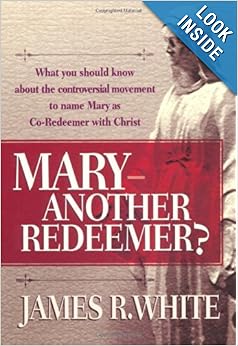
Perpetual Virginity, Immaculate Conception, Sinlessness, and Bodily Assumption of Mary have their beginnings in fictional accounts like the Protoevangelium of James and Gnostic writings like the Odes of Solomon and the Ascension of Isaiah (James White, Mary: Another Redeemer?, Bethany, 1998, p. 33). Pious beliefs like co-Mediatrix and co-Redemptrix, that could possibly be declared dogmas in the future by a Pope, are even more later innovative corruptions. _________________________________________________________________________________________________________ Another excellent book, which we have mentioned here many times before, is worth repeating again: Who is My Mother? by Eric Svendsen, Calvary Press, 2001.
"So, for Mary’s “beginning and end”, we have fiction and the Gnostics. The process by which these “things”, as you put it, became “universal feast days” relies in tremendous measure on the popular piety of what essentially were the baptized pagans of the Roman empire. While it is true that some early things said about Mary (i.e. “theotokos”) were truly intended to say things about Christ, Mary wouldn’t have been on the radar screen (from a Scriptural perspective) if these fictitious legends were not floating about the broader culture."
from John Bugay's article, "Why I reject the Marian Dogmas" at Triablogue. Good job, John!

Friday, November 15, 2013

Roman Catholics continue to give bad witness to Muslims


Pope Benedict XVI praying to a statue of Mary.  Even though Roman Catholics say, "we are not worshipping Mary, we are not giving her Latria, we are only asking her to pray for us and giving her "hyper-dulia" (extra veneration and honor).  Well, it looks like worship to me.  It is wrong; and it has been a bad witness to Muslims for centuries.  

I saw this today at a Muslim blog, so the bad witness to Muslims continues to this day. (no longer there, as Paul Williams deleted his blogs several times.)  Shame on the Roman Catholic Church! 

The Muslim quotes Surah 5:116-118.  

I left a comment:  

Indeed, this is exactly why Muhammad thought the Trinity was “Father, Son, and Mother”, as Surah 5:116 and 6:101 and 5:72-75 makes clear.
Because of the churches at that time had “left their first love” (Rev. 2:4-5) and they later exalted Mary too much and prayed to her and had icons and statues.
Those practices which included heretical churches and nominal Christians and also later developed into full blown Roman Catholicism and the iconography emphasis in the Eastern Orthodox Church, and other Oriental Orthodox Churches were a terrible witness to the Muslims.
Even to this day, most Muslims don’t even know what the Trinity is.
Since Muhammad and whoever compiled the Qur’an did not accurately know the doctrine of the Trinity, this proves that the Qur’an is not God’s word.

Monday, August 19, 2013

And Now... The Date for the Assumption of Mary...

...from the private musings of Taylor Marshall: What is the Historical Date for the Assumption of Mary:

"So I’m suggesting that Mary was assumed about A.D. 63 when Herod’s temple was finally finished. This temple did not have the true Ark of the Covenant – because Mary was the true Ark of the Covenant enshrined not in the Herodian Temple, but in the Temple of the Catholic Church. So the Assumption of Mary is a sort of “pre-tribulation” sign occurring before the seven years of Roman-Jerusalem gridlock culminating in the end of the Mosaic age – the destruction of the Temple in A.D. 70."

Thursday, August 15, 2013

Remembering the Assumption of Mary

On the Death of Mary: Why the Infallible Interpreter Still Needs to be Interpreted

10/16/2011 - James Swan
As I've understood Roman Catholicism, it isn't determined one way or the other that Mary died. A Roman Catholic is free to believe either. Catholic Answers founder Karl Keating states, 
The Church has never formally defined whether she died or not, and the integrity of the doctrine of the Assumption would not be impaired if she did not die, but the almost universal consensus is that she did in fact die [Karl Keating, Catholicism and Fundamentalism (San Fransisco: Ignatius Press, 1988), p. 273].

Against this "almost universal consensus" is none other than Patrick Madrid. Of Revelation 12:1-8 he states, 

This passage also shows us a vision of Mary, queen of heaven, and hints at her Assumption. The gift of suffering no corruption in the grave and of being 'caught up' into heaven while still alive is perfectly in accordance with Scripture [Patrick Madrid,Where is That in the Bible? (Indiana: Our Sunday Visitor, 2001), pp. 71-72].

Against this "almost universal consensus" is also the New Catholic Answer Bible:

If indeed she was free from sin, then it follows that she would not have to undergo the decay of death, which was the penalty for sin [The New Catholic Answer Bible (Kansas: Fireside Catholic Publishing, 2005) Insert F2].

On the other hand, there are Roman Catholic web pages like this stating the following:

In any case, it is at least a sententia certa (a certain teaching) that our Lady died before being raised and assumed into heaven. This is the clear and explicit tradition of the West and is maintained in a slightly less-clear (and more metaphorical) manner also in the East.

The confusion stems from the magisterial teaching of Pope Pius XII in Munificentissimus Deus. Some say he did not explicitly state that Mary died. Some Roman Catholics read this "infallible" pronouncement and state:

This certitude that Mary in fact died and was believed by the Roman Catholic Church to have died before her bodily assumption is nicely addressed by Pope Pius XII when he states in section 17 of Munificantissimu Deus...  in quoting an historical source that  "Adrian I, our predecessor of immortal memory, sent to the Emperor Charlemagne. These words are found in this volume: 'Venerable to us, O Lord, is the festivity of this day on which the holy Mother of God suffered temporal death, but still could not be kept down by the bonds of death, who has begotten your Son our Lord incarnate from herself."

Other Roman Catholics reading the same document declare:

However, the definition infallibly declared by Pius XII does not explicitly state that the Blessed Virgin suffered death: "We pronounce, declare, and define it to be a divinely revealed dogma: that the Immaculate Mother of God, the ever Virgin Mary, having completed the course of her earthly life, was assumed body and soul into heavenly glory."

These interpretive snippets demonstrate an ironic flaw in Romanism: even their alleged infallible dogmatic pronouncements are open to interpretation. We need to continually remind Roman Catholics about this when they argue that they have some sort of superior certainty that non-Romanists do not. Roman Catholics sometimes say that if one lacks an infallible interpreter, one is left with private interpretation (as Patrick Madrid call it, "a blueprint for anarchy"). But what this often assumes is that the actual infallible pronouncements don't need to be interpreted... but they do! One never escapes private interpretation, so when Roman Catholics raise the issue, the double standard needs to be exposed. One may respond that it really isn't that important whether Mary died or not. That individual Roman Catholics quibble over it is no big deal. Actually though it's simply one more example of a much bigger problem. For instance, on the fundamental issue of what are, or are not, the very Words of God, Catholics are not unified.  

Wednesday, February 06, 2013

And now, some slightly blasphemous prayers

While out at the abortion clinic, I've noticed that a few older Roman Catholic gentlemen come out as well for ~30 minutes, set out some pro-life signs, and pray what I was pretty sure was the Rosary.

Leaving aside the question of whether the Rosary has any effect on abortion (other than making demons laugh uproariously), last time I was out there, as they finished up their prayers and went back to their car, they passed my way and as we said hello, one of them handed me a pamphlet, saying, "These are the prayers we pray when we're out here."

I later flipped through it and found the following verses of sheer awesomeness, which I thought I'd share here. If you can pray these without wanting to throw up, you need to repent, and quickly.


Wednesday, July 04, 2012

Matthew 1:18; 25, Mary and "Until"

I was searching the blog, and came across an old post from 2009. It's a humorous response on the Roman Catholic exegesis of Matthew 1:18-25 and their curious interpretation of the word "until." Unfortunately, the link to the the author of the counter-argument below no longer works. Apparently, I found it on the Envoy Forum. It may perhaps originate from this banned person on the Catholic Answers forum.

Matthew 1:18-25
18 Now the birth of Jesus Christ was as follows: when His mother Mary had been betrothed to Joseph, before they came together she was found to be with child by the Holy Spirit. 19 And Joseph her husband, being a righteous man and not wanting to disgrace her, planned to send her away secretly. 20 But when he had considered this, behold, an angel of the Lord appeared to him in a dream, saying, “ Joseph, son of David, do not be afraid to take Mary as your wife; for the Child who has been conceived in her is of the Holy Spirit. 21 She will bear a Son; and you shall call His name Jesus, for He will save His people from their sins.” 22 Now all this took place to fulfill what was spoken by the Lord through the prophet: 23 “ Behold, the virgin shall be with child and shall bear a Son, and they shall call His name Immanuel,” which translated means, “ God with us.” 24 And Joseph awoke from his sleep and did as the angel of the Lord commanded him, and took Mary as his wife, 25 but kept her a virgin until she gave birth to a Son; and he called His name Jesus.

Catholic Answers:
Scripture’s statement that Joseph "knew [Mary] not until she brought forth her firstborn" would not necessarily mean they did "know" each other after she brought forth Jesus. Until is often used in Scripture as part of an idiomatic expression similar to our own usage in English. I may say to you, "Until we meet again, God bless you." Does that necessarily mean after we meet again, God curse you? By no means. A phrase like this is used to emphasize what is being described before the until is fulfilled. It is not intended to say anything about the future beyond that point. [source]

Counter-Argument
Are you married? If so, try telling your father-in-law this: "I did not have relations with your daughter until we got engaged." See what he thinks of that. After all, if your father-in-law is as perceptive as you are, there's no way he'll make a spurious assumption about pre-marital relations between the two of you based on such a statement.

It's fun to imagine these kinds of things....This is what it would look like, just for review: In casual conversation with your wife's dad, you mention that you didn't have (relations) with his daughter until you were engaged. After telling him not to read so much into an idiomatic statement and that he should stop being so historically ignorant, tell him your statement had nothing to do with what you guys did after the engagement. See how that flies.

Saturday, March 24, 2012

Facts About Mary You May Not Know

"As Mother of God and Mother of the Church, Mary prays in and with the Church at every decisive moment of salvation history. Let us entrust to her every moment of our own lives, and let her teach us the need for prayer, so that in loving union with her Son we may implore the outpouring of the Holy Spirit and the spread of the Gospel to all the ends of the earth." Benedict XVI, March 2012.

Thursday, January 19, 2012

Another Gem from Catholic Answers: Mary's Assumption

I find these sort of discussions fascinating:

Mary's Assumption

"I was watching a video that Steve Ray produced about a quick run through Jerusalem and he showed the church where the BVM died and was assumed into Heaven. What got me thinking is this, why did the BVM needed to die in order to be assumed? Elijah didn't die when he was taken up in the chariot. Also, I know that based on Tradition, it is said that the BVM didnt suffer the pangs of child birth because she was immaculately conceived and therefore was not subject to the effects of sin, but, if this is part of the Tradition, why did she have to die in order to be assumed into Heaven?"

-snip-

"it is not defined dogma that she did die, and I have seen this video several times and don't think he said definitely that she died. There is a long tradition in the Eastern Church in fact that she fell asleep, the Dormition."

-snip-

"The Church does NOT teach that Mary died before being assumed. Catholics are free to believe she died first or did not die first."

-snip-

"This falls under Common Teaching [Sententia Communis. This means Common Teaching is doctrine, which in itself belongs to the field of free opinions, but which is accepted by thelogians generally."

-snip-

"The document that pronounced the dogma of the Assumption is called Munificentissimus Deus. The specific paragraph containing the definition, remains open to whether or not Mary did or did not have a temporal death."

-snip-

"...I always thought that Mary was assumed with out dying, especially when I compared Elijah's assumption with that of Mary."

-snip-

"It was not necessary that Mary die. She chose to out of the imitation of Jesus."

-snip-

"There is a Scripture, and I hope that someone who knows where this is in Scripture will respond to this thread, that it has been appointed unto all men that they are to die once..."

-snip-

"Hebrews 9:27 (Douay Rheims) And as it is appointed unto men once to die, and after this the judgment"

-snip-

"And this is a good example of exactly the kind of problem there is with proof-texting...the context of that Scripture has nothing to do with the context of our thread here."

-snip-

"That is one acceptable intrepretation. However the other intepretation is also acceptable as well."