Showing posts with label justification by faith alone. Show all posts

Monday, June 08, 2026

Did Martin Luther say, “Love God? I hate Him!”?

This came up in a Roman Catholic vs. Protestant Facebook debate group:
“Love God?! I hate Him!" - Martin Luther. Question for Protestants who are not Anglican... Why would you listen to Martin Luther if he hates God?"
Lest one think this was an unbiased question from a sincere Roman Catholic participant, the same person went on to write, "let's not also forget he influenced Hitler with his Antisemitic writings" and "Martin Luther was evil." I was also informed that Martin Luther was in hell because of visions from a few saints. The intent of this question amounts to online rage bating.  

Let's take a closer look to see if Martin Luther really said he hates God.

Documentation
As is often the case from online hostile Roman Catholics, no documentation was provided. In the discussion I repeatedly asked for an actual quote, an actual context, and if possible, a meaningful link. The author of the question did not respond to this request. Very few Roman Catholic participants responded to this request. In fact, only one person ventured this proof:


Out of principle, I flatly rejected the A.I. method of lazy documentation. Would Rome's defenders step up and locate the quote? The same defender of Rome gave a few more tries with secondary links, even providing a link to R.C. Sproul's famous lecture on Luther. However, helpful Dr. Sproul's classic lecture is, it still doesn't show proper documentation. Even in the overview contained in his book, The Holiness of God, Dr. Sproul cites Roland Bainton's Here I Stand, a Martin Luther biography, not a primary source. The point in provoking Rome's defenders to search out a primary context is to have the correct document to determine who's correctly interpreting it.

Leaving this documentation cat and mouse game aside, there is no such exact quote from Luther in which he says, "Love God?! I hate Him!” I suspect the quote is a rendering of Luther's comment, "I did not love, yes, I hated the righteous God who punishes sinners..." being morphed with Dr. Sproul's classic lecture seeping into the collective unconscious of the Internet. 

If this is the correct quote, it's easy enough to locate. The primary source for would be Vorrede zum ersten Bande der Gesamtausgaben seiner lateinischen Schriften, Wittenberg 1545, located at WA 54:185. In English, this treatise is entitled, Preface to the Complete Edition of Luther’s Latin Writings, Wittenberg, 1545. The quote is found located at LW 34:336-337.


Context
Though I lived as a monk without reproach, I felt that I was a sinner before God with an extremely disturbed conscience. I could not believe that he was placated by my satisfaction. I did not love, yes, I hated the righteous God who punishes sinners, and secretly, if not blasphemously, certainly murmuring greatly, I was angry with God, and said, “As if, indeed, it is not enough, that miserable sinners, eternally lost through original sin, are crushed by every kind of calamity by the law of the decalogue, without having God add pain to pain by the gospel and also by the gospel threatening us with his righteousness and wrath!” Thus I raged with a fierce and troubled conscience. Nevertheless, I beat importunately upon Paul at that place, most ardently desiring to know what St. Paul wanted.
At last, by the mercy of God, meditating day and night, I gave heed to the context of the words, namely, “In it the righteousness of God is revealed, as it is written, ‘He who through faith is righteous shall live.’ ” There I began to understand that the righteousness of God is that by which the righteous lives by a gift of God, namely by faith. And this is the meaning: the righteousness of God is revealed by the gospel, namely, the passive righteousness with which merciful God justifies us by faith, as it is written, “He who through faith is righteous shall live.” Here I felt that I was altogether born again and had entered paradise itself through open gates. There a totally other face of the entire Scripture showed itself to me. Thereupon I ran through the Scriptures from memory. I also found in other terms an analogy, as, the work of God, that is, what God does in us, the power of God, with which he makes us strong, the wisdom of God, with which he makes us wise, the strength of God, the salvation of God, the glory of God.
And I extolled my sweetest word with a love as great as the hatred with which I had before hated the word “righteousness of God.” Thus that place in Paul was for me truly the gate to paradise. Later I read Augustine’s The Spirit and the Letter, where contrary to hope I found that he, too, interpreted God’s righteousness in a similar way, as the righteousness with which God clothes us when he justifies us. Although this was heretofore said imperfectly and he did not explain all things concerning imputation clearly, it nevertheless was pleasing that God’s righteousness with which we are justified was taught (LW 34:336-338).

Original text: 

Ego autem, qui me, utcunque irreprehensibüis monachus vivebam, sentirem coram Deo esse peccatorem inquietissimae conscientiae, nee raea satisfactione placatum confidere possem, non amabam, imo odiebam iustum et punientem peecatores Deum, tacitaque si non blasphemia, certe ingenti raurmuratione indignabar Deo, dicens: quasi vero non satis sit, miseros peecatores et aeternaliter perditos peccato originali omni genere calamitatis oppressos esse per legem decalogi, nisi Dens per euangelium dolorem dolori adderet, et etiam per euangelium nobis iustitiam et iram suam intentaret. Furebam ita saeva et perturbata conscieutia, pulsabam tarnen importunus eo loco Pallium, ardentissime sitiens scire, quid S. Paulus vellet.

Donec miserente Deo meditabundus dies et noctes connexionem verborum atteuderem, uempe: lustitia Dei revelatur in illo, sicut scriptum est: lustus ex fide vivit, ibi iustitiam Dei coepi intelligere eam, qua iustus dono Dei s vivit, nempe ex fide, et esse hanc sententiam, revelari per euangelium iustitiam Dei, scilicet passivam, qua uos Deus misericors iustificat per fidem, sicut scriptum est: lustus ex fide vivit. Hie ine prorsus renatum esse sensi, et apertis portis in ipsam paradisum intrasse. Ibi continuo alia mihi facies totius scripturae apparuit. Discurrebam deinde per scripturas, ut habebat lo memoria, et coUigebam etiam in aliis vocabulis analogiam, ut opus Dei, id est, quod operatur in nobis Deus, virtus Dei, qua nos potentes facit, sapientia Dei, qua nos sapientes facit, fortitudo Dei, salus Dei, gloria Dei.

lam quanto odio vocabulum 'iustitia Dei' oderam ante, tanto amore dulcissimum mihi vocabulum extollebam, ita mihi iste locus Pauli fuit vere is porta paradisi. Postea legebam Augustinum de spiritu et litera S ubi praeter spem offendi, quod et ipse iustitiam Dei similiter interpretatur: qua nos Deus induil, dum nos iustificat. Et quamquam imperfecte hoc adhuc sit dictum, ac de imputatione non clare omnia explicet, placuit tarnen iustitiam Dei doceri, qua nos iustificemur (WA 54:185-186).


Conclusion
This context provides Luther's detailed account of his discovery of justification by faith alone. It is one of the few detailed biographical accounts written by Luther himself. Even with this firsthand information, historians have not been able to conclusively determine the exact date or exact place in which the events described occurred. There have been a number of theories as to the specific date in which Luther came to his understanding of justification by faith alone.

The pertinent aspect of the context is that Luther did not leave the statement, "I did not love, yes, I hated the righteous God" hanging or representative of his total life. He goes on to describe his experience of coming to grasp that "the righteousness of God is that by which the righteous lives by a gift of God, namely by faith" (LW 34:337). He states he arrived at the opposite of hating the righteousness of God:
Here I felt that I was altogether born again and had entered paradise itself through open gates... And I extolled my sweetest word with a love as great as the hatred with which I had before hated the word “righteousness of God.” Thus that place in Paul was for me truly the gate to paradise (LW 34:337).


Monday, November 20, 2023

Did Luther Believe Justification is a Process?

An anonymous participant left this comment: "Luther believed justification is an ongoing process and not a one-time-event like most Protestants today hold to as part of their interpretation of faith alone." In support of this claim, the following citations were provided:

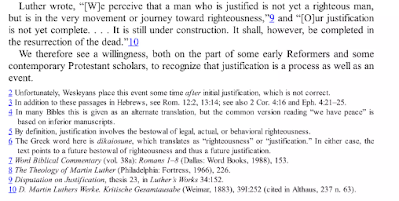
Luther said: “We perceive that a man who is justified is not yet a righteous man, but is in the very movement or journey toward righteousness,” - Disputation on Justification, thesis 23, in Luther’s Works 34:152.

“Our justification is not yet complete.... It is still under construction. It shall, however, be completed in the resurrection of the dead.” - D. Martin Luthers Werke. Kritische Gesamtausabe (Weimar, 1883), 39I:252 (cited in Althaus, 237 n. 63).

With these citations, Luther is put forth as an advocate of the process of justification... which is notoriously a Roman Catholic theological construct. Let's take a closer look at these quotes and see where they come from and what they are actually saying. We'll discover that the lines between what Luther and Rome are saying about Justification and the final judgment are being obfuscated. 

Documentation
The immediate red flag that this may be a blatant drive-by cut-and-paste are the English citations of Luther and accompanying German references. The cut-and-paste of these quotes is suspiciously similar to an old article by Rome's defender, Jimmy Akin, but more precisely material from Akin's later book, The Drama of Salvation, p. 29.  


It looks like Mr. Akin recycled his old article and made additions and corrections when he published his book (for instance, the first Luther quote is expanded in the book form and the documentation was corrected).  Mr. Akin has relied heavily on a section from Paul Althaus, The Theology of Martin Luther, (particularly page 226) in this presentation of Luther, with both quotes cited by Althaus on page 237 (Althaus translation of the first quote is slightly different than LW 34). Akin uses this material drawn from Althaus to conclude that "a number of recent Protestant scholars" recognize that Justification is a process and "in doing so they are retrieving a concept that was present in the thought of some of the early Reformers" (p.28). 

Mr. Akin argues for the Roman Catholic "process" of justification rather than the imputation of Christ's righteousness. For Akin, it's only "the final, consummating declaration of our righteousness" done in the future that will be the deciding factor if one is actually justified before God or not.  

Quote #1 "We perceive that a man who is justified is not yet a righteous man, but is in the very movement or journey toward righteousness"

This quote comes from a series of disputation statements based on Romanns 3:28, While this is the extent of the statement (it is point #23), the explanation of what Luther means in regard to justification is contained in the surrounding theses and subsequent explanations. In Theses #4, Luther says, "A man is truly justified by faith in the sight of God, even if he finds only disgrace before man and in his own self" (LW 34:151). For Luther, this is profound, for it is human nature to expect to earn salvation by works.  For Luther, our works do not contribute to standing before God as justified. In the same set of Theses, Luther says, "Therefore, whoever is justified is still a sinner; and yet he is considered fully and perfectly righteous by God who pardons and is merciful" (Theses #24).  Luther says the righteousness of Christ "cannot be laid hold of by our works" (Theses # 27) and that "faith alone justifies without our works " because one cannot say "I produce Christ or the righteousness of Christ" (Theses #28).

Luther says that God, in essence, tolerates sin in people until they enter his heavenly eternal kingdom. It is there he states, "For we perceive that a man who is justified is not yet a righteous man, but is in the very movement or journey toward righteousness." Is Luther saying that justification is a journey of the "process" of gaining righteousness toward some sort of eventual justification to stand before a holy God? Not at all. Luther says that good works done by the regenerate are the "start of a new creature" "in the battle against the sin of the flesh" (Theses #35).


Quote #2 “Our justification is not yet complete.... It is still under construction. It shall, however, be completed in the resurrection of the dead.” 

The document this quote comes from (Die Promotionsdisputation von Palladius und Tilemann [Rom 3:28] On the Works of the Law and of Grace [1537]) is scheduled to be released in a future volume of Luther's Works for English readers. The original text can be found here. Similar to the first quote, when Luther speaks of justification as "under construction" and then "completed in the resurrection of the dead," the emphasis is not on process-journey of gaining righteousness to stand before a holy God. The earthly existence is only the mere beginning of intrinsic personal righteousness.  As Paul Althaus explains of Luther, "The condition of being righteous in ourselves can be described in the present tense only as having begun, but its completion lies only in the future; we are only becoming righteous" (Althaus, 237). 


Conclusion
This blog entry is one of those keep your eyes on the ball exercises. For Luther, it's the one-time event in a person's life, in which the righteousness of Christ is imputed to a sinner that allows one into the saving presence of the Holy God, and to savingly remain forever in the presence of Holy God. In the final court room scene in each person's life, God declares a person righteous because the righteousness of Christ entirely covers that person.

The confusion that the anonymous commenter seized and applied to Romanism is that, according to Lutheran scholar Paul Althaus, "Luther used the term 'to justify' in [iustificare] and 'justification' [justificatio] in more than one sense" (Althaus, 226). Sometimes Luther used it to mean that sense in which a sinner stands before God and is judged according to the righteousness of Christ, imputed by faith. Other times he uses it to mean a person actually intrinsically becoming righteous. Althaus explains, "Justification in that sense remains incomplete on this earth and is first completed on the Last Day. Complete justification in this sense is an eschatological reality" (Althaus, 226).     By being made "perfectly righteous" Luther means being given a glorified body. Althaus later says of Luther's view, "This already present righteousness is both a complete and a partial righteousness, depending on the way in which it is viewed. It is complete when viewed as acceptance by God and as a participation in Christ's righteousness; Christ's righteousness is a totality and the believer participates in that totality. It is partial as man's new being and new obedience" (Althaus, 236). That new obedience culminates in the future: For Luther, in the final court room scene, a person is given a new existence: "Sin remains, then, perpetually in this life, until the hour of the last judgment comes and then at last we shall be made perfectly righteous" (LW 34:166).

For Rome, in the eternal state, God will look at person and judge whether or not that person is completely righteous. If that person is not completely infused with personal righteousness, that person is not given a glorified body, but is sent off to purgatory until personal righteousness is complete. In this world, therefore, a strong emphasis is placed on participating in the sacraments and gathering up as much righteousness as one can. Note Jimmy Akin's comment from his old article
[T]he ultimate and final courtroom declaration concerning the believer does not occur until he stands before God (at his death and at the end of the world). So we may infer that the ultimate and final pronouncement of the believer as righteous does not lie in this life.
In Luther's view, it is the righteousness of Christ given to a person that allows a sinner to enter into God's holy presence... and stay there. There is no need to be sent off to purgatory to be made righteous. In The Disputation Concerning Justification, Luther comments on the view of Erasmus that captures some of the nuances under scrutiny here: 
By faith we are justified and by faith we receive forgiveness of sins and the beginning of obedience, as Erasmus also argues. He distinguishes between faith and works in this way. Faith alone begins the forgiveness of sins, but works obtain salvation or merit and the kingdom of heaven or eternal life. He says that faith in this life removes sins and gives remission of sins, afterward he ascribes salvation to works. This is most excellent and plausible, and this argument pleases reason. For reason rushes in blindly and thinks thus: Eternal salvation is something else than Christian righteousness. It concludes that it can by its own works merit eternal salvation, as if we obtained justification through faith and salvation through works. So it seems plausible enough, since the text clearly said, “Man believes with his heart and so is justified, and he confesses with his lips and so is saved” [Rom. 10:10]. But this is absurd in the first place, because then Christ must be an incomplete and not a perfect savior. They wish thereby to make us more perfect than our Savior, because they attribute that which is the greatest to works and that which is least to Christ and faith. Even if Christ merits forgiveness of sins for us, we must still save ourselves. Likewise, we need Christ for justification, as if for the least important reason, afterward we need obedience for our salvation, as if for the most important reason. Who says such things? Beware of these arguments and of such men, since this now makes Christ less highly esteemed a savior, but detracts from his honor, that he has made us righteous by his death, since we ourselves can obtain eternal life by our works. These absurdities bring darkness into the minds of men. For they assume that Christ must not be the Savior, that he made us safe from original sin, and that we must later become perfect by ourselves. [LW 34:163]
In this life, if works are done, they are not done to gain favor with God.  In the Disputation in which the first quote was extracted, Luther repeatedly argues,
Works only reveal faith, just as fruits only show the tree, whether it is a good tree. I say, therefore, that works justify, that is, they show that we have been justified, just as his fruits show that a man is a Christian and believes in Christ, since he does not have a feigned faith and life before men. For the works indicate whether I have faith. I conclude, therefore, that he is righteous, when I see that he does good works. In God’s eyes that distinction is not necessary, for he is not deceived by hypocrisy. But it is necessary among men, so that they may correctly understand where faith is and where it is not. [LW 34:161].

Addendum

“Official Roman Catholic theology includes sanctification in the definition of justification, which it sees as a process rather than a single decisive event and affirms that while faith contributes to our acceptance with God, our works of satisfaction and merit contribute too. Rome sees baptism, viewed as a channel of sanctifying grace, as the primary instrumental cause of justification, and the sacrament of penance, whereby congruous merit is achieved through works of satisfaction, as the supplementary restorative cause whenever the grace of God’s initial acceptance is lost through mortal sin. Congruous, as distinct from condign, merit means merit that it is fitting, though not absolutely necessary, for God to reward by a fresh flow of sanctifying grace. On the Roman Catholic view, therefore, believers save themselves with the help of the grace that flows from Christ through the church’s sacramental system, and in this life no sense of confidence in God’s grace can ordinarily be had. Such teaching is a far cry from that of Paul.” (J.I. Packer Concise Theology)

Thursday, April 18, 2019

Responses to Catholic Nick's article on Imputation as part of Justification by Faith Alone

https://apologeticsandagape.wordpress.com/2019/04/18/response-to-catholic-nick-on-imputation-as-part-of-justification-by-faith-alone/

From several years ago, Joey Henry wrote an excellent 8 Part response to "Catholic Nick" (linked to on Devin Rose's blog) on Imputation as part of Justification by Faith Alone, which I hope to write more about later if and when I find the time.

Monday, November 19, 2018

CARM Discussion: Luther and Romans 3:28

Here's a conversation with one of Rome's defenders from the CARM Roman Catholic board on Luther and Romans 3:28. I began saving these interactions because they tend to vanish, There was no editing.

Originally posted by tester View Post
http://beggarsallreformation.blogspo...omans-328.html

Luther's actual reasoning for using "alone" in Romans 3:28
This is the sad part about those who use Luther's Open Letter On Translating against him. He actually goes on to give a detailed explanation of why he uses the word "alone" in Roamn 3:2/8 In the same document, in a calmer tone, Luther gives his reasoning for those with ears to hear:
“I know very well that in Romans 3 the word solum is not in the Greek or Latin text — the ******* did not have to teach me that. It is fact that the letters s-o-l-a are not there. And these blockheads stare at them like cows at a new gate, while at the same time they do not recognize that it conveys the sense of the text -- if the translation is to be clear and vigorous [klar und gewaltiglich], it belongs there. I wanted to speak German, not Latin or Greek, since it was German I had set about to speak in the translation.”
Luther continues to give multiple examples of the implied sense of meaning in translating words into German. He then offers an interpretive context of Romans:
“So much for translating and the nature of language. However, I was not depending upon or following the nature of the languages alone when I inserted the word solum in Romans 3. The text itself, and Saint Paul's meaning, urgently require and demand it. For in that passage he is dealing with the main point of Christian doctrine, namely, that we are justified by faith in Christ without any works of the Law. Paul excludes all works so completely as to say that the works of the Law, though it is God's law and word, do not aid us in justification. Using Abraham as an example, he argues that Abraham was so justified without works that even the highest work, which had been commanded by God, over and above all others, namely circumcision, did not aid him in justification. Rather, Abraham was justified without circumcision and without any works, but by faith, as he says in Chapter 4: "If Abraham were justified by works, he may boast, but not before God." So, when all works are so completely rejected — which must mean faith alone justifies — whoever would speak plainly and clearly about this rejection of works will have to say "Faith alone justifies and not works." The matter itself and the nature of language requires it.”
..Previous translations of the word “alone” in Romans 3:23
Luther offers another line of reasoning in his “Open Letter on Translating” that many of the current Cyber-Roman Catholics ignore (and most Protestants are not aware of):
“Furthermore, I am not the only one, nor the first, to say that faith alone makes one righteous. There was Ambrose, Augustine and many others who said it before me.”
Now here comes the fun part in this discussion.

The Roman Catholic writer Joseph A. Fitzmyer points out that Luther was not the only one to translate Romans 3:23 with the word “alone.”
http://beggarsallreformation.blogspo...omans-328.html

The list includes Thomas Aquinas, Augustine, Origen, Cyril of Alexandria,John Chrysostom,
and others
Nope. Luther had a very different meaning of "faith alone". It was NOT taught by any of the Fathers you mentioned. Luther was trying to use language to justify his inclusion and changing of the meaning of the Scripture. That's unfortunate. All one has to do is look at how he treated the canon of Scripture, deciding which books of the Old and New Testament that HE thought were inspired. How's that for someone thinking THEY alone can determine which books are inspired and which are not. And yes, he rejected New Testament as well as Old Testament books as not being inspired.

Originally posted by Mark Rome View Post
Nope. Luther had a very different meaning of "faith alone". It was NOT taught by any of the Fathers you mentioned. Luther was trying to use language to justify his inclusion and changing of the meaning of the Scripture.
Hi Mark,

Your zeal for your beliefs and defense of Rome is duly noted, and appreciated. The following comments are based on a CARM debate on this topic I had back in 2008.

True, it is entirely possible Luther’s understanding of “faith alone” differs from those before him... but that is not the issue. The issue is whether or not the thrust of Romans 3:28 implies “alone.” Others previous to Luther may have differed in theological interpretation, yet they saw the thrust of the words in context implied “alone.” So, whether or not Luther had "a very different meaning" is irrelevant. Did you know even some Roman Catholic versions of the New Testament also translated Romans 3:28 as did Luther? The Nuremberg Bible (1483), “nur durch den glauben” and the Italian Bibles of Geneva (1476) and of Venice (1538) say “per sola fede.”

Originally posted by Mark Rome View Post
In his An Open Letter on Translating: "So much for translating and the nature of language. However, I was not depending upon or following the nature of language when I inserted the word "solum" (alone) in Rom. 3 as the text itself, and St. Paul's meaning, urgently necessitated and demanded it."Luther inserted his own theology into the text.
When Luther says, "urgently necessitated and demanded it," this is exactly what the point is in bringing out the fact that others previous to Luther saw the intent of the text. Luther approached the work of a translator honestly. If Luther was attempting to radically distort the New Testament, his work failed in many ways. Luther did not add the word “alone” to Galatians 2:16, nor did he remove “alone” from James 2. Even in his revision of the Latin Vulgate, Luther left the Latin of Romans 3:28 as it was, because the contrast was apparent.

The entire Roman Catholic crusade against Luther on this issue is entirely unjustified when evaluated by their own paradigms. To my knowledge, there was not any official dogmatic statement prohibiting Luther from either translating the Bible or translating Romans 3:28 as he did. There was not an infallible interpretation of Romans 3 during Luther’s translation work. Until such dogmatic declarations, those throughout church history previous to such cannot be held anathema for their positions or interpretations of Biblical passages. Further, there wasn’t a defined Roman position on Justification previous to Luther. Roman Catholics cannot even indict Luther’s understanding of justification, because previous to Trent, there was not “one” Roman Catholic understanding of justification.

JS


Originally posted by James Swan View Post

Hi Mark,

Your zeal for your beliefs and defense of Rome is duly noted, and appreciated. The following comments are based on a CARM debate on this topic I had back in 2008.

True, it is entirely possible Luther’s understanding of “faith alone” differs from those before him... but that is not the issue. The issue is whether or not the thrust of Romans 3:28 implies “alone.” Others previous to Luther may have differed in theological interpretation, yet they saw the thrust of the words in context implied “alone.” So, whether or not Luther had "a very different meaning" is irrelevant. Did you know even some Roman Catholic versions of the New Testament also translated Romans 3:28 as did Luther? The Nuremberg Bible (1483), “allein durch den glauben” and the Italian Bibles of Geneva (1476) and of Venice (1538) say “per sola fede.”


When Luther says, "urgently necessitated and demanded it," this is exactly what the point is in bringing out the fact that others previous to Luther saw the intent of the text. Luther approached the work of a translator honestly. If Luther was attempting to radically distort the New Testament, his work failed in many ways. Luther did not add the word “alone” to Galatians 2:16, nor did he remove “alone” from James 2. Even in his revision of the Latin Vulgate, Luther left the Latin of Romans 3:28 as it was, because the contrast was apparent.

The entire Roman Catholic crusade against Luther on this issue is entirely unjustified when evaluated by their own paradigms. To my knowledge, there was not any official dogmatic statement prohibiting Luther from either translating the Bible or translating Romans 3:28 as he did. There was not an infallible interpretation of Romans 3 during Luther’s translation work. Until such dogmatic declarations, those throughout church history previous to such cannot be held anathema for their positions or interpretations of Biblical passages. Further, there wasn’t a defined Roman position on Justification previous to Luther. Roman Catholics cannot even indict Luther’s understanding of justification, because previous to Trent, there was not “one” Roman Catholic understanding of justification.

JS
Hello James. Your zeal in defending Luther and his theological novums of the 16th century is duly noted, and appreciated. As I have stated already, Luther admits he did not use the rules of language as the basis for adding the word alone. "However, I was not depending upon or following the nature of language when I inserted the word "solum" (alone) in Rom. 3 as the text itself, and St. Paul's meaning, urgently necessitated and demanded it."

Also, please note that Luther wasn't authorized to translate the Bible. This is not a small point. I think you would agree that translations matter. If they don't, then there's no reason you would discourage someone from using the New World Translation. You also seem to disregard Luther's disregard for 7 books of the Old Testament and 4 books of the New Testament. Luther was excommunicated and declared a heretic for many issues including his insistence on sola scriptura and setting himself up (and every individual) as the private judge of faith.

There is no "crusade" against Luther to posthumously anathematize him. One should be more concerned about Luther's crusade against the Church Christ founded. It wasn't a reformation, it was a rebellion.

Originally posted by Mark Rome View Post
Hello James. Your zeal in defending Luther and his theological novums of the 16th century is duly noted, and appreciated. As I have stated already, Luther admits he did not use the rules of language as the basis for adding the word alone. "However, I was not depending upon or following the nature of language when I inserted the word "solum" (alone) in Rom. 3 as the text itself, and St. Paul's meaning, urgently necessitated and demanded it."
Hi Mark: It would be prudent to read Luther's Open Letter on Translating with a careful eye.

Luther's intention was to translate the Bible into an easily comprehended form of popular German. His translation at times employed forms of dynamic equivalence, as many translations do. Word-for-word translations can be cumbersome and awkward, and not appealing to average readers. Rather, many translations seek to maximize readability with a minimum of verbal distortion by translating according to "concept." In translating Romans, Luther tried to present the "impact" of what the original Greek had on its first readers, and to present the German style and idiom equivalent for his readers.

An honest translator, Luther freely admitted (in the very Luther document you're citing) the word "only" does not appear in the original Greek at Romans 3:28. He states, "I know very well that in the original text this word does not occur. Nevertheless it belongs in any good German translation... Whenever we place two things in opposition and want to make clear that we acknowledge or accept the one and reject the other, we use the word 'only.' "The farmer brings no money but corn only.' 'No, at the moment I really have no money, but only grain.' 'I have only eaten, but not yet drunk.' 'Have you only written, without rereading?' This is the form which we use in countless expressions: over against 'not' or 'none' we have the word 'only,' to make the contrast clear."

Originally posted by Mark Rome View Post
Also, please note that Luther wasn't authorized to translate the Bible. This is not a small point. I think you would agree that translations matter. If they don't, then there's no reason you would discourage someone from using the New World Translation.
First, let's visit your worldview for a moment. I'm a bit rusty on my infallible Roman decretals, so perhaps you can refresh my memory as to the infallible standard on who was and was not allowed to translate the Bible during Luther's day? If I recall, it wasn't until Trent that the Latin Vulgate was formally affirmed as Rome's official version. FYI: Most of Trent took place after Luther's death.

Now let's play in my world for a moment. You've seemingly appealed to your ultimate authority (Rome) as that which sets the rules as to who, or who cannot, translate the Bible. I don't accept that ultimate authority. In fact, the ultimate authority of Rome never sanctioned the very Bible Jesus used.

Now let's venture into a non-logical world. These do not logically follow:

1. Unless Rome authorizes a translation of the Bible, translations do not matter.
2. Unless Rome authorizes a translation of the Bible, then the New World Translation is an acceptable translation.

Originally posted by Mark Rome View Post
You also seem to disregard Luther's disregard for 7 books of the Old Testament and 4 books of the New Testament.
I only casually visit CARM. If this was part of the discussion, I did not come across it, so my apologies. In regard to disregarding, I've written about Luther's canon numerous times, both here and elsewhere. A simple Google search would demonstrate that I've not disregarded Luther and the canon.

Originally posted by Mark Rome View Post
Luther was excommunicated and declared a heretic for many issues including his insistence on sola scriptura and setting himself up (and every individual) as the private judge of faith.
Where? In the Edict of Worms? That was the most important document that declared him a heretic. Read the "Items" in the Edict, Where was Luther condemned for "sola scriptura" and "setting himself up (and every individual) as the private judge of faith"? Perhaps you're reading the document differently than I am, or perhaps I simply missed these points in my old age.

Originally posted by Mark Rome View Post
There is no "crusade" against Luther to posthumously anathematize him. One should be more concerned about Luther's crusade against the Church Christ founded. It wasn't a reformation, it was a rebellion.
These three sentences of yours comprise merely your personal opinion. Each lacks substance, presenting your feelings. Similarly, I present my feelings: There is a concerted effort from some of Rome's defenders to continually attack Luther.
One should be more concerned with bringing Rome back into Christ's church than with attacking Luther.
There was a Reformation in the sixteenth century to overcome Rome's rebellion against Christ's church.

JS
Last edited by James Swan09-03-18, 12:31 AMReason: typos

Originally posted by James Swan View Post

Hi Mark: It would be prudent to read Luther's Open Letter on Translating with a careful eye.
I have. All of your appeals to the German language mean nothing because Luther freely admits, as I have quoted, that he was not following the rules of language when he inserted the word alone. He did it because he believed that Paul meant to say alone.

First, let's visit your worldview for a moment. I'm a bit rusty on my infallible Roman decretals, so perhaps you can refresh my memory as to the infallible standard on who was and was not allowed to translate the Bible during Luther's day? If I recall, it wasn't until Trent that the Latin Vulgate was formally affirmed as Rome's official version. FYI: Most of Trent took place after Luther's death.
The Church must approve any translations of the Bible. I suggest you look at John Tyndale, who was prior to ML, for more information.

Now let's play in my world for a moment. You've seemingly appealed to your ultimate authority (Rome) as that which sets the rules as to who, or who cannot, translate the Bible. I don't accept that ultimate authority. In fact, the ultimate authority of Rome never sanctioned the very Bible Jesus used.
What Bible did Jesus use? The Jews didn't have a closed canon until after 100AD.

Now let's play in my world for a moment. You've seemingly appealed to your ultimate authority (Rome) as that which sets the rules as to who, or who cannot, translate the Bible. I don't accept that ultimate authority. In fact, the ultimate authority of Rome never sanctioned the very Bible Jesus used.

Now let's venture into a non-logical world. These do not logically follow:

1. Unless Rome authorizes a translation of the Bible, translations do not matter.
2. Unless Rome authorizes a translation of the Bible, then the New World Translation is an acceptable translation.
I know you don't accept the authority of the Church. I am asking you about the New World Translation. Is it an acceptable translation to you? Who decides what is acceptable and what isn't? What about the KJV? Some say a Christian can ONLY read the KJV. The point is that you have no authority to say this translation is accepted and this isn't.

Where? In the Edict of Worms? That was the most important document that declared him a heretic. Read the "Items" in the Edict, Where was Luther condemned for "sola scriptura" and "setting himself up (and every individual) as the private judge of faith"? Perhaps you're reading the document differently than I am, or perhaps I simply missed these points in my old age.

Everything in that edict stems from him setting himself up as the private judge of faith from the Scriptures alone.

One should be more concerned with bringing Rome back into Christ's church than with attacking Luther.
There was a Reformation in the sixteenth century to overcome Rome's rebellion against Christ's church.
The Catholic Church is Christ's Church. We pray for and welcome the day when Protestants have unity with the Catholic Church again. I think the Joint Statement on the Doctrine of Justification between Lutherans and Catholics was a step in the right direction. God bless.

Originally posted by Mark Rome View Post
I have. All of your appeals to the German language mean nothing because Luther freely admits, as I have quoted, that he was not following the rules of language when he inserted the word alone. He did it because he believed that Paul meant to say alone.
I will demonstrate that you did not read Luther's Open Letter on Translating carefully. You quote Luther stating"However, I was not depending upon or following the nature of language when I inserted the word "solum" (alone) in Rom. 3 as the text itself, and St. Paul's meaning, urgently necessitated and demanded it." It appears to me you're relying on a less-accurate English translation of what Luther actually wrote. The German text of this sentence reads in part, "Aber nu hab ich nicht allein der sprachen art vertraut und gefolgt, daß ich Röm. 3, 28. solum (allein) hab hinzugesezt; sondern der Tert und die Meinung Pauli fodern und erzwingen es mit Gewalt." (WA 30 II:640). LW 35:195 rightly translates this, "Now I was not relying on and following the nature of the languages alone, however, when, in Roman 3[:28] I inserted the word solum (alone)." PE 5:20 translates similarly, "Now however, I was not only relying on the nature of the languages and following that when, in Romans iii, I inserted the word solum, 'only,' but the text itself and the sense of St. Paul demanded it and forced it upon me." Luther is saying that he did not ONLY follow the nature of the language, but also saw the thrust of the text demands using sola. Now back up to my previous post where I stated:

"...it is entirely possible Luther's understanding of "faith alone" differs from those before him... but that is not the issue. The issue is whether or not the thrust of Romans 3:28 implies "alone." Others previous to Luther may have differed in theological interpretation, yet they saw the thrust of the words in context implied "alone." So, whether or not Luther had "a very different meaning" is irrelevant. Did you know even some Roman Catholic versions of the New Testament also translated Romans 3:28 as did Luther? The Nuremberg Bible (1483), "allein durch den glauben" and the Italian Bibles of Geneva (1476) and of Venice (1538) say "per sola fede."
That you were misreading Luther should have been blatantly obvious, as he previously in the text does provide exegetical reasons for translating the verse the way he did. For whatever reason, you're fixated on a less-accurate English rendering of one sentence at the expense of the overall context. This sort of myopic misinterpretation of a basic text only leads me further away from Rome. It's the sort of interpretation that would have provoked Luther to use the old adage, "Sic volo, sic jubeo; sit pro ratione voluntas" (LW 35:185). It's the sort of interpretation that shows with clarity that Rome's defenders cannot see past their own biases as to what a text plainly says.

Originally posted by Mark Rome View Post
The Church must approve any translations of the Bible. I suggest you look at John Tyndale, who was prior to ML, for more information.
Where, in Luther's day, was this infallibly stated? Why wasn't it until Trent (after Luther's death) that the Latin Vulgate was formally affirmed as Rome's official version?

Originally posted by Mark Rome View Post
What Bible did Jesus use? The Jews didn't have a closed canon until after 100AD.
Jesus appears to have used the Septuagint. Are you trying to say that until the entire New Testament was written, there was no actual Bible? Are you inferring that until Rome "authorizes" a Bible, there is not actually a Bible? If so, wow.

Originally posted by Mark Rome View Post
I know you don't accept the authority of the Church. I am asking you about the New World Translation. Is it an acceptable translation to you? Who decides what is acceptable and what isn't? What about the KJV? Some say a Christian can ONLY read the KJV. The point is that you have no authority to say this translation is accepted and this isn't.
That's a good question, though tangential to your "Luther" ruckus on Romans 3:28. Briefly then, God has gifted his Church with a myriad of ancient manuscripts that collectively preserve the original text. Subsequently, He's provided humanity with those who have been gifted in linguistics and translating. THE NWT, when juxtaposed against both of these, falls short.

Originally posted by Mark Rome View Post
Everything in that edict stems from him setting himself up as the private judge of faith from the Scriptures alone.
As I suspected, you don't appear to have any idea of what the Edict of Worms states. Your saying, "Luther was excommunicated and declared a heretic for many issues including his insistence on sola scriptura and setting himself up (and every individual) as the private judge of faith" is simply a repeating of an accepted modern narrative put forth by Rome's defenders at the expense of historical documents.

Originally posted by Mark Rome View Post
The Catholic Church is Christ's Church. We pray for and welcome the day when Protestants have unity with the Catholic Church again. I think the Joint Statement on the Doctrine of Justification between Lutherans and Catholics was a step in the right direction. God bless.
That's fine to finish with your opinion. Here then is mine: The Roman sect needs to repent and fall under the authority of the Sacred Scriptures. This does not necessarily mean that all those with allegiance to Rome are not part of the Catholic and universal church. There may be those within Rome that embrace the righteousness of Christ alone, but this is despite Rome's official teaching.

JS
Last edited by James Swan09-03-18, 12:23 PM.

Originally posted by James Swan View Post

The Roman sect needs to repent and fall under the authority of the Sacred Scriptures.
It already does, in case you didn't know. It is authoritative as theopneustos, God breathed. Nothing the Church teaches is contradicted in Scripture.

But let's assume you meant the authority of Sacred Scriptures allein. How exactly would that work? Whose interpretation of Scripture should the Church rely on? Lutheran? Reformed? Pentecostal? Methodist? Mormon? Baptist? Which Protestant group claims infallibility?

I am a convert to the Catholic faith because I realized that I was basing my beliefs on my own personal opinions of Scripture or on the fallible opinions of Protestant ministers. That's not how God intended it or Christ set it up. It is ultimately an unworkable way to understand the Christian faith.
Last edited by Mark Rome09-03-18, 01:12 PM.

Originally posted by Mark Rome View Post
I am a convert to the Catholic faith because I realized that I was basing my beliefs on my own personal opinions of Scripture or on the fallible opinions of Protestant ministers. That's not how God intended it or Christ set it up. It is ultimately unworkable to understand the Christian faith.
Mark: When you joined Rome, that was also a personal choice you made based on your belief and your own personal opinion. You had to choose this infallible interpreter over that infallible interpreter.

As I stated many years ago:

To put it bluntly, those that have chosen to become Roman Catholics have to use their own private judgment to do so. One who converts to Rome had to engage in private judgment when making a decision to become Roman Catholic. Those touting Catholic "certainty" over against Protestant "uncertainty" are putting forth a double standard. They are claiming that their position is certain, while anything else is uncertain. But their own decision to become Catholic comes from their own private judgment. Svendsen notes of the convert to Rome:

"The fact is, he had to engage in the very same principle of private judgment that we all must use to decide among the various options; namely, a thinking, objective reasoning process, apart from reliance upon the system to which he would eventually subscribe. But it is that very same principle of private judgment that leads him to Rome and others of us away from Rome. Certainly Rome condemns the decision we reached, but she cannot condemn the principle we used to that decision, since it is the very same principle that all Roman Catholics must use to decide that Rome is the 'true' church. The Roman Catholic cannot introduce a double standard at this point and still be consistent." [Source: Eric Svendsen, Upon This Slippery Rock, 34].

Thus, the Catholic convert used private judgment and private interpretation to choose Rome, but in the next breath condemns the Protestant for using private judgment and private interpretation.
Once again, I do appreciate your zeal, and I do not mean that mockingly. It's just not a tenable position.

Regards, JS

Originally posted by James Swan View Post

Mark: When you joined Rome, that was also a personal choice you made based on your belief and your own personal opinion. You had to choose thisinfallible interpreter over that infallible interpreter.

As I stated many years ago:


Once again, I do appreciate your zeal, and I do not mean that mockingly. It's just not a tenable position.

Regards, JS
The thing is, James, you do not have an infallible interpreter. I do not claim to be infallible, but it doesn't follow that the Church isn't infallible. The question everyone must answer is "How do you know what the Christian faith is?"

It is everyone's responsibility to examine the truth claims of the Catholic Church. Some haven't (yet) recognized the truth claims of the Catholic Church either through ignorance or through deeply ingrained biases against the Catholic faith. Some may be obstinate about it, but I am not their judge, God is their judge.

I do sincerely appreciate your zeal to defend Martin Luther. Had he been a true reformer, it's quite possible that he would be Saint Luther in the Church today. Yours just is not a tenable position. Blessings.

Originally posted by Mark Rome View Post
The thing is, James, you do not have an infallible interpreter. I do not claim to be infallible, but it doesn't follow that the Church isn't infallible. The question everyone must answer is "How do you know what the Christian faith is?"

It is everyone's responsibility to examine the truth claims of the Catholic Church. Some haven't (yet) recognized the truth claims of the Catholic Church either through ignorance or through deeply ingrained biases against the Catholic faith. Some may be obstinate about it, but I am not their judge, God is their judge.

I do sincerely appreciate your zeal to defend Martin Luther. Had he been a true reformer, it's quite possible that he would be Saint Luther in the Church today. Yours just is not a tenable position. Blessings.
Mark, you made a fallible personal decision as to which infallible interpreter you desired to follow. You could have chosen a number of alleged infallible interpreters.... The Mormon church, the Jehovah's Witnesses, etc. There's a confusing number of infallible interpreters out there, all claiming to speak infallibly for God. The question for you to consider is one posed by Eric Svendsen many years ago..."How can you be certain that you are in the truth since all you have to go on is your own fallible private judgment that Rome is right?"

I realize your "sincere appreciation" is a spin on what I wrote previously. Ah well, I really did mean it. It takes a lot of courage to defend Rome in a hostile environment. It doesn't take any such courage for me to post here about the Reformation.

In regard to Luther, it appears I was able to respond to your charges in such a way as to shut the Luther part of our interaction down. Luther's Open Letter on Translating is one of my favorite Reformation documents, thanks for presenting the opportunity to revisit that writing.

Regards JS
Last edited by James Swan09-03-18, 10:39 PMReason: formatting, typo

Originally posted by James Swan View Post

In regard to Luther, it appears I was able to respond to your charges in such a way as to shut the Luther part of our interaction down. Luther's Open Letter on Translating is one of my favorite Reformation documents, thanks for presenting the opportunity to revisit that writing.
Actually you didn't. As I have quoted, Luther admits that he added the word alone because he felt that St Paul's meaning "urgently necessitated and needed it". You can argue all you want about how it was just a sincere language issue, but you can't get around Luther explaining that he is the one who understands what Paul meant. To quote him, "Dr. Martin Luther will have it so and he says that a p0pe and an *** are the same thing." I too like Luther's Open Letter on Translating because it is apparent for all to see just how arrogant he was and how he placed himself above all in translating Scripture.

I can see that Luther took great liberties with the Scriptures, can you? It was a pattern of his, including mutilating the Bible and casting doubt on inspired books. If a Luther came along today and did something similar, he would be shunned by most all, probably including you.


Originally posted by Mark Rome View Post
Actually you didn't. As I have quoted, Luther admits that he added the word alone because he felt that St Paul's meaning "urgently necessitated and needed it". You can argue all you want about how it was just a sincere language issue, but you can't get around Luther explaining that he is the one who understands what Paul meant. To quote him, "Dr. Martin Luther will have it so and he says that a p0pe and an *** are the same thing." I too like Luther's Open Letter on Translating because it is apparent for all to see just how arrogant he was and how he placed himself above all in translating Scripture. I can see that Luther took great liberties with the Scriptures, can you? It was a pattern of his, including mutilating the Bible and casting doubt on inspired books. If a Luther came along today and did something similar, he would be shunned by most all, probably including you.
I am willing to look at Luther's "great liberties with the Scriptures," in fact, I could list a number of ways in which I disagree with Luther or find him at fault. The problem is, first, you have not made a compelling case on Luther and Romans 3:28. I've demonstrated you overtly misread Luther. You provided no coherent counter response to the information I provided. In fact you avoided it and then simply restated your refuted position above in this response. Repeating the same thing over and over again reminds me of the old song by Genesis, "I know what I like, and I like what I know."

Second, the Beatles had a line, "Nothing's going to change my world." It strongly appears you're not willing to consider the verity of any information other than that which promotes your own worldview. Let me flesh this out: Roman Catholic scholar Joseph A. Fitzmyer also read Luther's Open Letter on Translating and stated, "Although 'alleyn/alleine' finds no corresponding adverb in the Greek text, two of the points that Luther made in his defense of the added adverb were that it was demanded by the context and that sola was used in the theological tradition before him[Romans, A New Translation with Introduction and Commentary (New York: Doubleday) 1993, 360]. Fitzmyer then lists a number of people previous to Luther to substantiate Luther's point. Fitzmyer's list was already provided to you. You were not able to cogently place the facts into your worldview. You simply dismissed Fitzmyer's work by saying:

Originally posted by Mark Rome View Post
Nope. Luther had a very different meaning of "faith alone". It was NOT taught by any of the Fathers you mentioned. Luther was trying to use language to justify his inclusion and changing of the meaning of the Scripture. That's unfortunate.
Luther was not the devilish translator you're slandering him to be. It's within the realm of possibility to use the word "alone" in Romans 3:28 in translation. Fitzmyer saw this. Why can't you? What would you really be giving up by simply letting the facts fall where they will? Simply admitting that it's within the realm of proper translation to use the word "alone" is not conceding that Luther's "sola fide" is right. This does not follow. After producing the list to substantiate Luther's point, Fitzmyer goes on to say, "Even so, one must further ask whether Luther meant by 'only' what his predecessors meant" (p.362). Perhaps you missed it when I also previously stated, "it is entirely possible Luther's understanding of 'faith alone' differs from those before him... but that is not the issue. The issue is whether or not the thrust of Romans 3:28 implies 'alone.'"

My time is limited on CARM, so unless you're willing to actually interact with the facts beyond repeating the same thing over and over, in the word's of Groucho Marx:

Hello, I must be going
I cannot stay
I came to say
I must be going
I'm glad I came
But just the same
I must be going, la-la!

JS


Originally posted by James Swan View Post

My time is limited on CARM, so unless you're willing to actually interact with the facts beyond repeating the same thing over and over, in the word's of Groucho Marx:

Hello, I must be going
I cannot stay
I came to say
I must be going
I'm glad I came
But just the same
I must be going, la-la!

JS
Paul did not intend to say "faith alone" in Romans 3:28. If he had, he would have written it. You've already admitted that Luther through that Paul meant to say "faith alone". You've also agreed that the word alone isn't in the Greek. This is why the Church is very careful with Bible translations. Guess what? The Church even burned bad translations of the Bible. You know what? If I see a copy of the NWT translation at a used book store, I would buy it and burn it rather than have someone unsuspecting buy it and be led into heresy.

Paul was the most prolific writer of the New Testament when it comes to faith and not once did he use the phrase "faith alone". If he wanted to say we are justified by faith alone, he would have. But he didn't.

Since your time is limited, I'll let your song be the your "swan song"  I am sure you will respond so I'll let you have the last word since my time is limited too. Blessings.