Showing posts with label alcohol. Show all posts

Monday, July 20, 2020

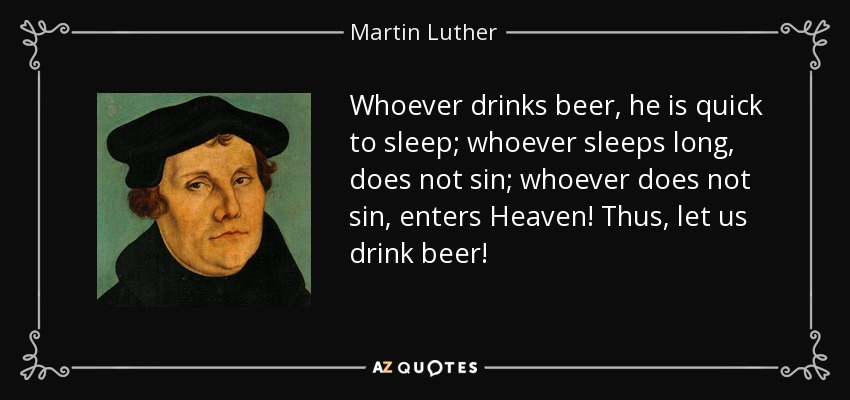
Luther: "Whoever drinks beer, he is quick to sleep; whoever sleeps long, does not sin; whoever does not sin, enters Heaven! Thus, let us drink beer!"


Here's a Luther quote pulled from a Lutheran discussion group:
Whoever drinks beer, he is quick to sleep; whoever sleeps long, does not sin; whoever does not sin, enters Heaven! Thus, let us drink beer!
This is another one of those Luther quotes splattered all over the internet.  It appears to be particularly an obvious favorite of beer websites and beer enthusiasts. One site states,  "I not 100% sure that the following quote is truly from Martin Luther; however I’ve seen it attributed to him enough that I willing to do the same." One page considers the quote one of 50 Profound Martin Luther Quotes About Faith.  A basic book search reveals it's gone to print as well. Let's take a closer look. No, it wasn't Luther, but it is surprising to find out that one of Luther's closest associates was using a version of it.

Documentation
Typically, there is no documentation other than attributing the quote to "Martin Luther." Others have sought to verify this quote. This author claims the quote "seems to have appeared suddenly in 2007 on a blog" but doesn't provide a link to substantiate the claim.  An intriguing clue is found on Wikipedia, dating the phrase in Latin to 1658:

Whoever drinks beer, he is quick to sleep; whoever sleeps long, does not sin; whoever does not sin, enters Heaven! Thus, let us drink beer!
  • Widely attributed to Luther, but actually is an example given in 1658 book Ἑρμηνεια logica of faulty logic. In Latin:
    • Si vero termini in sorite sunt causae subordinatae per accidens, sorites non valet; ut ia hoc, Qui bene bibit, bene dormit; qui bene dormit, non peccat; qui non peccat, est beatus; ergo: qui bene bibit est beatus. Vitium est, quod bene bibere sit causa per accidens somni.
  • Translated via Fauxtations:
    • If, however, the conclusions in the sorite are subordinate by accident, the sorites is not valid; as in this one, He who sleeps well, drinks well; he who sleeps well, does not sin; he who does not sin, is blessed; therefore, he who drinks well is blessed. The problem is that to drink well is a cause of sleep only by accident.

The 1658 book / page cited by Wikipedia can be found here.  Wiki, as admitted, absorbed this information from this source, a blog entitled, Fauxations, because sometimes the Internet is wrong. Kudos to this source for at least determining the quote has an old pedigree that need not necessarily be linked to Martin Luther. Unfortunately, while 1658 may appear at first glance to be the oldest use of the quote found via Google Books, this does not determine if its the actual origin of this quote or if Luther originally said it or not.

An interesting clue that Fauxations points out is the aspect of the "syllogism"... that the quote was not intended to be a cute saying, but rather an example of a logical problem.  This nineteenth-century source refers to it as a "classic canticle" citing it as: Bene vivit. Qui bene vivit Bene dormit. Qui bene dormit Non peccat. Qui non peccat In cælum venit. Ergo qui bene bibet In cælum venit. Another nineteenth-century text refers to it as "the syllogism," another, "the formula."  This text refers to it as "a profane syllogism obtained by Lord John Russell from an old Spanish priest": Qui bene bibet bene dormit, qui bene dormit non peccat, qui non peccat salvatus erirt (the incident appears to be recorded here and here).  This text puts the syllogism in a narrative form. The one thing these texts at least have similarly in is that the syllogism existed as common knowledge.

Philip Melanchthon?
One can go deeper than 1658 and find the syllogism being toyed with by none other than Luther's associate... Philip Melanchthon!  In a Google book from 1529 from Melanchthon one finds


This text reads, Qui bene bibet, bene dormit, Qui bene dormit, non peccat, qui no peccat erit beatus, ergo qui bene bibet erit beatus. There appears to be correlation of this Latin syllogism to the German jingle, Zu nacht wohl essen, macht wohl schlafen, und wohl leben, macht wohl sterben.


Conclusion
I doubt Luther coined the phrase in it's typical logical formula or in the form Melanchthon presented. It is fascinating though that Philip Melanchthon, a close associate, was using it in his logic textbooks and Luther was well aware of his publications.  It is therefore, not out of the possibility that Luther could have repeated it, or a version of it, say in a Table Talk (my cursory search though didn't find anything). It would be interesting to determine if the syllogism existed previous to Melanchthon (I suspect it may have) in a book on logic.

The version that currently circulates the Internet is the obvious work of an editor, perhaps unintentionally or humorously, making the syllogism specific to beer and specific to Luther.   But hey, maybe tacking on "Luther" can actually generate $$$.


Friday, May 25, 2018

Luther: Whoever First Brewed Beer Has Prepared a Pest for Germany

Above: A product from the LutherBiere line. 

Cyberspace is replete with descriptions of Martin Luther as the beer-guzzling antinomian. Here's a rare instance of the opposite description. Luther is reported to have stated,
Whoever first brewed beer has prepared a pest for Germany. I have prayed to God that he would destroy the whole growing industry. I have often pronounced a curse on the brewer. All Germany could live on the barley that is spoiled and turned into a curse by the brewer.
Multiple sources have used this quote, typically undocumented, particularly in support of Prohibition. It appears versions of this Luther quote only gained popularity around the time of Prohibition in the United States For instance:


And also:
We are told that Martin Luther, who lived four hundred years ago, foresaw the great evil of the beer business and prayed to God for deliverance for Germany from its curse. He is quoted as having said: “Whoever first brewed beer has prepared a pest for Germany.”Then he added: “I have prayed to God that He would destroy the whole brewing industry. . . . . . . All Germany could live on the barley that is spoiled and turned into a curse by the brewer.”
Martin Luther saw a long way ahead when he made that prayer, but it is not yet too late for God to answer and destroy the whole brewing business. It is indeed a curse to the human family and needs to be put out of the way. No doubt many a brewer has laughed in his sleeve at Martin Luther's prayer for the destruction of this great evil, fully believing that because it was not answered immediately, it would never be. It is now most likely that the man is now living who will see the day when Martin Luther's prayer will be answered and the brewing business destroyed. It looks that way now—the nations are turning against “the jolly old brewer.”

There is also an alternate version:
The man who first brewed beer was a pest for Germany. Food must be dear in all our land, for the horses eat up all our oats, and the peasants drink up all our barley in the form of beer. I have survived the end of genuine beer, for it has now become small beer in every sense, and I have prayed to God that He might destroy the whole beer-brewing business, and the first beer-brewer I have often cursed. There is enough barley destroyed in the breweries to feed all Germany. 

Documentation
The quote is typically undocumented. This source claims it is from "Martin Luther in his Table Talks.One of the most popular sources for quoting Luther is the Tischreden, in English known as the Table Talk. The Table Talk is a collection of second hand comments written down by Luther's friends and students, published after his death. It is a popular source because the comments are witty, and often stand alone, in fact they most often stand alone because the actual historical context of the purported remarks is unknown. 

A version of this particular beer-bashing comment can be found in the TischredenWATR 1:23 states,

This particular saying was recorded by John Schlaginhaufen (he recorded statements of Luther from 1531-1532). LW explains his collections was not published until 1888 (LW 54:125) by Wilhelm Preger. When WATR refers to "Schlag. 49," they are referring to entry 49 found here. "CLM. 943" refers to the Munich codex that Grisar says was the primary source "used by Preger." It was a copy of  Schlaginhaufen's notes ("made by some unknown person about 1551...").  "233b" and "234" then refer to the entry numbers in that handwritten manuscript.  Notice at the bottom WATR 1 refers to "Nr. 2344 (Cord. 442)." This refers also to one of the compilers of the Table TalkConrad Cordatus was one of the earliest to take notes on Luther's incidental statements. Here is statement 442 from Cordatus:
Notice how sparse the comment recorded by Cordatus actually is, basically repeating the sentiment about the first beer brewer being the pest of Germany.  But like many of the Table Talk statements, multiple versions exist. Note the similarities in this Table Talk statement  and this statement!

The English edition of Luther's Works did include Schlaginhaufen's comment (WATR 1:23;1281). It can be found at LW 54:132. They also included the comment from Cordatus (WATR 3:5; 2810b), found at LW 54:172, which had been attached to another comment about Adam. Cordatus took Luther's comments from other sources. He later revised his Table Talk notes, making stylistic changes. Because of this, Luther's Works (English edition) includes only a small sampling of those statements compiled by Cordatus.

Context

No. 1281: Large Proportion of Grain Used to Make Beer
Between December 28 and 31, 1531
“Whoever it was who invented the brewing of beer has been a curse for Germany. Prices must be high in our lands. Horses devour the greatest part of the grain, for we grow more oats than rye. Then the good peasants and townspeople drink up almost as much of the grain in the form of beer. On this account the farmers in noble Thuringia, where the land is very fertile, have learned the rascality of growing woad where good and noble grain used to be cultivated, and this has so burned and exhausted the soil that it is beyond all reason.” (LW 54:132)

No. 2810b: Adam Must Have Lived a Simple Life
Between November 24 and December 8, 1532
“Adam was a very simple and unassuming man, [said Luther]. I don’t think he lighted candles. He didn’t know that the ox has suet in his body, for he wasn’t as yet slaughtering cattle. I wonder where he got the hides. Beyond this, Adam was undoubtedly a handsome man. He lived so long that he saw the eighth generation of his descendants, up to the time of Noah. No doubt he was a very sensible man and well practiced in a variety of trials. He lived most temperately and drank neither wine nor beer.
“I wish the brewing of beer had never been invented, for a great deal of grain is consumed to make it, and nothing good is brewed.” (LW 54:172)
Conclusion
Because there are so many quotes from Luther that prove he drank and enjoyed beer, one may be tempted to conclude that Luther was being inconsistent. If the statement was really made by Luther, I do not think he was inconsistent, because his general concern throughout his life was in regard to the excess of alcohol. There are a great many legitimate comments from Luther about drunkenness. Consider particularly, Luther's 1539 Sermon on Soberness and Moderation (LW 51:289-299). Consider one excerpt:
Eating and drinking are not forbidden, but rather all food is a matter of freedom, even a modest drink for one’s pleasure. If you do not wish to conduct yourself this way, if you are going to go beyond this and be a born pig and guzzle beer and wine, then, if this cannot be stopped by the rulers, you must know that you cannot be saved. For God will not admit such piggish drinkers into the kingdom of heaven [cf. Gal. 5:19–21] (LW 51:293).
Luther preached and wrote against drunkenness throughout his entire life with vigor and force. As biographer Heinrich Boehmer notes, “Luther attacked the craving for drink with word and pen more vigorously than any German of his time. He told even princes his opinion of it, in private and public, blamed the elector himself publicly for this vice, and read the elector’s courtiers an astonishingly drastic lecture” [Heinrich Boehmer, Luther and the Reformation in the Light of Modern Research (London: G. Bell and Sons LTD, 1930), 198]. It appears to me that those in support of Prohibition took one Table Talk comment and ran with it, attempting to make Luther into something he was not.

Friday, April 13, 2018

Luther: It is better to Think of Church in the Ale-House Than to Think of the Ale-House in Church

Here's one from the CARM boards:
As a beer loving German Lutheran, my favorite quotation by Martin Luther is the following: "It is better to think about church in the ale-house than to think about the ale-house in church."
The quote also appears in these forms:
"It is better to think of church in the ale-house than to think of the ale-house in church."

"Tis' better to think of church in the alehouse than to think of the alehouse in church."

"Better to think of church in the ale-house than to think of the ale-house in church."

A quick Internet search reveals heavy usage of this quote, even having its own jpg's and wallpaper:


I particularly enjoyed this invented commentary on the quote:
Luther said, “It is better to think of church in the ale-house than to think of the ale-house in church.” What I take from this quote is that God longs to be included in every part of our existence – not just the hour we spend on Sunday mornings in Church. Beer and hymns is a great opportunity to invite God into the routine activities of something as simple as eating and drinking.

Documentation
I found no documentation. All the online usages I came across appear to be recent, post-2000.

Conclusion
The quote appears to be spurious. Here are two versions of a quote from a sermon from Luther on 1 Tim. 1:5-7 that were the closest thing I could find to the quote in question:
If you can sit day and night in a tavern or somewhere else with good companions, gossiping, talking, singing, and bawling, and not grow tired or feel that it is work, then you can also sit in church for an hour and listen in the services of God and his will. What would you do if he commanded you to carry stones or to go on a pilgrimage or imposed some other heavy work upon you, as was imposed upon us formerly, when we willingly performed everything we were told to do and into the bargain were fleeced of money, goods, and body with silly lies and frauds? (LW 51:264)
This service which God hath enjoined upon us, is not laborious, but easy. It requireth nothing but our time and attention: and if it can afford a person pleasure to sit during whole days and evenings at an ale-house or tavern, engaged in revelry and mirth with lewd and wicked companions, it should give him little pain to sit, during a few hours, in the house of God ; for he would not only spend his time more profitably to himself, but would also render an acceptable service to his Maker.  If this duty seem burthensome, how should we endure to go from temple to temple, and from altar to altar, to attend to rites and ceremonies, as we did among the papists? Or how should we sustain those laborious services, such as carrying stones from quarries, and going armed on pilgrimages, which those blind bigots imposed upon us! These services were performed willingly, when we were deluded by false doctrine (source).
There are a number of spurious quotes attributed to Luther and alcohol. On  the other hand, there are a great many legitimate comments from Luther about, alcohol, drinking, and drunkenness. Consider particularly, Luther's 1539 Sermon on Soberness and Moderation (LW 51:289-299). Consider one excerpt:
Eating and drinking are not forbidden, but rather all food is a matter of freedom, even a modest drink for one’s pleasure. If you do not wish to conduct yourself this way, if you are going to go beyond this and be a born pig and guzzle beer and wine, then, if this cannot be stopped by the rulers, you must know that you cannot be saved. For God will not admit such piggish drinkers into the kingdom of heaven [cf. Gal. 5:19–21] (LW 51:293).
The historical record nowhere documents Luther ever being drunk. It does provide evidence that he did drink alcohol and that he enjoyed drinking. One needs only survey the massive output of work that Luther physically did (preaching, teaching, etc.) and produced to settle the matter that Luther did not have a drinking problem. Luther preached and wrote against drunkenness throughout his entire life with vigor and force. As biographer Heinrich Boehmer notes, “Luther attacked the craving for drink with word and pen more vigorously than any German of his time. He told even princes his opinion of it, in private and public, blamed the elector himself publicly for this vice, and read the elector’s courtiers an astonishingly drastic lecture” [Heinrich Boehmer,Luther and the Reformation in the Light of Modern Research (London: G. Bell and Sons LTD, 1930), 198]. 


Addendum #1: A Few Comments from Luther on Alcohol, The Ale-House, and Church

Here a few Luther comments that I came across while putting this entry together:
There is a proverb invented by the priests, and it seems to me that the devil himself was making fun of them with it. When our Lord God was making a priest, the devil was watching and wanted to imitate Him. But he made the tonsure too wide, and it turned out to be a monk. Therefore the monks are the devil’s creatures. Of course, that is said in fun, as a joke, but it is really true. When the devil sees God commanding obedience and mutual love and creating a fine, spiritual people of His own, he cannot let it go at that. He just has to build his chapel or tavern next to the church and then to start teaching his monkery, poverty, gray coats, and the like. Thus the monks are always the devil’s priests. They preach nothing but the doctrine of demons, as Paul calls it (1 Tim. 4:1), which they have taken up on the basis of their own supposition and which, in their superior wisdom, they claim to be an improvement on the work of God. (LW 21:263)
In the extreme wickedness of the world, the godly person is as one alone, unexampled as it were, a rose among thorns; therefore he must endure every form of misfortune, of censure, shame and wrong. The apostle's thought is: He who would live soberly, righteously and godly must expect to meet all manner of enmity and must take up the cross. He must not allow himself to be misled, even though he has to live alone, like Lot in Sodom and Abraham in Canaan, among none but the gluttonous, the drunken, the incontinent, unrighteous, false and ungodly. His environment is world and must remain world. He has to resist and overcome the enticements of earth, censuring worldly desires. To live right in this present world, mark you, is like living soberly in a saloon, chastely in a brothel, godly in a gaiety hall, uprightly in a den of murderers. The character of the world is such as to render our earthly life difficult and distressing, until we longingly cry out for death and the day of judgment, and await them with ardent desire; as the next clause in the text indicates. Life being subject to so many evils, its only hope is in being led by grace. Human nature and reason are at a loss to direct it. “Looking for the blessed hope.” [source]
Many Do Not Appreciate the Bread of Life
"Is there any bran?" Our Epicureans are also like that. We place the finest fare of our salvation before them in church, the forgiveness of sins and the grace of God. Then they turn up the nose and grub (scharren) for dollars, saying: Is there any bran? Well, garbage is to be put into a sow. Thus it happened to Ambrosius. He was once told by his parishioners, after they had been admonished to hear the Word and the sermon: The truth is, dear pastor, that if you were to tap a keg of beer in church and call us to enjoy it, we would be glad to come. (W-T 3, No. 3663) [English translation: Ewald Plass, What Luther Says, Vol. 1, p. 303].