
Tuesday, July 17, 2007
Well, this is an odd day for me. Historically, if I recall, July 17th was the day Luther entered the Augustinian cloister. It is also the anniversary of the death of John Coltrane, one of my favorite musicians. And yes, it is my birthday. And now, like anyone thrilled with another chance to celebrate a year older, i'm going to work.
Resources: Reformed Apologetics
Resources: Reformed Apologetics
Aomin Reformed Apologetics (James White)
A Reformed Theology Resource
Lorraine Boettner: General Writings
CRTA: Center for Reformed Theology and Apologetics
Light After Darkness
Reformation Ink
The Threshold: Monergism.com
Calvinism 101
Atonment (Article links from "the Highway")
Double Predestination (R.C. Sproul)
Election (B.B. Warfield)
Packer's Introduction to Owen's "Death of Death in the Death of Christ"
Objections Commonly Urged Agasinst the Reformed doctrine of Predestination (Lorraine Boettner)
What Fatalism Is (B.B. Warfield)
Tulip: An Explanation of the Doctrines of Grace
Aomin Reformed Apologetics (James White)
A Reformed Theology Resource
Lorraine Boettner: General Writings
CRTA: Center for Reformed Theology and Apologetics
Light After Darkness
Reformation Ink
The Threshold: Monergism.com
Calvinism 101
Atonment (Article links from "the Highway")
Double Predestination (R.C. Sproul)
Election (B.B. Warfield)
Packer's Introduction to Owen's "Death of Death in the Death of Christ"
Objections Commonly Urged Agasinst the Reformed doctrine of Predestination (Lorraine Boettner)
What Fatalism Is (B.B. Warfield)
Tulip: An Explanation of the Doctrines of Grace
Sunday, July 15, 2007
Luther: "There are almost as many sects and beliefs as there are heads..." (2007 Exploration)

"There are almost as many sects and beliefs as there are heads; this one will not admit baptism; that one rejects the Sacrament of the altar; another places another world between the present one and the day of judgment; some teach that Jesus Christ is not God. There is not an individual, however clownish he may be, who does not claim to be inspired by the Holy Ghost, and who does not put forth as prophecies his ravings and dreams."- Martin Luther
Zealous defenders of the Roman Catholic Church often use shock quotes like this. For instance, Steve Ray thinks lack of the infallible Roman Catholic Church leads to Biblical anarchy: everyone becomes his or her own pope, interpreting the Bible on their own:
Don't bother searching the English edition of Luther Works for this quote. It isn’t there. however, there has been a multitude of old biographies and books on Luther recently been made available online. For instance, a better context and reference comes from Roman Catholic historian Hartmann Grisar:
But why did Luther write to Antwerp? From an odd text, The Prophecies of Martin Luther, an historical context emerges. It is the work of one of Luther’s students: Andreas Musculus (1514-1581). Musculus says,
"Letter of doctor Martin to the Christians of Antwerp."
Second, Steve Ray operates under the delusion that somehow, Roman Catholics are all unified in belief. They are not. Roman Catholics hold to sola ecclesia. This is their ultimate infallible source. It does not provide unity! One can find scores of Roman Catholics disagreeing with each other! It is simply ridiculous for Roman Catholics to hold Protestants to a standard they themselves can’t live up to. That some people misinterpret or twist the Bible is not the fault of the Bible, hence not a proof against sola scriptura. In the same way, that I may possibly configure my computer incorrectly is not the fault of the owner’s manual that comes with it. The misuse of a sufficient source does not negate the clarity of that sufficient source.
Rome has only explicitly defined a handful of passages and allows their theologians and laymen to speculate and use their private judgment on the majority of Scripture. Roman Catholic laymen can’t really know what the Scriptures do mean in most cases. Rome has claimed infallible interpretive rights but rarely use this right! Roman Catholics can claim unity, but without an infallible interpretation of the entirety of the Bible, their balking against alleged Protestant disunity is more a clanging gong or a facade rather than an actual argument.
This was something Luther was aware of. Note the following from Luther and its similarity to the Luther quote used by Ray. Luther in this letter says that within sixteenth century Roman Catholic theology (and before), there are as many sects as there are heads:
Zealous defenders of the Roman Catholic Church often use shock quotes like this. For instance, Steve Ray thinks lack of the infallible Roman Catholic Church leads to Biblical anarchy: everyone becomes his or her own pope, interpreting the Bible on their own:
Since the Bible is not as perspicuous as Protestants sometimes think (as is proven by the thousands of different interpretations by well-meaning, sincere folks), [Luther said in his Commentary on the Psalms, ‘The Bible is its own interpreter.’ It doesn't take a genius to see where that idea has gotten us. Even Luther quickly saw its devastating effect: ‘There are almost as many sects and beliefs as there are heads; this one will not admit baptism; that one rejects the Sacrament of the altar; another places another world between the present one and the day of judgment; some teach that Jesus Christ is not God. There is not an individual, however clownish he may be, who does not claim to be inspired by the Holy Ghost and who does not put forth as prophecies his ravings and dreams’ (Martin Luther, cited in Leslie Rumble, Bible Quizzes to a Street Preacher (Rockford: TAN Books, 1976, 22).When checking these obscure Luther quotes used by Roman Catholics, the first thing to realize is they probably didn’t get the quote by reading Luther in his own context. Often, they’ve pulled these quotes from secondary sources. One of the first places I normally check is Father Patrick O’Hare’s The Facts About Luther. O’Hare cites this quote on page 208 giving the reference “M. Luther, De Wette III,61." His translation is shorter, and a little different:
"This one will not hear of Baptism, that one denies the Sacraments, another puts a world between this and the last day: some teach that Christ is not God, some say this, some say that: there are about as many sects and creeds as there are heads. No Yokel is so rude but when he has dreams and fancies, he thinks himself inspired by the Holy Ghost and must be a prophet."I think the citation, as it’s floating around cyberspace, has been popularized by Steve Ray’s use of Leslie Rumble’s, Bible Quizzes to a Street Preacher (Rockford: TAN Books, 1976, 22).” Both versions though, be it O’Hare’s or Rumble’s, can be found on the Internet.
Don't bother searching the English edition of Luther Works for this quote. It isn’t there. however, there has been a multitude of old biographies and books on Luther recently been made available online. For instance, a better context and reference comes from Roman Catholic historian Hartmann Grisar:
Amidst the excitement of his struggle with the fanatics he wrote as early as 1525 to the "Christians at Antwerp "The tiresome devil begins to rage amongst the ungodly and to belch forth many wild and mazy beliefs and doctrines. This man will have nothing of baptism, that one denies the Sacrament, a third awaits another world between this and the Last Day ; some teach that Christ is not God ; some say this, some that, and there are as many sects and beliefs as there are heads ; no peasant is so rude but that if he dreams or fancies something, it must forsooth be the Holy Spirit which inspires him, and he himself must be a prophet." (April, 1525, " Werke," Weim. ed., 18, p. 547 ; Erl. ed., 53, p. 342 " Briefwechsel," 5, p. 151).Grisar provides a year (1525), and also a treatise name (to the "Christians at Antwerp"). We can probably safely infer it was a letter. The year is extremely pertinent. Anyone with even a cursory knowledge of the sixteenth century knows 1525 was part of the tumultuous years of the peasants' revolt. The peasants had sporadic outbursts of violence previous to their great uprising in the spring of 1525. Luther was very aware of the peasant situation. He had personally visited some of the peasants and was almost killed by them. Charismatic leaders spurred them on, using religion as part of the motivation to violently revolt against the establishment. As any basic Reformation text will note, Luther was aware of these charismatic radicals and wrote against them.
But why did Luther write to Antwerp? From an odd text, The Prophecies of Martin Luther, an historical context emerges. It is the work of one of Luther’s students: Andreas Musculus (1514-1581). Musculus says,
“Not long before, Luther confuted Nicholas Storke, Thomas Muncer, and other Phanatick persons, who called themselves Prophets, and broaching new Doctrines, pretended Evangelical Revelations, and Conferences with God himself: These were they who denyed the Baptism of Infants, and thereby sowed the seed of Anabaptisme and were powerfully and Victoriously opposed by Luther; Some few years afterwards, the Anabaptists finding Wittenbergh too hot for them, did spread themselves over all Helvetia, and other parts of Germany, and began to broach their Fancies at Antwerp; whereupon Luther by an Epistle full of Christian Direction, did Advertise the Reformed Church at Antwerp to take heed of such Erronious Spirits, who had very much afflicted him. In the same letter, he recited the impostures of false Spirits of Popery, and of other suducing Spitits of present time. And in another Letter he again described the Erronious Articles of the Tumultous Spirits at Antwerp, and clearly opened the Inconstancy, boldness and secret Pride, lurking in that profession, and intreating them to abandon the Question concerning Gods Hidden Will, he desired them to attend unto, and to follow the necessary precepts set before them by GOD himself in his own word. The Articles of the Anabaptists were these; 1. That every Man hath the Spirit. 2. That the Spirit was nothing else but our Reason and Understanding. 3. That every man believeth. 4. That there was no place of Torment for men Soules, but that the Body onely was condemned. 5 . That every Soul should be saved. 6. But even by the law of Nature, we are taught to do good to our neighbors, as we would they should do unto us, and that his Will in us was Faith. 7. That we sin not against the law, by desiring any thing, if our Will consent not to our Desires and lusts. 8. That he who hath not the Spirit, hath not Sin, because he wanteth Reason, which Reason these Anabaptists do call the holy Ghost."Here is an extended excerpt from Luther’s letter to Antwerp as referred to by Grisar and described by Musculus:
"Letter of doctor Martin to the Christians of Antwerp."
We believed, during the reign of the pope, that the spirits which make a noise and disturbance in the night, were those of the souls of men, who after death, return and wander about in expiation of their sins. This error, thank God, has been discovered by the Gospel, and it is known at present, that they are not the souls of men, but nothing else than those malicious devils who used to deceive men by false answers. It is they that have brought so much idolatry into the world.
The devil seeing that this sort of disturbance could not last, has devised a new one; and begins to rage in his members, I mean in the ungodly, through whom he makes his way in all sorts of chimerical follies and extravagant doctrines. This won't have baptism, that denies the efficacy of the Lord's supper; a third, puts a world between this and the last judgment ; others teach that Jesus Christ is not God ; some say this, others that ; and there are almost as many sects and beliefs as there are heads.
I must cite one instance, by way of exemplification, for I have plenty to do with these sort of spirits. There is not one of them that does think himself more learned than Luther; they all try to win their spurs against me; and would to heaven that they were all such as they think themselves, and that I were nothing! The one of whom I speak assured me, amongst other things, that lie was sent to me by the God of heaven and earth, and talked most magnificently, but the clown peeped through all. At last, he ordered me to read the books of Moses. I asked for a sign in confirmation of this order, ' It is,' said he, ' written in the gospel of St. John.' By this time I had heard enough, and I told him, to come again, for that we should not have time, just now, to read the books of Moses. . . .
I have plenty to do in the course of the year with these poor people: the devil could not have found a better pretext for tormenting me. As yet the world had been full of those clamorous spirits without bodies, who oppressed the souls of men; now they have bodies, and give themselves out for living angels . . .
When the pope reigned we heard nothing of these troubles. The strong one (the devil) was in peace in his fortress; but now that a stronger one than he is come, and prevails against him and drives him out, as the Gospel says, he storms and comes forth with noise and fury.
Dear friends, one of these spirits of disorder has come amongst you in flesh and blood; he would lead you astray with the inventions of his pride: beware of him.
First, he tells you that all men have the Holy Ghost. Secondly, that the Holy Ghost is nothing more than our reason and our understanding. Thirdly, that all men have faith. Fourthly, that there is no hell, that at least the flesh only will be damned. Fifthly, that all souls will enjoy eternal life. Sixthly, that nature itself teaches us to do to our neighbour what we would he should do to us ; this he calls faith. Seventhly, that the law is not violated by concupiscence, so long as we are not consenting to the pleasure. Eighthly, that he that has not the Holy Ghost, is also without sin, for he is destitute of reason.
All these are audacious propositions, vain imaginations; if we except the seventh, the others are not worthy of reply. . . .
It is sufficient for us to know that God wills no sin. As to his sufferance of sin, we ought not to approach the question. The servant is not to know his master's secrets, simply his master's orders: how much less should a poor creature attempt to scrutinize or sound the mysteries and the majesty of the Creator ? . . .
" To learn the law of God, and to know his soul Jesus Christ, is sufficient to absorb the whole of life. . . . A.D. 1525." (Luth. Werke,tom. ii. p. 61,sqq.)A date, background, and context help bring this quote to life, rather than it simply bouncing around cyber space as a polemical Roman Catholic apologetic. The charge though of Steve Ray still needs to be addressed, namely,
Since the Bible is not as perspicuous as Protestants sometimes think (as is proven by the thousands of different interpretations by well-meaning, sincere folks), [Luther said in his Commentary on the Psalms, ‘The Bible is its own interpreter.’] It doesn't take a genius to see where that idea has gotten us. Even Luther quickly saw its devastating effect.First, it is obvious the quote in question is being used out of context. Luther isn’t talking about the devastating effect of sola scriptura. He’s talking about the devastating effect of the devil, who, Luther says, was at peace in his papal fortress, but now with the Gospel being loudly proclaimed, must find a different way to keep men enslaved to sin and darkness.
Second, Steve Ray operates under the delusion that somehow, Roman Catholics are all unified in belief. They are not. Roman Catholics hold to sola ecclesia. This is their ultimate infallible source. It does not provide unity! One can find scores of Roman Catholics disagreeing with each other! It is simply ridiculous for Roman Catholics to hold Protestants to a standard they themselves can’t live up to. That some people misinterpret or twist the Bible is not the fault of the Bible, hence not a proof against sola scriptura. In the same way, that I may possibly configure my computer incorrectly is not the fault of the owner’s manual that comes with it. The misuse of a sufficient source does not negate the clarity of that sufficient source.
Rome has only explicitly defined a handful of passages and allows their theologians and laymen to speculate and use their private judgment on the majority of Scripture. Roman Catholic laymen can’t really know what the Scriptures do mean in most cases. Rome has claimed infallible interpretive rights but rarely use this right! Roman Catholics can claim unity, but without an infallible interpretation of the entirety of the Bible, their balking against alleged Protestant disunity is more a clanging gong or a facade rather than an actual argument.
This was something Luther was aware of. Note the following from Luther and its similarity to the Luther quote used by Ray. Luther in this letter says that within sixteenth century Roman Catholic theology (and before), there are as many sects as there are heads:
I do not read the scholastics blindfolded, as they do, but ponder them. The apostle told us to prove all things, and hold to that which is good. I do not despise all theirs, neither consider it all good. But these creatures generally kindle a fire out of a spark, and make an elephant out of a flea. When it was permitted to a Thomas to stand out against the whole world, and a Scotus, Gabriel, and others to contradict him, and when, even among the scholastics, there are as many sects as there are heads, or rather every single head daily builds up a new system of divinity, why should I not have the same liberty? But when God lifts up His hand no one can stay it, and when He rests no one can arouse Him.
In regard to “sects”- Luther said of the Roman Catholic Church:
…[T]here is no other place in the world where there are so many sects, schisms, and errors as in the papal church. For the papacy, because it builds the church upon a city and person, has become the head and fountain of all sects which have followed it and have characterized Christian life in terms of eating and drinking, clothes and shoes, tonsures and hair, city and place, day and hour. For the spirituality and holiness of the papal church lives by such things, as was said above. This order fasts at this time, another order fasts at another time; this one does not eat meat, the other one does not eat eggs; this one wears black, the other one white; this one is Carthusian, the other Benedictine; and so they continue to create innumerable sects and habits, while faith and true Christian life go to pieces. All this is the result of the blindness which desires to see rather than believe the Christian church and to seek devout Christian life not in faith but in works, of which St. Paul writes so much in Colossians [2]. These things have invaded the church and blindness has confirmed the government of the pope” (LW 39:220-221).
Addendum 8/7/14
I began looking for this quote in 2006: The Evils of Private Interpretation: "There are almost as many sects and beliefs as there are heads". I then followed it up with Luther: Sola Scriptura Had a "Devastating Effect?" Then there was this entry. Finally in 2012 I posted Luther: There are almost as many sects and beliefs as there are heads. This quote still pops up from time to time, most often being used by Rome's defenders. A new English translation of Luther's Letter to the Christians of Antwerp is scheduled to be included in a forthcoming volume of Luther's works. For now, the German text is available here. The quote in question is on page 547 (WA 18:547).
I began looking for this quote in 2006: The Evils of Private Interpretation: "There are almost as many sects and beliefs as there are heads". I then followed it up with Luther: Sola Scriptura Had a "Devastating Effect?" Then there was this entry. Finally in 2012 I posted Luther: There are almost as many sects and beliefs as there are heads. This quote still pops up from time to time, most often being used by Rome's defenders. A new English translation of Luther's Letter to the Christians of Antwerp is scheduled to be included in a forthcoming volume of Luther's works. For now, the German text is available here. The quote in question is on page 547 (WA 18:547).
Revised March 2026
Free Book: Heinrich Boehmer, Luther In Light of Recent Research
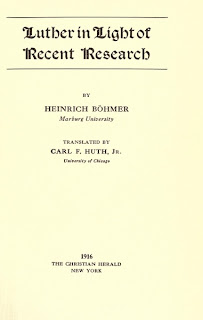
For those of you who spend time dialoging with Roman Catholics about Martin Luther, one of my favorite texts is available online:
Heinrich Boehmer, Luther In Light of Recent Research (New York: The Christian Herald, 1916).
Boehmer refutes a lot of the typical Roman Catholic polemic against Luther, and did so long ago. I've had this book for quite some time, and I use it often in research. I recall spending some serious $$ to get this book, but I'm glad it's available for free, so people can do their own research.
If I recall, it was a footnote in the English edition of Luther's Works that led me to this book.
One thing though to note, this is an earlier edition of this book. Boehmer revised the work, making it longer.

Saturday, July 14, 2007

I just got back from the outer banks of North Carolina. I stayed about a half mile from the Cape Hatteras lighthouse. I go to the outer banks usually once a year.
It was about a 12 hour drive to get there- normally I like to scan the AM radio dial to hear odd preachers, and this trip had plenty to offer. I heard lots of stuff on end times. The highlight was some woman who claimed to be a medical doctor turned minister crying and pleading for people not to take the mark of the beast. She also said we should pray to be visited by one of the 24 elders mentioned in Revelation.
I also like to do "church spotting."Driving down, we took the scenic route. My favorite church spotting was a one called, "The Apocalyptic Tabernacle." I didn't see any Reformed churches.
I also watched Joyce Meyer every morning.
I'm not sure why, but I tend to do things like this on vacation. I figure, while in the south, I might as well try to fit in. I probably still looked like an arrogant yankee to everyone whom I came in contact with.
Monday, July 09, 2007
Another Development Question

I will be away from the blog for a few days.
Below is a comment from Kepha that I’d like to highlight. He posted it in the comment section of a previous blog entry, but it was insightful, and deserved not to be hidden away in the comments section.
My question is: Upon what basis do modern Roman Catholics proudly embrace the Doctrine of the Development of Doctrine, if the only inspired, and therefore infallible, inscripturated Apostolic Tradition, i.e., the New Testament, does not teach that the teaching of the Apostles develops? Is the (recent and famed)Development of Doctrine itself a development of doctrine? I can just imagine the ancient scene: a successor of a successor of a successor of a successor of an Apostle one day realizes that doctrine develops. He announces this "new discovery" (not a "new revelation," mind you) to his congregation.
Father: I've just realized, by my special guidance of the Holy Spirit, that doctrine develops. And, only I can tell you what that development is.
A faithful member from the congregation humbly asks, "Father, can you please show us where in the writings of the New Testament, or where in the Apostolic Tradition this teaching of the development of doctrine is?"
Father: How dare you question my apostolic authority! We don't believe in that everything has to be found in the writings of the New Testament!
Faithful: Of course, of course, Father. I did not mean that. Please forgive me for my ignorance. We most certainly believe that the Faith is partly in the Scriptures and partly in the Tradition. I simply want to know where in the Tradition, if not in the Scriptures, is this apostolic teaching that doctrine develops.
Father: You presume to teach me? "Gird up your loins like a man and I will instruct you"! The apostolic teaching that doctrine develops is not in Scripture and not in the Tradition, in the way that you think. "One day is like a thousand years to the Lord"! "Your ways are not His ways"'!
Faithful: In what way then, Venerable Father, is this teaching partly in Scripture and partly in Tradition?
Father: Implicitly!
Faithful: What??
Father: "Do not let your right hand know what your left hand is doing"! The right hand represents the New Testament writers, while the left hand represents the work of the Holy Spirit in the development of doctrine. Listen again: "New wine cannot be placed in old wine skins"! The old wine skins burst because they are insufficient; these, my son, are the only inspired writings we have, namely the Word of God. The wine is the development of doctrine.
Faithful: Praise God that we have you as our infallible interpreter, Father! And what of the Fathers and your predecessors, Father? You said they believes this apostolic teaching "implicitly"?
Father: Yes, and ignorantly.
Faithful: "Ignorantly"??
Father: Yes, they had no idea they believed this teaching.
Faithful: But how do you know that they believed this?
Father: Curse your rebelliousness and doubt of my apostolic authority! The "foolishness of God is wisdom for men"! Did not the Lord say, "there are sheep not yet in my fold"? The "fold" is the truth in all its development; the sheep not yet in the fold are the members of the Church who have yet to know the fullness of the truth.
Faithful: I understand! The evidence is always ambiguous to the people. We are like the soldiers who accompanied the Apostle Paul, we hear but do not understand the voice from Heaven.
Father: Now you are acquiring holiness and wisdom my son.
Faithful: And we need you, our infallible ruler, to tell us what the evidence is and what it means!
Father: Give thanks to God, my son, "for many longed to see what you now see." Like Doubting Thomas, who demanded evidence for the Resurrection, you demanded evidence for the development of doctrine. When you saw that there was no evidence in Scripture or the Tradition, you then, like Abraham who dared to speak yet once more to God, dared to demand evidence for why their wasn't evidence for the development of doctrine in Scripture and Tradition. Now you see and believe, but "blessed are those who do not see and believe."
On another note, James, your question reminds me of a recent conversation with a very good friend of mine (a Catholic who is converting to Orthodoxy), wherein I said that it seems as though the infallible certainty hailed by Catholic apologists as the chief characteristic of Catholicism is really only a temporal infallible certainty. In other words, I can have "infallible certainty" right now that the Magisterium doesn't infallibly teach that Mary is Co-Redemptirx and Mediatrix of All Graces. However, I cannot have "infallible certainty" that these unofficial and popular marian teachings are not infallible truths, for at some point in the future they may be declared to be such!
Here was an interesting blog article put up on Gorija's Stomping Ground:
Patristics, Sex, And Mary -- From a Texas Reader
I'd like to check some of those quotes out in their contexts. Interesting.
Patristics, Sex, And Mary -- From a Texas Reader
I'd like to check some of those quotes out in their contexts. Interesting.
Sunday, July 08, 2007
You probably will read this without me mentioning it, but James White posted a section of commentary on Galatians 1 he wrote 18 years ago.
"The fact that Paul had no problem in calling the teaching of the Galatian leaders a non-gospel should tell us that he was not laboring under the impression that the Gospel was unclear or unknowable."
"The fact that Paul had no problem in calling the teaching of the Galatian leaders a non-gospel should tell us that he was not laboring under the impression that the Gospel was unclear or unknowable."
Saturday, July 07, 2007
Development Question

Here's a quote from Karl Adam's The Spirit of Catholicism:
"We Catholics acknowledge readily, without any shame, nay with pride, that Catholicism cannot be identified simply and wholly with primitive Christianity, nor even with the Gospel of Christ, in the same way that the great oak cannot be identified with the tiny acorn. There is no mechanical identity, but an organic identity. And we go further and say that thousands of years hence Catholicism will probably be even richer, more luxuriant, more manifold in dogma, morals, law and worship than the Catholicism of the present day."
The question I have for my Roman Catholic readers, how do you know when a doctrine has fully developed?
Friday, July 06, 2007
The battle rages on over here: 51% Protestant. This is an interesting read, watching this dispensationalist evangelical struggle with truth. Is truth so ambiguous it can't be defined? Here is a statement that I found troubling:
"Again, I continue to be misunderstood about a fundamental point (something I’ve underscored over and over again): Just as an evangelical is not defined by majority opinion about what evangelicals believe, a Catholic is not defined by official pronouncements about what Catholics believe."
In other words, if these positions can't be defined, no one is responsible for what "group x" teaches. Roman Catholics cannot be held responsible for what their church officially teaches, because everyone interprets it differently. Evangelicals cannot be held responsible for what any evangelical teaches, because there is not an agreed upon consensus of evangelical teaching.
Funny though, Jesus held people responsible for what the Scriptures taught.
"Again, I continue to be misunderstood about a fundamental point (something I’ve underscored over and over again): Just as an evangelical is not defined by majority opinion about what evangelicals believe, a Catholic is not defined by official pronouncements about what Catholics believe."
In other words, if these positions can't be defined, no one is responsible for what "group x" teaches. Roman Catholics cannot be held responsible for what their church officially teaches, because everyone interprets it differently. Evangelicals cannot be held responsible for what any evangelical teaches, because there is not an agreed upon consensus of evangelical teaching.
Funny though, Jesus held people responsible for what the Scriptures taught.
Thursday, July 05, 2007
Fan Club Testimonials

"A little warning next time about where your links lead is all that I ask. At best, one of us might get a computer virus. At worst, we might end up reading James Swan. " [source]
Wednesday, July 04, 2007
On the Depressed Luther

It's no secret that Luther had many bouts with depression. A Catholic apologist concludes Luther "probably" suffered from "biochemically produced" "serious psychological maladies." Well, I can't prove that is completely wrong about "biochemically produced" "serious psychological maladies," nor can someone prove such charges are completely right. Luther's not here to do tests on.
I will say this: anyone who has ever read a biography of Luther knows what the man's life was like. I have never thought of fear or depression from those going through high waters anything less than normal. Luther lived a continuing difficult life in a volatile time. One can speculate on "biochemically produced" "serious psychological maladies." I, on the other hand, don't venture into seriously using pyschohistory as history.
Here are some interesting links:
The Revolt of Martin Luther by Robert Herndon Fife
Luther and the Reformation vol.III by James Mackinnnon
I have used both of these books in the past for research. Mackinnon's set is an expensive purchase. It is criticized often for being a tedious set and too long, but it does provide some valuable material (Dave might enjoy looking up Mackinnon's treatment of his hero, Hartmann Grisar in some of the other volumes).
I've seen Mackinnon cited saying Luther had, "...fits of dejection to which he was temperamentally subject." The context though, is quite revealing. Luther was secluded at the Wartburg, struggling with loneliness: "For the honour of the Word, and for the confirmation of myself and others, I would rather burn on live coals than, half living and not able to die, rot away here alone. . . ." Mackinnon then states:
"His infirmity was, however, more serious than he cared to let be generally known. He had suffered at Worms from an attack of indigestion. The strain had told on his emaciated body and the malady increased with the change to the Wartburg. The lack of exercise and the rich diet which his host insisted on providing resulted in persistent constipation, with bleeding from the bowels and sleeplessness the worst he had hitherto experienced. It was accompanied by fits of dejection to which he was temperamentally subject."
Yep, just another "biochemically produced" "serious psychological malady"! Any normal person would've just shaken off the pain and loneliness, seized the day, and sang like the guy in Monty Python's Holy Grail "I feel like....singing!"
I will say this: anyone who has ever read a biography of Luther knows what the man's life was like. I have never thought of fear or depression from those going through high waters anything less than normal. Luther lived a continuing difficult life in a volatile time. One can speculate on "biochemically produced" "serious psychological maladies." I, on the other hand, don't venture into seriously using pyschohistory as history.
Here are some interesting links:
The Revolt of Martin Luther by Robert Herndon Fife
Luther and the Reformation vol.III by James Mackinnnon
I have used both of these books in the past for research. Mackinnon's set is an expensive purchase. It is criticized often for being a tedious set and too long, but it does provide some valuable material (Dave might enjoy looking up Mackinnon's treatment of his hero, Hartmann Grisar in some of the other volumes).
I've seen Mackinnon cited saying Luther had, "...fits of dejection to which he was temperamentally subject." The context though, is quite revealing. Luther was secluded at the Wartburg, struggling with loneliness: "For the honour of the Word, and for the confirmation of myself and others, I would rather burn on live coals than, half living and not able to die, rot away here alone. . . ." Mackinnon then states:
"His infirmity was, however, more serious than he cared to let be generally known. He had suffered at Worms from an attack of indigestion. The strain had told on his emaciated body and the malady increased with the change to the Wartburg. The lack of exercise and the rich diet which his host insisted on providing resulted in persistent constipation, with bleeding from the bowels and sleeplessness the worst he had hitherto experienced. It was accompanied by fits of dejection to which he was temperamentally subject."
Yep, just another "biochemically produced" "serious psychological malady"! Any normal person would've just shaken off the pain and loneliness, seized the day, and sang like the guy in Monty Python's Holy Grail "I feel like....singing!"
Update 7/7/07 Here's some comments from someone who disagrees with me:
"The usual obsessive, puerile inanities are occurring at James Swan's blog. First (if you have the patience for it) see his ridiculous post, in "reply" to mine:http://beggarsallreformation.blo...sed- luther.html He starts out by agreeing with my simple, innocent claim:"It's no secret that Luther had many bouts with depression."That is sufficient to completely nullify his entire ensuing post (since we have no disagreement on this!). But nevertheless, he insists on proceeding to play the petty, obnoxious fool, by desperately looking for something in my post that he can mock (primarily some of my phrases that he repeats over and over as if they are self-evidently absurd and laughable). This guy needs to get a life (and a serious "writing life").


The Reformers Ride The Beast

Pictured: CALVINISM TEARING DOWN THE ROMAN EMPIRE. Roman Catholic burlesque of the seventeenth century
You know how some Protestants find the Roman Catholic Church in the book of Revelation? You know, the pope is the antichrist, the woman rides the beast, etc…all that Jack Chick / Dave Hunt claptrap…What if a Roman Catholic read Revelation and interpreted it as the events of the Reformation? I found just that.
Take a minute to reread Revelation 9. Now, take a look at Haydock’s Catholic Bible Commentary (1859 edition) on Revelation 9. Here are some highlights:
Verse 1: “And the fifth angel sounded the trumpet, and I saw a star fall from heaven upon the earth, and there was given to him the key of the bottomless pit.”
Interpretation: “Here is a description of the rise and progress of the reformation. This trumpet begins with announcing to us the fall of a star from heaven; a very just emblem of the apostacy of Luther, who in quality of a priest and religious man is styled a star, but renouncing the faith and vows, may truly be said to have fallen from heaven upon the earth.”
Verse 2: “And he opened the bottomless pit: and the smoke of the pit arose, as the smoke of a great furnace; and the sun and the air were darkened with the smoke of the pit.”
Interpretation: “Luther and his followers propagated and defended their new doctrines with such heat and violence, as to occasion every where seditions and insurrections, which they seemed to glory in. Luther openly boasted of it. ‘You complain,’ said he, ‘that by our gospel the world is become more tumultuous; I answer, God be thanked for it; these things I would have so to be, and woe to me if such things were not.’ ….By the sun, therefore, and air being darkened, we are to understand faith and morality obscured and perverted by the novel doctrines of the reformers."
Verse 3: “And from the smoke of the pit there came out locusts upon the earth. And power was given to them, as the scorpions of the earth have power:”
Interpretation: “Heretics are compared to locusts, says St. Jerome, because they are a species of insects extremely hurtful to mankind, as they occasion famine, eat up the harvest, and even strip the trees and the vines. With very great propriety then may the locusts here mentioned be understood of the first reformers, not only on account of their rapacity, but also for their number. Luther was their leader, by allowing every one to be his own interpreter of Scripture, the effects of which we have described by Dudithius, a learned Protestant divine, in his epistle to Beza. "What sort of people are our Protestants, straggling to and fro, and carried about with every wind of doctrine, sometimes to this side, and sometimes to that? You may, perhaps, know what their sentiments in matters of religion are to-day; but you can never certainly tell what they will be to-morrow. In what article of religion do these churches agree, which have cast off the bishop of Rome? Examine all of them from top to bottom, and you will scarce find one thing affirmed by one, which is not immediately condemned by another for wicked doctrine."
Verse 4: “And it was commanded them that they should not hurt the grass of the earth, nor any green thing, nor any tree: but only the men who have not the sign of God on their foreheads.”
Interpretation: “…that though the locusts, or the sects of Protestants, are allowed by the Almighty to seduce some of all sorts from the Church, yet that the generality of the faithful will be preserved unhurt.”
Verse 7: “And the shapes of the locusts were like unto horses prepared unto battle: and on their heads were, as it were, crowns like gold: and their faces were as the faces of men.”
Interpretation: “We now come to the description of these locusts, which expresses the spirit of sedition and rebellion that animated the reformers and their proselytes. Luther proclaimed himself the leader in this as well as in other articles of the new discipline: see his works, particularly Contra statem ecclesiæ et falso nominatum ordinem Episcoporum, lib. contra Sylvest. Prieras, De Seculari potestate et Contra Rusticos, &c. Erasmus thus describes the effects of the inflammatory doctrine of these ministers of evangelical liberty: ‘I saw them (the people) come forth from their sermons with fierce looks and threatening countenances,’ like men ‘that just come from hearing bloody invectives and seditious speeches." Accordingly, we found "these evangelical people always ready to rise up in arms, and equally as good at fighting as at disputing.’”
Verse 8: “And they had hair as the hair of women; and their teeth were as lions:”
Interpretation: “This latter allusion, unhappily for the sectaries, betrays too plainly their sensual disposition towards that sex, their shameful doctrine on that score, and the scandalous example of their practice. Luther, in despite of a vow he had solemnly made to God of observing continence, married; and married a nun, equally bound as himself to that sacred religious promise! But, as St. Jerome says, ‘it is rare to find a heretic that loves chastity.’ Luther's example had indeed been anticipated by Carlostadius, a priest and ringleader of the Sacramentarians, who had married a little before; and it was followed by most of the heads of the reformation. Zuinglius, a priest and chief of that sect which bore his name, took a wife. Bucer, a religious man of the order of St. Dominic, became a Lutheran, left his cloister, and married a nun. Œcolampadius, a Brigittin monk, became a Zuinglian, and also married. Cranmer, archbishop of Canterbury, had also his wife. Peter Martyr, a canon regular, embraced the doctrine of Calvin; but followed the example of Luther, and married a nun. Ochin, general of the Capuchins, became a Lutheran, and also married. Beza, the most celebrated minister in the Calvinistic party, being asked in his old age, by an intimate acquaintance of his, (Deshayes, governor of Montargis) what was the leading reason which connected him so closely with the Calvinists? Beza called in his mistress, a beautiful young girl who lived with him, and said: "That is the principle reason which convinces me of the excellence of my religion."
…Thus the principal leaders in the reformation went forth preaching the new gospel, with two marks upon them---apostacy from the faith, and open violation of the most sacred vows. The passion of lust, it is well known, hurried Henry VIII. of England, into a separation from the Catholic Church, and ranked him amongst the reformers."
You know how some Protestants find the Roman Catholic Church in the book of Revelation? You know, the pope is the antichrist, the woman rides the beast, etc…all that Jack Chick / Dave Hunt claptrap…What if a Roman Catholic read Revelation and interpreted it as the events of the Reformation? I found just that.
Take a minute to reread Revelation 9. Now, take a look at Haydock’s Catholic Bible Commentary (1859 edition) on Revelation 9. Here are some highlights:
Verse 1: “And the fifth angel sounded the trumpet, and I saw a star fall from heaven upon the earth, and there was given to him the key of the bottomless pit.”
Interpretation: “Here is a description of the rise and progress of the reformation. This trumpet begins with announcing to us the fall of a star from heaven; a very just emblem of the apostacy of Luther, who in quality of a priest and religious man is styled a star, but renouncing the faith and vows, may truly be said to have fallen from heaven upon the earth.”
Verse 2: “And he opened the bottomless pit: and the smoke of the pit arose, as the smoke of a great furnace; and the sun and the air were darkened with the smoke of the pit.”
Interpretation: “Luther and his followers propagated and defended their new doctrines with such heat and violence, as to occasion every where seditions and insurrections, which they seemed to glory in. Luther openly boasted of it. ‘You complain,’ said he, ‘that by our gospel the world is become more tumultuous; I answer, God be thanked for it; these things I would have so to be, and woe to me if such things were not.’ ….By the sun, therefore, and air being darkened, we are to understand faith and morality obscured and perverted by the novel doctrines of the reformers."
Verse 3: “And from the smoke of the pit there came out locusts upon the earth. And power was given to them, as the scorpions of the earth have power:”
Interpretation: “Heretics are compared to locusts, says St. Jerome, because they are a species of insects extremely hurtful to mankind, as they occasion famine, eat up the harvest, and even strip the trees and the vines. With very great propriety then may the locusts here mentioned be understood of the first reformers, not only on account of their rapacity, but also for their number. Luther was their leader, by allowing every one to be his own interpreter of Scripture, the effects of which we have described by Dudithius, a learned Protestant divine, in his epistle to Beza. "What sort of people are our Protestants, straggling to and fro, and carried about with every wind of doctrine, sometimes to this side, and sometimes to that? You may, perhaps, know what their sentiments in matters of religion are to-day; but you can never certainly tell what they will be to-morrow. In what article of religion do these churches agree, which have cast off the bishop of Rome? Examine all of them from top to bottom, and you will scarce find one thing affirmed by one, which is not immediately condemned by another for wicked doctrine."
Verse 4: “And it was commanded them that they should not hurt the grass of the earth, nor any green thing, nor any tree: but only the men who have not the sign of God on their foreheads.”
Interpretation: “…that though the locusts, or the sects of Protestants, are allowed by the Almighty to seduce some of all sorts from the Church, yet that the generality of the faithful will be preserved unhurt.”
Verse 7: “And the shapes of the locusts were like unto horses prepared unto battle: and on their heads were, as it were, crowns like gold: and their faces were as the faces of men.”
Interpretation: “We now come to the description of these locusts, which expresses the spirit of sedition and rebellion that animated the reformers and their proselytes. Luther proclaimed himself the leader in this as well as in other articles of the new discipline: see his works, particularly Contra statem ecclesiæ et falso nominatum ordinem Episcoporum, lib. contra Sylvest. Prieras, De Seculari potestate et Contra Rusticos, &c. Erasmus thus describes the effects of the inflammatory doctrine of these ministers of evangelical liberty: ‘I saw them (the people) come forth from their sermons with fierce looks and threatening countenances,’ like men ‘that just come from hearing bloody invectives and seditious speeches." Accordingly, we found "these evangelical people always ready to rise up in arms, and equally as good at fighting as at disputing.’”
Verse 8: “And they had hair as the hair of women; and their teeth were as lions:”
Interpretation: “This latter allusion, unhappily for the sectaries, betrays too plainly their sensual disposition towards that sex, their shameful doctrine on that score, and the scandalous example of their practice. Luther, in despite of a vow he had solemnly made to God of observing continence, married; and married a nun, equally bound as himself to that sacred religious promise! But, as St. Jerome says, ‘it is rare to find a heretic that loves chastity.’ Luther's example had indeed been anticipated by Carlostadius, a priest and ringleader of the Sacramentarians, who had married a little before; and it was followed by most of the heads of the reformation. Zuinglius, a priest and chief of that sect which bore his name, took a wife. Bucer, a religious man of the order of St. Dominic, became a Lutheran, left his cloister, and married a nun. Œcolampadius, a Brigittin monk, became a Zuinglian, and also married. Cranmer, archbishop of Canterbury, had also his wife. Peter Martyr, a canon regular, embraced the doctrine of Calvin; but followed the example of Luther, and married a nun. Ochin, general of the Capuchins, became a Lutheran, and also married. Beza, the most celebrated minister in the Calvinistic party, being asked in his old age, by an intimate acquaintance of his, (Deshayes, governor of Montargis) what was the leading reason which connected him so closely with the Calvinists? Beza called in his mistress, a beautiful young girl who lived with him, and said: "That is the principle reason which convinces me of the excellence of my religion."
…Thus the principal leaders in the reformation went forth preaching the new gospel, with two marks upon them---apostacy from the faith, and open violation of the most sacred vows. The passion of lust, it is well known, hurried Henry VIII. of England, into a separation from the Catholic Church, and ranked him amongst the reformers."
Here's a link to Haydock's Catholic Bible Commentary, 1859 edition. "This Catholic Bible commentary, following the Douay-Rheims Bible text, was originally compiled by Catholic priest and biblical scholar Rev. George Leo Haydock (1774-1849)." I'm enjoying looking through this.
Tuesday, July 03, 2007
Sippo On Luther Biographies Revisted

"I proudly stand in the tradition of Fr. Denifle et al and I warn people that the foundation of the Protestant Deformation was in the psychopathology of one man-- Martin Luther -- whose melancholy and bipolar disorder touched a personal chord with many Northern Europeans but which had NOTHING to do with the Gospel of Jesus Christ. It caused them to revolt against historic Christianity and to invent a new family of disparate religions that catered to bourgeosie morality and subjective personal needs, and not to either theological integrity or moral rectitude."- Art Sippo
Wow, it must be slow for Catholic apologetics today. First, Madrid, now some fan mail from Art Sippo: Springtime for Luther and Germany. Sippo is at it again, championing the scholarship of Denifle and Grisar, two men whose work on Luther is usually viewed as part of outdated destructive criticism.
Also, Sippo is attempting once again to minimize the work of Catholic historian Joseph Lortz on Luther. Lortz is perhaps the most famous Catholic Luther scholar of the twentieth century. I did a detailed response some time ago to Sippo's views on Lortz: Catholic Apologist Art Sippo on Catholic Historian Joseph Lortz.
I did a detailed response some time ago to Sippo's views a number of Luther biographers:
I. On Dialoging With Catholic apologist Art Sippo on Luther Scholarship
II. Catholic Apologist Art Sippo on Father O’Hare’s “Facts About Luther”
III. Catholic Apologist Art Sippo on Luther Scholarship and Research (Part 1)
IV. Art Sippo on Catholic Historians Grisar and Denifle and Luther’s Demon Possession (part 2)
V. Using Psychohistory To Interpret Luther (A Response To Catholic Apologist Art Sippo (part3)
VI. Catholic Apologist Art Sippo Takes The Time To Thank Me For My Luther Research
VII. Luther Between God and the Devil: Catholic Apologist Art Sippo on Heiko Oberman
VIII. Catholic Apologist Art Sippo on Roland Bainton's "Here I Stand"
IX. Catholic Apologist Art Sippo on Richard Marius
X. Catholic Apologist Art Sippo on Catholic Historian Joseph Lortz
XI. A Last Look At Catholic Apologist Art's Sippo's View Of Luther Biographies
XII. Art Sippo on Luther Biographies Revisited: Marius on Denifle
A note of thanks from Patrick Madrid:
"I almost didn't bother checking the link to Swan's page to see what his comments were. I haven't been there in quite a long time, but it's obvious that nothing has changed. A quick scan of his recent posts reveals Swan's obsession with this forum. Apparently, he's still smarting from being banned from posting here. Who knows? In any case, judging from his seeming fixation on what happens over here on this forum, it really does seem to be time for him to get over it and move on. He'll no doubt soon compose a "rebuttal" to this post of mine -- which will supply additional, if unnecessary, evidence that he follows this forum very, very, very closely. He's clearly far more interested in what I and others say over here than I am in what he says over there (or anywhere else, for that matter). Anyway, his attempt to portray this thread about an interesting and well-produced short film as somehow entailing a connection with purgatory is laughable. The film, as I pointed out above, has nothing to do with purgatory, at least not in the sense that the Catholic Church teaches the doctrine (for an overview of the teaching, see here: http://www.envoymagazine.com/PlanetEnvoy/Special-PurgatoryEmergencyRoom1.htm). The statement in the film by the devil character about it being purgatory is, as I pointed out, wrong. The fictitious incident portrayed in the clip has nothing to do with purgatory nor, in fact, does it reflect Catholic teaching in general about the afterlife. Of course, Swan can say whatever he wants about purgatory on his own weblog (although he can't do so anymore here on this forum, after being deported), but you'd think the guy would at least try to make a meaningful, pertinent comment, as opposed to the foolishness there now. And that goes also for the foolishness contained in several of the posts in his comments' section. Oh, and though I probably won't bother to check, whoever does read Swan's weblog with any regularity will no doubt soon see him post a "rebuttal" to my article on purgatory, linked above. Whatever. Talk about Pavlov's dogs. I tinkle the bell over here and, as sure as night follows day, you know exactly what's going to happen over there. Swan must have a truly incredible amount of free time on his hands to spend so much time obsessing about and commenting on what people say on this forum.The phrase "get a life" comes to mind."
I don't think I've mentioned Envoy since they wrote about my aomin entries on Michuta's book back in May, so I'm not sure exactly what Madrid is talking about. Yes, I read Envoy. Big deal.
I really don't have anything to add to this, other than what I've stated. The video, posted by Madrid (earlier without qualification) on Purgatory was awful. But, more offensive was watching the Simpsons bounce Jesus Christ on a mock-trampoline. If Roman Catholics like this stuff, fine. I do not.
"I almost didn't bother checking the link to Swan's page to see what his comments were. I haven't been there in quite a long time, but it's obvious that nothing has changed. A quick scan of his recent posts reveals Swan's obsession with this forum. Apparently, he's still smarting from being banned from posting here. Who knows? In any case, judging from his seeming fixation on what happens over here on this forum, it really does seem to be time for him to get over it and move on. He'll no doubt soon compose a "rebuttal" to this post of mine -- which will supply additional, if unnecessary, evidence that he follows this forum very, very, very closely. He's clearly far more interested in what I and others say over here than I am in what he says over there (or anywhere else, for that matter). Anyway, his attempt to portray this thread about an interesting and well-produced short film as somehow entailing a connection with purgatory is laughable. The film, as I pointed out above, has nothing to do with purgatory, at least not in the sense that the Catholic Church teaches the doctrine (for an overview of the teaching, see here: http://www.envoymagazine.com/PlanetEnvoy/Special-PurgatoryEmergencyRoom1.htm). The statement in the film by the devil character about it being purgatory is, as I pointed out, wrong. The fictitious incident portrayed in the clip has nothing to do with purgatory nor, in fact, does it reflect Catholic teaching in general about the afterlife. Of course, Swan can say whatever he wants about purgatory on his own weblog (although he can't do so anymore here on this forum, after being deported), but you'd think the guy would at least try to make a meaningful, pertinent comment, as opposed to the foolishness there now. And that goes also for the foolishness contained in several of the posts in his comments' section. Oh, and though I probably won't bother to check, whoever does read Swan's weblog with any regularity will no doubt soon see him post a "rebuttal" to my article on purgatory, linked above. Whatever. Talk about Pavlov's dogs. I tinkle the bell over here and, as sure as night follows day, you know exactly what's going to happen over there. Swan must have a truly incredible amount of free time on his hands to spend so much time obsessing about and commenting on what people say on this forum.The phrase "get a life" comes to mind."
I don't think I've mentioned Envoy since they wrote about my aomin entries on Michuta's book back in May, so I'm not sure exactly what Madrid is talking about. Yes, I read Envoy. Big deal.
I really don't have anything to add to this, other than what I've stated. The video, posted by Madrid (earlier without qualification) on Purgatory was awful. But, more offensive was watching the Simpsons bounce Jesus Christ on a mock-trampoline. If Roman Catholics like this stuff, fine. I do not.
An Ancient Voice For The Day #18
 Polycarp, bishop of Smyrna (69-155/156):
"These things, brethren, I write to you concerning righteousness, not because I take anything upon myself, but because ye have invited me to do so. For neither I, nor any other such one, can come up to the wisdom of the blessed and glorified Paul. He, when among you, accurately and steadfastly taught the word of truth in the presence of those who were then alive. And when absent from you, he wrote you a letter, which, if you carefully study, you will find to be the means of building you up in that faith which has been given you, and which, being followed by hope, and preceded by love towards God, and Christ, and our neighbor, “is the mother of us all.” For if any one be inwardly possessed of these graces, he hath fulfilled the command of righteousness, since he that hath love is far from all sin."
Source: ANF: Vol. I, The Apostolic Fathers, the Epistle of Polycarp to the Philippians, Chapter 3.
For an excellent compilation of quotes of the Church fathers teaching on the primacy, sufficiency and ultimate authority of Scripture, get a copy of Holy Scripture:The Ground and Pillar of Our Faith Vol III- The Writings of the Church Fathers Affirming the Reformation Principle of Sola Scriptura.
Saturday, June 30, 2007
Madrid's Video Picks On Purgatory And The Simpsons

Do you have about eight minutes to endure something awful? Catholic apologist Patrick Madrid has posted a YouTube clip he described thus:
"This is good. Really good. You'll want to watch it all the way to the end."
It was awful, but really puts a belief in perspective. Purgatory is not simply a theoretical doctrine for Catholic apologists, it is a reality they believe in. Madrid's approval of the clip shows this clearly. Here is a link to the clip. Pray for those who believe in such non-biblical doctrines.
Madrid has anchored the purgatory video post over on Envoy, along with this post:
VIDEO: THE SIMPONS' CATHOLIC VS. PROTESTANT HEAVEN
I do find the Simpsons funny, even this clip is funny. However, call me humorless if you want, but toward the end of this video clip Bart and Homer in "Catholic Heaven" are bouncing Jesus on a mock-trampoline. I find this highly offensive, but perhaps I should just lighten up and view the clip as the difference between the way I understand Jesus, and the way some Roman Catholics understand Jesus. I'm actually stunned that even Madrid would want to post something that puts a caricature of Christ on a trampoline bouncing him up and down, as he yells out "Stop it, guys I'm serious!" Some things simply are not funny.
"This is good. Really good. You'll want to watch it all the way to the end."
It was awful, but really puts a belief in perspective. Purgatory is not simply a theoretical doctrine for Catholic apologists, it is a reality they believe in. Madrid's approval of the clip shows this clearly. Here is a link to the clip. Pray for those who believe in such non-biblical doctrines.
Madrid has anchored the purgatory video post over on Envoy, along with this post:
VIDEO: THE SIMPONS' CATHOLIC VS. PROTESTANT HEAVEN
I do find the Simpsons funny, even this clip is funny. However, call me humorless if you want, but toward the end of this video clip Bart and Homer in "Catholic Heaven" are bouncing Jesus on a mock-trampoline. I find this highly offensive, but perhaps I should just lighten up and view the clip as the difference between the way I understand Jesus, and the way some Roman Catholics understand Jesus. I'm actually stunned that even Madrid would want to post something that puts a caricature of Christ on a trampoline bouncing him up and down, as he yells out "Stop it, guys I'm serious!" Some things simply are not funny.
Hey Patrick, which Bible are you reading?
Recent Purchases
I always have a constant influx of books. Here are some things I picked up this week. So far, I've been reading "The Other Bible", which is one of the best compilations of extra-Biblical material I've come across. I read the "Apocalypse of Paul" and also the "Apocalype of Peter." My only comment thus far is reading the non-Biblical New Testament texts really shows how incredible the New Testament books are. I've thumbed through "The Scriptural Roots of Catholic Teaching", and it appears to be the typical pop-apologetic stuff. Very interesting is the book "Catholicism: The Story of Catholic Christianity" by Gerald O'Collins and Mario Farrugia. Both of these authors are Roman Catholic, and it's interesting to read a non-pop-apologetic work (you know, different from the Madrid/Hahn stuff, those books geared toward the Catholic Convert epidemic).


Friday, June 29, 2007
Catholic apologist Robert Sungenis appears to be having some problems getting an imprimatur for his recent work. Read about it here. Also, the Envoy folks are dealing with this as well.
I wasn't going to comment on this, but the irony of a Catholic apologist who claims to have refuted every Protestant he's faced hanging around outside a Catholic apologetic conference, rather than actually attending it is too tempting not to mention:
"I will be attending the Defending the Faith Conference in Steubenville, Ohio (Friday, July 27 - Sunday, July 29th), for the seventh time this year. I say "attending" but actually I will just be hanging out in the little "square" near the entrance to the main conference auditorium, because I'm not actually paying for the conference (as a poor apologist with four children, whose work relatively few deem worthy of financial support, I can't afford it, and am blessed to be able to stay with a local friend, to save on lodging costs). The last time I was there, they had a television outside the auditorium, so that people could actually view the speakers live, even if not registered."
I wasn't going to comment on this, but the irony of a Catholic apologist who claims to have refuted every Protestant he's faced hanging around outside a Catholic apologetic conference, rather than actually attending it is too tempting not to mention:
"I will be attending the Defending the Faith Conference in Steubenville, Ohio (Friday, July 27 - Sunday, July 29th), for the seventh time this year. I say "attending" but actually I will just be hanging out in the little "square" near the entrance to the main conference auditorium, because I'm not actually paying for the conference (as a poor apologist with four children, whose work relatively few deem worthy of financial support, I can't afford it, and am blessed to be able to stay with a local friend, to save on lodging costs). The last time I was there, they had a television outside the auditorium, so that people could actually view the speakers live, even if not registered."
Thursday, June 28, 2007
I just wanted to say thanks to all of you who have been adding comments....Gene Bridges, Carrie, Theo, L.P. Cruz, Ree, Rhology, Pilgrim, ...and everyone else. I haven't posted a lot of blog entries because of your comments. I don't get a lot of time to respond to the comments, but any of you that knew me over at CARM know I love a good dialog.
I've been thinking of doing a complete blog overhaul...a new template, and a complete revision of my sidebar. Also, I would love to have others join me in making this a group blog. Particularly when I begin taking classes via Westminster in the fall, my blogging time will be a little tricky.
I've been thinking of doing a complete blog overhaul...a new template, and a complete revision of my sidebar. Also, I would love to have others join me in making this a group blog. Particularly when I begin taking classes via Westminster in the fall, my blogging time will be a little tricky.
Wednesday, June 27, 2007
Discussion: Iustitia Dei: A History of the Christian Doctrine of Justification
 Updated: 6/28/07
My friend hilasterion is working through Alister McGrath's book. Iustitia Dei: A History of the Christian Doctrine of Justification. I have interest in this book, not because I feel it's the definitive historical work on this subject, but rather because of the way Roman Catholics cite this book. It amazes me how frequently McGrath is either misquoted, or misunderstood by Rome's apologists. I think I first heard about this book listening to an old debate between Gerry Matatics and James White. Gerry referred to it as proof Protestant scholars see faith alone as theological novum.
hilasterion started a CARM discussion thread:
I'm posting this link here so I can check in on it. He's got some people to contend with: a Lutheran that doesn't like Calvinism, one or two somewhat knowledgeable people, a confused Catholic who stated, "I have never read the book, but Im pretty sure there were post/threads in the past where people said that in that book McGrath said something to the effect that Faith Alone was an invention by Luther and had never been taught by previous Christians."
Update 6/28/07

Yes, it's true, there is now a third edition of this book. Amazon has copies around $80, and used copies start around $68. I found a reasonably priced copy here, which I did purchase. On my sidebar, I link to Abebooks. I purchase many of my books via this site. It's not always the case, but often I can find a book for much less than the Amazon price via Abebooks.
Sunday, June 24, 2007
John Calvin on Latria and Dulia
 A DISTINCTION WITHOUT A DIFFERENCE
In fact, the distinction between latria and dulia, as they called them, was invented in order that divine honors might seem to be transferred with impunity to angels and the dead. For it is obvious that the honor the papists give to the saints really does not differ from the honoring of God. Indeed, they worship both God and the saints indiscriminately, except that, when they are pressed, they wriggle out with the excuse that they keep unimpaired for God what is due him because they leave latria to him. But since the thing itself, not the word, is in question, who can permit them to make light of this most important of all matters?
But — to pass over this also — their distinction in the end boils down to this: they render honor [cultus] to God alone, but undergo servitude [servitium] for the others. For latreia, among the Greeks means the same thing as cultus among the Latins; douleia properly signifies servitus; and yet in Scripture this distinction is sometimes blurred. But suppose we concede it to be unvarying. Then we must inquire what both words mean: douleia is servitude; latreia, honor. Now no one doubts that it is greater to be enslaved than to honor. For it would very often be hard for you to be enslaved to one whom you were not unwilling to honor. Thus it would be unequal dealing to assign to the saints what is greater and leave to God what is lesser. Yet many of the old writers used this distinction. What, then, if all perceive that it is not only inept but entirely worthless?
Source: Calvin's Institutes, 1:12:2 (Battles Translation)
Alternate translation: (Beveridge Translation)
"The distinction of what is called dulia and latria was invented for the very purpose of permitting divine honors to be paid to angels and dead men with apparent impunity. For it is plain that the worship which Papists pay to saints differs in no respect from the worship of God: for this worship is paid without distinction; only when they are pressed they have recourse to the evasion, that what belongs to God is kept unimpaired, because they leave him latria. But since the question relates not to the word, but the thing, how can they be allowed to sport at will with a matter of the highest moment? But not to insist on this, the utmost they will obtain by their distinction is, that they give worship to God, and service to the others. For "latreia" in Greek has the same meaning as worship in Latin; whereas "douleia" properly means service, though the words are sometimes used in Scripture indiscriminately. But granting that the distinction is invariably preserved, the thing to be inquired into is the meaning of each. "Douleia" unquestionably means service, and "latreia" worship. But no man doubts that to serve is something higher than to worship. For it were often a hard thing to serve him whom you would not refuse to reverence. It is, therefore, an unjust division to assign the greater to the saints and leave the less to God. But several of the ancient fathers observed this distinction. What if they did, when all men see that it is not only improper, but utterly frivolous?
Saturday, June 23, 2007
Luther's Tavern Songs: A CCM Argument For Contemporary Worship

Have you ever heard that Martin Luther took tavern songs and simply put his own words to them? I’ve even heard this about his song A Mighty fortress Is Our God (See this link, for an interesting evaluation of this claim).
This argument is put forth for various reasons. First, it is mentioned to disparage Luther. That is, Luther was a drinker and simply took pub music and tried to make it spiritual. Or it is sometimes put forth, Luther couldn’t come up with music, so he stole someone else’s. Lastly, some involved in Contemporary Christian Music use this argument to validate contemporary styles of music being used in church: if even the great Martin Luther found value in contemporary music being used in Church, shouldn’t we likewise do the same? Should there not be church services with rap, metal, reggae, techno, etc.? I mean, let’s be consistent. Luther used contemporary pub songs.
In a book that was given to me entitled, Why I Left The Contemporary Christian Music Movement, author Dan Lucarini cites John Makujina stating:
“Luther took the entire melody from only one secular song, ‘I Came from an Alien Country’ for ‘From Heaven on High, I Come to You’. It first appeared in 1535 but four years later was replaced by an original tune from Luther, not the borrowed one. The secular tune does not reappear until after his death. The tune’s use in worldly haunts would sully the sacred text and bring secular associations inappropriate to worship, so Luther replaced it.”
Source: Dan Lucarini, Why I Left The Contemporary Christian Music Movement (New York: Evangelical Press, 2002), p.107
The editors of Luther’s Works note:
“The first stanza [of ‘I Came from an Alien Country’] is actually patterned after a pre-Reformation secular folk song, a singing game popular with the young people in Luther’s time, that began with the lines:
Good news from far abroad I bring,
Glad tidings for you all I sing.
I bring so much you’d like to know
Much more than I shall tell you though.
After this verse the singer would propose a riddle to one of the girls, and unless she could solve it, she had to give him her wreath. Originally Luther used the lilting melody of this folk song for his Christmas carol [‘From Heaven on High, I Come to You’]. It is found in the earliest extant source, the Klug hymnal of 1535, and many subsequent hymnals. But with the increasing popularity of “From Heaven on High I Come to You,” he must have felt that the hymn deserved its own melody. The new music first appeared in the Schumann hymnal of 1539 and ultimately became the proper tune. Quite likely Luther wrote it himself, for it has the same beginning and the same strong emphasis on the upper tonic that are found in his melodies for “A New Song Here Shall Be Begun” and “Our God He Is a Castle Strong.” The earlier folk-song melody was ultimately assigned to “From Heaven the Angel Troop Came Near”… [LW 53:289].
Also, doing a brief web search, I found this little factoid:
“Dean McIntyre, director of music resources at the Board of Discipleship, recently debunked this popular story [Luther using contemporary pub music]. He states that this myth is often toldabout Martin Luther… McIntyre traces the legend to confusionover the terms "bar tune" or "bar form." These terms refer to a medieval pattern of poetry consisting of three or more stanzas. This pattern and terminology were later applied to songwriting. Along the way, "bar tune" was misinterpreted as "tavern music." Many of the most popular hymns are such "bar tunes." "A Mighty Fortress is Our God," "Come, thou Almighty King," and "Love Divine, All Loves Excelling" are just a few examples. This form is used for secular songs as well."
That music was important to Luther is common knowledge. Luther stated,
"…[N]ext to the Word of God, music deserves the highest praise. She is a mistress and governess of those human emotions—to pass over the animals—which as masters govern men or more often overwhelm them. No greater commendation than this can be found—at least not by us. For whether you wish to comfort the sad, to terrify the happy, to encourage the despairing, to humble the proud, to calm the passionate, or to appease those full of hate—and who could number all these masters of the human heart, namely, the emotions, inclinations, and affections that impel men to evil or good?—what more effective means than music could you find?" [LW 53:323]
“…[T]he gift of language combined with the gift of song was only given to man to let him know that he should praise God with both word and music, namely, by proclaiming [the Word of God] through music and by providing sweet melodies with words.” [LW 53:323]
I have found those most interested in debunking Luther’s “bar songs” are those seeking to put a stop to the Contemporary Christian Music being used in the church. For instance, this webpage, Did Luther Use Tavern Music? Was put up by a Fundamental Baptist group. Dan Lucarini (Why I Left The Contemporary Christian Music Movement) was a former worship leader.
My own 2 cents on this is not as critical as the view put forth by these people. I go to a very conservative church, with traditional music (organ, piano, and the minister leads the hymn sing). We use primarily the CRC Psalter. I enjoy this way of worship, for a few reasons.
First, I have played guitar, bass, and Chapman Stick. I began on the guitar around age 13. I was in a lot of rock bands, eventually progressed to Jazz, New Age, and various other types of music. I know music well. I know when I see a good player. I know when someone should not be playing. I’ve attended many church services that had “worship bands.” There was simply no way I could ever worship, simply because of my own sinful evaluation of whomever was playing. Or, I’ve actually been to worship services where the musicians were trained professionals. I could not concentrate on worship because the players were too good. One particular bass player used to be the object of my worship when I saw him play! So, a traditional service brings me out of my element. I can actually concentrate on worship without being distracted by instruments I’m familiar with. Most of the people in my church have no idea I can play music. I like this, I will never seek to play music in church. I would be too interested in myself to actually worship.
Second, most of you Reformed folks already know this, but the content of the Psalter is God glorifying. It is actually theological and even if I don’t know the song, I can still glean from the words. To remind myself of the poor content of CCM worship music, I keep the following chorus on a page in my Bible. Now, I could probably sing this song to my wife, but worship God with this? Whoever wrote it was deluded:
Draw me close to You, Never let me go.
I lay it all down again To hear you say that I’m your friend
You are my desire, No one else will do,
‘Cause nothing else could take Your place;
To feel the warmth of Your embrace.
Help me find the way, Bring me back to you.
You’re all I want, You’re all I’ve ever needed.
You’re all I want
Help me know You are near.
Thursday, June 21, 2007
"Who empowered the Church to grant indulgences? Christ. Who's sacrifice made the indulgences possible? Christ.”

I don’t spend too much time interacting on discussion boards these days, but I admit I do skim through the ones on my sidebar. Recently, I found a discussion on Luther’s Mariology (a subject that usually gets my attention). It interests me, because I’m hoping someone else besides me is actually checking citations rather than posting the usual propaganda.
Here’s a recent thread: Luther’s Mariology, which, unfortunately, is a lot of propaganda, at least from the zealous defenders of Rome who contributed. It is being hosted on (the late) Walter Martin’s discussion boards. I found this thread while searching for something else, and yes, I added my 2 cents to the discussion.
When I read the opening post, I realized the words were…MINE! But, not entirely: some of the words were from a Catholic apologist mixed in with mine, without distinction. So I signed up, and just planned on pointing out that I don't mind people citing my work, but please don't cite my words and someone else's words together without distinction.
Here’s a recent thread: Luther’s Mariology, which, unfortunately, is a lot of propaganda, at least from the zealous defenders of Rome who contributed. It is being hosted on (the late) Walter Martin’s discussion boards. I found this thread while searching for something else, and yes, I added my 2 cents to the discussion.
When I read the opening post, I realized the words were…MINE! But, not entirely: some of the words were from a Catholic apologist mixed in with mine, without distinction. So I signed up, and just planned on pointing out that I don't mind people citing my work, but please don't cite my words and someone else's words together without distinction.
In the discussion, I received some fairly hostile rhetoric from a guy named “Vladimir.” He’s …you know, one of those guys who would burn you at the stake in honor of Mother Church if he could.
I wanted to point out one particular thing Vladimir said, just to show the mindset of these people. We brought up “Christ alone”, one of the Reformation slogans. Of course, he felt the Catholic Church did embrace “Christ alone.” I replied, “Believing in indulgences is not part of 'Christ alone'.” His response was as follows:
“Sure it is. Who empowered the Church to grant indulgences? Christ. Who's sacrifice made the indulgences possible? Christ.”
This would be funny if it wasn’t so sad. It is sola ecclesia 101, for there is nowhere in the Bible that teaches Christ decided to mix his merit with anyone, Mary, saints, or whoever, in order to sanctify his people. Vladimir’s words show us who the ultimate authority is: Mother Church. They decide that indulgences are true.
But you Christian are reconciled to God by Christ alone, and we have already been reconciled, and need no indulgence:
"For if while we were enemies we were reconciled to God through the death of His Son, much more, having been reconciled, we shall be saved by His life. And not only this, but we also exult in God through our Lord Jesus Christ, through whom we have now received the reconciliation." (Romans 5:10-11)
“Now all these things are from God, who reconciled us to Himself through Christ and gave us the ministry of reconciliation, namely, that God was in Christ reconciling the world to Himself, not counting their trespasses against them, and He has committed to us the word of reconciliation. Therefore, we are ambassadors for Christ, as though God were making an appeal through us; we beg you on behalf of Christ, be reconciled to God.” (2 Cor. 5:18-20)
Wednesday, June 20, 2007
An Ancient Voice For The Day #17
Theodoret of Cyrrhus (393-466): "The divine Scripture is accustomed to accommodate its lessons to those who are to be instructed; and to the perfect, to offer that which is perfect; and to the ignorant, elementary points and things suited to their ability."
Source: William Goode, The Divine Rule of Faith and Practice, 2nd ed., 3 Vols. (London: John Henry Jackson, 1853), Vol. 3, p. 285. For the Greek text, see Quæstiones in Genesim, Interrogatio 1, PG 80:77.
"The divine Scripture accommodates its language to men; and orders its words so that they may be able to understand."
Source: William Goode, The Divine Rule of Faith and Practice, 2nd ed., 3 Vols. (London: John Henry Jackson, 1853), Vol. 3, p. 285. For the Greek text, see Quæstiones in Genesim, Interrogatio 52, PG 80:156.
"For, as great as is the difference between God and the devil, so great is the difference between the teaching of God and that of the devil. And the beauty of the divine oracles sending forth the beams of a light suited to the faculties of man, when compared with those fables, will more clearly show this."
Source: William Goode, The Divine Rule of Faith and Practice, 2nd ed., 3 Vols. (London: John Henry Jackson, 1853), Vol. 3, p. 287. For the Greek text, see Compendium hæreticarum fabularum, Liber V, PG 83:441.
"Why from our very cradles do we suck the instruction of the divine Scriptures, like milk from the breast, but that, when trouble falls upon us, we may be able to apply the teaching of the Spirit as a salve for our pain?"
Source: NPNF2: Vol. III, Letters of the Blessed Theodoret, Bishop of Cyrus, Letter 14 - To Alexandra.
For an excellent compilation of quotes of the Church fathers teaching on the primacy, sufficiency and ultimate authority of Scripture, get a copy of Holy Scripture:The Ground and Pillar of Our Faith Vol III- The Writings of the Church Fathers Affirming the Reformation Principle of Sola Scriptura.
Monday, June 18, 2007
Did Luther believe Mary Should Be Given Hyperdulia?
Rome distinguishes between kinds of worship. Mary can receive the highest form of worship/veneration, hyperdulia, which is short of the worship of God. This type of worship is expressed in prayers, songs, ceremonies and pilgrimages. On a discussion board, a Roman Catholic suggested Martin Luther thought Mary should be given hyperdulia. The quote given was this one, and a particular part of it was underlined:
The old theologians went to astounding lengths [mirabiliter se cruciarunt] in answering this question of whether the humanity is to be worshipped, and they established three ways [species] in which the humanity may be adored: Dulia,when Peter and Paul and all the other saints are adored; hyperdulia, when the Virgin Mary is adored, and here they included the humanity of Christ, and called [this worship] hyperdulia as well; and latria, when Christ is worshipped with regard to his divinity. Christ clearly dissolves [the distinction, for] whoever worships the humanity of Christ here no longer adores a creature (for this is what is meant by the union of natures), but the Creator himself, for the unity is what is fundamental.The context for this quote can be found here. Anyone reading this quote beyond the underlined section sees the problem: Luther says, Christ clearly dissolves the distinction, and even in the underlined part, Luther is not saying Mary should be given hyperdulia. Luther abandoned the distinctions of latria, dulia, and hyper-dulia. When commenting on Deuteronomy 6:13 Luther said,
Here the scholastics have concocted various dreams about dulia, latria, and hyperdulia. With one and the same word the Hebrew denotes service toward God and toward men, so that their distinction is useless. But Moses wants to say this: “Serve Him alone. That is, whatever you do, and whether you live under the bondage of men or as a manager of affairs, refer it to Me, and do it in no other name than that you are sure in faith that I alone am served in this (LW 9:71).But yet this easily found reference doesn't stop Rome's apologists from saying things like:
[Luther] understood the difference between veneration and worship, just as Catholics do (and he also strongly criticized excesses in Marian devotion, just as Catholics also do; particularly in Vatican II). He didn't feel compelled to create the absolute (and quite unbiblical) silly dichotomy that characterizes present-day Reformed thought and much of Protestantism, generally-speaking -- where no creature can ever be given honor, lest this immediately be an assault upon God and idolatry.I do not deny that Luther spoke favorably about Mary, but when Roman Catholics say "honor", they mean something quite different than Protestants. Missing from the above point is any notion of how a Protestant should honor Mary or how Luther and his contemporaries thought Mary should be honored. The following is a summation from Melancthon’s Apology of the Augsburg Confession:
“The saints, and among them the blessed Mary, should be honored in three ways. One should be grateful to God for them. One should take advantage of their examples to strengthen one's own faith. One should imitate their faith and their actions in keeping with one's own calling.”Is this the complete picture of what Rome means by Marian Devotion? While I’m sure a Roman apologist would agree these are principles in harmony with Catholicism, they can’t possibly mean that these principles fully comprise Roman Catholic Marian piety. To suggest that Luther’s “veneration” of Mary is nothing but Roman Catholicism properly understood is mistaken.
Here is a little survey of the word “veneration” as used by Luther, to see if Luther accepted the Roman Catholic veneration (or praise) of the saints. Below is almost the entirety of references to the word “veneration” in Luther’s Works:
LW 12:284, “… a Franciscan venerates his rule and his St. Francis as an idol.”
LW 16:227, “the papists, having abandoned faith, have venerated sects, works designed to gain righteousness, vigils, cowls, and even their own lice, invoking the aid of unknown saints, and have fallen not only away from God but in opposition to God.”
LW 17:140, “The soldier thinks, “I shall venerate Saint Barbara; she will preserve the sacraments for me three days.” This is the basic idea: idolatry is nothing else but an opinion apart from the Word of God.”
LW 23:136, “The Papists… confess that faith in Christ helps, but at the same time they state that the Lord did not exclude other methods. Thus they manufacture many ways that are to lead to eternal life, among which are intercession of the saints, the veneration of the Virgin Mary, the monastic vocation, and the observance of their ordinances. No, all these are of no avail for eternal life. Christ excludes them all; they are definitely rejected.”
LW 24:355, ““Behold, our papistic rabble… have brought it about that everything the pope has been able to decree, dream up, and put on parade—even open deception, such as indulgences, purgatory, pilgrimages, cowls, tonsures, the veneration of saints, etc.—is declared to have come from the Holy Spirit, even though they themselves have to admit that this is not found in the Gospel and that Christ has said nothing about it.”
LW 25:288, “Rude, puerile, and even hypocritical are those people who venerate the relics of the holy cross with the highest outward honor and then flee from and curse their sufferings and adversities.”
LW 25:324, “The Thomists, the Scotists, and the other schools act with the same temerity when they defend the writings and words of their founders with such zeal that they not only disdain to seek their spirit but actually quench it by their excessive desire to venerate them, thinking that it is enough if they merely retain the words even without the spirit.”
LW 34:351, 359, The faculty of Louvain held, “It is rightly done in the church, that we venerate and call upon the saints who are active with Christ in heaven, that they should pray for us. Through their merits also and intercession, Christ here gives us many things; otherwise he will not give. Through them he also performs many miracles on earth.”
Luther responded, “This one thing they have done rightly, that, Christ having been rejected, they may not be atheists altogether, they have invented for themselves new gods and call upon the dead, saints or not saints, that makes no difference to them. [This shows] that, as the people is, such gods it shall have, according to the righteous judgment of God, whose Word they despise and blaspheme. Here it would please to mock them with Elijah, “Cry aloud, for they are gods: they are musing, or they are busy, or they are on a journey, or perhaps he is asleep and must be awakened.”
LW: 34:23-24, “What was the condition of your churches before our gospel came but a series of daily innovations rushing in one after another, in great number, like a cloudburst? One set up St. Anne, another St. Christopher, another St. George, another St. Barbara, another St. Sebastian, another St. Catherine, another perhaps the Fourteen Helpers in Need. Who alone wants to recount the new kinds of saint veneration? Are not these innovations? Where were bishops and shouters who should not permit such innovations?
LW 34:54, “The things which have been practice and custom in the pretended church… Veneration of saints, some of whom were never born… Mary made a common idol with countless services, celebrations, fasts, hymns, and antiphons.”
LW 34:20, “From this abomination have come all the other outrages (they had to come from it, too, and there was no way of warding them off), namely, the self-righteousness of so many of the monasteries and chapters, with their worship service, the sacrificial masses, purgatory, vigils, brotherhoods, pilgrimages, indulgences, fasts, veneration of saints, relics, poltergeists, and the whole parade of the hellish procession of the cross.”
LW 35: 198-201, “Thus the worship of saints shows itself to be nothing but human twaddle, man’s own invention apart from the word of God and the Scriptures. Since in the matter of divine worship, however, it is not proper for us to undertake anything without God’s command—whoever does so is tempting God—it is therefore neither to be advised nor tolerated that one should call upon the departed saints to intercede for him or teach others to call upon them…. It was exceedingly bitter for me to tear myself away from [the worship of] the saints, for I was steeped and fairly drowned in it. But the light of the gospel is now shining so clearly that henceforth no one has any excuse to remain in darkness.”
LW 38:159, “For, although we did have baptism, sacrament, and the word, they were nevertheless so perverted and obscured by human doctrine and abuse (when we had grown up and become more mature) that we could no longer glory in them, but had to comfort ourselves with strange masses, our own works, monkery, pilgrimages, veneration of the saints, and similar matters in a manner no different from the way in which the Turks and the Jews console themselves with their works and worship.”
Subscribe to:
Posts (Atom)

 Posts
Posts


